What is postmodernism?
Postmodernists claim that in a media-saturated world, the distinction between reality and the media representation of it becomes blurred or even invisible.
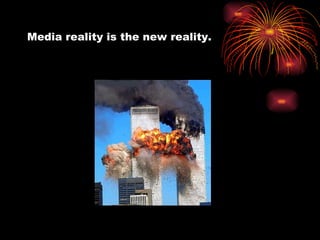
Media reality is the new reality.
Jean Baudrillard   controversially claimed that the 9/11 attacks were the ‘absolute event’, we only understand them in terms of the media images which bombarded us.  He argued that the events were as much televisual as ‘real’. We cannot distinguish the representation of the events on television from the actual events. Baudrillard calls this state ‘hyperreality’. There is no longer a distinction between reality and its representing image, or  simulacrum .
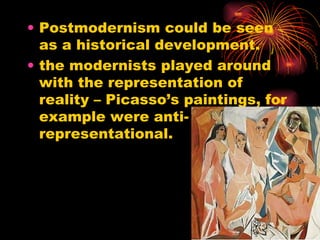
Postmodernism could be seen as a historical development. the modernists played around with the representation of reality – Picasso’s paintings, for example were anti-representational.
We think about Modernism belonging to the late 19 th  century and early 20 th  .
What was happening then in terms of new technology, science, art and literature and the mass media?  Why might these times have been seen as modern?
New technology – the automobile, bus, aeroplane, telephone, typewriter, reinforced concrete, man-made fibres. Mass media – the gramophone, cinematography, wireless telegraph, radio wave transmission. Science – pschoanalysis, radium radioactivity, genetics. Art – impressionism, cubism.
Postmodernists ‘re-mix’ representation. They play around with it through pastiche, parody and intertextual references. Texts deliberately expose their nature as constructions – they don’t pretend to be ‘realist’.
A starting point. Some basic ideas to think about.
Postmodern media rejects the idea that any media product or text is of any greater value than another.  All value judgements are merely taste. Anything can be art. Culture ‘eats itself’ as there is no longer anything new to produce or distribute.
The distinction between media and reality has collapsed, and we now live in a ‘reality’ defined by images and representations – a state of simulacrum. Images refer to each other and represent each other as reality rather than as some ‘pure’ reality that exists before the image represents it – this is the state of hyperreality.
All ideas of ‘the truth’ are just competing claims - or discourses – and what we believe to be the truth at any point is just the ‘winning’ discourse.
There are many media examples of texts or products which deliberately set out to explore and play with this state of hyperreality. These texts are said to be intertextual and self-referential. They break the rules of realism to explore the nature of their own status as construced texts. They don’t want to represent reality, but to represent media reality.
So,  how many texts can you think of which do this?


What is postmodernism

  • 1.
  • 2.
    Postmodernists claim thatin a media-saturated world, the distinction between reality and the media representation of it becomes blurred or even invisible.
  • 3.
    Media reality isthe new reality.
  • 4.
    Jean Baudrillard controversially claimed that the 9/11 attacks were the ‘absolute event’, we only understand them in terms of the media images which bombarded us. He argued that the events were as much televisual as ‘real’. We cannot distinguish the representation of the events on television from the actual events. Baudrillard calls this state ‘hyperreality’. There is no longer a distinction between reality and its representing image, or simulacrum .
  • 5.
    Postmodernism could beseen as a historical development. the modernists played around with the representation of reality – Picasso’s paintings, for example were anti-representational.
  • 6.
    We think aboutModernism belonging to the late 19 th century and early 20 th .
  • 7.
    What was happeningthen in terms of new technology, science, art and literature and the mass media? Why might these times have been seen as modern?
  • 8.
    New technology –the automobile, bus, aeroplane, telephone, typewriter, reinforced concrete, man-made fibres. Mass media – the gramophone, cinematography, wireless telegraph, radio wave transmission. Science – pschoanalysis, radium radioactivity, genetics. Art – impressionism, cubism.
  • 9.
    Postmodernists ‘re-mix’ representation.They play around with it through pastiche, parody and intertextual references. Texts deliberately expose their nature as constructions – they don’t pretend to be ‘realist’.
  • 10.
    A starting point.Some basic ideas to think about.
  • 11.
    Postmodern media rejectsthe idea that any media product or text is of any greater value than another. All value judgements are merely taste. Anything can be art. Culture ‘eats itself’ as there is no longer anything new to produce or distribute.
  • 12.
    The distinction betweenmedia and reality has collapsed, and we now live in a ‘reality’ defined by images and representations – a state of simulacrum. Images refer to each other and represent each other as reality rather than as some ‘pure’ reality that exists before the image represents it – this is the state of hyperreality.
  • 13.
    All ideas of‘the truth’ are just competing claims - or discourses – and what we believe to be the truth at any point is just the ‘winning’ discourse.
  • 14.
    There are manymedia examples of texts or products which deliberately set out to explore and play with this state of hyperreality. These texts are said to be intertextual and self-referential. They break the rules of realism to explore the nature of their own status as construced texts. They don’t want to represent reality, but to represent media reality.
  • 15.
    So, howmany texts can you think of which do this?
  • 16.
  • 17.