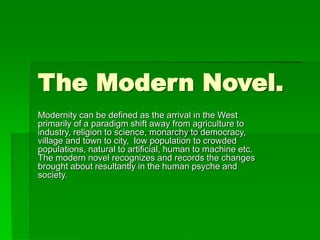
The Modern Novel.
Modernity can be defined as the arrival in the West
primarily of a paradigm shift away from agriculture to
industry, religion to science, monarchy to democracy,
village and town to city, low population to crowded
populations, natural to artificial, human to machine etc.
The modern novel recognizes and records the changes
brought about resultantly in the human psyche and
society.
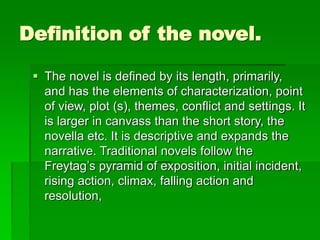
Definition of the novel.
 The novel is defined by its length, primarily,
and has the elements of characterization, point
of view, plot (s), themes, conflict and settings. It
is larger in canvass than the short story, the
novella etc. It is descriptive and expands the
narrative. Traditional novels follow the
Freytag’s pyramid of exposition, initial incident,
rising action, climax, falling action and
resolution,
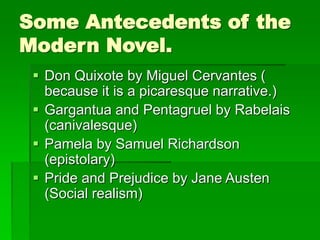
Some Antecedents of the
Modern Novel.
 Don Quixote by Miguel Cervantes (
because it is a picaresque narrative.)
 Gargantua and Pentagruel by Rabelais
(canivalesque)
 Pamela by Samuel Richardson
(epistolary)
 Pride and Prejudice by Jane Austen
(Social realism)
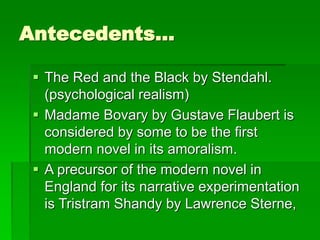
Antecedents…
 The Red and the Black by Stendahl.
(psychological realism)
 Madame Bovary by Gustave Flaubert is
considered by some to be the first
modern novel in its amoralism.
 A precursor of the modern novel in
England for its narrative experimentation
is Tristram Shandy by Lawrence Sterne,
A brief history of the novel
and its evolution.
 Novels are differentiated by not being
historical narrative but fiction and by its
length and medium, which is print.
 It started in the eighteenth century in
England and drew from sources as
diverse as the French roman a clef, the
Italian novella, the German
bildungsroman, belles lettres etc.
History and evolution of
the novel continued…
 IN Britain the novel started in serialized form and hence epistolary
novels were common. Eg; Pamela. But gradually the format
changed though it was still a populist medium. Daniel Defoe,
Henry Fielding and Lawrence Sterne gave it much respectability.
Later Dickens came and along with women writers like Charlotte
Bronte or writers like Trollope and others changed the English
novel into a world wide literary force during the time of Queen
Victoria leading to influence in places as far off as Russia and
India from their little island.
 During the nineteenth century the novel peaked in becoming a
form in the traditional mould as explained earlier with its five
elements and its pyramidal structure. A classic example is a novel
like Oliver Twist with its vast, panoramic, yet ordered sprawl that
was typically novelistic,
The Modern Novel: Main
features (20th century)
 This usually refers to the twentieth century
novel.
 The main characteristics are
 Realism, not idealism
 Psychological analysis of characters due to the
influence of Freud.
 Subjectivity and individualism of the writer.
 Objective treatment of themes, rather than
didactic.
 Experimental narrative and use of language.
Social and Cultural
context.
 The two World Wars and colonialism.
 The rise of science.
 The loss of faith or the individualization of faith.
 The theory of evolution and Darwinism.
 The arrival of psychology as a new discipline
and psychological analysis or Freudianism.
 The rise of Marxism and fascisms.
The key facts in the
twentieth century.
 In 1920 Ulysses by James Joyce making use
of the stream of consciousness technique is
published.
 Other major writers of the experimental, in form
or content categories, include Virginia Woolf
and D H Lawrence. These are significant
writers before, between and after the two wars.
 The post – II World war novel is political or
social or psychological or a mix of all three.
Key facts continued
 The post-II world war novel includes
William Golding and writers like John
Wain, Alan Sillitoe, Kingsley Amis and
John Osborne.
 The move to post-modernism is primarily
signalled by a writer like Samuel Beckett
in his novels.
Meanwhile….
 In America also the novel was being
attempted successfully by Hawthorne,
Melville, Twain and Poe. This was in the
eighteenth and nineteenth centuries.
 In the twentieth century came Henry
James, the precursor to the modern
novel and Faulkner (stream of
consciousness), Steinbeck, Hemingway
etc.
The American Novel
 The American novel was different from the
British in its language but also in its ability right
from the beginning to be very specific in
description and narrative to the context from
which it sprang.
 Henry James is important because of the
sophistication he brought to the point of view
(fallible narrator and his prefaces that treated
the novel like a high art form insisting on rigour
in composition in every aspect of it.
Henry James and
psychological realism
 A typical example of rigorous novel writing and
psychological realism is Portrait of a Lady. By
studying primarily one character Isabel Archer
in great depth, seeing things from her point of
view, James created a masterpiece because
her point of view gradually transcends to a
deeper understanding of human psychology
even as the the reader’s does in understanding
her psychology.
The End.
 © Dr A.V. Koshy 2013

The modern novel

  • 1.
    The Modern Novel. Modernitycan be defined as the arrival in the West primarily of a paradigm shift away from agriculture to industry, religion to science, monarchy to democracy, village and town to city, low population to crowded populations, natural to artificial, human to machine etc. The modern novel recognizes and records the changes brought about resultantly in the human psyche and society.
  • 2.
    Definition of thenovel.  The novel is defined by its length, primarily, and has the elements of characterization, point of view, plot (s), themes, conflict and settings. It is larger in canvass than the short story, the novella etc. It is descriptive and expands the narrative. Traditional novels follow the Freytag’s pyramid of exposition, initial incident, rising action, climax, falling action and resolution,
  • 3.
    Some Antecedents ofthe Modern Novel.  Don Quixote by Miguel Cervantes ( because it is a picaresque narrative.)  Gargantua and Pentagruel by Rabelais (canivalesque)  Pamela by Samuel Richardson (epistolary)  Pride and Prejudice by Jane Austen (Social realism)
  • 4.
    Antecedents…  The Redand the Black by Stendahl. (psychological realism)  Madame Bovary by Gustave Flaubert is considered by some to be the first modern novel in its amoralism.  A precursor of the modern novel in England for its narrative experimentation is Tristram Shandy by Lawrence Sterne,
  • 5.
    A brief historyof the novel and its evolution.  Novels are differentiated by not being historical narrative but fiction and by its length and medium, which is print.  It started in the eighteenth century in England and drew from sources as diverse as the French roman a clef, the Italian novella, the German bildungsroman, belles lettres etc.
  • 6.
    History and evolutionof the novel continued…  IN Britain the novel started in serialized form and hence epistolary novels were common. Eg; Pamela. But gradually the format changed though it was still a populist medium. Daniel Defoe, Henry Fielding and Lawrence Sterne gave it much respectability. Later Dickens came and along with women writers like Charlotte Bronte or writers like Trollope and others changed the English novel into a world wide literary force during the time of Queen Victoria leading to influence in places as far off as Russia and India from their little island.  During the nineteenth century the novel peaked in becoming a form in the traditional mould as explained earlier with its five elements and its pyramidal structure. A classic example is a novel like Oliver Twist with its vast, panoramic, yet ordered sprawl that was typically novelistic,
  • 7.
    The Modern Novel:Main features (20th century)  This usually refers to the twentieth century novel.  The main characteristics are  Realism, not idealism  Psychological analysis of characters due to the influence of Freud.  Subjectivity and individualism of the writer.  Objective treatment of themes, rather than didactic.  Experimental narrative and use of language.
  • 8.
    Social and Cultural context. The two World Wars and colonialism.  The rise of science.  The loss of faith or the individualization of faith.  The theory of evolution and Darwinism.  The arrival of psychology as a new discipline and psychological analysis or Freudianism.  The rise of Marxism and fascisms.
  • 9.
    The key factsin the twentieth century.  In 1920 Ulysses by James Joyce making use of the stream of consciousness technique is published.  Other major writers of the experimental, in form or content categories, include Virginia Woolf and D H Lawrence. These are significant writers before, between and after the two wars.  The post – II World war novel is political or social or psychological or a mix of all three.
  • 10.
    Key facts continued The post-II world war novel includes William Golding and writers like John Wain, Alan Sillitoe, Kingsley Amis and John Osborne.  The move to post-modernism is primarily signalled by a writer like Samuel Beckett in his novels.
  • 11.
    Meanwhile….  In Americaalso the novel was being attempted successfully by Hawthorne, Melville, Twain and Poe. This was in the eighteenth and nineteenth centuries.  In the twentieth century came Henry James, the precursor to the modern novel and Faulkner (stream of consciousness), Steinbeck, Hemingway etc.
  • 12.
    The American Novel The American novel was different from the British in its language but also in its ability right from the beginning to be very specific in description and narrative to the context from which it sprang.  Henry James is important because of the sophistication he brought to the point of view (fallible narrator and his prefaces that treated the novel like a high art form insisting on rigour in composition in every aspect of it.
  • 13.
    Henry James and psychologicalrealism  A typical example of rigorous novel writing and psychological realism is Portrait of a Lady. By studying primarily one character Isabel Archer in great depth, seeing things from her point of view, James created a masterpiece because her point of view gradually transcends to a deeper understanding of human psychology even as the the reader’s does in understanding her psychology.
  • 14.
    The End.  ©Dr A.V. Koshy 2013