NPS : Assured Contribution to Assured Return
PRESENTATION BY :
SOUMIT DAS
Financial Goal Achievers
Financial Goal Achievers, is a boutique consulting firm that specializes
in Financial Planning, Risk Management, Wealth Creation and
Treasury Management Solutions. We are a group of Finance
Professionals committed to build a society, wherein every individual
would experience Financial Freedom. We help our clients to make
smart investment decisions through solid relationships founded on
uncompromising integrity, trust and personalized services.
Page 2 of 31
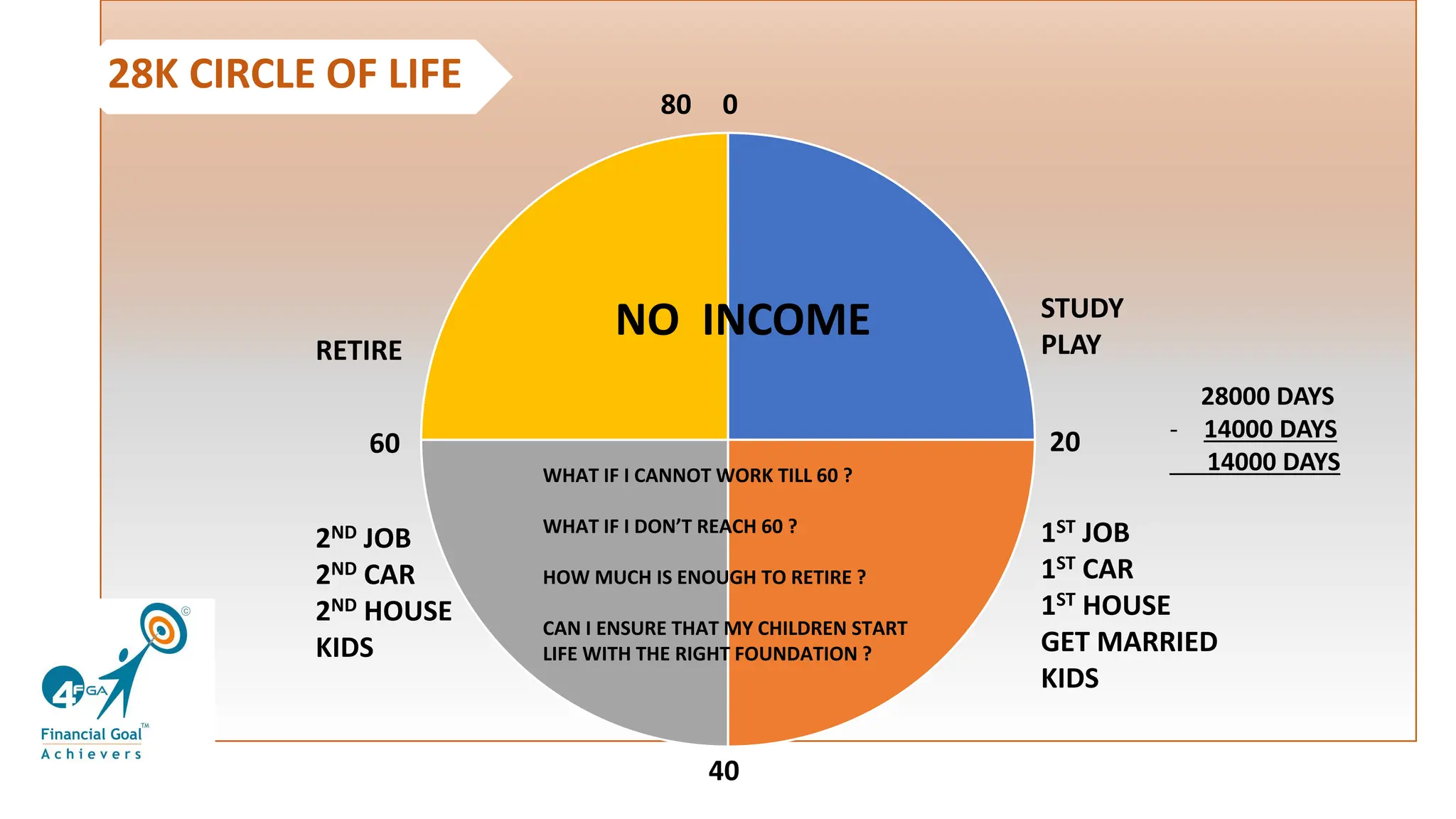
28K CIRCLE OF LIFE
20
60
WHAT IF I CANNOT WORK TILL 60 ?
WHAT IF I DON’T REACH 60 ?
HOW MUCH IS ENOUGH TO RETIRE ?
CAN I ENSURE THAT MY CHILDREN START
LIFE WITH THE RIGHT FOUNDATION ?
STUDY
PLAY
0
40
1ST JOB
1ST CAR
1ST HOUSE
GET MARRIED
KIDS
2ND JOB
2ND CAR
2ND HOUSE
KIDS
RETIRE
80
NO INCOME
28000 DAYS
- 14000 DAYS
14000 DAYS
3 Pillars of Financial Planning
➢Provision for Emergency Fund
➢Provision for Life Long Earning
➢Provision to Beat Inflation
Page 10 of 31
Retire at what income ?
Page 10 of 31
Plan an Enjoyable 2nd Innings
Page 10 of 31
Page 10 of 31
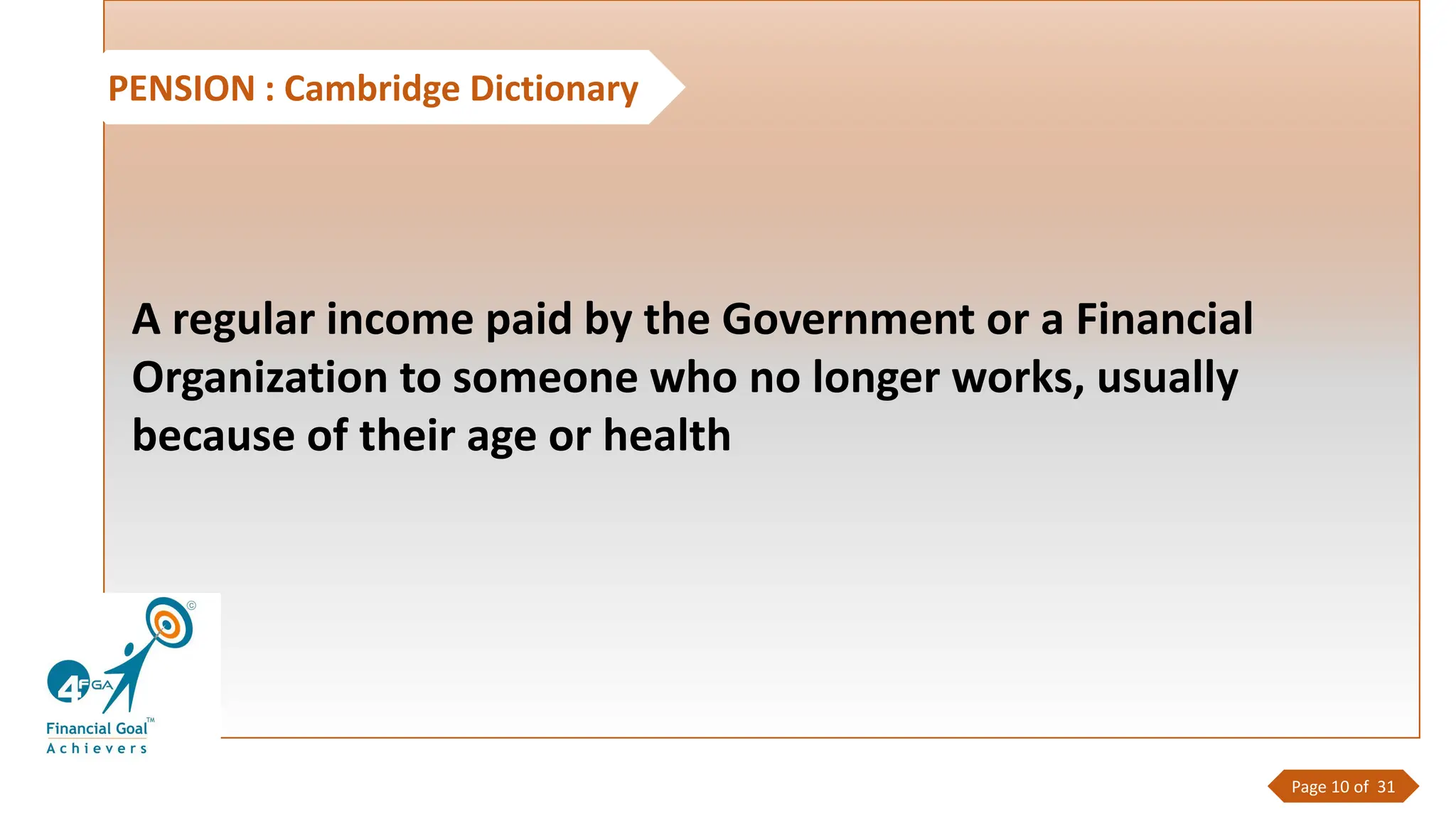
PENSION : Cambridge Dictionary
A regular income paid by the Government or a Financial
Organization to someone who no longer works, usually
because of their age or health
Page 10 of 31
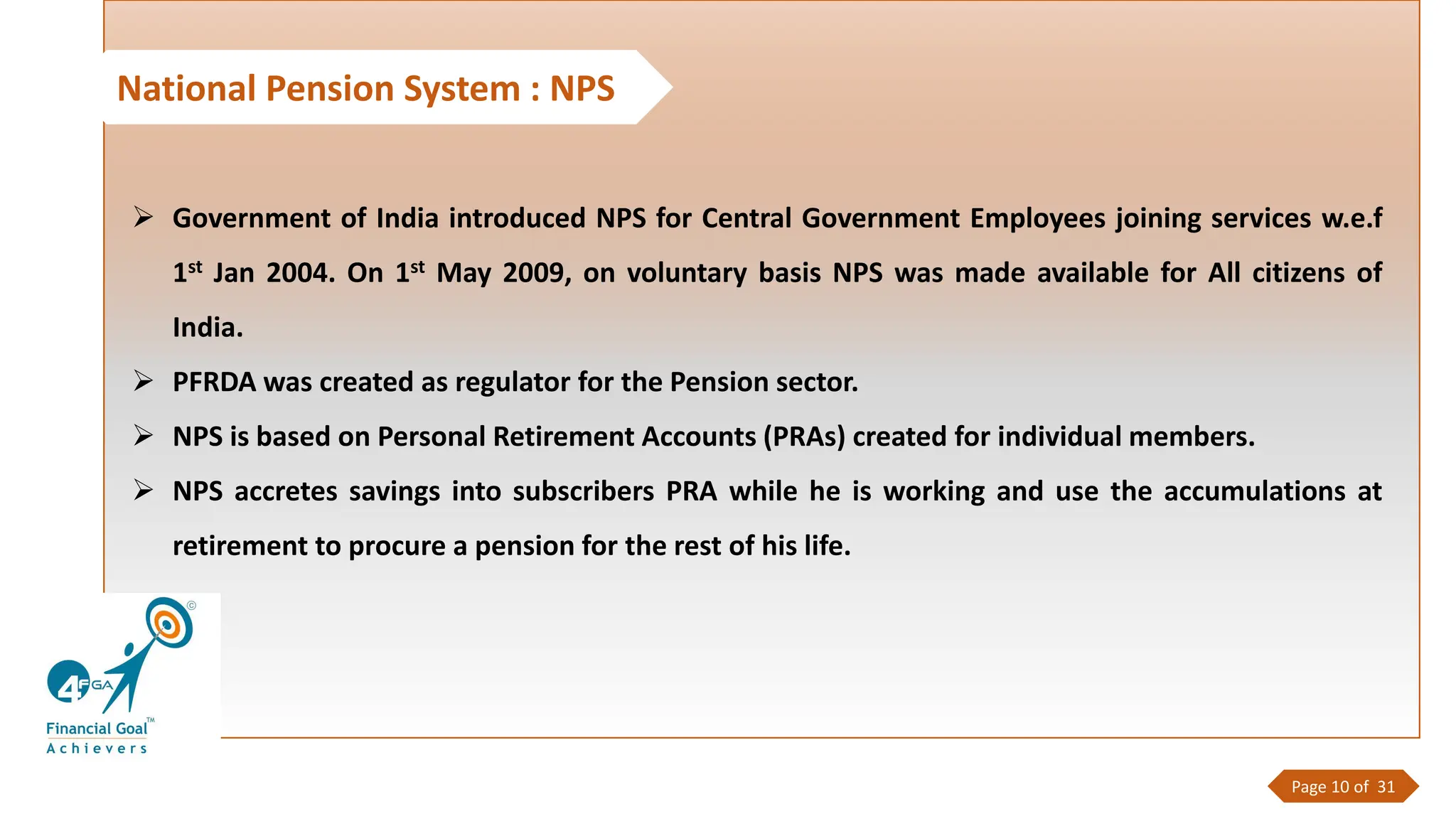
National Pension System : NPS
➢ Government of India introduced NPS for Central Government Employees joining services w.e.f
1st Jan 2004. On 1st May 2009, on voluntary basis NPS was made available for All citizens of
India.
➢ PFRDA was created as regulator for the Pension sector.
➢ NPS is based on Personal Retirement Accounts (PRAs) created for individual members.
➢ NPS accretes savings into subscribers PRA while he is working and use the accumulations at
retirement to procure a pension for the rest of his life.
Page 10 of 31
Benefits of NPS
➢ Simple
➢ Flexible
➢ Portable
➢ Strong Regulations
➢ Tax Savings
➢ Transparent Cost Structure
Page 10 of 31
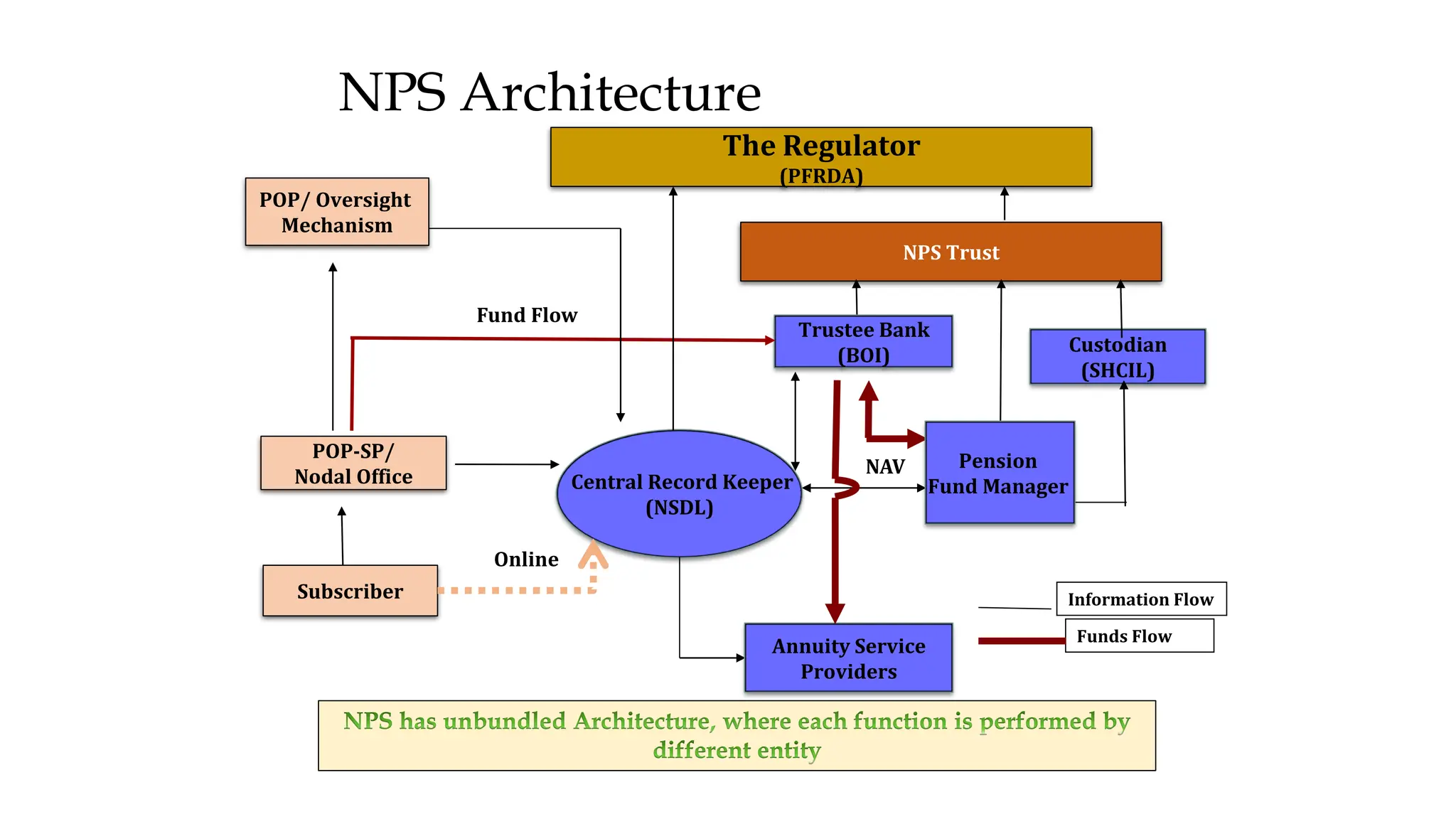
NPS Architecture
11
Subscriber
POP-SP/
Nodal Office Central Record Keeper
(NSDL)
Custodian
(SHCIL)
NPS Trust
Trustee Bank
(BOI)
Fund Flow
Annuity Service
Providers
Funds Flow
Information Flow
Pension
Fund Manager
NAV
The Regulator
(PFRDA)
POP/ Oversight
Mechanism
Online
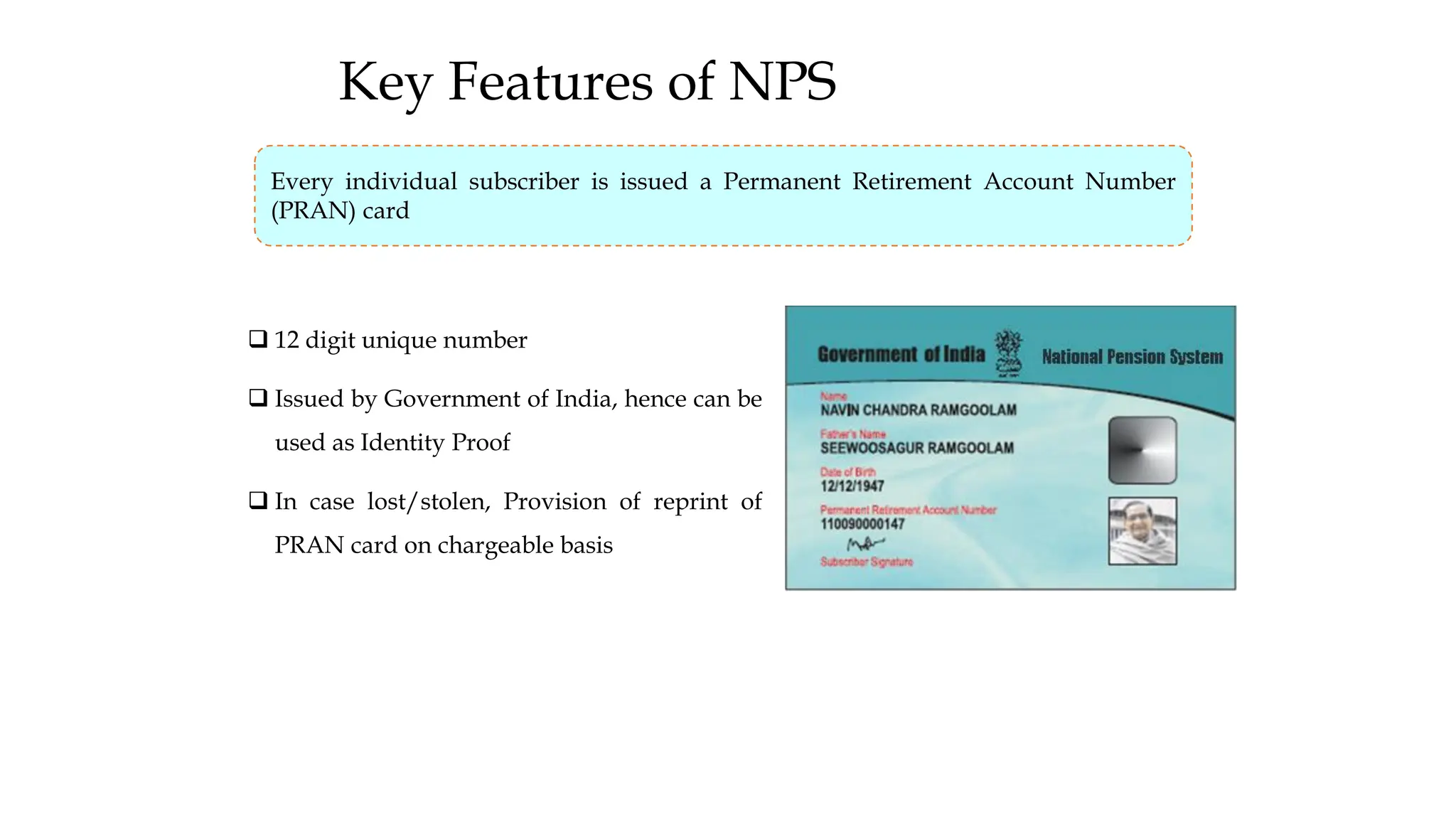
Key Features of NPS
❑ 12 digit unique number
❑ Issued by Government of India, hence can be
used as Identity Proof
❑ In case lost/stolen, Provision of reprint of
PRAN card on chargeable basis
Every individual subscriber is issued a Permanent Retirement Account Number
(PRAN) card
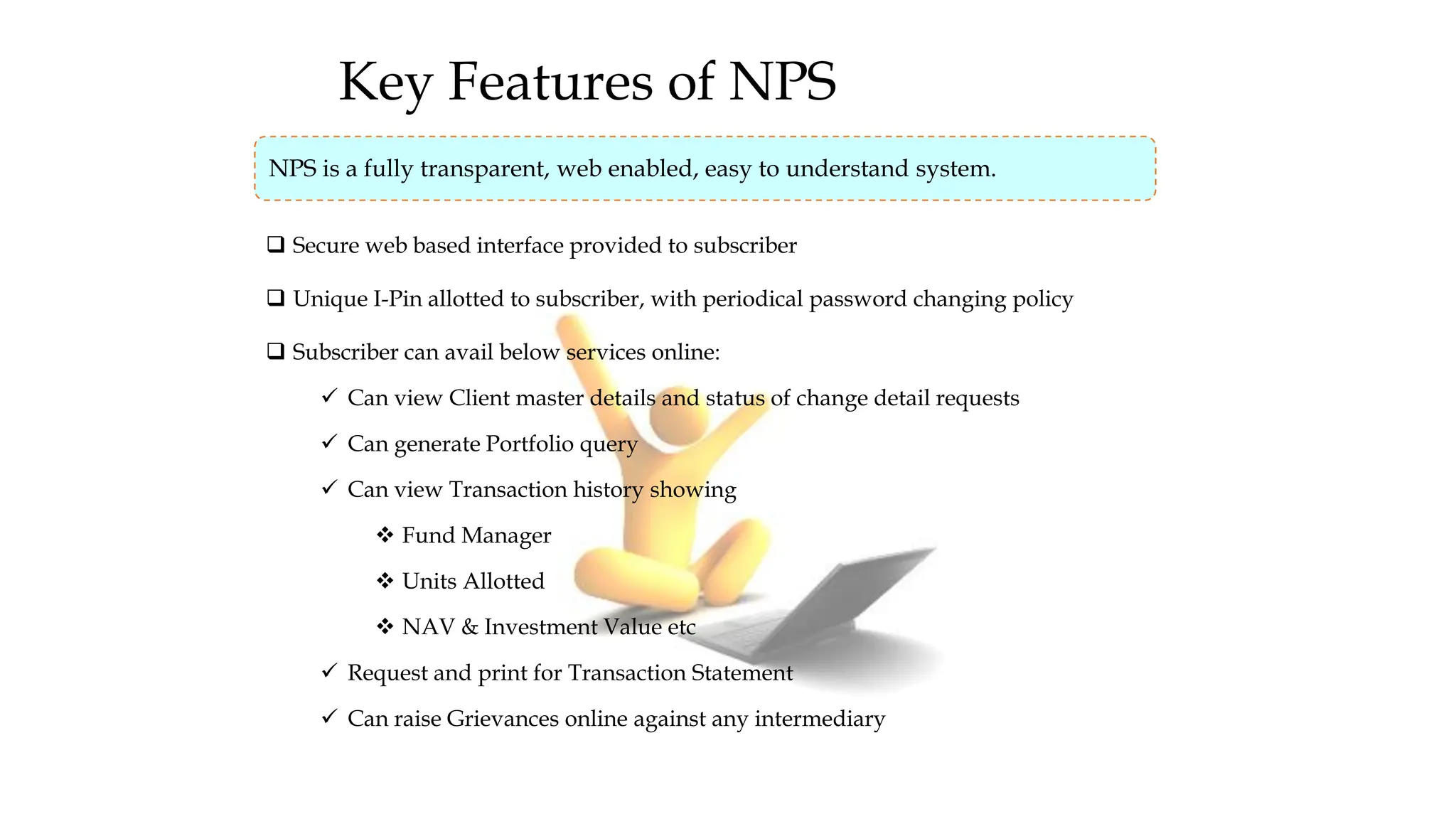
Key Features of NPS
NPS is a fully transparent, web enabled, easy to understand system.
❑ Secure web based interface provided to subscriber
❑ Unique I-Pin allotted to subscriber, with periodical password changing policy
❑ Subscriber can avail below services online:
✓ Can view Client master details and status of change detail requests
✓ Can generate Portfolio query
✓ Can view Transaction history showing
❖ Fund Manager
❖ Units Allotted
❖ NAV & Investment Value etc
✓ Request and print for Transaction Statement
✓ Can raise Grievances online against any intermediary
Tax Benefits of NPS
Tax Benefit available to Individual:
Any individual who is Subscriber of NPS can claim tax benefit under Sec 80 CCD (1) with in the overall ceiling of Rs. 1.5 lac
under Sec 80 CCE.
Exclusive Tax Benefit to all NPS Subscribers u/s 80CCD (1B)
An additional deduction for investment up to Rs. 50,000 in NPS (Tier I account) is available exclusively to NPS subscribers under
subsection 80CCD (1B). This is over and above the deduction of Rs. 1.5 lakh available under section 80C of Income Tax Act.
1961.
Tax Benefits under the Corporate Sector:
a.Corporate Subscriber:
Additional Tax Benefit is available to Subscribers under Corporate Sector, u/s 80CCD (2) of Income Tax Act. Employer's NPS
contribution (for the benefit of employee) up to 10% of salary (Basic + DA), is deductible from taxable income, up-to 7.5 Lakh.
b.Corporates
Employer’s Contribution towards NPS up to 10% of salary (Basic + DA) can be deducted as ‘Business Expense’ from their Profit
& Loss Account
Page 10 of 31
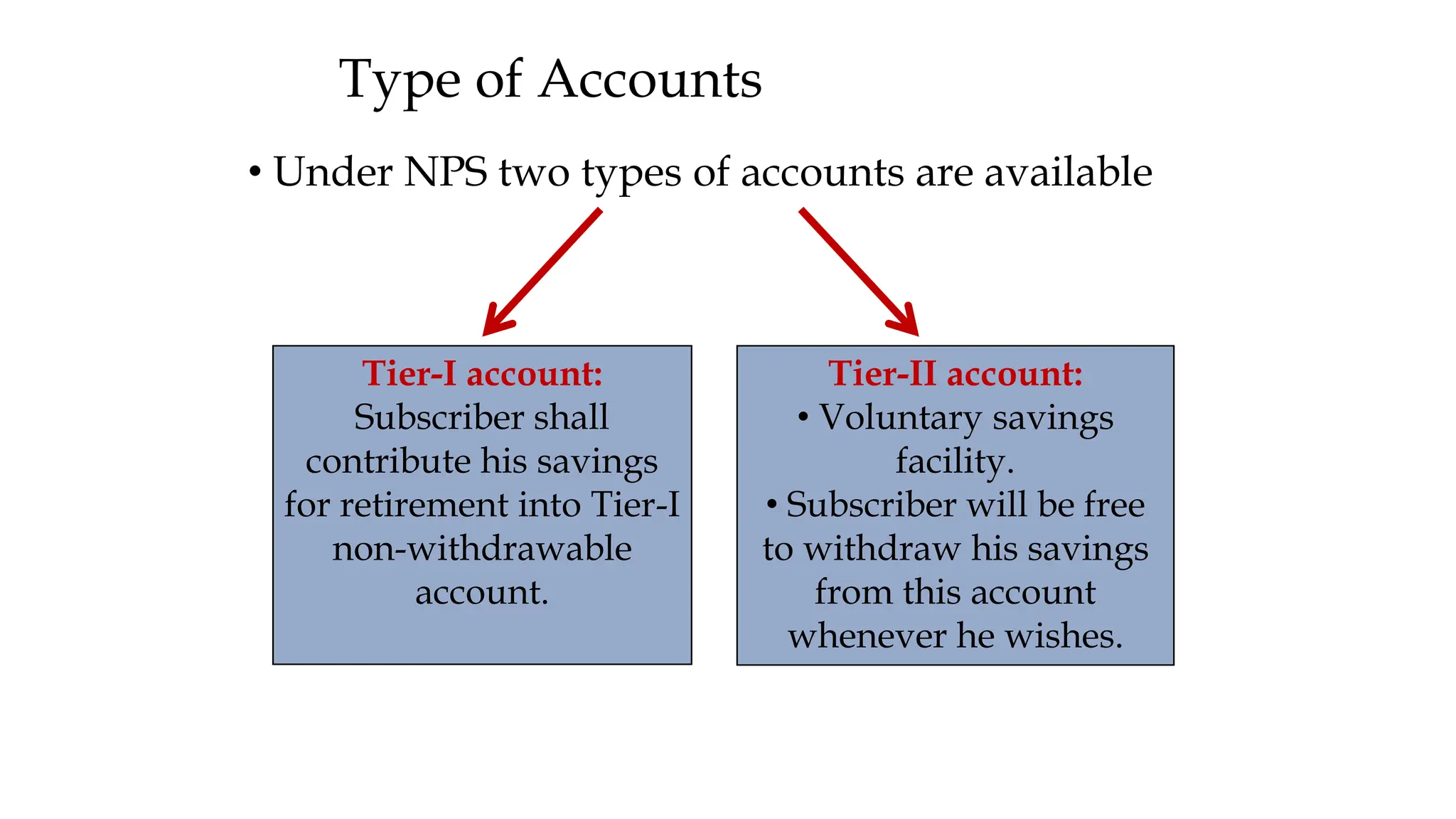
Type of Accounts
• Under NPS two types of accounts are available
Tier-I account:
Subscriber shall
contribute his savings
for retirement into Tier-I
non-withdrawable
account.
Tier-II account:
• Voluntary savings
facility.
• Subscriber will be free
to withdraw his savings
from this account
whenever he wishes.
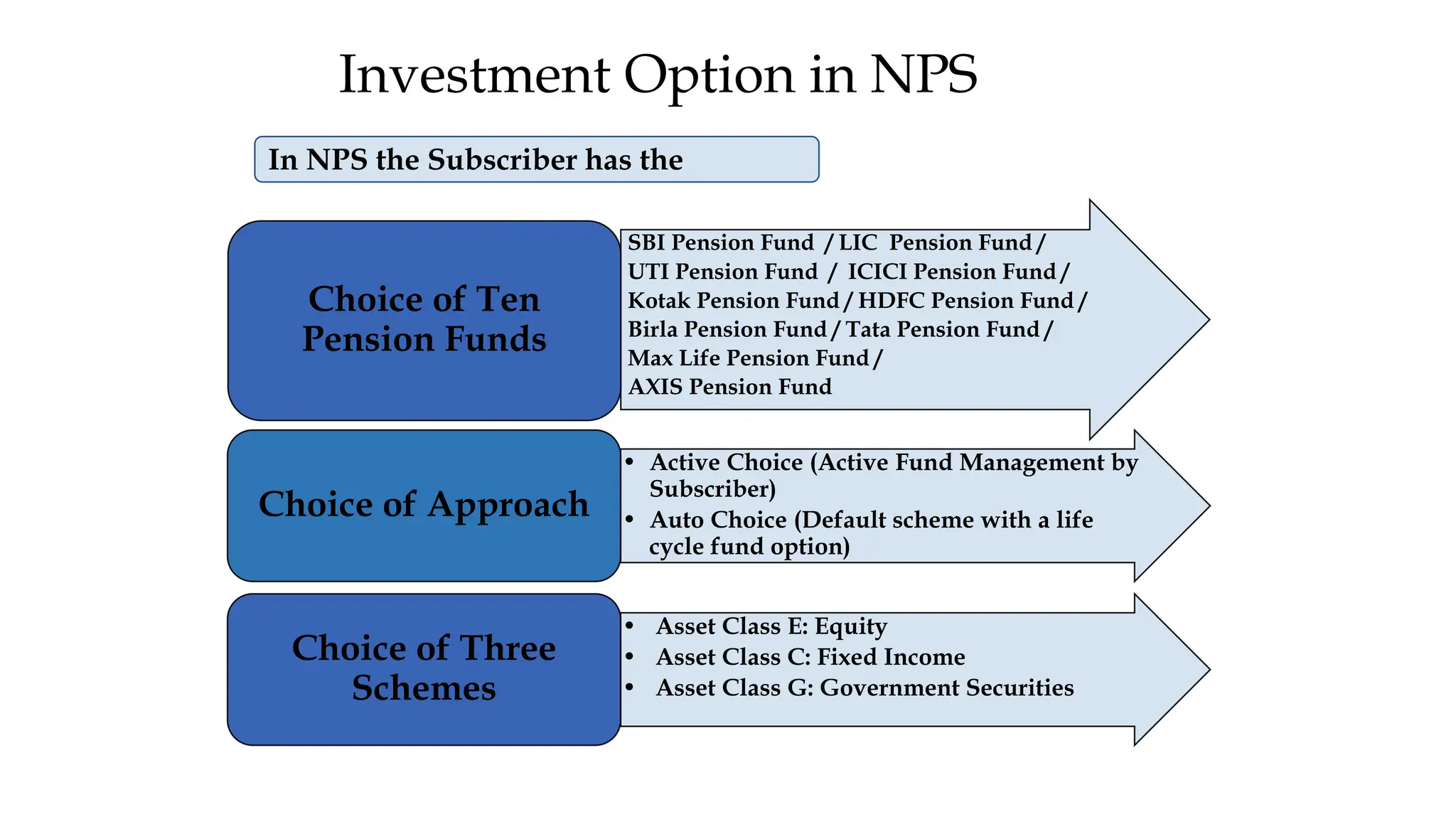
Investment Option in NPS
SBI Pension Fund / LIC Pension Fund /
UTI Pension Fund / ICICI Pension Fund /
Kotak Pension Fund / HDFC Pension Fund /
Birla Pension Fund / Tata Pension Fund /
Max Life Pension Fund /
AXIS Pension Fund
Choice of Ten
Pension Funds
• Asset Class E: Equity
• Asset Class C: Fixed Income
• Asset Class G: Government Securities
Choice of Three
Schemes
• Active Choice (Active Fund Management by
Subscriber)
• Auto Choice (Default scheme with a life
cycle fund option)
Choice of Approach
In NPS the Subscriber has the
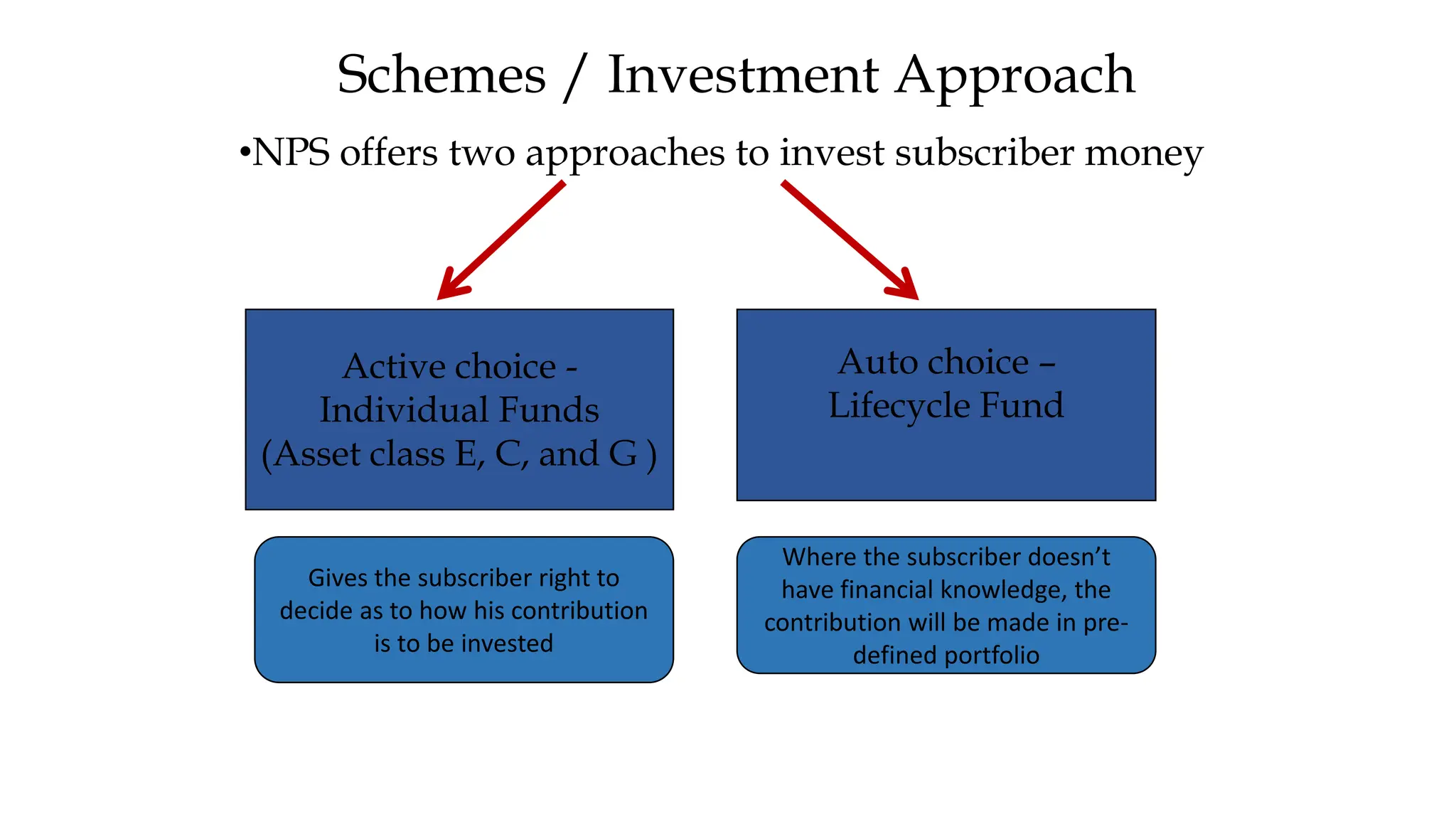
Schemes / Investment Approach
•NPS offers two approaches to invest subscriber money
Active choice -
Individual Funds
(Asset class E, C, and G )
Auto choice –
Lifecycle Fund
Gives the subscriber right to
decide as to how his contribution
is to be invested
Where the subscriber doesn’t
have financial knowledge, the
contribution will be made in pre-
defined portfolio
Approach 1: Active Choice
•Subscriber have the option to actively decide as to how his NPS pension
contribution is to be invested in the three options i.e.
❑Asset Class E - investments in predominantly equity market instruments
❑Asset Class C - investments in fixed income instruments other than
Government securities
❑Asset Class G - investments in Government securities.
Approach 2: Auto Choice
❑ Subscribers who do not have
✓the financial and investment knowledge
✓unable/unwilling to exercise any choice of investment,
•then their contribution can be invested in accordance
with the Auto Choice option.
❑In this option, the investments will be made in a life-cycle
fund.
❑The fraction of funds invested across three asset classes E,
C & G will be determined by a pre-defined portfolio.
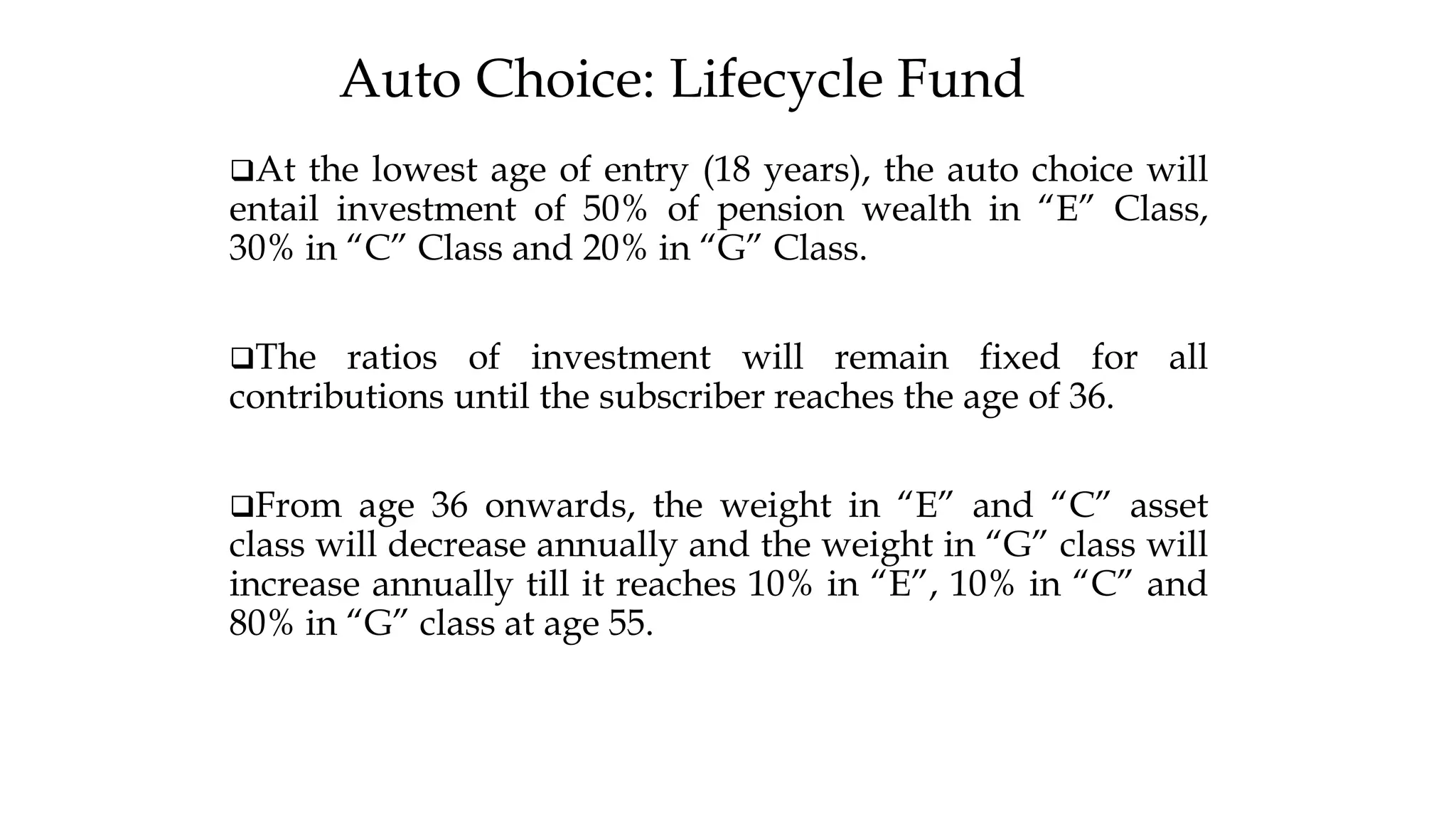
Auto Choice: Lifecycle Fund
❑At the lowest age of entry (18 years), the auto choice will
entail investment of 50% of pension wealth in “E” Class,
30% in “C” Class and 20% in “G” Class.
❑The ratios of investment will remain fixed for all
contributions until the subscriber reaches the age of 36.
❑From age 36 onwards, the weight in “E” and “C” asset
class will decrease annually and the weight in “G” class will
increase annually till it reaches 10% in “E”, 10% in “C” and
80% in “G” class at age 55.
Our Understanding
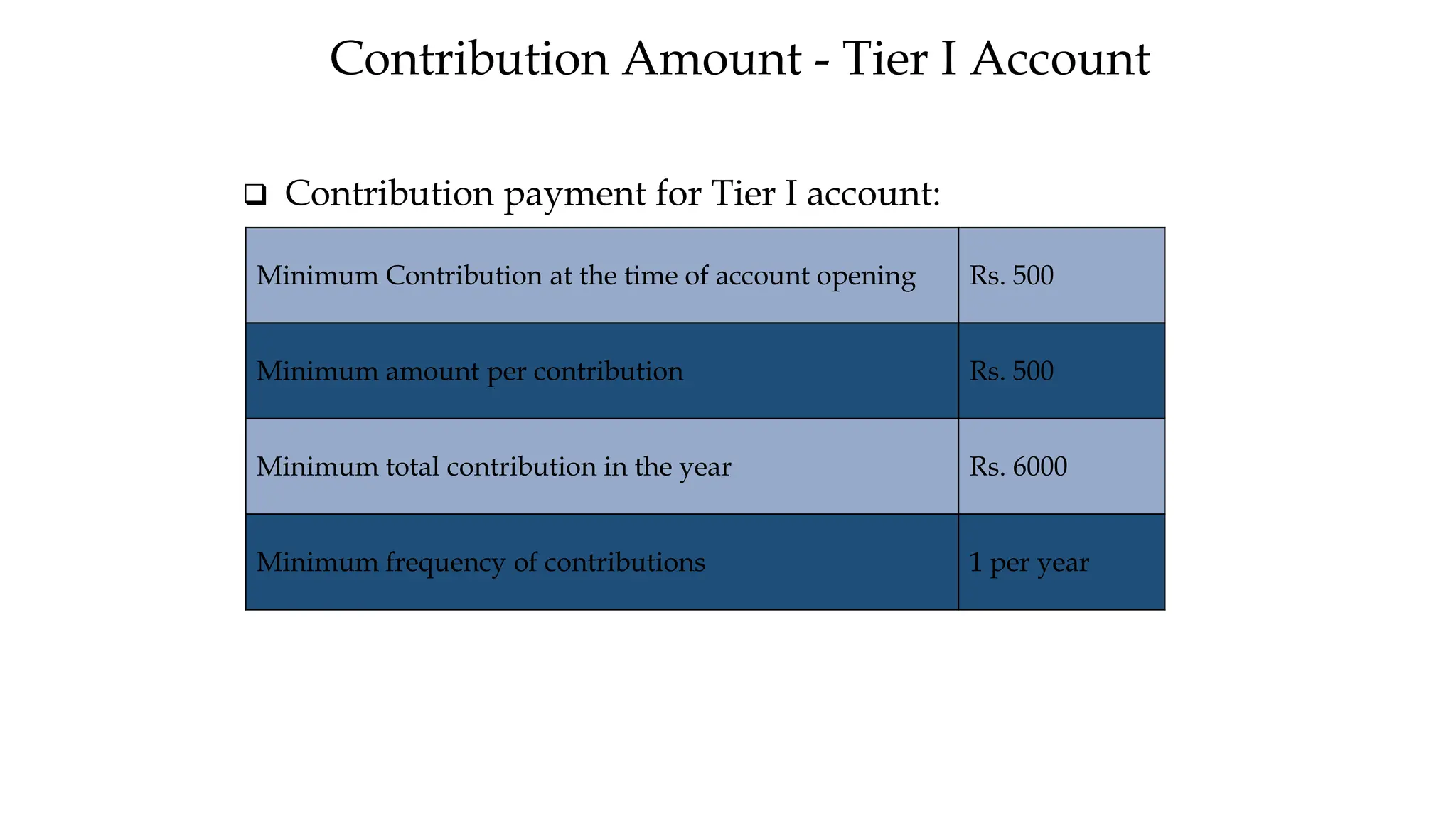
Contribution Amount - Tier I Account
❑ Contribution payment for Tier I account:
Minimum Contribution at the time of account opening Rs. 500
Minimum amount per contribution Rs. 500
Minimum total contribution in the year Rs. 6000
Minimum frequency of contributions 1 per year
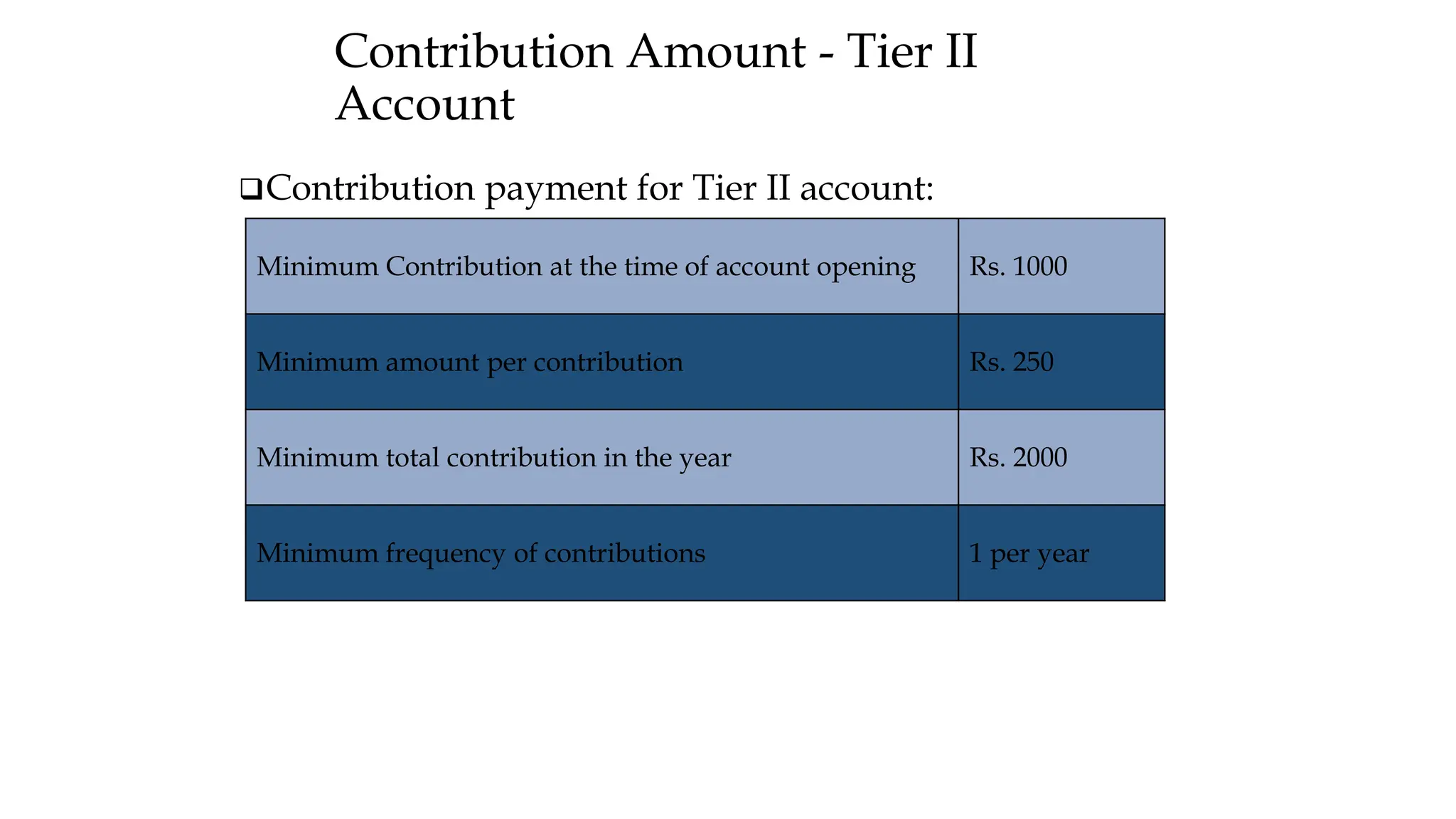
Contribution Amount - Tier II
Account
❑Contribution payment for Tier II account:
Minimum Contribution at the time of account opening Rs. 1000
Minimum amount per contribution Rs. 250
Minimum total contribution in the year Rs. 2000
Minimum frequency of contributions 1 per year
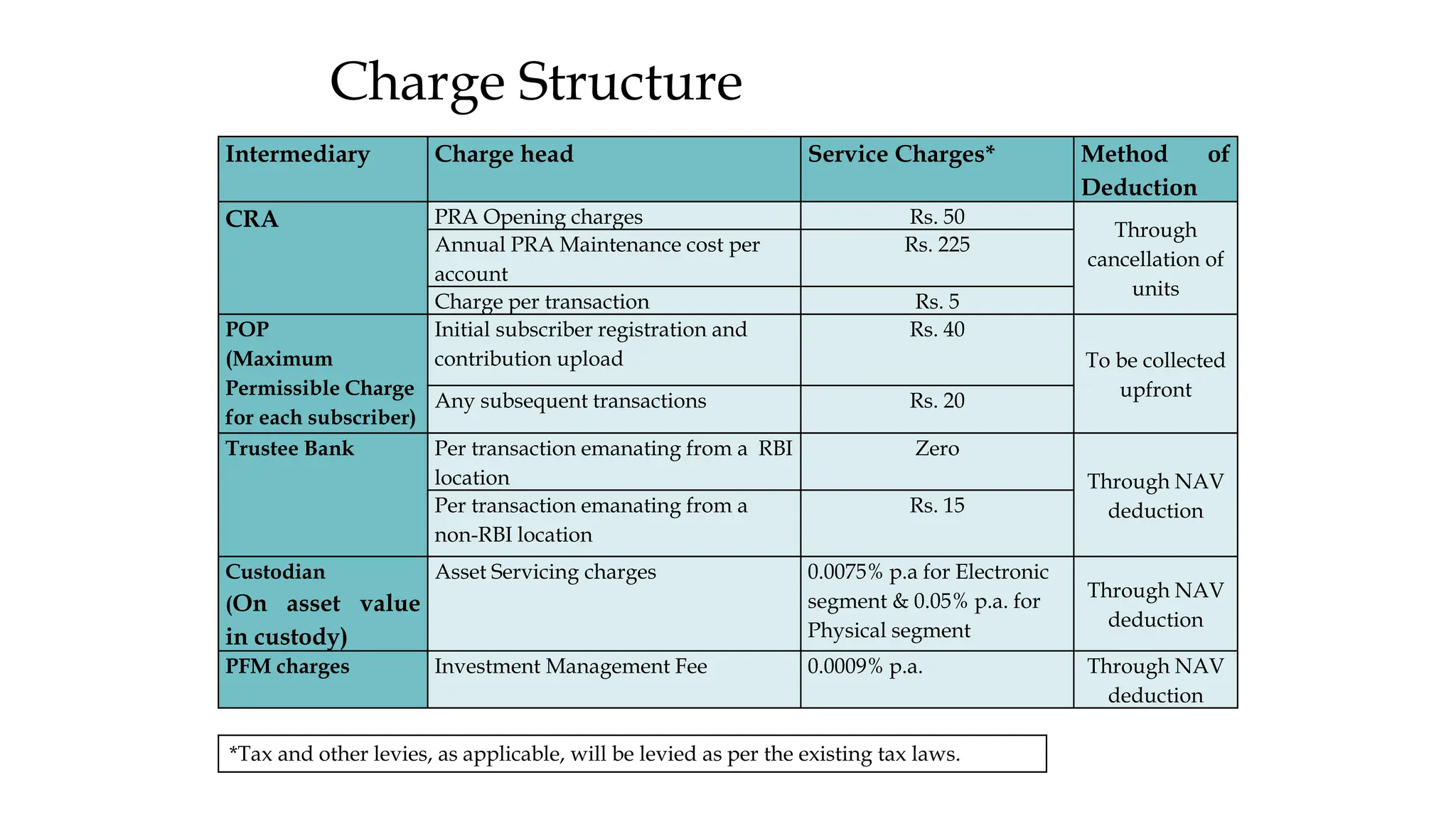
Charge Structure
Intermediary Charge head Service Charges* Method of
Deduction
CRA PRA Opening charges Rs. 50
Through
cancellation of
units
Annual PRA Maintenance cost per
account
Rs. 225
Charge per transaction Rs. 5
POP
(Maximum
Permissible Charge
for each subscriber)
Initial subscriber registration and
contribution upload
Rs. 40
To be collected
upfront
Any subsequent transactions Rs. 20
Trustee Bank Per transaction emanating from a RBI
location
Zero
Through NAV
deduction
Per transaction emanating from a
non-RBI location
Rs. 15
Custodian
(On asset value
in custody)
Asset Servicing charges 0.0075% p.a for Electronic
segment & 0.05% p.a. for
Physical segment
Through NAV
deduction
PFM charges Investment Management Fee 0.0009% p.a. Through NAV
deduction
*Tax and other levies, as applicable, will be levied as per the existing tax laws.
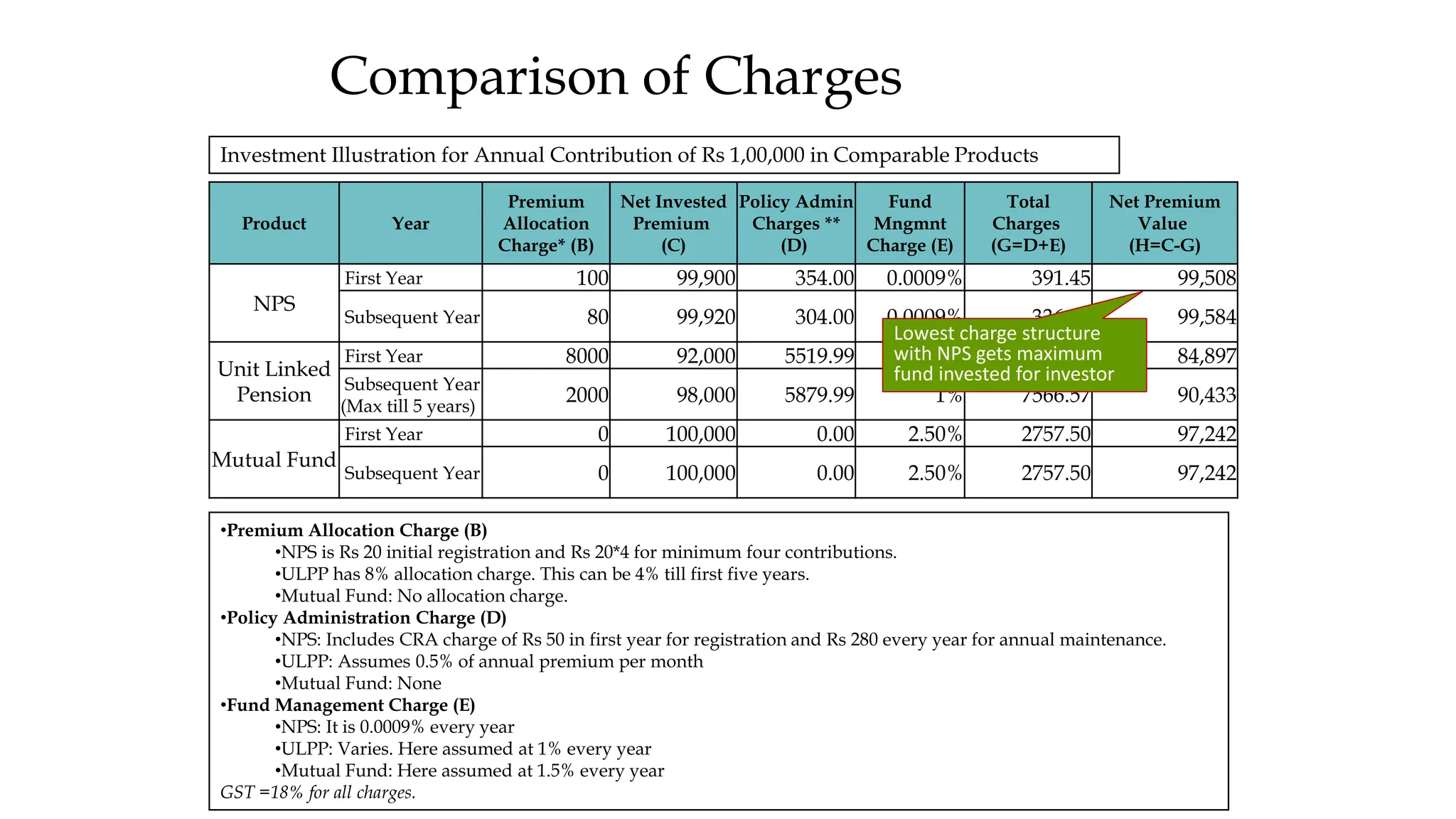
Comparison of Charges
Product Year
Premium
Allocation
Charge* (B)
Net Invested
Premium
(C)
Policy Admin
Charges **
(D)
Fund
Mngmnt
Charge (E)
Total
Charges
(G=D+E)
Net Premium
Value
(H=C-G)
NPS
First Year 100 99,900 354.00 0.0009% 391.45 99,508
Subsequent Year 80 99,920 304.00 0.0009% 336.30 99,584
Unit Linked
Pension
First Year 8000 92,000 5519.99 1% 7103.31 84,897
Subsequent Year
(Max till 5 years)
2000 98,000 5879.99 1% 7566.57 90,433
Mutual Fund
First Year 0 100,000 0.00 2.50% 2757.50 97,242
Subsequent Year 0 100,000 0.00 2.50% 2757.50 97,242
Investment Illustration for Annual Contribution of Rs 1,00,000 in Comparable Products
•Premium Allocation Charge (B)
•NPS is Rs 20 initial registration and Rs 20*4 for minimum four contributions.
•ULPP has 8% allocation charge. This can be 4% till first five years.
•Mutual Fund: No allocation charge.
•Policy Administration Charge (D)
•NPS: Includes CRA charge of Rs 50 in first year for registration and Rs 280 every year for annual maintenance.
•ULPP: Assumes 0.5% of annual premium per month
•Mutual Fund: None
•Fund Management Charge (E)
•NPS: It is 0.0009% every year
•ULPP: Varies. Here assumed at 1% every year
•Mutual Fund: Here assumed at 1.5% every year
GST =18% for all charges.
Lowest charge structure
with NPS gets maximum
fund invested for investor
Annuity in NPS
❑ Annuity is the fixed monthly (periodic) income which a subscriber will get
against the corpus invested.
❑ The larger the corpus size, bigger the annuity.
❑ In case of normal retirement, subscriber can annuities a minimum of 40% and
maximum of 100 % of his corpus towards buying annuity.
❑ NPS provides an option to the subscriber to decide his retirement age which
can be anytime before 60. In such case subscriber can annuities a minimum of
80% and maximum of 100 % of his corpus towards buying annuity.
❑ At the time of exit the subscriber will have an option to purchase annuity
online.
❑ Subscriber would be given the following online facilities –
✓ Selection of Annuity Service Provider (ASP).
✓ Selection of annuity scheme.
✓ Option to change ASP & scheme (if already registered) before
attaining retirement age.
✓ The entire transfer of amount between NPS System and ASP will
take without any manual intervention.
❑ ASP to be regulated by IRDA.
nAnnuity Selection
nuity Selection
Deferred Withdrawal
❑On attaining Normal Retirement age of 60 years, subscriber is
required to invest minimum 40% of his/her accumulated
savings (pension wealth) to purchase a life annuity from any
IRDA-regulated life insurance company
❑The remaining pension wealth can be withdrawn as lump sum
at any point of time before the age of 70.
Page 15 of 23
Page 16 of 23
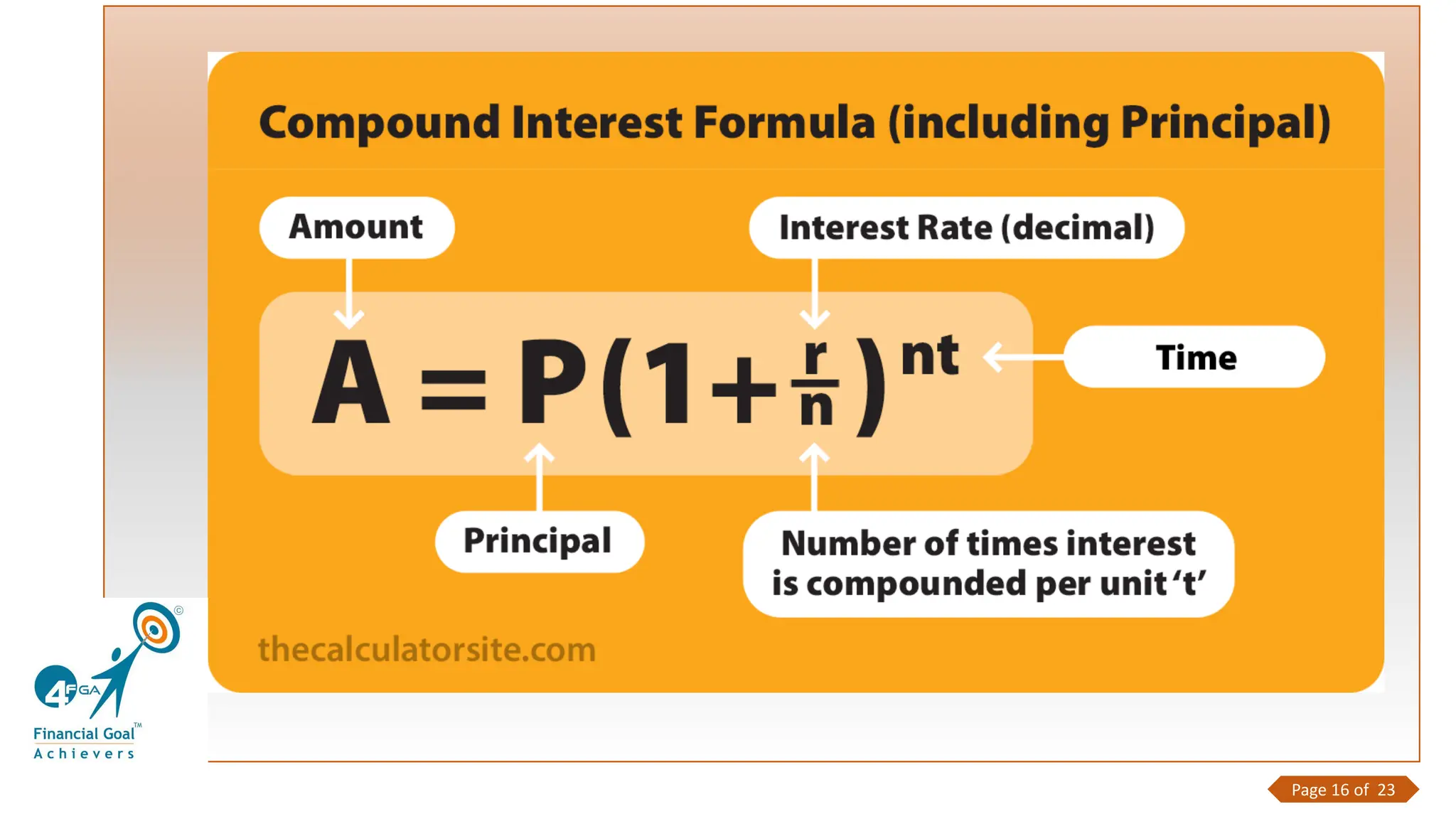
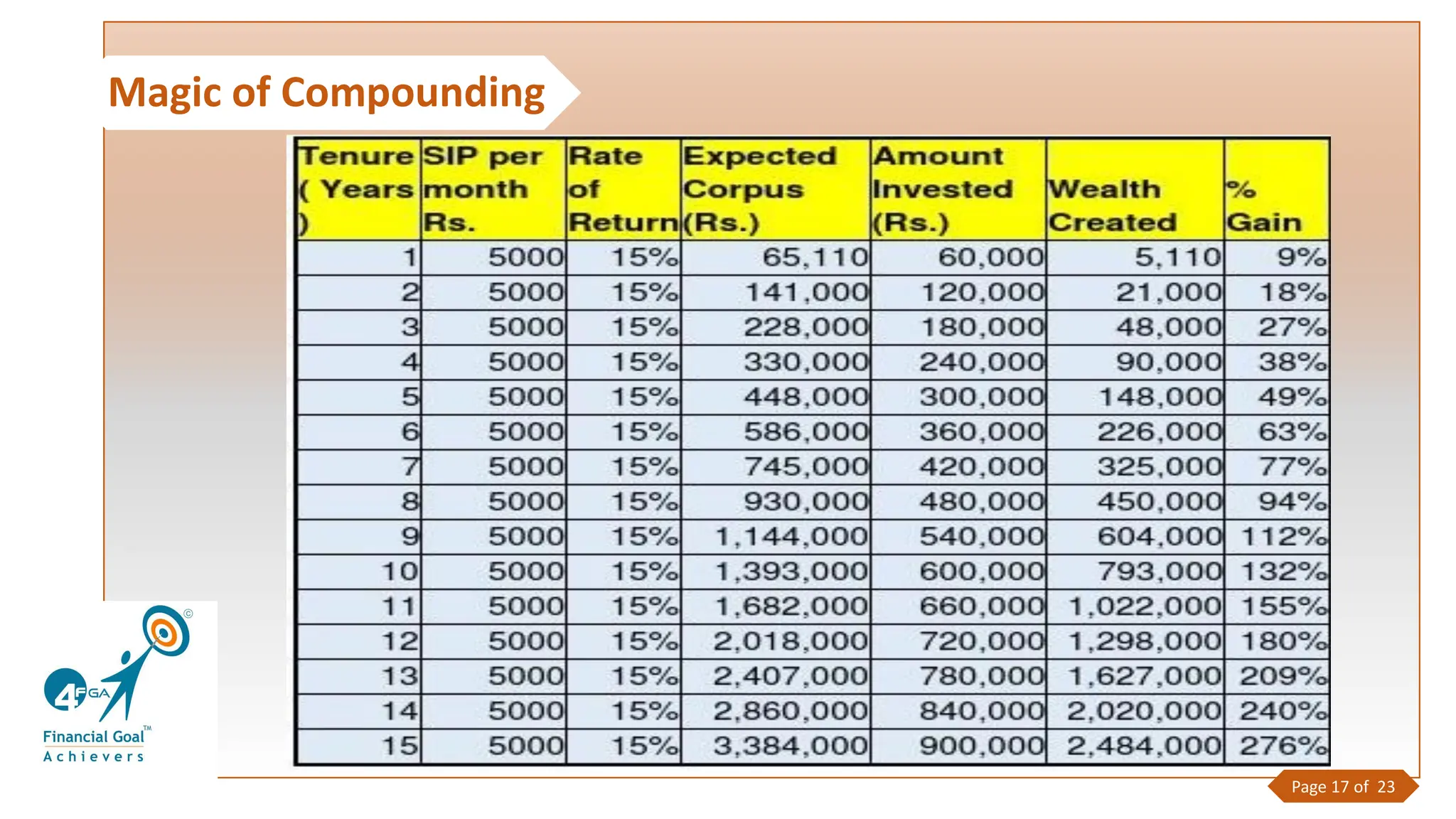
Magic of Compounding
Page 17 of 23
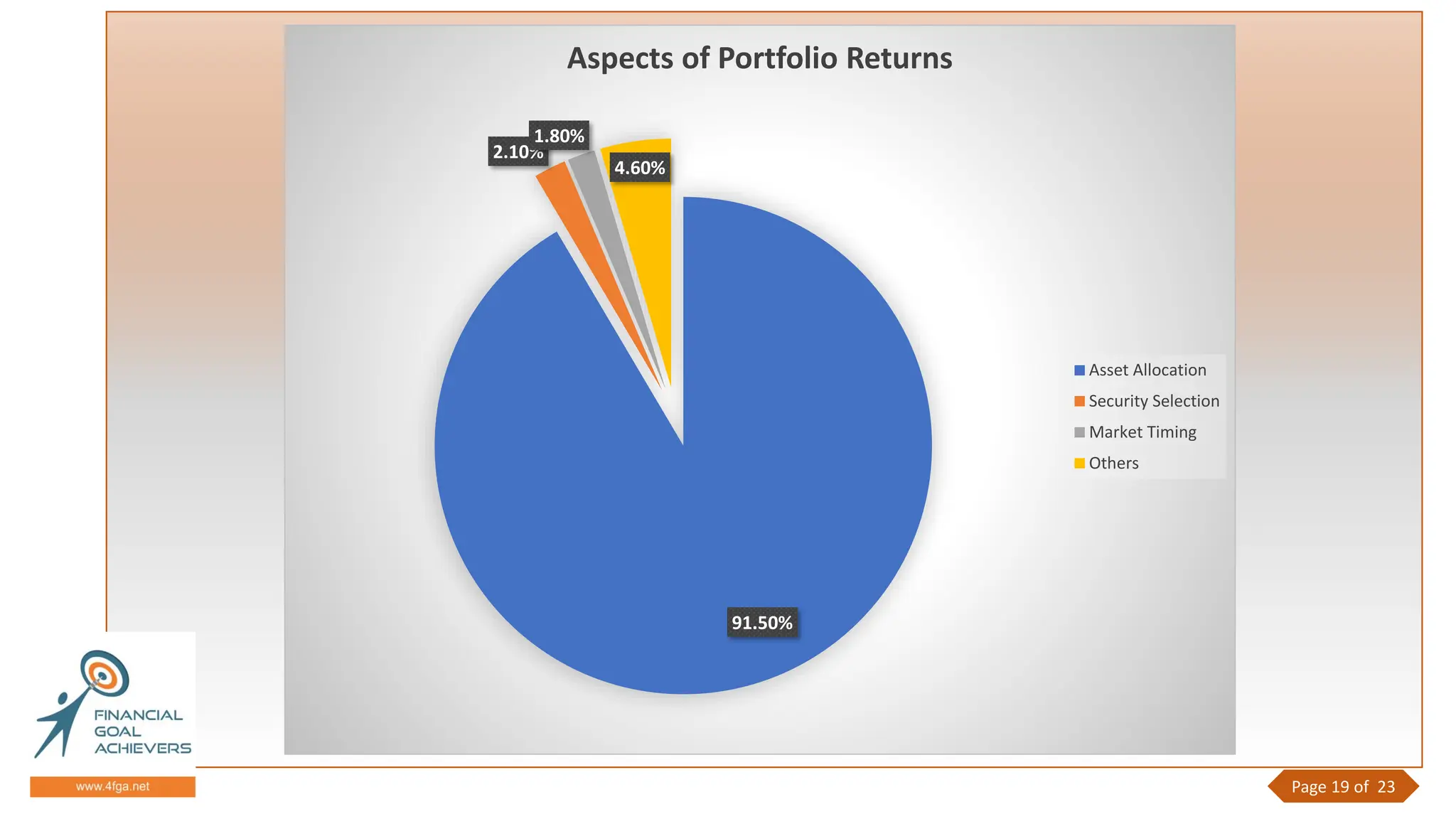
Page 19 of 23
91.50%
2.10%
1.80%
4.60%
Aspects of Portfolio Returns
Asset Allocation
Security Selection
Market Timing
Others
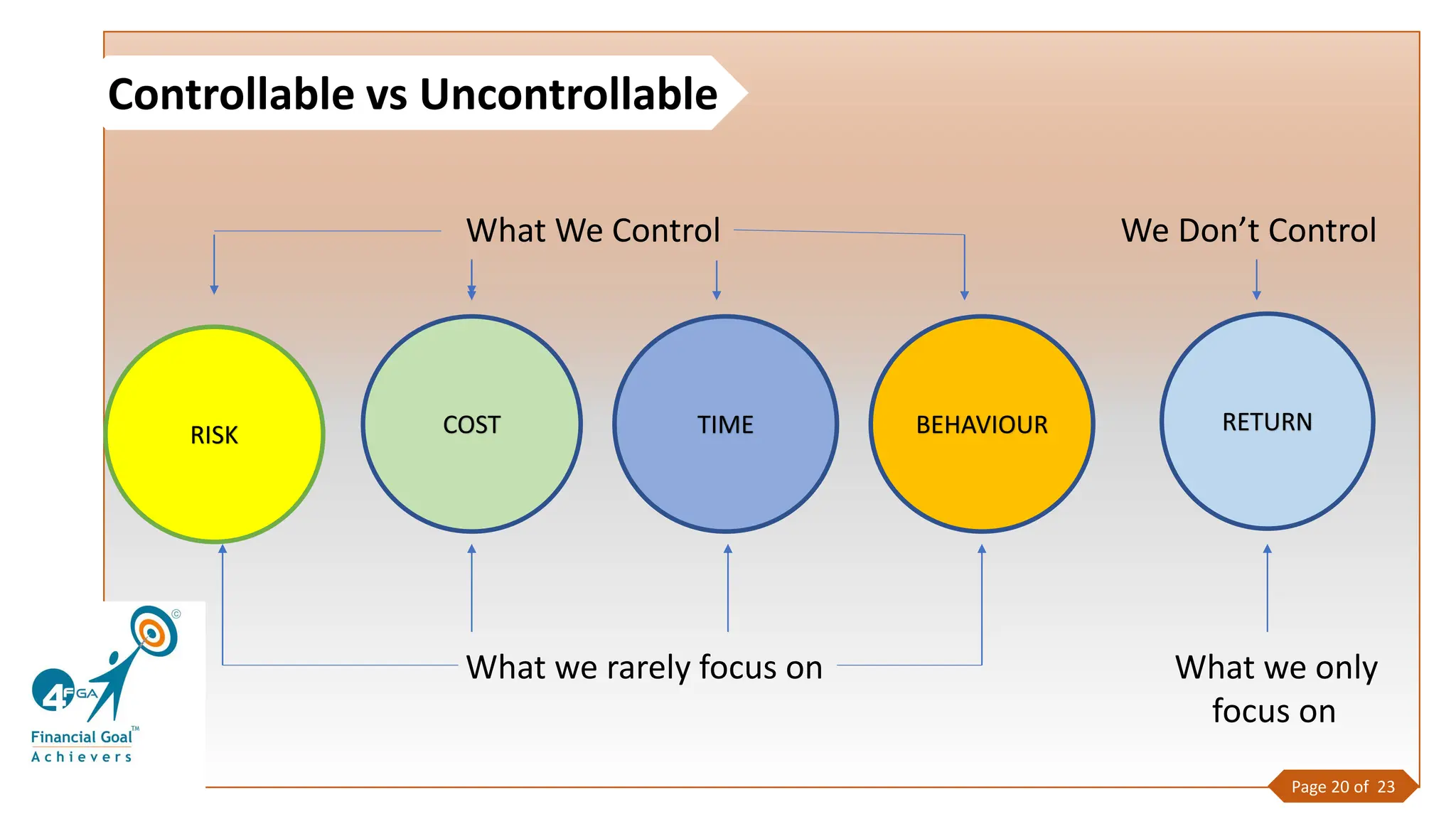
What We Control We Don’t Control
What we rarely focus on What we only
focus on
Controllable vs Uncontrollable
Page 20 of 23
RISK COST TIME BEHAVIOUR RETURN
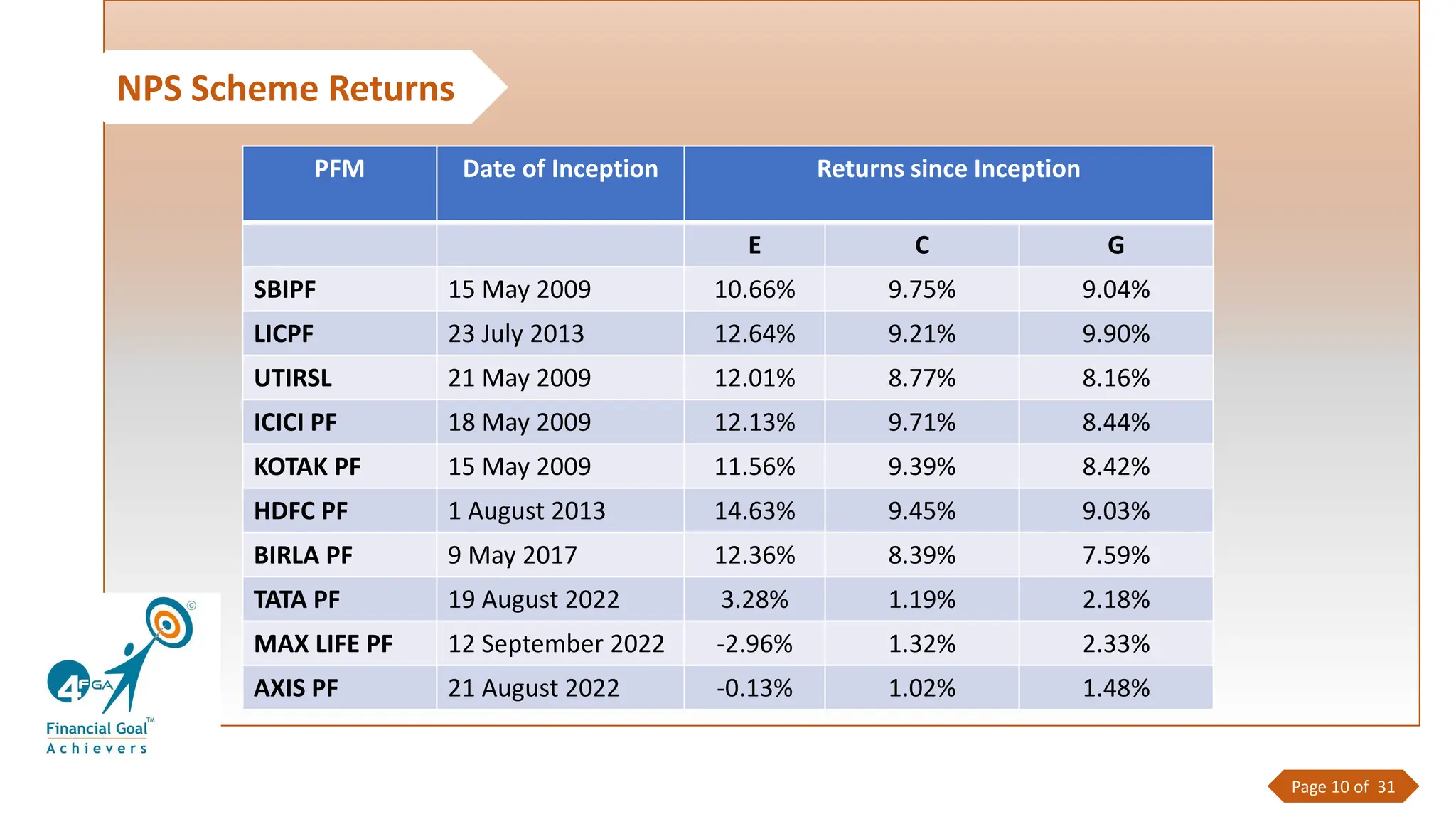
NPS Scheme Returns
Page 10 of 31
PFM Date of Inception Returns since Inception
E C G
SBIPF 15 May 2009 10.66% 9.75% 9.04%
LICPF 23 July 2013 12.64% 9.21% 9.90%
UTIRSL 21 May 2009 12.01% 8.77% 8.16%
ICICI PF 18 May 2009 12.13% 9.71% 8.44%
KOTAK PF 15 May 2009 11.56% 9.39% 8.42%
HDFC PF 1 August 2013 14.63% 9.45% 9.03%
BIRLA PF 9 May 2017 12.36% 8.39% 7.59%
TATA PF 19 August 2022 3.28% 1.19% 2.18%
MAX LIFE PF 12 September 2022 -2.96% 1.32% 2.33%
AXIS PF 21 August 2022 -0.13% 1.02% 1.48%
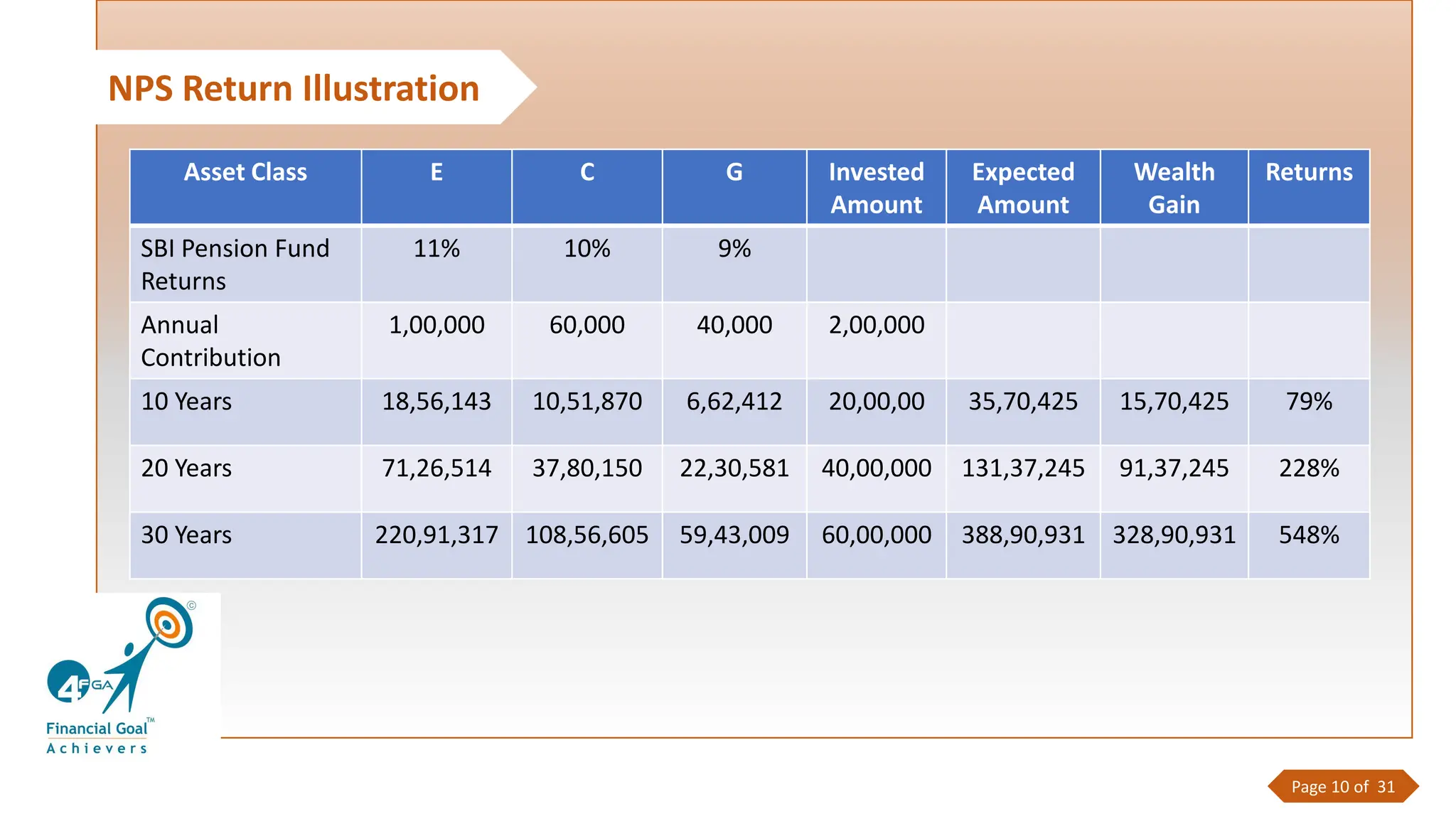
NPS Return Illustration
Page 10 of 31
Asset Class E C G Invested
Amount
Expected
Amount
Wealth
Gain
Returns
SBI Pension Fund
Returns
11% 10% 9%
Annual
Contribution
1,00,000 60,000 40,000 2,00,000
10 Years 18,56,143 10,51,870 6,62,412 20,00,00 35,70,425 15,70,425 79%
20 Years 71,26,514 37,80,150 22,30,581 40,00,000 131,37,245 91,37,245 228%
30 Years 220,91,317 108,56,605 59,43,009 60,00,000 388,90,931 328,90,931 548%
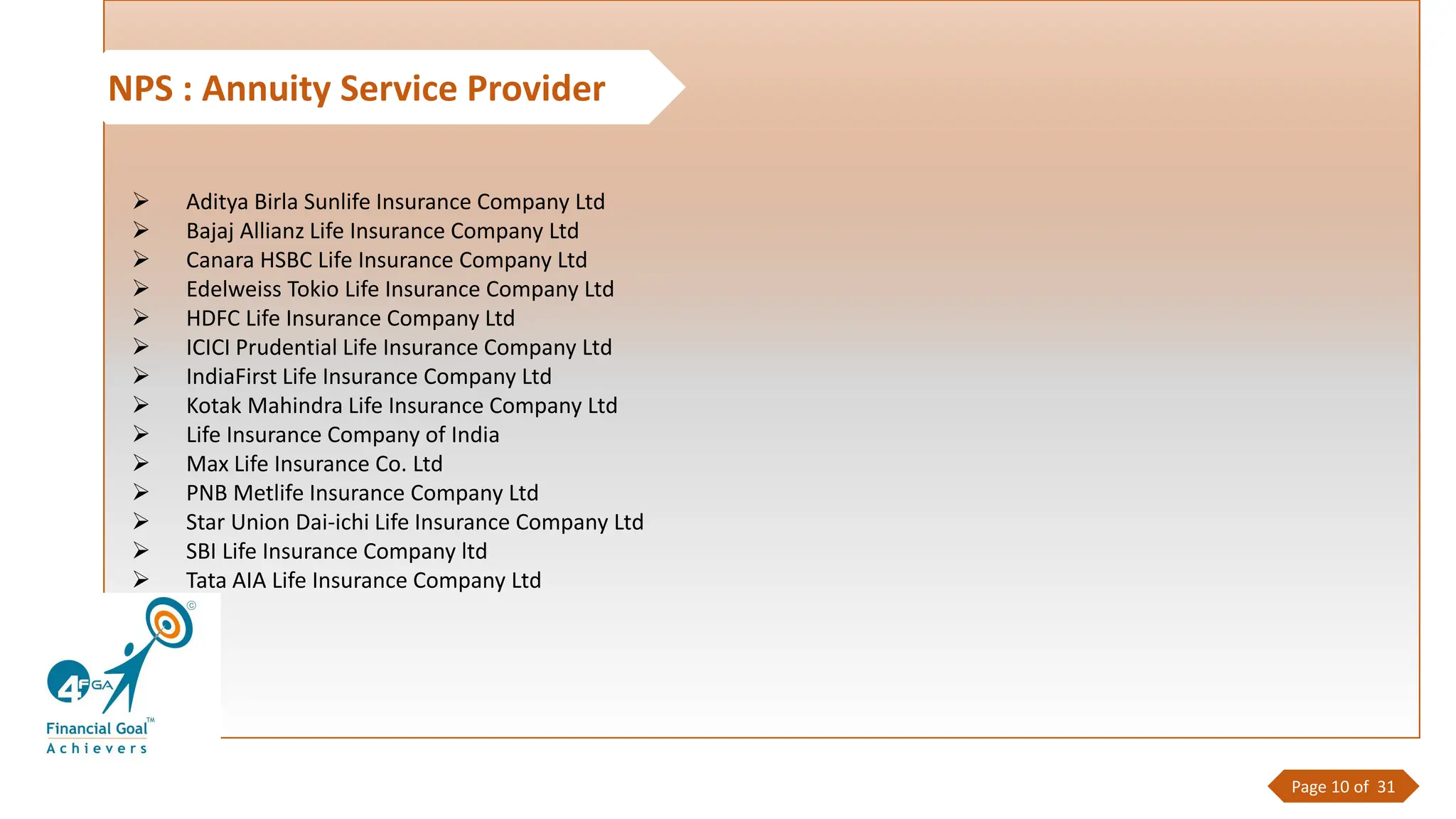
NPS : Annuity Service Provider
➢ Aditya Birla Sunlife Insurance Company Ltd
➢ Bajaj Allianz Life Insurance Company Ltd
➢ Canara HSBC Life Insurance Company Ltd
➢ Edelweiss Tokio Life Insurance Company Ltd
➢ HDFC Life Insurance Company Ltd
➢ ICICI Prudential Life Insurance Company Ltd
➢ IndiaFirst Life Insurance Company Ltd
➢ Kotak Mahindra Life Insurance Company Ltd
➢ Life Insurance Company of India
➢ Max Life Insurance Co. Ltd
➢ PNB Metlife Insurance Company Ltd
➢ Star Union Dai-ichi Life Insurance Company Ltd
➢ SBI Life Insurance Company ltd
➢ Tata AIA Life Insurance Company Ltd
Page 10 of 31
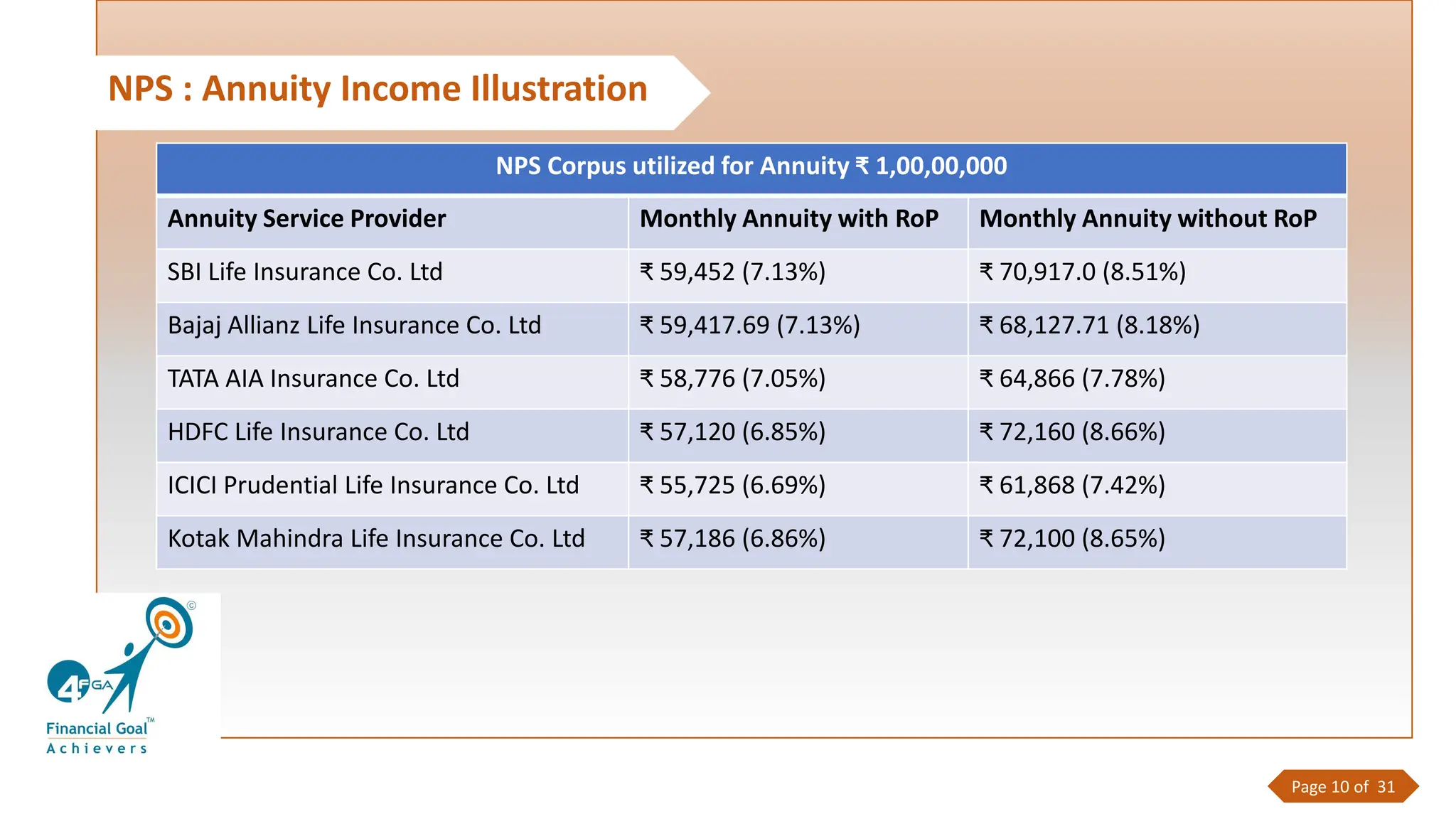
NPS : Annuity Income Illustration
Page 10 of 31
NPS Corpus utilized for Annuity ₹ 1,00,00,000
Annuity Service Provider Monthly Annuity with RoP Monthly Annuity without RoP
SBI Life Insurance Co. Ltd ₹ 59,452 (7.13%) ₹ 70,917.0 (8.51%)
Bajaj Allianz Life Insurance Co. Ltd ₹ 59,417.69 (7.13%) ₹ 68,127.71 (8.18%)
TATA AIA Insurance Co. Ltd ₹ 58,776 (7.05%) ₹ 64,866 (7.78%)
HDFC Life Insurance Co. Ltd ₹ 57,120 (6.85%) ₹ 72,160 (8.66%)
ICICI Prudential Life Insurance Co. Ltd ₹ 55,725 (6.69%) ₹ 61,868 (7.42%)
Kotak Mahindra Life Insurance Co. Ltd ₹ 57,186 (6.86%) ₹ 72,100 (8.65%)
Holistic Investing
Page 28 of 31
➢Invest in Yourself
➢ Invest in Your Relationships
➢ Invest in Spiritualism
Page 29 of 31
QUESTIONS & ANSWERS
Page 30 of 31
Feel free to ask Any Question
Mobile : +91-7506648757
Email : soumit@4fga.net
220, Shiv Centre, Plot 72, Sector 17,
Vashi, Navi Mumbai,
Maharashtra – 400703
Follow us on : https://www.facebook.com/forfga/
Website : www.4fga.net
THANK YOU

NPS_Assured_Conribution_Assured_Return.pdf

  • 1.
    NPS : AssuredContribution to Assured Return PRESENTATION BY : SOUMIT DAS
  • 2.
    Financial Goal Achievers FinancialGoal Achievers, is a boutique consulting firm that specializes in Financial Planning, Risk Management, Wealth Creation and Treasury Management Solutions. We are a group of Finance Professionals committed to build a society, wherein every individual would experience Financial Freedom. We help our clients to make smart investment decisions through solid relationships founded on uncompromising integrity, trust and personalized services. Page 2 of 31
  • 3.
    28K CIRCLE OFLIFE 20 60 WHAT IF I CANNOT WORK TILL 60 ? WHAT IF I DON’T REACH 60 ? HOW MUCH IS ENOUGH TO RETIRE ? CAN I ENSURE THAT MY CHILDREN START LIFE WITH THE RIGHT FOUNDATION ? STUDY PLAY 0 40 1ST JOB 1ST CAR 1ST HOUSE GET MARRIED KIDS 2ND JOB 2ND CAR 2ND HOUSE KIDS RETIRE 80 NO INCOME 28000 DAYS - 14000 DAYS 14000 DAYS
  • 4.
    3 Pillars ofFinancial Planning ➢Provision for Emergency Fund ➢Provision for Life Long Earning ➢Provision to Beat Inflation Page 10 of 31
  • 5.
    Retire at whatincome ? Page 10 of 31
  • 6.
    Plan an Enjoyable2nd Innings Page 10 of 31
  • 7.
  • 8.
    PENSION : CambridgeDictionary A regular income paid by the Government or a Financial Organization to someone who no longer works, usually because of their age or health Page 10 of 31
  • 9.
    National Pension System: NPS ➢ Government of India introduced NPS for Central Government Employees joining services w.e.f 1st Jan 2004. On 1st May 2009, on voluntary basis NPS was made available for All citizens of India. ➢ PFRDA was created as regulator for the Pension sector. ➢ NPS is based on Personal Retirement Accounts (PRAs) created for individual members. ➢ NPS accretes savings into subscribers PRA while he is working and use the accumulations at retirement to procure a pension for the rest of his life. Page 10 of 31
  • 10.
    Benefits of NPS ➢Simple ➢ Flexible ➢ Portable ➢ Strong Regulations ➢ Tax Savings ➢ Transparent Cost Structure Page 10 of 31
  • 11.
    NPS Architecture 11 Subscriber POP-SP/ Nodal OfficeCentral Record Keeper (NSDL) Custodian (SHCIL) NPS Trust Trustee Bank (BOI) Fund Flow Annuity Service Providers Funds Flow Information Flow Pension Fund Manager NAV The Regulator (PFRDA) POP/ Oversight Mechanism Online
  • 12.
    Key Features ofNPS ❑ 12 digit unique number ❑ Issued by Government of India, hence can be used as Identity Proof ❑ In case lost/stolen, Provision of reprint of PRAN card on chargeable basis Every individual subscriber is issued a Permanent Retirement Account Number (PRAN) card
  • 13.
    Key Features ofNPS NPS is a fully transparent, web enabled, easy to understand system. ❑ Secure web based interface provided to subscriber ❑ Unique I-Pin allotted to subscriber, with periodical password changing policy ❑ Subscriber can avail below services online: ✓ Can view Client master details and status of change detail requests ✓ Can generate Portfolio query ✓ Can view Transaction history showing ❖ Fund Manager ❖ Units Allotted ❖ NAV & Investment Value etc ✓ Request and print for Transaction Statement ✓ Can raise Grievances online against any intermediary
  • 14.
    Tax Benefits ofNPS Tax Benefit available to Individual: Any individual who is Subscriber of NPS can claim tax benefit under Sec 80 CCD (1) with in the overall ceiling of Rs. 1.5 lac under Sec 80 CCE. Exclusive Tax Benefit to all NPS Subscribers u/s 80CCD (1B) An additional deduction for investment up to Rs. 50,000 in NPS (Tier I account) is available exclusively to NPS subscribers under subsection 80CCD (1B). This is over and above the deduction of Rs. 1.5 lakh available under section 80C of Income Tax Act. 1961. Tax Benefits under the Corporate Sector: a.Corporate Subscriber: Additional Tax Benefit is available to Subscribers under Corporate Sector, u/s 80CCD (2) of Income Tax Act. Employer's NPS contribution (for the benefit of employee) up to 10% of salary (Basic + DA), is deductible from taxable income, up-to 7.5 Lakh. b.Corporates Employer’s Contribution towards NPS up to 10% of salary (Basic + DA) can be deducted as ‘Business Expense’ from their Profit & Loss Account Page 10 of 31
  • 15.
    Type of Accounts •Under NPS two types of accounts are available Tier-I account: Subscriber shall contribute his savings for retirement into Tier-I non-withdrawable account. Tier-II account: • Voluntary savings facility. • Subscriber will be free to withdraw his savings from this account whenever he wishes.
  • 16.
    Investment Option inNPS SBI Pension Fund / LIC Pension Fund / UTI Pension Fund / ICICI Pension Fund / Kotak Pension Fund / HDFC Pension Fund / Birla Pension Fund / Tata Pension Fund / Max Life Pension Fund / AXIS Pension Fund Choice of Ten Pension Funds • Asset Class E: Equity • Asset Class C: Fixed Income • Asset Class G: Government Securities Choice of Three Schemes • Active Choice (Active Fund Management by Subscriber) • Auto Choice (Default scheme with a life cycle fund option) Choice of Approach In NPS the Subscriber has the
  • 17.
    Schemes / InvestmentApproach •NPS offers two approaches to invest subscriber money Active choice - Individual Funds (Asset class E, C, and G ) Auto choice – Lifecycle Fund Gives the subscriber right to decide as to how his contribution is to be invested Where the subscriber doesn’t have financial knowledge, the contribution will be made in pre- defined portfolio
  • 18.
    Approach 1: ActiveChoice •Subscriber have the option to actively decide as to how his NPS pension contribution is to be invested in the three options i.e. ❑Asset Class E - investments in predominantly equity market instruments ❑Asset Class C - investments in fixed income instruments other than Government securities ❑Asset Class G - investments in Government securities.


  • 19.
    Approach 2: AutoChoice ❑ Subscribers who do not have ✓the financial and investment knowledge ✓unable/unwilling to exercise any choice of investment, •then their contribution can be invested in accordance with the Auto Choice option. ❑In this option, the investments will be made in a life-cycle fund. ❑The fraction of funds invested across three asset classes E, C & G will be determined by a pre-defined portfolio.
  • 20.
    Auto Choice: LifecycleFund ❑At the lowest age of entry (18 years), the auto choice will entail investment of 50% of pension wealth in “E” Class, 30% in “C” Class and 20% in “G” Class. ❑The ratios of investment will remain fixed for all contributions until the subscriber reaches the age of 36. ❑From age 36 onwards, the weight in “E” and “C” asset class will decrease annually and the weight in “G” class will increase annually till it reaches 10% in “E”, 10% in “C” and 80% in “G” class at age 55.
  • 21.
    Our Understanding Contribution Amount- Tier I Account ❑ Contribution payment for Tier I account: Minimum Contribution at the time of account opening Rs. 500 Minimum amount per contribution Rs. 500 Minimum total contribution in the year Rs. 6000 Minimum frequency of contributions 1 per year
  • 22.
    Contribution Amount -Tier II Account ❑Contribution payment for Tier II account: Minimum Contribution at the time of account opening Rs. 1000 Minimum amount per contribution Rs. 250 Minimum total contribution in the year Rs. 2000 Minimum frequency of contributions 1 per year
  • 23.
    Charge Structure Intermediary Chargehead Service Charges* Method of Deduction CRA PRA Opening charges Rs. 50 Through cancellation of units Annual PRA Maintenance cost per account Rs. 225 Charge per transaction Rs. 5 POP (Maximum Permissible Charge for each subscriber) Initial subscriber registration and contribution upload Rs. 40 To be collected upfront Any subsequent transactions Rs. 20 Trustee Bank Per transaction emanating from a RBI location Zero Through NAV deduction Per transaction emanating from a non-RBI location Rs. 15 Custodian (On asset value in custody) Asset Servicing charges 0.0075% p.a for Electronic segment & 0.05% p.a. for Physical segment Through NAV deduction PFM charges Investment Management Fee 0.0009% p.a. Through NAV deduction *Tax and other levies, as applicable, will be levied as per the existing tax laws.
  • 24.
    Comparison of Charges ProductYear Premium Allocation Charge* (B) Net Invested Premium (C) Policy Admin Charges ** (D) Fund Mngmnt Charge (E) Total Charges (G=D+E) Net Premium Value (H=C-G) NPS First Year 100 99,900 354.00 0.0009% 391.45 99,508 Subsequent Year 80 99,920 304.00 0.0009% 336.30 99,584 Unit Linked Pension First Year 8000 92,000 5519.99 1% 7103.31 84,897 Subsequent Year (Max till 5 years) 2000 98,000 5879.99 1% 7566.57 90,433 Mutual Fund First Year 0 100,000 0.00 2.50% 2757.50 97,242 Subsequent Year 0 100,000 0.00 2.50% 2757.50 97,242 Investment Illustration for Annual Contribution of Rs 1,00,000 in Comparable Products •Premium Allocation Charge (B) •NPS is Rs 20 initial registration and Rs 20*4 for minimum four contributions. •ULPP has 8% allocation charge. This can be 4% till first five years. •Mutual Fund: No allocation charge. •Policy Administration Charge (D) •NPS: Includes CRA charge of Rs 50 in first year for registration and Rs 280 every year for annual maintenance. •ULPP: Assumes 0.5% of annual premium per month •Mutual Fund: None •Fund Management Charge (E) •NPS: It is 0.0009% every year •ULPP: Varies. Here assumed at 1% every year •Mutual Fund: Here assumed at 1.5% every year GST =18% for all charges. Lowest charge structure with NPS gets maximum fund invested for investor
  • 25.
    Annuity in NPS ❑Annuity is the fixed monthly (periodic) income which a subscriber will get against the corpus invested. ❑ The larger the corpus size, bigger the annuity. ❑ In case of normal retirement, subscriber can annuities a minimum of 40% and maximum of 100 % of his corpus towards buying annuity. ❑ NPS provides an option to the subscriber to decide his retirement age which can be anytime before 60. In such case subscriber can annuities a minimum of 80% and maximum of 100 % of his corpus towards buying annuity. ❑ At the time of exit the subscriber will have an option to purchase annuity online.
  • 26.
    ❑ Subscriber wouldbe given the following online facilities – ✓ Selection of Annuity Service Provider (ASP). ✓ Selection of annuity scheme. ✓ Option to change ASP & scheme (if already registered) before attaining retirement age. ✓ The entire transfer of amount between NPS System and ASP will take without any manual intervention. ❑ ASP to be regulated by IRDA. nAnnuity Selection nuity Selection
  • 27.
    Deferred Withdrawal ❑On attainingNormal Retirement age of 60 years, subscriber is required to invest minimum 40% of his/her accumulated savings (pension wealth) to purchase a life annuity from any IRDA-regulated life insurance company ❑The remaining pension wealth can be withdrawn as lump sum at any point of time before the age of 70.
  • 28.
  • 29.
  • 30.
  • 31.
    Page 19 of23 91.50% 2.10% 1.80% 4.60% Aspects of Portfolio Returns Asset Allocation Security Selection Market Timing Others
  • 32.
    What We ControlWe Don’t Control What we rarely focus on What we only focus on Controllable vs Uncontrollable Page 20 of 23 RISK COST TIME BEHAVIOUR RETURN
  • 33.
    NPS Scheme Returns Page10 of 31 PFM Date of Inception Returns since Inception E C G SBIPF 15 May 2009 10.66% 9.75% 9.04% LICPF 23 July 2013 12.64% 9.21% 9.90% UTIRSL 21 May 2009 12.01% 8.77% 8.16% ICICI PF 18 May 2009 12.13% 9.71% 8.44% KOTAK PF 15 May 2009 11.56% 9.39% 8.42% HDFC PF 1 August 2013 14.63% 9.45% 9.03% BIRLA PF 9 May 2017 12.36% 8.39% 7.59% TATA PF 19 August 2022 3.28% 1.19% 2.18% MAX LIFE PF 12 September 2022 -2.96% 1.32% 2.33% AXIS PF 21 August 2022 -0.13% 1.02% 1.48%
  • 34.
    NPS Return Illustration Page10 of 31 Asset Class E C G Invested Amount Expected Amount Wealth Gain Returns SBI Pension Fund Returns 11% 10% 9% Annual Contribution 1,00,000 60,000 40,000 2,00,000 10 Years 18,56,143 10,51,870 6,62,412 20,00,00 35,70,425 15,70,425 79% 20 Years 71,26,514 37,80,150 22,30,581 40,00,000 131,37,245 91,37,245 228% 30 Years 220,91,317 108,56,605 59,43,009 60,00,000 388,90,931 328,90,931 548%
  • 35.
    NPS : AnnuityService Provider ➢ Aditya Birla Sunlife Insurance Company Ltd ➢ Bajaj Allianz Life Insurance Company Ltd ➢ Canara HSBC Life Insurance Company Ltd ➢ Edelweiss Tokio Life Insurance Company Ltd ➢ HDFC Life Insurance Company Ltd ➢ ICICI Prudential Life Insurance Company Ltd ➢ IndiaFirst Life Insurance Company Ltd ➢ Kotak Mahindra Life Insurance Company Ltd ➢ Life Insurance Company of India ➢ Max Life Insurance Co. Ltd ➢ PNB Metlife Insurance Company Ltd ➢ Star Union Dai-ichi Life Insurance Company Ltd ➢ SBI Life Insurance Company ltd ➢ Tata AIA Life Insurance Company Ltd Page 10 of 31
  • 36.
    NPS : AnnuityIncome Illustration Page 10 of 31 NPS Corpus utilized for Annuity ₹ 1,00,00,000 Annuity Service Provider Monthly Annuity with RoP Monthly Annuity without RoP SBI Life Insurance Co. Ltd ₹ 59,452 (7.13%) ₹ 70,917.0 (8.51%) Bajaj Allianz Life Insurance Co. Ltd ₹ 59,417.69 (7.13%) ₹ 68,127.71 (8.18%) TATA AIA Insurance Co. Ltd ₹ 58,776 (7.05%) ₹ 64,866 (7.78%) HDFC Life Insurance Co. Ltd ₹ 57,120 (6.85%) ₹ 72,160 (8.66%) ICICI Prudential Life Insurance Co. Ltd ₹ 55,725 (6.69%) ₹ 61,868 (7.42%) Kotak Mahindra Life Insurance Co. Ltd ₹ 57,186 (6.86%) ₹ 72,100 (8.65%)
  • 37.
    Holistic Investing Page 28of 31 ➢Invest in Yourself ➢ Invest in Your Relationships ➢ Invest in Spiritualism
  • 38.
  • 39.
    QUESTIONS & ANSWERS Page30 of 31 Feel free to ask Any Question
  • 40.
    Mobile : +91-7506648757 Email: soumit@4fga.net 220, Shiv Centre, Plot 72, Sector 17, Vashi, Navi Mumbai, Maharashtra – 400703 Follow us on : https://www.facebook.com/forfga/ Website : www.4fga.net THANK YOU