NPS
What is NPS? A new scheme, where individuals fund their own financial security during their work-life for their old age when they no longer work Any individual between 18 to 55 years may be part of NPS
Nomenclature PRAN (Permanent Retirement Account Number) Subscribers are issued with PRAN  May be accessed on line through POPs  (Point of Presence) You can retain PRAN, even if you change POP, job, residence, PFM or allocation of investment.
CRA Central Record Keeping Agency NSDL (National Securities Depositories Ltd) is Central agency that maintains all the accounts i. e. CRA for NPS Acts as interface between POPs, PFMs Banks etc.
PFM Pension Fund Managers (PFMs) who share common CRA infrastructure  6 PFMs are appointed :   - SBI   - ICICI   - IDFC   - Kotek Mahindra   - Reliance capital   - UTI
PFM would invest savings put into PRAs, dividing into three parts: (a) Equity (E) (b) Government Bonds (G) (c) Debt Instruments/ Corporate Bonds/ FDs (C)  PFM
Method Subscriber should be aged between 18 to 55 years Minimum Contribution is Rs 500/- Minimum four times a year Minimum amount to be paid in a year is Rs 6000/-
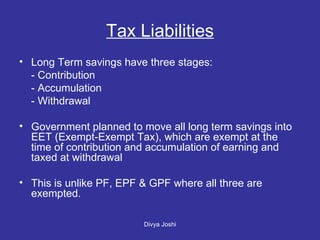
Tax Liabilities Long Term savings have three stages: - Contribution - Accumulation - Withdrawal Government planned to move all long term savings into EET (Exempt-Exempt Tax), which are exempt at the time of contribution and accumulation of earning and taxed at withdrawal This is unlike PF, EPF & GPF where all three are exempted.
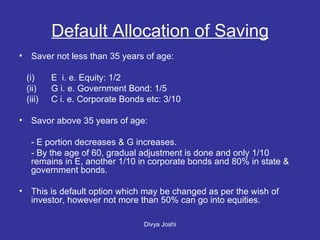
Default Allocation of Saving Saver not less than 35 years of age: (i) E  i. e. Equity: 1/2 (ii) G i. e. Government Bond: 1/5 (iii) C i. e. Corporate Bonds etc: 3/10 Savor above 35 years of age: - E portion decreases & G increases. - By the age of 60, gradual adjustment is done and only 1/10 remains in E, another 1/10 in corporate bonds and 80% in state & government bonds. This is default option which may be changed as per the wish of investor, however not more than 50% can go into equities.
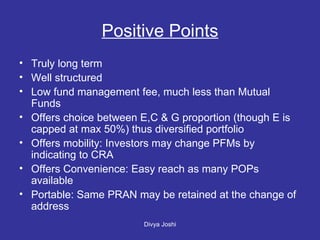
Positive Points Truly long term Well structured Low fund management fee, much less than Mutual Funds Offers choice between E,C & G proportion (though E is capped at max 50%) thus diversified portfolio Offers mobility: Investors may change PFMs by indicating to CRA Offers Convenience: Easy reach as many POPs available Portable: Same PRAN may be retained at the change of address
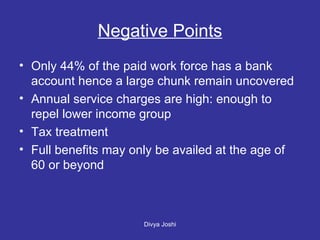
Negative Points Only 44% of the paid work force has a bank account hence a large chunk remain uncovered Annual service charges are high: enough to repel lower income group Tax treatment Full benefits may only be availed at the age of 60 or beyond
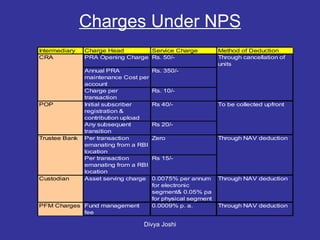
Charges Under NPS
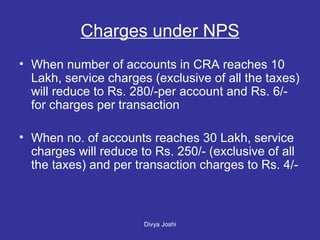
When number of accounts in CRA reaches 10 Lakh, service charges (exclusive of all the taxes) will reduce to Rs. 280/-per account and Rs. 6/- for charges per transaction When no. of accounts reaches 30 Lakh, service charges will reduce to Rs. 250/- (exclusive of all the taxes) and per transaction charges to Rs. 4/- Charges under NPS
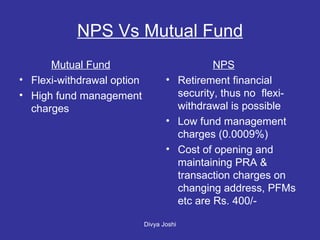
NPS Vs Mutual Fund Mutual Fund Flexi-withdrawal option High fund management charges   NPS Retirement financial security, thus no  flexi-withdrawal is possible Low fund management charges (0.0009%) Cost of opening and maintaining PRA & transaction charges on changing address, PFMs etc are Rs. 400/-
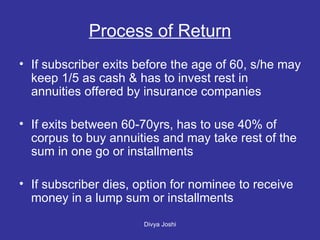
Process of Return If subscriber exits before the age of 60, s/he may keep 1/5 as cash & has to invest rest in annuities offered by insurance companies If exits between 60-70yrs, has to use 40% of corpus to buy annuities and may take rest of the sum in one go or installments If subscriber dies, option for nominee to receive money in a lump sum or installments
Whatโ€™s left to be desiredโ€ฆโ€ฆ Reduction of annual Service charges: 3 Options: - Reduction of annual service charges for contribution at threshold & increase for those investing large sum -  Back loaded charges: Low initially & increase as contribution builds up - Government to pitch in to subsidize small investors
What Moreโ€ฆ.. Scrapping partition between civil servant pensions and private pensions Higher equity investment option  Equal tax regime Allow companies with more than 10 employees to opt out of paying monthly contribution to EPFO & pay into NPS
Bibliography Economic Times www.pfrda.org.in www.livemint.com www.icai.org  (Report of Committee on Insurance & Pension) http://finmin.nic www.iief.com

New Pension Scheme

  • 1.
  • 2.
    What is NPS?A new scheme, where individuals fund their own financial security during their work-life for their old age when they no longer work Any individual between 18 to 55 years may be part of NPS
  • 3.
    Nomenclature PRAN (PermanentRetirement Account Number) Subscribers are issued with PRAN May be accessed on line through POPs (Point of Presence) You can retain PRAN, even if you change POP, job, residence, PFM or allocation of investment.
  • 4.
    CRA Central RecordKeeping Agency NSDL (National Securities Depositories Ltd) is Central agency that maintains all the accounts i. e. CRA for NPS Acts as interface between POPs, PFMs Banks etc.
  • 5.
    PFM Pension FundManagers (PFMs) who share common CRA infrastructure 6 PFMs are appointed : - SBI - ICICI - IDFC - Kotek Mahindra - Reliance capital - UTI
  • 6.
    PFM would investsavings put into PRAs, dividing into three parts: (a) Equity (E) (b) Government Bonds (G) (c) Debt Instruments/ Corporate Bonds/ FDs (C) PFM
  • 7.
    Method Subscriber shouldbe aged between 18 to 55 years Minimum Contribution is Rs 500/- Minimum four times a year Minimum amount to be paid in a year is Rs 6000/-
  • 8.
    Tax Liabilities LongTerm savings have three stages: - Contribution - Accumulation - Withdrawal Government planned to move all long term savings into EET (Exempt-Exempt Tax), which are exempt at the time of contribution and accumulation of earning and taxed at withdrawal This is unlike PF, EPF & GPF where all three are exempted.
  • 9.
    Default Allocation ofSaving Saver not less than 35 years of age: (i) E i. e. Equity: 1/2 (ii) G i. e. Government Bond: 1/5 (iii) C i. e. Corporate Bonds etc: 3/10 Savor above 35 years of age: - E portion decreases & G increases. - By the age of 60, gradual adjustment is done and only 1/10 remains in E, another 1/10 in corporate bonds and 80% in state & government bonds. This is default option which may be changed as per the wish of investor, however not more than 50% can go into equities.
  • 10.
    Positive Points Trulylong term Well structured Low fund management fee, much less than Mutual Funds Offers choice between E,C & G proportion (though E is capped at max 50%) thus diversified portfolio Offers mobility: Investors may change PFMs by indicating to CRA Offers Convenience: Easy reach as many POPs available Portable: Same PRAN may be retained at the change of address
  • 11.
    Negative Points Only44% of the paid work force has a bank account hence a large chunk remain uncovered Annual service charges are high: enough to repel lower income group Tax treatment Full benefits may only be availed at the age of 60 or beyond
  • 12.
  • 13.
    When number ofaccounts in CRA reaches 10 Lakh, service charges (exclusive of all the taxes) will reduce to Rs. 280/-per account and Rs. 6/- for charges per transaction When no. of accounts reaches 30 Lakh, service charges will reduce to Rs. 250/- (exclusive of all the taxes) and per transaction charges to Rs. 4/- Charges under NPS
  • 14.
    NPS Vs MutualFund Mutual Fund Flexi-withdrawal option High fund management charges NPS Retirement financial security, thus no flexi-withdrawal is possible Low fund management charges (0.0009%) Cost of opening and maintaining PRA & transaction charges on changing address, PFMs etc are Rs. 400/-
  • 15.
    Process of ReturnIf subscriber exits before the age of 60, s/he may keep 1/5 as cash & has to invest rest in annuities offered by insurance companies If exits between 60-70yrs, has to use 40% of corpus to buy annuities and may take rest of the sum in one go or installments If subscriber dies, option for nominee to receive money in a lump sum or installments
  • 16.
    Whatโ€™s left tobe desiredโ€ฆโ€ฆ Reduction of annual Service charges: 3 Options: - Reduction of annual service charges for contribution at threshold & increase for those investing large sum - Back loaded charges: Low initially & increase as contribution builds up - Government to pitch in to subsidize small investors
  • 17.
    What Moreโ€ฆ.. Scrappingpartition between civil servant pensions and private pensions Higher equity investment option Equal tax regime Allow companies with more than 10 employees to opt out of paying monthly contribution to EPFO & pay into NPS
  • 18.
    Bibliography Economic Timeswww.pfrda.org.in www.livemint.com www.icai.org (Report of Committee on Insurance & Pension) http://finmin.nic www.iief.com