What is KRA?
What is the full form of KRA? The full form of KRA is Key Result Area or Key Responsibility Area.
KRA is a management concept that defines the job position and duty of an employee, and also
refers to the different areas of work for which he may take responsibility.
What does KRA mean?
Key Responsibility Area
KRA is the abbreviation used for the Key Responsibility Area or Key Result Area. The meaning of
KRA sums up a comprehensive description of the roles and responsibilities of employees at their
workplace. They are both qualitative and quantitative and outline the scope of the job in achieving
organizational goals.
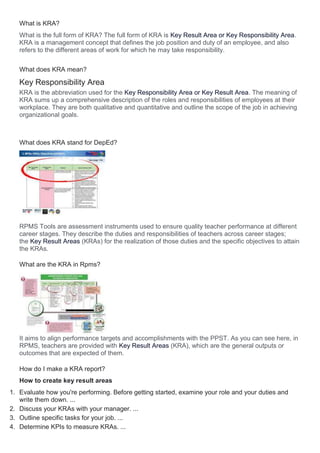
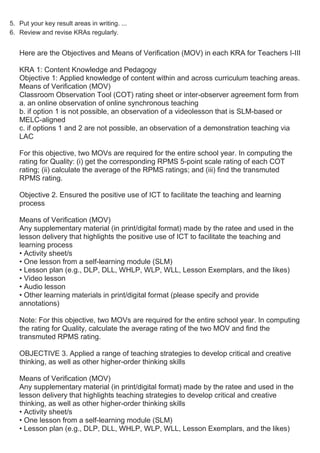
What does KRA stand for DepEd?
RPMS Tools are assessment instruments used to ensure quality teacher performance at different
career stages. They describe the duties and responsibilities of teachers across career stages;
the Key Result Areas (KRAs) for the realization of those duties and the specific objectives to attain
the KRAs.
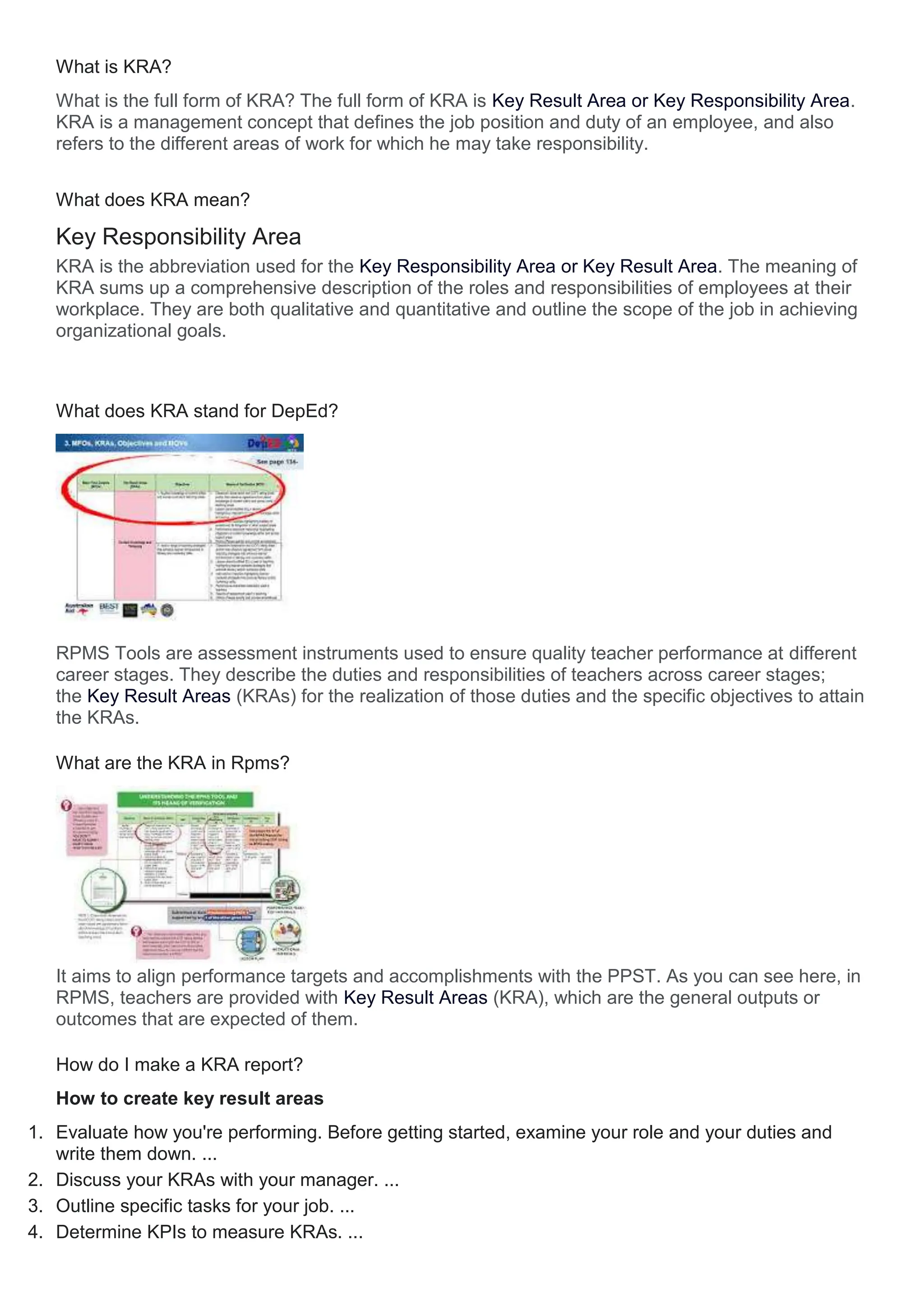
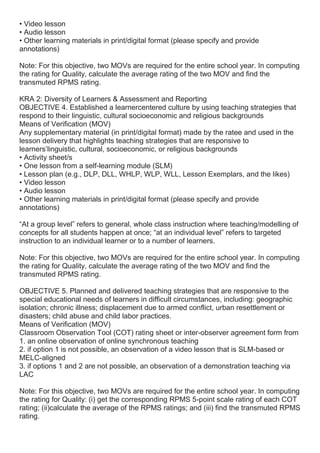
What are the KRA in Rpms?
It aims to align performance targets and accomplishments with the PPST. As you can see here, in
RPMS, teachers are provided with Key Result Areas (KRA), which are the general outputs or
outcomes that are expected of them.
How do I make a KRA report?
How to create key result areas
1. Evaluate how you're performing. Before getting started, examine your role and your duties and
write them down. ...
2. Discuss your KRAs with your manager. ...
3. Outline specific tasks for your job. ...
4. Determine KPIs to measure KRAs. ...
5. Put your key result areas in writing. ...
6. Review and revise KRAs regularly.
Here are the Objectives and Means of Verification (MOV) in each KRA for Teachers I-III
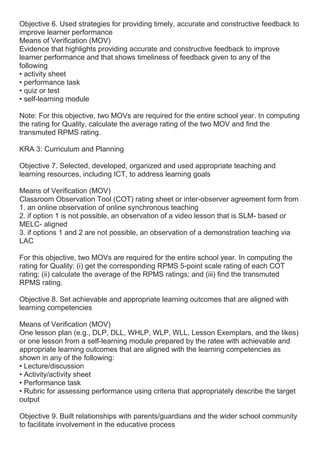
KRA 1: Content Knowledge and Pedagogy
Objective 1: Applied knowledge of content within and across curriculum teaching areas.
Means of Verification (MOV)
Classroom Observation Tool (COT) rating sheet or inter-observer agreement form from
a. an online observation of online synchronous teaching
b. if option 1 is not possible, an observation of a videolesson that is SLM-based or
MELC-aligned
c. if options 1 and 2 are not possible, an observation of a demonstration teaching via
LAC
For this objective, two MOVs are required for the entire school year. In computing the
rating for Quality: (i) get the corresponding RPMS 5-point scale rating of each COT
rating; (ii) calculate the average of the RPMS ratings; and (iii) find the transmuted
RPMS rating.
Objective 2. Ensured the positive use of ICT to facilitate the teaching and learning
process
Means of Verification (MOV)
Any supplementary material (in print/digital format) made by the ratee and used in the
lesson delivery that highlights the positive use of ICT to facilitate the teaching and
learning process
• Activity sheet/s
• One lesson from a self-learning module (SLM)
• Lesson plan (e.g., DLP, DLL, WHLP, WLP, WLL, Lesson Exemplars, and the likes)
• Video lesson
• Audio lesson
• Other learning materials in print/digital format (please specify and provide
annotations)
Note: For this objective, two MOVs are required for the entire school year. In computing
the rating for Quality, calculate the average rating of the two MOV and find the
transmuted RPMS rating.
OBJECTIVE 3. Applied a range of teaching strategies to develop critical and creative
thinking, as well as other higher-order thinking skills
Means of Verification (MOV)
Any supplementary material (in print/digital format) made by the ratee and used in the
lesson delivery that highlights teaching strategies to develop critical and creative
thinking, as well as other higher-order thinking skills
• Activity sheet/s
• One lesson from a self-learning module (SLM)
• Lesson plan (e.g., DLP, DLL, WHLP, WLP, WLL, Lesson Exemplars, and the likes)
• Video lesson
• Audio lesson
• Other learning materials in print/digital format (please specify and provide
annotations)
Note: For this objective, two MOVs are required for the entire school year. In computing
the rating for Quality, calculate the average rating of the two MOV and find the
transmuted RPMS rating.
KRA 2: Diversity of Learners & Assessment and Reporting
OBJECTIVE 4. Established a learnercentered culture by using teaching strategies that
respond to their linguistic, cultural socioeconomic and religious backgrounds
Means of Verification (MOV)
Any supplementary material (in print/digital format) made by the ratee and used in the
lesson delivery that highlights teaching strategies that are responsive to
learners’linguistic, cultural, socioeconomic, or religious backgrounds
• Activity sheet/s
• One lesson from a self-learning module (SLM)
• Lesson plan (e.g., DLP, DLL, WHLP, WLP, WLL, Lesson Exemplars, and the likes)
• Video lesson
• Audio lesson
• Other learning materials in print/digital format (please specify and provide
annotations)
“At a group level” refers to general, whole class instruction where teaching/modelling of
concepts for all students happen at once; “at an individual level” refers to targeted
instruction to an individual learner or to a number of learners.
Note: For this objective, two MOVs are required for the entire school year. In computing
the rating for Quality, calculate the average rating of the two MOV and find the
transmuted RPMS rating.
OBJECTIVE 5. Planned and delivered teaching strategies that are responsive to the
special educational needs of learners in difficult circumstances, including: geographic
isolation; chronic illness; displacement due to armed conflict, urban resettlement or
disasters; child abuse and child labor practices.
Means of Verification (MOV)
Classroom Observation Tool (COT) rating sheet or inter-observer agreement form from
1. an online observation of online synchronous teaching
2. if option 1 is not possible, an observation of a video lesson that is SLM-based or
MELC-aligned
3. if options 1 and 2 are not possible, an observation of a demonstration teaching via
LAC
Note: For this objective, two MOVs are required for the entire school year. In computing
the rating for Quality: (i) get the corresponding RPMS 5-point scale rating of each COT
rating; (ii)calculate the average of the RPMS ratings; and (iii) find the transmuted RPMS
rating.
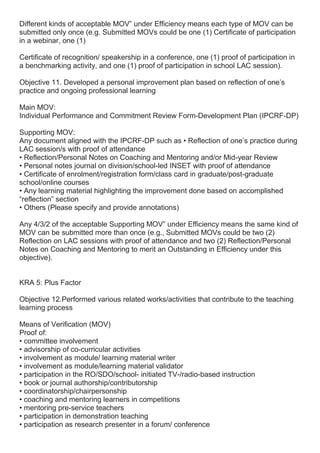
Objective 6. Used strategies for providing timely, accurate and constructive feedback to
improve learner performance
Means of Verification (MOV)
Evidence that highlights providing accurate and constructive feedback to improve
learner performance and that shows timeliness of feedback given to any of the
following
• activity sheet
• performance task
• quiz or test
• self-learning module
Note: For this objective, two MOVs are required for the entire school year. In computing
the rating for Quality, calculate the average rating of the two MOV and find the
transmuted RPMS rating.
KRA 3: Curriculum and Planning
Objective 7. Selected, developed, organized and used appropriate teaching and
learning resources, including ICT, to address learning goals
Means of Verification (MOV)
Classroom Observation Tool (COT) rating sheet or inter-observer agreement form from
1. an online observation of online synchronous teaching
2. if option 1 is not possible, an observation of a video lesson that is SLM- based or
MELC- aligned
3. if options 1 and 2 are not possible, an observation of a demonstration teaching via
LAC
For this objective, two MOVs are required for the entire school year. In computing the
rating for Quality: (i) get the corresponding RPMS 5-point scale rating of each COT
rating; (ii) calculate the average of the RPMS ratings; and (iii) find the transmuted
RPMS rating.
Objective 8. Set achievable and appropriate learning outcomes that are aligned with
learning competencies
Means of Verification (MOV)
One lesson plan (e.g., DLP, DLL, WHLP, WLP, WLL, Lesson Exemplars, and the likes)
or one lesson from a self-learning module prepared by the ratee with achievable and
appropriate learning outcomes that are aligned with the learning competencies as
shown in any of the following:
• Lecture/discussion
• Activity/activity sheet
• Performance task
• Rubric for assessing performance using criteria that appropriately describe the target
output
Objective 9. Built relationships with parents/guardians and the wider school community
to facilitate involvement in the educative process
Means of Verification (MOV)
1. Proof of participation in any activity for improved access to education such as, but
not limited to the ff. activities
• Distribution of learning materials to learners/parents (e.g., receipt form/monitoring
form during distribution of learning materials, etc.)
• Brigada Eskwela (e.g., commitment form to stakeholders, developed advocacy
materials, certificate of participation that involves parents’/stakeholders’ engagement
signed by the school head, etc.)
• Home visitation (e.g., home visitation form, etc.)
• Others (please specify and provide annotations)
2. Parent-teacher log or proof of other stakeholders meeting (e.g., one-on-one parent-
teacher-learner conference log; attendance sheet with minutes of online or face-to-face
meeting; proof of involvement in the learners’/parents’ orientation, etc.)
3. Any form of communication to parents/stakeholders (e.g., notice of meeting;
screenshot of chat/text message/communication with parent/guardian [name or any
identifier removed]; digital/ printed copy of Learner Enrollment Survey Form signed by
the ICT Coordinator/Focal person and School Head)
“Any 4/3/2 of the acceptable MOV” under Efficiency means the same kind of MOV can
be submitted more than once (e.g., Submitted MOVs could be two (2) Parent-teacher
logs, one (1) printed LESF, and one (1) screenshot of correspondence with parents via
an online platform to merit an Outstanding in Efficiency for this objective.)
KRA 4: Community Linkages and Professional Engagement & Personal Growth and
Professional Development
Objective 10. Participated in professional networks to share knowledge and to enhance
practice
Means of Verification (MOV)
• Certificate of completion in a course/training • Certificate of participation in a webinar,
retooling, upskilling, and other training/ seminar/ workshop with proof of implementation
• Certificate of recognition/speakership in a webinar, retooling, upskilling, and other
training/ seminar/ workshop
• Any proof of participation to a benchmarking activity • Any proof of participation in
school LAC sessions (online/face-to-face) certified by the LAC Coordinator
• Others (please specify and provide annotations)
Output” may include, but not limited to, lesson plan, instructional materials, action plan,
or any teaching and learning-related materials.
Proof of implementation” can be in the form of implemented action plan, lesson plan
executed in class, application project, etc.
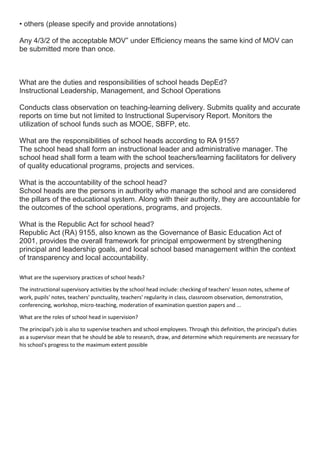
Different kinds of acceptable MOV” under Efficiency means each type of MOV can be
submitted only once (e.g. Submitted MOVs could be one (1) Certificate of participation
in a webinar, one (1)
Certificate of recognition/ speakership in a conference, one (1) proof of participation in
a benchmarking activity, and one (1) proof of participation in school LAC session).
Objective 11. Developed a personal improvement plan based on reflection of one’s
practice and ongoing professional learning
Main MOV:
Individual Performance and Commitment Review Form-Development Plan (IPCRF-DP)
Supporting MOV:
Any document aligned with the IPCRF-DP such as • Reflection of one’s practice during
LAC session/s with proof of attendance
• Reflection/Personal Notes on Coaching and Mentoring and/or Mid-year Review
• Personal notes journal on division/school-led INSET with proof of attendance
• Certificate of enrolment/registration form/class card in graduate/post-graduate
school/online courses
• Any learning material highlighting the improvement done based on accomplished
“reflection” section
• Others (Please specify and provide annotations)
Any 4/3/2 of the acceptable Supporting MOV” under Efficiency means the same kind of
MOV can be submitted more than once (e.g., Submitted MOVs could be two (2)
Reflection on LAC sessions with proof of attendance and two (2) Reflection/Personal
Notes on Coaching and Mentoring to merit an Outstanding in Efficiency under this
objective).
KRA 5: Plus Factor
Objective 12.Performed various related works/activities that contribute to the teaching
learning process
Means of Verification (MOV)
Proof of:
• committee involvement
• advisorship of co-curricular activities
• involvement as module/ learning material writer
• involvement as module/learning material validator
• participation in the RO/SDO/school- initiated TV-/radio-based instruction
• book or journal authorship/contributorship
• coordinatorship/chairpersonship
• coaching and mentoring learners in competitions
• mentoring pre-service teachers
• participation in demonstration teaching
• participation as research presenter in a forum/ conference
• others (please specify and provide annotations)
Any 4/3/2 of the acceptable MOV” under Efficiency means the same kind of MOV can
be submitted more than once.
What are the duties and responsibilities of school heads DepEd?
Instructional Leadership, Management, and School Operations
Conducts class observation on teaching-learning delivery. Submits quality and accurate
reports on time but not limited to Instructional Supervisory Report. Monitors the
utilization of school funds such as MOOE, SBFP, etc.
What are the responsibilities of school heads according to RA 9155?
The school head shall form an instructional leader and administrative manager. The
school head shall form a team with the school teachers/learning facilitators for delivery
of quality educational programs, projects and services.
What is the accountability of the school head?
School heads are the persons in authority who manage the school and are considered
the pillars of the educational system. Along with their authority, they are accountable for
the outcomes of the school operations, programs, and projects.
What is the Republic Act for school head?
Republic Act (RA) 9155, also known as the Governance of Basic Education Act of
2001, provides the overall framework for principal empowerment by strengthening
principal and leadership goals, and local school based management within the context
of transparency and local accountability.
What are the supervisory practices of school heads?
The instructional supervisory activities by the school head include: checking of teachers' lesson notes, scheme of
work, pupils' notes, teachers' punctuality, teachers' regularity in class, classroom observation, demonstration,
conferencing, workshop, micro-teaching, moderation of examination question papers and ...
What are the roles of school head in supervision?
The principal's job is also to supervise teachers and school employees. Through this definition, the principal's duties
as a supervisor mean that he should be able to research, draw, and determine which requirements are necessary for
his school's progress to the maximum extent possible

What is KRA.docx

  • 1.
    What is KRA? Whatis the full form of KRA? The full form of KRA is Key Result Area or Key Responsibility Area. KRA is a management concept that defines the job position and duty of an employee, and also refers to the different areas of work for which he may take responsibility. What does KRA mean? Key Responsibility Area KRA is the abbreviation used for the Key Responsibility Area or Key Result Area. The meaning of KRA sums up a comprehensive description of the roles and responsibilities of employees at their workplace. They are both qualitative and quantitative and outline the scope of the job in achieving organizational goals. What does KRA stand for DepEd? RPMS Tools are assessment instruments used to ensure quality teacher performance at different career stages. They describe the duties and responsibilities of teachers across career stages; the Key Result Areas (KRAs) for the realization of those duties and the specific objectives to attain the KRAs. What are the KRA in Rpms? It aims to align performance targets and accomplishments with the PPST. As you can see here, in RPMS, teachers are provided with Key Result Areas (KRA), which are the general outputs or outcomes that are expected of them. How do I make a KRA report? How to create key result areas 1. Evaluate how you're performing. Before getting started, examine your role and your duties and write them down. ... 2. Discuss your KRAs with your manager. ... 3. Outline specific tasks for your job. ... 4. Determine KPIs to measure KRAs. ...
  • 2.
    5. Put yourkey result areas in writing. ... 6. Review and revise KRAs regularly. Here are the Objectives and Means of Verification (MOV) in each KRA for Teachers I-III KRA 1: Content Knowledge and Pedagogy Objective 1: Applied knowledge of content within and across curriculum teaching areas. Means of Verification (MOV) Classroom Observation Tool (COT) rating sheet or inter-observer agreement form from a. an online observation of online synchronous teaching b. if option 1 is not possible, an observation of a videolesson that is SLM-based or MELC-aligned c. if options 1 and 2 are not possible, an observation of a demonstration teaching via LAC For this objective, two MOVs are required for the entire school year. In computing the rating for Quality: (i) get the corresponding RPMS 5-point scale rating of each COT rating; (ii) calculate the average of the RPMS ratings; and (iii) find the transmuted RPMS rating. Objective 2. Ensured the positive use of ICT to facilitate the teaching and learning process Means of Verification (MOV) Any supplementary material (in print/digital format) made by the ratee and used in the lesson delivery that highlights the positive use of ICT to facilitate the teaching and learning process • Activity sheet/s • One lesson from a self-learning module (SLM) • Lesson plan (e.g., DLP, DLL, WHLP, WLP, WLL, Lesson Exemplars, and the likes) • Video lesson • Audio lesson • Other learning materials in print/digital format (please specify and provide annotations) Note: For this objective, two MOVs are required for the entire school year. In computing the rating for Quality, calculate the average rating of the two MOV and find the transmuted RPMS rating. OBJECTIVE 3. Applied a range of teaching strategies to develop critical and creative thinking, as well as other higher-order thinking skills Means of Verification (MOV) Any supplementary material (in print/digital format) made by the ratee and used in the lesson delivery that highlights teaching strategies to develop critical and creative thinking, as well as other higher-order thinking skills • Activity sheet/s • One lesson from a self-learning module (SLM) • Lesson plan (e.g., DLP, DLL, WHLP, WLP, WLL, Lesson Exemplars, and the likes)
  • 3.
    • Video lesson •Audio lesson • Other learning materials in print/digital format (please specify and provide annotations) Note: For this objective, two MOVs are required for the entire school year. In computing the rating for Quality, calculate the average rating of the two MOV and find the transmuted RPMS rating. KRA 2: Diversity of Learners & Assessment and Reporting OBJECTIVE 4. Established a learnercentered culture by using teaching strategies that respond to their linguistic, cultural socioeconomic and religious backgrounds Means of Verification (MOV) Any supplementary material (in print/digital format) made by the ratee and used in the lesson delivery that highlights teaching strategies that are responsive to learners’linguistic, cultural, socioeconomic, or religious backgrounds • Activity sheet/s • One lesson from a self-learning module (SLM) • Lesson plan (e.g., DLP, DLL, WHLP, WLP, WLL, Lesson Exemplars, and the likes) • Video lesson • Audio lesson • Other learning materials in print/digital format (please specify and provide annotations) “At a group level” refers to general, whole class instruction where teaching/modelling of concepts for all students happen at once; “at an individual level” refers to targeted instruction to an individual learner or to a number of learners. Note: For this objective, two MOVs are required for the entire school year. In computing the rating for Quality, calculate the average rating of the two MOV and find the transmuted RPMS rating. OBJECTIVE 5. Planned and delivered teaching strategies that are responsive to the special educational needs of learners in difficult circumstances, including: geographic isolation; chronic illness; displacement due to armed conflict, urban resettlement or disasters; child abuse and child labor practices. Means of Verification (MOV) Classroom Observation Tool (COT) rating sheet or inter-observer agreement form from 1. an online observation of online synchronous teaching 2. if option 1 is not possible, an observation of a video lesson that is SLM-based or MELC-aligned 3. if options 1 and 2 are not possible, an observation of a demonstration teaching via LAC Note: For this objective, two MOVs are required for the entire school year. In computing the rating for Quality: (i) get the corresponding RPMS 5-point scale rating of each COT rating; (ii)calculate the average of the RPMS ratings; and (iii) find the transmuted RPMS rating.
  • 4.
    Objective 6. Usedstrategies for providing timely, accurate and constructive feedback to improve learner performance Means of Verification (MOV) Evidence that highlights providing accurate and constructive feedback to improve learner performance and that shows timeliness of feedback given to any of the following • activity sheet • performance task • quiz or test • self-learning module Note: For this objective, two MOVs are required for the entire school year. In computing the rating for Quality, calculate the average rating of the two MOV and find the transmuted RPMS rating. KRA 3: Curriculum and Planning Objective 7. Selected, developed, organized and used appropriate teaching and learning resources, including ICT, to address learning goals Means of Verification (MOV) Classroom Observation Tool (COT) rating sheet or inter-observer agreement form from 1. an online observation of online synchronous teaching 2. if option 1 is not possible, an observation of a video lesson that is SLM- based or MELC- aligned 3. if options 1 and 2 are not possible, an observation of a demonstration teaching via LAC For this objective, two MOVs are required for the entire school year. In computing the rating for Quality: (i) get the corresponding RPMS 5-point scale rating of each COT rating; (ii) calculate the average of the RPMS ratings; and (iii) find the transmuted RPMS rating. Objective 8. Set achievable and appropriate learning outcomes that are aligned with learning competencies Means of Verification (MOV) One lesson plan (e.g., DLP, DLL, WHLP, WLP, WLL, Lesson Exemplars, and the likes) or one lesson from a self-learning module prepared by the ratee with achievable and appropriate learning outcomes that are aligned with the learning competencies as shown in any of the following: • Lecture/discussion • Activity/activity sheet • Performance task • Rubric for assessing performance using criteria that appropriately describe the target output Objective 9. Built relationships with parents/guardians and the wider school community to facilitate involvement in the educative process
  • 5.
    Means of Verification(MOV) 1. Proof of participation in any activity for improved access to education such as, but not limited to the ff. activities • Distribution of learning materials to learners/parents (e.g., receipt form/monitoring form during distribution of learning materials, etc.) • Brigada Eskwela (e.g., commitment form to stakeholders, developed advocacy materials, certificate of participation that involves parents’/stakeholders’ engagement signed by the school head, etc.) • Home visitation (e.g., home visitation form, etc.) • Others (please specify and provide annotations) 2. Parent-teacher log or proof of other stakeholders meeting (e.g., one-on-one parent- teacher-learner conference log; attendance sheet with minutes of online or face-to-face meeting; proof of involvement in the learners’/parents’ orientation, etc.) 3. Any form of communication to parents/stakeholders (e.g., notice of meeting; screenshot of chat/text message/communication with parent/guardian [name or any identifier removed]; digital/ printed copy of Learner Enrollment Survey Form signed by the ICT Coordinator/Focal person and School Head) “Any 4/3/2 of the acceptable MOV” under Efficiency means the same kind of MOV can be submitted more than once (e.g., Submitted MOVs could be two (2) Parent-teacher logs, one (1) printed LESF, and one (1) screenshot of correspondence with parents via an online platform to merit an Outstanding in Efficiency for this objective.) KRA 4: Community Linkages and Professional Engagement & Personal Growth and Professional Development Objective 10. Participated in professional networks to share knowledge and to enhance practice Means of Verification (MOV) • Certificate of completion in a course/training • Certificate of participation in a webinar, retooling, upskilling, and other training/ seminar/ workshop with proof of implementation • Certificate of recognition/speakership in a webinar, retooling, upskilling, and other training/ seminar/ workshop • Any proof of participation to a benchmarking activity • Any proof of participation in school LAC sessions (online/face-to-face) certified by the LAC Coordinator • Others (please specify and provide annotations) Output” may include, but not limited to, lesson plan, instructional materials, action plan, or any teaching and learning-related materials. Proof of implementation” can be in the form of implemented action plan, lesson plan executed in class, application project, etc.
  • 6.
    Different kinds ofacceptable MOV” under Efficiency means each type of MOV can be submitted only once (e.g. Submitted MOVs could be one (1) Certificate of participation in a webinar, one (1) Certificate of recognition/ speakership in a conference, one (1) proof of participation in a benchmarking activity, and one (1) proof of participation in school LAC session). Objective 11. Developed a personal improvement plan based on reflection of one’s practice and ongoing professional learning Main MOV: Individual Performance and Commitment Review Form-Development Plan (IPCRF-DP) Supporting MOV: Any document aligned with the IPCRF-DP such as • Reflection of one’s practice during LAC session/s with proof of attendance • Reflection/Personal Notes on Coaching and Mentoring and/or Mid-year Review • Personal notes journal on division/school-led INSET with proof of attendance • Certificate of enrolment/registration form/class card in graduate/post-graduate school/online courses • Any learning material highlighting the improvement done based on accomplished “reflection” section • Others (Please specify and provide annotations) Any 4/3/2 of the acceptable Supporting MOV” under Efficiency means the same kind of MOV can be submitted more than once (e.g., Submitted MOVs could be two (2) Reflection on LAC sessions with proof of attendance and two (2) Reflection/Personal Notes on Coaching and Mentoring to merit an Outstanding in Efficiency under this objective). KRA 5: Plus Factor Objective 12.Performed various related works/activities that contribute to the teaching learning process Means of Verification (MOV) Proof of: • committee involvement • advisorship of co-curricular activities • involvement as module/ learning material writer • involvement as module/learning material validator • participation in the RO/SDO/school- initiated TV-/radio-based instruction • book or journal authorship/contributorship • coordinatorship/chairpersonship • coaching and mentoring learners in competitions • mentoring pre-service teachers • participation in demonstration teaching • participation as research presenter in a forum/ conference
  • 7.
    • others (pleasespecify and provide annotations) Any 4/3/2 of the acceptable MOV” under Efficiency means the same kind of MOV can be submitted more than once. What are the duties and responsibilities of school heads DepEd? Instructional Leadership, Management, and School Operations Conducts class observation on teaching-learning delivery. Submits quality and accurate reports on time but not limited to Instructional Supervisory Report. Monitors the utilization of school funds such as MOOE, SBFP, etc. What are the responsibilities of school heads according to RA 9155? The school head shall form an instructional leader and administrative manager. The school head shall form a team with the school teachers/learning facilitators for delivery of quality educational programs, projects and services. What is the accountability of the school head? School heads are the persons in authority who manage the school and are considered the pillars of the educational system. Along with their authority, they are accountable for the outcomes of the school operations, programs, and projects. What is the Republic Act for school head? Republic Act (RA) 9155, also known as the Governance of Basic Education Act of 2001, provides the overall framework for principal empowerment by strengthening principal and leadership goals, and local school based management within the context of transparency and local accountability. What are the supervisory practices of school heads? The instructional supervisory activities by the school head include: checking of teachers' lesson notes, scheme of work, pupils' notes, teachers' punctuality, teachers' regularity in class, classroom observation, demonstration, conferencing, workshop, micro-teaching, moderation of examination question papers and ... What are the roles of school head in supervision? The principal's job is also to supervise teachers and school employees. Through this definition, the principal's duties as a supervisor mean that he should be able to research, draw, and determine which requirements are necessary for his school's progress to the maximum extent possible