HYPOTHESES
JAMES FRANCIS A. GOSE, MBA
1
Introduction
• The purpose of hypothesis testing is to determine whether
there is enough statistical evidence in favor of a certain
belief about a parameter.
• An hypothesis is a preliminary or tentative explanation or
postulate by the researcher of what the researcher
considers the outcome of an investigation will be. It is an
informed/educated guess.
• It indicates the expectations of the researcher regarding
certain variables. It is the most specific way in which an
answer to a problem can be stated.
2
What is hypothesis
• A tentative statement about a population
parameter that might be true or wrong
3
THE DIFFERENCE BETWEEN AN HYPOTHESIS AND A PROBLEM
• Both an hypothesis and a problem contribute to
the body of knowledge which supports or refutes
an existing theory.
• An hypothesis differs from a problem.
• A problem is formulated in the form of a question;
it serves as the basis or origin from which an
hypothesis is derived.
• An hypothesis is a suggested solution to a
problem.
• A problem (question) cannot be directly tested,
whereas an hypothesis can be tested and verified.
4
WHEN IS AN HYPOTHESIS FORMULATED
• An hypothesis is formulated after the problem
has been stated and the literature study has
been concluded.
• It is formulated when the researcher is totally
aware of the theoretical and empirical
background to the problem.
5
PURPOSE AND FUNCTION OF AN HYPOTHESIS
• It offers explanations for the relationships between
those variables that can be empirically tested.
• It furnishes proof that the researcher has sufficient
background knowledge to enable him/her to make
suggestions in order to extend existing knowledge.
• It gives direction to an investigation.
• It structures the next phase in the investigation and
therefore furnishes continuity to the examination
of the problem.
6
CHARACTERISTICS OF AN HYPOTHESIS
• It should have elucidating power.
• It should strive to furnish an acceptable
explanation of the phenomenon.
• It must be verifiable.
• It must be formulated in simple,
understandable terms.
• It should corresponds with existing
knowledge.
7
Types of Hypotheses
1. Descriptive Hypotheses:
• These are propositions that describe the characteristics
( such as size, form or distribution) of a variable. The
variable may be an object, person, organization etc. ,
e.g., The rate of unemployment among arts graduates is higher than that of
commerce graduates. The educational system is not oriented to human
resource needs of a country.
2. Relational Hypotheses.
• These are propositions which describe the relationship
between tow variables.
e. g. , Families with higher incomes spend more for recreation
Upper – class people have fewer children than lower class people.
8
Cont…
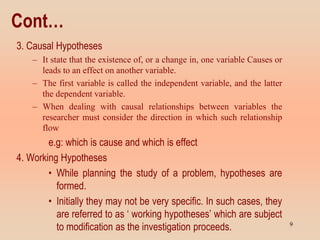
3. Causal Hypotheses
– It state that the existence of, or a change in, one variable Causes or
leads to an effect on another variable.
– The first variable is called the independent variable, and the latter
the dependent variable.
– When dealing with causal relationships between variables the
researcher must consider the direction in which such relationship
flow
e.g: which is cause and which is effect
4. Working Hypotheses
• While planning the study of a problem, hypotheses are
formed.
• Initially they may not be very specific. In such cases, they
are referred to as ‘ working hypotheses’ which are subject
to modification as the investigation proceeds. 9
Cont…
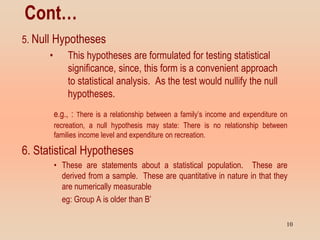
5. Null Hypotheses
• This hypotheses are formulated for testing statistical
significance, since, this form is a convenient approach
to statistical analysis. As the test would nullify the null
hypotheses.
e.g., : There is a relationship between a family’s income and expenditure on
recreation, a null hypothesis may state: There is no relationship between
families income level and expenditure on recreation.
6. Statistical Hypotheses
• These are statements about a statistical population. These are
derived from a sample. These are quantitative in nature in that they
are numerically measurable
eg: Group A is older than B’
10
Cont…
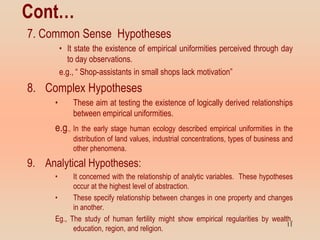
7. Common Sense Hypotheses
• It state the existence of empirical uniformities perceived through day
to day observations.
e.g., “ Shop-assistants in small shops lack motivation”
8. Complex Hypotheses
• These aim at testing the existence of logically derived relationships
between empirical uniformities.
e.g., In the early stage human ecology described empirical uniformities in the
distribution of land values, industrial concentrations, types of business and
other phenomena.
9. Analytical Hypotheses:
• It concerned with the relationship of analytic variables. These hypotheses
occur at the highest level of abstraction.
• These specify relationship between changes in one property and changes
in another.
Eg., The study of human fertility might show empirical regularities by wealth,
education, region, and religion.
11
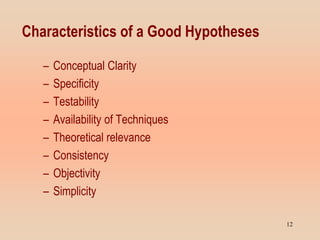
Characteristics of a Good Hypotheses
– Conceptual Clarity
– Specificity
– Testability
– Availability of Techniques
– Theoretical relevance
– Consistency
– Objectivity
– Simplicity
12
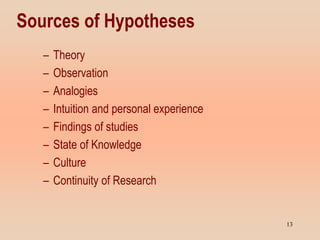
Sources of Hypotheses
– Theory
– Observation
– Analogies
– Intuition and personal experience
– Findings of studies
– State of Knowledge
– Culture
– Continuity of Research
13

What is Hypotheses an introduction in hypothesis

  • 1.
  • 2.
    Introduction • The purposeof hypothesis testing is to determine whether there is enough statistical evidence in favor of a certain belief about a parameter. • An hypothesis is a preliminary or tentative explanation or postulate by the researcher of what the researcher considers the outcome of an investigation will be. It is an informed/educated guess. • It indicates the expectations of the researcher regarding certain variables. It is the most specific way in which an answer to a problem can be stated. 2
  • 3.
    What is hypothesis •A tentative statement about a population parameter that might be true or wrong 3
  • 4.
    THE DIFFERENCE BETWEENAN HYPOTHESIS AND A PROBLEM • Both an hypothesis and a problem contribute to the body of knowledge which supports or refutes an existing theory. • An hypothesis differs from a problem. • A problem is formulated in the form of a question; it serves as the basis or origin from which an hypothesis is derived. • An hypothesis is a suggested solution to a problem. • A problem (question) cannot be directly tested, whereas an hypothesis can be tested and verified. 4
  • 5.
    WHEN IS ANHYPOTHESIS FORMULATED • An hypothesis is formulated after the problem has been stated and the literature study has been concluded. • It is formulated when the researcher is totally aware of the theoretical and empirical background to the problem. 5
  • 6.
    PURPOSE AND FUNCTIONOF AN HYPOTHESIS • It offers explanations for the relationships between those variables that can be empirically tested. • It furnishes proof that the researcher has sufficient background knowledge to enable him/her to make suggestions in order to extend existing knowledge. • It gives direction to an investigation. • It structures the next phase in the investigation and therefore furnishes continuity to the examination of the problem. 6
  • 7.
    CHARACTERISTICS OF ANHYPOTHESIS • It should have elucidating power. • It should strive to furnish an acceptable explanation of the phenomenon. • It must be verifiable. • It must be formulated in simple, understandable terms. • It should corresponds with existing knowledge. 7
  • 8.
    Types of Hypotheses 1.Descriptive Hypotheses: • These are propositions that describe the characteristics ( such as size, form or distribution) of a variable. The variable may be an object, person, organization etc. , e.g., The rate of unemployment among arts graduates is higher than that of commerce graduates. The educational system is not oriented to human resource needs of a country. 2. Relational Hypotheses. • These are propositions which describe the relationship between tow variables. e. g. , Families with higher incomes spend more for recreation Upper – class people have fewer children than lower class people. 8
  • 9.
    Cont… 3. Causal Hypotheses –It state that the existence of, or a change in, one variable Causes or leads to an effect on another variable. – The first variable is called the independent variable, and the latter the dependent variable. – When dealing with causal relationships between variables the researcher must consider the direction in which such relationship flow e.g: which is cause and which is effect 4. Working Hypotheses • While planning the study of a problem, hypotheses are formed. • Initially they may not be very specific. In such cases, they are referred to as ‘ working hypotheses’ which are subject to modification as the investigation proceeds. 9
  • 10.
    Cont… 5. Null Hypotheses •This hypotheses are formulated for testing statistical significance, since, this form is a convenient approach to statistical analysis. As the test would nullify the null hypotheses. e.g., : There is a relationship between a family’s income and expenditure on recreation, a null hypothesis may state: There is no relationship between families income level and expenditure on recreation. 6. Statistical Hypotheses • These are statements about a statistical population. These are derived from a sample. These are quantitative in nature in that they are numerically measurable eg: Group A is older than B’ 10
  • 11.
    Cont… 7. Common SenseHypotheses • It state the existence of empirical uniformities perceived through day to day observations. e.g., “ Shop-assistants in small shops lack motivation” 8. Complex Hypotheses • These aim at testing the existence of logically derived relationships between empirical uniformities. e.g., In the early stage human ecology described empirical uniformities in the distribution of land values, industrial concentrations, types of business and other phenomena. 9. Analytical Hypotheses: • It concerned with the relationship of analytic variables. These hypotheses occur at the highest level of abstraction. • These specify relationship between changes in one property and changes in another. Eg., The study of human fertility might show empirical regularities by wealth, education, region, and religion. 11
  • 12.
    Characteristics of aGood Hypotheses – Conceptual Clarity – Specificity – Testability – Availability of Techniques – Theoretical relevance – Consistency – Objectivity – Simplicity 12
  • 13.
    Sources of Hypotheses –Theory – Observation – Analogies – Intuition and personal experience – Findings of studies – State of Knowledge – Culture – Continuity of Research 13