Land Reform and
Agrarian
Reform
Meaning of Land Reform
• Reform - implies the existence of a defect that
  something is deformed or malformed and does not
  suit the existing condition.
• Land Reform - refers to the full range of
  measures that may or should be taken to improve
  or remedy the respect to their rights in land.
  Defined as an integral set of measures designed to
  eliminate obstacles to economic and social
  development arising out of defects in the
  agrarian structure.
Meaning of Land Tenure Structure
• Land Tenure Structure - is a concept which refers
  to one or more land structure systems
  regulating the rights to ownership and control and
  usage of land and the duties accompanying such
  right.
• Agricultural Tenancy - as a manner of holding

  agricultural lands, is only one of several forms of
  land tenure or rights of land
Examples of Land Tenure Reform
            Measures
• Redistribution of private lands (through expropriation
  or purchase)
• Distribution of lands in the public domain       -
  resettlement or colonization
• Regulation of tenancy ( provision on penalties
  for wrongful eviction of tenants, prohibition of
  subletting by tenant, etc)
• Regulation of agricultural labor contracts and
  wages
• Elimination of absentee landlordism and transfer of
  land ownership to actual tillers
Meaning of Production Structure
• A concept which relates to the nature, type
  and modus operandi as well as the actual
  process of production or farm operation.
• Directly related to the size, location and
  shape of production unit or holding,
  which may be operated singly or with
  assistance from others.
Examples Production Reform
             Measures
• Consolidation of small, uneconomic holdings to
  insure optimum utilization.
• Imposition of a floor on holdings or economic size
   beyond which subdivisions is to be
  prevented.
• Promotion of cooperative or compact farming
  among sub marginal farmers.
• Imposition of a ceiling on holdings of no
  cultivating owners.
• Organization of crop rotation system.
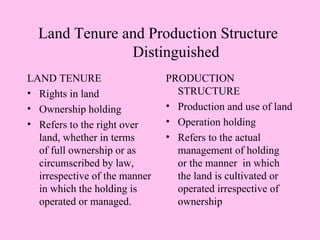
Land Tenure and Production Structure
               Distinguished
LAND TENURE                    PRODUCTION
• Rights in land                 STRUCTURE
• Ownership holding            • Production and use of land
• Refers to the right over     • Operation holding
  land, whether in terms       • Refers to the actual
  of full ownership or as        management of holding
  circumscribed by law,          or the manner in which
  irrespective of the manner     the land is cultivated or
  in which the holding is        operated irrespective of
  operated or managed.           ownership
Meaning of Agrarian Structure
• Is defined as a complex set of relationships
  within the agricultural sector among
  tenure structure, production structure and
  the structure of supporting services.
Agrarian Reform
• Comprises of land reform and development
  of complimentary institutional       framework
  such        as administrative agencies of the
  national government, rural education and social
  welfare institutions.
• It means remedying not only the defect in the
  distribution and use of land but also and
  especially, the accompanying human relations
  regarding lands, including economic, social and
  political relations.
Comprehensive Agrarian Reform
               Law
• Agrarian reform is defined to mean “ the
  redistribution of lands, regardless of crops or fruits
  produced, to farmers and regular farm workers who are
  landless, irrespective of tenurial arrangement , to include
  the totality of factors and support services designed to
  lift the economic status of the beneficiaries and all other
  arrangements alternative to the physical redistribution of
  lands, such as production, profit-sharing , labor
  administration, and the distribution of shares of stocks,
  which will allow beneficiaries to receive a just share of
   the fruits of the land they work”.
Aspects of Agrarian Reform
• Vital Position of Agriculture in National
  Economy
• Obstacles to Agricultural Productivity
• Agrarian Reform is an Instrument for
  Increasing Agricultural Productivity
Taxation Defined
• Taxation - the act of levying a tax; the process or
  means by which the sovereign, through its law-
  making body, raises revenues to defray the
  necessary expenses of the government .
• Taxes - enforced proportional contributions from
  persons and property levied by the law- making
  body of the state by virtue of its sovereignty for
  the support of the government and all public
  needs.
Essential Characteristics
                 of a Tax
• It is an enforced contribution.
• It is generally payable in money.
• It is proportionate in character.
• It is levied on persons and property.
• It is levied by the state which has a jurisdiction
  over person or property.
• It is levied by the law-making body of the state.
• It is levied for public purposes.
Classification of Taxes
• As to subject matter or object
     - Personal, pool or capitation
     - Property tax
     - Excise tax
• As to purpose
     - General, fiscal or revenue
     - Special or regulatory
• As to scope (or authority imposing the tax)
     - National
     - Municipal or local
• As to determination of account
     - Specific
• As to who bears the burden
     - Direct
     - Indirect
• As to graduation of rate
     - Proportional
     - Progressive or graduated
     - Regressive
Tax Administration and
            Procedure
• Levy from the congress
• Assessment from the BIR
• Collection by BIR of designated agencies
Tax Evasion and Tax
             Avoidance
• Tax avoidance - use by a taxpayer of legally
  permissible means or methods in order to
  avoid or reduce tax liability. It is not
  punishable by law.
• Tax evasion - use by the taxpayer of illegal
  or fraudulent means to defeat or reduce the
  payment of a tax. It is punishable by law.

LAND & AGRARIAN REFORM

  • 1.
  • 2.
    Meaning of LandReform • Reform - implies the existence of a defect that something is deformed or malformed and does not suit the existing condition. • Land Reform - refers to the full range of measures that may or should be taken to improve or remedy the respect to their rights in land. Defined as an integral set of measures designed to eliminate obstacles to economic and social development arising out of defects in the agrarian structure.
  • 3.
    Meaning of LandTenure Structure • Land Tenure Structure - is a concept which refers to one or more land structure systems regulating the rights to ownership and control and usage of land and the duties accompanying such right. • Agricultural Tenancy - as a manner of holding agricultural lands, is only one of several forms of land tenure or rights of land
  • 4.
    Examples of LandTenure Reform Measures • Redistribution of private lands (through expropriation or purchase) • Distribution of lands in the public domain - resettlement or colonization • Regulation of tenancy ( provision on penalties for wrongful eviction of tenants, prohibition of subletting by tenant, etc) • Regulation of agricultural labor contracts and wages • Elimination of absentee landlordism and transfer of land ownership to actual tillers
  • 5.
    Meaning of ProductionStructure • A concept which relates to the nature, type and modus operandi as well as the actual process of production or farm operation. • Directly related to the size, location and shape of production unit or holding, which may be operated singly or with assistance from others.
  • 6.
    Examples Production Reform Measures • Consolidation of small, uneconomic holdings to insure optimum utilization. • Imposition of a floor on holdings or economic size beyond which subdivisions is to be prevented. • Promotion of cooperative or compact farming among sub marginal farmers. • Imposition of a ceiling on holdings of no cultivating owners. • Organization of crop rotation system.
  • 7.
    Land Tenure andProduction Structure Distinguished LAND TENURE PRODUCTION • Rights in land STRUCTURE • Ownership holding • Production and use of land • Refers to the right over • Operation holding land, whether in terms • Refers to the actual of full ownership or as management of holding circumscribed by law, or the manner in which irrespective of the manner the land is cultivated or in which the holding is operated irrespective of operated or managed. ownership
  • 8.
    Meaning of AgrarianStructure • Is defined as a complex set of relationships within the agricultural sector among tenure structure, production structure and the structure of supporting services.
  • 9.
    Agrarian Reform • Comprisesof land reform and development of complimentary institutional framework such as administrative agencies of the national government, rural education and social welfare institutions. • It means remedying not only the defect in the distribution and use of land but also and especially, the accompanying human relations regarding lands, including economic, social and political relations.
  • 10.
    Comprehensive Agrarian Reform Law • Agrarian reform is defined to mean “ the redistribution of lands, regardless of crops or fruits produced, to farmers and regular farm workers who are landless, irrespective of tenurial arrangement , to include the totality of factors and support services designed to lift the economic status of the beneficiaries and all other arrangements alternative to the physical redistribution of lands, such as production, profit-sharing , labor administration, and the distribution of shares of stocks, which will allow beneficiaries to receive a just share of the fruits of the land they work”.
  • 11.
    Aspects of AgrarianReform • Vital Position of Agriculture in National Economy • Obstacles to Agricultural Productivity • Agrarian Reform is an Instrument for Increasing Agricultural Productivity
  • 12.
    Taxation Defined • Taxation- the act of levying a tax; the process or means by which the sovereign, through its law- making body, raises revenues to defray the necessary expenses of the government . • Taxes - enforced proportional contributions from persons and property levied by the law- making body of the state by virtue of its sovereignty for the support of the government and all public needs.
  • 13.
    Essential Characteristics of a Tax • It is an enforced contribution. • It is generally payable in money. • It is proportionate in character. • It is levied on persons and property. • It is levied by the state which has a jurisdiction over person or property. • It is levied by the law-making body of the state. • It is levied for public purposes.
  • 14.
    Classification of Taxes •As to subject matter or object - Personal, pool or capitation - Property tax - Excise tax • As to purpose - General, fiscal or revenue - Special or regulatory
  • 15.
    • As toscope (or authority imposing the tax) - National - Municipal or local • As to determination of account - Specific • As to who bears the burden - Direct - Indirect
  • 16.
    • As tograduation of rate - Proportional - Progressive or graduated - Regressive
  • 17.
    Tax Administration and Procedure • Levy from the congress • Assessment from the BIR • Collection by BIR of designated agencies
  • 18.
    Tax Evasion andTax Avoidance • Tax avoidance - use by a taxpayer of legally permissible means or methods in order to avoid or reduce tax liability. It is not punishable by law. • Tax evasion - use by the taxpayer of illegal or fraudulent means to defeat or reduce the payment of a tax. It is punishable by law.