
Organized by Anita Pitock,
Esquire a nurse attorney at
Anapol Schwartz.
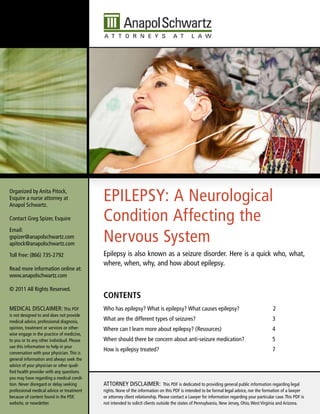
                                            EPilEPSy: A Neurological
Contact Greg Spizer, Esquire                Condition Affecting the
                                            Nervous System
Email:
gspizer@anapolschwartz.com
apitock@anapolschwartz.com

Toll Free: (866) 735-2792                   Epilepsy is also known as a seizure disorder. Here is a quick who, what,
                                            where, when, why, and how about epilepsy.
Read more information online at:
www.anapolschwartz.com

© 2011 All Rights Reserved.
                                            Contents
MEdiCAl diSClAiMER: This PdF                Who has epilepsy? What is epilepsy? What causes epilepsy?                                         2
is not designed to and does not provide
medical advice, professional diagnosis,     What are the different types of seizures?                                                        3
opinion, treatment or services or other-    Where can i learn more about epilepsy? (Resources)                                               4
wise engage in the practice of medicine,
to you or to any other individual. Please   When should there be concern about anti-seizure medication?                                      5
use this information to help in your
                                            How is epilepsy treated?                                                                         7
conversation with your physician. This is
general information and always seek the
advice of your physician or other quali-
fied health provider with any questions
you may have regarding a medical condi-
tion. Never disregard or delay seeking      ATTORNEy diSClAiMER:                This PdF is dedicated to providing general public information regarding legal
professional medical advice or treatment    rights. None of the information on this PdF is intended to be formal legal advice, nor the formation of a lawyer
because of content found in the PdF,        or attorney client relationship. Please contact a lawyer for information regarding your particular case. This PdF is
website, or newsletter.                     not intended to solicit clients outside the states of Pennsylvania, New Jersey, Ohio, West Virginia and Arizona.
Who has epilepsy?                                             What is epilepsy?
   •	 Epilepsy can develop at any age; epilepsy
                                                              What Causes epilepsy?
      and seizures affect almost 3 million                    What are the different types
      Americans.                                               of seizures?
   •	 About 30 percent of the 200,000 new
      cases every year begin in children                      Epilepsy is a neurological condition affecting the nervous system. Epi-
      particularly around adolescence.                        lepsy is also known as a seizure disorder. The first seizure is usually fol-
   •	 Ten percent of the American population                  lowed by a thorough medical evaluation so the doctor can determine
      will experience a seizure in their lifetime.            whether to recommend treatment with seizure-preventing drugs, or
                                                              to wait and see whether it occurs again.
   •	 incidence is highest under the age of 2
      and over 65.
                                                              Epilepsy is not diagnosed until at least two seizures that were not
   •	 Three percent will develop epilepsy by
                                                              caused by alcohol withdrawal or extremely low blood sugar.
      age 75.
   •	 Trend shows decreased incidence in                      Probability is a key factor in determining treatment.
      children; increased incidence in the
      elderly.
   •	 incidence is greater in African American
                                                              What Causes epilepsy?
      and socially disadvantaged populations.
                                                              in about seven out of 10, no cause can be found. Causes may
   •	 in 70 percent of new cases, no cause is                 include:
      apparent.
   •	 By 20 years of age, one percent of the                     •	 head injuries or lack of oxygen may affect the brain’s
      population will have developed epilepsy.                      electrical system
   •	 By 75 years of age, three percent of the                   •	 brain tumors
      population can be expected to have been                    •	 genetic conditions
      diagnosed with epilepsy, and ten percent                   •	 lead poisoning
      will have experienced some type of
                                                                 •	 problems in development of the brain before birth
      seizure.
                                                                 •	 infections like meningitis or encephalitis
        (Source: Epilepsy Foundation)


EPilEPSy: A NEuROlOGiCAl CONdiTiON AFFECTiNG THE
NERVOuS SySTEM
Copyright © 2004–2011 All rights reserved. Anapol Schwartz.
Read more information online at www.anapolschwartz.com.                                                                                 2
What are the different types of seizures?
There are 40 different types of seizures. Here are some of the more common:

ABSENCE SEizuRES—goes blank, repetitive blinking, un-               SiMPlE PARTiAl SEizuRES—experienced differently from
aware it happened, resembles daydreaming, lasts 10 to 20            person to person depending on where it begins in the brain;
seconds                                                             the person remains alert and can remember what happens.
                                                                    For motor seizures—jerking, stiffening of muscles, lack of
ATyPiCAl ABSENCE SEizuRES—staring spells, may be                    coordination; for sensory seizures—ringing, clicking, numb-
cognitively impaired, maybe be related to lennox-Gastaut            ness, and floating in space; autonomic seizures—changes in
Syndrome, lasts 30 to 50 seconds                                    heart rate, sweating; and psychic seizures—déjà vu, garbled
                                                                    speech, fear, and depression; lasts 1 to 2 minutes.
ATONiC SEizuRES—muscles suddenly lose strength or drop
seizures, eyelids droop, head nods, person drops things and         COMPlEx PARTiAl SEizuRES—starts with a simple partial
falls to the ground; remains conscious throughout, lasts up to      seizure or aura; which includes an odd feeling in the stom-
15 seconds                                                          ach; loses awareness and stares blankly; move mouth, pick
                                                                    at the air or clothing, or perform other purposeless actions;
TONiC SEizuRES—muscles suddenly stiffen, tonic seizures             has memory lapses before and after; lasts 30 seconds to 2
often occur during sleep and usually involve all or most of the     minutes
brain, affecting both sides of the body. if standing when the
tonic seizure begins, they will fall; remains conscious, lasts 10   SECONdARily GENERAlizEd SEizuRES—may start with a
seconds                                                             tingling or aura; these seizures become generalized spreading
                                                                    to both sides of the brain after the initial or primary event,
TONiC-ClONiC SEizuRES—frequently called grand mal sei-              a partial seizure, has already begun. The seizure starts with
zure, all the muscles stiffen, shriek, loses consciousness and      a burst of electrical activity in a limited area and spreads
falls to the floor; tongue or cheek bitten, may turn blue; arms     throughout the brain; sometimes hard to detect
and legs begin to jerk rapidly then slows and stops; bladder
or bowel control may be gone as body relaxes; consciousness         Seizures are frequently described by their cause, the ease or
slowly returns and the person may be confused, tired, de-           difficulty of treatment, plus other characteristics. your doctor
pressed, or agitated; lasts from 1 to 3 minutes. if lasts longer,   will be able to provide a better understanding of the type of
seek emergency medical help.                                        seizure affecting you or a loved one.

MyOClONiC SEizuRES—brief, shock-like muscle jerking or
twitching on both sides of the body at the same time, lasts 1
or 2 seconds; may be triggered by flashing lights


EPilEPSy: A NEuROlOGiCAl CONdiTiON AFFECTiNG THE
NERVOuS SySTEM
Copyright © 2004–2011 All rights reserved. Anapol Schwartz.
Read more information online at www.anapolschwartz.com.                                                                             3
Where Can i learn more about epilepsy? (resourCes)

Nationwide                                                       Pennsylvania
Epilepsy.com
                                                                 Epilepsy Foundation of Eastern PA
Keep a diary, participate in a forum, find out about clinical
trials, and learn how to maximize seizure preparedness
                                                                 Epilepsy Foundation of Western and Central PA
techniques.

Epilepsy Foundation
Find facts and an affiliate chapter near you.                    New Jersey

CuRE                                                             Epilepsy Foundation New Jersey
CuRE puts a face on epilepsy and shows 10 ways how you can
make a difference.

Purple day—March 26
Global awareness day for epilepsy celebrated around the world.
Share your story. Find an event. Get involved!


Epilepsy and Pregnant Women

Epilepsy Birth Control Registry
Women with epilepsy have unique concerns
when selecting a birth control method. your
participation is voluntary.


Epilepsy pregnancy registries
develop guidelines for the selection of safe and
effective birth control methods


EPilEPSy: A NEuROlOGiCAl CONdiTiON AFFECTiNG THE
NERVOuS SySTEM
Copyright © 2004–2011 All rights reserved. Anapol Schwartz.
Read more information online at www.anapolschwartz.com.                                                          4
When should there be ConCern about anti-seizure mediCation?
side effects and birth defects and topamax


Side effects                                                  Birth defects
like any medication, anti seizure medications                 Back in 2001, the New England Journal of Medicine found that preg-
have a litany of side effects based on each medi-             nant women taking anti seizure drugs could cause birth defects. The
cation. Some of the side effects associated with              study focused on 316 babies whose mothers had taken anti seizure
27 medications:                                               drugs while pregnant and 98 whose mothers had taken the same
                                                              drugs but stopped before pregnancy occurred. Babies born to 508
  dizziness, drowsiness, upset stomach, nausea,               women without epilepsy were used as a control group.
  fatigue, insomnia, behavior problems, inability
  to focus, itching, blurry vision, abnormal                  The deformities monitored were of the face and fingers as well as
  blood count, loss of appetite, twitching, hair              head circumference which is a good indication of brain development.
  loss, weight gain, irritability, numbness, poor
  coordination, skin rash, kidney stones, liver               21% of babies whose mothers took one anti-seizure drug during preg-
  toxicity, tremors, frequent urination, abnormal             nancy suffered birth defects. in the group of mothers who took at
  MRis, limb swelling, fever, headache,                       least two anti-seizure drugs during pregnancy, 28% of their babies
  confusion, and more.                                        suffered defects. 8.5% of babies born to women in the control group
                                                              had defects.

                                                              None of the 98 babies whose mothers had stopped the drugs before
                                                              pregnancy had any major birth defects.


                                                              Topamax
                                                              Topamax has been available in the u.S. since 1996. On
                                                              March 4, 2011, the Food & drug Administration announced
                                                              that pregnant women taking Topamax or its generic version
                                                              topiramate had double the risk of cleft palate and cleft lip birth
                                                              defects than while taking other anti seizure medications.

                                                              Topamax is also prescribed to prevent migraine headaches.

                                                              if your baby has suffered a cleft palate or cleft lip and you took To-
                                                              pamax during your first trimester, you may be able to participate in a
                                                              Topamax birth defect lawsuit.


EPilEPSy: A NEuROlOGiCAl CONdiTiON AFFECTiNG THE
NERVOuS SySTEM
Copyright © 2004–2011 All rights reserved. Anapol Schwartz.
Read more information online at www.anapolschwartz.com.                                                                            5
Why do seizures oCCur more frequently?
Sometimes seizures just happen but usually there are reasons for seizures. Some of those reasons are known as triggers. if you
can identify these triggers, you can hopefully avoid more seizures. Keeping a seizure diary is a good way to start.

TRiGGER: don’t skip or forget to take your seizure            TRiGGER: Too much stress can cause hyperventilation. Worry or fright
medication. don’t abruptly stop taking it either.             increases the risk of seizures as does stress induced hormonal changes.
Missing one dose is more likely to cause seizures if          Generalized stress may cause you to forget to take your medications.
you’re scheduled to only take your medicine once
a day. if you miss a dose, you’ve missed a full day           TRiGGER: Hormonal changes associated with a menstrual cycle in-
of medication. if you take it two to four times a             crease seizure frequency. High doses of estrogen can worsen seizures
day, the risk from missing one dose is less. But              while high doses of progesterone acts like an anti seizure drug.
if you miss several doses in a row you will most
likely trigger a seizure                                      TRiGGER: Very low levels of sugar in the blood can cause seizures
                                                              especially for people with diabetes who take too much insulin.
TRiGGER: lack of sleep. The sleep-wake cycle is
associated with prominent changes in brain elec-              TRiGGER: Binge drinking and alcohol withdrawal can cause seizures.
trical activity and hormonal activity, so seizures            Three or more drinks can increase the risk of seizures. your tolerance
and the sleep-wake cycle are often related.                   for alcohol will be lowered by seizure medication. Being drunk or in-
                                                              toxicated may cause you to forget to take your medication.

                                                              TRiGGER: Cocaine and seizures are a big no-no causing seizures with-
                                                              in seconds, minutes, or hours after use.

                                                              TRiGGER: When abused, amphetamines and other stimulants may
                                                              cause lack of sleep, confusion, and psychiatric disorders all leading
                                                              to seizures.

                                                              TRiGGER: Marijuana is a double edged sword. Some studies say it has
                                                              anti-seizure properties while other studies say it has seizure inducing
                                                              effects. Also while under the influence of marijuana, you may forget
                                                              to take your medication.

                                                              TRiGGER: Oddly enough, heroin related narcotics do not directly af-
                                                              fect seizures. However, while under the influence you will forget to
                                                              take your medication.

                                                              TRiGGER: Regular usage of nicotine and caffeine do not affect sei-
                                                              zures. However, for people who smoke cigarettes, dropping a ciga-
                                                              rette during a seizure can start a fire.
EPilEPSy: A NEuROlOGiCAl CONdiTiON AFFECTiNG THE
NERVOuS SySTEM
Copyright © 2004–2011 All rights reserved. Anapol Schwartz.
Read more information online at www.anapolschwartz.com.                                                                            6
hoW is epilepsy treated? drugs, diet, surgery, Vns

drugs                                                         diet
different drugs control different kinds of seizures.          A special high fat, low carbohydrate has had some success controlling
Most epilepsy medicines are taken by mouth as                 seizures in children with epilepsy. The ketogenic diet must be doctor
tablets, capsules, sprinkles, or syrup.                       approved and monitored by a dietician for strict measurements of pro-
                                                              tein, fluid, and calories. it is similar to the Atkins diet.
The following are commonly prescribed to prevent
seizures:                                                     This diet is prescribed if seizure medication is working. While on the
   Carbamazepine (brand names, Tegretol, Te-                  diet, the child can take less medication. And like medication, a child
   gretolxR, Carbatrol); clonazepam (Klonopin);               would never just stop the diet cold turkey. He or she must gradually
   ethosuximide (zarontin); phenobarbital; phe-               get off the diet.
   nytoin (dilantin); primidone (Mysoline); valp-
   roic acid (depakene); divalproex sodium (de-               Ask your healthcare provider if the ketogenic diet is right for your
   pakote); and more.                                         situation.


Newer drugs which are also prescribed for epi-                SuRGERy
lepsy include felbamate (Felbatol); gabapentin
                                                              if medication doesn’t help control seizures, then surgery could be an
(Neurontin); lamotrigine (lamictal); levetiracetam
                                                              option. The benefits must be weighed against the risks and as with
(Keppra), oxcarbazepine (Trileptal); tiagabine
                                                              any surgery, there is no guarantee that surgery will be successful in
(Gabitril); topiramate (Topamax) and zonisamide
                                                              controlling seizures.
(zonagran). More new drugs are in development.
                                                              VNS—VNS stands for vagus nerve stimulation. it’s a medical device
A steroid drug, ACTH, may be given by injection
                                                              which is implanted under the skin on the chest wall which sends elec-
to treat children with a type of epilepsy called in-
                                                              trical energy to the brain by way of the vagus nerve.
fantile spasms, or for severe seizures that can’t be
controlled with other drugs. it is usually given by
a doctor who has had special training in using this
medicine for epilepsy.

A rectal gel form of diazepam (diastat) maybe
prescribed for parent or caregiver to use in stop-
ping cluster seizures or prolonged seizures. Some
doctors may prescribe pills of diazepam (Valium),
lorazepam (Ativan), or clonazepam (Klonopin) for
the same purpose.


EPilEPSy: A NEuROlOGiCAl CONdiTiON AFFECTiNG THE
NERVOuS SySTEM
Copyright © 2004–2011 All rights reserved. Anapol Schwartz.
Read more information online at www.anapolschwartz.com.                                                                           7

Epilepsy

  • 1.
    Organized by AnitaPitock, Esquire a nurse attorney at Anapol Schwartz. EPilEPSy: A Neurological Contact Greg Spizer, Esquire Condition Affecting the Nervous System Email: gspizer@anapolschwartz.com apitock@anapolschwartz.com Toll Free: (866) 735-2792 Epilepsy is also known as a seizure disorder. Here is a quick who, what, where, when, why, and how about epilepsy. Read more information online at: www.anapolschwartz.com © 2011 All Rights Reserved. Contents MEdiCAl diSClAiMER: This PdF Who has epilepsy? What is epilepsy? What causes epilepsy? 2 is not designed to and does not provide medical advice, professional diagnosis, What are the different types of seizures? 3 opinion, treatment or services or other- Where can i learn more about epilepsy? (Resources) 4 wise engage in the practice of medicine, to you or to any other individual. Please When should there be concern about anti-seizure medication? 5 use this information to help in your How is epilepsy treated? 7 conversation with your physician. This is general information and always seek the advice of your physician or other quali- fied health provider with any questions you may have regarding a medical condi- tion. Never disregard or delay seeking ATTORNEy diSClAiMER: This PdF is dedicated to providing general public information regarding legal professional medical advice or treatment rights. None of the information on this PdF is intended to be formal legal advice, nor the formation of a lawyer because of content found in the PdF, or attorney client relationship. Please contact a lawyer for information regarding your particular case. This PdF is website, or newsletter. not intended to solicit clients outside the states of Pennsylvania, New Jersey, Ohio, West Virginia and Arizona.
  • 2.
    Who has epilepsy? What is epilepsy? • Epilepsy can develop at any age; epilepsy What Causes epilepsy? and seizures affect almost 3 million What are the different types Americans. of seizures? • About 30 percent of the 200,000 new cases every year begin in children Epilepsy is a neurological condition affecting the nervous system. Epi- particularly around adolescence. lepsy is also known as a seizure disorder. The first seizure is usually fol- • Ten percent of the American population lowed by a thorough medical evaluation so the doctor can determine will experience a seizure in their lifetime. whether to recommend treatment with seizure-preventing drugs, or to wait and see whether it occurs again. • incidence is highest under the age of 2 and over 65. Epilepsy is not diagnosed until at least two seizures that were not • Three percent will develop epilepsy by caused by alcohol withdrawal or extremely low blood sugar. age 75. • Trend shows decreased incidence in Probability is a key factor in determining treatment. children; increased incidence in the elderly. • incidence is greater in African American What Causes epilepsy? and socially disadvantaged populations. in about seven out of 10, no cause can be found. Causes may • in 70 percent of new cases, no cause is include: apparent. • By 20 years of age, one percent of the • head injuries or lack of oxygen may affect the brain’s population will have developed epilepsy. electrical system • By 75 years of age, three percent of the • brain tumors population can be expected to have been • genetic conditions diagnosed with epilepsy, and ten percent • lead poisoning will have experienced some type of • problems in development of the brain before birth seizure. • infections like meningitis or encephalitis (Source: Epilepsy Foundation) EPilEPSy: A NEuROlOGiCAl CONdiTiON AFFECTiNG THE NERVOuS SySTEM Copyright © 2004–2011 All rights reserved. Anapol Schwartz. Read more information online at www.anapolschwartz.com. 2
  • 3.
    What are thedifferent types of seizures? There are 40 different types of seizures. Here are some of the more common: ABSENCE SEizuRES—goes blank, repetitive blinking, un- SiMPlE PARTiAl SEizuRES—experienced differently from aware it happened, resembles daydreaming, lasts 10 to 20 person to person depending on where it begins in the brain; seconds the person remains alert and can remember what happens. For motor seizures—jerking, stiffening of muscles, lack of ATyPiCAl ABSENCE SEizuRES—staring spells, may be coordination; for sensory seizures—ringing, clicking, numb- cognitively impaired, maybe be related to lennox-Gastaut ness, and floating in space; autonomic seizures—changes in Syndrome, lasts 30 to 50 seconds heart rate, sweating; and psychic seizures—déjà vu, garbled speech, fear, and depression; lasts 1 to 2 minutes. ATONiC SEizuRES—muscles suddenly lose strength or drop seizures, eyelids droop, head nods, person drops things and COMPlEx PARTiAl SEizuRES—starts with a simple partial falls to the ground; remains conscious throughout, lasts up to seizure or aura; which includes an odd feeling in the stom- 15 seconds ach; loses awareness and stares blankly; move mouth, pick at the air or clothing, or perform other purposeless actions; TONiC SEizuRES—muscles suddenly stiffen, tonic seizures has memory lapses before and after; lasts 30 seconds to 2 often occur during sleep and usually involve all or most of the minutes brain, affecting both sides of the body. if standing when the tonic seizure begins, they will fall; remains conscious, lasts 10 SECONdARily GENERAlizEd SEizuRES—may start with a seconds tingling or aura; these seizures become generalized spreading to both sides of the brain after the initial or primary event, TONiC-ClONiC SEizuRES—frequently called grand mal sei- a partial seizure, has already begun. The seizure starts with zure, all the muscles stiffen, shriek, loses consciousness and a burst of electrical activity in a limited area and spreads falls to the floor; tongue or cheek bitten, may turn blue; arms throughout the brain; sometimes hard to detect and legs begin to jerk rapidly then slows and stops; bladder or bowel control may be gone as body relaxes; consciousness Seizures are frequently described by their cause, the ease or slowly returns and the person may be confused, tired, de- difficulty of treatment, plus other characteristics. your doctor pressed, or agitated; lasts from 1 to 3 minutes. if lasts longer, will be able to provide a better understanding of the type of seek emergency medical help. seizure affecting you or a loved one. MyOClONiC SEizuRES—brief, shock-like muscle jerking or twitching on both sides of the body at the same time, lasts 1 or 2 seconds; may be triggered by flashing lights EPilEPSy: A NEuROlOGiCAl CONdiTiON AFFECTiNG THE NERVOuS SySTEM Copyright © 2004–2011 All rights reserved. Anapol Schwartz. Read more information online at www.anapolschwartz.com. 3
  • 4.
    Where Can ilearn more about epilepsy? (resourCes) Nationwide Pennsylvania Epilepsy.com Epilepsy Foundation of Eastern PA Keep a diary, participate in a forum, find out about clinical trials, and learn how to maximize seizure preparedness Epilepsy Foundation of Western and Central PA techniques. Epilepsy Foundation Find facts and an affiliate chapter near you. New Jersey CuRE Epilepsy Foundation New Jersey CuRE puts a face on epilepsy and shows 10 ways how you can make a difference. Purple day—March 26 Global awareness day for epilepsy celebrated around the world. Share your story. Find an event. Get involved! Epilepsy and Pregnant Women Epilepsy Birth Control Registry Women with epilepsy have unique concerns when selecting a birth control method. your participation is voluntary. Epilepsy pregnancy registries develop guidelines for the selection of safe and effective birth control methods EPilEPSy: A NEuROlOGiCAl CONdiTiON AFFECTiNG THE NERVOuS SySTEM Copyright © 2004–2011 All rights reserved. Anapol Schwartz. Read more information online at www.anapolschwartz.com. 4
  • 5.
    When should therebe ConCern about anti-seizure mediCation? side effects and birth defects and topamax Side effects Birth defects like any medication, anti seizure medications Back in 2001, the New England Journal of Medicine found that preg- have a litany of side effects based on each medi- nant women taking anti seizure drugs could cause birth defects. The cation. Some of the side effects associated with study focused on 316 babies whose mothers had taken anti seizure 27 medications: drugs while pregnant and 98 whose mothers had taken the same drugs but stopped before pregnancy occurred. Babies born to 508 dizziness, drowsiness, upset stomach, nausea, women without epilepsy were used as a control group. fatigue, insomnia, behavior problems, inability to focus, itching, blurry vision, abnormal The deformities monitored were of the face and fingers as well as blood count, loss of appetite, twitching, hair head circumference which is a good indication of brain development. loss, weight gain, irritability, numbness, poor coordination, skin rash, kidney stones, liver 21% of babies whose mothers took one anti-seizure drug during preg- toxicity, tremors, frequent urination, abnormal nancy suffered birth defects. in the group of mothers who took at MRis, limb swelling, fever, headache, least two anti-seizure drugs during pregnancy, 28% of their babies confusion, and more. suffered defects. 8.5% of babies born to women in the control group had defects. None of the 98 babies whose mothers had stopped the drugs before pregnancy had any major birth defects. Topamax Topamax has been available in the u.S. since 1996. On March 4, 2011, the Food & drug Administration announced that pregnant women taking Topamax or its generic version topiramate had double the risk of cleft palate and cleft lip birth defects than while taking other anti seizure medications. Topamax is also prescribed to prevent migraine headaches. if your baby has suffered a cleft palate or cleft lip and you took To- pamax during your first trimester, you may be able to participate in a Topamax birth defect lawsuit. EPilEPSy: A NEuROlOGiCAl CONdiTiON AFFECTiNG THE NERVOuS SySTEM Copyright © 2004–2011 All rights reserved. Anapol Schwartz. Read more information online at www.anapolschwartz.com. 5
  • 6.
    Why do seizuresoCCur more frequently? Sometimes seizures just happen but usually there are reasons for seizures. Some of those reasons are known as triggers. if you can identify these triggers, you can hopefully avoid more seizures. Keeping a seizure diary is a good way to start. TRiGGER: don’t skip or forget to take your seizure TRiGGER: Too much stress can cause hyperventilation. Worry or fright medication. don’t abruptly stop taking it either. increases the risk of seizures as does stress induced hormonal changes. Missing one dose is more likely to cause seizures if Generalized stress may cause you to forget to take your medications. you’re scheduled to only take your medicine once a day. if you miss a dose, you’ve missed a full day TRiGGER: Hormonal changes associated with a menstrual cycle in- of medication. if you take it two to four times a crease seizure frequency. High doses of estrogen can worsen seizures day, the risk from missing one dose is less. But while high doses of progesterone acts like an anti seizure drug. if you miss several doses in a row you will most likely trigger a seizure TRiGGER: Very low levels of sugar in the blood can cause seizures especially for people with diabetes who take too much insulin. TRiGGER: lack of sleep. The sleep-wake cycle is associated with prominent changes in brain elec- TRiGGER: Binge drinking and alcohol withdrawal can cause seizures. trical activity and hormonal activity, so seizures Three or more drinks can increase the risk of seizures. your tolerance and the sleep-wake cycle are often related. for alcohol will be lowered by seizure medication. Being drunk or in- toxicated may cause you to forget to take your medication. TRiGGER: Cocaine and seizures are a big no-no causing seizures with- in seconds, minutes, or hours after use. TRiGGER: When abused, amphetamines and other stimulants may cause lack of sleep, confusion, and psychiatric disorders all leading to seizures. TRiGGER: Marijuana is a double edged sword. Some studies say it has anti-seizure properties while other studies say it has seizure inducing effects. Also while under the influence of marijuana, you may forget to take your medication. TRiGGER: Oddly enough, heroin related narcotics do not directly af- fect seizures. However, while under the influence you will forget to take your medication. TRiGGER: Regular usage of nicotine and caffeine do not affect sei- zures. However, for people who smoke cigarettes, dropping a ciga- rette during a seizure can start a fire. EPilEPSy: A NEuROlOGiCAl CONdiTiON AFFECTiNG THE NERVOuS SySTEM Copyright © 2004–2011 All rights reserved. Anapol Schwartz. Read more information online at www.anapolschwartz.com. 6
  • 7.
    hoW is epilepsytreated? drugs, diet, surgery, Vns drugs diet different drugs control different kinds of seizures. A special high fat, low carbohydrate has had some success controlling Most epilepsy medicines are taken by mouth as seizures in children with epilepsy. The ketogenic diet must be doctor tablets, capsules, sprinkles, or syrup. approved and monitored by a dietician for strict measurements of pro- tein, fluid, and calories. it is similar to the Atkins diet. The following are commonly prescribed to prevent seizures: This diet is prescribed if seizure medication is working. While on the Carbamazepine (brand names, Tegretol, Te- diet, the child can take less medication. And like medication, a child gretolxR, Carbatrol); clonazepam (Klonopin); would never just stop the diet cold turkey. He or she must gradually ethosuximide (zarontin); phenobarbital; phe- get off the diet. nytoin (dilantin); primidone (Mysoline); valp- roic acid (depakene); divalproex sodium (de- Ask your healthcare provider if the ketogenic diet is right for your pakote); and more. situation. Newer drugs which are also prescribed for epi- SuRGERy lepsy include felbamate (Felbatol); gabapentin if medication doesn’t help control seizures, then surgery could be an (Neurontin); lamotrigine (lamictal); levetiracetam option. The benefits must be weighed against the risks and as with (Keppra), oxcarbazepine (Trileptal); tiagabine any surgery, there is no guarantee that surgery will be successful in (Gabitril); topiramate (Topamax) and zonisamide controlling seizures. (zonagran). More new drugs are in development. VNS—VNS stands for vagus nerve stimulation. it’s a medical device A steroid drug, ACTH, may be given by injection which is implanted under the skin on the chest wall which sends elec- to treat children with a type of epilepsy called in- trical energy to the brain by way of the vagus nerve. fantile spasms, or for severe seizures that can’t be controlled with other drugs. it is usually given by a doctor who has had special training in using this medicine for epilepsy. A rectal gel form of diazepam (diastat) maybe prescribed for parent or caregiver to use in stop- ping cluster seizures or prolonged seizures. Some doctors may prescribe pills of diazepam (Valium), lorazepam (Ativan), or clonazepam (Klonopin) for the same purpose. EPilEPSy: A NEuROlOGiCAl CONdiTiON AFFECTiNG THE NERVOuS SySTEM Copyright © 2004–2011 All rights reserved. Anapol Schwartz. Read more information online at www.anapolschwartz.com. 7