ER&L 2012
Introducing the Global Open
Knowledgebase (GOKb)
Maria Collins and Kristen Wilson
NCSU Libraries
The Global Open Knowledgebase
(GOKb)
 Mellon Grant, April 2012-March 2013
 Knowledgebase for Kuali OLE
 Build a Global Open Knowledgebase (GOKb)
that will be community maintained
 Focus on data management and integration
services
 Open knowledgebase using a standards-
based architecture, CC0 license
 Enhanced global data elements
 APIs to interact with data—emphasis on
ingest and maintenance
Key Deliverables
Intersection with Kuali OLE
 Kuali OLE building a community source
library management system
 Mellon commissioned a feasibility
study, 2008-9
 Funded build project, 2010-12 : $2.5 million
from Mellon, $2.5 million from partners
 Version 1.0 – basic functionality by the
beginning of 2013.
Kuali OLE Community
Intersection and Partnership with JISC
 Collaborate on data model
 Provide seed data of managed titles
 Additional incentive for publishers –
international scope of the project
 Assistance with supply chain and identifier
issues
 Share the load: initial community for this
project
The Problem Space: ERMS
Experiment (ILS integration and IDs)
 Stop gap measures: add-on ERMS
 ERM functionality is fundamental to ILS
services
 Movement in the marketplace to build
inclusive tools that include a suite of ERM
tools
 Positive and necessary experience
The Problem Space: Lessons Learned
 Identifiers are crucial
 Workflow management is a must
 Have to build systems that accept information
from multiple sources and can support
multiple data stores
 Need to manage all electronic
 Systems should integrate and be Kb-centric
The Problem Space: Kb-centric
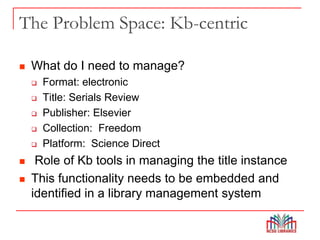
 What do I need to manage?
 Format: electronic
 Title: Serials Review
 Publisher: Elsevier
 Collection: Freedom
 Platform: Science Direct
 Role of Kb tools in managing the title instance
 This functionality needs to be embedded and
identified in a library management system
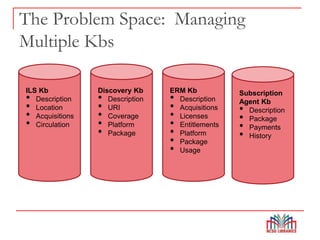
The Problem Space: Managing
Multiple Kbs
ILS Kb
• Description
• Location
• Acquisitions
• Circulation
Discovery Kb
• Description
• URI
• Coverage
• Platform
• Package
ERM Kb
• Description
• Acquisitions
• Licenses
• Entitlements
• Platform
• Package
• Usage
Subscription
Agent Kb
• Description
• Package
• Payments
• History
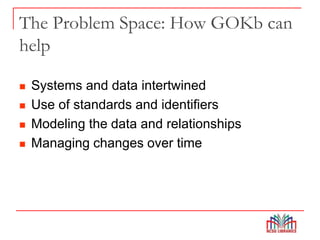
The Problem Space: How GOKb can
help
 Systems and data intertwined
 Use of standards and identifiers
 Modeling the data and relationships
 Managing changes over time
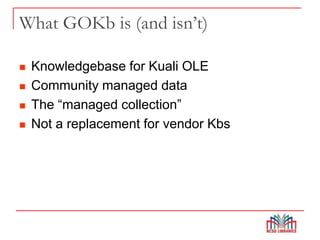
What GOKb is (and isn’t)
 Knowledgebase for Kuali OLE
 Community managed data
 The ―managed collection‖
 Not a replacement for vendor Kbs
What GOKb is (and isn’t)
 Open dataset available to all
 Raw data
 No interface
 Accessible using APIs
 Way for libraries and vendors to share
identifiers
GOKb project stages: data modeling
 The GOKb team and JISC have been
working on a data model that:
 Matches reality
 Is extensible
 Is global
 Allows e-resources management to be done at
the right level
GOKb project stages: data modeling
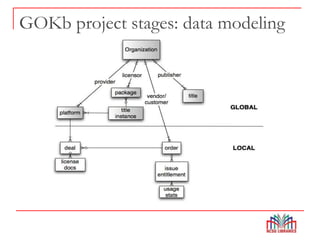
 Global data elements
 Title instance (Title + publisher + format)
 Standard ID
 Package (a.k.a Collection)
 Platform
 TIPP (Title instance + package +
platform)
 This is what we buy
GOKb project stages: data modeling
 Local data elements
 Subscription (Deal)
 Purchase order
 Issue entitlement
 License
 Usage statistics
 Not part of GOKb data
 Will be managed in Kuali OLE
GOKb project stages: data modeling
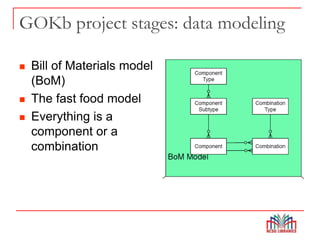
 Bill of Materials model
(BoM)
 The fast food model
 Everything is a
component or a
combination
GOKb project stages: data modeling
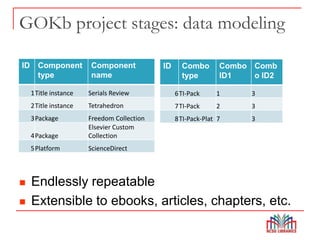
 Endlessly repeatable
 Extensible to ebooks, articles, chapters, etc.
ID Component
type
Component
name
1Title instance Serials Review
2Title instance Tetrahedron
3Package Freedom Collection
4Package
Elsevier Custom
Collection
5Platform ScienceDirect
ID Combo
type
Combo
ID1
Comb
o ID2
6TI-Pack 1 3
7TI-Pack 2 3
8TI-Pack-Plat 7 3
GOKb project stages: data sourcing
 Where will the data come from?
 Publishers
 Freely available from publisher or on web
 KBART
 Might include proprietary IDs
 CUFTS partnership
 Manual creation
GOKb project stages: data sourcing
 Management by Kuali OLE partners
 Contributions from JISC
 Possible future for greater community
involvement
GOKb project stages: governance and
sustainability
 Year 1: Mellon grant
 Year 2+: Absorbed into Kuali OLE
 Beyond: Part of the project is to figure this out
Benefits and possibilities
 Tightly integrated knowledgebase for Kuali
OLE
 Separation of data and software
 Opportunities for other open source projects
 International common ground
 Incentives for better sharing of identifiers
How you can help
 Give feedback on data requirements
 Contribute data and identifiers
 Use the data
 Ingest identifiers to create match points
Questions?
Maria Collins
maria_collins@ncsu.edu
Kristen Wilson
kristen_wilson@ncsu.edu

Introducing the Global Open Knowledgebase (ER&L 2012)

  • 1.
    ER&L 2012 Introducing theGlobal Open Knowledgebase (GOKb) Maria Collins and Kristen Wilson NCSU Libraries
  • 2.
    The Global OpenKnowledgebase (GOKb)  Mellon Grant, April 2012-March 2013  Knowledgebase for Kuali OLE  Build a Global Open Knowledgebase (GOKb) that will be community maintained  Focus on data management and integration services
  • 3.
     Open knowledgebaseusing a standards- based architecture, CC0 license  Enhanced global data elements  APIs to interact with data—emphasis on ingest and maintenance Key Deliverables
  • 4.
    Intersection with KualiOLE  Kuali OLE building a community source library management system  Mellon commissioned a feasibility study, 2008-9  Funded build project, 2010-12 : $2.5 million from Mellon, $2.5 million from partners  Version 1.0 – basic functionality by the beginning of 2013.
  • 5.
  • 6.
    Intersection and Partnershipwith JISC  Collaborate on data model  Provide seed data of managed titles  Additional incentive for publishers – international scope of the project  Assistance with supply chain and identifier issues  Share the load: initial community for this project
  • 7.
    The Problem Space:ERMS Experiment (ILS integration and IDs)  Stop gap measures: add-on ERMS  ERM functionality is fundamental to ILS services  Movement in the marketplace to build inclusive tools that include a suite of ERM tools  Positive and necessary experience
  • 8.
    The Problem Space:Lessons Learned  Identifiers are crucial  Workflow management is a must  Have to build systems that accept information from multiple sources and can support multiple data stores  Need to manage all electronic  Systems should integrate and be Kb-centric
  • 9.
    The Problem Space:Kb-centric  What do I need to manage?  Format: electronic  Title: Serials Review  Publisher: Elsevier  Collection: Freedom  Platform: Science Direct  Role of Kb tools in managing the title instance  This functionality needs to be embedded and identified in a library management system
  • 10.
    The Problem Space:Managing Multiple Kbs ILS Kb • Description • Location • Acquisitions • Circulation Discovery Kb • Description • URI • Coverage • Platform • Package ERM Kb • Description • Acquisitions • Licenses • Entitlements • Platform • Package • Usage Subscription Agent Kb • Description • Package • Payments • History
  • 11.
    The Problem Space:How GOKb can help  Systems and data intertwined  Use of standards and identifiers  Modeling the data and relationships  Managing changes over time
  • 12.
    What GOKb is(and isn’t)  Knowledgebase for Kuali OLE  Community managed data  The ―managed collection‖  Not a replacement for vendor Kbs
  • 13.
    What GOKb is(and isn’t)  Open dataset available to all  Raw data  No interface  Accessible using APIs  Way for libraries and vendors to share identifiers
  • 14.
    GOKb project stages:data modeling  The GOKb team and JISC have been working on a data model that:  Matches reality  Is extensible  Is global  Allows e-resources management to be done at the right level
  • 15.
    GOKb project stages:data modeling  Global data elements  Title instance (Title + publisher + format)  Standard ID  Package (a.k.a Collection)  Platform  TIPP (Title instance + package + platform)  This is what we buy
  • 16.
    GOKb project stages:data modeling  Local data elements  Subscription (Deal)  Purchase order  Issue entitlement  License  Usage statistics  Not part of GOKb data  Will be managed in Kuali OLE
  • 17.
    GOKb project stages:data modeling
  • 18.
    GOKb project stages:data modeling  Bill of Materials model (BoM)  The fast food model  Everything is a component or a combination
  • 19.
    GOKb project stages:data modeling  Endlessly repeatable  Extensible to ebooks, articles, chapters, etc. ID Component type Component name 1Title instance Serials Review 2Title instance Tetrahedron 3Package Freedom Collection 4Package Elsevier Custom Collection 5Platform ScienceDirect ID Combo type Combo ID1 Comb o ID2 6TI-Pack 1 3 7TI-Pack 2 3 8TI-Pack-Plat 7 3
  • 20.
    GOKb project stages:data sourcing  Where will the data come from?  Publishers  Freely available from publisher or on web  KBART  Might include proprietary IDs  CUFTS partnership  Manual creation
  • 21.
    GOKb project stages:data sourcing  Management by Kuali OLE partners  Contributions from JISC  Possible future for greater community involvement
  • 22.
    GOKb project stages:governance and sustainability  Year 1: Mellon grant  Year 2+: Absorbed into Kuali OLE  Beyond: Part of the project is to figure this out
  • 23.
    Benefits and possibilities Tightly integrated knowledgebase for Kuali OLE  Separation of data and software  Opportunities for other open source projects  International common ground  Incentives for better sharing of identifiers
  • 24.
    How you canhelp  Give feedback on data requirements  Contribute data and identifiers  Use the data  Ingest identifiers to create match points
  • 25.