What is a floating
software license?
Having an active software license can be thought of as
having a seat at the table. When you assign a ‘named user
license’ to someone, a seat at the table is reserved in that
user's name, and that seat is always available until the
software license expires.
In the case of floating software licenses, multiple users
(usually 5-25 users) share a defined number of seats at the
table and whoever gets to the table first gets a seat, if there
is one available.
When an authorised user wishes to run an application they
request a license from a central pool of available licenses. If
no licenses are available, the software can’t be accessed.
When a user exits the software or when the allowed license
period expires, licenses are returned to the license pool
and made available to other authorised users.
Floating software licensing offers considerable value to software
buyers by ensuring a closer match between the purchase of a
license and its actual usage. Usually, the maximum number of
concurrent users is only a portion of the total users employed at a
company.
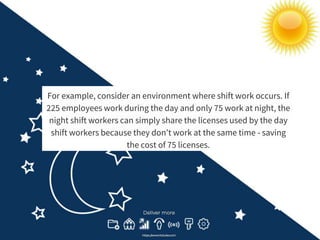
For example, consider an environment where shift work occurs. If
225 employees work during the day and only 75 work at night, the
night shift workers can simply share the licenses used by the day
shift workers because they don’t work at the same time - saving
the cost of 75 licenses.
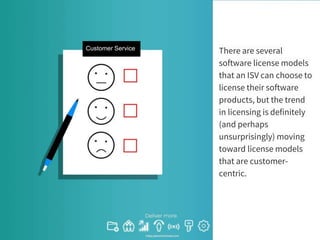
There are several
software license models
that an ISV can choose to
license their software
products, but the trend
in licensing is definitely
(and perhaps
unsurprisingly) moving
toward license models
that are customer-
centric.
Customer Service
With the growth of SaaS and the change in customer
expectations towards paying for what they use, many
software vendors are moving to subscription, floating, or use
time license models to meet customer demands.
These popular license models more accurately reflect a
customer's usage of a particular software product.
Unsurprisingly, giving your customers what they want will
increase your bottom line.
IDC Futurescape predicts that by 2019, more than 50% of all
industries will price and package their offerings as services
with a flexible subscription or consumption-based pricing
models, like floating licensing.
An on-premise license server like Flexnet or FlexLM used to be
the only way to enforce floating license models.
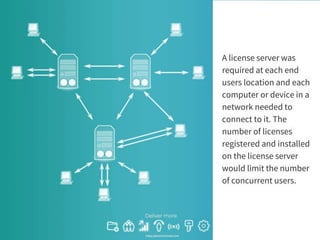
A license server was
required at each end
users location and each
computer or device in a
network needed to
connect to it. The
number of licenses
registered and installed
on the license server
would limit the number
of concurrent users.
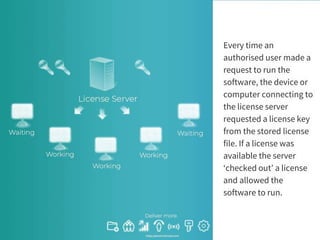
Every time an
authorised user made a
request to run the
software, the device or
computer connecting to
the license server
requested a license key
from the stored license
file. If a license was
available the server
‘checked out’ a license
and allowed the
software to run.
This approach to implementing floating licensing does work
but it’s a very traditional approach, best suited to the
software industry of the 1990s.
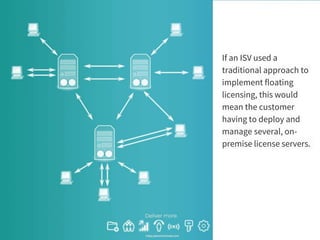
If an ISV used a
traditional approach to
implement floating
licensing, this would
mean the customer
having to deploy and
manage several, on-
premise license servers.
...And issue and manage all of the license keys for each of
the end users authorized to draw on the floating license
pool, mapping these to the license servers, etc.
All in all, quite a burden involving lots of manual tasks both
for the ISV and also for their customer.
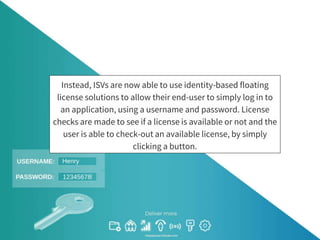
Instead, ISVs are now able to use identity-based floating
license solutions to allow their end-user to simply log in to
an application, using a username and password. License
checks are made to see if a license is available or not and the
user is able to check-out an available license, by simply
clicking a button.
All enabled from the cloud - both the ISV and the
customer avoid all the hassles that go along with
deploying a traditional floating license system.
It is dynamic and operated in real-time.
Company-wide roll-out across one office or across ten
offices takes an equivalent amount of time as all
configuration and set up is done in the cloud.
When changes are made to license terms, these
changes propagate through the system immediately,
meaning that there are no license keys to return,
revoke or reconcile.
From the end-user perspective, a modern identity-
based licensing solution allows them to see in real
time what licenses they have access to, what licenses
they have consumed and even what license gap or
wait may exist before a floating license becomes
available.
10Duke Entitlements is a
cloud-based software
licensing solution that
supports the modern
implementation of
floating licenses.
No license keys
no license files
No license servers for a customer
to install.
Underpinned by the concept of identity-based
licensing, 10Duke Entitlements empowers ISVs to easily
deploy the most appropriate license models for their
products and ensure that their customers get software
products in a manner that closely aligns to their actual
usage of them.
Discover more…
10duke.com

What is a floating software license

  • 1.
    What is afloating software license?
  • 2.
    Having an activesoftware license can be thought of as having a seat at the table. When you assign a ‘named user license’ to someone, a seat at the table is reserved in that user's name, and that seat is always available until the software license expires.
  • 3.
    In the caseof floating software licenses, multiple users (usually 5-25 users) share a defined number of seats at the table and whoever gets to the table first gets a seat, if there is one available.
  • 4.
    When an authoriseduser wishes to run an application they request a license from a central pool of available licenses. If no licenses are available, the software can’t be accessed.
  • 5.
    When a userexits the software or when the allowed license period expires, licenses are returned to the license pool and made available to other authorised users.
  • 6.
    Floating software licensingoffers considerable value to software buyers by ensuring a closer match between the purchase of a license and its actual usage. Usually, the maximum number of concurrent users is only a portion of the total users employed at a company.
  • 7.
    For example, consideran environment where shift work occurs. If 225 employees work during the day and only 75 work at night, the night shift workers can simply share the licenses used by the day shift workers because they don’t work at the same time - saving the cost of 75 licenses.
  • 8.
    There are several softwarelicense models that an ISV can choose to license their software products, but the trend in licensing is definitely (and perhaps unsurprisingly) moving toward license models that are customer- centric. Customer Service
  • 9.
    With the growthof SaaS and the change in customer expectations towards paying for what they use, many software vendors are moving to subscription, floating, or use time license models to meet customer demands.
  • 10.
    These popular licensemodels more accurately reflect a customer's usage of a particular software product. Unsurprisingly, giving your customers what they want will increase your bottom line.
  • 11.
    IDC Futurescape predictsthat by 2019, more than 50% of all industries will price and package their offerings as services with a flexible subscription or consumption-based pricing models, like floating licensing.
  • 12.
    An on-premise licenseserver like Flexnet or FlexLM used to be the only way to enforce floating license models.
  • 13.
    A license serverwas required at each end users location and each computer or device in a network needed to connect to it. The number of licenses registered and installed on the license server would limit the number of concurrent users.
  • 14.
    Every time an authoriseduser made a request to run the software, the device or computer connecting to the license server requested a license key from the stored license file. If a license was available the server ‘checked out’ a license and allowed the software to run.
  • 15.
    This approach toimplementing floating licensing does work but it’s a very traditional approach, best suited to the software industry of the 1990s.
  • 16.
    If an ISVused a traditional approach to implement floating licensing, this would mean the customer having to deploy and manage several, on- premise license servers.
  • 17.
    ...And issue andmanage all of the license keys for each of the end users authorized to draw on the floating license pool, mapping these to the license servers, etc. All in all, quite a burden involving lots of manual tasks both for the ISV and also for their customer.
  • 18.
    Instead, ISVs arenow able to use identity-based floating license solutions to allow their end-user to simply log in to an application, using a username and password. License checks are made to see if a license is available or not and the user is able to check-out an available license, by simply clicking a button.
  • 19.
    All enabled fromthe cloud - both the ISV and the customer avoid all the hassles that go along with deploying a traditional floating license system.
  • 20.
    It is dynamicand operated in real-time. Company-wide roll-out across one office or across ten offices takes an equivalent amount of time as all configuration and set up is done in the cloud.
  • 21.
    When changes aremade to license terms, these changes propagate through the system immediately, meaning that there are no license keys to return, revoke or reconcile.
  • 22.
    From the end-userperspective, a modern identity- based licensing solution allows them to see in real time what licenses they have access to, what licenses they have consumed and even what license gap or wait may exist before a floating license becomes available.
  • 23.
    10Duke Entitlements isa cloud-based software licensing solution that supports the modern implementation of floating licenses.
  • 24.
    No license keys nolicense files No license servers for a customer to install.
  • 25.
    Underpinned by theconcept of identity-based licensing, 10Duke Entitlements empowers ISVs to easily deploy the most appropriate license models for their products and ensure that their customers get software products in a manner that closely aligns to their actual usage of them.
  • 26.