This work is supported by the National Science Foundation’s
Transforming Undergraduate Education in STEM program within the
Directorate for Education and Human Resources (DUE-1245025). Questions, contact education-AT-unavco.org
ASSESSMENTS & RUBRICS
MODIFIED FROM PRESENTATIONS BY
ELLEN IVERSON (SERC) AND DAVID STEER (U OF AKRON)
The webinar begins at:
1 pm PT | 2 pm MT | 3 pm CT | 4 pm ET
3 pm PT | 4 pm MT | 5 pm CT | 6 pm ET
For audio, call: 1-877-668-4490
(or 1-408-792-6300)
805 841 242 #
Press *6 to mute and unmute
(but hopefully we won’t need any muting)
Headphones give less feedback than speakerphone.
FOLLOW UP WORK BEFORE FEBRUARY 5 WEBINAR
• Navigate to “Reporting” page in your module
and fill in “Team Member Information” for you
(near the bottom of the page)
• Navigate to “Checkpoint 1 Workpage” and
copy in the notes related to Alignment with
Guiding Principles
• Do a call with your author partner to discuss
module goals. Input ideas to “Checkpoint 1
Workpage”
GOALS FOR THIS WEBINAR
By the end of the webinar you will be able to:
1. Define and use typical terminology
associated with assessments, and rubrics
2. Propose assessments for different outcomes
and levels
3. Access and use the GETSI Materials Design
Rubric – particularly for Goals and
Assessments
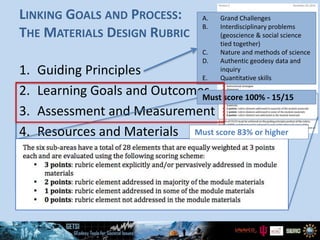
LINKING GOALS AND PROCESS:
THE MATERIALS DESIGN RUBRIC
1. Guiding Principles
2. Learning Goals and Outcomes
3. Assessment and Measurement
4. Resources and Materials
5. Instructional Strategies
6. Alignment
A. Grand Challenges
B. Interdisciplinary problems
(geoscience & social science
tied together)
C. Nature and methods of science
D. Authentic geodesy data and
inquiry
E. Quantitative skills
Must score 100% - 15/15
Must score 83% or higher
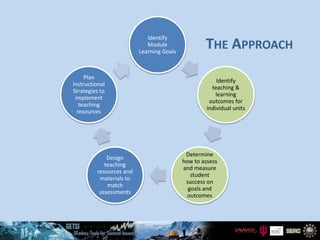
Identify
Module
Learning Goals
Identify
teaching &
learning
outcomes for
individual units
Determine
how to assess
and measure
student
success on
goals and
outcomes
Design
teaching
resources and
materials to
match
assessments
Plan
Instructional
Strategies to
implement
teaching
resources
THE APPROACH
LEARNING GOALS AND OUTCOMES
What is required from the Materials
Development Rubric?
• Learning outcomes describe measureable geoscience
literacy goals
• Instructions and/or rubrics provide guidance for how
students meet learning goals
• Learning outcomes and goals are appropriate for the
intended use of the course/module
• Learning outcomes and goals are clearly stated for each
module in language suitable for the level of the students
• Learning outcomes and goals address the process and
nature of science and development of scientific habits of
mind
Must score 13/15 on this section
WRITING LEARNING OUTCOMES
• Describe conditions under which behavior is
to be performed
• Use action verbs
• State Criteria
• Add the product, process or outcome
From Climate Unit: After completing this unit, students will
be able to correctly distinguish between forced and unforced
climate change.
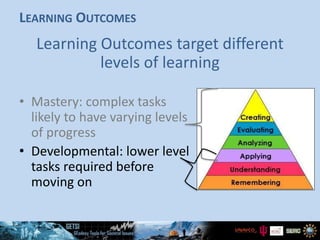
LEARNING OUTCOMES
Learning Outcomes target different
levels of learning
• Mastery: complex tasks
likely to have varying levels
of progress
• Developmental: lower level
tasks required before
moving on
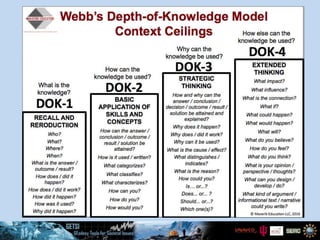
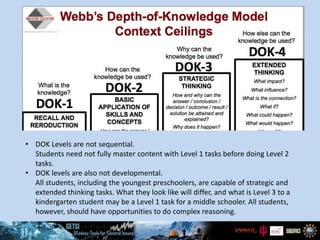
• DOK Levels are not sequential.
Students need not fully master content with Level 1 tasks before doing Level 2
tasks.
• DOK levels are also not developmental.
All students, including the youngest preschoolers, are capable of strategic and
extended thinking tasks. What they look like will differ, and what is Level 3 to a
kindergarten student may be a Level 1 task for a middle schooler. All students,
however, should have opportunities to do complex reasoning.
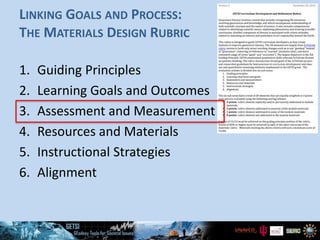
LINKING GOALS AND PROCESS:
THE MATERIALS DESIGN RUBRIC
1. Guiding Principles
2. Learning Goals and Outcomes
3. Assessment and Measurement
4. Resources and Materials
5. Instructional Strategies
6. Alignment
ASSESSMENTS AND MEASUREMENTS
What is required from the Materials
Development Rubric?
• Assessments measure the learning goals
• Assessments are criterion referenced
• Assessments are consistent with course activities
and resources expected
• Assessments are sequenced, varied and
appropriate to the content
• Assessments address goals at successively higher
cognitive levels
Must score 13/15 on this section
ASSESSMENTS AND MEASUREMENTS
There are two broad categories of
assessments:
• Formative: While the learning is occurring
– Purpose to monitor student learning
– Immediate feedback
– Help students & faculty identify weaknesses
– Low stakes
• Summative: After learning has occurred
– Purpose to evaluate learning against some benchmark
– High stakes (graded)
ASSESSMENTS AND MEASUREMENTS
What are formative and summative assessment strategies that you find most
effective?
• FORMATIVE
• Bobby: Discussion posts about papers/concepts; anonymous in class
quizzes related to last 5 minutes—recap as needed (Socrative App)
• Venkatesh: In class assignments such as numerical examples
• Becca: observations and discussions in class (likes real-time feedback
and not graded) – ready to move on or not?
• SUMMATIVE
• Bobby: likes projects--actively creating; larger projects are highest on
the Bloom’s tax
• Venkatesh: quizzes & exams
• Question
• Homework assignments? – formative or summative?
• Becca: has made level-1, level-2, level-3 assessment categories to see
the cognitive level achieved
ASSESSMENTS AND MEASUREMENTS
What are formative and summative assessment strategies that you find most
effective?
• FORMATIVE
• Susan: new to using formative assessment; entrance or exit tickets to
class; has found it really valuable addition; picking up misconceptions
• Karen: think-pair-share; concept tests w/ clickers; worksheets together
during class
• Bruce: worksheets in small groups
• Beth: informal discussions during activities
• SUMMATIVE
• Susan: most interesting is collaborative portions of exams; more
difficult material
• Karen: project & presentation; collaborative exams
• Bruce: larger, longer project reports
• Other
• Susan: mostly in upper division courses
• Karen: intro level
ASSESSMENTS AND MEASUREMENTS
What will the assessment team need from
classroom testing?
Enough assessment opportunities to conclusively
demonstrate the level of learning achieved
• Unit-level (learning outcomes)
– Both formative and summative
• Module-level (module goals)
– SUMMATIVE
– These assessments need to show what students know
and are able to do as related to the broader goals
LEARNING GOALS AND OUTCOMES
What is required from the Materials
Development Rubric?
• Learning outcomes describe measureable geoscience
literacy goals
• Instructions and/or rubrics provide guidance for how
students meet learning goals
• Learning outcomes and goals are appropriate for the
intended use of the course/module
• Learning outcomes and goals are clearly stated for each
module in language suitable for the level of the students
• Learning outcomes and goals address the process and
nature of science and development of scientific habits of
mind
Must score 13/15 on this section
ASSESSMENTS AND MEASUREMENTS
What is required from the Materials
Development Rubric?
• Assessments measure the learning goals
• Assessments are criterion referenced
• Assessments are consistent with course activities
and resources expected
• Assessments are sequenced, varied and
appropriate to the content
• Assessments address goals at successively higher
cognitive levels
Must score 13/15 on this section
WHAT ARE SCORING RUBRICS?
Scoring rubrics are descriptive scoring
schemes used to evaluate effort
Two Major Types
• Holistic: set of descriptions used to assign a
score to the whole
• Analytic: Set of components that are
independently evaluated (sum for score)
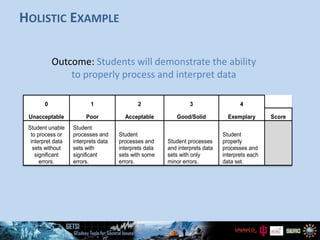
HOLISTIC EXAMPLE
Outcome: Students will demonstrate the ability
to properly process and interpret data
0 1 2 3 4
Unacceptable Poor Acceptable Good/Solid Exemplary Score
Student unable
to process or
interpret data
sets without
significant
errors.
Student
processes and
interprets data
sets with
significant
errors.
Student
processes and
interprets data
sets with some
errors.
Student processes
and interprets data
sets with only
minor errors.
Student
properly
processes and
interprets each
data set.
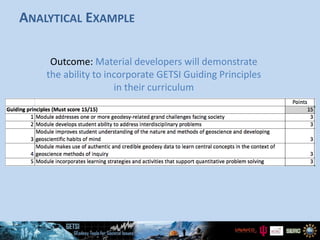
ANALYTICAL EXAMPLE
Outcome: Material developers will demonstrate
the ability to incorporate GETSI Guiding Principles
in their curriculum
DESIGNING RUBRICS
• Determine the most important attributes
needed to evaluate the Learning Outcome
• Decide analytic or holistic
• Define levels
Needs Work Part Way There Success
GOOD RUBRICS
• Have clear criteria
– Each criteria is distinct, clearly delineated and fully
appropriate for the outcome
• Have distinctive levels
– Each level is distinct and progresses in a clear and logical
order
• Can be used reliably by multiple raters
• Provide guidance to learners
– Rubric serves as primary reference point for discussion and
guidance as well as evaluation of assignment(s)
• Support Metacognition
– Rubric is regularly referenced and used to help learners
identify the skills and knowledge they are developing
throughout the program
LOOK AT SOME CURRENT GETSI EXAMPLES
FOLLOW UP WORK BEFORE FEBRUARY 9
• Review the Information for Team Members,
page and bring additional questions to the
February In-person Workshop
• Review the meeting agenda
• Bring/email the signed Author Agreement
paperwork that you received via email.

Presentation: Assessments & Rubrics

  • 1.
    This work issupported by the National Science Foundation’s Transforming Undergraduate Education in STEM program within the Directorate for Education and Human Resources (DUE-1245025). Questions, contact education-AT-unavco.org ASSESSMENTS & RUBRICS MODIFIED FROM PRESENTATIONS BY ELLEN IVERSON (SERC) AND DAVID STEER (U OF AKRON) The webinar begins at: 1 pm PT | 2 pm MT | 3 pm CT | 4 pm ET 3 pm PT | 4 pm MT | 5 pm CT | 6 pm ET For audio, call: 1-877-668-4490 (or 1-408-792-6300) 805 841 242 # Press *6 to mute and unmute (but hopefully we won’t need any muting) Headphones give less feedback than speakerphone.
  • 2.
    FOLLOW UP WORKBEFORE FEBRUARY 5 WEBINAR • Navigate to “Reporting” page in your module and fill in “Team Member Information” for you (near the bottom of the page) • Navigate to “Checkpoint 1 Workpage” and copy in the notes related to Alignment with Guiding Principles • Do a call with your author partner to discuss module goals. Input ideas to “Checkpoint 1 Workpage”
  • 3.
    GOALS FOR THISWEBINAR By the end of the webinar you will be able to: 1. Define and use typical terminology associated with assessments, and rubrics 2. Propose assessments for different outcomes and levels 3. Access and use the GETSI Materials Design Rubric – particularly for Goals and Assessments
  • 4.
    LINKING GOALS ANDPROCESS: THE MATERIALS DESIGN RUBRIC 1. Guiding Principles 2. Learning Goals and Outcomes 3. Assessment and Measurement 4. Resources and Materials 5. Instructional Strategies 6. Alignment A. Grand Challenges B. Interdisciplinary problems (geoscience & social science tied together) C. Nature and methods of science D. Authentic geodesy data and inquiry E. Quantitative skills Must score 100% - 15/15 Must score 83% or higher
  • 5.
    Identify Module Learning Goals Identify teaching & learning outcomesfor individual units Determine how to assess and measure student success on goals and outcomes Design teaching resources and materials to match assessments Plan Instructional Strategies to implement teaching resources THE APPROACH
  • 6.
    LEARNING GOALS ANDOUTCOMES What is required from the Materials Development Rubric? • Learning outcomes describe measureable geoscience literacy goals • Instructions and/or rubrics provide guidance for how students meet learning goals • Learning outcomes and goals are appropriate for the intended use of the course/module • Learning outcomes and goals are clearly stated for each module in language suitable for the level of the students • Learning outcomes and goals address the process and nature of science and development of scientific habits of mind Must score 13/15 on this section
  • 7.
    WRITING LEARNING OUTCOMES •Describe conditions under which behavior is to be performed • Use action verbs • State Criteria • Add the product, process or outcome From Climate Unit: After completing this unit, students will be able to correctly distinguish between forced and unforced climate change.
  • 8.
    LEARNING OUTCOMES Learning Outcomestarget different levels of learning • Mastery: complex tasks likely to have varying levels of progress • Developmental: lower level tasks required before moving on
  • 10.
    • DOK Levelsare not sequential. Students need not fully master content with Level 1 tasks before doing Level 2 tasks. • DOK levels are also not developmental. All students, including the youngest preschoolers, are capable of strategic and extended thinking tasks. What they look like will differ, and what is Level 3 to a kindergarten student may be a Level 1 task for a middle schooler. All students, however, should have opportunities to do complex reasoning.
  • 11.
    LINKING GOALS ANDPROCESS: THE MATERIALS DESIGN RUBRIC 1. Guiding Principles 2. Learning Goals and Outcomes 3. Assessment and Measurement 4. Resources and Materials 5. Instructional Strategies 6. Alignment
  • 12.
    ASSESSMENTS AND MEASUREMENTS Whatis required from the Materials Development Rubric? • Assessments measure the learning goals • Assessments are criterion referenced • Assessments are consistent with course activities and resources expected • Assessments are sequenced, varied and appropriate to the content • Assessments address goals at successively higher cognitive levels Must score 13/15 on this section
  • 13.
    ASSESSMENTS AND MEASUREMENTS Thereare two broad categories of assessments: • Formative: While the learning is occurring – Purpose to monitor student learning – Immediate feedback – Help students & faculty identify weaknesses – Low stakes • Summative: After learning has occurred – Purpose to evaluate learning against some benchmark – High stakes (graded)
  • 14.
    ASSESSMENTS AND MEASUREMENTS Whatare formative and summative assessment strategies that you find most effective? • FORMATIVE • Bobby: Discussion posts about papers/concepts; anonymous in class quizzes related to last 5 minutes—recap as needed (Socrative App) • Venkatesh: In class assignments such as numerical examples • Becca: observations and discussions in class (likes real-time feedback and not graded) – ready to move on or not? • SUMMATIVE • Bobby: likes projects--actively creating; larger projects are highest on the Bloom’s tax • Venkatesh: quizzes & exams • Question • Homework assignments? – formative or summative? • Becca: has made level-1, level-2, level-3 assessment categories to see the cognitive level achieved
  • 15.
    ASSESSMENTS AND MEASUREMENTS Whatare formative and summative assessment strategies that you find most effective? • FORMATIVE • Susan: new to using formative assessment; entrance or exit tickets to class; has found it really valuable addition; picking up misconceptions • Karen: think-pair-share; concept tests w/ clickers; worksheets together during class • Bruce: worksheets in small groups • Beth: informal discussions during activities • SUMMATIVE • Susan: most interesting is collaborative portions of exams; more difficult material • Karen: project & presentation; collaborative exams • Bruce: larger, longer project reports • Other • Susan: mostly in upper division courses • Karen: intro level
  • 16.
    ASSESSMENTS AND MEASUREMENTS Whatwill the assessment team need from classroom testing? Enough assessment opportunities to conclusively demonstrate the level of learning achieved • Unit-level (learning outcomes) – Both formative and summative • Module-level (module goals) – SUMMATIVE – These assessments need to show what students know and are able to do as related to the broader goals
  • 17.
    LEARNING GOALS ANDOUTCOMES What is required from the Materials Development Rubric? • Learning outcomes describe measureable geoscience literacy goals • Instructions and/or rubrics provide guidance for how students meet learning goals • Learning outcomes and goals are appropriate for the intended use of the course/module • Learning outcomes and goals are clearly stated for each module in language suitable for the level of the students • Learning outcomes and goals address the process and nature of science and development of scientific habits of mind Must score 13/15 on this section
  • 18.
    ASSESSMENTS AND MEASUREMENTS Whatis required from the Materials Development Rubric? • Assessments measure the learning goals • Assessments are criterion referenced • Assessments are consistent with course activities and resources expected • Assessments are sequenced, varied and appropriate to the content • Assessments address goals at successively higher cognitive levels Must score 13/15 on this section
  • 19.
    WHAT ARE SCORINGRUBRICS? Scoring rubrics are descriptive scoring schemes used to evaluate effort Two Major Types • Holistic: set of descriptions used to assign a score to the whole • Analytic: Set of components that are independently evaluated (sum for score)
  • 20.
    HOLISTIC EXAMPLE Outcome: Studentswill demonstrate the ability to properly process and interpret data 0 1 2 3 4 Unacceptable Poor Acceptable Good/Solid Exemplary Score Student unable to process or interpret data sets without significant errors. Student processes and interprets data sets with significant errors. Student processes and interprets data sets with some errors. Student processes and interprets data sets with only minor errors. Student properly processes and interprets each data set.
  • 21.
    ANALYTICAL EXAMPLE Outcome: Materialdevelopers will demonstrate the ability to incorporate GETSI Guiding Principles in their curriculum
  • 22.
    DESIGNING RUBRICS • Determinethe most important attributes needed to evaluate the Learning Outcome • Decide analytic or holistic • Define levels Needs Work Part Way There Success
  • 23.
    GOOD RUBRICS • Haveclear criteria – Each criteria is distinct, clearly delineated and fully appropriate for the outcome • Have distinctive levels – Each level is distinct and progresses in a clear and logical order • Can be used reliably by multiple raters • Provide guidance to learners – Rubric serves as primary reference point for discussion and guidance as well as evaluation of assignment(s) • Support Metacognition – Rubric is regularly referenced and used to help learners identify the skills and knowledge they are developing throughout the program
  • 24.
    LOOK AT SOMECURRENT GETSI EXAMPLES
  • 25.
    FOLLOW UP WORKBEFORE FEBRUARY 9 • Review the Information for Team Members, page and bring additional questions to the February In-person Workshop • Review the meeting agenda • Bring/email the signed Author Agreement paperwork that you received via email.

Editor's Notes

  • #3 Remind them they need to be logged into SERC account
  • #10 Technically this is actually the Anderson/Krathwohl revised Bloom’s taxonomy
  • #11 https://www.edutopia.org/blog/webbs-depth-knowledge-increase-rigor-gerald-aungsthttp://dmfa3ba8wpnh6.cloudfront.net/cb/ba/331d6fa84dcca80ecb4ed685bdcb/dokceilings.png
  • #12 https://www.edutopia.org/blog/webbs-depth-knowledge-increase-rigor-gerald-aungsthttp://dmfa3ba8wpnh6.cloudfront.net/cb/ba/331d6fa84dcca80ecb4ed685bdcb/dokceilings.png