Thoughts on successor
    Assessment


             Duane Lakin, Ph.D.
            Consulting Psychologist
Need for succession planning


10,000 new Social Security recipients per day

Lean: do more with less people

Big dangerous trucks still exist (“Mack truck rule.”)
Approaches to choosing a
           successor
“Seemed like a good idea at the time”

Best friend

“It’s his turn.”

“She’s great...and a minority!”

“He’s just like me.”

“It doesn’t look good to go ‘outside’.”

“Who we got?”
Major challenge in choosing a
           successor


No one is ever ready...either too early or too late
Second major challenge in
  choosing a successor


 There is likely going to be a loser.
Reality of successor selection


The next job is very different than the current one.
Reality of successor selection
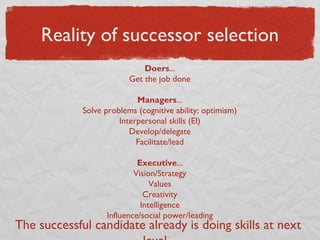
                              Doers...
                          Get the job done

                            Managers...
             Solve problems (cognitive ability; optimism)
                       Interpersonal skills (EI)
                          Develop/delegate
                            Facilitate/lead

                            Executive...
                           Vision/Strategy
                                Values
                              Creativity
                             Intelligence
                   Influence/social power/leading
The successful candidate already is doing skills at next
Assessing successor candidates
          What is needed?
       What is a fatal weakness?
       What can be developed?
Assessing the successor
            candidate

           Begin by looking at the
     characteristics needed in the ROLE...

...to do the things managers/leaders need to do
...to implement company strategy
...to fit or change company culture
Assessing successor candidates

      Relevant knowledge and skills,
                  Scope,
              Passion/Values,
             People judgment,
       Judgment and common sense
    Temperament, Attitude, and Style,
     Ability to gain trust and respect
Assessing successor candidates


       I look for the absence of key competencies;
I look for presence of characteristics that are NEGATIVE
                        indicators;

      The good ones may not show up to work;
    the bad ones ALWAYS make their appearance.

     “Beauty is only skin deep; ugly goes to the bone.”
Scope of thinking
              One Day (“X is true because of this or this.”)

              3 months (“X is true because of this and this.”)

1 year (“X is true, because if we do this, it will lead to that which will lead
                        to that and then cause Z.”)


2 year (“If we do X, it will lead to Y and then Z, but we have to consider
that if we do not do X and do A instead, that will lead to B and C. So we
                   must consider both possibilities...”)

     5 year, 10 year (much more concept based than just data based)
Scope of thinking;
what does the job need?

     One Day: most plant personnel

     3 months: most sales people or
  lead production people or supervisors

  1 year: Plant managers; Sales managers

        2 year: General Managers

      5 years; 10 years: Executives
Assessing successor candidates
I look for absence of desired characteristics such as:
                        Proactivity
                 Efficiency Orientation
                     Positive Regard
           Influence/ Concern with Impact
                        Objectivity
                        Intelligence
             Interpersonal awareness (EI)
                  Communication skill
               Accurate self-assessment
                        Leadership
The successful candidate already demonstrates the
          characteristics needed in the next job.

He/she may not have the experience or specific knowledge.
Assessing successor candidates

   Examples of NEGATIVE indicators:

    Lack of ego strength/ high anxiety
            Poor self-awareness
           Low stress tolerance
          Arrogance/defensiveness
    Lack of self-control or composure
    Inclination to blame or be a victim
   Narcissism/lack of respect for others
Can you remedy the problem?

       Coaching/Counseling

           Mentoring

            Teaching

           Confronting
What is a reasonable development
               expectation?


            What are YOU doing better today
than you did 2 years ago? How much have YOU developed
                   in the past 2 years?
    How hard was it to develop new skills, knowledge,
                      judgment, etc.?

 If someone is expected to develop in specific areas, who
             will be the coach? You? When?
The unspoken question


What do you tell the person who does not get the job?
Is there a better seat on the bus?
   Provide feedback. Don’t mislead. If someone
    is not going to get promoted, be honest.

    Don’t offer an impossible development plan
   with unrealistic expectations. Offer a helpful
                development plan.

     If possible, find a better career path. Try to
 find another way for person to improve income
      without an inappropriate promotion yet
           benefits the organization, too.
Final thoughts
  What is your “onboarding” plan for someone who is
promoted?

  When do you decide to go outside for candidates?
When does “new blood” trump an in-house “A”
player?

  Is Succession Plan a measure of how well your
“talent management” plan works? Are you coaching and
mentoring your “A” players?

 Should you really ever pick your own successor?
Happy Hunting!
Want some help in assessing
    talent or planning
      development?

     Duane Lakin, Ph.D.
   Consulting Psychologist
 www.lakinassociates.com
630-871-2996 (Wheaton, IL)
drlakin@lakinassociates.com

Successor assessment

  • 1.
    Thoughts on successor Assessment Duane Lakin, Ph.D. Consulting Psychologist
  • 2.
    Need for successionplanning 10,000 new Social Security recipients per day Lean: do more with less people Big dangerous trucks still exist (“Mack truck rule.”)
  • 3.
    Approaches to choosinga successor “Seemed like a good idea at the time” Best friend “It’s his turn.” “She’s great...and a minority!” “He’s just like me.” “It doesn’t look good to go ‘outside’.” “Who we got?”
  • 4.
    Major challenge inchoosing a successor No one is ever ready...either too early or too late
  • 5.
    Second major challengein choosing a successor There is likely going to be a loser.
  • 6.
    Reality of successorselection The next job is very different than the current one.
  • 7.
    Reality of successorselection Doers... Get the job done Managers... Solve problems (cognitive ability; optimism) Interpersonal skills (EI) Develop/delegate Facilitate/lead Executive... Vision/Strategy Values Creativity Intelligence Influence/social power/leading The successful candidate already is doing skills at next
  • 8.
    Assessing successor candidates What is needed? What is a fatal weakness? What can be developed?
  • 9.
    Assessing the successor candidate Begin by looking at the characteristics needed in the ROLE... ...to do the things managers/leaders need to do ...to implement company strategy ...to fit or change company culture
  • 10.
    Assessing successor candidates Relevant knowledge and skills, Scope, Passion/Values, People judgment, Judgment and common sense Temperament, Attitude, and Style, Ability to gain trust and respect
  • 11.
    Assessing successor candidates I look for the absence of key competencies; I look for presence of characteristics that are NEGATIVE indicators; The good ones may not show up to work; the bad ones ALWAYS make their appearance. “Beauty is only skin deep; ugly goes to the bone.”
  • 12.
    Scope of thinking One Day (“X is true because of this or this.”) 3 months (“X is true because of this and this.”) 1 year (“X is true, because if we do this, it will lead to that which will lead to that and then cause Z.”) 2 year (“If we do X, it will lead to Y and then Z, but we have to consider that if we do not do X and do A instead, that will lead to B and C. So we must consider both possibilities...”) 5 year, 10 year (much more concept based than just data based)
  • 13.
    Scope of thinking; whatdoes the job need? One Day: most plant personnel 3 months: most sales people or lead production people or supervisors 1 year: Plant managers; Sales managers 2 year: General Managers 5 years; 10 years: Executives
  • 14.
    Assessing successor candidates Ilook for absence of desired characteristics such as: Proactivity Efficiency Orientation Positive Regard Influence/ Concern with Impact Objectivity Intelligence Interpersonal awareness (EI) Communication skill Accurate self-assessment Leadership
  • 15.
    The successful candidatealready demonstrates the characteristics needed in the next job. He/she may not have the experience or specific knowledge.
  • 16.
    Assessing successor candidates Examples of NEGATIVE indicators: Lack of ego strength/ high anxiety Poor self-awareness Low stress tolerance Arrogance/defensiveness Lack of self-control or composure Inclination to blame or be a victim Narcissism/lack of respect for others
  • 17.
    Can you remedythe problem? Coaching/Counseling Mentoring Teaching Confronting
  • 18.
    What is areasonable development expectation? What are YOU doing better today than you did 2 years ago? How much have YOU developed in the past 2 years? How hard was it to develop new skills, knowledge, judgment, etc.? If someone is expected to develop in specific areas, who will be the coach? You? When?
  • 19.
    The unspoken question Whatdo you tell the person who does not get the job?
  • 20.
    Is there abetter seat on the bus? Provide feedback. Don’t mislead. If someone is not going to get promoted, be honest. Don’t offer an impossible development plan with unrealistic expectations. Offer a helpful development plan. If possible, find a better career path. Try to find another way for person to improve income without an inappropriate promotion yet benefits the organization, too.
  • 21.
    Final thoughts What is your “onboarding” plan for someone who is promoted? When do you decide to go outside for candidates? When does “new blood” trump an in-house “A” player? Is Succession Plan a measure of how well your “talent management” plan works? Are you coaching and mentoring your “A” players? Should you really ever pick your own successor?
  • 22.
    Happy Hunting! Want somehelp in assessing talent or planning development? Duane Lakin, Ph.D. Consulting Psychologist www.lakinassociates.com 630-871-2996 (Wheaton, IL) drlakin@lakinassociates.com

Editor's Notes

  • #6 .
  • #13 Simple, additive, Serial, parallel,
  • #16 And here is where it gets fuzzy. I have given you two lists from different psychologists that are samples of traits or competencies. What are they really? Who knows. I will call them “Characteristics”...Look at the lists (or your own lists in your head) and decide: WHAT DOES ROLE NEED???? Then assessing candidates is partly looking for the existence of such characteristics.
  • #17 .
  • #18 this list continues to grow...I am always surprised by what people can be made of. Why are these critical NEGATIVE indicators?....because no amount of development can impact them.
  • #19 planning, networking
  • #22 Sometimes works....markting person DID NOT get promoted; result of process said she was glad and realized she did not want sales exec role. Sometimes doesnt...seller got angry for not being promoted and left for a mgt job...now on his 3rd company. Theoretically: works on getting developed...highly motivated when not getting job...ever work?