Not every management assessment is the same. Picking the right
assessment approach could mean the difference between having an
outstanding investment return and having to explain an ugly mess to
your partners. Different options answer different questions, so you
need to figure out what you most want to learn.
What you might like to know
Has he done it before?
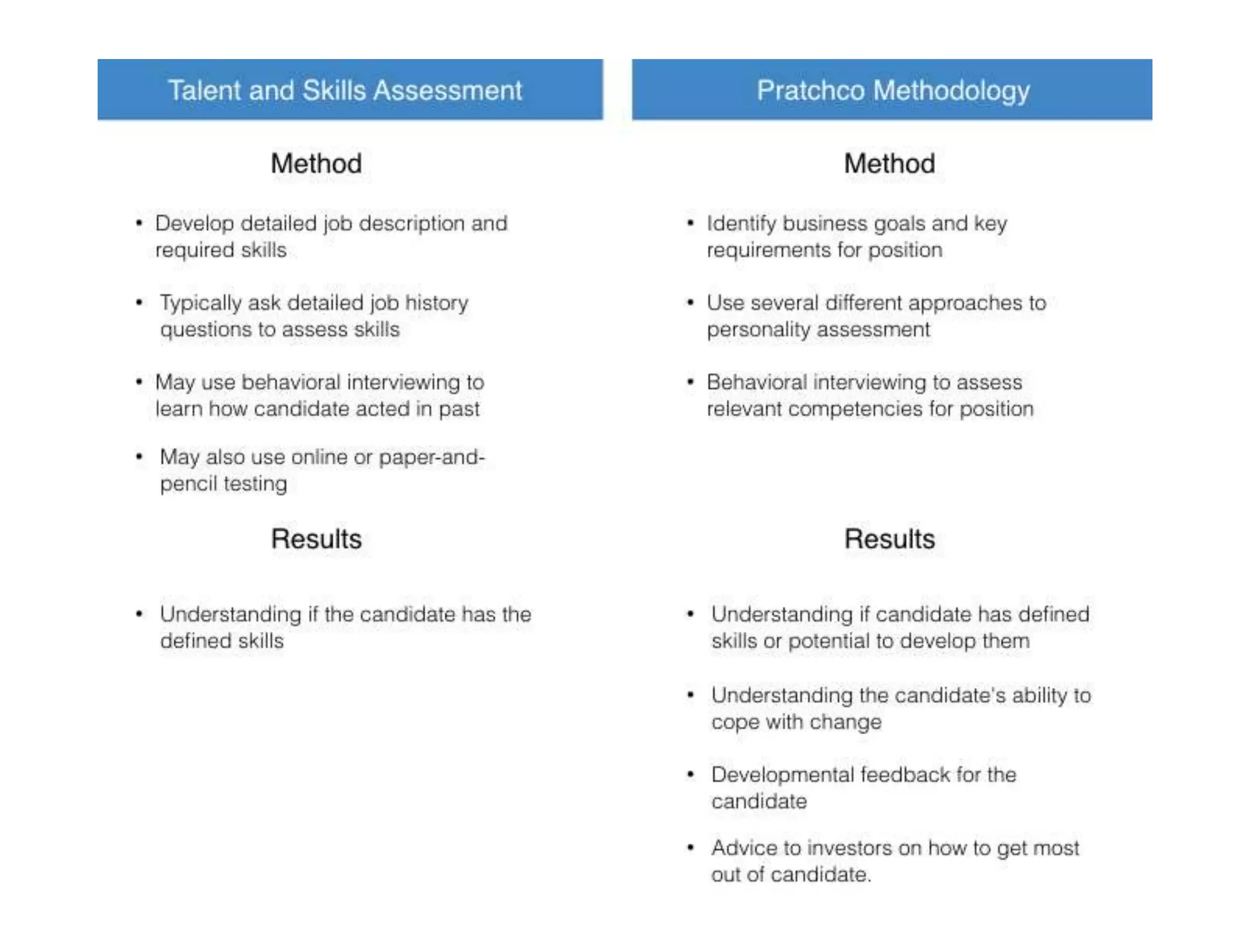
This question is good to ask when you know what you want and are sure
it isn't going to change. A good way to answer this question is with a
talent and skill assessment. Search firms, many assessment firms, and
many psychologists focus on past achievements. They document if the
“candidate has done it before in a compelling fashion.” Typically, they
use behavioral interviewing to understand how and when the candidate
has “done it before.”
If you plan to exit the deal in three to five years, and know that the
company won’t change and the world won’t change in that interim, and
that there will be no unexpected opportunities and no unexpected
problems, then this could be a good approach – for your needs.
How will he cope with change?
Will he capitalize on opportunity? Can he do something no one has ever
done? How much do you care about how well the candidate will
perform under new or unexpected conditions? You can pick someone
who seems like he fits the bill but the world changes for better or
worse. When it changes for the worse, you see how adaptable he is. But
you may not know when it changes for the better, because the
executive doesn’t take advantage of the change until the competition
does.
In faster-moving or more uncertain markets, expecting the unexpected
makes sense. You need someone with skills but ability to cope – which
requires raw cognitive capability and a stable information-seeking
personality much more than specific pre-defined skills – is also critical.
Talent and skill assessments don't address these at all. An approach like
Pratch & Company's – aimed at understanding active coping capabilities
as they will be needed for the business challenge – fits well here.
How can you get the most out of the executive?
Sometimes a candidate brings a lot but isn't perfect. That introduces the
other party in the interaction -- you. How can you act so you capitalize
on the executive’s strengths and proactively protect against his
weaknesses as a leader? Talent and skill assessments won't shed any
light here; Pratch & Company's approach to understanding personality
as part of the assessment will.
How will he cope in a private equity environment?
The pace is fast, and CEOs have to cope with having investors
challenging their thinking. If they’ve been in a private equity
environment in the past and you know the investors they worked with
before, a talent assessment is adequate. If they’ve never been in a
private equity environment or you don’t know the other investors, you
should use Pratch & Company.
Are incumbents worth keeping, even though the strategy is
changing?
You are inheriting a management team. They know the business and
losing them would be a big loss. But they haven't done what is being
called for next, even if they thought of it (similar to founders' problem
with startup), so they will all fail a simple talent assessment. But they
might very well be keeping if you could supplement them with your
skills or add a team member at the right time. If you assume that they
can’t do it, you will have to hire a new team, which will lack the
understanding of the company the original team had.
What's in it for the executive?
Executives don't generally relish the opportunity to be assessed. Putting
them through a painful assessment that provides no value to them
won't be a great way to start a relationship and might even be a way to
end one.
Talent and skill assessments document what the executive says and
usually provide no value to the executive. Assessments like Pratch &
Company's that find underlying themes can help executives understand
themselves better and can provide guidance that the executives can use
to improve how they interact with others (including but not limited to
you).
About the Author
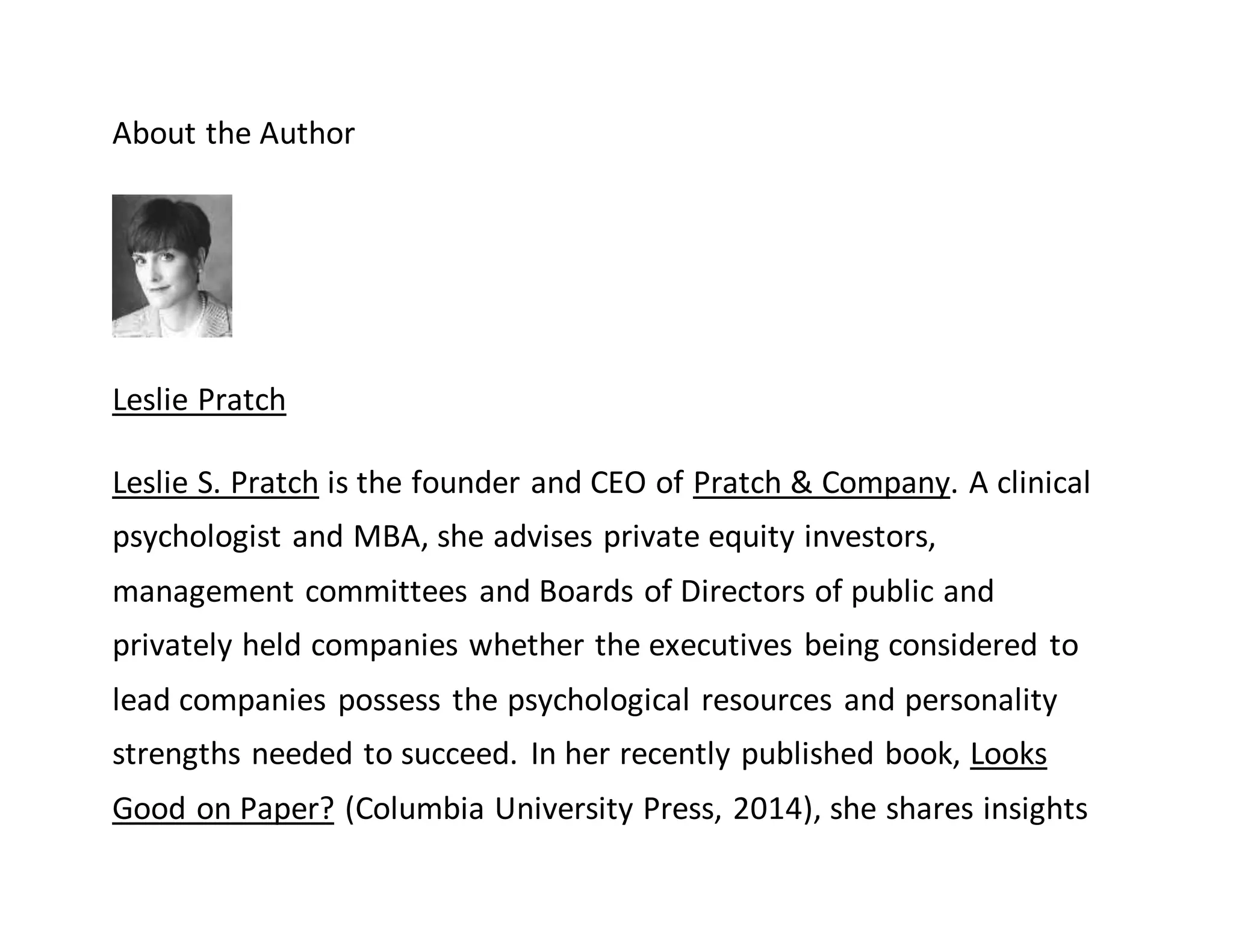
Leslie Pratch
Leslie S. Pratch is the founder and CEO of Pratch & Company. A clinical
psychologist and MBA, she advises private equity investors,
management committees and Boards of Directors of public and
privately held companies whether the executives being considered to
lead companies possess the psychological resources and personality
strengths needed to succeed. In her recently published book, Looks
Good on Paper? (Columbia University Press, 2014), she shares insights
from more than twenty years of executive evaluations and offers an
empirically based approach to identify executives who will be effective
within organizations – and to flag those who will ultimately very likely
fail – by evaluating aspects of personality and character that are hidden
beneath the surface.

How to avoid an ugly mess

  • 2.
    Not every managementassessment is the same. Picking the right assessment approach could mean the difference between having an outstanding investment return and having to explain an ugly mess to your partners. Different options answer different questions, so you need to figure out what you most want to learn.
  • 4.
    What you mightlike to know Has he done it before? This question is good to ask when you know what you want and are sure it isn't going to change. A good way to answer this question is with a talent and skill assessment. Search firms, many assessment firms, and many psychologists focus on past achievements. They document if the “candidate has done it before in a compelling fashion.” Typically, they use behavioral interviewing to understand how and when the candidate has “done it before.” If you plan to exit the deal in three to five years, and know that the company won’t change and the world won’t change in that interim, and
  • 5.
    that there willbe no unexpected opportunities and no unexpected problems, then this could be a good approach – for your needs. How will he cope with change? Will he capitalize on opportunity? Can he do something no one has ever done? How much do you care about how well the candidate will perform under new or unexpected conditions? You can pick someone who seems like he fits the bill but the world changes for better or worse. When it changes for the worse, you see how adaptable he is. But you may not know when it changes for the better, because the executive doesn’t take advantage of the change until the competition does.
  • 6.
    In faster-moving ormore uncertain markets, expecting the unexpected makes sense. You need someone with skills but ability to cope – which requires raw cognitive capability and a stable information-seeking personality much more than specific pre-defined skills – is also critical. Talent and skill assessments don't address these at all. An approach like Pratch & Company's – aimed at understanding active coping capabilities as they will be needed for the business challenge – fits well here. How can you get the most out of the executive? Sometimes a candidate brings a lot but isn't perfect. That introduces the other party in the interaction -- you. How can you act so you capitalize on the executive’s strengths and proactively protect against his weaknesses as a leader? Talent and skill assessments won't shed any
  • 7.
    light here; Pratch& Company's approach to understanding personality as part of the assessment will. How will he cope in a private equity environment? The pace is fast, and CEOs have to cope with having investors challenging their thinking. If they’ve been in a private equity environment in the past and you know the investors they worked with before, a talent assessment is adequate. If they’ve never been in a private equity environment or you don’t know the other investors, you should use Pratch & Company.
  • 8.
    Are incumbents worthkeeping, even though the strategy is changing? You are inheriting a management team. They know the business and losing them would be a big loss. But they haven't done what is being called for next, even if they thought of it (similar to founders' problem with startup), so they will all fail a simple talent assessment. But they might very well be keeping if you could supplement them with your skills or add a team member at the right time. If you assume that they can’t do it, you will have to hire a new team, which will lack the understanding of the company the original team had.
  • 9.
    What's in itfor the executive? Executives don't generally relish the opportunity to be assessed. Putting them through a painful assessment that provides no value to them won't be a great way to start a relationship and might even be a way to end one. Talent and skill assessments document what the executive says and usually provide no value to the executive. Assessments like Pratch & Company's that find underlying themes can help executives understand themselves better and can provide guidance that the executives can use to improve how they interact with others (including but not limited to you).
  • 10.
    About the Author LesliePratch Leslie S. Pratch is the founder and CEO of Pratch & Company. A clinical psychologist and MBA, she advises private equity investors, management committees and Boards of Directors of public and privately held companies whether the executives being considered to lead companies possess the psychological resources and personality strengths needed to succeed. In her recently published book, Looks Good on Paper? (Columbia University Press, 2014), she shares insights
  • 11.
    from more thantwenty years of executive evaluations and offers an empirically based approach to identify executives who will be effective within organizations – and to flag those who will ultimately very likely fail – by evaluating aspects of personality and character that are hidden beneath the surface.