
Enterprise Architecture for Complex
System-of-Systems Contexts
Philip Boxer and Suzanne Garcia
March 25th 2009
1Copyright © Philip Boxer 2009
Agenda
Double challenge facing collaborating players (4)
Enterprise architecture and beyond (6)
Modeling the relation to the ‘beyond’ (3)
2Copyright © Philip Boxer 2009
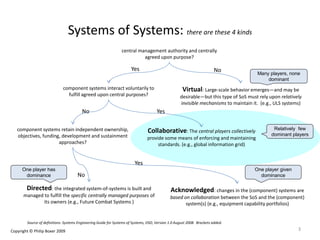
Collaborative: The central players collectively
provide some means of enforcing and maintaining
standards. (e.g., global information grid)
Relatively few
dominant players
Systems of Systems: there are these 4 kinds
central management authority and centrally
agreed upon purpose?
NoYes
component systems interact voluntarily to
fulfill agreed upon central purposes?
No Yes
component systems retain independent ownership,
objectives, funding, development and sustainment
approaches?
No
Yes
Virtual: Large-scale behavior emerges—and may be
desirable—but this type of SoS must rely upon relatively
invisible mechanisms to maintain it. (e.g., ULS systems)
Many players, none
dominant
Acknowledged: changes in the (component) systems are
based on collaboration between the SoS and the (component)
system(s) (e.g., equipment capability portfolios)
One player given
dominance
Directed: the integrated system-of-systems is built and
managed to fulfill the specific centrally managed purposes of
its owners (e.g., Future Combat Systems )
One player has
dominance
Source of definitions: Systems Engineering Guide for Systems of Systems, OSD, Version 1.0 August 2008. Brackets added.
3Copyright © Philip Boxer 2009
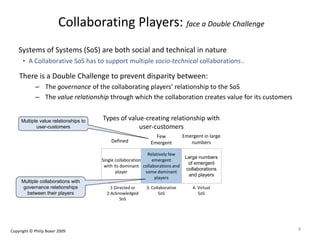
Collaborating Players: face a Double Challenge
There is a Double Challenge to prevent disparity between:
– The governance of the collaborating players’ relationship to the SoS
– The value relationship through which the collaboration creates value for its customers
Single collaboration
with its dominant
player
Types of value-creating relationship with
user-customers
Defined
1:Directed or
2:Acknowledged
SoS
Relatively few
emergent
collaborations and
some dominant
players
Few
Emergent
3: Collaborative
SoS
Large numbers
of emergent
collaborations
and players
Emergent in large
numbers
4: Virtual
SoS
Systems of Systems (SoS) are both social and technical in nature
• A Collaborative SoS has to support multiple socio-technical collaborations..
Multiple collaborations with
governance relationships
between their players
Multiple value relationships to
user-customers
4Copyright © Philip Boxer 2009
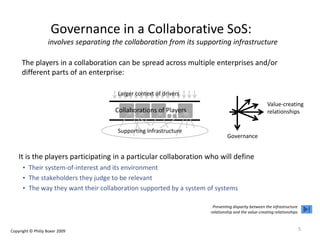
Governance in a Collaborative SoS:
involves separating the collaboration from its supporting infrastructure
The players in a collaboration can be spread across multiple enterprises and/or
different parts of an enterprise:
Larger context of drivers
Governance
Collaborations of Players
Value-creating
relationships
It is the players participating in a particular collaboration who will define
• Their system-of-interest and its environment
• The stakeholders they judge to be relevant
• The way they want their collaboration supported by a system of systems
Supporting Infrastructure
5Copyright © Philip Boxer 2009
Preventing disparity between the infrastructure
relationship and the value-creating relationships
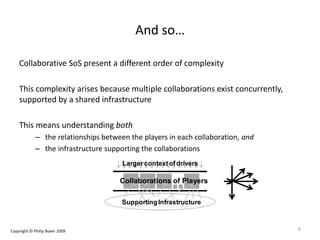
And so…
Collaborative SoS present a different order of complexity
This complexity arises because multiple collaborations exist concurrently,
supported by a shared infrastructure
This means understanding both
– the relationships between the players in each collaboration, and
– the infrastructure supporting the collaborations
Largercontextofdrivers
SupportingInfrastructure
Collaborations of Players
6Copyright © Philip Boxer 2009
Agenda
Double challenge facing collaborating players (4)
Enterprise architecture and beyond (6)
Modeling the relation to the ‘beyond’ (3)
7Copyright © Philip Boxer 2009
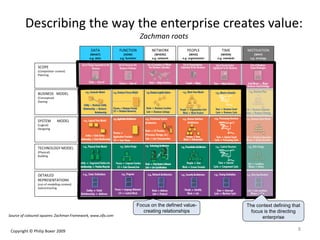
Describing the way the enterprise creates value:
Zachman roots
Source of coloured squares: Zachman Framework, www.zifa.com
SCOPE
(Competitive context)
Planning
BUSINESS MODEL
(Conceptual)
Owning
SYSTEM MODEL
(Logical)
Designing
TECHNOLOGY MODEL
(Physical)
Building
DETAILED
REPRESENTATIONS
(out-of-modelling-context)
Subcontracting
DATA
(WHAT)
e.g. data
MOTIVATION
(WHY)
e.g. strategy
TIME
(WHEN)
e.g. schedule
PEOPLE
(WHO)
e.g. organisation
NETWORK
(WHERE)
e.g. network
FUNCTION
(HOW)
e.g. function
The context defining that
focus is the directing
enterprise
Focus on the defined value-
creating relationships
8Copyright © Philip Boxer 2009
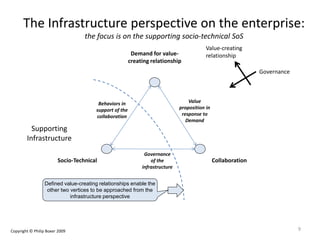
The Infrastructure perspective on the enterprise:
the focus is on the supporting socio-technical SoS
Defined value-creating relationships enable the
other two vertices to be approached from the
infrastructure perspective
Value
proposition in
response to
Demand
Governance
Value-creating
relationship
CollaborationSocio-Technical
Governance
of the
infrastructure
Supporting
Infrastructure
Demand for value-
creating relationship
Behaviors in
support of the
collaboration
9Copyright © Philip Boxer 2009
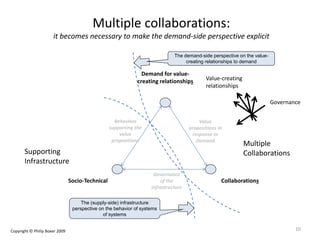
Multiple collaborations:
it becomes necessary to make the demand-side perspective explicit
Demand for value-
creating relationships
CollaborationsSocio-Technical
Value
propositions in
response to
Demand
Behaviors
supporting the
value
propositions
Governance
of the
infrastructure
The demand-side perspective on the value-
creating relationships to demand
Multiple
Collaborations
Governance
Value-creating
relationships
The (supply-side) infrastructure
perspective on the behavior of systems
of systems
Supporting
Infrastructure
10Copyright © Philip Boxer 2009
Source of gaps: Philip Boxer, Modeling structure-determining processes, http://www.asymmetricdesign.com/archives/59, December 2006
SCOPE
(Competitive context)
Planning
BUSINESS MODEL
(Conceptual)
Owning
SYSTEM MODEL
(Logical) Designing
TECHNOLOGY MODEL
(Physical) Building
DETAILED
REPRESENTATIONS
(out-of-modelling-context)
Subcontracting
DATA (WHAT)
e.g. data
MOTIVATION
(WHY)
e.g. strategy
TIME (WHEN)
e.g. schedule
PEOPLE (WHO)
e.g. organisation
NETWORK (WHERE)
e.g. network
FUNCTION (HOW)
e.g. function
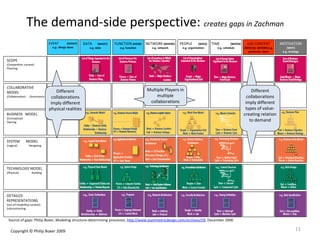
COLLABORATIVE
MODEL
(Collaboration) Governance
Multiple players in
multiple
collaborations
Multiple Players in
multiple
collaborations
USE CONTEXT
(WHO for WHOM) e.g.
particular client
Different
collaborations
imply different
types of value-
creating relation
to demand
Different
collaborations
imply different
types of value-
creating relation
to demand
EVENT (WHAT)
e.g. things done
Different
collaborations
imply different
physical realities
Different
collaborations
imply different
physical realities
The demand-side perspective: creates gaps in Zachman
11Copyright © Philip Boxer 2009
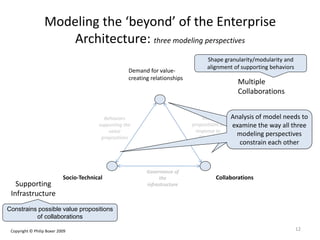
Modeling the ‘beyond’ of the Enterprise
Architecture: three modeling perspectives
Demand for value-
creating relationships
CollaborationsSocio-Technical
Value
propositions in
response to
Demand
Behaviors
supporting the
value
propositions
Governance of
the
infrastructure
Shape granularity/modularity and
alignment of supporting behaviors
Multiple
Collaborations
Constrains possible value propositions
of collaborations
Supporting
Infrastructure
Analysis of model needs to
examine the way all three
modeling perspectives
constrain each other
Analysis of model needs to
examine the way all three
modeling perspectives
constrain each other
Analysis of model needs to
examine the way all three
modeling perspectives
constrain each other
12Copyright © Philip Boxer 2009
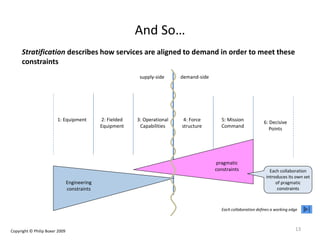
Engineering
constraints
And So…
Stratification describes how services are aligned to demand in order to meet these
constraints
6: Decisive
Points
5: Mission
Command
4: Force
structure
pragmatic
constraints Each collaboration
introduces its own set
of pragmatic
constraints
3: Operational
Capabilities
2: Fielded
Equipment
1: Equipment
demand-sidesupply-side
13Copyright © Philip Boxer 2009
Each collaboration defines a working edge
Agenda
Double challenge facing collaborating players (4)
Enterprise architecture and beyond (6)
Modeling the relation to the ‘beyond’ (3)
14Copyright © Philip Boxer 2009
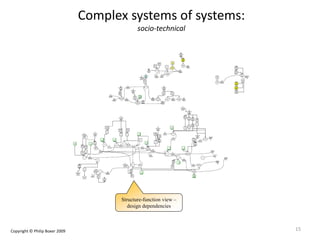
Complex systems of systems:
socio-technical
Structure-function view –
design dependencies
15Copyright © Philip Boxer 2009
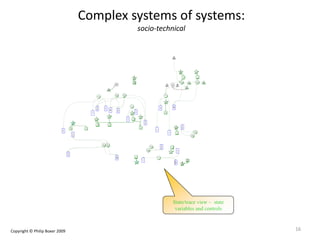
Complex systems of systems:
socio-technical
State/trace view – state
variables and controls
16Copyright © Philip Boxer 2009
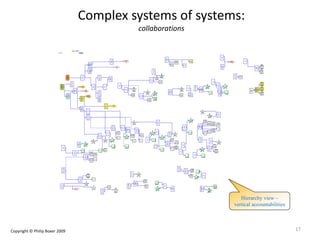
Complex systems of systems:
collaborations
Hierarchy view –
vertical accountabilities
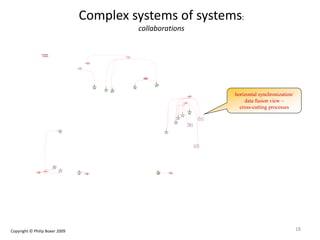
17Copyright © Philip Boxer 2009
horizontal synchronization/
data fusion view –
cross-cutting processes
Complex systems of systems:
collaborations
18Copyright © Philip Boxer 2009
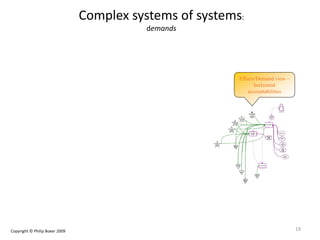
Effects/Demand view –
horizontal
accountabilities
Complex systems of systems:
demands
19Copyright © Philip Boxer 2009
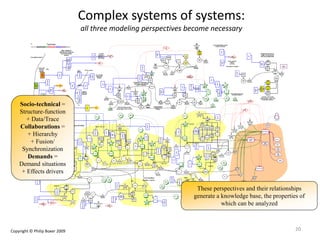
Complex systems of systems:
all three modeling perspectives become necessary
Socio-technical =
Structure-function
+ Data/Trace
Collaborations =
+ Hierarchy
+ Fusion/
Synchronization
Demands =
Demand situations
+ Effects drivers
These perspectives and their relationships
generate a knowledge base, the properties of
which can be analyzed
20Copyright © Philip Boxer 2009
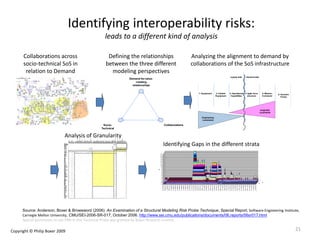
Identifying interoperability risks:
leads to a different kind of analysis
Source: Anderson, Boxer & Browsword (2006) An Examination of a Structural Modeling Risk Probe Technique, Special Report, Software Engineering Institute,
Carnegie Mellon University, CMU/SEI-2006-SR-017, October 2006. http://www.sei.cmu.edu/publications/documents/06.reports/06sr017.html
Special permission to use PAN in this Technical Probe was granted by Boxer Research Limited.
Identifying Gaps in the different strata
Analysis of Granularity
Collaborations across
socio-technical SoS in
relation to Demand
Defining the relationships
between the three different
modeling perspectives
Demand forvalue-
creating
relationships
CollaborationsSocio-
Technical
Analyzing the alignment to demand by
collaborations of the SoS infrastructure
Engineering
constraints
6: Decisive
Points
5: Mission
Command
4: Agile force
structure
pragmatic
constraints
3: Operational
Capabilities
2: Fielded
Equipment
1: Equipment
demand-sidesupply-side
21Copyright © Philip Boxer 2009
Conclusion
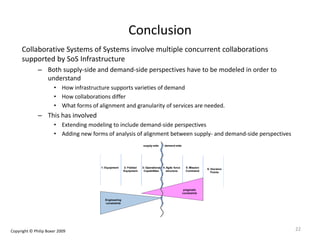
Collaborative Systems of Systems involve multiple concurrent collaborations
supported by SoS Infrastructure
– Both supply-side and demand-side perspectives have to be modeled in order to
understand
• How infrastructure supports varieties of demand
• How collaborations differ
• What forms of alignment and granularity of services are needed.
– This has involved
• Extending modeling to include demand-side perspectives
• Adding new forms of analysis of alignment between supply- and demand-side perspectives
Engineering
constraints
6: Decisive
Points
5: Mission
Command
4: Agile force
structure
pragmatic
constraints
3: Operational
Capabilities
2: Fielded
Equipment
1: Equipment
demand-sidesupply-side
22Copyright © Philip Boxer 2009
END
23Copyright © Philip Boxer 2009
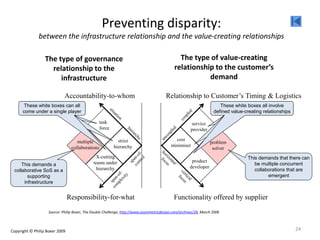
The type of governance
relationship to the
infrastructure
The type of value-creating
relationship to the customer’s
demand
Responsibility-for-what
Accountability-to-whom Relationship to Customer’s Timing & Logistics
Functionality offered by supplier
problem
solver
product
developer
service
provider
cost
minimiser
strict
hierarchy
X-cutting
teams under
hierarchy
task
force
multiple
collaborations
Preventing disparity:
between the infrastructure relationship and the value-creating relationships
This demands that there can
be multiple concurrent
collaborations that are
emergent
Source: Philip Boxer, The Double Challenge, http://www.asymmetricdesign.com/archives/26, March 2006
These white boxes all involve
defined value-creating relationships
These white boxes all involve
defined value-creating relationships
These white boxes all involve
defined value-creating relationships
This demands a
collaborative SoS as a
supporting
infrastructure
These white boxes can all
come under a single player
These white boxes can all
come under a single player
These white boxes can all
come under a single player
24Copyright © Philip Boxer 2009
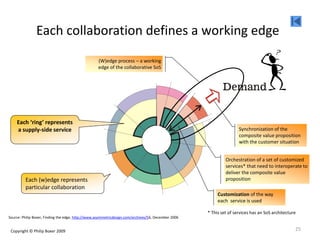
Synchronization of the
composite value proposition
with the customer situation
Each ‘ring’ represents
a supply-side service
(W)edge process – a working
edge of the collaborative SoS
* This set of services has an SoS architecture
Orchestration of a set of customized
services* that need to interoperate to
deliver the composite value
proposition
Customization of the way
each service is used
Each collaboration defines a working edge
Each (w)edge represents
particular collaboration
Source: Philip Boxer, Finding the edge, http://www.asymmetricdesign.com/archives/56, December 2006
25Copyright © Philip Boxer 2009

Enterprise architecture for complex system of-systems contexts

  • 1.
    Enterprise Architecture forComplex System-of-Systems Contexts Philip Boxer and Suzanne Garcia March 25th 2009 1Copyright © Philip Boxer 2009
  • 2.
    Agenda Double challenge facingcollaborating players (4) Enterprise architecture and beyond (6) Modeling the relation to the ‘beyond’ (3) 2Copyright © Philip Boxer 2009
  • 3.
    Collaborative: The centralplayers collectively provide some means of enforcing and maintaining standards. (e.g., global information grid) Relatively few dominant players Systems of Systems: there are these 4 kinds central management authority and centrally agreed upon purpose? NoYes component systems interact voluntarily to fulfill agreed upon central purposes? No Yes component systems retain independent ownership, objectives, funding, development and sustainment approaches? No Yes Virtual: Large-scale behavior emerges—and may be desirable—but this type of SoS must rely upon relatively invisible mechanisms to maintain it. (e.g., ULS systems) Many players, none dominant Acknowledged: changes in the (component) systems are based on collaboration between the SoS and the (component) system(s) (e.g., equipment capability portfolios) One player given dominance Directed: the integrated system-of-systems is built and managed to fulfill the specific centrally managed purposes of its owners (e.g., Future Combat Systems ) One player has dominance Source of definitions: Systems Engineering Guide for Systems of Systems, OSD, Version 1.0 August 2008. Brackets added. 3Copyright © Philip Boxer 2009
  • 4.
    Collaborating Players: facea Double Challenge There is a Double Challenge to prevent disparity between: – The governance of the collaborating players’ relationship to the SoS – The value relationship through which the collaboration creates value for its customers Single collaboration with its dominant player Types of value-creating relationship with user-customers Defined 1:Directed or 2:Acknowledged SoS Relatively few emergent collaborations and some dominant players Few Emergent 3: Collaborative SoS Large numbers of emergent collaborations and players Emergent in large numbers 4: Virtual SoS Systems of Systems (SoS) are both social and technical in nature • A Collaborative SoS has to support multiple socio-technical collaborations.. Multiple collaborations with governance relationships between their players Multiple value relationships to user-customers 4Copyright © Philip Boxer 2009
  • 5.
    Governance in aCollaborative SoS: involves separating the collaboration from its supporting infrastructure The players in a collaboration can be spread across multiple enterprises and/or different parts of an enterprise: Larger context of drivers Governance Collaborations of Players Value-creating relationships It is the players participating in a particular collaboration who will define • Their system-of-interest and its environment • The stakeholders they judge to be relevant • The way they want their collaboration supported by a system of systems Supporting Infrastructure 5Copyright © Philip Boxer 2009 Preventing disparity between the infrastructure relationship and the value-creating relationships
  • 6.
    And so… Collaborative SoSpresent a different order of complexity This complexity arises because multiple collaborations exist concurrently, supported by a shared infrastructure This means understanding both – the relationships between the players in each collaboration, and – the infrastructure supporting the collaborations Largercontextofdrivers SupportingInfrastructure Collaborations of Players 6Copyright © Philip Boxer 2009
  • 7.
    Agenda Double challenge facingcollaborating players (4) Enterprise architecture and beyond (6) Modeling the relation to the ‘beyond’ (3) 7Copyright © Philip Boxer 2009
  • 8.
    Describing the waythe enterprise creates value: Zachman roots Source of coloured squares: Zachman Framework, www.zifa.com SCOPE (Competitive context) Planning BUSINESS MODEL (Conceptual) Owning SYSTEM MODEL (Logical) Designing TECHNOLOGY MODEL (Physical) Building DETAILED REPRESENTATIONS (out-of-modelling-context) Subcontracting DATA (WHAT) e.g. data MOTIVATION (WHY) e.g. strategy TIME (WHEN) e.g. schedule PEOPLE (WHO) e.g. organisation NETWORK (WHERE) e.g. network FUNCTION (HOW) e.g. function The context defining that focus is the directing enterprise Focus on the defined value- creating relationships 8Copyright © Philip Boxer 2009
  • 9.
    The Infrastructure perspectiveon the enterprise: the focus is on the supporting socio-technical SoS Defined value-creating relationships enable the other two vertices to be approached from the infrastructure perspective Value proposition in response to Demand Governance Value-creating relationship CollaborationSocio-Technical Governance of the infrastructure Supporting Infrastructure Demand for value- creating relationship Behaviors in support of the collaboration 9Copyright © Philip Boxer 2009
  • 10.
    Multiple collaborations: it becomesnecessary to make the demand-side perspective explicit Demand for value- creating relationships CollaborationsSocio-Technical Value propositions in response to Demand Behaviors supporting the value propositions Governance of the infrastructure The demand-side perspective on the value- creating relationships to demand Multiple Collaborations Governance Value-creating relationships The (supply-side) infrastructure perspective on the behavior of systems of systems Supporting Infrastructure 10Copyright © Philip Boxer 2009
  • 11.
    Source of gaps:Philip Boxer, Modeling structure-determining processes, http://www.asymmetricdesign.com/archives/59, December 2006 SCOPE (Competitive context) Planning BUSINESS MODEL (Conceptual) Owning SYSTEM MODEL (Logical) Designing TECHNOLOGY MODEL (Physical) Building DETAILED REPRESENTATIONS (out-of-modelling-context) Subcontracting DATA (WHAT) e.g. data MOTIVATION (WHY) e.g. strategy TIME (WHEN) e.g. schedule PEOPLE (WHO) e.g. organisation NETWORK (WHERE) e.g. network FUNCTION (HOW) e.g. function COLLABORATIVE MODEL (Collaboration) Governance Multiple players in multiple collaborations Multiple Players in multiple collaborations USE CONTEXT (WHO for WHOM) e.g. particular client Different collaborations imply different types of value- creating relation to demand Different collaborations imply different types of value- creating relation to demand EVENT (WHAT) e.g. things done Different collaborations imply different physical realities Different collaborations imply different physical realities The demand-side perspective: creates gaps in Zachman 11Copyright © Philip Boxer 2009
  • 12.
    Modeling the ‘beyond’of the Enterprise Architecture: three modeling perspectives Demand for value- creating relationships CollaborationsSocio-Technical Value propositions in response to Demand Behaviors supporting the value propositions Governance of the infrastructure Shape granularity/modularity and alignment of supporting behaviors Multiple Collaborations Constrains possible value propositions of collaborations Supporting Infrastructure Analysis of model needs to examine the way all three modeling perspectives constrain each other Analysis of model needs to examine the way all three modeling perspectives constrain each other Analysis of model needs to examine the way all three modeling perspectives constrain each other 12Copyright © Philip Boxer 2009
  • 13.
    Engineering constraints And So… Stratification describeshow services are aligned to demand in order to meet these constraints 6: Decisive Points 5: Mission Command 4: Force structure pragmatic constraints Each collaboration introduces its own set of pragmatic constraints 3: Operational Capabilities 2: Fielded Equipment 1: Equipment demand-sidesupply-side 13Copyright © Philip Boxer 2009 Each collaboration defines a working edge
  • 14.
    Agenda Double challenge facingcollaborating players (4) Enterprise architecture and beyond (6) Modeling the relation to the ‘beyond’ (3) 14Copyright © Philip Boxer 2009
  • 15.
    Complex systems ofsystems: socio-technical Structure-function view – design dependencies 15Copyright © Philip Boxer 2009
  • 16.
    Complex systems ofsystems: socio-technical State/trace view – state variables and controls 16Copyright © Philip Boxer 2009
  • 17.
    Complex systems ofsystems: collaborations Hierarchy view – vertical accountabilities 17Copyright © Philip Boxer 2009
  • 18.
    horizontal synchronization/ data fusionview – cross-cutting processes Complex systems of systems: collaborations 18Copyright © Philip Boxer 2009
  • 19.
    Effects/Demand view – horizontal accountabilities Complexsystems of systems: demands 19Copyright © Philip Boxer 2009
  • 20.
    Complex systems ofsystems: all three modeling perspectives become necessary Socio-technical = Structure-function + Data/Trace Collaborations = + Hierarchy + Fusion/ Synchronization Demands = Demand situations + Effects drivers These perspectives and their relationships generate a knowledge base, the properties of which can be analyzed 20Copyright © Philip Boxer 2009
  • 21.
    Identifying interoperability risks: leadsto a different kind of analysis Source: Anderson, Boxer & Browsword (2006) An Examination of a Structural Modeling Risk Probe Technique, Special Report, Software Engineering Institute, Carnegie Mellon University, CMU/SEI-2006-SR-017, October 2006. http://www.sei.cmu.edu/publications/documents/06.reports/06sr017.html Special permission to use PAN in this Technical Probe was granted by Boxer Research Limited. Identifying Gaps in the different strata Analysis of Granularity Collaborations across socio-technical SoS in relation to Demand Defining the relationships between the three different modeling perspectives Demand forvalue- creating relationships CollaborationsSocio- Technical Analyzing the alignment to demand by collaborations of the SoS infrastructure Engineering constraints 6: Decisive Points 5: Mission Command 4: Agile force structure pragmatic constraints 3: Operational Capabilities 2: Fielded Equipment 1: Equipment demand-sidesupply-side 21Copyright © Philip Boxer 2009
  • 22.
    Conclusion Collaborative Systems ofSystems involve multiple concurrent collaborations supported by SoS Infrastructure – Both supply-side and demand-side perspectives have to be modeled in order to understand • How infrastructure supports varieties of demand • How collaborations differ • What forms of alignment and granularity of services are needed. – This has involved • Extending modeling to include demand-side perspectives • Adding new forms of analysis of alignment between supply- and demand-side perspectives Engineering constraints 6: Decisive Points 5: Mission Command 4: Agile force structure pragmatic constraints 3: Operational Capabilities 2: Fielded Equipment 1: Equipment demand-sidesupply-side 22Copyright © Philip Boxer 2009
  • 23.
  • 24.
    The type ofgovernance relationship to the infrastructure The type of value-creating relationship to the customer’s demand Responsibility-for-what Accountability-to-whom Relationship to Customer’s Timing & Logistics Functionality offered by supplier problem solver product developer service provider cost minimiser strict hierarchy X-cutting teams under hierarchy task force multiple collaborations Preventing disparity: between the infrastructure relationship and the value-creating relationships This demands that there can be multiple concurrent collaborations that are emergent Source: Philip Boxer, The Double Challenge, http://www.asymmetricdesign.com/archives/26, March 2006 These white boxes all involve defined value-creating relationships These white boxes all involve defined value-creating relationships These white boxes all involve defined value-creating relationships This demands a collaborative SoS as a supporting infrastructure These white boxes can all come under a single player These white boxes can all come under a single player These white boxes can all come under a single player 24Copyright © Philip Boxer 2009
  • 25.
    Synchronization of the compositevalue proposition with the customer situation Each ‘ring’ represents a supply-side service (W)edge process – a working edge of the collaborative SoS * This set of services has an SoS architecture Orchestration of a set of customized services* that need to interoperate to deliver the composite value proposition Customization of the way each service is used Each collaboration defines a working edge Each (w)edge represents particular collaboration Source: Philip Boxer, Finding the edge, http://www.asymmetricdesign.com/archives/56, December 2006 25Copyright © Philip Boxer 2009