
Successful Writing Welcome!
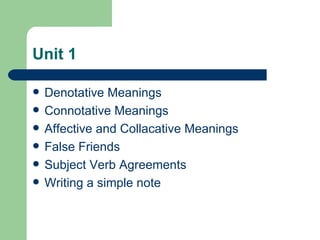
Unit 1 Denotative Meanings Connotative Meanings Affective and Collacative Meanings False Friends Subject Verb Agreements Writing a simple note
Denotation and Connotation  Denotation: this refers to the literal and primary meaning of a word—the definition that you would find in the dictionary Connotation: this refers to a commonly understood  subjective   cultural  and/or  emotional  association that some word or phrase carries, in addition to the word or phrase's explicit or literal  meaning , which is its  denotation .
Connotation  A connotation is frequently described as either positive or negative, with regards to its pleasing or displeasing emotional connection.  For example, a stubborn person may be described as being either  strong-willed  or  pig-headed ; although these have the same literal meaning ( stubborn ),  strong-willed  connotes admiration for the level of someone's will (a positive connotation), while  pig-headed  connotes frustration in dealing with someone (a negative connotation).
Denotation and Connotation Exercises on page 2 Classroom Activities on page 2 & 3
Attitude You can tell more about a sentence through the attitude that is being used  Words can be similar in denotative meanings but different in affective meanings (meanings that reveal different attitudes of the writer)
Classroom Activity Single woman  *bizarre Fossil  *resolute  Unique  *senior citizen Stubborn  *spinster Lick one’s boots Praise Flatter
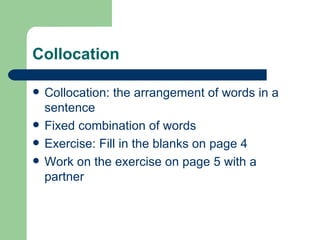
Collocation Collocation: the arrangement of words in a sentence  Fixed combination of words Exercise: Fill in the blanks on page 4 Work on the exercise on page 5 with a partner
False Friends False Friends are pair of words that are similar in appearance or pronunciation but different in meaning  We learn about false friends to avoid confusion Read conversation on page 5 & discuss Activity on page 6 together
Homework Write a correct story using the false friends found on page 6 Homework will be submitted next class

Successful writing. Lesson one.

  • 1.
  • 2.
    Unit 1 DenotativeMeanings Connotative Meanings Affective and Collacative Meanings False Friends Subject Verb Agreements Writing a simple note
  • 3.
    Denotation and Connotation Denotation: this refers to the literal and primary meaning of a word—the definition that you would find in the dictionary Connotation: this refers to a commonly understood subjective cultural and/or emotional association that some word or phrase carries, in addition to the word or phrase's explicit or literal meaning , which is its denotation .
  • 4.
    Connotation Aconnotation is frequently described as either positive or negative, with regards to its pleasing or displeasing emotional connection. For example, a stubborn person may be described as being either strong-willed or pig-headed ; although these have the same literal meaning ( stubborn ), strong-willed connotes admiration for the level of someone's will (a positive connotation), while pig-headed connotes frustration in dealing with someone (a negative connotation).
  • 5.
    Denotation and ConnotationExercises on page 2 Classroom Activities on page 2 & 3
  • 6.
    Attitude You cantell more about a sentence through the attitude that is being used Words can be similar in denotative meanings but different in affective meanings (meanings that reveal different attitudes of the writer)
  • 7.
    Classroom Activity Singlewoman *bizarre Fossil *resolute Unique *senior citizen Stubborn *spinster Lick one’s boots Praise Flatter
  • 8.
    Collocation Collocation: thearrangement of words in a sentence Fixed combination of words Exercise: Fill in the blanks on page 4 Work on the exercise on page 5 with a partner
  • 9.
    False Friends FalseFriends are pair of words that are similar in appearance or pronunciation but different in meaning We learn about false friends to avoid confusion Read conversation on page 5 & discuss Activity on page 6 together
  • 10.
    Homework Write acorrect story using the false friends found on page 6 Homework will be submitted next class

Editor's Notes

  • #3 *read the next two slides first before getting into the book
  • #6 *have a students read page two, stop at the exercise and do it as a class, keep reading and then get them to work in pairs on the classroom activities on page 2 & 3
  • #8 *give the class these words as a guideline for activity 1 and 2 on page 4
  • #9 *do the exercise on page 4 as a class, the exercises on page 5 with a partner
  • #10 *read the conversation on page five and discuss what the misunderstanding is within the conversation *get them to work in pairs for the activity on page 6 and take it up together as a class