TOWARDS A HETERODOX THEORY OF THE SPATIAL ECONOMY 
Heterodox Microeconomics: A Foundation for Urban Economic Theory
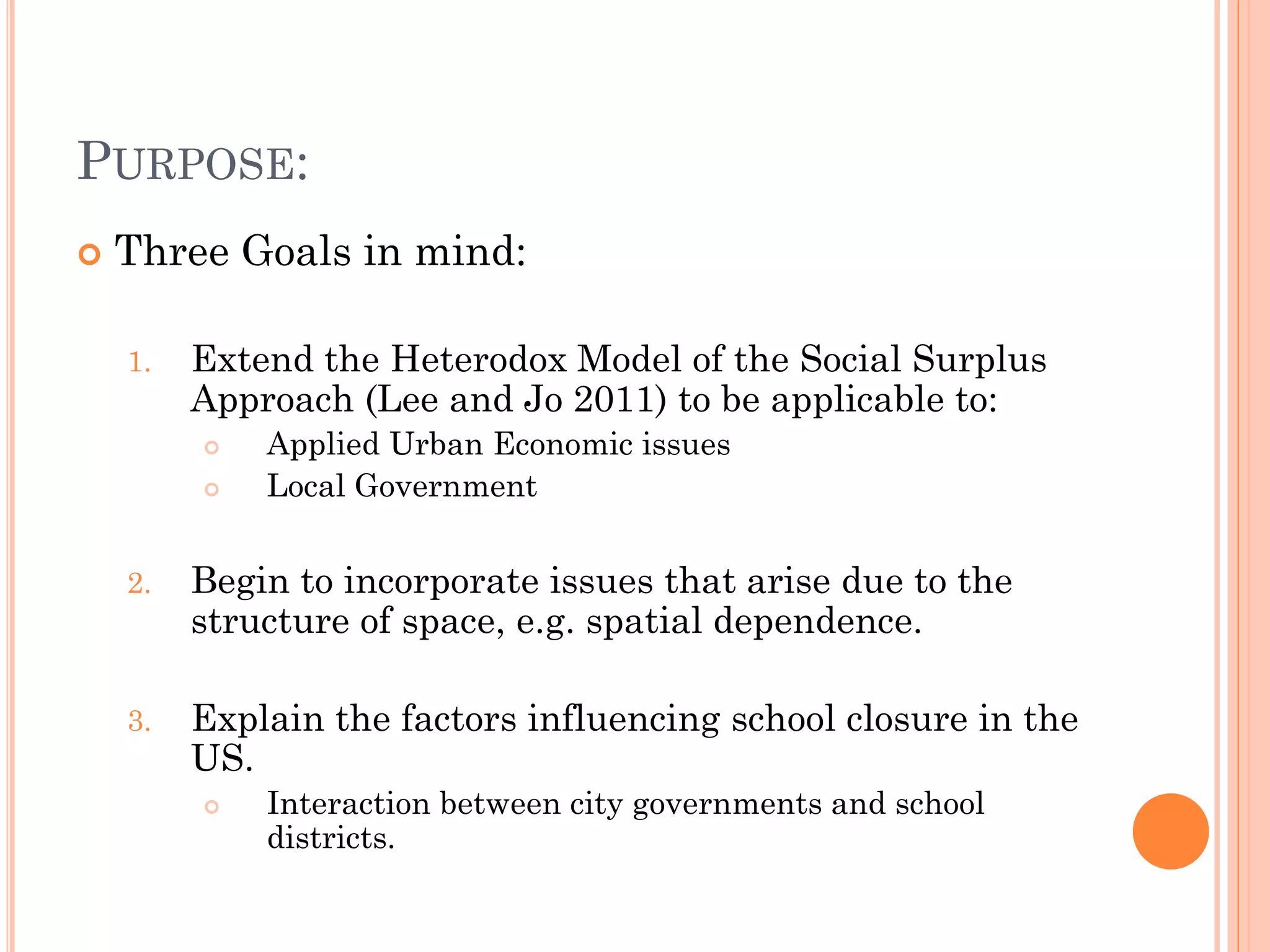
PURPOSE: 
Three Goals in mind: 
1.Extend the Heterodox Model of the Social Surplus Approach (Lee and Jo 2011) to be applicable to: 
Applied Urban Economic issues 
Local Government 
2.Begin to incorporate issues that arise due to the structure of space, e.g. spatial dependence. 
3.Explain the factors influencing school closure in the US. 
Interaction between city governments and school districts.
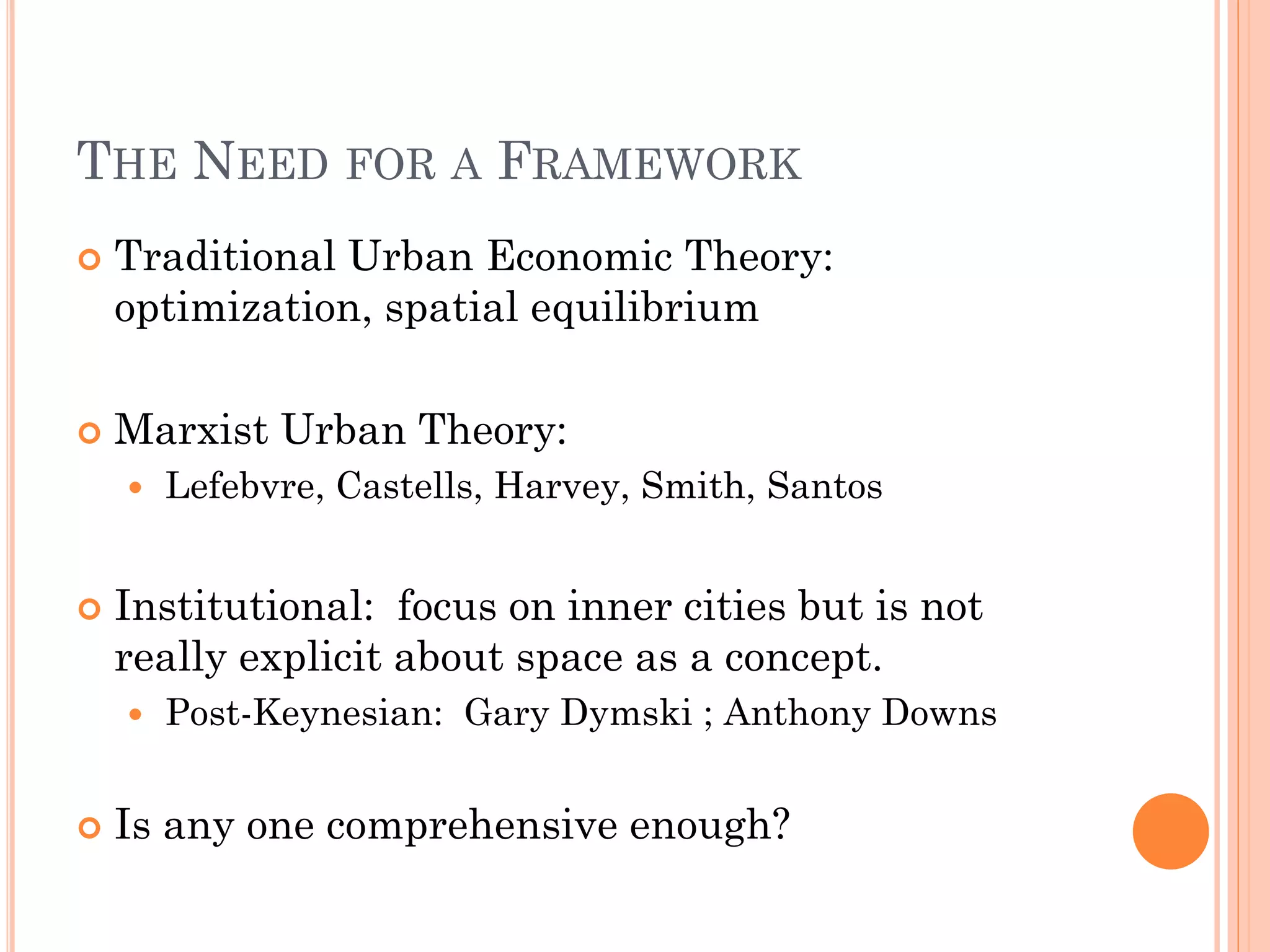
THE NEED FOR A FRAMEWORK 
Traditional Urban Economic Theory: optimization, spatial equilibrium 
Marxist Urban Theory: 
Lefebvre, Castells, Harvey, Smith, Santos 
Institutional: focus on inner cities but is not really explicit about space as a concept. 
Post-Keynesian: Gary Dymski ; Anthony Downs 
Is any one comprehensive enough?
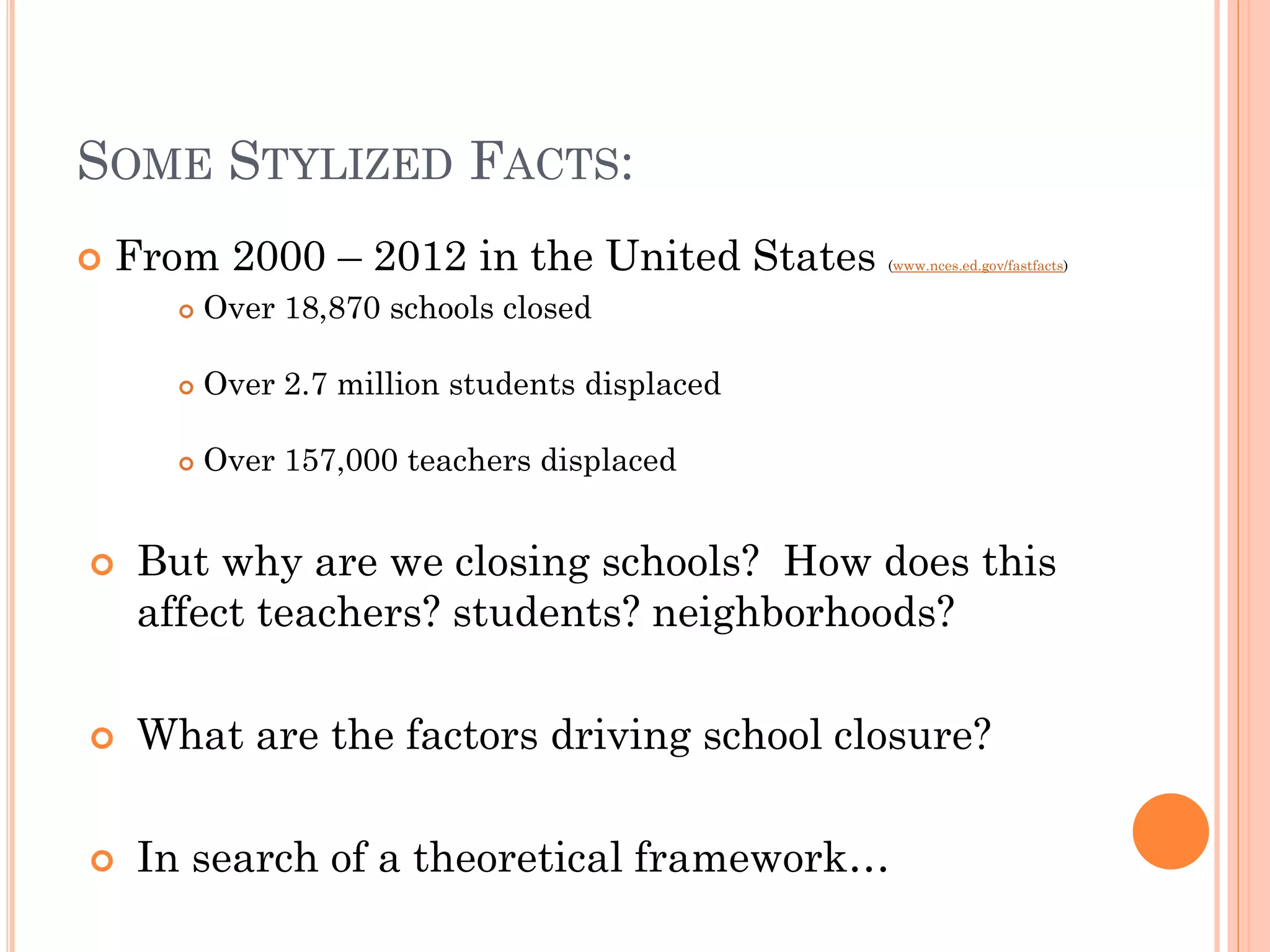
SOME STYLIZED FACTS: 
From 2000 – 2012 in the United States (www.nces.ed.gov/fastfacts) 
Over 18,870 schools closed 
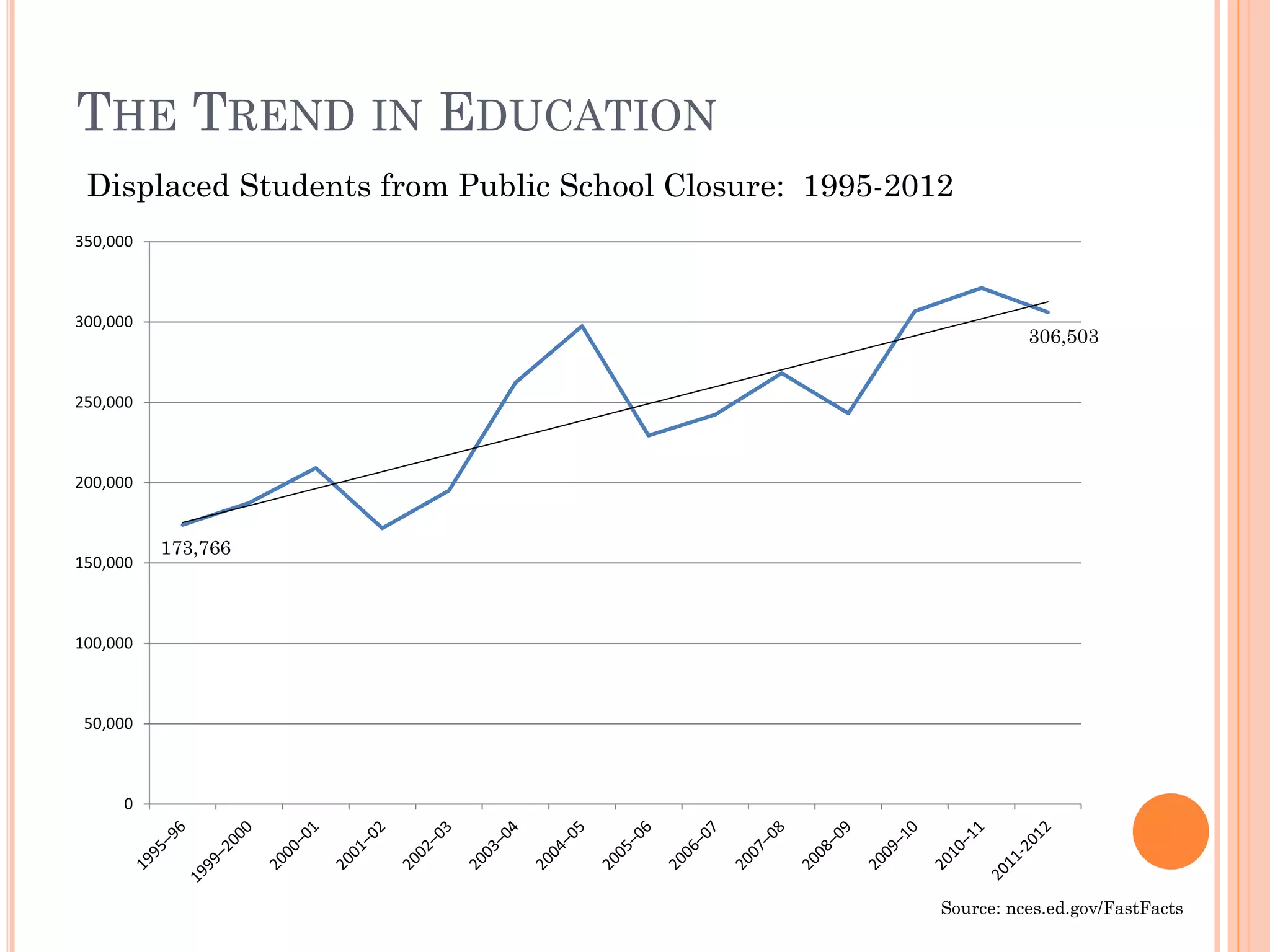
Over 2.7 million students displaced 
Over 157,000 teachers displaced 
But why are we closing schools? How does this affect teachers? students? neighborhoods? 
What are the factors driving school closure? 
In search of a theoretical framework…
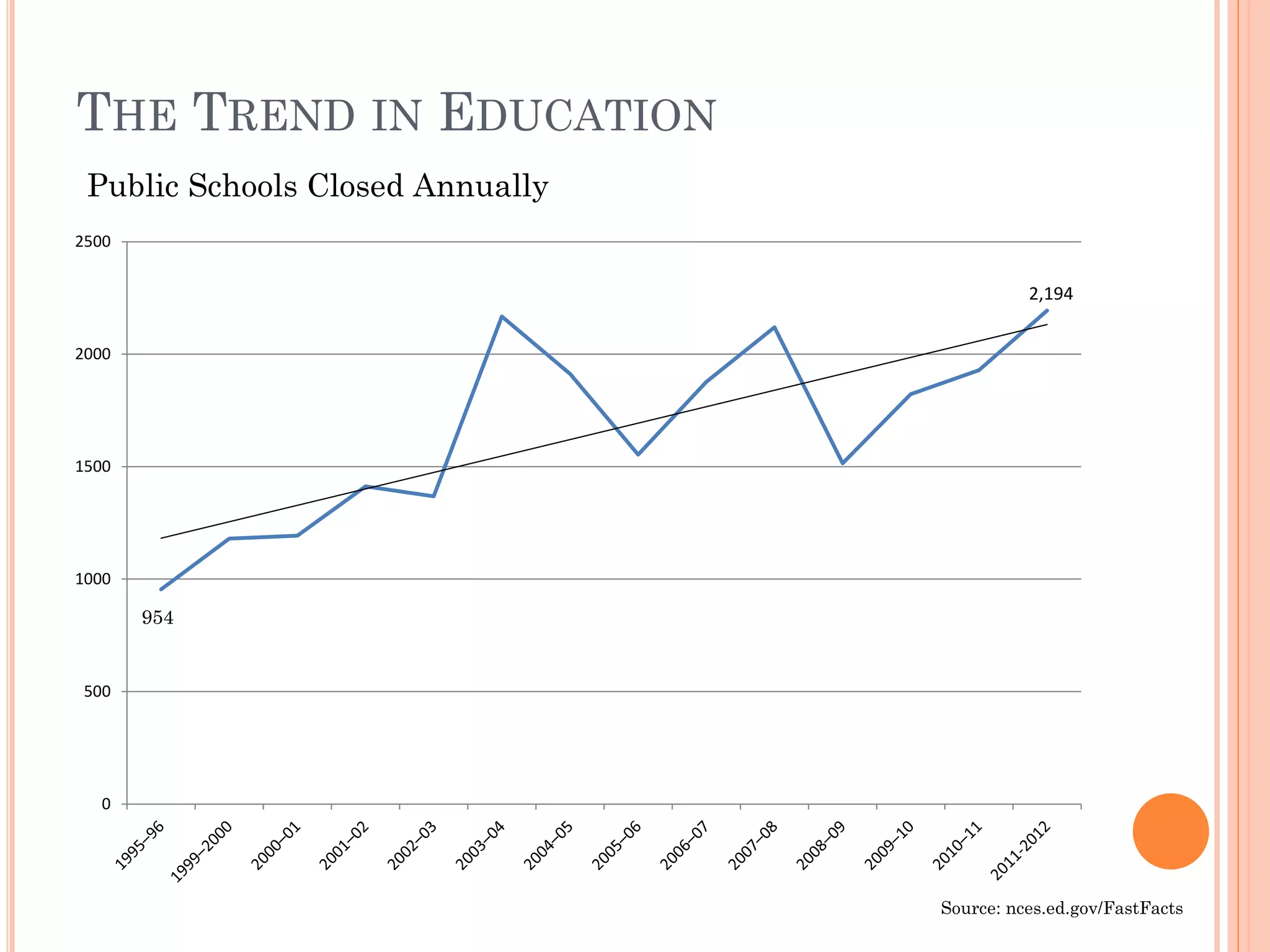
THE TREND IN EDUCATION 
0 
500 
1000 
1500 
2000 
2500 
2,194 
Public Schools Closed Annually 
Source: nces.ed.gov/FastFacts 
954
THE TREND IN EDUCATION 
Displaced Students from Public School Closure: 1995-2012 
Source: nces.ed.gov/FastFacts 
0 
50,000 
100,000 
150,000 
200,000 
250,000 
300,000 
350,000 
306,503 
173,766
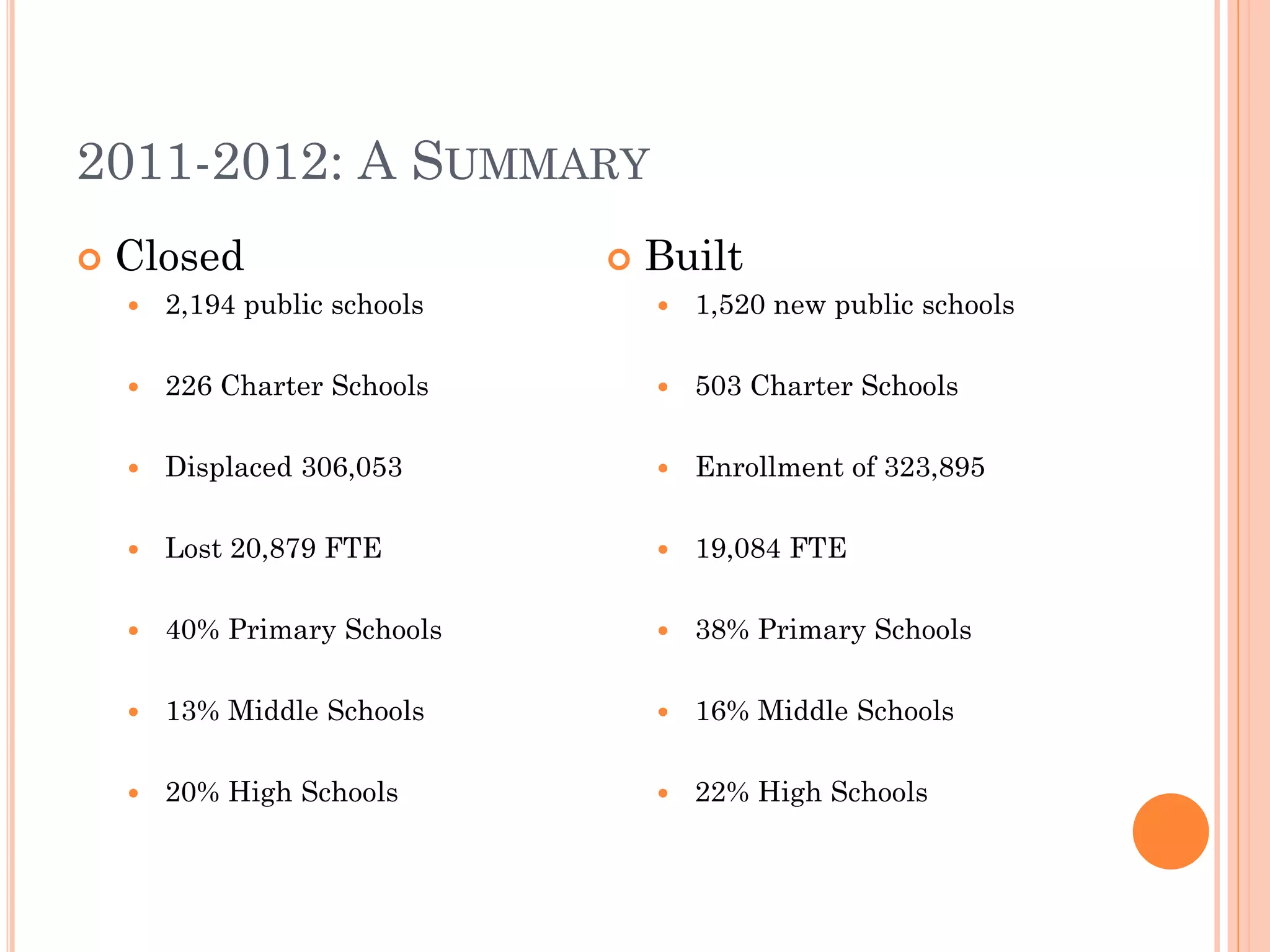
2011-2012: A SUMMARY 
Closed 
2,194 public schools 
226 Charter Schools 
Displaced 306,053 
Lost 20,879 FTE 
40% Primary Schools 
13% Middle Schools 
20% High Schools 
Built 
1,520 new public schools 
503 Charter Schools 
Enrollment of 323,895 
19,084 FTE 
38% Primary Schools 
16% Middle Schools 
22% High Schools
HISTORY & THEORY: A NEXUS 
All great theorists were once contemporary theorists 
Smith sought to describe a system of economic motion that was free of the tyranny of the Church or the State. 
Keynes sought to free economic theory – and his fellow economists – from the dogmatic view of a self- regulating society. 
Dr. Lee continues to try and rescue this great art from an “Incoherent Emperor” that took the consumer as its king and the individual as its sole force.
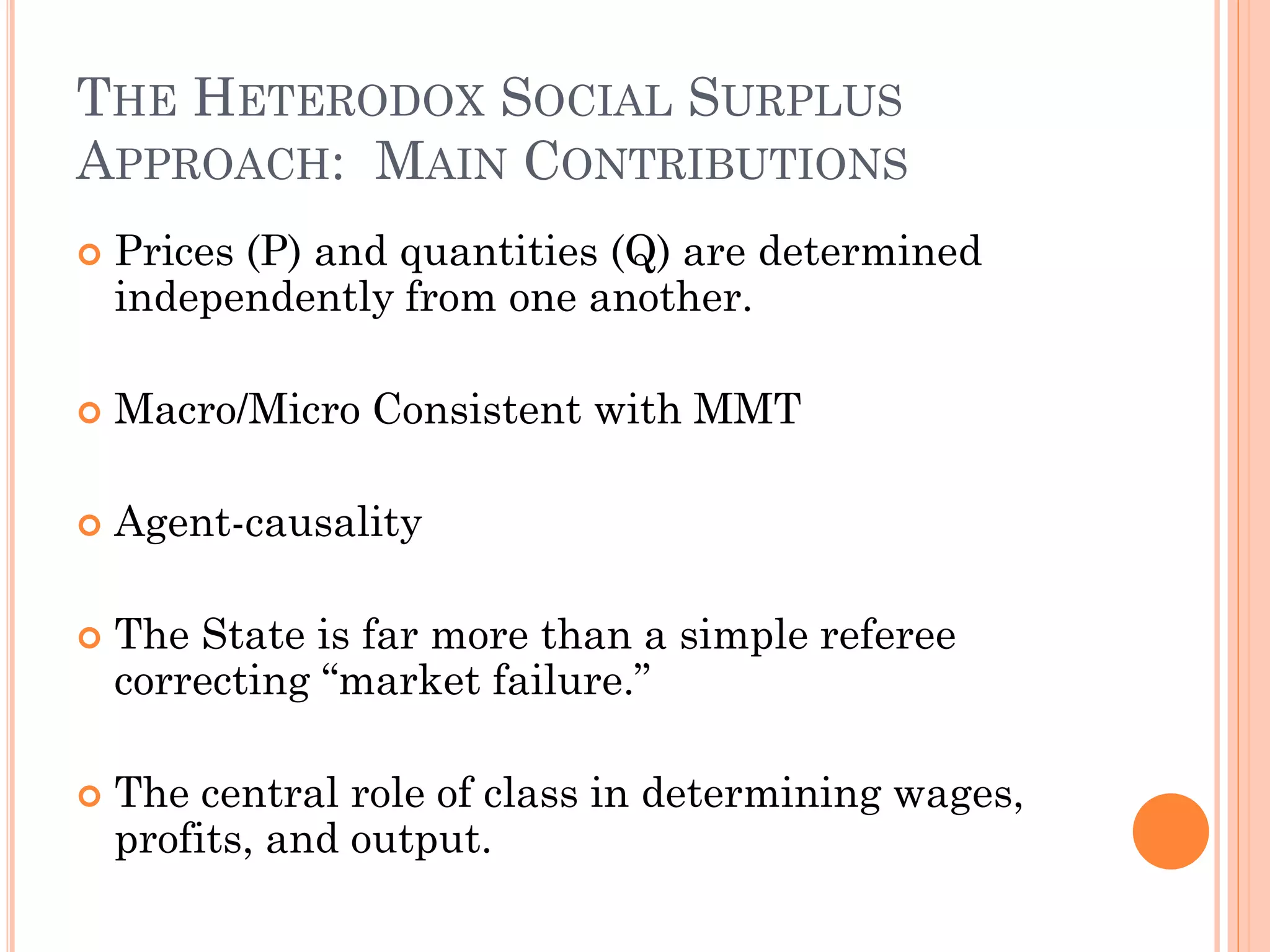
THE HETERODOX SOCIAL SURPLUS APPROACH: MAIN CONTRIBUTIONS 
Prices (P) and quantities (Q) are determined independently from one another. 
Macro/Micro Consistent with MMT 
Agent-causality 
The State is far more than a simple referee correcting “market failure.” 
The central role of class in determining wages, profits, and output.
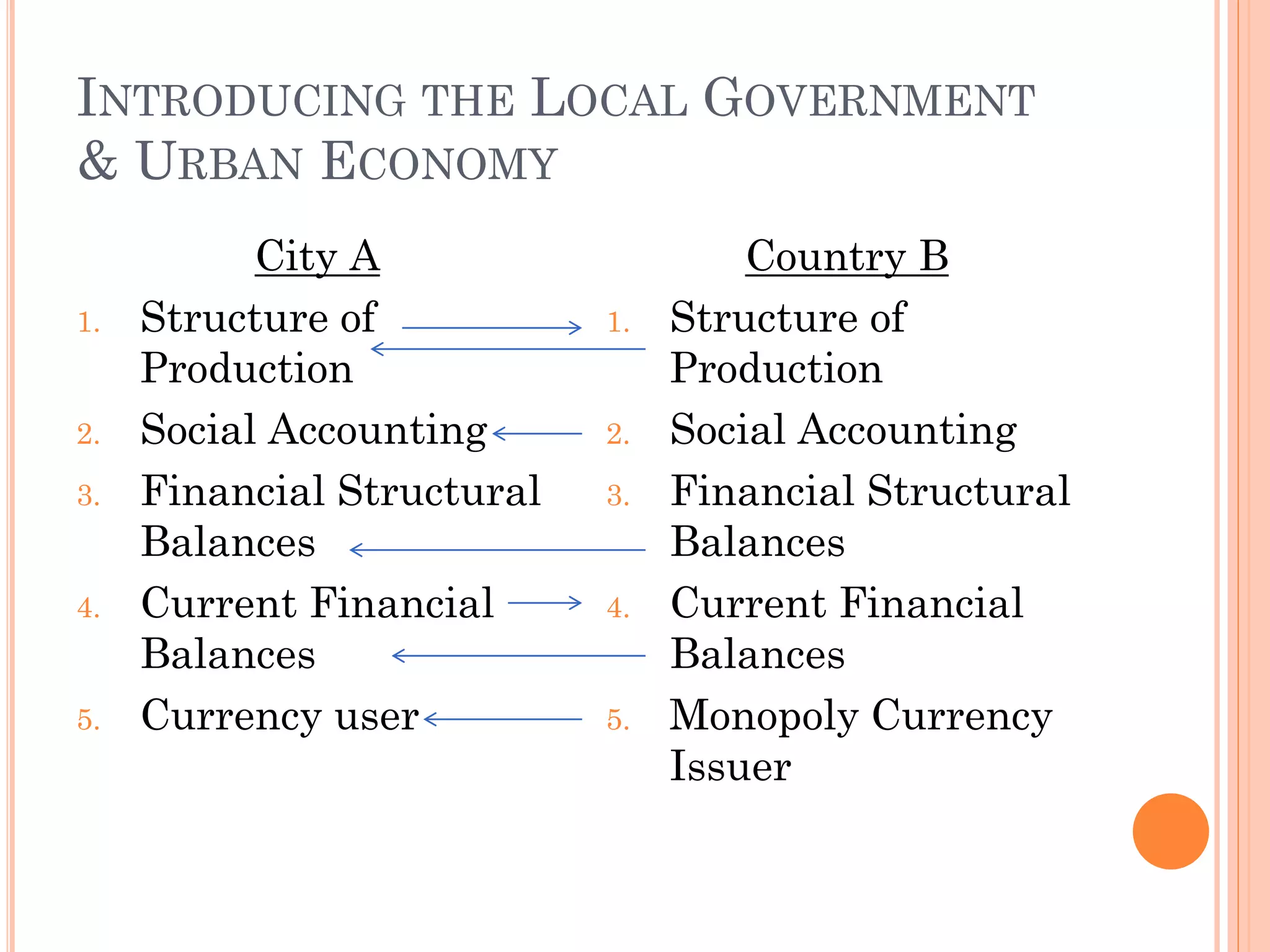
INTRODUCING THE LOCAL GOVERNMENT & URBAN ECONOMY 
City A 
1.Structure of Production 
2.Social Accounting 
3.Financial Structural Balances 
4.Current Financial Balances 
5.Currency user 
Country B 
1.Structure of Production 
2.Social Accounting 
3.Financial Structural Balances 
4.Current Financial Balances 
5.Monopoly Currency Issuer
THE STRUCTURE OF PRODUCTION WITHIN A CITY 
1.The cost of production is dependent upon local government services: 퐾 43,퐾 1,푅푅1,퐹퐴1,퐿퐵1: 퐺11푃1+퐿11푤 + 휋 → 푄1푃1 (1) [Basic] 
퐾 43,퐾 2 ,푅푅2,퐹퐴2,퐿퐵2: 퐺21푃1+퐿21푤 + 휋→ 푄2푃2 (2) [Surplus] 
Local Government (including county, school board, etc.) has policy space to address prices, wages, and profits. 
No smokestack chasing! Invest in the local economy. 
Infrastructure spending 푃푖↓ and/or ↑ 휋 via mark-up 
Invest in education, including early child-hood ed. 
Local min. wage policies
SOCIAL ACCOUNTING IN THE CITY 
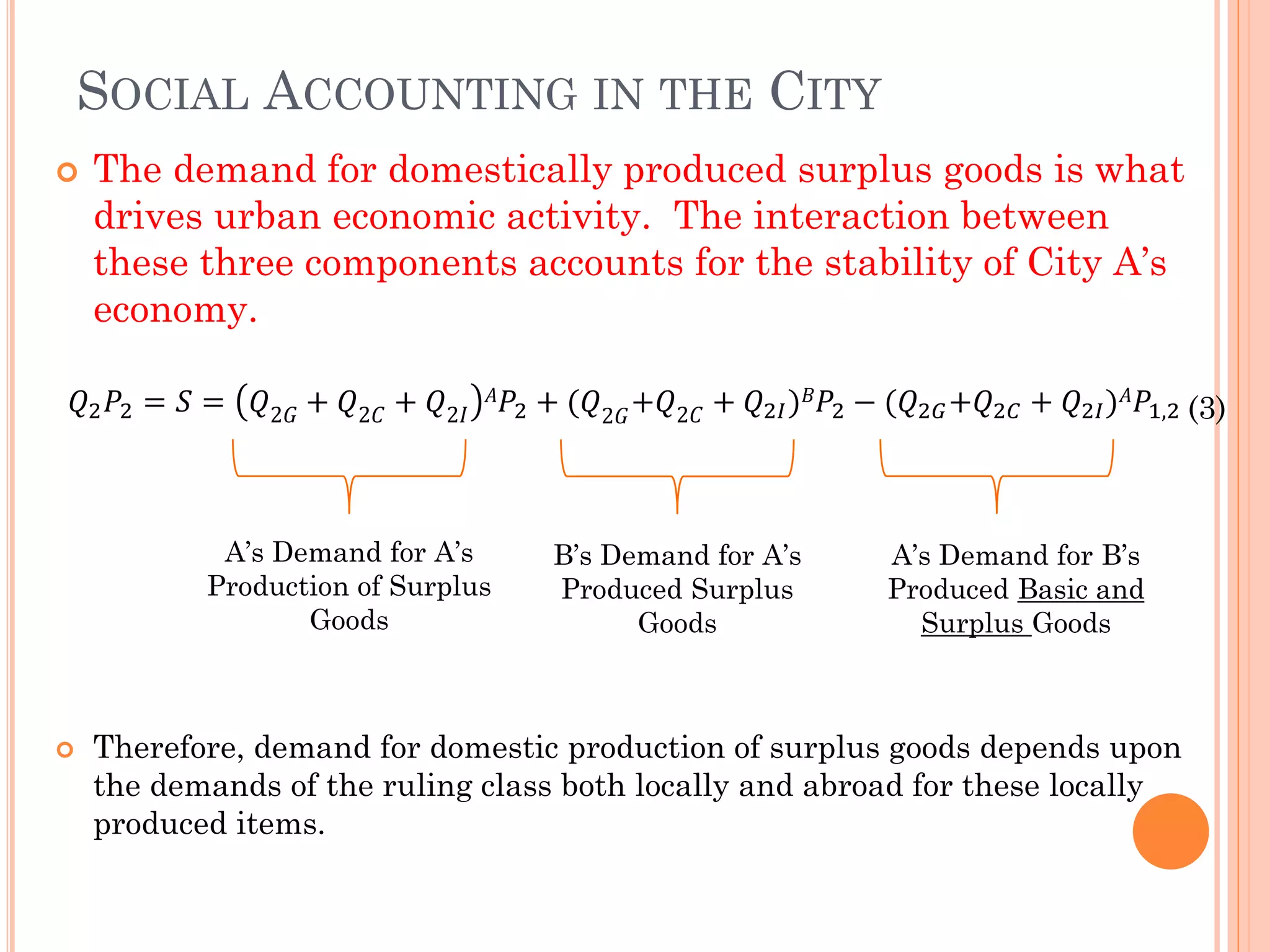
The demand for domestically produced surplus goods is what drives urban economic activity. The interaction between these three components accounts for the stability of City A’s economy. 푄2푃2=푆=푄2퐺+푄2퐶+푄2퐼 퐴푃2+(푄2퐺+푄2퐶+푄2퐼)퐵푃2−(푄2퐺+푄2퐶+푄2퐼)퐴푃1,2 
Therefore, demand for domestic production of surplus goods depends upon the demands of the ruling class both locally and abroad for these locally produced items. A’s Demand for A’s Production of Surplus Goods 
B’s Demand for A’s Produced Surplus 
Goods 
A’s Demand for B’s Produced Basic and Surplus Goods (3)
DYMSKI’S FINANCIAL FLOWS 
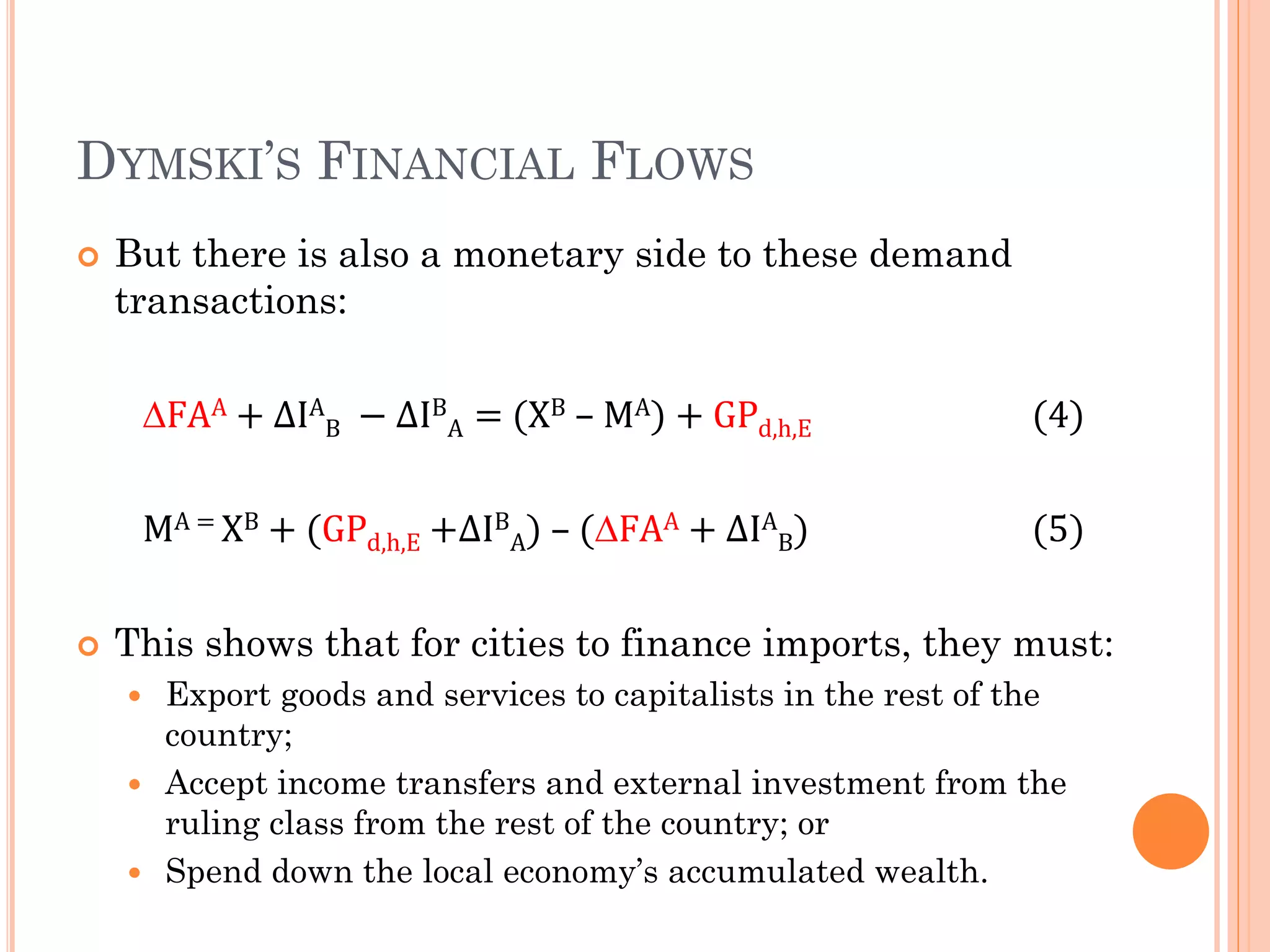
But there is also a monetary side to these demand transactions: 
ΔFAA+ΔIAB −ΔIBA= (XB – MA) + GPd,h,E (4) 
MA = XB + (GPd,h,E +ΔIBA) – (ΔFAA+ΔIAB) (5) 
This shows that for cities to finance imports, they must: 
Export goods and services to capitalists in the rest of the country; 
Accept income transfers and external investment from the ruling class from the rest of the country; or 
Spend down the local economy’s accumulated wealth.
MODERN MONEY IN THE CITY 
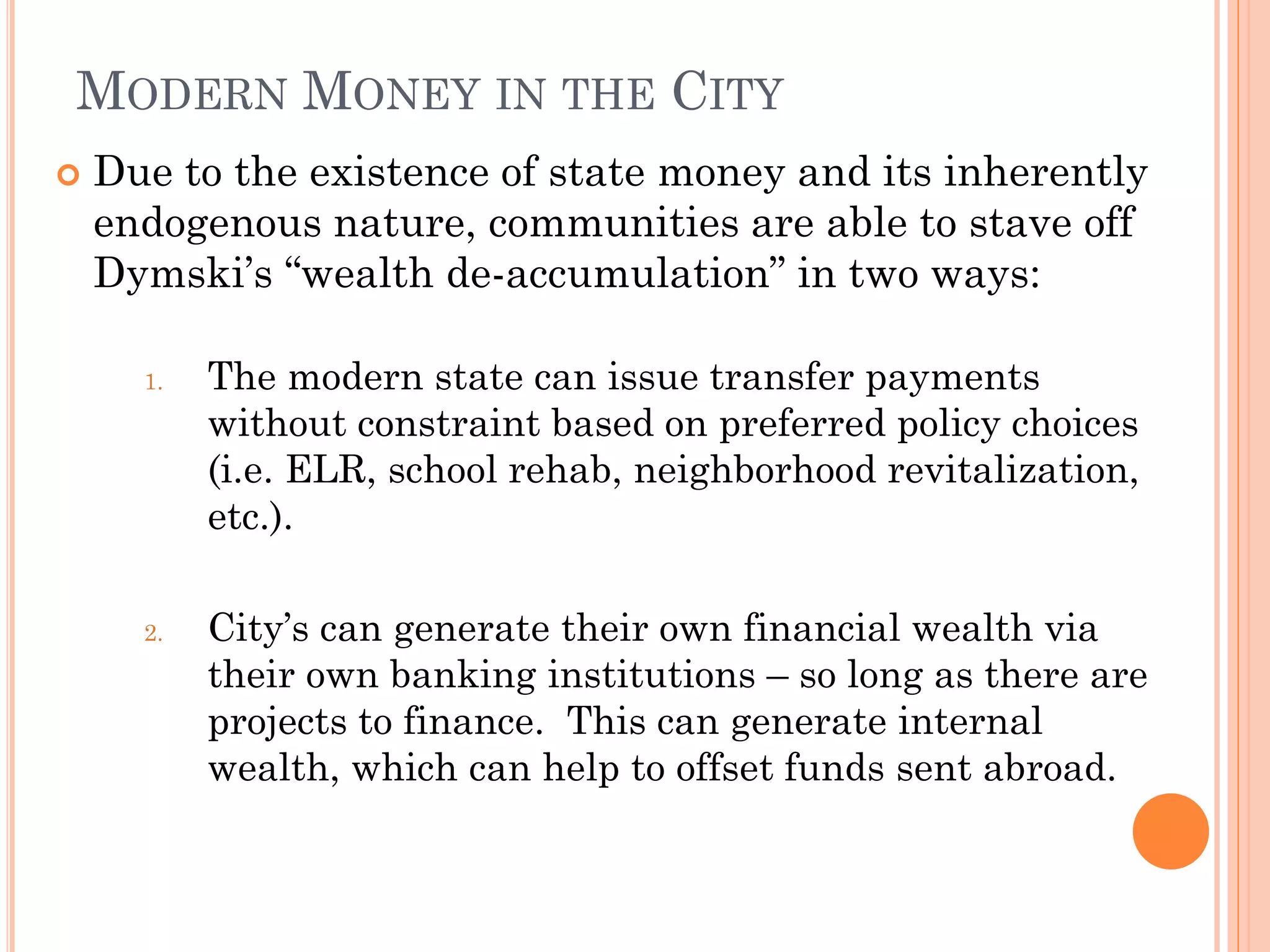
Due to the existence of state money and its inherently endogenous nature, communities are able to stave off Dymski’s “wealth de-accumulation” in two ways: 
1.The modern state can issue transfer payments without constraint based on preferred policy choices (i.e. ELR, school rehab, neighborhood revitalization, etc.). 
2.City’s can generate their own financial wealth via their own banking institutions – so long as there are projects to finance. This can generate internal wealth, which can help to offset funds sent abroad.
OUTPUT & EMPLOYMENT IN THE CITY 
Given the Leontief/Sraffian system, a change in S will lead to an even greater change in 푄1in the same direction. 푄1=[I-A11T]-1A21TS (6) 
L* = 푙푇 1 [I-A11T]-1A21TS + 푙푇 1S + LBanks (7) 
As the A matrix is based on the G matrix, which is augmented by the level of local investment in infrastructure (at ever improving vintages of technology), the maximum eigenvalue will fall faster as S is maintained and/or increased over repeated production cycles. 
Given that output and employment are tied to S, we can conclude that urban employment is dependent upon the decisions of the local ruling class plus the ruling class of the country as a whole. 
This same result also means that the ruling classes establish the network linkages to other cities within the country. 
Given that all output, wages, and profits are in State-money prices, and given that the ruling class governs both the control of State-money and of state investment decisions at all levels of government, the fate of a city can be held captive by the willful decisions of the ruling class outside the city – as is often the case for smaller more rural communities. This is applicable across space within a city as well, depending on the degree of dependency.
A BRIEF SUMMARY OF EXTENSIONS THUS FAR 
퐾 43,퐾 1,푅푅1,퐹퐴1,퐿퐵1: 퐺11푃1+퐿11푤 + 휋 → 푄1푃1 (1) 
퐾 43,퐾 2 ,푅푅2,퐹퐴2,퐿퐵2: 퐺21푃1+퐿21푤 + 휋→ 푄2푃2 (2) 
푄2푃2=푆=XB −MA+G (3) 
ΔFAA+ΔIAB −ΔIBA= (XB – MA) + GPd,h,E (4) 
MA = XB + (GPd,h,E +IBA) – (FAA+IAB) (5) 
푄1=[I-A11T]-1A21TS (6) 
L* = 푙푇 1 [I-A11T]-1A21TS + 푙푇 1S + LBank (7) 
Basic Goods 
Surplus Goods 
Urban Networks 
Urban Trade Flow Condition 
Dymski Condition 
Output of Basic Goods 
Employment Model
INITIAL TAKEAWAYS FROM THE MODEL 
Economic Development Policy: 
City’s have far more potential policy space than tends to be assumed. 
Invest in infrastructure, education, new technologies (e.g. Google fiber), and potentially look to set local wage policies. 
Output and Employment within the urban economy is subject to the desires of its local and external ruling classes. These interests do not necessarily need to be in-line. 
These ruling class elites also control the connections and flows of information between other cities.
HOW DOES SPATIAL STRUCTURE FIT IN?
THE PIN FACTORY HOPEFULLY HAD AN ADDRESS! 
The production of Space
HENRI LEFEBVRE: THE PRODUCTION OF SPACE 
“…social space is socially produced.” 
“every society produces a space, its own space.” 
“Social relations, which are concrete abstractions, have no real existence save in and through space. Their underpinning is spatial.”
LEFEBVRE 
The Pin Factory was real. It had an address. 
Space is produced & therefore has a history 
Implication, space is managed 
Managed by whom? For whom?
WHY SPACE MATTERS 
Networks that spread information 
Contagious/Diffusive – the disasterous effects of perceptions of “disorder.” 
Heterogeneity 
All production and consumption occurs within socially constructed spaces. Cities impose upon that space, via the administrative elite, rules and regulations that allocate and then distribute spatial rights. 
Space is fundamentally another structure that affects production. The ability to re-shape it so as to meet the needs of production – or investment – is critical to success.
SPATIAL CONTROL AND THE CLOSURE DECISION 
Locations of Agency within the model 
Two institutions that dominate the urban spatial landscape: the City and the School District 
How do we incorporate their interaction – or lack thereof – into the model?
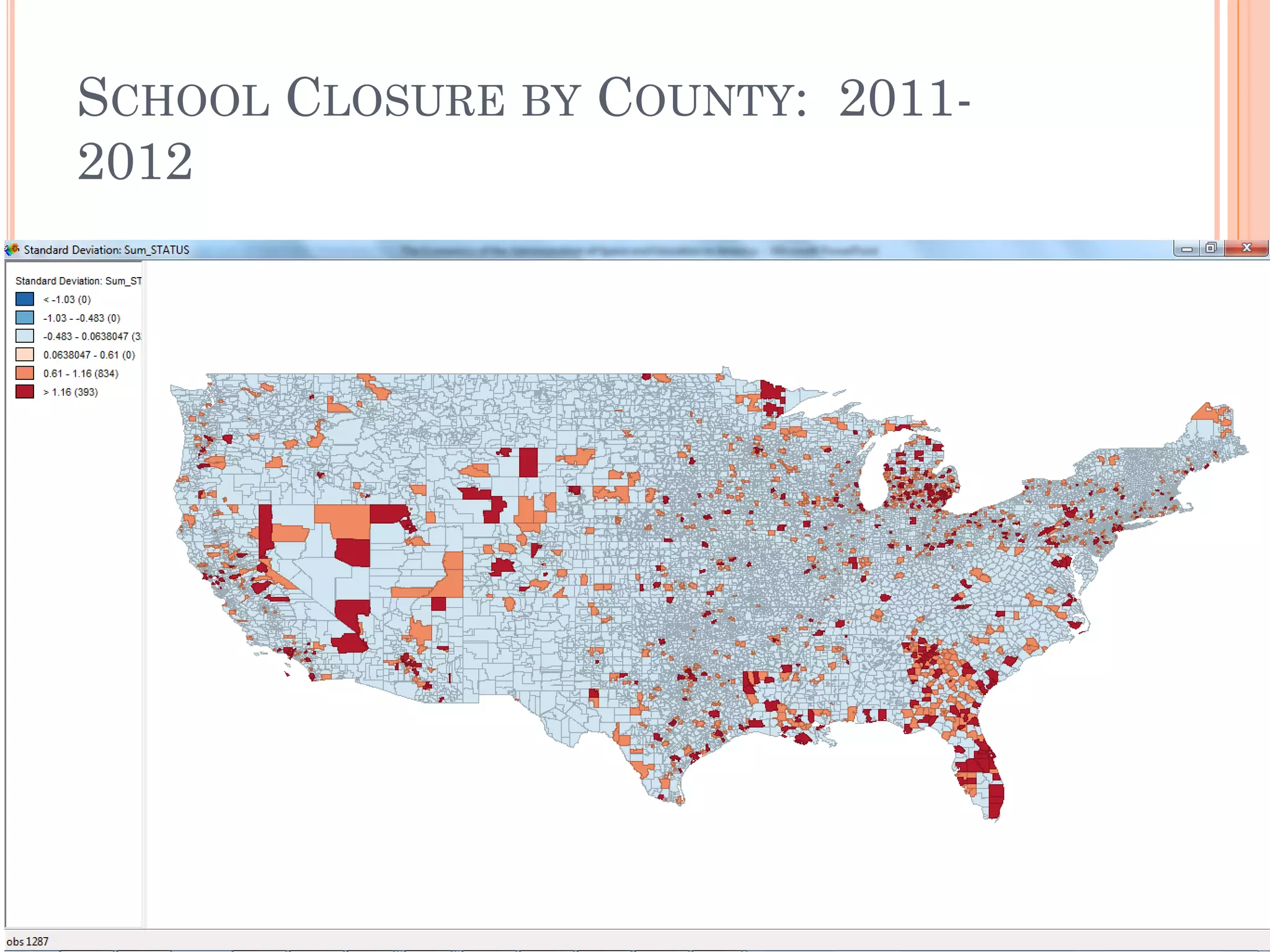
SCHOOL CLOSURE BY COUNTY: 2011- 2012
A DYNAMIC STORY OF SPATIAL RE- ORGANZATION? 
All space is owned in the US. 
Most privately held space is financed, meaning it is owned by interests in financial institutions. 
Space is regulated by local governments and the causal mechanisms through which agents alter spatial segments. 
Therefore space is organized to ensure higher returns. 
As time proceeds, the rates of profit within a community on space falls. 
Space must be re-organized. Old space must be made into new space.
FACTORS DRIVING SCHOOL CLOSURE: 
2008-2009 
Logistic regression Number of obs = 83760 
Wald chi2(11) = 435.07 
Prob > chi2 = 0.0000 
Log pseudolikelihood = -4953.5763 Pseudo R2 = 0.1081 
(Std. Err. adjusted for 12257 clusters in stid08) 
------------------------------------------------------------------------------ 
| Robust 
Closed | Odds Ratio Std. Err. z P>|z| [95% Conf. Interval] 
-------------+---------------------------------------------------------------- 
fte08 | .9304691 .0046535 -14.41 0.000 .921393 .9396345*** 
titlei08 | .9625282 .100877 -0.36 0.716 .7837976 1.182015 
chartr08 | .8487812 .1397205 -1.00 0.319 .6147192 1.171965 
HISPPCT | 1.004919 .0020588 2.40 0.017 1.000892 1.008963** 
BLACKPCT | 1.013971 .0017002 8.27 0.000 1.010644 1.017308*** 
ulocal1 | 1.063835 .22252 0.30 0.767 .7060415 1.602943 
ulocal2 | .9826764 .2467171 -0.07 0.945 .6007619 1.60738 
ulocal3 | 1.864095 .4264939 2.72 0.006 1.190469 2.918891*** 
ulocal4 | 1.103108 .1537998 0.70 0.482 .8393438 1.449759 
ulocal7 | 1.197396 .217458 0.99 0.321 .8387868 1.709321 
ulocal10 | .8191589 .1100281 -1.49 0.138 .6295585 1.06586 
_cons | .0421768 .0053566 -24.93 0.000 .0328827 .0540978*** 
------------------------------------------------------------------------------ 
Smaller central cities ( < 100,000), slightly skewed toward minority 
schools.
FACTORS DRIVING SCHOOL 
CONSTRUCTION: 2008-2009 
Logistic regression Number of obs = 83760 
Wald chi2(11) = 1045.97 
Prob > chi2 = 0.0000 
Log pseudolikelihood = -5647.5458 Pseudo R2 = 0.1176 
(Std. Err. adjusted for 12257 clusters in stid08) 
------------------------------------------------------------------------------ 
| Robust 
New | Odds Ratio Std. Err. z P>|z| [95% Conf. Interval] 
-------------+---------------------------------------------------------------- 
fte08 | .9720276 .0027112 -10.17 0.000 .9667282 .977356*** 
titlei08 | .3518723 .0323725 -11.35 0.000 .293815 .4214017*** 
chartr08 | 4.342266 .4338637 14.70 0.000 3.569993 5.281599*** 
HISPPCT | 1.016806 .0013472 12.58 0.000 1.014169 1.01945*** 
BLACKPCT | 1.013122 .0014065 9.39 0.000 1.010369 1.015882*** 
ulocal1 | 1.162444 .1453408 1.20 0.229 .9097997 1.485244 
ulocal2 | .9936273 .1595202 -0.04 0.968 .7253854 1.361063 
ulocal3 | .954336 .2535298 -0.18 0.860 .5669834 1.606321 
ulocal4 | 1.076797 .1221828 0.65 0.514 .8620831 1.344989 
ulocal7 | 1.137618 .2157903 0.68 0.497 .7843963 1.6499 
ulocal10 | 2.996785 .2942182 11.18 0.000 2.472215 3.63266*** 
_cons | .020951 .0019555 -41.42 0.000 .0174485 .0251566 
------------------------------------------------------------------------------ 
Non-federally funded through Title 1. Strong presence of Charter schools. 
Located in rural areas within five miles of an urbanized area.
FACTORS DRIVING SCHOOL CLOSURE: 2011-2012 
Logistic regression Number of obs = 80917 
Wald chi2(11) = 515.84 
Prob > chi2 = 0.0000 
Log pseudolikelihood = -5327.4963 Pseudo R2 = 0.1120 
(Std. Err. adjusted for 12373 clusters in stid) 
------------------------------------------------------------------------------ 
| Robust 
Closed | Odds Ratio Std. Err. z P>|z| [95% Conf. Interval] 
-------------+---------------------------------------------------------------- 
fte | .9277881 .0040424 -17.20 0.000 .919899 .9357449*** 
titlei | .9188991 .0804422 -0.97 0.334 .7740198 1.090897 
chartr | 1.641101 .2209695 3.68 0.000 1.260444 2.136718*** 
HISPPCT | .9950249 .0023623 -2.10 0.036 .9904057 .9996657** 
BLACKPCT | 1.01518 .0016256 9.41 0.000 1.011999 1.018371*** 
ulocal11 | 1.222924 .2442028 1.01 0.314 .8268464 1.80873 
ulocal12 | 1.686955 .3008436 2.93 0.003 1.189335 2.392779*** 
ulocal13 | 1.188237 .1792946 1.14 0.253 .8840245 1.597137 
ulocal21 | 1.014854 .1298852 0.12 0.908 .7897016 1.304199 
ulocal31 | 1.086921 .275931 0.33 0.743 .6608572 1.787673 
ulocal41 | 1.112418 .1326646 0.89 0.372 .8805533 1.405337 
_cons | .0235065 .007057 -12.49 0.000 .013051 .0423381 
------------------------------------------------------------------------------ 
Charter schools in the Urban Core of mid-sized Metros
FACTORS DRIVING SCHOOL CONSTRUCTION: 
2011-2012 
Logistic regression Number of obs = 80917 
Wald chi2(11) = 607.44 
Prob > chi2 = 0.0000 
Log pseudolikelihood = -3990.099 Pseudo R2 = 0.1402 
(Std. Err. adjusted for 12373 clusters in stid) 
------------------------------------------------------------------------------ 
| Robust 
New | Odds Ratio Std. Err. z P>|z| [95% Conf. Interval] 
-------------+---------------------------------------------------------------- 
fte | .9530533 .0043783 -10.47 0.000 .9445105 .9616733*** 
titlei | 2.400399 .2452979 8.57 0.000 1.964712 2.932704*** 
chartr | .2024001 .0249385 -12.97 0.000 .1589757 .2576859*** 
HISPPCT | 1.007996 .0021545 3.73 0.000 1.003782 1.012227*** 
BLACKPCT | 1.010103 .0016087 6.31 0.000 1.006955 1.01326*** 
ulocal11 | 1.665956 .272162 3.12 0.002 1.209499 2.294677*** 
ulocal12 | 1.379295 .2940517 1.51 0.131 .9082174 2.094714 
ulocal13 | 1.358901 .22997 1.81 0.070 .9752975 1.893384 
ulocal21 | 1.391157 .197376 2.33 0.020 1.053437 1.837147** 
ulocal31 | 1.792355 .6017819 1.74 0.082 .928183 3.461101 
ulocal41 | 2.317466 .3053464 6.38 0.000 1.790029 3.000313*** 
_cons | .0922707 .0269121 -8.17 0.000 .0520953 .1634289*** 
------------------------------------------------------------------------------ 
Title 1 funded schools in large urban centers and rural fringe.

TOWARDS A HETERODOX THEORY OF THE SPATIAL ECONOMY

  • 1.
    TOWARDS A HETERODOXTHEORY OF THE SPATIAL ECONOMY Heterodox Microeconomics: A Foundation for Urban Economic Theory
  • 2.
    PURPOSE: Three Goalsin mind: 1.Extend the Heterodox Model of the Social Surplus Approach (Lee and Jo 2011) to be applicable to: Applied Urban Economic issues Local Government 2.Begin to incorporate issues that arise due to the structure of space, e.g. spatial dependence. 3.Explain the factors influencing school closure in the US. Interaction between city governments and school districts.
  • 3.
    THE NEED FORA FRAMEWORK Traditional Urban Economic Theory: optimization, spatial equilibrium Marxist Urban Theory: Lefebvre, Castells, Harvey, Smith, Santos Institutional: focus on inner cities but is not really explicit about space as a concept. Post-Keynesian: Gary Dymski ; Anthony Downs Is any one comprehensive enough?
  • 4.
    SOME STYLIZED FACTS: From 2000 – 2012 in the United States (www.nces.ed.gov/fastfacts) Over 18,870 schools closed Over 2.7 million students displaced Over 157,000 teachers displaced But why are we closing schools? How does this affect teachers? students? neighborhoods? What are the factors driving school closure? In search of a theoretical framework…
  • 5.
    THE TREND INEDUCATION 0 500 1000 1500 2000 2500 2,194 Public Schools Closed Annually Source: nces.ed.gov/FastFacts 954
  • 6.
    THE TREND INEDUCATION Displaced Students from Public School Closure: 1995-2012 Source: nces.ed.gov/FastFacts 0 50,000 100,000 150,000 200,000 250,000 300,000 350,000 306,503 173,766
  • 7.
    2011-2012: A SUMMARY Closed 2,194 public schools 226 Charter Schools Displaced 306,053 Lost 20,879 FTE 40% Primary Schools 13% Middle Schools 20% High Schools Built 1,520 new public schools 503 Charter Schools Enrollment of 323,895 19,084 FTE 38% Primary Schools 16% Middle Schools 22% High Schools
  • 8.
    HISTORY & THEORY:A NEXUS All great theorists were once contemporary theorists Smith sought to describe a system of economic motion that was free of the tyranny of the Church or the State. Keynes sought to free economic theory – and his fellow economists – from the dogmatic view of a self- regulating society. Dr. Lee continues to try and rescue this great art from an “Incoherent Emperor” that took the consumer as its king and the individual as its sole force.
  • 9.
    THE HETERODOX SOCIALSURPLUS APPROACH: MAIN CONTRIBUTIONS Prices (P) and quantities (Q) are determined independently from one another. Macro/Micro Consistent with MMT Agent-causality The State is far more than a simple referee correcting “market failure.” The central role of class in determining wages, profits, and output.
  • 10.
    INTRODUCING THE LOCALGOVERNMENT & URBAN ECONOMY City A 1.Structure of Production 2.Social Accounting 3.Financial Structural Balances 4.Current Financial Balances 5.Currency user Country B 1.Structure of Production 2.Social Accounting 3.Financial Structural Balances 4.Current Financial Balances 5.Monopoly Currency Issuer
  • 11.
    THE STRUCTURE OFPRODUCTION WITHIN A CITY 1.The cost of production is dependent upon local government services: 퐾 43,퐾 1,푅푅1,퐹퐴1,퐿퐵1: 퐺11푃1+퐿11푤 + 휋 → 푄1푃1 (1) [Basic] 퐾 43,퐾 2 ,푅푅2,퐹퐴2,퐿퐵2: 퐺21푃1+퐿21푤 + 휋→ 푄2푃2 (2) [Surplus] Local Government (including county, school board, etc.) has policy space to address prices, wages, and profits. No smokestack chasing! Invest in the local economy. Infrastructure spending 푃푖↓ and/or ↑ 휋 via mark-up Invest in education, including early child-hood ed. Local min. wage policies
  • 12.
    SOCIAL ACCOUNTING INTHE CITY The demand for domestically produced surplus goods is what drives urban economic activity. The interaction between these three components accounts for the stability of City A’s economy. 푄2푃2=푆=푄2퐺+푄2퐶+푄2퐼 퐴푃2+(푄2퐺+푄2퐶+푄2퐼)퐵푃2−(푄2퐺+푄2퐶+푄2퐼)퐴푃1,2 Therefore, demand for domestic production of surplus goods depends upon the demands of the ruling class both locally and abroad for these locally produced items. A’s Demand for A’s Production of Surplus Goods B’s Demand for A’s Produced Surplus Goods A’s Demand for B’s Produced Basic and Surplus Goods (3)
  • 13.
    DYMSKI’S FINANCIAL FLOWS But there is also a monetary side to these demand transactions: ΔFAA+ΔIAB −ΔIBA= (XB – MA) + GPd,h,E (4) MA = XB + (GPd,h,E +ΔIBA) – (ΔFAA+ΔIAB) (5) This shows that for cities to finance imports, they must: Export goods and services to capitalists in the rest of the country; Accept income transfers and external investment from the ruling class from the rest of the country; or Spend down the local economy’s accumulated wealth.
  • 14.
    MODERN MONEY INTHE CITY Due to the existence of state money and its inherently endogenous nature, communities are able to stave off Dymski’s “wealth de-accumulation” in two ways: 1.The modern state can issue transfer payments without constraint based on preferred policy choices (i.e. ELR, school rehab, neighborhood revitalization, etc.). 2.City’s can generate their own financial wealth via their own banking institutions – so long as there are projects to finance. This can generate internal wealth, which can help to offset funds sent abroad.
  • 15.
    OUTPUT & EMPLOYMENTIN THE CITY Given the Leontief/Sraffian system, a change in S will lead to an even greater change in 푄1in the same direction. 푄1=[I-A11T]-1A21TS (6) L* = 푙푇 1 [I-A11T]-1A21TS + 푙푇 1S + LBanks (7) As the A matrix is based on the G matrix, which is augmented by the level of local investment in infrastructure (at ever improving vintages of technology), the maximum eigenvalue will fall faster as S is maintained and/or increased over repeated production cycles. Given that output and employment are tied to S, we can conclude that urban employment is dependent upon the decisions of the local ruling class plus the ruling class of the country as a whole. This same result also means that the ruling classes establish the network linkages to other cities within the country. Given that all output, wages, and profits are in State-money prices, and given that the ruling class governs both the control of State-money and of state investment decisions at all levels of government, the fate of a city can be held captive by the willful decisions of the ruling class outside the city – as is often the case for smaller more rural communities. This is applicable across space within a city as well, depending on the degree of dependency.
  • 16.
    A BRIEF SUMMARYOF EXTENSIONS THUS FAR 퐾 43,퐾 1,푅푅1,퐹퐴1,퐿퐵1: 퐺11푃1+퐿11푤 + 휋 → 푄1푃1 (1) 퐾 43,퐾 2 ,푅푅2,퐹퐴2,퐿퐵2: 퐺21푃1+퐿21푤 + 휋→ 푄2푃2 (2) 푄2푃2=푆=XB −MA+G (3) ΔFAA+ΔIAB −ΔIBA= (XB – MA) + GPd,h,E (4) MA = XB + (GPd,h,E +IBA) – (FAA+IAB) (5) 푄1=[I-A11T]-1A21TS (6) L* = 푙푇 1 [I-A11T]-1A21TS + 푙푇 1S + LBank (7) Basic Goods Surplus Goods Urban Networks Urban Trade Flow Condition Dymski Condition Output of Basic Goods Employment Model
  • 17.
    INITIAL TAKEAWAYS FROMTHE MODEL Economic Development Policy: City’s have far more potential policy space than tends to be assumed. Invest in infrastructure, education, new technologies (e.g. Google fiber), and potentially look to set local wage policies. Output and Employment within the urban economy is subject to the desires of its local and external ruling classes. These interests do not necessarily need to be in-line. These ruling class elites also control the connections and flows of information between other cities.
  • 18.
    HOW DOES SPATIALSTRUCTURE FIT IN?
  • 19.
    THE PIN FACTORYHOPEFULLY HAD AN ADDRESS! The production of Space
  • 20.
    HENRI LEFEBVRE: THEPRODUCTION OF SPACE “…social space is socially produced.” “every society produces a space, its own space.” “Social relations, which are concrete abstractions, have no real existence save in and through space. Their underpinning is spatial.”
  • 21.
    LEFEBVRE The PinFactory was real. It had an address. Space is produced & therefore has a history Implication, space is managed Managed by whom? For whom?
  • 22.
    WHY SPACE MATTERS Networks that spread information Contagious/Diffusive – the disasterous effects of perceptions of “disorder.” Heterogeneity All production and consumption occurs within socially constructed spaces. Cities impose upon that space, via the administrative elite, rules and regulations that allocate and then distribute spatial rights. Space is fundamentally another structure that affects production. The ability to re-shape it so as to meet the needs of production – or investment – is critical to success.
  • 23.
    SPATIAL CONTROL ANDTHE CLOSURE DECISION Locations of Agency within the model Two institutions that dominate the urban spatial landscape: the City and the School District How do we incorporate their interaction – or lack thereof – into the model?
  • 24.
    SCHOOL CLOSURE BYCOUNTY: 2011- 2012
  • 25.
    A DYNAMIC STORYOF SPATIAL RE- ORGANZATION? All space is owned in the US. Most privately held space is financed, meaning it is owned by interests in financial institutions. Space is regulated by local governments and the causal mechanisms through which agents alter spatial segments. Therefore space is organized to ensure higher returns. As time proceeds, the rates of profit within a community on space falls. Space must be re-organized. Old space must be made into new space.
  • 26.
    FACTORS DRIVING SCHOOLCLOSURE: 2008-2009 Logistic regression Number of obs = 83760 Wald chi2(11) = 435.07 Prob > chi2 = 0.0000 Log pseudolikelihood = -4953.5763 Pseudo R2 = 0.1081 (Std. Err. adjusted for 12257 clusters in stid08) ------------------------------------------------------------------------------ | Robust Closed | Odds Ratio Std. Err. z P>|z| [95% Conf. Interval] -------------+---------------------------------------------------------------- fte08 | .9304691 .0046535 -14.41 0.000 .921393 .9396345*** titlei08 | .9625282 .100877 -0.36 0.716 .7837976 1.182015 chartr08 | .8487812 .1397205 -1.00 0.319 .6147192 1.171965 HISPPCT | 1.004919 .0020588 2.40 0.017 1.000892 1.008963** BLACKPCT | 1.013971 .0017002 8.27 0.000 1.010644 1.017308*** ulocal1 | 1.063835 .22252 0.30 0.767 .7060415 1.602943 ulocal2 | .9826764 .2467171 -0.07 0.945 .6007619 1.60738 ulocal3 | 1.864095 .4264939 2.72 0.006 1.190469 2.918891*** ulocal4 | 1.103108 .1537998 0.70 0.482 .8393438 1.449759 ulocal7 | 1.197396 .217458 0.99 0.321 .8387868 1.709321 ulocal10 | .8191589 .1100281 -1.49 0.138 .6295585 1.06586 _cons | .0421768 .0053566 -24.93 0.000 .0328827 .0540978*** ------------------------------------------------------------------------------ Smaller central cities ( < 100,000), slightly skewed toward minority schools.
  • 27.
    FACTORS DRIVING SCHOOL CONSTRUCTION: 2008-2009 Logistic regression Number of obs = 83760 Wald chi2(11) = 1045.97 Prob > chi2 = 0.0000 Log pseudolikelihood = -5647.5458 Pseudo R2 = 0.1176 (Std. Err. adjusted for 12257 clusters in stid08) ------------------------------------------------------------------------------ | Robust New | Odds Ratio Std. Err. z P>|z| [95% Conf. Interval] -------------+---------------------------------------------------------------- fte08 | .9720276 .0027112 -10.17 0.000 .9667282 .977356*** titlei08 | .3518723 .0323725 -11.35 0.000 .293815 .4214017*** chartr08 | 4.342266 .4338637 14.70 0.000 3.569993 5.281599*** HISPPCT | 1.016806 .0013472 12.58 0.000 1.014169 1.01945*** BLACKPCT | 1.013122 .0014065 9.39 0.000 1.010369 1.015882*** ulocal1 | 1.162444 .1453408 1.20 0.229 .9097997 1.485244 ulocal2 | .9936273 .1595202 -0.04 0.968 .7253854 1.361063 ulocal3 | .954336 .2535298 -0.18 0.860 .5669834 1.606321 ulocal4 | 1.076797 .1221828 0.65 0.514 .8620831 1.344989 ulocal7 | 1.137618 .2157903 0.68 0.497 .7843963 1.6499 ulocal10 | 2.996785 .2942182 11.18 0.000 2.472215 3.63266*** _cons | .020951 .0019555 -41.42 0.000 .0174485 .0251566 ------------------------------------------------------------------------------ Non-federally funded through Title 1. Strong presence of Charter schools. Located in rural areas within five miles of an urbanized area.
  • 28.
    FACTORS DRIVING SCHOOLCLOSURE: 2011-2012 Logistic regression Number of obs = 80917 Wald chi2(11) = 515.84 Prob > chi2 = 0.0000 Log pseudolikelihood = -5327.4963 Pseudo R2 = 0.1120 (Std. Err. adjusted for 12373 clusters in stid) ------------------------------------------------------------------------------ | Robust Closed | Odds Ratio Std. Err. z P>|z| [95% Conf. Interval] -------------+---------------------------------------------------------------- fte | .9277881 .0040424 -17.20 0.000 .919899 .9357449*** titlei | .9188991 .0804422 -0.97 0.334 .7740198 1.090897 chartr | 1.641101 .2209695 3.68 0.000 1.260444 2.136718*** HISPPCT | .9950249 .0023623 -2.10 0.036 .9904057 .9996657** BLACKPCT | 1.01518 .0016256 9.41 0.000 1.011999 1.018371*** ulocal11 | 1.222924 .2442028 1.01 0.314 .8268464 1.80873 ulocal12 | 1.686955 .3008436 2.93 0.003 1.189335 2.392779*** ulocal13 | 1.188237 .1792946 1.14 0.253 .8840245 1.597137 ulocal21 | 1.014854 .1298852 0.12 0.908 .7897016 1.304199 ulocal31 | 1.086921 .275931 0.33 0.743 .6608572 1.787673 ulocal41 | 1.112418 .1326646 0.89 0.372 .8805533 1.405337 _cons | .0235065 .007057 -12.49 0.000 .013051 .0423381 ------------------------------------------------------------------------------ Charter schools in the Urban Core of mid-sized Metros
  • 29.
    FACTORS DRIVING SCHOOLCONSTRUCTION: 2011-2012 Logistic regression Number of obs = 80917 Wald chi2(11) = 607.44 Prob > chi2 = 0.0000 Log pseudolikelihood = -3990.099 Pseudo R2 = 0.1402 (Std. Err. adjusted for 12373 clusters in stid) ------------------------------------------------------------------------------ | Robust New | Odds Ratio Std. Err. z P>|z| [95% Conf. Interval] -------------+---------------------------------------------------------------- fte | .9530533 .0043783 -10.47 0.000 .9445105 .9616733*** titlei | 2.400399 .2452979 8.57 0.000 1.964712 2.932704*** chartr | .2024001 .0249385 -12.97 0.000 .1589757 .2576859*** HISPPCT | 1.007996 .0021545 3.73 0.000 1.003782 1.012227*** BLACKPCT | 1.010103 .0016087 6.31 0.000 1.006955 1.01326*** ulocal11 | 1.665956 .272162 3.12 0.002 1.209499 2.294677*** ulocal12 | 1.379295 .2940517 1.51 0.131 .9082174 2.094714 ulocal13 | 1.358901 .22997 1.81 0.070 .9752975 1.893384 ulocal21 | 1.391157 .197376 2.33 0.020 1.053437 1.837147** ulocal31 | 1.792355 .6017819 1.74 0.082 .928183 3.461101 ulocal41 | 2.317466 .3053464 6.38 0.000 1.790029 3.000313*** _cons | .0922707 .0269121 -8.17 0.000 .0520953 .1634289*** ------------------------------------------------------------------------------ Title 1 funded schools in large urban centers and rural fringe.