TEACHING PHYSICAL
EDUCATION LESSONS THROUGH
THE TACTICAL GAMES MODEL
Dr. Stephen Harvey & David Robertson
West Virginia University, USA
Presentation at the WVDE Kid Strong Conference, Charleston, WV, USA, 16-
17th June, 2015
Workshop purposes
1. Identify the key features and pedagogical
principles associated with the Tactical Games
Model.
2. Assess the viability of the Tactical Games
Model for teaching games in providing
opportunities for elementary and secondary
physical education pupils to achieve stated
Physical Activity recommendations.
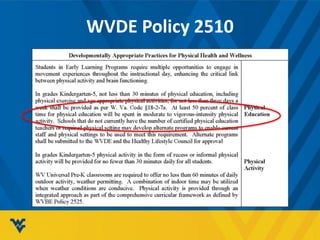
Physical Activity Recommendations
for Physical Education Lessons
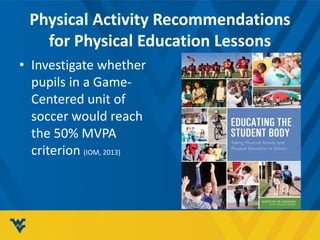
• Investigate whether
pupils in a Game-
Centered unit of
soccer would reach
the 50% MVPA
criterion (IOM, 2013)
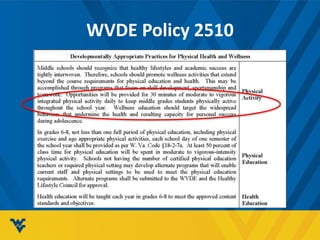
WVDE Policy 2510
WVDE Policy 2510
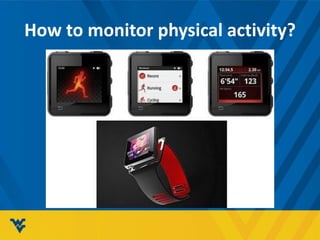
How to monitor physical activity?
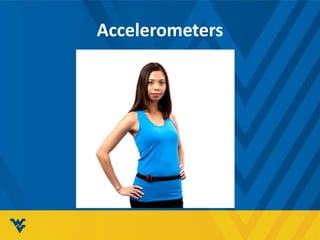
Accelerometers
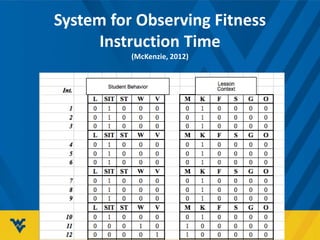
System for Observing Fitness
Instruction Time
(McKenzie, 2012)
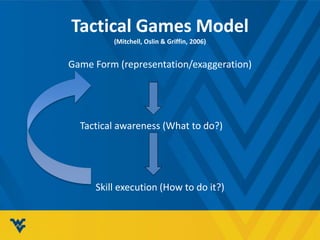
Tactical Games Model
Game Form (representation/exaggeration)
Tactical awareness (What to do?)
Skill execution (How to do it?)
Tactical Games Model
(Mitchell, Oslin & Griffin, 2006)
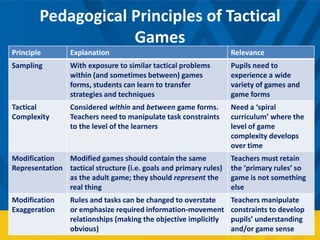
Pedagogical Principles of Tactical
Games
Principle Explanation Relevance
Sampling With exposure to similar tactical problems
within (and sometimes between) games
forms, students can learn to transfer
strategies and techniques
Pupils need to
experience a wide
variety of games and
game forms
Tactical
Complexity
Considered within and between game forms.
Teachers need to manipulate task constraints
to the level of the learners
Need a ‘spiral
curriculum’ where the
level of game
complexity develops
over time
Modification
Representation
Modified games should contain the same
tactical structure (i.e. goals and primary rules)
as the adult game; they should represent the
real thing
Teachers must retain
the ‘primary rules’ so
game is not something
else
Modification
Exaggeration
Rules and tasks can be changed to overstate
or emphasize required information-movement
relationships (making the objective implicitly
obvious)
Teachers manipulate
constraints to develop
pupils’ understanding
and/or game sense
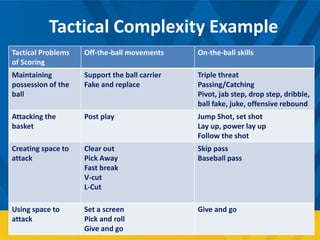
Tactical Complexity Example
Tactical Problems
of Scoring
Off-the-ball movements On-the-ball skills
Maintaining
possession of the
ball
Support the ball carrier
Fake and replace
Triple threat
Passing/Catching
Pivot, jab step, drop step, dribble,
ball fake, juke, offensive rebound
Attacking the
basket
Post play Jump Shot, set shot
Lay up, power lay up
Follow the shot
Creating space to
attack
Clear out
Pick Away
Fast break
V-cut
L-Cut
Skip pass
Baseball pass
Using space to
attack
Set a screen
Pick and roll
Give and go
Give and go
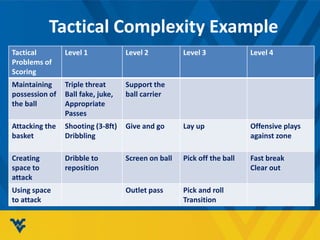
Tactical Complexity Example
Tactical
Problems of
Scoring
Level 1 Level 2 Level 3 Level 4
Maintaining
possession of
the ball
Triple threat
Ball fake, juke,
Appropriate
Passes
Support the
ball carrier
Attacking the
basket
Shooting (3-8ft)
Dribbling
Give and go Lay up Offensive plays
against zone
Creating
space to
attack
Dribble to
reposition
Screen on ball Pick off the ball Fast break
Clear out
Using space
to attack
Outlet pass Pick and roll
Transition
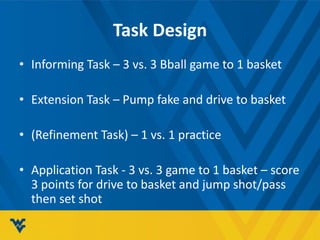
Task Design
• Informing Task – 3 vs. 3 Bball game to 1 basket
• Extension Task – Pump fake and drive to basket
• (Refinement Task) – 1 vs. 1 practice
• Application Task - 3 vs. 3 game to 1 basket – score
3 points for drive to basket and jump shot/pass
then set shot
When designing games…consider
• Does it represent the real (parent) game?
• Are modifications simple enough for everyone to
understand? (oftentimes games with many rule
changes are difficult to follow)
• Does the game offer participants enough
opportunities to try out solutions to the tactical
problem? Can they start to do what you wanted
more often?
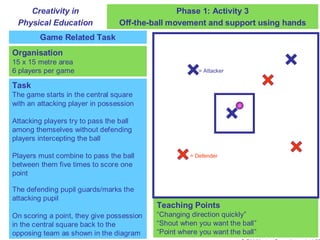
Phase 1: Activity 3
Off-the-ball movement and support using hands
Task
The game starts in the central square
with an attacking player in possession
Attacking players try to pass the ball
among themselves without defending
players intercepting the ball
Players must combine to pass the ball
between them five times to score one
point
The defending pupil guards/marks the
attacking pupil
On scoring a point, they give possession
in the central square back to the
opposing team as shown in the diagram
Organisation
15 x 15 metre area
6 players per game
Creativity in
Physical Education
= Attacker
= Defender
Teaching Points
“Changing direction quickly”
“Shout when you want the ball”
“Point where you want the ball”
Game Related Task
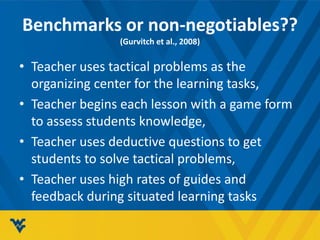
Benchmarks or non-negotiables??
(Gurvitch et al., 2008)
• Teacher uses tactical problems as the
organizing center for the learning tasks,
• Teacher begins each lesson with a game form
to assess students knowledge,
• Teacher uses deductive questions to get
students to solve tactical problems,
• Teacher uses high rates of guides and
feedback during situated learning tasks
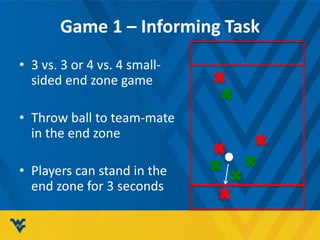
Game 1 – Informing Task
• 3 vs. 3 or 4 vs. 4 small-
sided end zone game
• Throw ball to team-mate
in the end zone
• Players can stand in the
end zone for 3 seconds
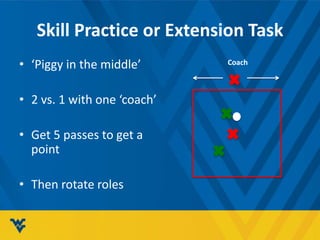
Skill Practice or Extension Task
• ‘Piggy in the middle’
• 2 vs. 1 with one ‘coach’
• Get 5 passes to get a
point
• Then rotate roles
Coach
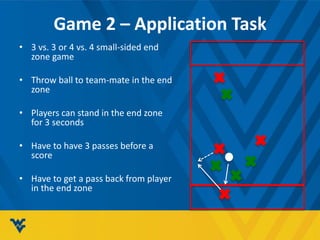
Game 2 – Application Task
• 3 vs. 3 or 4 vs. 4 small-sided end
zone game
• Throw ball to team-mate in the end
zone
• Players can stand in the end zone
for 3 seconds
• Have to have 3 passes before a
score
• Have to get a pass back from player
in the end zone
Review of data…
• SOFIT
– Student physical activity
• Sedentary
• MVPA
• VPA
– Lesson Context
• Accelerometers
– Did you meet 50% MVPA?
– What was the level of VPA?
Some strategies for encouraging
physical activity
• Keep the time in game play higher than in skill
practice
• Don’t stop the whole group
• If you do have to stop the whole group, keep
task presentations or interjections between
30s and 1 minute (carry a stopwatch!)
• If players are waiting (coaching) have them
walk, run in place or do jump jacks
• More???
Questions?

West Virginia DoE Kid Strong presentation 2015

  • 1.
    TEACHING PHYSICAL EDUCATION LESSONSTHROUGH THE TACTICAL GAMES MODEL Dr. Stephen Harvey & David Robertson West Virginia University, USA Presentation at the WVDE Kid Strong Conference, Charleston, WV, USA, 16- 17th June, 2015
  • 2.
    Workshop purposes 1. Identifythe key features and pedagogical principles associated with the Tactical Games Model. 2. Assess the viability of the Tactical Games Model for teaching games in providing opportunities for elementary and secondary physical education pupils to achieve stated Physical Activity recommendations.
  • 3.
    Physical Activity Recommendations forPhysical Education Lessons • Investigate whether pupils in a Game- Centered unit of soccer would reach the 50% MVPA criterion (IOM, 2013)
  • 4.
  • 5.
  • 6.
    How to monitorphysical activity?
  • 7.
  • 8.
    System for ObservingFitness Instruction Time (McKenzie, 2012)
  • 9.
  • 10.
    Game Form (representation/exaggeration) Tacticalawareness (What to do?) Skill execution (How to do it?) Tactical Games Model (Mitchell, Oslin & Griffin, 2006)
  • 11.
    Pedagogical Principles ofTactical Games Principle Explanation Relevance Sampling With exposure to similar tactical problems within (and sometimes between) games forms, students can learn to transfer strategies and techniques Pupils need to experience a wide variety of games and game forms Tactical Complexity Considered within and between game forms. Teachers need to manipulate task constraints to the level of the learners Need a ‘spiral curriculum’ where the level of game complexity develops over time Modification Representation Modified games should contain the same tactical structure (i.e. goals and primary rules) as the adult game; they should represent the real thing Teachers must retain the ‘primary rules’ so game is not something else Modification Exaggeration Rules and tasks can be changed to overstate or emphasize required information-movement relationships (making the objective implicitly obvious) Teachers manipulate constraints to develop pupils’ understanding and/or game sense
  • 12.
    Tactical Complexity Example TacticalProblems of Scoring Off-the-ball movements On-the-ball skills Maintaining possession of the ball Support the ball carrier Fake and replace Triple threat Passing/Catching Pivot, jab step, drop step, dribble, ball fake, juke, offensive rebound Attacking the basket Post play Jump Shot, set shot Lay up, power lay up Follow the shot Creating space to attack Clear out Pick Away Fast break V-cut L-Cut Skip pass Baseball pass Using space to attack Set a screen Pick and roll Give and go Give and go
  • 13.
    Tactical Complexity Example Tactical Problemsof Scoring Level 1 Level 2 Level 3 Level 4 Maintaining possession of the ball Triple threat Ball fake, juke, Appropriate Passes Support the ball carrier Attacking the basket Shooting (3-8ft) Dribbling Give and go Lay up Offensive plays against zone Creating space to attack Dribble to reposition Screen on ball Pick off the ball Fast break Clear out Using space to attack Outlet pass Pick and roll Transition
  • 14.
    Task Design • InformingTask – 3 vs. 3 Bball game to 1 basket • Extension Task – Pump fake and drive to basket • (Refinement Task) – 1 vs. 1 practice • Application Task - 3 vs. 3 game to 1 basket – score 3 points for drive to basket and jump shot/pass then set shot
  • 15.
    When designing games…consider •Does it represent the real (parent) game? • Are modifications simple enough for everyone to understand? (oftentimes games with many rule changes are difficult to follow) • Does the game offer participants enough opportunities to try out solutions to the tactical problem? Can they start to do what you wanted more often?
  • 16.
    Phase 1: Activity3 Off-the-ball movement and support using hands Task The game starts in the central square with an attacking player in possession Attacking players try to pass the ball among themselves without defending players intercepting the ball Players must combine to pass the ball between them five times to score one point The defending pupil guards/marks the attacking pupil On scoring a point, they give possession in the central square back to the opposing team as shown in the diagram Organisation 15 x 15 metre area 6 players per game Creativity in Physical Education = Attacker = Defender Teaching Points “Changing direction quickly” “Shout when you want the ball” “Point where you want the ball” Game Related Task
  • 17.
    Benchmarks or non-negotiables?? (Gurvitchet al., 2008) • Teacher uses tactical problems as the organizing center for the learning tasks, • Teacher begins each lesson with a game form to assess students knowledge, • Teacher uses deductive questions to get students to solve tactical problems, • Teacher uses high rates of guides and feedback during situated learning tasks
  • 18.
    Game 1 –Informing Task • 3 vs. 3 or 4 vs. 4 small- sided end zone game • Throw ball to team-mate in the end zone • Players can stand in the end zone for 3 seconds
  • 19.
    Skill Practice orExtension Task • ‘Piggy in the middle’ • 2 vs. 1 with one ‘coach’ • Get 5 passes to get a point • Then rotate roles Coach
  • 20.
    Game 2 –Application Task • 3 vs. 3 or 4 vs. 4 small-sided end zone game • Throw ball to team-mate in the end zone • Players can stand in the end zone for 3 seconds • Have to have 3 passes before a score • Have to get a pass back from player in the end zone
  • 21.
    Review of data… •SOFIT – Student physical activity • Sedentary • MVPA • VPA – Lesson Context • Accelerometers – Did you meet 50% MVPA? – What was the level of VPA?
  • 22.
    Some strategies forencouraging physical activity • Keep the time in game play higher than in skill practice • Don’t stop the whole group • If you do have to stop the whole group, keep task presentations or interjections between 30s and 1 minute (carry a stopwatch!) • If players are waiting (coaching) have them walk, run in place or do jump jacks • More???
  • 23.

Editor's Notes

  • #9 Students’ physical activity (PA) levels and lesson context were collected using the System of Observing Fitness Instruction Time (McKenzie, 2012) Teacher behavior data were collected using the West Virginia Teaching Evaluation System (Hawkins & Wiegand, 1989)
  • #11 This was new and in contrast to previous years – where they were simply participants in sessions Each workshop, trainees were given the opportunity to plan and deliver micro-teaching episodes using GBAs and subsequently received feedback from their peers Trainees, in turn, planned and taught a 30 minute lesson to their peers in learning teams using a Tactical Games Model and received feedback on their implementation of the model. Students then were expected to integrate into school placement This was then followed by me modelling best practice to the whole class for a further 30 mins
  • #16 Constructivist and constructionist (Kirk & MacDonald, 1998) Situated learning (Kirk & MacPhail, 2002) Non-linear pedagogy (Renshaw et al., 2010) Complexity thinking (Ovens, Hopper & Butler, 2013) Complex Learning Theory (Davis & Sumara, 2003; Light, 2008)
  • #18 The model’s designer is in effect saying that if a teacher makes decisions and carries out instruction in a way that is congruent with the model’s theoretical framework, students will be likely to learn what is intended.