Game Sense
Miss Roussos
5R
What is Game Sense?
Game Sense is a student centered, inquiry based approach in sports
education which allows students to develop their own skills and
understandings whilst being actively involved in a game(Pill, 2016).
The Game Sense approach allows the students to solely focus on the game
being played, instead of the discrete techniques or skills that traditional
approaches view as essential to be grasped before playing the game.
Ultimately Game Sense:
 Engages students in minor and modified game strategies and concepts
where there are opportunities to develop both skills and an
understating of the tactics of the game.
 Encourages simple modifications (easy or hard) to accommodate for
varying ability levels and maximize inclusion and challenge (Light, 2013).
 Modifies game rules, the playing area, or the equipment for the purpose
of highlighting aspects of the game such as TEAM A sending a ball
beyond the reach of opponents (Pill, 2016).
 Promotes the development of “thinking players” (Duyn as cited in Pill,
2016, p. 282).
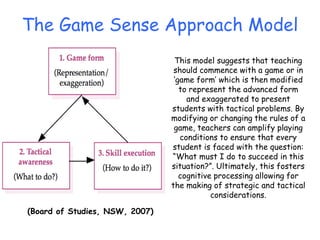
The Game Sense Approach Model
(Board of Studies, NSW, 2007)
This model suggests that teaching
should commence with a game or in
‘game form’ which is then modified
to represent the advanced form
and exaggerated to present
students with tactical problems. By
modifying or changing the rules of a
game, teachers can amplify playing
conditions to ensure that every
student is faced with the question:
“What must I do to succeed in this
situation?”. Ultimately, this fosters
cognitive processing allowing for
the making of strategic and tactical
considerations.
Game Sense Approach as Student Centered
Approach….
The Game Sense Approach can be essentially said to
be student centered. The approach puts the needs
and abilities of the students before the importance
of the game (Mandigo, et al., 2008).
Game Sense Approach categorises team games into 4
distinct areas:
 Invasion games (e.g. soccer, netball)
 Target games (e.g. golf, archery)
 Court and net games (e.g. volleyball, tennis)
 Striking and fielding games (e.g. cricket, softball)
 Fundamental Movement skills of static balance,
sprint run, vertical jump, catch, hop, side gallop,
skip, overarm throw, leap, kick, two hand strike,
and dodge can all be met through these three
categories.
The Game Sense Approach is used
in this way, at Carlton South Public
School:
 Games before drills and skills.
 High-activity levels are disguised within full and
challenging activities.
 Observe and avoid ‘over coaching’
 Use questions often – ‘ask the player’ prompts
 Provide feedback
 Once an activity is being undergone, take individuals
or small groups who may need more guidance.
 Encourage modifications
 Provide for fun, promote communication, ensure
inclusion, provide for challenge and foster higher-
order thinking !!
Game Sense Rationale
In our vastly changing society, there has often been critique
towards the way that PDHPE lessons have been taught – lessons are
overly focused on movement compliance in high performance
environments where the teaching is predominantly teacher
centered or lessons are taught through programs where students
process a variety of movements without sufficient time to develop
competency or proficiency in these skills and movements (Stolz &
Pill, 2013). In saying this, students consequently learn what they
‘cant’ do in PDHPE rather than what is actually possible and for this
reason the pedagogical Game Sense approach has brought attention
to cognitive processing of game and sport education and has
therefore been adopted. Ultimately, it is a holistic model which
focuses on the students’ physical, social and intellectual skills.
As a relatively new teaching approach, the Game Sense approach
has many strengths in which help foster the NSW BOSTES PDHPE
K-6 Syllabus essential skills of “moving, problem solving,
communicating, interacting, and decision making” (p. 9).
Continuing the rationale…
In Game sense, student learning is driven by the use of questioning
techniques by the teacher, challenging students to think about and
come to understandings of the playing dimensions of time, space
and technique. This helps in modifying games to focus the play on
concepts of movement and responses.
Game sense helps in fostering interpersonal relationships through
verbal and non-verbal communicating and interacting with team
members, thus also promoting inclusion. In saying this, Game Sense
also emphasizes active engagement by moving and through moving,
problem solving skills are promoted and decision making is
undergone. Thus, by focusing on the game itself, rather than
technique, players are encouraged to become more tactically aware
and make more informed decisions during the game. This also helps
foster strategic thinking about game concepts whilst developing
skills realistically and most importantly enjoying the game. In this
way, skills are being developed within a genuine context rather than
practice in isolation.
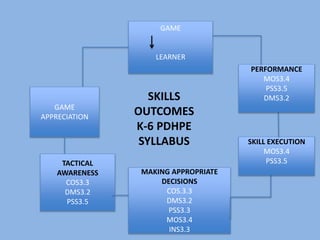
GAME
LEARNER
GAME
APPRECIATION
TACTICAL
AWARENESS
COS3.3
DMS3.2
PSS3.5
MAKING APPROPRIATE
DECISIONS
COS.3.3
DMS3.2
PSS3.3
MOS3.4
INS3.3
SKILL EXECUTION
MOS3.4
PSS3.5
PERFORMANCE
MOS3.4
PSS3.5
DMS3.2SKILLS
OUTCOMES
K-6 PDHPE
SYLLABUS
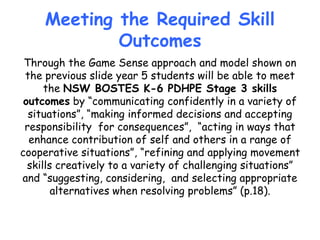
Meeting the Required Skill
Outcomes
Through the Game Sense approach and model shown on
the previous slide year 5 students will be able to meet
the NSW BOSTES K-6 PDHPE Stage 3 skills
outcomes by “communicating confidently in a variety of
situations”, “making informed decisions and accepting
responsibility for consequences”, “acting in ways that
enhance contribution of self and others in a range of
cooperative situations”, “refining and applying movement
skills creatively to a variety of challenging situations”
and “suggesting, considering, and selecting appropriate
alternatives when resolving problems” (p.18).
Example of Game Sense Approach
Tactical problem: maintaining possession (suited for netball, basketball, touch
football etc.)
Game form:
• Number of players 5 v 5.
• Equipment: rectangular court marked, coloured tails or bibs.
• Score goals by passing the ball – players throw to team members or to goal
(no movement allowed with ball).
• Play is started with a centre pass (mark centre of court).
• Ball can be regained by interception or by capturing loose ball.
Modifications/variations:
• Introduce time limit (e.g. 5 seconds with ball or 5 throws only between team
members).
• Change size of goal or location of goal.
Possible questions: when did you pass the ball? When did you keep the ball?
What techniques/strategies did you use to keep the ball away from opponent?
What did you do to make it easier to pass the ball around?
What did you do to make it easier or harder to get the ball? what did you do to
try get the ball back in your possession? Is there anything else that could have
been done? How did putting a time limit on the game, affect the game?
References

Game sense presentation

  • 1.
  • 2.
    What is GameSense? Game Sense is a student centered, inquiry based approach in sports education which allows students to develop their own skills and understandings whilst being actively involved in a game(Pill, 2016). The Game Sense approach allows the students to solely focus on the game being played, instead of the discrete techniques or skills that traditional approaches view as essential to be grasped before playing the game. Ultimately Game Sense:  Engages students in minor and modified game strategies and concepts where there are opportunities to develop both skills and an understating of the tactics of the game.  Encourages simple modifications (easy or hard) to accommodate for varying ability levels and maximize inclusion and challenge (Light, 2013).  Modifies game rules, the playing area, or the equipment for the purpose of highlighting aspects of the game such as TEAM A sending a ball beyond the reach of opponents (Pill, 2016).  Promotes the development of “thinking players” (Duyn as cited in Pill, 2016, p. 282).
  • 3.
    The Game SenseApproach Model (Board of Studies, NSW, 2007) This model suggests that teaching should commence with a game or in ‘game form’ which is then modified to represent the advanced form and exaggerated to present students with tactical problems. By modifying or changing the rules of a game, teachers can amplify playing conditions to ensure that every student is faced with the question: “What must I do to succeed in this situation?”. Ultimately, this fosters cognitive processing allowing for the making of strategic and tactical considerations.
  • 4.
    Game Sense Approachas Student Centered Approach…. The Game Sense Approach can be essentially said to be student centered. The approach puts the needs and abilities of the students before the importance of the game (Mandigo, et al., 2008). Game Sense Approach categorises team games into 4 distinct areas:  Invasion games (e.g. soccer, netball)  Target games (e.g. golf, archery)  Court and net games (e.g. volleyball, tennis)  Striking and fielding games (e.g. cricket, softball)  Fundamental Movement skills of static balance, sprint run, vertical jump, catch, hop, side gallop, skip, overarm throw, leap, kick, two hand strike, and dodge can all be met through these three categories.
  • 5.
    The Game SenseApproach is used in this way, at Carlton South Public School:  Games before drills and skills.  High-activity levels are disguised within full and challenging activities.  Observe and avoid ‘over coaching’  Use questions often – ‘ask the player’ prompts  Provide feedback  Once an activity is being undergone, take individuals or small groups who may need more guidance.  Encourage modifications  Provide for fun, promote communication, ensure inclusion, provide for challenge and foster higher- order thinking !!
  • 6.
    Game Sense Rationale Inour vastly changing society, there has often been critique towards the way that PDHPE lessons have been taught – lessons are overly focused on movement compliance in high performance environments where the teaching is predominantly teacher centered or lessons are taught through programs where students process a variety of movements without sufficient time to develop competency or proficiency in these skills and movements (Stolz & Pill, 2013). In saying this, students consequently learn what they ‘cant’ do in PDHPE rather than what is actually possible and for this reason the pedagogical Game Sense approach has brought attention to cognitive processing of game and sport education and has therefore been adopted. Ultimately, it is a holistic model which focuses on the students’ physical, social and intellectual skills. As a relatively new teaching approach, the Game Sense approach has many strengths in which help foster the NSW BOSTES PDHPE K-6 Syllabus essential skills of “moving, problem solving, communicating, interacting, and decision making” (p. 9).
  • 7.
    Continuing the rationale… InGame sense, student learning is driven by the use of questioning techniques by the teacher, challenging students to think about and come to understandings of the playing dimensions of time, space and technique. This helps in modifying games to focus the play on concepts of movement and responses. Game sense helps in fostering interpersonal relationships through verbal and non-verbal communicating and interacting with team members, thus also promoting inclusion. In saying this, Game Sense also emphasizes active engagement by moving and through moving, problem solving skills are promoted and decision making is undergone. Thus, by focusing on the game itself, rather than technique, players are encouraged to become more tactically aware and make more informed decisions during the game. This also helps foster strategic thinking about game concepts whilst developing skills realistically and most importantly enjoying the game. In this way, skills are being developed within a genuine context rather than practice in isolation.
  • 8.
  • 9.
    Meeting the RequiredSkill Outcomes Through the Game Sense approach and model shown on the previous slide year 5 students will be able to meet the NSW BOSTES K-6 PDHPE Stage 3 skills outcomes by “communicating confidently in a variety of situations”, “making informed decisions and accepting responsibility for consequences”, “acting in ways that enhance contribution of self and others in a range of cooperative situations”, “refining and applying movement skills creatively to a variety of challenging situations” and “suggesting, considering, and selecting appropriate alternatives when resolving problems” (p.18).
  • 10.
    Example of GameSense Approach Tactical problem: maintaining possession (suited for netball, basketball, touch football etc.) Game form: • Number of players 5 v 5. • Equipment: rectangular court marked, coloured tails or bibs. • Score goals by passing the ball – players throw to team members or to goal (no movement allowed with ball). • Play is started with a centre pass (mark centre of court). • Ball can be regained by interception or by capturing loose ball. Modifications/variations: • Introduce time limit (e.g. 5 seconds with ball or 5 throws only between team members). • Change size of goal or location of goal. Possible questions: when did you pass the ball? When did you keep the ball? What techniques/strategies did you use to keep the ball away from opponent? What did you do to make it easier to pass the ball around? What did you do to make it easier or harder to get the ball? what did you do to try get the ball back in your possession? Is there anything else that could have been done? How did putting a time limit on the game, affect the game?
  • 11.