PRACTICAL APPLICATION OF
TEACHING GAMES FOR
UNDERSTANDING IN FIELD
HOCKEY
USA Field Hockey
Presented on Sunday 24th January 2016 at the Level 1 Coaches Clinic,
Dublin, Ohio, USA
Dr. Stephen Harvey – West Virginia University, USA
Objectives
• To explain the games for understanding model and align
it to Rink’s four stage model of effective game play
• To physically experience examine how we, as coaches,
can use the four pedagogical principles of the games for
understanding model to design good games
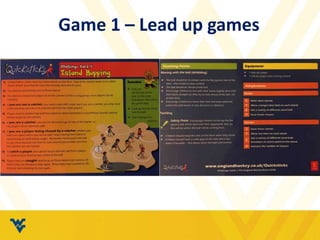
– Lead up games
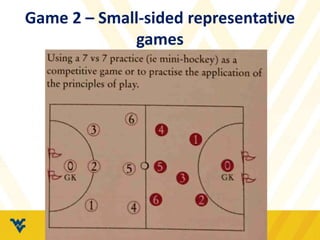
– Small-sided games
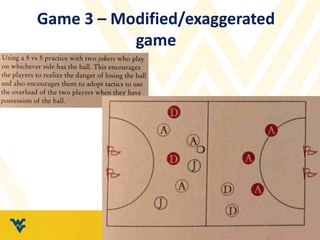
– Modified/exaggerated games
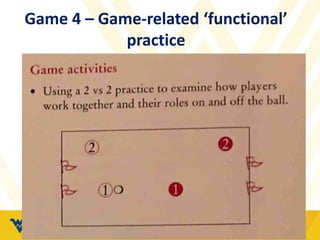
– Game-related ‘functional’ practices
• To discuss challenges of integrating games into your
regular coaching session/practices
What is Teaching Games for Understanding
and Why did it come about?
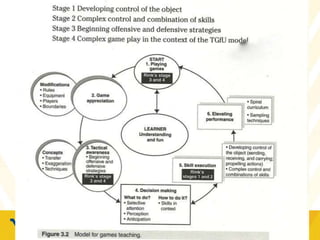
Rink’s Game Play Stages
• Stage 1: Developing control of the object
• Stage 2: Complex control and combination of
skills
• Stage 3: Beginning offensive and defensive
strategies
• Stage 4: Complex game play
What is Teaching Games for Understanding
and Why did it come about?
• There was recognition about the benefits of a
movement ‘education’ not simply drilling
• Need to develop ‘understanding of games’
• Inflexible techniques when applied to games
• There was little success in games sessions
which were just not fun
Bunker and Thorpe (1982)
Benefits of games for understanding
• Motivation
• Empowerment
• Interaction between tactical/strategical
knowledge and skill so pupils know ‘why’ as
well as ‘how’
• Alignment of practice to the ‘real’ game
• Transfer
Mitchell, Oslin and Griffin (2006)
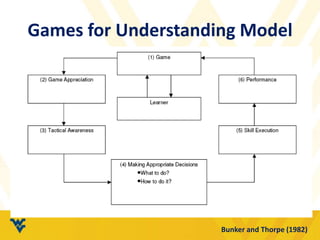
Games for Understanding Model
Bunker and Thorpe (1982)
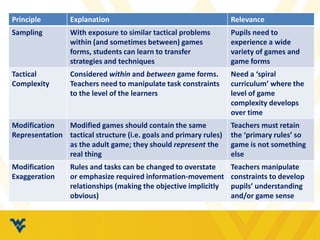
Pedagogical Principles of TGfU
Principle Explanation Relevance
Sampling With exposure to similar tactical problems
within (and sometimes between) games
forms, students can learn to transfer
strategies and techniques
Pupils need to
experience a wide
variety of games and
game forms
Tactical
Complexity
Considered within and between game forms.
Teachers need to manipulate task constraints
to the level of the learners
Need a ‘spiral
curriculum’ where the
level of game
complexity develops
over time
Modification
Representation
Modified games should contain the same
tactical structure (i.e. goals and primary rules)
as the adult game; they should represent the
real thing
Teachers must retain
the ‘primary rules’ so
game is not something
else
Modification
Exaggeration
Rules and tasks can be changed to overstate
or emphasize required information-movement
relationships (making the objective implicitly
obvious)
Teachers manipulate
constraints to develop
pupils’ understanding
and/or game sense
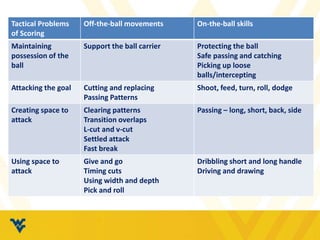
Tactical Complexity Example
Tactical Problems
of Scoring
Off-the-ball movements On-the-ball skills
Maintaining
possession of the
ball
Support the ball carrier Protecting the ball
Safe passing and catching
Picking up loose
balls/intercepting
Attacking the goal Cutting and replacing
Passing Patterns
Shoot, feed, turn, roll, dodge
Creating space to
attack
Clearing patterns
Transition overlaps
L-cut and v-cut
Settled attack
Fast break
Passing – long, short, back, side
Using space to
attack
Give and go
Timing cuts
Using width and depth
Pick and roll
Dribbling short and long handle
Driving and drawing
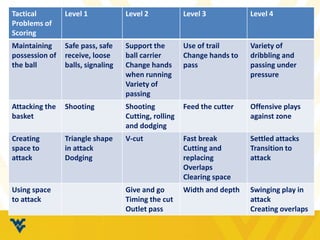
Tactical
Problems of
Scoring
Level 1 Level 2 Level 3 Level 4
Maintaining
possession of
the ball
Safe pass, safe
receive, loose
balls, signaling
Support the
ball carrier
Change hands
when running
Variety of
passing
Use of trail
Change hands to
pass
Variety of
dribbling and
passing under
pressure
Attacking the
basket
Shooting Shooting
Cutting, rolling
and dodging
Feed the cutter Offensive plays
against zone
Creating
space to
attack
Triangle shape
in attack
Dodging
V-cut Fast break
Cutting and
replacing
Overlaps
Clearing space
Settled attacks
Transition to
attack
Using space
to attack
Give and go
Timing the cut
Outlet pass
Width and depth Swinging play in
attack
Creating overlaps
Principles of Play
Principles of Play in Attack Definition
Penetration The act of breaking through the defense by dribbling,
shooting, running or passing.
Support A player in possession of the ball receives help to
maintain possession.
Mobility Attackers make runs into different areas of the field in
order to draw defenders out of their positions.
Width/depth The attacking team attempts to stretch the
opponent’s defensive shape. The attacking players use
the width/depth of the field to tempt defenders from
a compact shape covering the dangerous areas in
front of goal and in so doing create space.
Improvisation & Creativity Attackers will try to break down defenses by
employing the element of surprise. Skills such as lifts,
pull backs, v-drags, feints and fakes are all used to this
end. Comfort on the ball is critical at the highest level
of the game.
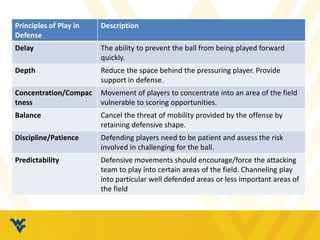
Principles of Play in
Defense
Description
Delay The ability to prevent the ball from being played forward
quickly.
Depth Reduce the space behind the pressuring player. Provide
support in defense.
Concentration/Compac
tness
Movement of players to concentrate into an area of the field
vulnerable to scoring opportunities.
Balance Cancel the threat of mobility provided by the offense by
retaining defensive shape.
Discipline/Patience Defending players need to be patient and assess the risk
involved in challenging for the ball.
Predictability Defensive movements should encourage/force the attacking
team to play into certain areas of the field. Channeling play
into particular well defended areas or less important areas of
the field
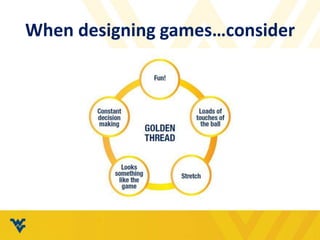
When designing games…consider
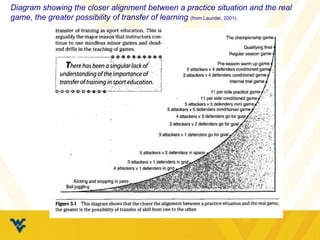
Diagram showing the closer alignment between a practice situation and the real
game, the greater possibility of transfer of learning (from Launder, 2001)
Challenges
• Tell me some challenges?
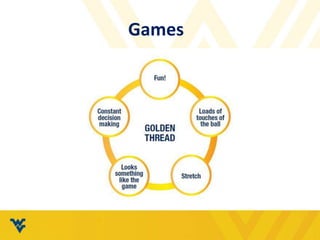
Games
Game 1 – Lead up games
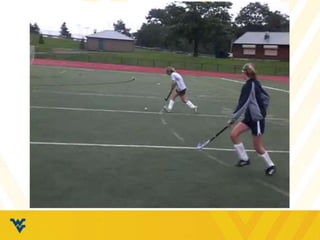
Game 2 – Small-sided representative
games
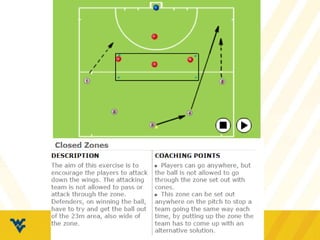
Game 3 – Modified/exaggerated
game
Game 4 – Game-related ‘functional’
practice
Game 5 – Game-related ‘phase-of-
play’
• Attack vs. defense on half-court
• Not doing this today
Games
I am challenging you to…
• Try one thing from today in your coaching
session…
• What might that be?
• Tell a partner...
Questions?

Usa field hockey games presentation

  • 1.
    PRACTICAL APPLICATION OF TEACHINGGAMES FOR UNDERSTANDING IN FIELD HOCKEY USA Field Hockey Presented on Sunday 24th January 2016 at the Level 1 Coaches Clinic, Dublin, Ohio, USA Dr. Stephen Harvey – West Virginia University, USA
  • 2.
    Objectives • To explainthe games for understanding model and align it to Rink’s four stage model of effective game play • To physically experience examine how we, as coaches, can use the four pedagogical principles of the games for understanding model to design good games – Lead up games – Small-sided games – Modified/exaggerated games – Game-related ‘functional’ practices • To discuss challenges of integrating games into your regular coaching session/practices
  • 3.
    What is TeachingGames for Understanding and Why did it come about?
  • 4.
    Rink’s Game PlayStages • Stage 1: Developing control of the object • Stage 2: Complex control and combination of skills • Stage 3: Beginning offensive and defensive strategies • Stage 4: Complex game play
  • 5.
    What is TeachingGames for Understanding and Why did it come about? • There was recognition about the benefits of a movement ‘education’ not simply drilling • Need to develop ‘understanding of games’ • Inflexible techniques when applied to games • There was little success in games sessions which were just not fun Bunker and Thorpe (1982)
  • 6.
    Benefits of gamesfor understanding • Motivation • Empowerment • Interaction between tactical/strategical knowledge and skill so pupils know ‘why’ as well as ‘how’ • Alignment of practice to the ‘real’ game • Transfer Mitchell, Oslin and Griffin (2006)
  • 7.
    Games for UnderstandingModel Bunker and Thorpe (1982)
  • 9.
  • 10.
    Principle Explanation Relevance SamplingWith exposure to similar tactical problems within (and sometimes between) games forms, students can learn to transfer strategies and techniques Pupils need to experience a wide variety of games and game forms Tactical Complexity Considered within and between game forms. Teachers need to manipulate task constraints to the level of the learners Need a ‘spiral curriculum’ where the level of game complexity develops over time Modification Representation Modified games should contain the same tactical structure (i.e. goals and primary rules) as the adult game; they should represent the real thing Teachers must retain the ‘primary rules’ so game is not something else Modification Exaggeration Rules and tasks can be changed to overstate or emphasize required information-movement relationships (making the objective implicitly obvious) Teachers manipulate constraints to develop pupils’ understanding and/or game sense
  • 11.
  • 12.
    Tactical Problems of Scoring Off-the-ballmovements On-the-ball skills Maintaining possession of the ball Support the ball carrier Protecting the ball Safe passing and catching Picking up loose balls/intercepting Attacking the goal Cutting and replacing Passing Patterns Shoot, feed, turn, roll, dodge Creating space to attack Clearing patterns Transition overlaps L-cut and v-cut Settled attack Fast break Passing – long, short, back, side Using space to attack Give and go Timing cuts Using width and depth Pick and roll Dribbling short and long handle Driving and drawing
  • 13.
    Tactical Problems of Scoring Level 1Level 2 Level 3 Level 4 Maintaining possession of the ball Safe pass, safe receive, loose balls, signaling Support the ball carrier Change hands when running Variety of passing Use of trail Change hands to pass Variety of dribbling and passing under pressure Attacking the basket Shooting Shooting Cutting, rolling and dodging Feed the cutter Offensive plays against zone Creating space to attack Triangle shape in attack Dodging V-cut Fast break Cutting and replacing Overlaps Clearing space Settled attacks Transition to attack Using space to attack Give and go Timing the cut Outlet pass Width and depth Swinging play in attack Creating overlaps
  • 14.
  • 15.
    Principles of Playin Attack Definition Penetration The act of breaking through the defense by dribbling, shooting, running or passing. Support A player in possession of the ball receives help to maintain possession. Mobility Attackers make runs into different areas of the field in order to draw defenders out of their positions. Width/depth The attacking team attempts to stretch the opponent’s defensive shape. The attacking players use the width/depth of the field to tempt defenders from a compact shape covering the dangerous areas in front of goal and in so doing create space. Improvisation & Creativity Attackers will try to break down defenses by employing the element of surprise. Skills such as lifts, pull backs, v-drags, feints and fakes are all used to this end. Comfort on the ball is critical at the highest level of the game.
  • 16.
    Principles of Playin Defense Description Delay The ability to prevent the ball from being played forward quickly. Depth Reduce the space behind the pressuring player. Provide support in defense. Concentration/Compac tness Movement of players to concentrate into an area of the field vulnerable to scoring opportunities. Balance Cancel the threat of mobility provided by the offense by retaining defensive shape. Discipline/Patience Defending players need to be patient and assess the risk involved in challenging for the ball. Predictability Defensive movements should encourage/force the attacking team to play into certain areas of the field. Channeling play into particular well defended areas or less important areas of the field
  • 17.
  • 18.
    Diagram showing thecloser alignment between a practice situation and the real game, the greater possibility of transfer of learning (from Launder, 2001)
  • 21.
    Challenges • Tell mesome challenges?
  • 22.
  • 23.
    Game 1 –Lead up games
  • 24.
    Game 2 –Small-sided representative games
  • 25.
    Game 3 –Modified/exaggerated game
  • 26.
    Game 4 –Game-related ‘functional’ practice
  • 27.
    Game 5 –Game-related ‘phase-of- play’ • Attack vs. defense on half-court • Not doing this today
  • 28.
  • 29.
    I am challengingyou to… • Try one thing from today in your coaching session… • What might that be? • Tell a partner...
  • 30.

Editor's Notes

  • #18 Does it represent the real (parent) game? Are modifications simple enough for everyone to understand? (oftentimes games with many rule changes are difficult to follow) Does the game offer participants enough opportunities to try out solutions to the tactical problem? Can they start to do what you wanted more often?
  • #22 Can we begin teaching with a game? i.e. Rink’s stages 3 and 4? If so, how can we make sure coaches have the skills to devise good games for pupils to play? How can we maximize motivation and the simultaneous development of tactical knowledge and skill?