G A M E 
S E N S E
Why PDHPE in Schools? 
Personal Development Health and Physical Education 
(PDHPE) is one of the six key learning areas (KLA’s) 
within the NSW Primary School Curriculum.
When teaching physical education lessons, teachers 
use a variety of approaches to meet students needs 
and learning abilities. 
One new approach that teachers are finding useful is 
Teaching Games for Understanding Approach (TGfU) 
also known as ‘Game Sense’. 
Game Sense 
Come along with me and my friends to find out 
about ‘Game Sense’; what it is, how we engage in 
‘Game Sense’ activities, the skills we learn from 
these activities and why ‘Game Sense’ is the best 
approach when teaching PE.
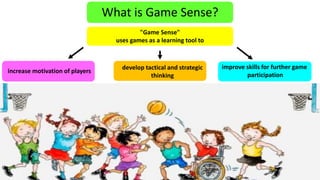
What is Game Sense? 
"Game Sense" 
uses games as a learning tool to 
increase motivation of players 
develop tactical and strategic 
thinking 
improve skills for further game 
participation
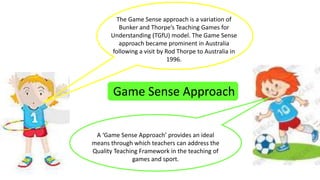
The Game Sense approach is a variation of 
Bunker and Thorpe’s Teaching Games for 
Understanding (TGfU) model. The Game Sense 
approach became prominent in Australia 
following a visit by Rod Thorpe to Australia in 
1996. 
Game Sense Approach 
A ‘Game Sense Approach’ provides an ideal 
means through which teachers can address the 
Quality Teaching Framework in the teaching of 
games and sport.
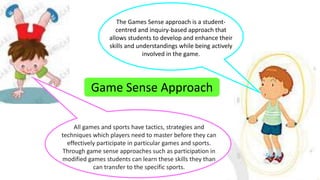
The Games Sense approach is a student-centred 
and inquiry-based approach that 
allows students to develop and enhance their 
skills and understandings while being actively 
involved in the game. 
Game Sense Approach 
All games and sports have tactics, strategies and 
techniques which players need to master before they can 
effectively participate in particular games and sports. 
Through game sense approaches such as participation in 
modified games students can learn these skills they than 
can transfer to the specific sports.
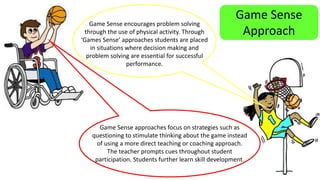
Game Sense 
Approach 
Game Sense encourages problem solving 
through the use of physical activity. Through 
‘Games Sense’ approaches students are placed 
in situations where decision making and 
problem solving are essential for successful 
performance. 
Game Sense approaches focus on strategies such as 
questioning to stimulate thinking about the game instead 
of using a more direct teaching or coaching approach. 
The teacher prompts cues throughout student 
participation. Students further learn skill development.
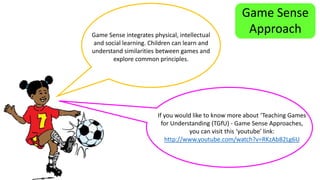
Game Sense 
Approach 
Game Sense integrates physical, intellectual 
and social learning. Children can learn and 
understand similarities between games and 
explore common principles. 
If you would like to know more about ‘Teaching Games 
for Understanding (TGfU) - Game Sense Approaches, 
you can visit this ‘youtube’ link: 
http://www.youtube.com/watch?v=RKzAbB2Lg6U
Game Categories 
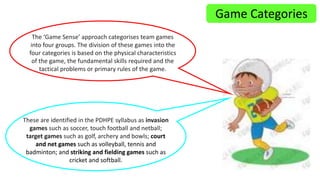
The ‘Game Sense’ approach categorises team games 
into four groups. The division of these games into the 
four categories is based on the physical characteristics 
of the game, the fundamental skills required and the 
tactical problems or primary rules of the game. 
These are identified in the PDHPE syllabus as invasion 
games such as soccer, touch football and netball; 
target games such as golf, archery and bowls; court 
and net games such as volleyball, tennis and 
badminton; and striking and fielding games such as 
cricket and softball.
Game Sense in Action 
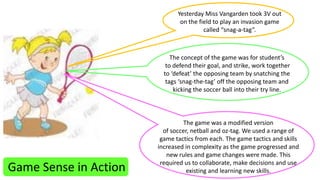
Yesterday Miss Vangarden took 3V out 
on the field to play an invasion game 
called “snag-a-tag”. 
The concept of the game was for student’s 
to defend their goal, and strike, work together 
to ‘defeat’ the opposing team by snatching the 
tags ‘snag-the-tag’ off the opposing team and 
kicking the soccer ball into their try line. 
The game was a modified version 
of soccer, netball and oz-tag. We used a range of 
game tactics from each. The game tactics and skills 
increased in complexity as the game progressed and 
new rules and game changes were made. This 
required us to collaborate, make decisions and use 
existing and learning new skills.
Outcomes We Achieved 
Interacting 
INS2.3 - Makes positive contributions in group 
activities. 
Communicating 
COS2.1 - Uses a variety of ways to 
communicate with and within groups. 
Games and Sports 
GSS2.8 - Participates and uses equipment in a 
variety of games and modified sports. 
practises and refines movement skills in a variety of games 
demonstrates efficient ways of using equipment while 
working cooperatively with others 
demonstrates a range of skills in practices and modified 
games, eg throwing and catching in moving and 
stationary positions
Skills Developed 
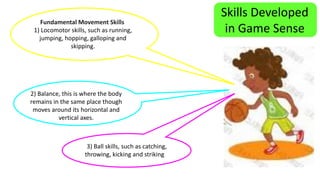
in Game Sense Fundamental Movement Skills 
1) Locomotor skills, such as running, 
jumping, hopping, galloping and 
skipping. 
2) Balance, this is where the body 
remains in the same place though 
moves around its horizontal and 
vertical axes. 
3) Ball skills, such as catching, 
throwing, kicking and striking
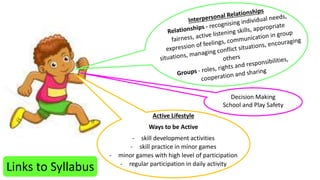
Links to Syllabus 
Active Lifestyle 
Ways to be Active 
- skill development activities 
- skill practice in minor games 
- minor games with high level of participation 
- regular participation in daily activity 
Decision Making 
School and Play Safety
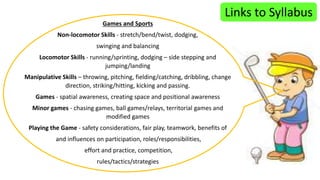
Links to Syllabus 
Games and Sports 
Non-locomotor Skills - stretch/bend/twist, dodging, 
swinging and balancing 
Locomotor Skills - running/sprinting, dodging – side stepping and 
jumping/landing 
Manipulative Skills – throwing, pitching, fielding/catching, dribbling, change 
direction, striking/hitting, kicking and passing. 
Games - spatial awareness, creating space and positional awareness 
Minor games - chasing games, ball games/relays, territorial games and 
modified games 
Playing the Game - safety considerations, fair play, teamwork, benefits of 
and influences on participation, roles/responsibilities, 
effort and practice, competition, 
rules/tactics/strategies
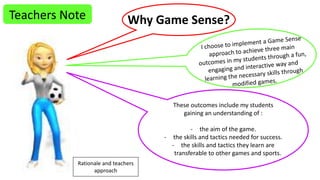
Teachers Note Why Game Sense? 
These outcomes include my students 
gaining an understanding of : 
- the aim of the game. 
- the skills and tactics needed for success. 
- the skills and tactics they learn are 
transferable to other games and sports. 
Rationale and teachers 
approach
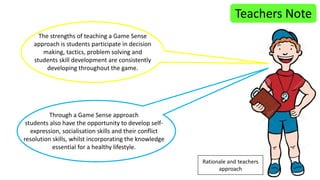
Teachers Note 
The strengths of teaching a Game Sense 
approach is students participate in decision 
making, tactics, problem solving and 
students skill development are consistently 
developing throughout the game. 
Through a Game Sense approach 
students also have the opportunity to develop self-expression, 
socialisation skills and their conflict 
resolution skills, whilst incorporating the knowledge 
essential for a healthy lifestyle. 
Rationale and teachers 
approach
T 
H 
E 
E 
N 
D
References 
Australian Government Australian Sports commission (n.d). Sports coach: Teaching games for understanding (TGfU). Retrieved 23rd September 
from http://www.ausport.gov.au/sportscoachmag/coaching_processes/teaching_games_for_understanding 
Australian Sports Commission. Youtube link. Coaching - Game Sense - Part 2. retrieved 23rd September from 
http://www.youtube.com/watch?v=RKzAbB2Lg6U 
Brookes, L. (n.d). How game sense approach in physical education can develop cognitive thinking. Physical education. Somerville House. 
Curry, C. (2011). Using the game sense approach to deliver quality teaching in physical education. Engaging learning. Retrieved 23rd 
September 2014 from http://learning21c.wordpress.com/2011/11/27/using-the-game-sense-approach-to-deliver-quality-teaching-in-physical- 
education/ 
Curry, C. (2011a). Using the game sense approach in physical education. Engaging learning. Retrieved 23rd September 2014 from 
http://learning21c.wordpress.com/2011/11/27/using-the-game-sense-approach-in-physical-education/ 
Google. (2014). Google images. Retrieved 23rd September from https://www.googleimages.com.au. 
Light, J. (2012). Game Sense. Pedagogy for Performance, Participation and Enjoyment. Routledge studies in physical education and youth 
sport. Routledge: UK. 
Light, R. (2002). Engaging the body in learning: Promoting cognition in games through teaching games for understanding. ACHPER Healthy 
Lifestyle Journal, 49(269-87).
References 
Light, R. (2003). The joy of learning: Emotion and learning in games through teaching games for understanding. Journal of physical education 
New Zealand. (p.93-99). 
New Zealand Rugby Union. (2014). Coaching toolbox. Game development: Game sense. Retrieved 23rd September 2014 from 
http://www.coachingtoolbox.co.nz/table/game-sense/ 
NSW Government. (n.d). PDHPE: Game sense to practical lessons. CS Feature Article. Retrieved 23rd September 2014 from 
http://www.curriculumsupport.education.nsw.gov.au/secondary/pdhpe/assets/pdf/pa_002.pdf 
NSW Government. (2011). New South Wales Department of Education and Communities. PDHPE: Rethinking the teaching of games and 
sports. Games categories. Retrieved 23rd September 2014 from 
http://www.curriculumsupport.education.nsw.gov.au/secondary/pdhpe/pdhpe7_10/physical_activity/games_002.htm 
NSW Government. (2011a). New South Wales Department of Education and Communities. PDHPE: Rethinking the teaching of games and 
sports. Retrieved 23rd September 2014 from 
http://www.curriculumsupport.education.nsw.gov.au/secondary/pdhpe/pdhpe7_10/physical_activity/games.htm 
Pearson, P., Webb, P., & McKeen, K. (2005). Linking Teaching Games for Understanding (TGfU) and Quality Teaching (QT). Game Sense youtube 
clip: http://www.youtube.com/watch?v=RKzAbB2Lg6U

Game Sense

  • 1.
    G A ME S E N S E
  • 2.
    Why PDHPE inSchools? Personal Development Health and Physical Education (PDHPE) is one of the six key learning areas (KLA’s) within the NSW Primary School Curriculum.
  • 3.
    When teaching physicaleducation lessons, teachers use a variety of approaches to meet students needs and learning abilities. One new approach that teachers are finding useful is Teaching Games for Understanding Approach (TGfU) also known as ‘Game Sense’. Game Sense Come along with me and my friends to find out about ‘Game Sense’; what it is, how we engage in ‘Game Sense’ activities, the skills we learn from these activities and why ‘Game Sense’ is the best approach when teaching PE.
  • 4.
    What is GameSense? "Game Sense" uses games as a learning tool to increase motivation of players develop tactical and strategic thinking improve skills for further game participation
  • 5.
    The Game Senseapproach is a variation of Bunker and Thorpe’s Teaching Games for Understanding (TGfU) model. The Game Sense approach became prominent in Australia following a visit by Rod Thorpe to Australia in 1996. Game Sense Approach A ‘Game Sense Approach’ provides an ideal means through which teachers can address the Quality Teaching Framework in the teaching of games and sport.
  • 6.
    The Games Senseapproach is a student-centred and inquiry-based approach that allows students to develop and enhance their skills and understandings while being actively involved in the game. Game Sense Approach All games and sports have tactics, strategies and techniques which players need to master before they can effectively participate in particular games and sports. Through game sense approaches such as participation in modified games students can learn these skills they than can transfer to the specific sports.
  • 7.
    Game Sense Approach Game Sense encourages problem solving through the use of physical activity. Through ‘Games Sense’ approaches students are placed in situations where decision making and problem solving are essential for successful performance. Game Sense approaches focus on strategies such as questioning to stimulate thinking about the game instead of using a more direct teaching or coaching approach. The teacher prompts cues throughout student participation. Students further learn skill development.
  • 8.
    Game Sense Approach Game Sense integrates physical, intellectual and social learning. Children can learn and understand similarities between games and explore common principles. If you would like to know more about ‘Teaching Games for Understanding (TGfU) - Game Sense Approaches, you can visit this ‘youtube’ link: http://www.youtube.com/watch?v=RKzAbB2Lg6U
  • 9.
    Game Categories The‘Game Sense’ approach categorises team games into four groups. The division of these games into the four categories is based on the physical characteristics of the game, the fundamental skills required and the tactical problems or primary rules of the game. These are identified in the PDHPE syllabus as invasion games such as soccer, touch football and netball; target games such as golf, archery and bowls; court and net games such as volleyball, tennis and badminton; and striking and fielding games such as cricket and softball.
  • 10.
    Game Sense inAction Yesterday Miss Vangarden took 3V out on the field to play an invasion game called “snag-a-tag”. The concept of the game was for student’s to defend their goal, and strike, work together to ‘defeat’ the opposing team by snatching the tags ‘snag-the-tag’ off the opposing team and kicking the soccer ball into their try line. The game was a modified version of soccer, netball and oz-tag. We used a range of game tactics from each. The game tactics and skills increased in complexity as the game progressed and new rules and game changes were made. This required us to collaborate, make decisions and use existing and learning new skills.
  • 11.
    Outcomes We Achieved Interacting INS2.3 - Makes positive contributions in group activities. Communicating COS2.1 - Uses a variety of ways to communicate with and within groups. Games and Sports GSS2.8 - Participates and uses equipment in a variety of games and modified sports. practises and refines movement skills in a variety of games demonstrates efficient ways of using equipment while working cooperatively with others demonstrates a range of skills in practices and modified games, eg throwing and catching in moving and stationary positions
  • 12.
    Skills Developed inGame Sense Fundamental Movement Skills 1) Locomotor skills, such as running, jumping, hopping, galloping and skipping. 2) Balance, this is where the body remains in the same place though moves around its horizontal and vertical axes. 3) Ball skills, such as catching, throwing, kicking and striking
  • 13.
    Links to Syllabus Active Lifestyle Ways to be Active - skill development activities - skill practice in minor games - minor games with high level of participation - regular participation in daily activity Decision Making School and Play Safety
  • 14.
    Links to Syllabus Games and Sports Non-locomotor Skills - stretch/bend/twist, dodging, swinging and balancing Locomotor Skills - running/sprinting, dodging – side stepping and jumping/landing Manipulative Skills – throwing, pitching, fielding/catching, dribbling, change direction, striking/hitting, kicking and passing. Games - spatial awareness, creating space and positional awareness Minor games - chasing games, ball games/relays, territorial games and modified games Playing the Game - safety considerations, fair play, teamwork, benefits of and influences on participation, roles/responsibilities, effort and practice, competition, rules/tactics/strategies
  • 15.
    Teachers Note WhyGame Sense? These outcomes include my students gaining an understanding of : - the aim of the game. - the skills and tactics needed for success. - the skills and tactics they learn are transferable to other games and sports. Rationale and teachers approach
  • 16.
    Teachers Note Thestrengths of teaching a Game Sense approach is students participate in decision making, tactics, problem solving and students skill development are consistently developing throughout the game. Through a Game Sense approach students also have the opportunity to develop self-expression, socialisation skills and their conflict resolution skills, whilst incorporating the knowledge essential for a healthy lifestyle. Rationale and teachers approach
  • 17.
    T H E E N D
  • 18.
    References Australian GovernmentAustralian Sports commission (n.d). Sports coach: Teaching games for understanding (TGfU). Retrieved 23rd September from http://www.ausport.gov.au/sportscoachmag/coaching_processes/teaching_games_for_understanding Australian Sports Commission. Youtube link. Coaching - Game Sense - Part 2. retrieved 23rd September from http://www.youtube.com/watch?v=RKzAbB2Lg6U Brookes, L. (n.d). How game sense approach in physical education can develop cognitive thinking. Physical education. Somerville House. Curry, C. (2011). Using the game sense approach to deliver quality teaching in physical education. Engaging learning. Retrieved 23rd September 2014 from http://learning21c.wordpress.com/2011/11/27/using-the-game-sense-approach-to-deliver-quality-teaching-in-physical- education/ Curry, C. (2011a). Using the game sense approach in physical education. Engaging learning. Retrieved 23rd September 2014 from http://learning21c.wordpress.com/2011/11/27/using-the-game-sense-approach-in-physical-education/ Google. (2014). Google images. Retrieved 23rd September from https://www.googleimages.com.au. Light, J. (2012). Game Sense. Pedagogy for Performance, Participation and Enjoyment. Routledge studies in physical education and youth sport. Routledge: UK. Light, R. (2002). Engaging the body in learning: Promoting cognition in games through teaching games for understanding. ACHPER Healthy Lifestyle Journal, 49(269-87).
  • 19.
    References Light, R.(2003). The joy of learning: Emotion and learning in games through teaching games for understanding. Journal of physical education New Zealand. (p.93-99). New Zealand Rugby Union. (2014). Coaching toolbox. Game development: Game sense. Retrieved 23rd September 2014 from http://www.coachingtoolbox.co.nz/table/game-sense/ NSW Government. (n.d). PDHPE: Game sense to practical lessons. CS Feature Article. Retrieved 23rd September 2014 from http://www.curriculumsupport.education.nsw.gov.au/secondary/pdhpe/assets/pdf/pa_002.pdf NSW Government. (2011). New South Wales Department of Education and Communities. PDHPE: Rethinking the teaching of games and sports. Games categories. Retrieved 23rd September 2014 from http://www.curriculumsupport.education.nsw.gov.au/secondary/pdhpe/pdhpe7_10/physical_activity/games_002.htm NSW Government. (2011a). New South Wales Department of Education and Communities. PDHPE: Rethinking the teaching of games and sports. Retrieved 23rd September 2014 from http://www.curriculumsupport.education.nsw.gov.au/secondary/pdhpe/pdhpe7_10/physical_activity/games.htm Pearson, P., Webb, P., & McKeen, K. (2005). Linking Teaching Games for Understanding (TGfU) and Quality Teaching (QT). Game Sense youtube clip: http://www.youtube.com/watch?v=RKzAbB2Lg6U