Checking Understanding
Checking Understanding:
Objectives
• to develop awareness and use of concept
checking, task checking and monitoring
• to raise awareness of the task cycle
• to give an overview of major test types
and reasons for assessing
• to give guidance on assessing in class
Why test?
• Read the card.
• In that context, what is the purpose of the
assessment?
• What are the pros and cons of these
assessments?
Concept Questions
In a perfect world…
• It’s not always possible to think of or
develop perfect concept checking
• Concept checking:
– should be yes/no or one word answer
questions
– shouldn’t use the target language
– should be easy for the learners to understand
– and most important of all, should…
CHECK THAT THE
LEARNERS UNDERSTAND
Developing good concept
questions
• Break the language exponent into basic
bits of meaning…
• “I’m playing tennis with Paul this evening.”
– I like playing tennis with Paul.
– I am not playing now.
– I didn’t play tennis last week
– I will play this evening.
– I have arranged to do it.
Developing good concept
questions - 2
• Turn the statements into questions
– I am not playing now.
• Am I playing now? – No.

– I will play this evening.
• Will I play this evening? - Yes

– I have arranged to do it.
• Have I arranged to do it? - Yes
• Did I arrange to do it? - Yes
Going to – intentions
• I am going to see the dentist on Friday.
– Am I at the doctor’s now?
– Will I see the doctor today?
– Will I see the doctor on Friday?
– Did I decide to see the doctor before now?
– (or: When did I decide to see the doctor?)
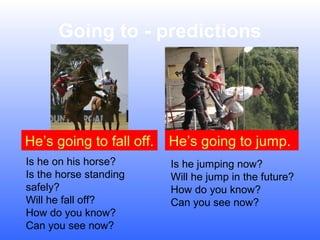
Going to - predictions

He’s going to fall off.

He’s going to jump.

Is he on his horse?
Is the horse standing
safely?
Will he fall off?
How do you know?
Can you see now?

Is he jumping now?
Will he jump in the future?
How do you know?
Can you see now?
Things to bear in mind…
• AIMS
– you need to know exactly what you are teaching

• CONTEXT
– no context means no (good) exponents

• EXPONENTS
– no exponents means no good concept questions

• “Do you understand?” is not a concept
question!!! Because the answer is always…
YES
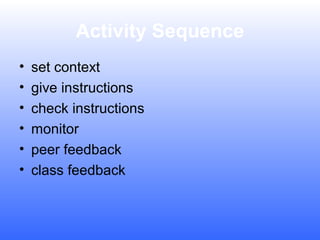
Activity Sequence
•
•
•
•
•
•

set context
give instructions
check instructions
monitor
peer feedback
class feedback
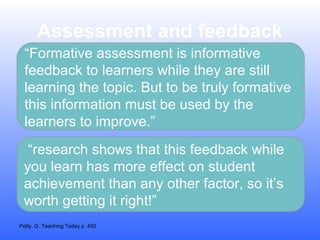
Assessment and feedback
“Formative assessment is informative
feedback to learners while they are still
learning the topic. But to be truly formative
this information must be used by the
learners to improve.”
“research shows that this feedback while
you learn has more effect on student
achievement than any other factor, so it’s
worth getting it right!”
Petty. G. Teaching Today p. 450
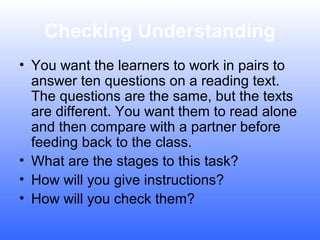
Checking Understanding
• You want the learners to work in pairs to
answer ten questions on a reading text.
The questions are the same, but the texts
are different. You want them to read alone
and then compare with a partner before
feeding back to the class.
• What are the stages to this task?
• How will you give instructions?
• How will you check them?
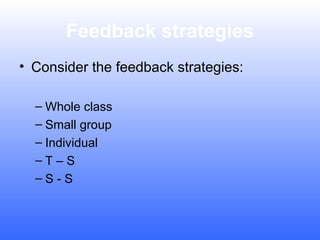
Feedback strategies
• Consider the feedback strategies:
– Whole class
– Small group
– Individual
–T–S
–S-S

Checking understanding

  • 1.
  • 2.
    Checking Understanding: Objectives • todevelop awareness and use of concept checking, task checking and monitoring • to raise awareness of the task cycle • to give an overview of major test types and reasons for assessing • to give guidance on assessing in class
  • 3.
    Why test? • Readthe card. • In that context, what is the purpose of the assessment? • What are the pros and cons of these assessments?
  • 4.
  • 5.
    In a perfectworld… • It’s not always possible to think of or develop perfect concept checking • Concept checking: – should be yes/no or one word answer questions – shouldn’t use the target language – should be easy for the learners to understand – and most important of all, should…
  • 6.
  • 7.
    Developing good concept questions •Break the language exponent into basic bits of meaning… • “I’m playing tennis with Paul this evening.” – I like playing tennis with Paul. – I am not playing now. – I didn’t play tennis last week – I will play this evening. – I have arranged to do it.
  • 8.
    Developing good concept questions- 2 • Turn the statements into questions – I am not playing now. • Am I playing now? – No. – I will play this evening. • Will I play this evening? - Yes – I have arranged to do it. • Have I arranged to do it? - Yes • Did I arrange to do it? - Yes
  • 9.
    Going to –intentions • I am going to see the dentist on Friday. – Am I at the doctor’s now? – Will I see the doctor today? – Will I see the doctor on Friday? – Did I decide to see the doctor before now? – (or: When did I decide to see the doctor?)
  • 10.
    Going to -predictions He’s going to fall off. He’s going to jump. Is he on his horse? Is the horse standing safely? Will he fall off? How do you know? Can you see now? Is he jumping now? Will he jump in the future? How do you know? Can you see now?
  • 11.
    Things to bearin mind… • AIMS – you need to know exactly what you are teaching • CONTEXT – no context means no (good) exponents • EXPONENTS – no exponents means no good concept questions • “Do you understand?” is not a concept question!!! Because the answer is always…
  • 12.
  • 13.
    Activity Sequence • • • • • • set context giveinstructions check instructions monitor peer feedback class feedback
  • 14.
    Assessment and feedback “Formativeassessment is informative feedback to learners while they are still learning the topic. But to be truly formative this information must be used by the learners to improve.” “research shows that this feedback while you learn has more effect on student achievement than any other factor, so it’s worth getting it right!” Petty. G. Teaching Today p. 450
  • 15.
    Checking Understanding • Youwant the learners to work in pairs to answer ten questions on a reading text. The questions are the same, but the texts are different. You want them to read alone and then compare with a partner before feeding back to the class. • What are the stages to this task? • How will you give instructions? • How will you check them?
  • 16.
    Feedback strategies • Considerthe feedback strategies: – Whole class – Small group – Individual –T–S –S-S