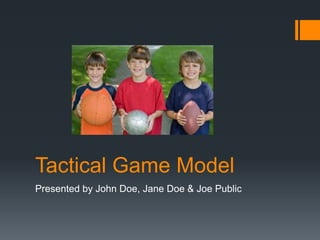
Tactical Game Model
Presented by John Doe, Jane Doe & Joe Public
Overview
 TGFU, Games for Learning, game sense, play practice
 Response to perceived inadequacies of traditional technique
based units.
 Seeks to teach students how to perform in CONTEXT.
 Students learn skill through gameplay, not in order to play
games.
 Based heavily upon the constructivist learning theory.
Need for this model
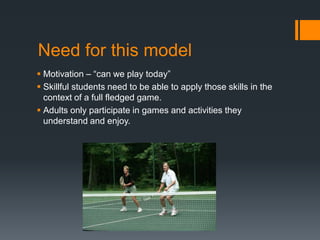
 Motivation – “can we play today”
 Skillful students need to be able to apply those skills in the
context of a full fledged game.
 Adults only participate in games and activities they
understand and enjoy.
Value Orientation
 This model is compatible with a learning process and/or
subject matter value orientation.
 Normally (but not exclusively) the subject matter will be sports.
 Sports organized around themes: net, invasion, target, fielding/striking
 Many tactics are applicable across a range of various sports:
 Moving to open space, speed accuracy trade-offs, playing to the weak spot
Characteristics
 WHY is learned before HOW.
 Students are guided to arrive at movement solutions through
teacher questioning.
 Why

 Most lessons follow a pattern of some sort that employs gamepractice-game.
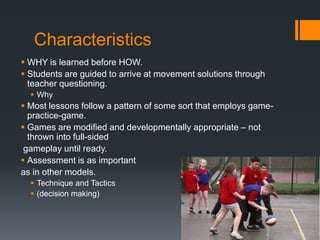
 Games are modified and developmentally appropriate – not
thrown into full-sided
gameplay until ready.
 Assessment is as important
as in other models.
 Technique and Tactics
 (decision making)
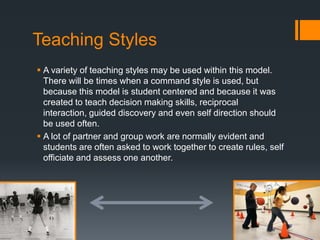
Teaching Styles
 A variety of teaching styles may be used within this model.
There will be times when a command style is used, but
because this model is student centered and because it was
created to teach decision making skills, reciprocal
interaction, guided discovery and even self direction should
be used often.
 A lot of partner and group work are normally evident and
students are often asked to work together to create rules, self
officiate and assess one another.
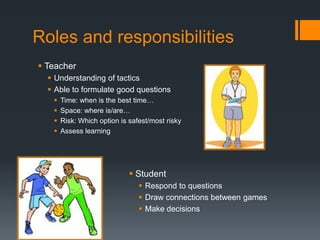
Roles and responsibilities
 Teacher
 Understanding of tactics
 Able to formulate good questions





Time: when is the best time…
Space: where is/are…
Risk: Which option is safest/most risky
Assess learning

 Student
 Respond to questions
 Draw connections between games
 Make decisions
Research
 Most studies report no difference is skill development when
comparing technique approach to tactical approach.
 Students generally report greater levels of enjoyment under a
tactical games approach.
 Some studies report students spend more time on task under
a tactical games approach.
Samples
 Yearly Plan (scope and sequence):
http://www.moe.gov.sg/education/syllabuses/aesthetics-healthand-moral-education/files/physical-education.pdf [see page 5]
 Unit plan (block plan):
http://www.hhpcommunities.com/metzler/index.php?option=com_
content&view=article&id=189:sample-unit-plan-for-tactical-gamesin-physical-education&catid=47:tactical-games&Itemid=63
 Lesson Plan:
https://www.dropbox.com/s/hmbivk7pxv3u2l0/TGFUbadminton%20example-HPE510.doc
Yearly Plan
Portion on a unit block plan
Lesson Plan
References
 Butler, J., & Griffen, L. (2010). More Teaching Games for Understanding: Moving
globally. Champaign: Human Kinetics.
 Butler, J., Griffen, L., Lombardo, B., & Nastasi, R. (2003). Teaching games for
understanding in physical education and sport. Reston: NASPE.
 Carpenter, E. (2010). The Tactical Games Model Sport Experience: An
Examination of Student Motivation and Game Performance during an Ultimate
Frisbee Unit. Amherst: Dissertations and Theses at ScholarWorks@UMass;
Paper 240.
 Hopper, T., & Kruisselbrink, D. (2014, January 4). Teaching Games for
Understanding: What does it look like and how does it influence student skill
acquisition and game performance? Retrieved from uvic.ca/~thopper:
http://web.uvic.ca/~thopper/articles/JTPE/TGFU.htm
 IMPE Resource Site. (2013, December 18). Retrieved from HHP Communities:
http://www.hhpcommunities.com/metzler/index.php?option=com_content&view=
article&id=189:sample-unit-plan-for-tactical-games-in-physicaleducation&catid=47:tactical-games&Itemid=63
 Metzler, M. (2011). Instructional Models for Physical Education (3rd Ed.).
Scottsdale: Holcomb Hathaway Publishers.

Tactical game model

  • 1.
    Tactical Game Model Presentedby John Doe, Jane Doe & Joe Public
  • 2.
    Overview  TGFU, Gamesfor Learning, game sense, play practice  Response to perceived inadequacies of traditional technique based units.  Seeks to teach students how to perform in CONTEXT.  Students learn skill through gameplay, not in order to play games.  Based heavily upon the constructivist learning theory.
  • 3.
    Need for thismodel  Motivation – “can we play today”  Skillful students need to be able to apply those skills in the context of a full fledged game.  Adults only participate in games and activities they understand and enjoy.
  • 4.
    Value Orientation  Thismodel is compatible with a learning process and/or subject matter value orientation.  Normally (but not exclusively) the subject matter will be sports.  Sports organized around themes: net, invasion, target, fielding/striking  Many tactics are applicable across a range of various sports:  Moving to open space, speed accuracy trade-offs, playing to the weak spot
  • 5.
    Characteristics  WHY islearned before HOW.  Students are guided to arrive at movement solutions through teacher questioning.  Why  Most lessons follow a pattern of some sort that employs gamepractice-game.  Games are modified and developmentally appropriate – not thrown into full-sided gameplay until ready.  Assessment is as important as in other models.  Technique and Tactics  (decision making)
  • 6.
    Teaching Styles  Avariety of teaching styles may be used within this model. There will be times when a command style is used, but because this model is student centered and because it was created to teach decision making skills, reciprocal interaction, guided discovery and even self direction should be used often.  A lot of partner and group work are normally evident and students are often asked to work together to create rules, self officiate and assess one another.
  • 7.
    Roles and responsibilities Teacher  Understanding of tactics  Able to formulate good questions     Time: when is the best time… Space: where is/are… Risk: Which option is safest/most risky Assess learning  Student  Respond to questions  Draw connections between games  Make decisions
  • 8.
    Research  Most studiesreport no difference is skill development when comparing technique approach to tactical approach.  Students generally report greater levels of enjoyment under a tactical games approach.  Some studies report students spend more time on task under a tactical games approach.
  • 9.
    Samples  Yearly Plan(scope and sequence): http://www.moe.gov.sg/education/syllabuses/aesthetics-healthand-moral-education/files/physical-education.pdf [see page 5]  Unit plan (block plan): http://www.hhpcommunities.com/metzler/index.php?option=com_ content&view=article&id=189:sample-unit-plan-for-tactical-gamesin-physical-education&catid=47:tactical-games&Itemid=63  Lesson Plan: https://www.dropbox.com/s/hmbivk7pxv3u2l0/TGFUbadminton%20example-HPE510.doc
  • 10.
  • 11.
    Portion on aunit block plan
  • 12.
  • 13.
    References  Butler, J.,& Griffen, L. (2010). More Teaching Games for Understanding: Moving globally. Champaign: Human Kinetics.  Butler, J., Griffen, L., Lombardo, B., & Nastasi, R. (2003). Teaching games for understanding in physical education and sport. Reston: NASPE.  Carpenter, E. (2010). The Tactical Games Model Sport Experience: An Examination of Student Motivation and Game Performance during an Ultimate Frisbee Unit. Amherst: Dissertations and Theses at ScholarWorks@UMass; Paper 240.  Hopper, T., & Kruisselbrink, D. (2014, January 4). Teaching Games for Understanding: What does it look like and how does it influence student skill acquisition and game performance? Retrieved from uvic.ca/~thopper: http://web.uvic.ca/~thopper/articles/JTPE/TGFU.htm  IMPE Resource Site. (2013, December 18). Retrieved from HHP Communities: http://www.hhpcommunities.com/metzler/index.php?option=com_content&view= article&id=189:sample-unit-plan-for-tactical-games-in-physicaleducation&catid=47:tactical-games&Itemid=63  Metzler, M. (2011). Instructional Models for Physical Education (3rd Ed.). Scottsdale: Holcomb Hathaway Publishers.