
strategy+business


issue 70 SPRING 2013


Well-Tailored IT
Develop a sophisticated, more strategically oriented information
technology approach.


by PETER BURNS, DAVID HOVENDEN,

AND MARK JOHNSON


reprint 00159
special section:
                                the new functional leader


                                Well-Tailored IT
                                Develop a sophisticated,
                                more strategically
                                oriented information
                                technology approach.
feature strategy & leadership


                                by Peter Burns, David Hovenden,
                                and Mark Johnson


                                Chief information officers and other IT leaders               technological advances, reduce errors and mishaps, sim-
                                have had their hands full during the past few years,          plify the customer and employee experience, protect
                                coping with disruptive change. The global economic            the company against cybersecurity threats, embrace
                                downturn has limited the technological investment             openness and social media, and realize the benefits of
                                available to most companies. Because of an aging work-        digitization—all while spending less. The net effect
      1
                                force and insufficiencies in science and technology           has been a rise in sophistication, and the outsourcing
                                education, the overall skill level of the IT talent pool      of many formerly transactional services. In the near fu-
                                is declining. Mergers and acquisitions have forced IT         ture, IT leaders and employees in most large businesses
                                functions to link up ill-matched technologies from dif-       and government agencies will work on activities such as
                                ferent legacies. Vendors are rapidly consolidating as well.   predictive analytics—setting up systems that capture
                                Employees demand access to mobile devices, tablets,           information in real time and using these systems to en-
                                and social media. The growth of cloud computing and           able better decisions or to program automated custom-
                                the acceptance of software-as-a-service, while sharply        er-tailored responses. IT staffers who specialize in more
                                reducing costs, have added a new level of complexity to       familiar tasks (for example, coding or providing tech
                                IT strategies and raised questions about information se-      support) will end up moving to dedicated outsourced
                                                                                                                                                          Illustration by Keith Negley


                                curity. Advances in robotics and digital fabrication are      organizations that are equipped with the scale to offer
                                beginning to have an effect on prototyping and supply         those services more effectively and inexpensively.
                                chain practices.                                                   A sophisticated, strategically oriented IT function
                                     Meanwhile, the demands placed on IT functions            is a desirable goal for any company. It’s especially de-
                                by most companies have increased in scale and num-            sirable when the business’s distinctive capabilities rely
                                ber. IT leaders are expected to simultaneously improve        heavily on information technology. If you are a chief
                                the quality of the services they provide, keep up with        information officer (CIO), a chief technology officer
features title of the article
feature strategy & leadership
                                2
Peter Burns                      David Hovenden                  Mark Johnson                  Also contributing to this
                                peter.burns@booz.com             david.hovenden@booz.com         mark.johnson@booz.com         article was Booz & Company
                                is a partner with Booz &         is a partner with Booz &        is a principal with Booz      associate Socrates Vossos.
                                Company based in Sydney.         Company based in Kuala          & Company based in
                                As the leader of the firm’s      Lumpur. He focuses on           Melbourne. He specializes
                                service operations business      financial services and is       in helping organizations
                                in the Australia, New Zealand,   a recognized leader in IT       develop IT strategies and
                                and Southeast Asia region, he    strategy, core banking system   architectures, and in IT-
                                focuses on financial-services    transformation, and IT          related transformations and
                                and government clients.          operating model design.         operational improvements.


                                (CTO), or any other senior IT leader, you need to make           covered that no single organization can possibly excel
                                the same kinds of disciplined choices for your depart-           at all six of these drivers. Each requires its own form of
                                ment that the CEO and top leadership team are making             investment and competence.
feature strategy & leadership


                                about the strategic direction of the enterprise.                      Thus, in many organizations, these value drivers
                                     When redesigning their function, IT leaders tend            are locked in some degree of tension with one another.
                                to look for guidance outside the enterprise, toward the          Attention to cost-effectiveness is seen as a curb on qual-
                                experts and acolytes of leading-edge technology com-             ity; eager responsiveness may seem to undermine the in-
                                panies. But their generic advice on IT strategy, by its          dependent thinking needed for innovation. Each value
                                nature, does not take into account the circumstances of          driver is worthy in itself, but together they add up to
                                any particular company. Therefore, it leads to a merely          incoherence—for the IT function, and for the company
                                transitory advantage. For example, you might be told             as a whole.
                                that companies should focus their IT strategy on serv-                The first step in your analysis should be to assess
                                ing customers; or to outsource as much as possible to            your current situation. Which of these value drivers
                                keep costs low; or to be “strategic,” which means focus-         represent strengths in your organization? In which of
                                ing on long-term projects tied to corporate priorities. All      them do you have weaknesses or gaps? Which are in
                                of these approaches will work well for a while, because          conflict with one another? Where do you feel the great-
                                they help to focus the IT function in some way. But as           est demand from the larger organization, and how well
      3
                                product lines shift, technologies evolve, customers mi-          are you meeting that demand? To help them conduct
                                grate, business processes digitize, and strategies change,       this analysis, some companies have ranked the value
                                the organization starts making demands for new servic-           drivers according to how well the IT department can
                                es and new technologies, and the focus dissipates again.         deliver them.
                                                                                                      The value drivers show what you’re doing now. But
                                Six Value Drivers                                                they do not define your primary role going forward,
                                We recommend a process for discovering and putting               which is to help create and sustain the differentiating
                                into place a coherent focus for the IT function targeted         capabilities that the enterprise needs most. This role is
                                to the particular value proposition of your company. It          not focused on issues solely related to information and
                                starts with a look at your current offerings, and how            communications technology (ICT)—providing tech-
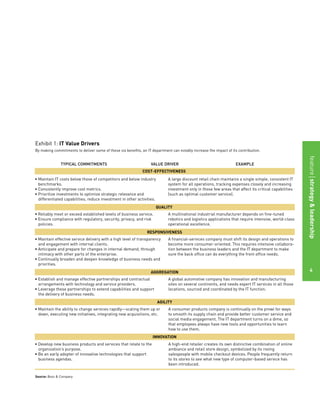
                                they provide value. We have identified six ways for IT           nical services, keeping up with developments such as
                                to create value for an enterprise through the improved           cloud computing, fixing problems in business systems,
                                                                                                                                                               strategy+business issue 70


                                deployment of technology (see Exhibit 1).                        or making sourcing decisions. Rather, it is focused on
                                     These six value drivers remain consistent priorities        contributing to the enterprise’s strategy. Thus, as your
                                for IT functions, no matter what changes take place              second step, you must build a richer understanding of
                                in technology, business, regulation, competition, and            your organization’s strategic imperatives—its value
                                global markets. At the same time, IT leaders have dis-           proposition in the market if it is a business, and its core
Exhibit 1: IT Value Drivers
By making commitments to deliver some of these six benefits, an IT department can notably increase the impact of its contribution.


                                                                                                                                                        features title of the article
                                                                                                                                                        feature strategy & leadership
              TYPICAL COMMITMENTS                                 VALUE DRIVER                                     EXAMPLE
                                                             COST-EFFECTIVENESS
• Maintain IT costs below those of competitors and below industry            A large discount retail chain maintains a single simple, consistent IT
  benchmarks.                                                                system for all operations, tracking expenses closely and increasing
• Consistently improve cost metrics.                                         investment only in those few areas that affect its critical capabilities
• Prioritize investments to optimize strategic relevance and                 (such as optimal customer service).
  differentiated capabilities; reduce investment in other activities.
                                                                     QUALITY
• Reliably meet or exceed established levels of business service.            A multinational industrial manufacturer depends on fine-tuned
• Ensure compliance with regulatory, security, privacy, and risk             robotics and logistics applications that require intensive, world-class
  policies.                                                                  operational excellence.
                                                                RESPONSIVENESS
• Maintain effective service delivery with a high level of transparency      A financial-services company must shift its design and operations to
  and engagement with internal clients.                                      become more consumer-oriented. This requires intensive collabora-
• Anticipate and prepare for changes in internal demand, through             tion between the business leaders and the IT department to make
  intimacy with other parts of the enterprise.                               sure the back office can do everything the front office needs.
• Continually broaden and deepen knowledge of business needs and
  priorities.
                                                                  AGGREGATION                                                                               4
• Establish and manage effective partnerships and contractual                A global automotive company has innovation and manufacturing
  arrangements with technology and service providers.                        sites on several continents, and needs expert IT services in all those
• Leverage these partnerships to extend capabilities and support             locations, sourced and coordinated by the IT function.
  the delivery of business needs.
                                                                        AGILITY
• Maintain the ability to change services rapidly—scaling them up or         A consumer products company is continually on the prowl for ways
  down, executing new initiatives, integrating new acquisitions, etc.        to smooth its supply chain and provide better customer service and
                                                                             social media engagement. The IT department turns on a dime, so
                                                                             that employees always have new tools and opportunities to learn
                                                                             how to use them.
                                                                   INNOVATION
• Develop new business products and services that relate to the              A high-end retailer creates its own distinctive combination of online
  organization’s purpose.                                                    ambiance and retail store design, symbolized by its roving
• Be an early adopter of innovative technologies that support                salespeople with mobile checkout devices. People frequently return
  business agendas.                                                          to its stores to see what new type of computer-based service has
                                                                             been introduced.

Source: Booz & Company
mission if it is a government agency or a not-for-profit
                                organization.
                                      Each enterprise has its own unique mix of capabili-
                                ties, but all enterprises have one thing in common: The
                                IT organization plays a significant role. It contributes
                                to—or even co-creates—the company’s differentiating
                                capabilities, working with the other functions that are
                                responsible for them, developing solutions, and leading
                                the way across the gap between where the organiza-
                                tion is and where it needs to be. For example, supply
                                chain logistics is a key differentiating capability at Avon
                                Products, and its IT department played a critical role in
                                making the company truly world-class.
                                      IT is also a primary enabler of those less strategi-
                                cally relevant capabilities, such as basic production and
                                distribution, which are competitive necessities if a com-     ability. If you pursue this agenda, you may need to resist
                                pany is to remain viable in its industry. For example,        the temptation to overinvest; world-class technological
                                                                                              excellence may not be justified, especially if it comes at
feature strategy & leadership


                                every financial-services institution needs to process
                                transactions quickly and accurately. The IT department        extra cost.
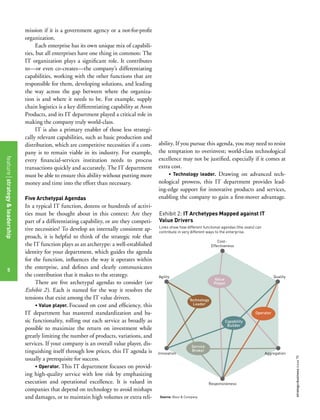
                                must be able to ensure this ability without putting more           • Technology leader. Drawing on advanced tech-
                                money and time into the effort than necessary.                nological prowess, this IT department provides lead-
                                                                                              ing-edge support for innovative products and services,
                                Five Archetypal Agendas                                       enabling the company to gain a first-mover advantage.
                                In a typical IT function, dozens or hundreds of activi-
                                ties must be thought about in this context: Are they          Exhibit 2: IT Archetypes Mapped against IT
                                part of a differentiating capability, or are they competi-    Value Drivers
                                                                                              Links show how different functional agendas (the ovals) can
                                tive necessities? To develop an internally consistent ap-     contribute in very different ways to the enterprise.
                                proach, it is helpful to think of the strategic role that
                                                                                                                                 Cost-
                                the IT function plays as an archetype: a well-established                                    Effectiveness
                                identity for your department, which guides the agenda
                                for the function, influences the way it operates within
      5
                                the enterprise, and defines and clearly communicates
                                the contribution that it makes to the strategy.               Agility                                                           Quality
                                                                                                                              Value
                                     There are five archetypal agendas to consider (see                                       Player
                                Exhibit 2 ). Each is named for the way it resolves the
                                tensions that exist among the IT value drivers.                                 Technology
                                     • Value player. Focused on cost and efficiency, this                         Leader

                                IT department has mastered standardization and ba-                                                                   Operator

                                sic functionality, rolling out each service as broadly as                                           Capability
                                                                                                                                     Builder
                                possible to maximize the return on investment while
                                greatly limiting the number of products, variations, and
                                services. If your company is an overall value player, dis-                       Service
                                tinguishing itself through low prices, this IT agenda is      Innovation
                                                                                                                 Broker
                                                                                                                                                            Aggregation
                                usually a prerequisite for success.
                                                                                                                                                                          strategy+business issue 70


                                     • Operator. This IT department focuses on provid-
                                ing high-quality service with low risk by emphasizing
                                execution and operational excellence. It is valued in                                      Responsiveness
                                companies that depend on technology to avoid mishaps
                                and damages, or to maintain high volumes or extra reli-        Source: Booz & Company
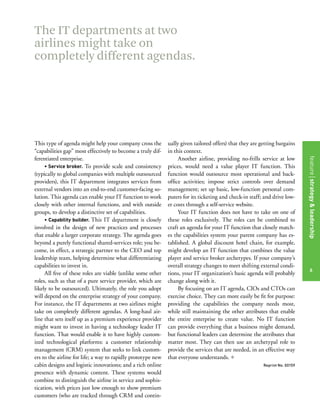
The IT departments at two
airlines might take on
completely different agendas.


This type of agenda might help your company cross the         ually given tailored offers) that they are getting bargains
“capabilities gap” most effectively to become a truly dif-    in this context.
ferentiated enterprise.                                            Another airline, providing no-frills service at low


                                                                                                                              features title of the article
                                                                                                                              feature strategy & leadership
     • Service broker. To provide scale and consistency       prices, would need a value player IT function. This
(typically to global companies with multiple outsourced       function would outsource most operational and back-
providers), this IT department integrates services from       office activities; impose strict controls over demand
external vendors into an end-to-end customer-facing so-       management; set up basic, low-function personal com-
lution. This agenda can enable your IT function to work       puters for its ticketing and check-in staff; and drive low-
closely with other internal functions, and with outside       er costs through a self-service website.
groups, to develop a distinctive set of capabilities.              Your IT function does not have to take on one of
     • Capability builder. This IT department is closely      these roles exclusively. The roles can be combined to
involved in the design of new practices and processes         craft an agenda for your IT function that closely match-
that enable a larger corporate strategy. The agenda goes      es the capabilities system your parent company has es-
beyond a purely functional shared-services role; you be-      tablished. A global discount hotel chain, for example,
come, in effect, a strategic partner to the CEO and top       might develop an IT function that combines the value
leadership team, helping determine what differentiating       player and service broker archetypes. If your company’s
capabilities to invest in.                                    overall strategy changes to meet shifting external condi-
                                                                                                                                  6
     All five of these roles are viable (unlike some other    tions, your IT organization’s basic agenda will probably
roles, such as that of a pure service provider, which are     change along with it.
likely to be outsourced). Ultimately, the role you adopt           By focusing on an IT agenda, CIOs and CTOs can
will depend on the enterprise strategy of your company.       exercise choice. They can more easily be fit for purpose:
For instance, the IT departments at two airlines might        providing the capabilities the company needs most,
take on completely different agendas. A long-haul air-        while still maintaining the other attributes that enable
line that sets itself up as a premium experience provider     the entire enterprise to create value. No IT function
might want to invest in having a technology leader IT         can provide everything that a business might demand,
function. That would enable it to have highly custom-         but functional leaders can determine the attributes that
ized technological platforms: a customer relationship         matter most. They can then use an archetypal role to
management (CRM) system that seeks to link custom-            provide the services that are needed, in an effective way
ers to the airline for life; a way to rapidly prototype new   that everyone understands. +
cabin designs and logistic innovations; and a rich online                                                 Reprint No. 00159
presence with dynamic content. These systems would
combine to distinguish the airline in service and sophis-
tication, with prices just low enough to show premium
customers (who are tracked through CRM and contin-
strategy+business magazine
is published by Booz & Company Inc.
To subscribe, visit strategy-business.com
or call 1-855-869-4862.

For more information about Booz & Company,
visit booz.com


• strategy-business.com
• facebook.com/strategybusiness
• http://twitter.com/stratandbiz
101 Park Ave., 18th Floor, New York, NY 10178


© 2013 Booz & Company Inc.

Well-Tailored IT

  • 1.
    strategy+business issue 70 SPRING2013 Well-Tailored IT Develop a sophisticated, more strategically oriented information technology approach. by PETER BURNS, DAVID HOVENDEN, AND MARK JOHNSON reprint 00159
  • 2.
    special section: the new functional leader Well-Tailored IT Develop a sophisticated, more strategically oriented information technology approach. feature strategy & leadership by Peter Burns, David Hovenden, and Mark Johnson Chief information officers and other IT leaders technological advances, reduce errors and mishaps, sim- have had their hands full during the past few years, plify the customer and employee experience, protect coping with disruptive change. The global economic the company against cybersecurity threats, embrace downturn has limited the technological investment openness and social media, and realize the benefits of available to most companies. Because of an aging work- digitization—all while spending less. The net effect 1 force and insufficiencies in science and technology has been a rise in sophistication, and the outsourcing education, the overall skill level of the IT talent pool of many formerly transactional services. In the near fu- is declining. Mergers and acquisitions have forced IT ture, IT leaders and employees in most large businesses functions to link up ill-matched technologies from dif- and government agencies will work on activities such as ferent legacies. Vendors are rapidly consolidating as well. predictive analytics—setting up systems that capture Employees demand access to mobile devices, tablets, information in real time and using these systems to en- and social media. The growth of cloud computing and able better decisions or to program automated custom- the acceptance of software-as-a-service, while sharply er-tailored responses. IT staffers who specialize in more reducing costs, have added a new level of complexity to familiar tasks (for example, coding or providing tech IT strategies and raised questions about information se- support) will end up moving to dedicated outsourced Illustration by Keith Negley curity. Advances in robotics and digital fabrication are organizations that are equipped with the scale to offer beginning to have an effect on prototyping and supply those services more effectively and inexpensively. chain practices. A sophisticated, strategically oriented IT function Meanwhile, the demands placed on IT functions is a desirable goal for any company. It’s especially de- by most companies have increased in scale and num- sirable when the business’s distinctive capabilities rely ber. IT leaders are expected to simultaneously improve heavily on information technology. If you are a chief the quality of the services they provide, keep up with information officer (CIO), a chief technology officer
  • 3.
    features title ofthe article feature strategy & leadership 2
  • 4.
    Peter Burns David Hovenden Mark Johnson Also contributing to this peter.burns@booz.com david.hovenden@booz.com mark.johnson@booz.com article was Booz & Company is a partner with Booz & is a partner with Booz & is a principal with Booz associate Socrates Vossos. Company based in Sydney. Company based in Kuala & Company based in As the leader of the firm’s Lumpur. He focuses on Melbourne. He specializes service operations business financial services and is in helping organizations in the Australia, New Zealand, a recognized leader in IT develop IT strategies and and Southeast Asia region, he strategy, core banking system architectures, and in IT- focuses on financial-services transformation, and IT related transformations and and government clients. operating model design. operational improvements. (CTO), or any other senior IT leader, you need to make covered that no single organization can possibly excel the same kinds of disciplined choices for your depart- at all six of these drivers. Each requires its own form of ment that the CEO and top leadership team are making investment and competence. feature strategy & leadership about the strategic direction of the enterprise. Thus, in many organizations, these value drivers When redesigning their function, IT leaders tend are locked in some degree of tension with one another. to look for guidance outside the enterprise, toward the Attention to cost-effectiveness is seen as a curb on qual- experts and acolytes of leading-edge technology com- ity; eager responsiveness may seem to undermine the in- panies. But their generic advice on IT strategy, by its dependent thinking needed for innovation. Each value nature, does not take into account the circumstances of driver is worthy in itself, but together they add up to any particular company. Therefore, it leads to a merely incoherence—for the IT function, and for the company transitory advantage. For example, you might be told as a whole. that companies should focus their IT strategy on serv- The first step in your analysis should be to assess ing customers; or to outsource as much as possible to your current situation. Which of these value drivers keep costs low; or to be “strategic,” which means focus- represent strengths in your organization? In which of ing on long-term projects tied to corporate priorities. All them do you have weaknesses or gaps? Which are in of these approaches will work well for a while, because conflict with one another? Where do you feel the great- they help to focus the IT function in some way. But as est demand from the larger organization, and how well 3 product lines shift, technologies evolve, customers mi- are you meeting that demand? To help them conduct grate, business processes digitize, and strategies change, this analysis, some companies have ranked the value the organization starts making demands for new servic- drivers according to how well the IT department can es and new technologies, and the focus dissipates again. deliver them. The value drivers show what you’re doing now. But Six Value Drivers they do not define your primary role going forward, We recommend a process for discovering and putting which is to help create and sustain the differentiating into place a coherent focus for the IT function targeted capabilities that the enterprise needs most. This role is to the particular value proposition of your company. It not focused on issues solely related to information and starts with a look at your current offerings, and how communications technology (ICT)—providing tech- they provide value. We have identified six ways for IT nical services, keeping up with developments such as to create value for an enterprise through the improved cloud computing, fixing problems in business systems, strategy+business issue 70 deployment of technology (see Exhibit 1). or making sourcing decisions. Rather, it is focused on These six value drivers remain consistent priorities contributing to the enterprise’s strategy. Thus, as your for IT functions, no matter what changes take place second step, you must build a richer understanding of in technology, business, regulation, competition, and your organization’s strategic imperatives—its value global markets. At the same time, IT leaders have dis- proposition in the market if it is a business, and its core
  • 5.
    Exhibit 1: ITValue Drivers By making commitments to deliver some of these six benefits, an IT department can notably increase the impact of its contribution. features title of the article feature strategy & leadership TYPICAL COMMITMENTS VALUE DRIVER EXAMPLE COST-EFFECTIVENESS • Maintain IT costs below those of competitors and below industry A large discount retail chain maintains a single simple, consistent IT benchmarks. system for all operations, tracking expenses closely and increasing • Consistently improve cost metrics. investment only in those few areas that affect its critical capabilities • Prioritize investments to optimize strategic relevance and (such as optimal customer service). differentiated capabilities; reduce investment in other activities. QUALITY • Reliably meet or exceed established levels of business service. A multinational industrial manufacturer depends on fine-tuned • Ensure compliance with regulatory, security, privacy, and risk robotics and logistics applications that require intensive, world-class policies. operational excellence. RESPONSIVENESS • Maintain effective service delivery with a high level of transparency A financial-services company must shift its design and operations to and engagement with internal clients. become more consumer-oriented. This requires intensive collabora- • Anticipate and prepare for changes in internal demand, through tion between the business leaders and the IT department to make intimacy with other parts of the enterprise. sure the back office can do everything the front office needs. • Continually broaden and deepen knowledge of business needs and priorities. AGGREGATION 4 • Establish and manage effective partnerships and contractual A global automotive company has innovation and manufacturing arrangements with technology and service providers. sites on several continents, and needs expert IT services in all those • Leverage these partnerships to extend capabilities and support locations, sourced and coordinated by the IT function. the delivery of business needs. AGILITY • Maintain the ability to change services rapidly—scaling them up or A consumer products company is continually on the prowl for ways down, executing new initiatives, integrating new acquisitions, etc. to smooth its supply chain and provide better customer service and social media engagement. The IT department turns on a dime, so that employees always have new tools and opportunities to learn how to use them. INNOVATION • Develop new business products and services that relate to the A high-end retailer creates its own distinctive combination of online organization’s purpose. ambiance and retail store design, symbolized by its roving • Be an early adopter of innovative technologies that support salespeople with mobile checkout devices. People frequently return business agendas. to its stores to see what new type of computer-based service has been introduced. Source: Booz & Company
  • 6.
    mission if itis a government agency or a not-for-profit organization. Each enterprise has its own unique mix of capabili- ties, but all enterprises have one thing in common: The IT organization plays a significant role. It contributes to—or even co-creates—the company’s differentiating capabilities, working with the other functions that are responsible for them, developing solutions, and leading the way across the gap between where the organiza- tion is and where it needs to be. For example, supply chain logistics is a key differentiating capability at Avon Products, and its IT department played a critical role in making the company truly world-class. IT is also a primary enabler of those less strategi- cally relevant capabilities, such as basic production and distribution, which are competitive necessities if a com- ability. If you pursue this agenda, you may need to resist pany is to remain viable in its industry. For example, the temptation to overinvest; world-class technological excellence may not be justified, especially if it comes at feature strategy & leadership every financial-services institution needs to process transactions quickly and accurately. The IT department extra cost. must be able to ensure this ability without putting more • Technology leader. Drawing on advanced tech- money and time into the effort than necessary. nological prowess, this IT department provides lead- ing-edge support for innovative products and services, Five Archetypal Agendas enabling the company to gain a first-mover advantage. In a typical IT function, dozens or hundreds of activi- ties must be thought about in this context: Are they Exhibit 2: IT Archetypes Mapped against IT part of a differentiating capability, or are they competi- Value Drivers Links show how different functional agendas (the ovals) can tive necessities? To develop an internally consistent ap- contribute in very different ways to the enterprise. proach, it is helpful to think of the strategic role that Cost- the IT function plays as an archetype: a well-established Effectiveness identity for your department, which guides the agenda for the function, influences the way it operates within 5 the enterprise, and defines and clearly communicates the contribution that it makes to the strategy. Agility Quality Value There are five archetypal agendas to consider (see Player Exhibit 2 ). Each is named for the way it resolves the tensions that exist among the IT value drivers. Technology • Value player. Focused on cost and efficiency, this Leader IT department has mastered standardization and ba- Operator sic functionality, rolling out each service as broadly as Capability Builder possible to maximize the return on investment while greatly limiting the number of products, variations, and services. If your company is an overall value player, dis- Service tinguishing itself through low prices, this IT agenda is Innovation Broker Aggregation usually a prerequisite for success. strategy+business issue 70 • Operator. This IT department focuses on provid- ing high-quality service with low risk by emphasizing execution and operational excellence. It is valued in Responsiveness companies that depend on technology to avoid mishaps and damages, or to maintain high volumes or extra reli- Source: Booz & Company
  • 7.
    The IT departmentsat two airlines might take on completely different agendas. This type of agenda might help your company cross the ually given tailored offers) that they are getting bargains “capabilities gap” most effectively to become a truly dif- in this context. ferentiated enterprise. Another airline, providing no-frills service at low features title of the article feature strategy & leadership • Service broker. To provide scale and consistency prices, would need a value player IT function. This (typically to global companies with multiple outsourced function would outsource most operational and back- providers), this IT department integrates services from office activities; impose strict controls over demand external vendors into an end-to-end customer-facing so- management; set up basic, low-function personal com- lution. This agenda can enable your IT function to work puters for its ticketing and check-in staff; and drive low- closely with other internal functions, and with outside er costs through a self-service website. groups, to develop a distinctive set of capabilities. Your IT function does not have to take on one of • Capability builder. This IT department is closely these roles exclusively. The roles can be combined to involved in the design of new practices and processes craft an agenda for your IT function that closely match- that enable a larger corporate strategy. The agenda goes es the capabilities system your parent company has es- beyond a purely functional shared-services role; you be- tablished. A global discount hotel chain, for example, come, in effect, a strategic partner to the CEO and top might develop an IT function that combines the value leadership team, helping determine what differentiating player and service broker archetypes. If your company’s capabilities to invest in. overall strategy changes to meet shifting external condi- 6 All five of these roles are viable (unlike some other tions, your IT organization’s basic agenda will probably roles, such as that of a pure service provider, which are change along with it. likely to be outsourced). Ultimately, the role you adopt By focusing on an IT agenda, CIOs and CTOs can will depend on the enterprise strategy of your company. exercise choice. They can more easily be fit for purpose: For instance, the IT departments at two airlines might providing the capabilities the company needs most, take on completely different agendas. A long-haul air- while still maintaining the other attributes that enable line that sets itself up as a premium experience provider the entire enterprise to create value. No IT function might want to invest in having a technology leader IT can provide everything that a business might demand, function. That would enable it to have highly custom- but functional leaders can determine the attributes that ized technological platforms: a customer relationship matter most. They can then use an archetypal role to management (CRM) system that seeks to link custom- provide the services that are needed, in an effective way ers to the airline for life; a way to rapidly prototype new that everyone understands. + cabin designs and logistic innovations; and a rich online Reprint No. 00159 presence with dynamic content. These systems would combine to distinguish the airline in service and sophis- tication, with prices just low enough to show premium customers (who are tracked through CRM and contin-
  • 8.
    strategy+business magazine is publishedby Booz & Company Inc. To subscribe, visit strategy-business.com or call 1-855-869-4862. For more information about Booz & Company, visit booz.com • strategy-business.com • facebook.com/strategybusiness • http://twitter.com/stratandbiz 101 Park Ave., 18th Floor, New York, NY 10178 © 2013 Booz & Company Inc.