strategy+business
ONLINE FEBRUARY 19, 2019
Tomorrow’s Data Heroes
Telecom companies are struggling to find a profitable
identity in today’s digital sphere. What about helping
customers control their information?
BY FLORIAN GRÖNE, PIERRE PÉLADEAU,
AND RAWIA ABDEL SAMAD
www.strategy-business.com
2
Florian Gröne
florian.groene@pwc.com
is an advisor to executives in the
telecommunications, digital, and
software sectors for Strategy&,
PwC’s strategy consulting group.
Based in New York, he is a
principal with PwC US. He helps
companies develop business
and technology strategies for the
digital era.
Pierre Péladeau
pierre.peladeau@pwc.com
is a leading practitioner
for Strategy& in the
telecommunications and high-
tech sectors, and in digital
transformations. Based in
Paris, he is a partner with PwC
France. He supports executives
working on digital strategy in the
telecommunications, technology,
energy, utilities, aerospace, and
retail sectors.
Rawia Abdel Samad
rawia.abdelsamad.us@pwc.com
is a manager with Strategy&
based in Boston. She works with
the technology and media sectors
and advises companies on growth
and technology strategies for the
digital era.
Also contributing to this article
was Strategy& thought leader
Samer Kallas, who is a director
with PwC France.
By 2025, Alex had had enough. There no longer seemed to be any distinction
between her analog and digital lives. Everywhere she went, every purchase she
completed, and just about every move she made, from exercising at the gym
to idly surfing the Web, triggered a vast flow of data. That in turn meant she
was bombarded with personalized advertising messages, targeted more and more
eerily to her. As she walked down the street, messages appeared on her phone
about the stores she was passing. Ads popped up on her all-purpose tablet–com-
puter–phone pushing drugs for minor health problems she didn’t know she had
— until the symptoms appeared the next day. Worse, she had recently learned
that she was being reassigned at work. An AI machine had mastered her current
job by analyzing her use of the firm’s productivity software.
It was as if the algorithms of global companies knew more about her than
she knew herself — and they probably did. How was it that her every action
and conversation, even her thoughts, added to the store of data held about her?
After all, it was her data: her preferences, dislikes, interests, friendships, consum-
er choices, activities, and whereabouts — her very identity — that was being
collected, analyzed, profited from, and even used to manage her. All these com-
panies seemed to be making money buying and selling this information. Why
shouldn’t she gain some control over the data she generated, and maybe earn
some cash by selling it to the companies that had long collected it free of charge?
So Alex signed up for the “personal data manager,” a new service that prom-
ised to give her control over her privacy and identity. It was offered by her U.S.-
based connectivity company (in this article, we’ll call it DigiLife, but it could be
www.strategy-business.com
3
one of many former telephone companies providing Internet services in 2025).
During the previous few years, DigiLife had transformed itself into a connectiv-
ity hub: a platform that made it easier for customers to join, manage, and track
interactions with media and software entities across the online world. Thanks to
recently passed laws regarding digital identity and data management, including
the “right to be forgotten,” the DigiLife data manager was more than window
dressing. It laid out easy-to-follow choices that all Web-based service providers
were required by law to honor.
First, prompted by the new service, Alex requested that the data that compa-
nies had already accumulated about her be deleted, so that she could begin with
a clean slate. Then she signed onto DigiLife’s data-management app, which act-
ed as a gatekeeper for all the information that from now on would pass from her
connected devices to the Internet.
The app offered Alex choices about how much she would be willing to reveal
to companies, service providers, and other organizations. Powered by an artifi-
cial intelligence system that used her customer profile to effectively predict her
needs and intentions, the app made it easy to choose different levels of privacy
and openness for each site, and to estimate the monetary value of the data she
generated.
Alex chose, for example, to allow a few selected e-commerce and finan-
cial-services companies to gain access to her identity authentication data, so she
could make purchases and bank online. But she prevented them from accessing
her location or combining her shopping data with that from other firms. She al-
lowed location information generated by her mobile phone to be revealed to the
provider of her mapping app and to send data from her fitness-tracking wrist-
band to her doctor, but not to her insurance company. Finally, she allowed a few
e-commerce companies, social media sites, insurance companies, drugmakers,
and others to collect data on her interests, preferences, and lifestyle choices. In
exchange, each of them offered her a financial incentive, such as discounts on
her car and health insurance or micropayments returned to her DigiLife billing
account. Over the following months, Alex found herself returning to the app
frequently to add new websites and refine her personal data settings.
Today, in 2019, personal data management applications like the one Alex
www.strategy-business.com
4
used exist only in nascent form, and consumers have yet to demonstrate that
they trust these services. Nor can they yet profit by selling their data. But the
need is great, and so is the opportunity for companies that fulfill it. By 2025,
the total value of the data economy as currently structured will rise to more than
US$400 billion, and by monetizing the vast amounts of data they produce, con-
sumers can potentially recapture as much as a quarter of that total.
Given the critical role of telecom operating companies within the digital
economy — the central position of their data networks, their networking capa-
bilities, their customer relationships, and their experience in government affairs
— they are in a good position to seize this business opportunity. They might not
do it alone; they are likely to form consortia with software companies or other
digital partners. Nonetheless, for legacy connectivity companies, providing this
type of service may be the most sustainable business option. It may also be the
best option for the rest of us, as we try to maintain control in a digital world
flooded with our personal data.
Estimating Data’s Value
A look at the numbers shows just how large — and profitable — the data econ-
omy has grown in recent years, and how much faster it will grow in the years
ahead. In 2018, according to the International Data Corporation (IDC), the
world generated 33 zettabytes of data from all sources, up from 4.4 zettabytes
just five years earlier. That’s a compound annual growth rate of 50 percent, and
this ocean of information is expected to increase to 175 zettabytes by 2025,
more than five times what it was in 2018. (A zettabyte is a billion terabytes, or
1021
bytes; data scientist Riza Berkan estimates that a zettabyte stored in printed
books would require a stack reaching to the sun and back five times.)
The vast majority of data interactions take place among machines — many
of them online, but a growing number through the Internet of Things (IoT). To
be sure, most data is stored for only a few milliseconds before being discarded.
Nonetheless, about 3.7 zettabytes of data generated by people — an average of
about 117 gigabytes of data per Internet user — is stored per year. About 25
percent of that is stored by Google (by far the largest percentage of user data
stored by any single company), and another 1 percent by Facebook. By 2025,
www.strategy-business.com
5
average data generation per person is expected to reach almost 300 gigabytes. A
Seagate-sponsored IDC report estimates that the average person will thus pro-
duce more than 4,900 data interactions per day, or one datum every 18 seconds,
about 20 percent of them critical to daily life. About 90 percent of this data will
be vulnerable to unauthorized capture or cyber theft, yet less than half of it will
be secured.
It’s mind-boggling to consider the sheer extent and granularity of all the data
stored and analyzed in this huge, rapidly-growing global algorithmic ecosystem
after just its first two decades of existence. Moreover, we estimate that this infor-
mation, combined with current analytics, creates close to a quarter of a trillion
dollars in economic value each year. None of this value accrues to the individ-
uals whose activity is the source of the data. Companies that use personal data
to enable targeted advertising (Google, Facebook, and other social media and
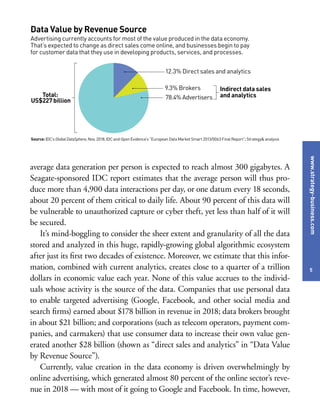
search firms) earned about $178 billion in revenue in 2018; data brokers brought
in about $21 billion; and corporations (such as telecom operators, payment com-
panies, and carmakers) that use consumer data to increase their own value gen-
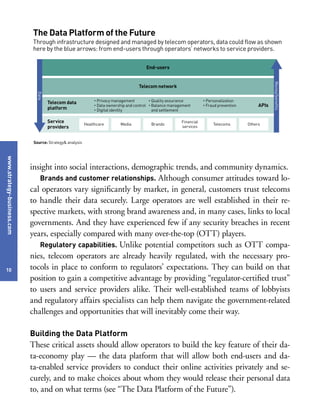
erated another $28 billion (shown as “direct sales and analytics” in “Data Value
by Revenue Source”).
Currently, value creation in the data economy is driven overwhelmingly by
online advertising, which generated almost 80 percent of the online sector’s reve-
nue in 2018 — with most of it going to Google and Facebook. In time, however,
Data Value by Revenue Source
Advertising currently accounts for most of the value produced in the data economy.
That’s expected to change as direct sales come online, and businesses begin to pay
for customer data that they use in developing products, services, and processes.
Source: IDC’s GlobalDataSphere, Nov. 2018; IDC and Open Evidence’s “European Data Market Smart 2013/0063 Final Report”; Strategy& analysis
Total:
US$227billion
12.3% Direct sales and analytics
9.3% Brokers
78.4% Advertisers
Indirect data sales
and analytics
www.strategy-business.com
6
advertising’s proportion of value creation will decline. Once virtually all adver-
tising goes digital, its growth will reach a limit, no matter how well targeted it
becomes. And the data brokers will struggle to sell personal information once
regulatory limits are placed on its dissemination and users begin to curtail its
collection.
Instead, growth will likely come from direct sales to enterprises such as auto
makers, retailers, payment companies, and telecom operators, all seeking to im-
prove their sales and operations. Once a viable commercial data ecosystem is
created through which all players, including service providers and users, can sell,
buy, trade, and profit from data, the conditions will be in place for a new type of
data-based economy. It will encompass a range of novel services, some in current
fields like healthcare, banking, insurance, media, and entertainment, and others
that are still unimagined.
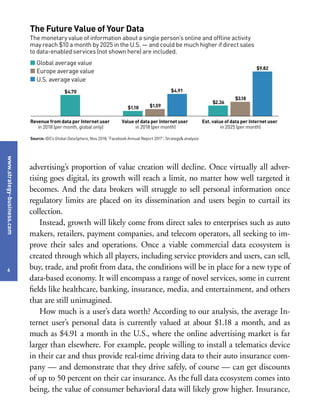
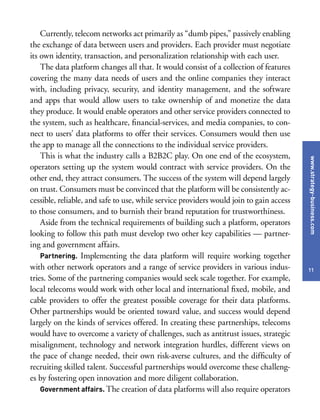
How much is a user’s data worth? According to our analysis, the average In-
ternet user’s personal data is currently valued at about $1.18 a month, and as
much as $4.91 a month in the U.S., where the online advertising market is far
larger than elsewhere. For example, people willing to install a telematics device
in their car and thus provide real-time driving data to their auto insurance com-
pany — and demonstrate that they drive safely, of course — can get discounts
of up to 50 percent on their car insurance. As the full data ecosystem comes into
being, the value of consumer behavioral data will likely grow higher. Insurance,
The Future Value of Your Data
The monetary value of information about a single person’s online and offline activity
may reach $10 a month by 2025 in the U.S. — and could be much higher if direct sales
to data-enabled services (not shown here) are included.
Source: IDC’s Global DataSphere, Nov.2018;“Facebook Annual Report 2017”; Strategy& analysis
Global average value
Europe average value
U.S. average value
$1.18
$4.91
Est. value of data per Internet user
in 2025 (per month)
Revenue from data per Internet user
in 2018 (per month, global only)
Value of data per Internet user
in 2018 (per month)
$1.59
$2.36
$3.18
$9.82
$4.70
www.strategy-business.com
7
healthcare, and e-commerce companies, among others, will aggregate their cus-
tomer data and use it to operate more efficiently and launch new products and
services more successfully. This alone could be worth several hundred dollars
a year to an individual in lower prices or outright payments (see “The Future
Value of Your Data”).
Rights and Expectations
Given the massive size and complexity of the data economy, it’s a wonder it works
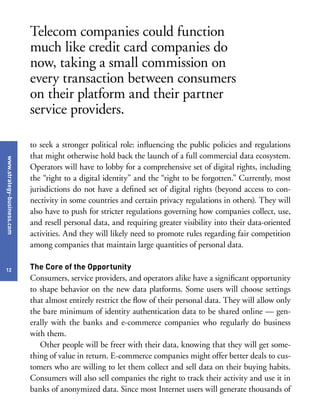
at all. Yet it does, for the most part. “User Needs in the Data Economy” lays out
the specific rights and needs of both end-users and service providers in six key
areas: privacy, security, authentication, data ownership, relevance, and friction-
less experiences. Users’ expectations for greater privacy, and for transparency into
how the data they generate is being used, will increase over time, while compa-
nies collecting, analyzing, and selling personal data will probably be forced to
meet ever more stringent privacy regulations.
As an example of the way in which telecom operators could seize an oppor-
tunity to help improve privacy, consider the standards called STIR/SHAKEN
(Secure Telephone Identity Revisited/Signature-based Handling of Asserted in-
formation using toKENs), which describe a cryptographic system for verifying
incoming phone numbers and thus reducing the irritation of robocalls. Intro-
duced in 2019 in the U.S., STIR/SHAKEN requires participating companies
Source: Strategy& analysis
User Need
Privacy
Security
Authentication
Ownership
Relevance
Frictionless
experiences
Data producers (including search engines and
social media) can:
Help users manage privacy settings, give them
visibility into how their data is used, and allow
them to easily opt in and out
Safeguard data from corruption, compromise,
or loss
Simplify the ID verification and authentication
journey
Help users take ownership of and monetize their
data, so that they benefit from its value
Help users access relevant and personalized
information and services
Provide seamless transactions and
fit-for-purpose network quality
Data-enabled service providers (including
telecoms) can:
Comply with privacy regulations and ensure
transparency
Safeguard businesses from cyber threats
Verify user ID and comply with regulations in a
simple and secure way
Monetize data through new services, business
models, and partnerships
Customize and personalize offerings based on
customer needs
Simplify checkout processes, minimize fees, and
guarantee experiences for end customers
User Needs in the Data Economy
www.strategy-business.com
8
to join a common governance system that would certify legitimate callers, and
it could become a prototype for verification and privacy-protection systems used
by connectivity companies in the future.
Users will also demand simpler systems, likely incorporating blockchain
technology, for proving who they are online. This will replace the welter of
user names and passwords they rely on now. Artificial intelligence and machine
learning systems will help provide referrals and access to websites, and help de-
termine the optimal level of Internet service quality, bandwidth, throughput,
latency, and security for each user. The kinds of connectivity demanded by users
in the dawning 5G world will depend on the activity in which they are engaged.
Some data companies are trying to address one or more of these needs, but
no one has managed to address all of them. Perhaps the closest current example
is Verimi, a cross-industry identity and data service that provides users with a
single sign-on to a variety of services. Launched in Germany in May 2018, Ver-
imi allows end-users to decide which providers can access which data. Partners
include Allianz, Axel Springer, Daimler, Deutsche Telekom, and Lufthansa.
A number of smaller firms and startups are getting into the act too. One
example is Solid. Founded in 2015 by Tim Berners-Lee, who developed the
World Wide Web protocol in 1989, Solid is an attempt to “re-decentralize” the
Web by enabling users to maintain their own data in “pods,” on their own com-
puters or in the cloud. Users choose which apps and websites get access to their
personal data.
Similarly, Datum, founded in 2017 and based in Hong Kong, is trying to
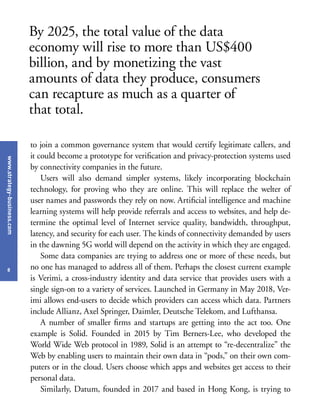
By 2025, the total value of the data
economy will rise to more than US$400
billion, and by monetizing the vast
amounts of data they produce, consumers
can recapture as much as a quarter of
that total.
www.strategy-business.com
9
create a marketplace where users can share or sell data on their own terms. Its
database, backed up by a blockchain ledger, allows people to store duplicate cop-
ies of their social network data, data from wearables, and smart-home and other
IoT devices securely, privately, and anonymously.
The Role for Telecom
The opportunity for telecom operators lies in helping customers manage their
Internet experience, including their privacy and connectivity rights. Telecom’s
role in the new data economy is grounded in operators’ core networking and
connectivity capabilities, their central position as the carriers of all digital traffic,
and their large customer constituencies. Already, many telecom leaders are deter-
mined to enrich their core operations, enabling them to gain value where they
have a natural and unique right to play.
Consider the range of telecom company assets that are deeply relevant to the
data economy:
Networks. Physical infrastructure is still essential to digital communication
— and could be a more powerful asset in the future. Telecom networks are rap-
idly increasing in coverage, capacity, and capabilities. The move to high-speed
5G mobile technology, expected to launch in 2020, will enable telecom operators
to collect more customer data — with the consent of users — and position them
to be critical enablers of connected experiences. However, operators are generally
local; they will have to team with other players to extend their influence beyond
their home markets and build global coverage.
Customer data. Although telecom operators do not currently have access to
the many kinds of personal data that flow among users and service providers,
they do maintain a great deal of critical data about customers. They have access
to large customer bases within their markets and to data related to users’ bills
and payments, their street addresses, and their phone numbers and email access
points. At the network level, telecoms can track the location of users based on
the radio access networks used for mobile telephony. They can tie every device
owned by every user to a specific account, giving them visibility into device-level
information. This allows them to manage authentication in the background, for
example, rather than rely on SMS tokens. And they can use this data to gain
www.strategy-business.com
10
insight into social interactions, demographic trends, and community dynamics.
Brands and customer relationships. Although consumer attitudes toward lo-
cal operators vary significantly by market, in general, customers trust telecoms
to handle their data securely. Large operators are well established in their re-
spective markets, with strong brand awareness and, in many cases, links to local
governments. And they have experienced few if any security breaches in recent
years, especially compared with many over-the-top (OTT) players.
Regulatory capabilities. Unlike potential competitors such as OTT compa-
nies, telecom operators are already heavily regulated, with the necessary pro-
tocols in place to conform to regulators’ expectations. They can build on that
position to gain a competitive advantage by providing “regulator-certified trust”
to users and service providers alike. Their well-established teams of lobbyists
and regulatory affairs specialists can help them navigate the government-related
challenges and opportunities that will inevitably come their way.
Building the Data Platform
These critical assets should allow operators to build the key feature of their da-
ta-economy play — the data platform that will allow both end-users and da-
ta-enabled service providers to conduct their online activities privately and se-
curely, and to make choices about whom they would release their personal data
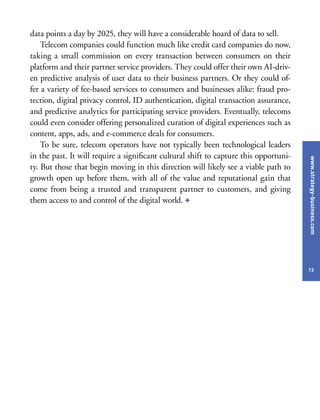
to, and on what terms (see “The Data Platform of the Future”).
The Data Platform of the Future
Through infrastructure designed and managed by telecom operators, data could flow as shown
here by the blue arrows: from end-users through operators’ networks to service providers.
Source: Strategy& analysis
End-users
Telecom network
Data
Money/benefits
Healthcare Media Brands
Financial
services
Telecoms Others
Service
providers
Telecom data
platform
• Privacy management
• Data ownership and control
• Digital identity
• Quality assurance
• Balance management
and settlement
• Personalization
• Fraud prevention APIs
www.strategy-business.com
11
Currently, telecom networks act primarily as “dumb pipes,” passively enabling
the exchange of data between users and providers. Each provider must negotiate
its own identity, transaction, and personalization relationship with each user.
The data platform changes all that. It would consist of a collection of features
covering the many data needs of users and the online companies they interact
with, including privacy, security, and identity management, and the software
and apps that would allow users to take ownership of and monetize the data
they produce. It would enable operators and other service providers connected to
the system, such as healthcare, financial-services, and media companies, to con-
nect to users’ data platforms to offer their services. Consumers would then use
the app to manage all the connections to the individual service providers.
This is what the industry calls a B2B2C play. On one end of the ecosystem,
operators setting up the system would contract with service providers. On the
other end, they attract consumers. The success of the system will depend largely
on trust. Consumers must be convinced that the platform will be consistently ac-
cessible, reliable, and safe to use, while service providers would join to gain access
to those consumers, and to burnish their brand reputation for trustworthiness.
Aside from the technical requirements of building such a platform, operators
looking to follow this path must develop two other key capabilities — partner-
ing and government affairs.
Partnering. Implementing the data platform will require working together
with other network operators and a range of service providers in various indus-
tries. Some of the partnering companies would seek scale together. For example,
local telecoms would work with other local and international fixed, mobile, and
cable providers to offer the greatest possible coverage for their data platforms.
Other partnerships would be oriented toward value, and success would depend
largely on the kinds of services offered. In creating these partnerships, telecoms
would have to overcome a variety of challenges, such as antitrust issues, strategic
misalignment, technology and network integration hurdles, different views on
the pace of change needed, their own risk-averse cultures, and the difficulty of
recruiting skilled talent. Successful partnerships would overcome these challeng-
es by fostering open innovation and more diligent collaboration.
Government affairs. The creation of data platforms will also require operators
www.strategy-business.com
12
to seek a stronger political role: influencing the public policies and regulations
that might otherwise hold back the launch of a full commercial data ecosystem.
Operators will have to lobby for a comprehensive set of digital rights, including
the “right to a digital identity” and the “right to be forgotten.” Currently, most
jurisdictions do not have a defined set of digital rights (beyond access to con-
nectivity in some countries and certain privacy regulations in others). They will
also have to push for stricter regulations governing how companies collect, use,
and resell personal data, and requiring greater visibility into their data-oriented
activities. And they will likely need to promote rules regarding fair competition
among companies that maintain large quantities of personal data.
The Core of the Opportunity
Consumers, service providers, and operators alike have a significant opportunity
to shape behavior on the new data platforms. Some users will choose settings
that almost entirely restrict the flow of their personal data. They will allow only
the bare minimum of identity authentication data to be shared online — gen-
erally with the banks and e-commerce companies who regularly do business
with them.
Other people will be freer with their data, knowing that they will get some-
thing of value in return. E-commerce companies might offer better deals to cus-
tomers who are willing to let them collect and sell data on their buying habits.
Consumers will also sell companies the right to track their activity and use it in
banks of anonymized data. Since most Internet users will generate thousands of
Telecom companies could function
much like credit card companies do
now, taking a small commission on
every transaction between consumers
on their platform and their partner
service providers.
www.strategy-business.com
13
data points a day by 2025, they will have a considerable hoard of data to sell.
Telecom companies could function much like credit card companies do now,
taking a small commission on every transaction between consumers on their
platform and their partner service providers. They could offer their own AI-driv-
en predictive analysis of user data to their business partners. Or they could of-
fer a variety of fee-based services to consumers and businesses alike: fraud pro-
tection, digital privacy control, ID authentication, digital transaction assurance,
and predictive analytics for participating service providers. Eventually, telecoms
could even consider offering personalized curation of digital experiences such as
content, apps, ads, and e-commerce deals for consumers.
To be sure, telecom operators have not typically been technological leaders
in the past. It will require a significant cultural shift to capture this opportuni-
ty. But those that begin moving in this direction will likely see a viable path to
growth open up before them, with all of the value and reputational gain that
come from being a trusted and transparent partner to customers, and giving
them access to and control of the digital world. +
strategy+business magazine
is published by certain member firms
of the PwC network.
To subscribe, visit strategy-business.com
or call 1-855-869-4862.
• strategy-business.com
• facebook.com/strategybusiness
• linkedin.com/company/strategy-business
• twitter.com/stratandbiz
Articles published in strategy+business do not necessarily represent the views of the member firms of the
PwC network. Reviews and mentions of publications, products, or services do not constitute endorsement
or recommendation for purchase.
© 2019 PwC. All rights reserved. PwC refers to the PwC network and/or one or more of its member firms,
each of which is a separate legal entity. Please see www.pwc.com/structure for further details. Mentions
of Strategy& refer to the global team of practical strategists that is integrated within the PwC network of
firms. For more about Strategy&, see www.strategyand.pwc.com. No reproduction is permitted in whole
or part without written permission of PwC. “strategy+business” is a trademark of PwC.

Tomorrow's Data Heros

  • 1.
    strategy+business ONLINE FEBRUARY 19,2019 Tomorrow’s Data Heroes Telecom companies are struggling to find a profitable identity in today’s digital sphere. What about helping customers control their information? BY FLORIAN GRÖNE, PIERRE PÉLADEAU, AND RAWIA ABDEL SAMAD
  • 2.
    www.strategy-business.com 2 Florian Gröne florian.groene@pwc.com is anadvisor to executives in the telecommunications, digital, and software sectors for Strategy&, PwC’s strategy consulting group. Based in New York, he is a principal with PwC US. He helps companies develop business and technology strategies for the digital era. Pierre Péladeau pierre.peladeau@pwc.com is a leading practitioner for Strategy& in the telecommunications and high- tech sectors, and in digital transformations. Based in Paris, he is a partner with PwC France. He supports executives working on digital strategy in the telecommunications, technology, energy, utilities, aerospace, and retail sectors. Rawia Abdel Samad rawia.abdelsamad.us@pwc.com is a manager with Strategy& based in Boston. She works with the technology and media sectors and advises companies on growth and technology strategies for the digital era. Also contributing to this article was Strategy& thought leader Samer Kallas, who is a director with PwC France. By 2025, Alex had had enough. There no longer seemed to be any distinction between her analog and digital lives. Everywhere she went, every purchase she completed, and just about every move she made, from exercising at the gym to idly surfing the Web, triggered a vast flow of data. That in turn meant she was bombarded with personalized advertising messages, targeted more and more eerily to her. As she walked down the street, messages appeared on her phone about the stores she was passing. Ads popped up on her all-purpose tablet–com- puter–phone pushing drugs for minor health problems she didn’t know she had — until the symptoms appeared the next day. Worse, she had recently learned that she was being reassigned at work. An AI machine had mastered her current job by analyzing her use of the firm’s productivity software. It was as if the algorithms of global companies knew more about her than she knew herself — and they probably did. How was it that her every action and conversation, even her thoughts, added to the store of data held about her? After all, it was her data: her preferences, dislikes, interests, friendships, consum- er choices, activities, and whereabouts — her very identity — that was being collected, analyzed, profited from, and even used to manage her. All these com- panies seemed to be making money buying and selling this information. Why shouldn’t she gain some control over the data she generated, and maybe earn some cash by selling it to the companies that had long collected it free of charge? So Alex signed up for the “personal data manager,” a new service that prom- ised to give her control over her privacy and identity. It was offered by her U.S.- based connectivity company (in this article, we’ll call it DigiLife, but it could be
  • 3.
    www.strategy-business.com 3 one of manyformer telephone companies providing Internet services in 2025). During the previous few years, DigiLife had transformed itself into a connectiv- ity hub: a platform that made it easier for customers to join, manage, and track interactions with media and software entities across the online world. Thanks to recently passed laws regarding digital identity and data management, including the “right to be forgotten,” the DigiLife data manager was more than window dressing. It laid out easy-to-follow choices that all Web-based service providers were required by law to honor. First, prompted by the new service, Alex requested that the data that compa- nies had already accumulated about her be deleted, so that she could begin with a clean slate. Then she signed onto DigiLife’s data-management app, which act- ed as a gatekeeper for all the information that from now on would pass from her connected devices to the Internet. The app offered Alex choices about how much she would be willing to reveal to companies, service providers, and other organizations. Powered by an artifi- cial intelligence system that used her customer profile to effectively predict her needs and intentions, the app made it easy to choose different levels of privacy and openness for each site, and to estimate the monetary value of the data she generated. Alex chose, for example, to allow a few selected e-commerce and finan- cial-services companies to gain access to her identity authentication data, so she could make purchases and bank online. But she prevented them from accessing her location or combining her shopping data with that from other firms. She al- lowed location information generated by her mobile phone to be revealed to the provider of her mapping app and to send data from her fitness-tracking wrist- band to her doctor, but not to her insurance company. Finally, she allowed a few e-commerce companies, social media sites, insurance companies, drugmakers, and others to collect data on her interests, preferences, and lifestyle choices. In exchange, each of them offered her a financial incentive, such as discounts on her car and health insurance or micropayments returned to her DigiLife billing account. Over the following months, Alex found herself returning to the app frequently to add new websites and refine her personal data settings. Today, in 2019, personal data management applications like the one Alex
  • 4.
    www.strategy-business.com 4 used exist onlyin nascent form, and consumers have yet to demonstrate that they trust these services. Nor can they yet profit by selling their data. But the need is great, and so is the opportunity for companies that fulfill it. By 2025, the total value of the data economy as currently structured will rise to more than US$400 billion, and by monetizing the vast amounts of data they produce, con- sumers can potentially recapture as much as a quarter of that total. Given the critical role of telecom operating companies within the digital economy — the central position of their data networks, their networking capa- bilities, their customer relationships, and their experience in government affairs — they are in a good position to seize this business opportunity. They might not do it alone; they are likely to form consortia with software companies or other digital partners. Nonetheless, for legacy connectivity companies, providing this type of service may be the most sustainable business option. It may also be the best option for the rest of us, as we try to maintain control in a digital world flooded with our personal data. Estimating Data’s Value A look at the numbers shows just how large — and profitable — the data econ- omy has grown in recent years, and how much faster it will grow in the years ahead. In 2018, according to the International Data Corporation (IDC), the world generated 33 zettabytes of data from all sources, up from 4.4 zettabytes just five years earlier. That’s a compound annual growth rate of 50 percent, and this ocean of information is expected to increase to 175 zettabytes by 2025, more than five times what it was in 2018. (A zettabyte is a billion terabytes, or 1021 bytes; data scientist Riza Berkan estimates that a zettabyte stored in printed books would require a stack reaching to the sun and back five times.) The vast majority of data interactions take place among machines — many of them online, but a growing number through the Internet of Things (IoT). To be sure, most data is stored for only a few milliseconds before being discarded. Nonetheless, about 3.7 zettabytes of data generated by people — an average of about 117 gigabytes of data per Internet user — is stored per year. About 25 percent of that is stored by Google (by far the largest percentage of user data stored by any single company), and another 1 percent by Facebook. By 2025,
  • 5.
    www.strategy-business.com 5 average data generationper person is expected to reach almost 300 gigabytes. A Seagate-sponsored IDC report estimates that the average person will thus pro- duce more than 4,900 data interactions per day, or one datum every 18 seconds, about 20 percent of them critical to daily life. About 90 percent of this data will be vulnerable to unauthorized capture or cyber theft, yet less than half of it will be secured. It’s mind-boggling to consider the sheer extent and granularity of all the data stored and analyzed in this huge, rapidly-growing global algorithmic ecosystem after just its first two decades of existence. Moreover, we estimate that this infor- mation, combined with current analytics, creates close to a quarter of a trillion dollars in economic value each year. None of this value accrues to the individ- uals whose activity is the source of the data. Companies that use personal data to enable targeted advertising (Google, Facebook, and other social media and search firms) earned about $178 billion in revenue in 2018; data brokers brought in about $21 billion; and corporations (such as telecom operators, payment com- panies, and carmakers) that use consumer data to increase their own value gen- erated another $28 billion (shown as “direct sales and analytics” in “Data Value by Revenue Source”). Currently, value creation in the data economy is driven overwhelmingly by online advertising, which generated almost 80 percent of the online sector’s reve- nue in 2018 — with most of it going to Google and Facebook. In time, however, Data Value by Revenue Source Advertising currently accounts for most of the value produced in the data economy. That’s expected to change as direct sales come online, and businesses begin to pay for customer data that they use in developing products, services, and processes. Source: IDC’s GlobalDataSphere, Nov. 2018; IDC and Open Evidence’s “European Data Market Smart 2013/0063 Final Report”; Strategy& analysis Total: US$227billion 12.3% Direct sales and analytics 9.3% Brokers 78.4% Advertisers Indirect data sales and analytics
  • 6.
    www.strategy-business.com 6 advertising’s proportion ofvalue creation will decline. Once virtually all adver- tising goes digital, its growth will reach a limit, no matter how well targeted it becomes. And the data brokers will struggle to sell personal information once regulatory limits are placed on its dissemination and users begin to curtail its collection. Instead, growth will likely come from direct sales to enterprises such as auto makers, retailers, payment companies, and telecom operators, all seeking to im- prove their sales and operations. Once a viable commercial data ecosystem is created through which all players, including service providers and users, can sell, buy, trade, and profit from data, the conditions will be in place for a new type of data-based economy. It will encompass a range of novel services, some in current fields like healthcare, banking, insurance, media, and entertainment, and others that are still unimagined. How much is a user’s data worth? According to our analysis, the average In- ternet user’s personal data is currently valued at about $1.18 a month, and as much as $4.91 a month in the U.S., where the online advertising market is far larger than elsewhere. For example, people willing to install a telematics device in their car and thus provide real-time driving data to their auto insurance com- pany — and demonstrate that they drive safely, of course — can get discounts of up to 50 percent on their car insurance. As the full data ecosystem comes into being, the value of consumer behavioral data will likely grow higher. Insurance, The Future Value of Your Data The monetary value of information about a single person’s online and offline activity may reach $10 a month by 2025 in the U.S. — and could be much higher if direct sales to data-enabled services (not shown here) are included. Source: IDC’s Global DataSphere, Nov.2018;“Facebook Annual Report 2017”; Strategy& analysis Global average value Europe average value U.S. average value $1.18 $4.91 Est. value of data per Internet user in 2025 (per month) Revenue from data per Internet user in 2018 (per month, global only) Value of data per Internet user in 2018 (per month) $1.59 $2.36 $3.18 $9.82 $4.70
  • 7.
    www.strategy-business.com 7 healthcare, and e-commercecompanies, among others, will aggregate their cus- tomer data and use it to operate more efficiently and launch new products and services more successfully. This alone could be worth several hundred dollars a year to an individual in lower prices or outright payments (see “The Future Value of Your Data”). Rights and Expectations Given the massive size and complexity of the data economy, it’s a wonder it works at all. Yet it does, for the most part. “User Needs in the Data Economy” lays out the specific rights and needs of both end-users and service providers in six key areas: privacy, security, authentication, data ownership, relevance, and friction- less experiences. Users’ expectations for greater privacy, and for transparency into how the data they generate is being used, will increase over time, while compa- nies collecting, analyzing, and selling personal data will probably be forced to meet ever more stringent privacy regulations. As an example of the way in which telecom operators could seize an oppor- tunity to help improve privacy, consider the standards called STIR/SHAKEN (Secure Telephone Identity Revisited/Signature-based Handling of Asserted in- formation using toKENs), which describe a cryptographic system for verifying incoming phone numbers and thus reducing the irritation of robocalls. Intro- duced in 2019 in the U.S., STIR/SHAKEN requires participating companies Source: Strategy& analysis User Need Privacy Security Authentication Ownership Relevance Frictionless experiences Data producers (including search engines and social media) can: Help users manage privacy settings, give them visibility into how their data is used, and allow them to easily opt in and out Safeguard data from corruption, compromise, or loss Simplify the ID verification and authentication journey Help users take ownership of and monetize their data, so that they benefit from its value Help users access relevant and personalized information and services Provide seamless transactions and fit-for-purpose network quality Data-enabled service providers (including telecoms) can: Comply with privacy regulations and ensure transparency Safeguard businesses from cyber threats Verify user ID and comply with regulations in a simple and secure way Monetize data through new services, business models, and partnerships Customize and personalize offerings based on customer needs Simplify checkout processes, minimize fees, and guarantee experiences for end customers User Needs in the Data Economy
  • 8.
    www.strategy-business.com 8 to join acommon governance system that would certify legitimate callers, and it could become a prototype for verification and privacy-protection systems used by connectivity companies in the future. Users will also demand simpler systems, likely incorporating blockchain technology, for proving who they are online. This will replace the welter of user names and passwords they rely on now. Artificial intelligence and machine learning systems will help provide referrals and access to websites, and help de- termine the optimal level of Internet service quality, bandwidth, throughput, latency, and security for each user. The kinds of connectivity demanded by users in the dawning 5G world will depend on the activity in which they are engaged. Some data companies are trying to address one or more of these needs, but no one has managed to address all of them. Perhaps the closest current example is Verimi, a cross-industry identity and data service that provides users with a single sign-on to a variety of services. Launched in Germany in May 2018, Ver- imi allows end-users to decide which providers can access which data. Partners include Allianz, Axel Springer, Daimler, Deutsche Telekom, and Lufthansa. A number of smaller firms and startups are getting into the act too. One example is Solid. Founded in 2015 by Tim Berners-Lee, who developed the World Wide Web protocol in 1989, Solid is an attempt to “re-decentralize” the Web by enabling users to maintain their own data in “pods,” on their own com- puters or in the cloud. Users choose which apps and websites get access to their personal data. Similarly, Datum, founded in 2017 and based in Hong Kong, is trying to By 2025, the total value of the data economy will rise to more than US$400 billion, and by monetizing the vast amounts of data they produce, consumers can recapture as much as a quarter of that total.
  • 9.
    www.strategy-business.com 9 create a marketplacewhere users can share or sell data on their own terms. Its database, backed up by a blockchain ledger, allows people to store duplicate cop- ies of their social network data, data from wearables, and smart-home and other IoT devices securely, privately, and anonymously. The Role for Telecom The opportunity for telecom operators lies in helping customers manage their Internet experience, including their privacy and connectivity rights. Telecom’s role in the new data economy is grounded in operators’ core networking and connectivity capabilities, their central position as the carriers of all digital traffic, and their large customer constituencies. Already, many telecom leaders are deter- mined to enrich their core operations, enabling them to gain value where they have a natural and unique right to play. Consider the range of telecom company assets that are deeply relevant to the data economy: Networks. Physical infrastructure is still essential to digital communication — and could be a more powerful asset in the future. Telecom networks are rap- idly increasing in coverage, capacity, and capabilities. The move to high-speed 5G mobile technology, expected to launch in 2020, will enable telecom operators to collect more customer data — with the consent of users — and position them to be critical enablers of connected experiences. However, operators are generally local; they will have to team with other players to extend their influence beyond their home markets and build global coverage. Customer data. Although telecom operators do not currently have access to the many kinds of personal data that flow among users and service providers, they do maintain a great deal of critical data about customers. They have access to large customer bases within their markets and to data related to users’ bills and payments, their street addresses, and their phone numbers and email access points. At the network level, telecoms can track the location of users based on the radio access networks used for mobile telephony. They can tie every device owned by every user to a specific account, giving them visibility into device-level information. This allows them to manage authentication in the background, for example, rather than rely on SMS tokens. And they can use this data to gain
  • 10.
    www.strategy-business.com 10 insight into socialinteractions, demographic trends, and community dynamics. Brands and customer relationships. Although consumer attitudes toward lo- cal operators vary significantly by market, in general, customers trust telecoms to handle their data securely. Large operators are well established in their re- spective markets, with strong brand awareness and, in many cases, links to local governments. And they have experienced few if any security breaches in recent years, especially compared with many over-the-top (OTT) players. Regulatory capabilities. Unlike potential competitors such as OTT compa- nies, telecom operators are already heavily regulated, with the necessary pro- tocols in place to conform to regulators’ expectations. They can build on that position to gain a competitive advantage by providing “regulator-certified trust” to users and service providers alike. Their well-established teams of lobbyists and regulatory affairs specialists can help them navigate the government-related challenges and opportunities that will inevitably come their way. Building the Data Platform These critical assets should allow operators to build the key feature of their da- ta-economy play — the data platform that will allow both end-users and da- ta-enabled service providers to conduct their online activities privately and se- curely, and to make choices about whom they would release their personal data to, and on what terms (see “The Data Platform of the Future”). The Data Platform of the Future Through infrastructure designed and managed by telecom operators, data could flow as shown here by the blue arrows: from end-users through operators’ networks to service providers. Source: Strategy& analysis End-users Telecom network Data Money/benefits Healthcare Media Brands Financial services Telecoms Others Service providers Telecom data platform • Privacy management • Data ownership and control • Digital identity • Quality assurance • Balance management and settlement • Personalization • Fraud prevention APIs
  • 11.
    www.strategy-business.com 11 Currently, telecom networksact primarily as “dumb pipes,” passively enabling the exchange of data between users and providers. Each provider must negotiate its own identity, transaction, and personalization relationship with each user. The data platform changes all that. It would consist of a collection of features covering the many data needs of users and the online companies they interact with, including privacy, security, and identity management, and the software and apps that would allow users to take ownership of and monetize the data they produce. It would enable operators and other service providers connected to the system, such as healthcare, financial-services, and media companies, to con- nect to users’ data platforms to offer their services. Consumers would then use the app to manage all the connections to the individual service providers. This is what the industry calls a B2B2C play. On one end of the ecosystem, operators setting up the system would contract with service providers. On the other end, they attract consumers. The success of the system will depend largely on trust. Consumers must be convinced that the platform will be consistently ac- cessible, reliable, and safe to use, while service providers would join to gain access to those consumers, and to burnish their brand reputation for trustworthiness. Aside from the technical requirements of building such a platform, operators looking to follow this path must develop two other key capabilities — partner- ing and government affairs. Partnering. Implementing the data platform will require working together with other network operators and a range of service providers in various indus- tries. Some of the partnering companies would seek scale together. For example, local telecoms would work with other local and international fixed, mobile, and cable providers to offer the greatest possible coverage for their data platforms. Other partnerships would be oriented toward value, and success would depend largely on the kinds of services offered. In creating these partnerships, telecoms would have to overcome a variety of challenges, such as antitrust issues, strategic misalignment, technology and network integration hurdles, different views on the pace of change needed, their own risk-averse cultures, and the difficulty of recruiting skilled talent. Successful partnerships would overcome these challeng- es by fostering open innovation and more diligent collaboration. Government affairs. The creation of data platforms will also require operators
  • 12.
    www.strategy-business.com 12 to seek astronger political role: influencing the public policies and regulations that might otherwise hold back the launch of a full commercial data ecosystem. Operators will have to lobby for a comprehensive set of digital rights, including the “right to a digital identity” and the “right to be forgotten.” Currently, most jurisdictions do not have a defined set of digital rights (beyond access to con- nectivity in some countries and certain privacy regulations in others). They will also have to push for stricter regulations governing how companies collect, use, and resell personal data, and requiring greater visibility into their data-oriented activities. And they will likely need to promote rules regarding fair competition among companies that maintain large quantities of personal data. The Core of the Opportunity Consumers, service providers, and operators alike have a significant opportunity to shape behavior on the new data platforms. Some users will choose settings that almost entirely restrict the flow of their personal data. They will allow only the bare minimum of identity authentication data to be shared online — gen- erally with the banks and e-commerce companies who regularly do business with them. Other people will be freer with their data, knowing that they will get some- thing of value in return. E-commerce companies might offer better deals to cus- tomers who are willing to let them collect and sell data on their buying habits. Consumers will also sell companies the right to track their activity and use it in banks of anonymized data. Since most Internet users will generate thousands of Telecom companies could function much like credit card companies do now, taking a small commission on every transaction between consumers on their platform and their partner service providers.
  • 13.
    www.strategy-business.com 13 data points aday by 2025, they will have a considerable hoard of data to sell. Telecom companies could function much like credit card companies do now, taking a small commission on every transaction between consumers on their platform and their partner service providers. They could offer their own AI-driv- en predictive analysis of user data to their business partners. Or they could of- fer a variety of fee-based services to consumers and businesses alike: fraud pro- tection, digital privacy control, ID authentication, digital transaction assurance, and predictive analytics for participating service providers. Eventually, telecoms could even consider offering personalized curation of digital experiences such as content, apps, ads, and e-commerce deals for consumers. To be sure, telecom operators have not typically been technological leaders in the past. It will require a significant cultural shift to capture this opportuni- ty. But those that begin moving in this direction will likely see a viable path to growth open up before them, with all of the value and reputational gain that come from being a trusted and transparent partner to customers, and giving them access to and control of the digital world. +
  • 14.
    strategy+business magazine is publishedby certain member firms of the PwC network. To subscribe, visit strategy-business.com or call 1-855-869-4862. • strategy-business.com • facebook.com/strategybusiness • linkedin.com/company/strategy-business • twitter.com/stratandbiz Articles published in strategy+business do not necessarily represent the views of the member firms of the PwC network. Reviews and mentions of publications, products, or services do not constitute endorsement or recommendation for purchase. © 2019 PwC. All rights reserved. PwC refers to the PwC network and/or one or more of its member firms, each of which is a separate legal entity. Please see www.pwc.com/structure for further details. Mentions of Strategy& refer to the global team of practical strategists that is integrated within the PwC network of firms. For more about Strategy&, see www.strategyand.pwc.com. No reproduction is permitted in whole or part without written permission of PwC. “strategy+business” is a trademark of PwC.