WELLNESS
NETWORK
APSA Professional Development Day
February 9, 2012
Session Thought Progression:
   What is Wellness Network?
   What is a campus-coalition model for wellness?
   Who is involved in Wellness Network?
   What does Wellness Network do and how does it
    do it?
   How can I get involved?
What is Wellness Network?
Wellness Network
   The Wellness Network is a campus-wide coalition
    committed to assessing and addressing the health
    and wellness needs of students, faculty, and staff at
    The University of Texas at Austin.
Wellness Network, Cont.
   The Wellness Network brings together advocates
    for health and wellness from across UT-Austin in
    order to share information, strategies, and
    resources.
   Through this collaboration, we aim to shape the
    environment in which we learn, live, work, and play
    to support overall health and healthy choices. The
    Wellness Network works toward a campus
    community where the healthy choice is the easy
    choice.
What this has to do with the theme of
this conference:
   Link between health and academic performance

   We are only as healthy as the environment in which
    we live (work, study, play, etc.)

   Data to support the financial implications/cost-
    savings of a “well” campus
Social-Ecological Model of Health


      Societal                         Community                                  Relationship                    Individual


Larger societal factors (norms,      Community contexts in which            Proximal social relationships     Characteristics of the individual
     policies, laws, etc.)               social relationships are            (peers/colleagues, partners,      (biological, personal history,
                                                embedded                          family members)                   attitudinal factors )
                                      (residence hall, department,
                                        workplace, campus, etc.)


                         Based on graphic from Kathleen C. Basile, Ph.D., of the CDC’s Division of Violence Prevention
What is a campus-coalition?
Theoretical Support
Community Coalition Defined

 “… a group of individuals representing
  diverse organizations, factions, or
  constituencies within the community who
  agree to work together to achieve a
  common goal”
   (Feighery & Rogers, 1990)
Campus Coalitions

Coalitions are a promising practice on campuses
  supported by:
   SPHPHE 2—Collaborative Practice
       Advocating a shared vision of health promotion is the
        responsibility of all campus community members, and
        developing and participating in campus and community
        partnerships that advance health promotion initiatives

   Part 10–CAS Professional Standards for Higher
    Education calls for “sustaining partnerships”

   Healthy Campus 2010/2020 calls for collaboration
    among campus leaders, faculty, and staff.
Coalition Tasks

   Coalitions work to prevent or reduce a
    community problem by:
     Analyzing       the problem
     Gathering        data and assessing needs
     Developing        an action plan with identified solutions
     Implementing          those solutions
     Reaching        community-level outcomes
     Creating        social change
    (Butterfoss & Kegler, 2009)
Coalition Benefits

   Exchange of knowledge, ideas, and strategies
   Become involved in new, broader issues without assuming sole
    responsibility
   Demonstrate and develop community support
   Maximize the power of individuals and groups through collective
    action
   Build a constituency for a given issue
   Change community norms and standards
   Minimize duplication and use resources efficiently
   Share costs and associated risks

    (Butterfoss & Kegler, 2009)
Who is involved with Wellness
Network?
Who?
   University Health Services                   Department of Kinesiology & Health
   Counseling and Mental Health Center           Education
   Division of Recreational Sports              The Fitness Institute of Texas
   Student Government                           Department of Aerospace
                                                  Engineering and Engineering
   Division of Housing and Food Service          Mechanics
   Office of the Dean of Students               Staff Council
   Services for Students with Disabilities      Department of Curriculum &
   Work Life Balance and Wellness                Instruction
    Program through Human Resource               Office of Student Financial Services
    Services
                                                 Texas Public Health Student
   Office of the Vice President for              Organization
    Student Affairs
                                                 Campus Environmental Center
   School of Social Work
                                                 University Unions
   Gender and Sexuality Center
                                                 Students
Executive Committee
   Susan Hochman – Chair
    Manager, Health Promotion Resource Center
   Natalie Butler
    President, Student Government
   Laura Ebady
    Staff Psychologist & Outreach Coordinator, Counseling and Mental
    Health Center
   Arlin Fernandez
    Student Conduct Specialist, Office of the Dean of Students
   Jennifer Speer
    Associate Director, Division of Recreational Sports
   Claire Moore
    Wellness and Work-Life Balance Coordinator, Human Resource Services
What does Wellness Network do
and how does it do it?
Strategic Plan
Strategic Plan – 2011-2014
   Vision
    A culture of health and wellness
   Mission
    A sustainable, campus-wide coalition that supports a healthy
    campus culture and a campus environment in which the
    healthy choice is the easy choice
   Values
       Holistic health and wellness
       Collaboration and partnership
       Diversity and inclusiveness
       Assessment
       Alignment
       Balanced lifestyle
Strategic Plan - Initiatives
   Infrastructure
   Assessment and analysis
   Communication and outreach
   Programs and policies
Infrastructure
Wellness Network has leadership body and
membership infrastructure that facilitates the success
and sustainability of the Wellness Network.
Infrastructure
   Executive committee
   Leadership team
   Sub-committee members
   Wellness Network members
Sub-Committees
   Assessment and Analysis
   Program and Policy
   Communications
Assessment
Collect and analyze relevant data to identify
University needs, assets, benchmarks, and trends in the
area of health and wellness. Use data to set priorities
and inform initiatives.
Assessment
   Data collection, assessment, and evaluation
   Identify priority health issues
   Determine needs, assets, and trends
   Inventory of data
   Systematic monitoring and evaluation
Communication
   Promote the UT Wellness Network as a healthy
    campus coalition
   Educate members of The University of Texas at
    Austin community on health and wellness initiatives,
    services, and resources
Communication
   Brand and marketing
   Technology and social media
   Promote existing resources
   Consistent messaging
   Opportunities for involvement
Program and Policy
   Identify, develop, and recommend or implement
    health and wellness programs and policies.
   Promote enhanced collaboration and a campus-
    wide, multi-level approach to addressing priority
    health issues
Program and Policy
   Programming guidelines
   Collaboration
   Academic performance
   Campus-wide, multi-level approaches
Ad-Hoc Committees & Work Groups

   High Risk Drinking Prevention

   Tobacco Programs & Policy

   Healthy Dining Work Group
Website
www.wellnessnetwork.utexas.edu

   Calendar of events
   Campus data on the health and wellness of our
    community
   Opportunities for involvement
   Meeting RSVP
How to get involved
   Sign up on the website
   Attend all-member meeting once per-semester
     Next
         meeting: March 1, 2012. 11-1pm. Gregory Gym
      Games Room.
   Join the listserv
   Join a sub-committee
   Suggest a work group
   Lead a committee or workgroup
Questions?
NATIONAL COLLEGE HEALTH
ASSESSMENT

   THE UNIVERSITY OF TEXAS
   FALL 2011
About NCHA
   National survey organized by ACHA
     Largest  known comprehensive data set on the health of
      college students
     Assists campuses in collecting data about their students’
      habits, behaviors and perceptions on the most prevalent
      health concerns

   We are now using version ACHA-NCHA-II

   Student self-reported data
UT Administration
   Web-based
   Incentives
   Fall 2011
   1586 respondents (20% response rate)
Included in the instrument
   Health, health education, and safety
   Alcohol, tobacco, and other drug use
   Sexual behaviors
   Weight, nutrition, and exercise
   Mental and physical health
   Impediments to academic performance
   Demographics
UT Students…


 are generally healthy! 93% report their
 health status as good, very good, or
 excellent.
Healthyhorns…
   98% Wear seatbelts when riding in cars
   40% Got vaccinated against the flu
   50 % Report having routine gynecological exam
    (females)
   52% Regularly wear sunscreen
   25% Got tested for HIV
Health Information Seeking
   42% Prefer to receive health information from
    online/internet sources
     46% search for health information online at least once per
      month
     When searching online, students are most likely to search for
      information about cold/flu/sore throat, followed by physical
      fitness/exercise, and nutrition.
   18% Prefer to receive health information from UHS
    Medical Staff
   13% Prefer to receive health information from parents
Top reported clinical diagnoses
1.   Allergies
2.   Sinus Infection
3.   Strep Throat
4.   Back Pain
5.   Asthma

43% have been seen at UHS in the last year
69% believe their health affects their academic
performance.
55% report having missed one or more classes due to
illness.
Academic Impacts
   Within the past 12 months, have any of the
    following affected your academic performance?
     Not applicable
     Experienced, but academics not affected

     Lower grade on exam or important project

     Lower grade in the course

     Incomplete/dropped a course
Academic Impacts, Cont.
1.   Stress                  6.    Depression
2.   Sleep                   7.    Work
3.   Anxiety                 8.    Relationship Difficulties
4.   Internet Use/Computer   9.    Participation in
     Games                         Extracurricular Activities
5.   Cold/Flu/Sore Throat    10.   Concern for troubled
                                   friend or family member
Violence, Abusive Relationships, and
    Personal Safety
                                               % Male   % Female   % Total
A physical fight                                 5.6        1.3        3.0
A physical assault                               1.9        1.6        1.7
A verbal threat                                 18.1        11.8       14.2
Sexual touching w/out consent                    2.0        6.4        4.7

Sexual penetration attempt without consent       1.2        2.7        2.1
Sexual penetration without consent               0.7        2.0        1.5
Stalking                                         3.3        6.1        5.0
An emotionally abusive intimate relationship     5.8        8.9        7.6
A physically abusive intimate relationship       2.4        1.4        1.8
A sexually abusive intimate relationship         1.0        1.9        1.5
Safety
   UT students reported feeling very safe:

     90% On campus, daytime
     32% On campus, nighttime

     55% In the area around campus, daytime

     14% In the area around campus, nighttime
Alcohol
   19% of UT students report never having consumed
    alcohol
   68% drank alcohol in the past 30 days, though
    students perceive this number to be higher (95%)
   Most students consumed 4 or fewer drinks the last
    time they “partied” or socialized
Alcohol- Protective Behaviors
              98% engaged in one or more protective behaviors

             Use a designated driver
   Stick with only one kind of alcohol
          Stay with the same people
         Pace drinks to 1 or > per hr.
           Keep track of # consumed
Have a friend let you know when you…
                    Eat before/during
                            Set a limit
                    Chose not to drink
               Avoid Drinking Games
           Alternate w/ non-alcoholic
                                     0    20   40    60     80   100
Alcohol- Negative consequences
              48.3% Experienced one or more negative consequences

                 Drove a car after any
                  Drove a car after 5+
           Seroiusly considered suicide
                Physically Injured other
                  Physically injured self
                   Had unprotected sex
          Had sex with getting consent
        Had sex without giving consent
          Got in trouble with the police
Forgot where you were or what you did
     Did something you later regretted
                                            0   10     20       30   40
Tobacco and Marijuana

                           Actual   Perceived
Never smoked cigarettes    66%      7%
Smoked cigarettes in the   14%      77%
last 30 days
Never smoked marijuana     60%      8%
Smoked marijuana in the    17%      80%
last 30 days
Other illegal &
prescription drug use
   Very few students reported using any other illegal
    drugs in the past 30 days

   14% reported using prescription drugs not
    prescribed to them (in the last 12 months)
     8% Stimulants
     7% pain killers
Sexual Activity
   34% reported no oral/vaginal/anal sex in past 12
    months
   Of those who reported sex in past 12 months:
     63%  had 1 or 2 partners
     35% discussed HIV/STI testing with current/most recent
      partner before sex

                          Never   /last 30 days   Yes

     Oral Sex             30%     28%             42%
     Vaginal Sex          36%     21%             44%
     Anal Sex             78%     18%             5%
Sexual Activity, cont.
Of those who had sex in the past 30 days:
   51% mostly or always used condoms during vaginal sex
   4% mostly or always used condoms during oral sex
   26% mostly or always used condoms during anal sex
79% report using a contraceptive method at last sex
Of those who used a contraceptive method the last time:
    62% used male condom

    58% used birth control pill

    27% used withdrawal

Of those who had vaginal sex in the past 12 months:
17% used EC (unknown frequency)
Condoms
   41% have received a Healthyhorns Play Safe
    condom

   18% have used a Healthyhorns Play Safe condom

   46% keep condoms in their room

   12% keep condoms in purse, wallet, or backpack
Nutrition
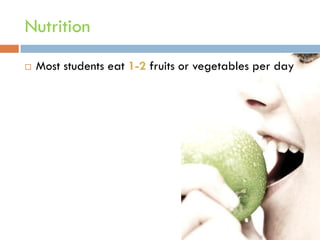
   Most students eat 1-2 fruits or vegetables per day
Weight
   Most students fall into a normal weight range
     8% obese
     7% underweight


   32% consider themselves to be overweight

   47% are trying to lose weight
     36% diet
     52% exercise
Physical activity
30 min moderate-intensity             20 min. vigorous-intensity
        cardio                                  cardio


                                           3-7
                                           days          0 days
  1-4
                   5-7                     26%            41%
  days
  56%              days
                   22%                            1-4
          0 days                                  days
           22%                                    33%


            49.5% meet recommended guidelines
Mental Health
Top mental health diagnoses or treated in the past 12
  months:
             Anxiety- 11%
             Depression- 9%
             Panic Attacks- 5%
   16% have ever been diagnosed with depression
   13% have sought counseling at CMHC
   76% would seek counseling in the future if needed
Stress
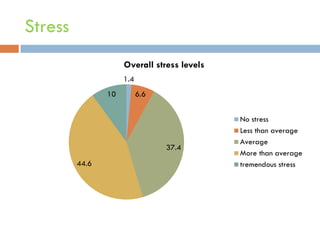
                     Overall stress levels
                     1.4
                10         6.6


                                             No stress
                                             Less than average
                                             Average
                                 37.4
                                             More than average
         44.6                                tremendous stress
Sleep
        Past 7 days, got enough sleep to feel rested


                   9.5     10


                                                       0 days
                                                       1-2 days
                                  32.5                 3-5 days
                                                       6+ days
            48

Wellness Network

  • 1.
  • 2.
    Session Thought Progression:  What is Wellness Network?  What is a campus-coalition model for wellness?  Who is involved in Wellness Network?  What does Wellness Network do and how does it do it?  How can I get involved?
  • 3.
  • 4.
    Wellness Network  The Wellness Network is a campus-wide coalition committed to assessing and addressing the health and wellness needs of students, faculty, and staff at The University of Texas at Austin.
  • 5.
    Wellness Network, Cont.  The Wellness Network brings together advocates for health and wellness from across UT-Austin in order to share information, strategies, and resources.  Through this collaboration, we aim to shape the environment in which we learn, live, work, and play to support overall health and healthy choices. The Wellness Network works toward a campus community where the healthy choice is the easy choice.
  • 6.
    What this hasto do with the theme of this conference:  Link between health and academic performance  We are only as healthy as the environment in which we live (work, study, play, etc.)  Data to support the financial implications/cost- savings of a “well” campus
  • 7.
    Social-Ecological Model ofHealth Societal Community Relationship Individual Larger societal factors (norms, Community contexts in which Proximal social relationships Characteristics of the individual policies, laws, etc.) social relationships are (peers/colleagues, partners, (biological, personal history, embedded family members) attitudinal factors ) (residence hall, department, workplace, campus, etc.) Based on graphic from Kathleen C. Basile, Ph.D., of the CDC’s Division of Violence Prevention
  • 8.
    What is acampus-coalition? Theoretical Support
  • 9.
    Community Coalition Defined “… a group of individuals representing diverse organizations, factions, or constituencies within the community who agree to work together to achieve a common goal” (Feighery & Rogers, 1990)
  • 10.
    Campus Coalitions Coalitions area promising practice on campuses supported by:  SPHPHE 2—Collaborative Practice  Advocating a shared vision of health promotion is the responsibility of all campus community members, and developing and participating in campus and community partnerships that advance health promotion initiatives  Part 10–CAS Professional Standards for Higher Education calls for “sustaining partnerships”  Healthy Campus 2010/2020 calls for collaboration among campus leaders, faculty, and staff.
  • 11.
    Coalition Tasks  Coalitions work to prevent or reduce a community problem by:  Analyzing the problem  Gathering data and assessing needs  Developing an action plan with identified solutions  Implementing those solutions  Reaching community-level outcomes  Creating social change (Butterfoss & Kegler, 2009)
  • 12.
    Coalition Benefits  Exchange of knowledge, ideas, and strategies  Become involved in new, broader issues without assuming sole responsibility  Demonstrate and develop community support  Maximize the power of individuals and groups through collective action  Build a constituency for a given issue  Change community norms and standards  Minimize duplication and use resources efficiently  Share costs and associated risks (Butterfoss & Kegler, 2009)
  • 14.
    Who is involvedwith Wellness Network?
  • 15.
    Who?  University Health Services  Department of Kinesiology & Health  Counseling and Mental Health Center Education  Division of Recreational Sports  The Fitness Institute of Texas  Student Government  Department of Aerospace Engineering and Engineering  Division of Housing and Food Service Mechanics  Office of the Dean of Students  Staff Council  Services for Students with Disabilities  Department of Curriculum &  Work Life Balance and Wellness Instruction Program through Human Resource  Office of Student Financial Services Services  Texas Public Health Student  Office of the Vice President for Organization Student Affairs  Campus Environmental Center  School of Social Work  University Unions  Gender and Sexuality Center  Students
  • 16.
    Executive Committee  Susan Hochman – Chair Manager, Health Promotion Resource Center  Natalie Butler President, Student Government  Laura Ebady Staff Psychologist & Outreach Coordinator, Counseling and Mental Health Center  Arlin Fernandez Student Conduct Specialist, Office of the Dean of Students  Jennifer Speer Associate Director, Division of Recreational Sports  Claire Moore Wellness and Work-Life Balance Coordinator, Human Resource Services
  • 17.
    What does WellnessNetwork do and how does it do it? Strategic Plan
  • 18.
    Strategic Plan –2011-2014  Vision A culture of health and wellness  Mission A sustainable, campus-wide coalition that supports a healthy campus culture and a campus environment in which the healthy choice is the easy choice  Values  Holistic health and wellness  Collaboration and partnership  Diversity and inclusiveness  Assessment  Alignment  Balanced lifestyle
  • 19.
    Strategic Plan -Initiatives  Infrastructure  Assessment and analysis  Communication and outreach  Programs and policies
  • 20.
    Infrastructure Wellness Network hasleadership body and membership infrastructure that facilitates the success and sustainability of the Wellness Network.
  • 21.
    Infrastructure  Executive committee  Leadership team  Sub-committee members  Wellness Network members
  • 22.
    Sub-Committees  Assessment and Analysis  Program and Policy  Communications
  • 23.
    Assessment Collect and analyzerelevant data to identify University needs, assets, benchmarks, and trends in the area of health and wellness. Use data to set priorities and inform initiatives.
  • 24.
    Assessment  Data collection, assessment, and evaluation  Identify priority health issues  Determine needs, assets, and trends  Inventory of data  Systematic monitoring and evaluation
  • 25.
    Communication  Promote the UT Wellness Network as a healthy campus coalition  Educate members of The University of Texas at Austin community on health and wellness initiatives, services, and resources
  • 26.
    Communication  Brand and marketing  Technology and social media  Promote existing resources  Consistent messaging  Opportunities for involvement
  • 27.
    Program and Policy  Identify, develop, and recommend or implement health and wellness programs and policies.  Promote enhanced collaboration and a campus- wide, multi-level approach to addressing priority health issues
  • 28.
    Program and Policy  Programming guidelines  Collaboration  Academic performance  Campus-wide, multi-level approaches
  • 29.
    Ad-Hoc Committees &Work Groups  High Risk Drinking Prevention  Tobacco Programs & Policy  Healthy Dining Work Group
  • 30.
    Website www.wellnessnetwork.utexas.edu  Calendar of events  Campus data on the health and wellness of our community  Opportunities for involvement  Meeting RSVP
  • 31.
    How to getinvolved  Sign up on the website  Attend all-member meeting once per-semester  Next meeting: March 1, 2012. 11-1pm. Gregory Gym Games Room.  Join the listserv  Join a sub-committee  Suggest a work group  Lead a committee or workgroup
  • 32.
  • 33.
    NATIONAL COLLEGE HEALTH ASSESSMENT THE UNIVERSITY OF TEXAS FALL 2011
  • 34.
    About NCHA  National survey organized by ACHA  Largest known comprehensive data set on the health of college students  Assists campuses in collecting data about their students’ habits, behaviors and perceptions on the most prevalent health concerns  We are now using version ACHA-NCHA-II  Student self-reported data
  • 35.
    UT Administration  Web-based  Incentives  Fall 2011  1586 respondents (20% response rate)
  • 36.
    Included in theinstrument  Health, health education, and safety  Alcohol, tobacco, and other drug use  Sexual behaviors  Weight, nutrition, and exercise  Mental and physical health  Impediments to academic performance  Demographics
  • 37.
    UT Students… aregenerally healthy! 93% report their health status as good, very good, or excellent.
  • 38.
    Healthyhorns…  98% Wear seatbelts when riding in cars  40% Got vaccinated against the flu  50 % Report having routine gynecological exam (females)  52% Regularly wear sunscreen  25% Got tested for HIV
  • 39.
    Health Information Seeking  42% Prefer to receive health information from online/internet sources  46% search for health information online at least once per month  When searching online, students are most likely to search for information about cold/flu/sore throat, followed by physical fitness/exercise, and nutrition.  18% Prefer to receive health information from UHS Medical Staff  13% Prefer to receive health information from parents
  • 40.
    Top reported clinicaldiagnoses 1. Allergies 2. Sinus Infection 3. Strep Throat 4. Back Pain 5. Asthma 43% have been seen at UHS in the last year 69% believe their health affects their academic performance. 55% report having missed one or more classes due to illness.
  • 41.
    Academic Impacts  Within the past 12 months, have any of the following affected your academic performance?  Not applicable  Experienced, but academics not affected  Lower grade on exam or important project  Lower grade in the course  Incomplete/dropped a course
  • 42.
    Academic Impacts, Cont. 1. Stress 6. Depression 2. Sleep 7. Work 3. Anxiety 8. Relationship Difficulties 4. Internet Use/Computer 9. Participation in Games Extracurricular Activities 5. Cold/Flu/Sore Throat 10. Concern for troubled friend or family member
  • 43.
    Violence, Abusive Relationships,and Personal Safety % Male % Female % Total A physical fight 5.6 1.3 3.0 A physical assault 1.9 1.6 1.7 A verbal threat 18.1 11.8 14.2 Sexual touching w/out consent 2.0 6.4 4.7 Sexual penetration attempt without consent 1.2 2.7 2.1 Sexual penetration without consent 0.7 2.0 1.5 Stalking 3.3 6.1 5.0 An emotionally abusive intimate relationship 5.8 8.9 7.6 A physically abusive intimate relationship 2.4 1.4 1.8 A sexually abusive intimate relationship 1.0 1.9 1.5
  • 44.
    Safety  UT students reported feeling very safe:  90% On campus, daytime  32% On campus, nighttime  55% In the area around campus, daytime  14% In the area around campus, nighttime
  • 45.
    Alcohol  19% of UT students report never having consumed alcohol  68% drank alcohol in the past 30 days, though students perceive this number to be higher (95%)  Most students consumed 4 or fewer drinks the last time they “partied” or socialized
  • 46.
    Alcohol- Protective Behaviors 98% engaged in one or more protective behaviors Use a designated driver Stick with only one kind of alcohol Stay with the same people Pace drinks to 1 or > per hr. Keep track of # consumed Have a friend let you know when you… Eat before/during Set a limit Chose not to drink Avoid Drinking Games Alternate w/ non-alcoholic 0 20 40 60 80 100
  • 47.
    Alcohol- Negative consequences 48.3% Experienced one or more negative consequences Drove a car after any Drove a car after 5+ Seroiusly considered suicide Physically Injured other Physically injured self Had unprotected sex Had sex with getting consent Had sex without giving consent Got in trouble with the police Forgot where you were or what you did Did something you later regretted 0 10 20 30 40
  • 48.
    Tobacco and Marijuana Actual Perceived Never smoked cigarettes 66% 7% Smoked cigarettes in the 14% 77% last 30 days Never smoked marijuana 60% 8% Smoked marijuana in the 17% 80% last 30 days
  • 49.
    Other illegal & prescriptiondrug use  Very few students reported using any other illegal drugs in the past 30 days  14% reported using prescription drugs not prescribed to them (in the last 12 months)  8% Stimulants  7% pain killers
  • 50.
    Sexual Activity  34% reported no oral/vaginal/anal sex in past 12 months  Of those who reported sex in past 12 months:  63% had 1 or 2 partners  35% discussed HIV/STI testing with current/most recent partner before sex Never /last 30 days Yes Oral Sex 30% 28% 42% Vaginal Sex 36% 21% 44% Anal Sex 78% 18% 5%
  • 51.
    Sexual Activity, cont. Ofthose who had sex in the past 30 days:  51% mostly or always used condoms during vaginal sex  4% mostly or always used condoms during oral sex  26% mostly or always used condoms during anal sex 79% report using a contraceptive method at last sex Of those who used a contraceptive method the last time:  62% used male condom  58% used birth control pill  27% used withdrawal Of those who had vaginal sex in the past 12 months: 17% used EC (unknown frequency)
  • 52.
    Condoms  41% have received a Healthyhorns Play Safe condom  18% have used a Healthyhorns Play Safe condom  46% keep condoms in their room  12% keep condoms in purse, wallet, or backpack
  • 53.
    Nutrition  Most students eat 1-2 fruits or vegetables per day
  • 54.
    Weight  Most students fall into a normal weight range  8% obese  7% underweight  32% consider themselves to be overweight  47% are trying to lose weight  36% diet  52% exercise
  • 55.
    Physical activity 30 minmoderate-intensity 20 min. vigorous-intensity cardio cardio 3-7 days 0 days 1-4 5-7 26% 41% days 56% days 22% 1-4 0 days days 22% 33% 49.5% meet recommended guidelines
  • 56.
    Mental Health Top mentalhealth diagnoses or treated in the past 12 months: Anxiety- 11% Depression- 9% Panic Attacks- 5%  16% have ever been diagnosed with depression  13% have sought counseling at CMHC  76% would seek counseling in the future if needed
  • 57.
    Stress Overall stress levels 1.4 10 6.6 No stress Less than average Average 37.4 More than average 44.6 tremendous stress
  • 58.
    Sleep Past 7 days, got enough sleep to feel rested 9.5 10 0 days 1-2 days 32.5 3-5 days 6+ days 48