Developing and delivering undergraduate
interprofessional learning: a collaboration
• Pamela Jackson
• Lead for Interprofessional Learning
University of Southampton, UK
The New Generation Project
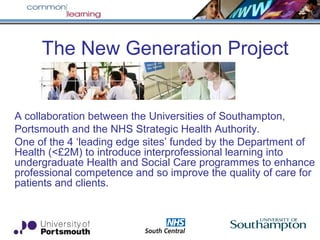
A collaboration between the Universities of Southampton,
Portsmouth and the NHS Strategic Health Authority.
One of the 4 ‘leading edge sites’ funded by the Department of
Health (<£2M) to introduce interprofessional learning into
undergraduate Health and Social Care programmes to enhance
professional competence and so improve the quality of care for
patients and clients.
Context – why?
• Modernisation of the NHS
The NHS and Social Services need graduates who can work together in
multi-professional health and social care teams
- A Health Service for All the Talents: Developing the NHS Workforce, 2000
• Many professions have a poor track record of working together
– Working Together – Learning Together, 2001
• Reports from service failures
– Bristol Royal Infirmary, Shipman, Climbie, baby Peter,
• Increasing team based approaches to care
‘Health professionals are required to negotiate within and across an intricate
web of professional relationships which have the potential to affect the
health outcomes and safety of patients’ (Braithwaite et al 2006)
• Evidence that team working leads to better outcomes for patients,
clients and staff
‘The quality of teamwork is directly and positively related to the quality of
patient care and innovation in healthcare’ (Borrill et al, 2002)
Driver: NHS Plan
‘We expect Workforce Development Confederations
and Higher Education Institutions to put
interprofessional education, at all levels, at the top of
their agendas. As a minimum we intend to ensure that:
common learning runs from undergraduate and pre-registration
programmes, through to continuing professional education
common learning takes place in practice placements as well as
the classroom
common learning centres on the needs of patients and clients.
The regulators
• Regular meetings and dialogue
• Minutes agreed and published
•Validation agreed in advance – ‘Minor change big
difference’
Department of Health Regulatory Unit
Development of curriculum
Common content was identified through triangulation of
analyses of:
• Academic and practitioner standards
• Curriculum documents
• Relevant policy documents
• Local and national expert focus groups
• Consultation
This generated a list of interprofessional topics that could be
divided into learning in common and common learning
How do we do it?
Theoretical underpinning
• CONTACT THEORY: “…the contact hypothesis holds that contact between
members of different groups, in the appropriate conditions, can lessen
intergroup discrimination and hostility. One reason suggested for this is that
contact allows the discovery of similarities of value and belief which can lead
to attraction” (Brown et al., 1986)
• But Contact is not enough: simply putting students together will not
bring about attitude change.
• Key features for Contact to result in positive attitude change include:
institutional support for programme, opportunity to work as equals in
small groups on shared tasks in a cooperative atmosphere, positive
expectations, a concern for and understanding of similarities and
differences (Barnes et al., 2000; Carpenter and Hewstone, 1996).
• SOCIAL IDENTITY THEORY: Identification of self in terms of
a social group (the ‘in’ group) and as compared to another group
(the ‘out’ group).
• The Common Learning Programme aims to change the way in
which health and social care professionals of the future work
together in teams.
• Attitudes and behaviours of members of one group towards another
are governed by the nature, strength and salience of the members’
social identity.
• Stereotyping and social identity are closely linked
• Stereotypes are judgements that may guide behaviour;
• Stereotypes exist as students enter higher education
• Evidence: Stereotypes may (Carpenter & Hewstone, 1996) or may
not change through interprofessional education (Barnes et al., 2000)
Curriculum Aims
Students are expected to demonstrate mutual respect for
all members of the interprofessional team, a reluctance
to stereotype, an absence of discriminatory behaviour,
and an increase in their:
• Skills and confidence in functioning as an effective interprofessional
team member
• Understanding and valuing of the contributions made by others
• Ability to learn from others
• Understanding of and respect for other health and social care roles, in
order to benefit service users.
• Understanding and comfort with different ways of working and changing
future professional roles
Interprofessional Learning
• 11 pre qualifying professions + 3 foundation degrees
(Social Work, Audiology, Nursing, Medicine, Midwifery, Occupational Therapy,
Physiotherapy, Podiatry, Pharmacy, Radiography (Diagnostic &Therapeutic)
• Small group model of learning (10-11)
• 1300 students in each unit
• Health and Social Care employers across Hampshire & IOW
• Unit 1 - Collaborative Learning, based in HEI
• Unit 2 - Interprofessional Team Working, based in practice
• Unit 3 - Interprofessional Development in Practice, based in
practice
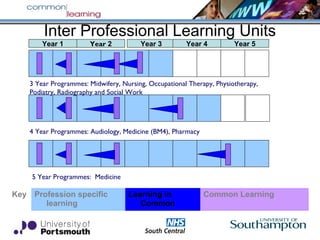
Inter Professional Learning Units
Year 1 Year 2 Year 3 Year 4 Year 5
3 Year Programmes: Midwifery, Nursing, Occupational Therapy, Physiotherapy,
Podiatry, Radiography and Social Work
Key Profession specific
learning
Learning in
Common
Common Learning
4 Year Programmes: Audiology, Medicine (BM4), Pharmacy
5 Year Programmes: Medicine
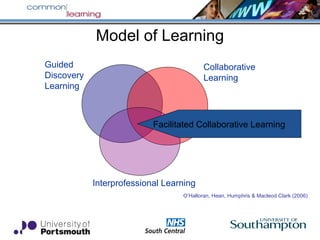
Model of Learning
Guided
Discovery
Learning
Collaborative
Learning
Interprofessional Learning
Facilitated Collaborative Learning
O’Halloran, Hean, Humphris & Macleod Clark (2006)
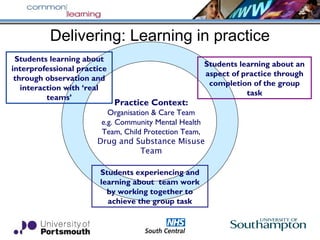
Delivering: Learning in practice
Practice Context:
Organisation & Care Team
e.g. Community Mental Health
Team, Child Protection Team,
Drug and Substance Misuse
Team
Students learning about
interprofessional practice
through observation and
interaction with ‘real
teams’
Students learning about an
aspect of practice through
completion of the group
task
Students experiencing and
learning about team work
by working together to
achieve the group task
Assessment
Common assessment
• Assessment compulsory in all programmes
• Mix of individual, group and peer assessment.
• On-line submission of work by students and
marking by assessors (both practice & academic)
• Presentation to practice managers & organisation
Leads
information and resources available at www.commonlearning.net
• Learning in Common prior to each Unit
• Briefing specific to each Unit from HEI
 Project specific information and background
from Facilitator prior to Unit
 Information and e-based resources
available at: www.commonlearning.net
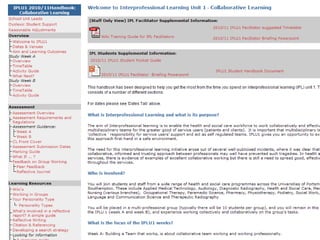
E based resources and systems
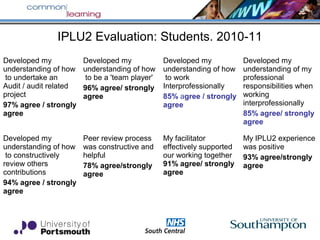
IPLU2 Evaluation: Students. 2010-11
Developed my
understanding of how
to undertake an
Audit / audit related
project
97% agree / strongly
agree
Developed my
understanding of how
to be a 'team player'
96% agree/ strongly
agree
Developed my
understanding of how
to work
Interprofessionally
85% agree / strongly
agree
Developed my
understanding of my
professional
responsibilities when
working
interprofessionally
85% agree/ strongly
agree
Developed my
understanding of how
to constructively
review others
contributions
94% agree / strongly
agree
Peer review process
was constructive and
helpful
78% agree/strongly
agree
My facilitator
effectively supported
our working together
91% agree/ strongly
agree
My IPLU2 experience
was positive
93% agree/strongly
agree
Staff Development: preparing facilitators
• Unit 1: University based, facilitated by
academic staff
• Unit 2/3: Practice based, facilitated by practice
staff
• Prepared through a 1 day facilitator workshop
and supported by Learning Environment Leads
/school contact briefings and debriefings
– Overview of whole project
– Facilitation and team working skills
– Assessment skills
– Learning journey
– Developing practice placements (units 2/3)
Benefits for hosts and students
• Real Practice-based Projects
– Both students and practitioners benefit from a valuable learning
experience and a useable report
• Groups facilitated/supported by senior prctitioners & practice
managers
– Time commitment and benefit recognised
• Senior managers, Heads of relevant agencies and HEI
representatives attend the presentations
– IPL activity valued by organisation and interest appreciated by
students
• Placements increased students’ awareness / understanding of
social and health care issues
– Expose students to new practice areas
– Positive Impact on recruitment
– Learn transferable skills
Examples of placement activity: IPLU2 audit
• Operating Theatres
– how much of the scheduled operating session is actually used for operating.
• Falls pathways
– effectiveness of the falls pathway intervention in a number of organisations
• Maternal Health
– meeting the standards in decision-to-delivery times in emergency caesarean
sections and reasons for delays
• Diagnostic Imaging
– appropriateness of knee and ankle x-ray referrals from A/E nurse practitioners
• Centre for Children with Learning Disabilities
– respite care, jointly facilitated by health and social care
IPLU2 audit
• Are there ward based teaching programmes in place on
all wards? how well attended are they? How are staff
assessed?
• audit of hospital's compliance with data protection.
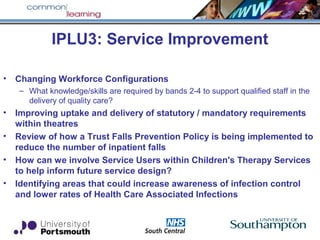
IPLU3: Service Improvement
• Changing Workforce Configurations
– What knowledge/skills are required by bands 2-4 to support qualified staff in the
delivery of quality care?
• Improving uptake and delivery of statutory / mandatory requirements
within theatres
• Review of how a Trust Falls Prevention Policy is being implemented to
reduce the number of inpatient falls
• How can we involve Service Users within Children's Therapy Services
to help inform future service design?
• Identifying areas that could increase awareness of infection control
and lower rates of Health Care Associated Infections
IPLU3: Service Improvement
• In 2009, an NHS Trust Library Service took decision to
purchase more electronic books instead of printed
books. The Library Services Manager asked an IPLU3
group to produce an action plan for library staff to enable
them to manage this change within this busy acute trust,
which must include a strategy to keep library customers
well informed and adequately supported.
Does it make a difference?
1. Follow up of selected groups in practice
Evaluation of the Outcomes of Student Projects: Interprofessional Learning in
Practice Units 2 and 3
– Qualitative study - identified key factors contributing to the success or
otherwise: context, facilitation, task and inter-relationships
IPLU2/3 Projects followed up (pilot) – of those who responded,
– over 65% reported to have been implemented in practice in some form.
– 73% rated the quality of the report to be at least 7/10
Larger follow up planned: all projects now on database.
2. Follow up of students during 1st
3 years after graduation

Jackson2011

  • 1.
    Developing and deliveringundergraduate interprofessional learning: a collaboration • Pamela Jackson • Lead for Interprofessional Learning University of Southampton, UK
  • 2.
    The New GenerationProject A collaboration between the Universities of Southampton, Portsmouth and the NHS Strategic Health Authority. One of the 4 ‘leading edge sites’ funded by the Department of Health (<£2M) to introduce interprofessional learning into undergraduate Health and Social Care programmes to enhance professional competence and so improve the quality of care for patients and clients.
  • 3.
    Context – why? •Modernisation of the NHS The NHS and Social Services need graduates who can work together in multi-professional health and social care teams - A Health Service for All the Talents: Developing the NHS Workforce, 2000 • Many professions have a poor track record of working together – Working Together – Learning Together, 2001 • Reports from service failures – Bristol Royal Infirmary, Shipman, Climbie, baby Peter, • Increasing team based approaches to care ‘Health professionals are required to negotiate within and across an intricate web of professional relationships which have the potential to affect the health outcomes and safety of patients’ (Braithwaite et al 2006) • Evidence that team working leads to better outcomes for patients, clients and staff ‘The quality of teamwork is directly and positively related to the quality of patient care and innovation in healthcare’ (Borrill et al, 2002)
  • 4.
    Driver: NHS Plan ‘Weexpect Workforce Development Confederations and Higher Education Institutions to put interprofessional education, at all levels, at the top of their agendas. As a minimum we intend to ensure that: common learning runs from undergraduate and pre-registration programmes, through to continuing professional education common learning takes place in practice placements as well as the classroom common learning centres on the needs of patients and clients.
  • 5.
    The regulators • Regularmeetings and dialogue • Minutes agreed and published •Validation agreed in advance – ‘Minor change big difference’ Department of Health Regulatory Unit
  • 6.
    Development of curriculum Commoncontent was identified through triangulation of analyses of: • Academic and practitioner standards • Curriculum documents • Relevant policy documents • Local and national expert focus groups • Consultation This generated a list of interprofessional topics that could be divided into learning in common and common learning
  • 7.
    How do wedo it? Theoretical underpinning • CONTACT THEORY: “…the contact hypothesis holds that contact between members of different groups, in the appropriate conditions, can lessen intergroup discrimination and hostility. One reason suggested for this is that contact allows the discovery of similarities of value and belief which can lead to attraction” (Brown et al., 1986) • But Contact is not enough: simply putting students together will not bring about attitude change. • Key features for Contact to result in positive attitude change include: institutional support for programme, opportunity to work as equals in small groups on shared tasks in a cooperative atmosphere, positive expectations, a concern for and understanding of similarities and differences (Barnes et al., 2000; Carpenter and Hewstone, 1996).
  • 8.
    • SOCIAL IDENTITYTHEORY: Identification of self in terms of a social group (the ‘in’ group) and as compared to another group (the ‘out’ group). • The Common Learning Programme aims to change the way in which health and social care professionals of the future work together in teams. • Attitudes and behaviours of members of one group towards another are governed by the nature, strength and salience of the members’ social identity. • Stereotyping and social identity are closely linked • Stereotypes are judgements that may guide behaviour; • Stereotypes exist as students enter higher education • Evidence: Stereotypes may (Carpenter & Hewstone, 1996) or may not change through interprofessional education (Barnes et al., 2000)
  • 9.
    Curriculum Aims Students areexpected to demonstrate mutual respect for all members of the interprofessional team, a reluctance to stereotype, an absence of discriminatory behaviour, and an increase in their: • Skills and confidence in functioning as an effective interprofessional team member • Understanding and valuing of the contributions made by others • Ability to learn from others • Understanding of and respect for other health and social care roles, in order to benefit service users. • Understanding and comfort with different ways of working and changing future professional roles
  • 10.
    Interprofessional Learning • 11pre qualifying professions + 3 foundation degrees (Social Work, Audiology, Nursing, Medicine, Midwifery, Occupational Therapy, Physiotherapy, Podiatry, Pharmacy, Radiography (Diagnostic &Therapeutic) • Small group model of learning (10-11) • 1300 students in each unit • Health and Social Care employers across Hampshire & IOW • Unit 1 - Collaborative Learning, based in HEI • Unit 2 - Interprofessional Team Working, based in practice • Unit 3 - Interprofessional Development in Practice, based in practice
  • 11.
    Inter Professional LearningUnits Year 1 Year 2 Year 3 Year 4 Year 5 3 Year Programmes: Midwifery, Nursing, Occupational Therapy, Physiotherapy, Podiatry, Radiography and Social Work Key Profession specific learning Learning in Common Common Learning 4 Year Programmes: Audiology, Medicine (BM4), Pharmacy 5 Year Programmes: Medicine
  • 12.
    Model of Learning Guided Discovery Learning Collaborative Learning InterprofessionalLearning Facilitated Collaborative Learning O’Halloran, Hean, Humphris & Macleod Clark (2006)
  • 13.
    Delivering: Learning inpractice Practice Context: Organisation & Care Team e.g. Community Mental Health Team, Child Protection Team, Drug and Substance Misuse Team Students learning about interprofessional practice through observation and interaction with ‘real teams’ Students learning about an aspect of practice through completion of the group task Students experiencing and learning about team work by working together to achieve the group task
  • 14.
    Assessment Common assessment • Assessmentcompulsory in all programmes • Mix of individual, group and peer assessment. • On-line submission of work by students and marking by assessors (both practice & academic) • Presentation to practice managers & organisation Leads information and resources available at www.commonlearning.net
  • 15.
    • Learning inCommon prior to each Unit • Briefing specific to each Unit from HEI  Project specific information and background from Facilitator prior to Unit  Information and e-based resources available at: www.commonlearning.net
  • 16.
    E based resourcesand systems
  • 17.
    IPLU2 Evaluation: Students.2010-11 Developed my understanding of how to undertake an Audit / audit related project 97% agree / strongly agree Developed my understanding of how to be a 'team player' 96% agree/ strongly agree Developed my understanding of how to work Interprofessionally 85% agree / strongly agree Developed my understanding of my professional responsibilities when working interprofessionally 85% agree/ strongly agree Developed my understanding of how to constructively review others contributions 94% agree / strongly agree Peer review process was constructive and helpful 78% agree/strongly agree My facilitator effectively supported our working together 91% agree/ strongly agree My IPLU2 experience was positive 93% agree/strongly agree
  • 18.
    Staff Development: preparingfacilitators • Unit 1: University based, facilitated by academic staff • Unit 2/3: Practice based, facilitated by practice staff • Prepared through a 1 day facilitator workshop and supported by Learning Environment Leads /school contact briefings and debriefings – Overview of whole project – Facilitation and team working skills – Assessment skills – Learning journey – Developing practice placements (units 2/3)
  • 19.
    Benefits for hostsand students • Real Practice-based Projects – Both students and practitioners benefit from a valuable learning experience and a useable report • Groups facilitated/supported by senior prctitioners & practice managers – Time commitment and benefit recognised • Senior managers, Heads of relevant agencies and HEI representatives attend the presentations – IPL activity valued by organisation and interest appreciated by students • Placements increased students’ awareness / understanding of social and health care issues – Expose students to new practice areas – Positive Impact on recruitment – Learn transferable skills
  • 20.
    Examples of placementactivity: IPLU2 audit • Operating Theatres – how much of the scheduled operating session is actually used for operating. • Falls pathways – effectiveness of the falls pathway intervention in a number of organisations • Maternal Health – meeting the standards in decision-to-delivery times in emergency caesarean sections and reasons for delays • Diagnostic Imaging – appropriateness of knee and ankle x-ray referrals from A/E nurse practitioners • Centre for Children with Learning Disabilities – respite care, jointly facilitated by health and social care
  • 21.
    IPLU2 audit • Arethere ward based teaching programmes in place on all wards? how well attended are they? How are staff assessed? • audit of hospital's compliance with data protection.
  • 22.
    IPLU3: Service Improvement •Changing Workforce Configurations – What knowledge/skills are required by bands 2-4 to support qualified staff in the delivery of quality care? • Improving uptake and delivery of statutory / mandatory requirements within theatres • Review of how a Trust Falls Prevention Policy is being implemented to reduce the number of inpatient falls • How can we involve Service Users within Children's Therapy Services to help inform future service design? • Identifying areas that could increase awareness of infection control and lower rates of Health Care Associated Infections
  • 23.
    IPLU3: Service Improvement •In 2009, an NHS Trust Library Service took decision to purchase more electronic books instead of printed books. The Library Services Manager asked an IPLU3 group to produce an action plan for library staff to enable them to manage this change within this busy acute trust, which must include a strategy to keep library customers well informed and adequately supported.
  • 24.
    Does it makea difference? 1. Follow up of selected groups in practice Evaluation of the Outcomes of Student Projects: Interprofessional Learning in Practice Units 2 and 3 – Qualitative study - identified key factors contributing to the success or otherwise: context, facilitation, task and inter-relationships IPLU2/3 Projects followed up (pilot) – of those who responded, – over 65% reported to have been implemented in practice in some form. – 73% rated the quality of the report to be at least 7/10 Larger follow up planned: all projects now on database. 2. Follow up of students during 1st 3 years after graduation

Editor's Notes

  • #3 The project aim To introduce an element of common learning into the pre-registration programmes in health and social care at the two universities in order to enhance professional competence and so improve the quality of care provided for patients and clients.
  • #4 Modernisation of the NHS The NHS Plan A Health Service for All the Talents: Developing the NHS Workforce Working Together – Learning Together Reports from service failures Bristol Royal Infirmary Inquiry Victoria Climbie Inquiry Evidence that team working leads to better outcomes for patients, clients and staff Health Care Team Effectiveness Project
  • #5 IPL is working in groups, in practice. Its not just being taught together
  • #8   social identity and categorisation theory and contact theory.     CONTACT THEORY Pettigrew (1986) “..the contact theory exemplifies the top-down approach when it specifies the situational conditions that shape individual tendencies differentially.”(p171).   “…the contact hypothesis holds that contact between members of different groups, in the appropriate conditions, can lessen intergroup discrimination and hostility. One reason suggested for this is that contact allows the discovery of similarities of value and belief which are generally found to lead to attraction (Pettigrew, 1986 quoted in Brown et al., 1986)   It should be expected if contact alone was sufficient, that the frequency of contact between groups be strongly with the favourability of intergroup attitudes. Looking at intergroup relations in a paper factory, it was shown that a general attitude towards other groups (in terms of the contribution each group made) (group differentiation) was only weakly (and negatively) associated with frequency of contact, i.e. greater levels of contact doesn’t mean a dramatic higher or consistently more positive attitude towards the other groups. Suggest that a distinction should be made between interpersonal contact (when group membership is not salient) and intergroup contact (when group membership is salient). It was suggested that it would be the latter (intergroup contact) that would have the longer and more significant influence on intergroup attitudes(Brown et al., 1986). The question then remains (vip for social id proposal) is that in the CL groups are intergroup membership salient or not.   Same applied for measures of group identification which are also positively although weakly associated with more positive intergroup attitudes (Brown et al., 1986)   Simply putting students in contact with each other with inappropriate conditions will not bring about attitude change. Simply putting students together in a mixed classroom wont achieve much. Can in fact cause negative outcomes: may ignore each other but more usually resented the other groups and felt learning opportunities were being diluted (Szasz, 1969 quoted in carpenter and hewstone, 1969). McMichael and Irvine, 1983 quoted in Carpenter and hewstone, 1969) find same that unless students have structured opportunities to work together then positive interaction will not take place. This is empirical evidence against multiprofessional education as opposed to interprofessional.   Key features for contact to result in positive attitude change in an interprofessional educational arena (as the conditions for change in other contexts may be different) have been institutional support for programme, opportunity to work as equals in pairs and small groups on shared tasks in a cooperative atmosphere, positive expectations, a concern for and understanding similarities and differences, the perceptions of others of the group as typical and not just exceptions to the group (Barnes et al., 2000; Carpenter and Hewstone, 1996).
  • #9 Social identity theory Talking about attitude change, it strictly speaking aren’t attitudes towards other professions but the stereotypes they hold of other professions that one appears to want to change.   The theoretical framework requires refinement and evidence supporting a variety of different assumptions need to be incorporated where available.   The Common Learning Programme aims to change the way in which health and social care professionals of the future work together in teams. There are several factors known to optimise the way in which a team works together. High participation, clear objectiveness, clear leadership, high participation and good communication are examples of these (Borrill et al. 2001). It is conceivable that other aspects of the relationships between members will also influence the working of the team. Health and social care teams are made up of a range of differing professionals. Based on the reports of strained relationships between different professionals, a theoretical perspective that seeks to understand conflict and collaboration between different groups would seem appropriate. Social categorization and the more contemporary social identity theories offer such a perspective (Turner 1999).   Social identity is the identification of self in terms of a social group (the in group) and as compared to another group (the out group). The stated theories hinge on the premise that attitudes and behaviours of members of one group towards another are governed by the nature, strength and salience of the members’ social identity. The interaction of members of a health and social care team may, therefore, in some contexts be dictated by these identities. Personal, social and a variety of differing social identities may coexist but dependent on context, one or the other may be salient and hence govern attitudes and behaviours towards one’s own and members of other groups. An understanding of the salience and strength of social identity and how this may change over the course of the CLP will inform our understanding of the changes in beliefs, attitudes and behaviours of students that occur in parallel.   Stereotyping and social identity are closely linked. From the perspective of social identity, stereotypes are a “social categorical judgement or perception of people in terms of their group memberships” (p26, Turner, 1999). They are judgements with which sense can be made and behaviour guided when interaction between groups occur. They are means of making meaning as opposed to an aberration from which they are viewed from a psychological perspective.   The nature of stereotypes and related behaviours will vary dependent on the salience and strength of a particular social identity. These responses are often triggered by some external threat to social identity (Branscombe et al. 1999) and a range of these threats exist. Perceived threat to value and/or the distinctiveness of the ingroup are two examples. The responses are dependent on the strength/ salience of the social identity at the time of threat.   It is conceivable that a multiprofessional team is a context in which threat (perceived or otherwise) between groups occur. For example, a threat to the competence of a group will result in low identifiers disidentifying from this group. High identifiers, experiencing the same threat, however, may show outgroup derogation, higher ingroup homogeneity, and increased self stereotyping.   To begin to understand how the CLP may influence relationships between different professional groups at an undergraduate level, changes in stereotyping will be measured across the duration of the CLP. Further, as social identity is a major determining factor in the expression of stereotypes, the salience (and change therein) of two possible social identities will be observed. Firstly, identification with each profession (a subordinate identity) and secondly the identity as a health and social care professional (superordinate identity).   It may be further hypothesised that the measurements of stereotypes will influence the attitudes and behaviours of students to other professional groups and with whom they are interacting as part of the programme. Figure 1 is a diagrammatic representation of this. Following the direction of this diagram, stereotypes (as a series of beliefs) may be translated into particular attitudes. Measures of attitude towards other professionals and towards the programme have been included in the questionnaires applied to the 2002 comparison group cohort. Whether these variables remain in the research design needs to be decided, taking the length of the questionnaire and the manageability of the research endeavour into consideration.   Although these attitudes may or may not be translated into behaviour. no behavioural measure has been put forward as part of the research design as yet.   Finally, it is an objective of the CLP that students learn from and about each other during the programme. It is assumed that this knowledge will in turn influence their beliefs and attitudes towards one another. Measurement of this change in knowledge and its relationship with stereotype and attitudinal change will assist in understanding the functioning of the CLP.   STEREOTYPES Variation in findings. Barnes (2000), for example, in a 1 year programme involving postgraduate ots, psychologists, social workers, community psychiatric nurses. Only 1 day a week. Found strong stereotypes of other professionals to exist on attributes such as interpersonal skills, communication skills, academic ability, practical skills etc. But that these attitudes hadn’t changed over the course of the proframme, leading them to copnclude that this might have been because a range of the conditions listed for contact theory had not been met. This emphasizes a point made by some about where to implement IPE. Barnes states there were several contact variables that have prevented, not least that these workers are working and this means the work life is probably a stronger influence on their stereotype formation than the course. This is perhaps points to the need to introduce ipe in undergraduate courses before negative stereotypes form and in the hope that they will be so strongly formed that they will be sufficient to resist the negative influences they will encounter later on (assuming they are not picking up the influences from teachers in the uniprofessional component of their course.   In contrast in a undergraduate course (1 week), medicine,social wokri, nurses (although not first year students..near end of training) but do find attiude change; Difficulty ere is this due to the fact that the intervention comes earlier and they are not fully in practice as yet,
  • #11 Unit 1 - Collaborative Learning: Introduces students to the concept and practice of collaborative learning and team working and develops the knowledge management and IT skills needed to participate in collaborative learning supported by on-line methods. Unit 2 - Inter-professional Team Working: Provides students with an opportunity to apply their team working and negotiation skills in an inter-professional context while participating in practice audit. Unit 3 – Inter-professional Development in Practice: Helps students gain an understanding of the need for role flexibility and the complexity of governance and introducing change into inter-professional service provision.
  • #12 Medicine now developing activities in years 3 &amp; 4
  • #13 Guided discovery learning – key features Learning outcomes provide a framework for learning. Learners have responsibility for exploring content necessary for understanding through self-directed learning. Study guides used to facilitate and guide self directed learning. Understanding is reinforced through application in a problem oriented, task based or work related experience. Collaborative Learning An intellectual activity in which individuals act jointly with others to become knowledgeable about a particular subject Inter-professional Learning: Occasions when two or more professions learn from and about each other to improve collaboration and the quality of care.
  • #14 A model of learning familiar to many as it is to be found in curricula using enquiry-based learning, problem-based learning etc etc The important feature of this model is that learning outcomes are used to set boundaries for the discovery learning. There are expectations that certain things will be learnt.
  • #22 Knee and ankle This project will give you the opportunity to understand clinical decision rules when healthcare professionals use them when making x-ray requests and gain an insight into how professionals work and communicate together. It will also encourage an exploration of the perceptions and expectations of the patient, the nurse practitioner and radiographer as well as other clinical staff.  
  • #24 This project evolved from the Department of Health (2002) (DoH) white paper ‘Day Surgery: Operational Guide.
  • #26 Not yet analysed Qualitative-pilot identified key factors contributing to the success or otherwise: context, facilitation, task and inter-relationships Projects followed up-all been implemented in practice