Stresses Surrounding Wellbore
The magnitude of Sv is equivalent to integration of rock densities from the
surface to the depth of interest, z. In other words,
Sv = ∫
z
0
ρ(z)gdz ≈ ρ′gz
where ρ(z) is the density as a function of depth, g is gravitational
acceleration and ρ′ is the mean overburden density (Jaeger and Cook,
1971). In offshore areas, correction for water depth is done
Sv = ρwgzw + ∫
z
zw
ρ(z)gdz ≈ ρwgzw + ρ′g(z − zw)
Figure. Dependence of rock
strength on the angle of weak
bedding or foliation planes.
(a) Rock samples can be tested
with the orientation of weak
planes at different angles, β, to
the maximum principal stress,
σ1. (b) The strength can be
defined in terms of the intact
rock strength (when the weak
planes do not affect failure) and
the strength of the weak planes.
(c) Prediction of rock strength
(normalized by the cohesion of
bedding planes) as function of
β.Modified from Donath (1966)
and Jaeger and Cook (1979).
Figure. When bedding planes dip
steeply, both the deviation and
azimuth of wells have a strong
effect on wellbore stability (similar
to Willson, Last et al. 1999). (a)
Wellbore stability diagram that
shows the case above a fault at
about 15,000 ft depth, where the
bedding plane orientation (the red
dot is the pole to the bedding
planes) was such that drilling a
near vertical well was quite
problematic. Drilling orthogonal to
the bedding planes (to offset the
effect of bedding on strength)
would require a steeply dipping
well to the northwest. (b) Below
the fault, the bedding orientation
changes such that a near-vertical
well is stable.
Figure . A pre-drill
well design, made
by assuming that
the pore pressure
and the fracture
gradient limit the
mud window. (After
Moos, Peska et al.
2003). Reprinted
with Permission of
Elsevier.
Figure . In this case study for an
offshore Gulf of Mexico well, near
vertical wells and those deviated
to the northwest or southeast
require unrealistically high mud
weights (i.e. in excess of the frac
gradient) to achieve an
acceptable degree of wellbore
stability. In contrast, wells that
are highly deviated to the
southwest or northeast are
relatively stable.
Figure. Two views of a well trajectory that takes advantage
of the principles demonstrated in Figure 10.5. By turning
the well to the southwest in the problematic area, wellbore
stability could be achieved with a mud weight less than the
fracture gradient. The colour indicates the mud weight (in
ppg) required to stabilize the well at a given depth.
Filter cake in shale and stress support
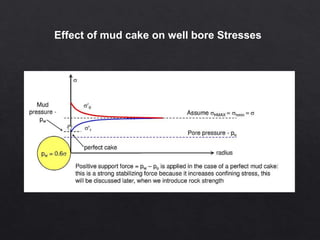
Effect of mud cake on well bore Stresses
Heating and cooling in the hole and thermal alteration of σ’θ
Effect of rock yield on σ’θ and
Ballooning
Figure. Schematic diagram
illustrating the effects of
reservoir depletion on
deformation surrounding the
reservoir and contours of the
stress changes resulting
from depletion in a reservoir
at unit depth and radius
(from Segall 1989). Note that
in compressional tectonic
settings, reverse
faulting is promoted above
and below the reservoir
whereas in extensional
tectonic settings, normal
faulting is promoted around
the edges of the reservoir.
The evolution of the least
principal stresses with
decreasing pore pressure
in the Tor reservoir of the
Valhall field in the North
Sea (after Zoback and
Zinke 2002).
Pore pressure history of Field X
(after Chan and Zoback 2002).
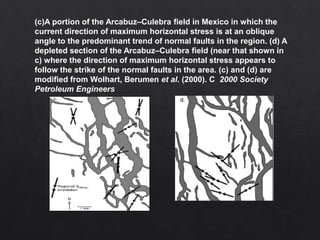
(c)A portion of the Arcabuz–Culebra field in Mexico in which the
current direction of maximum horizontal stress is at an oblique
angle to the predominant trend of normal faults in the region. (d) A
depleted section of the Arcabuz–Culebra field (near that shown in
c) where the direction of maximum horizontal stress appears to
follow the strike of the normal faults in the area. (c) and (d) are
modified from Wolhart, Berumen et al. (2000). C 2000 Society
Petroleum Engineers
Fig. showing the hydro fracturing in non
depleted and depleted reservoir.
Wellbore stress analysis

Wellbore stress analysis

  • 4.
  • 6.
    The magnitude ofSv is equivalent to integration of rock densities from the surface to the depth of interest, z. In other words, Sv = ∫ z 0 ρ(z)gdz ≈ ρ′gz where ρ(z) is the density as a function of depth, g is gravitational acceleration and ρ′ is the mean overburden density (Jaeger and Cook, 1971). In offshore areas, correction for water depth is done Sv = ρwgzw + ∫ z zw ρ(z)gdz ≈ ρwgzw + ρ′g(z − zw)
  • 8.
    Figure. Dependence ofrock strength on the angle of weak bedding or foliation planes. (a) Rock samples can be tested with the orientation of weak planes at different angles, β, to the maximum principal stress, σ1. (b) The strength can be defined in terms of the intact rock strength (when the weak planes do not affect failure) and the strength of the weak planes. (c) Prediction of rock strength (normalized by the cohesion of bedding planes) as function of β.Modified from Donath (1966) and Jaeger and Cook (1979).
  • 9.
    Figure. When beddingplanes dip steeply, both the deviation and azimuth of wells have a strong effect on wellbore stability (similar to Willson, Last et al. 1999). (a) Wellbore stability diagram that shows the case above a fault at about 15,000 ft depth, where the bedding plane orientation (the red dot is the pole to the bedding planes) was such that drilling a near vertical well was quite problematic. Drilling orthogonal to the bedding planes (to offset the effect of bedding on strength) would require a steeply dipping well to the northwest. (b) Below the fault, the bedding orientation changes such that a near-vertical well is stable.
  • 11.
    Figure . Apre-drill well design, made by assuming that the pore pressure and the fracture gradient limit the mud window. (After Moos, Peska et al. 2003). Reprinted with Permission of Elsevier.
  • 12.
    Figure . Inthis case study for an offshore Gulf of Mexico well, near vertical wells and those deviated to the northwest or southeast require unrealistically high mud weights (i.e. in excess of the frac gradient) to achieve an acceptable degree of wellbore stability. In contrast, wells that are highly deviated to the southwest or northeast are relatively stable.
  • 13.
    Figure. Two viewsof a well trajectory that takes advantage of the principles demonstrated in Figure 10.5. By turning the well to the southwest in the problematic area, wellbore stability could be achieved with a mud weight less than the fracture gradient. The colour indicates the mud weight (in ppg) required to stabilize the well at a given depth.
  • 18.
    Filter cake inshale and stress support
  • 19.
    Effect of mudcake on well bore Stresses
  • 20.
    Heating and coolingin the hole and thermal alteration of σ’θ
  • 21.
    Effect of rockyield on σ’θ and Ballooning
  • 23.
    Figure. Schematic diagram illustratingthe effects of reservoir depletion on deformation surrounding the reservoir and contours of the stress changes resulting from depletion in a reservoir at unit depth and radius (from Segall 1989). Note that in compressional tectonic settings, reverse faulting is promoted above and below the reservoir whereas in extensional tectonic settings, normal faulting is promoted around the edges of the reservoir.
  • 24.
    The evolution ofthe least principal stresses with decreasing pore pressure in the Tor reservoir of the Valhall field in the North Sea (after Zoback and Zinke 2002). Pore pressure history of Field X (after Chan and Zoback 2002).
  • 25.
    (c)A portion ofthe Arcabuz–Culebra field in Mexico in which the current direction of maximum horizontal stress is at an oblique angle to the predominant trend of normal faults in the region. (d) A depleted section of the Arcabuz–Culebra field (near that shown in c) where the direction of maximum horizontal stress appears to follow the strike of the normal faults in the area. (c) and (d) are modified from Wolhart, Berumen et al. (2000). C 2000 Society Petroleum Engineers
  • 26.
    Fig. showing thehydro fracturing in non depleted and depleted reservoir.