WELFARE STATE
ABRAR
1
REFERENCES
• www.centreforwelfarereform.org
• The Professional Reclassification of Youth in Arendt H (2007) The Jewish Writings.
New York, Shocken. p.30
• www.youtube.com/watch?v=G_g-QDKsXk0 last viewed on 4 Nov 2016
• https://www.youtube.com/watch?v=d99DY1jcGqI&t=20s last viewed on 7 Nov
2016
• Chopra, D. (2014): Welfare, Development, Rights in South Asia, in: G. Koehler and D.
Chopra (eds.): Development and Welfare Policy in South Asia. Abingdon: Routledge.
ABRAR
2
REFERENCES
• Koehler, G. (2011): Transformative Social Protection: eflections on South Asian
Policy Experiences, in: IDS Bulletin, Social Protection for Social Justice, 42(6): 96–
103.
• UNDP (2013): Human Development Report. New York: UNDP; available at:
www.undp.org
• UN DESA (2013): Inequality Matters: Report on the World Social Situation 2013.
New York, United Nations.
• ILO (2010): World Social Security Report; available at: www.ilo.org.
ABRAR
3
INTRODUCTION
•A welfare state is a system of government which is
based on equality of wealth and opportunity and
its distribution.
ABRAR
4
DEFINITION
• A concept of government in which the state plays a key role in the protection and
promotion of the economic and social well-being of its citizens.
• A welfare state is based on the principles of equality of opportunity, equitable
distribution of wealth and public responsibility for those unable to avail
themselves of the minimal provisions of a good life. Under this system, the
welfare of its citizens is the responsibility of the state.
ABRAR
5
DEFINITION IN U.S. PREAMBLE
• “We the people of the united states, in order to form a more perfect
union, establish justice, insure domestic Tranquility, provide for the
common defense, promote the general welfare and secure the blessings
of liberty to ourselves and our posterity, do ordain and establish this
constitution for the United States of America.”
ABRAR
6
HISTORY
• Welfare State is originated around 19 - 20 century, was
rooted in Europe as a form of government. Further, it
spread enormously among nations.
• In Germany, the foremost Chancellor Otto von Bismarck
generated the modern welfare state in early 1840s.
ABRAR
7
HISTORY
• In U.K. generation of a welfare state took place during the
time of Prime Minister Herbert Asquith in 1906–1914.
• In U.S.A. the welfare state was introduced by Lester Frank
Ward (1841–1913), known as “the ancestor of the modern
welfare state.”
ABRAR
8
IMPORTANT CHARACTERISTICS OF
WELFARE STATE
• Country of mix economy
• The high level of economic development of the country, which allows for
redistribution of incomes of the population, without prejudice to the large
owners
• Socialistic by nature which is based on equality. That is Social Democracy.
ABRAR
9
IMPORTANT CHARACTERISTICS OF
WELFARE STATE
• Control over the economic activities by government and monitoring to the
private organizations
• Legalize and manage all private organizations. Such control includes
registration, licensing, taxation etc.
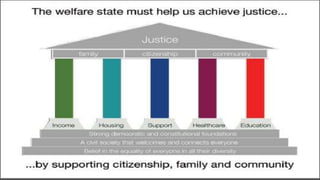
• A welfare state ensures justice to all.
ABRAR
10
FUNCTIONS
• Education, at least for primary and secondary levels;
• Health access for all, in terms of services and funding
mechanisms;
• Social protection in its components of contributory social
security and tax-funded social assistance;
ABRAR
11
FUNCTIONS
• Active labour market policies to generate employment, as well as
microcredit and insurance provisions for the enterprise sector; and
• Family policy, such as child-related policies and welfare services.

• Recently, environmental policy – policies and measures that address
environmental sustainability – has been seen as integral to welfare
state policy (UNRISD 2014).
ABRAR
12
ADVANTAGES - WHY IT IS IMPORTANT
• Retired people/pensioners receive state/retirement pension.
• Women whose husbands die before they retire if they are aged 45 or over
receive widow’s pension.
• Women who leave work to have a baby receive maternity pay.
• Every child until he/she leaves school or longer if the child continues
education (up to 19) receives child benefit.
ABRAR
13
• A person who is out of work for up to a year receives unemployment
benefit.
• Families with children who have very low incomes receive family credit.
• A person who is unable to work after a sickness period receives invalidity
pension.
• Disabled people receive mobility allowance to pay for transport or to buy a
special vehicle etc.
ADVANTAGES - WHY IT IS IMPORTANT
ABRAR
14
Now we will give an example to describe the problems a
welfare state faces if the welfare planning is not done
properly.
Let us take United Kingdom – U.K. as the example.
ABRAR
15
AN EXAMPLE – UNITED KINGDOM
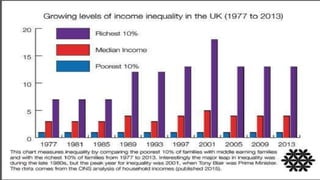
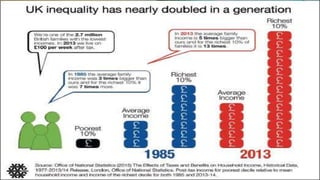
• ‘What has changed is our commitment to equality and justice?
Inequality has nearly doubled in a generation.’ - Dr Simon
Duffy about the welfare of U.K.
ABRAR
16
IN U.K. -
INEQUALITY HAS NEARLY DOUBLED IN A
GENERATION
ABRAR
17
ABRAR
18
ABRAR
19
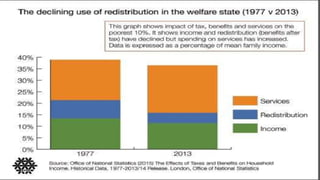
GOVT. OF U.K.
NOW SPEND MUCH LESS ON REDISTRIBUTION
BUT SPEND
MUCH MORE ON SERVICES
ABRAR
20
ABRAR
21
These trends seem particularly severe in the UK
where they have pulled off the undesirable trick of being
(a)The most unequal country in Europe
(b)Very hard working and
(c) Very unproductive.
ABRAR
22
ABRAR
23
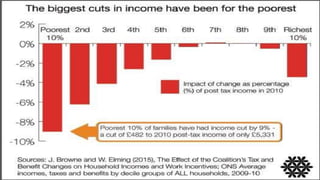
SINCE THE BANKING CRISIS AND 2010
ELECTION THINGS
HAVE GOT EVEN WORSE.
ABRAR
24
ABRAR
25
ABRAR
26
ABRAR
27
WELFARE STATE AND BANGLADESH
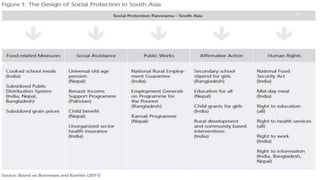
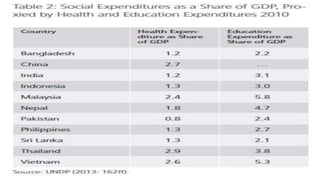
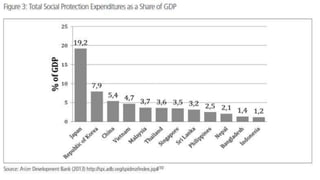
• As per the Constitution, Bangladesh must be a welfare state with quality health
and education services to be ensured by the state. (The Daily Star, 2014)
•BUT is it actually achieved?
Let some statistics collected from different sources
to answer this question
ABRAR
28
ABRAR
29
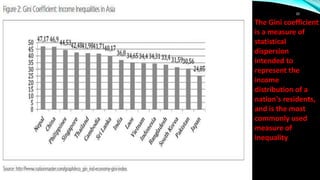
The Gini coefficient
is a measure of
statistical
dispersion
intended to
represent the
income
distribution of a
nation's residents,
and is the most
commonly used
measure of
inequality
ABRAR
30
WELFARE STATE AND BANGLADESH
ABRAR
31
WELFARE STATE AND BANGLADESH
ABRAR
32
WELFARE STATE AND BANGLADESH
• Govt. arranged Govt. hospital, free primary education, public transport
for its citizen.
• Govt. of Bangladesh fails in ensuring justice to all.
• A welfare state must ensure Non-corrupted environment and
accomplishment of their requirements where Bangladesh fails
drastically.
• High effect of Red-Tapism, Nepotism in administrative structure and
culture etc.
ABRAR
33
SO, WHAT WE NEED TO DO TO?
ABRAR
34
• We need to move our attention upstream - beyond
services, treatments and institutions for the sake of the mass
people.
• Local government can play a critical leadership to ensure social
democracy, equality and others
• This will require a change in our thinking about own
roles - a need for humility etc.
ABRAR
35
FINALLY-
ABRAR
36
ABRAR
37
ABRAR
38
A welfare is not a charity rather it’s the right of the citizens. We
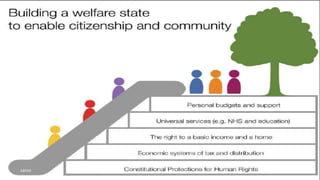
shouldn’t make it feel to the poor like charity. Because-
“Charity is not solidarity; it usually helps only isolated
individuals, with no overall plan; and that is why, in the end, it is
not productive.
Charity divides a people into those who give
and those who receive.”
And they are the True leaders who consider all of their citizens
as the “CITIZEN” – Not Burden –
BUT ---
ABRAR
39
True leaders are hardly known to their followers.
Next after them are the leaders people know and admire;
after them, those they fear;
after them, those they despise.
To give no trust
is to get no trust.
When the work's done right, with no fuss or boasting,
ordinary people say,
“Oh! we did it.”
ABRAR
40
•A PERFECT STATE DOESN’T EXIST BUT IT’S NOT EVEN
UNAFFORDABLE. BECAUSE –
ABRAR
41
• As welfare state generated in Europe, a good example of welfare state is
found in Nordic countries. The Nordic countries or Nordics are a geographical
and cultural region in Northern Europe and the North Atlantic, where they
are most commonly known as Norden.
•Lets enjoy a video on that -
ABRAR
42
ABRAR
43
ABRAR
44
ABRAR
45

Welfare state

  • 1.
  • 2.
    REFERENCES • www.centreforwelfarereform.org • TheProfessional Reclassification of Youth in Arendt H (2007) The Jewish Writings. New York, Shocken. p.30 • www.youtube.com/watch?v=G_g-QDKsXk0 last viewed on 4 Nov 2016 • https://www.youtube.com/watch?v=d99DY1jcGqI&t=20s last viewed on 7 Nov 2016 • Chopra, D. (2014): Welfare, Development, Rights in South Asia, in: G. Koehler and D. Chopra (eds.): Development and Welfare Policy in South Asia. Abingdon: Routledge. ABRAR 2
  • 3.
    REFERENCES • Koehler, G.(2011): Transformative Social Protection: eflections on South Asian Policy Experiences, in: IDS Bulletin, Social Protection for Social Justice, 42(6): 96– 103. • UNDP (2013): Human Development Report. New York: UNDP; available at: www.undp.org • UN DESA (2013): Inequality Matters: Report on the World Social Situation 2013. New York, United Nations. • ILO (2010): World Social Security Report; available at: www.ilo.org. ABRAR 3
  • 4.
    INTRODUCTION •A welfare stateis a system of government which is based on equality of wealth and opportunity and its distribution. ABRAR 4
  • 5.
    DEFINITION • A conceptof government in which the state plays a key role in the protection and promotion of the economic and social well-being of its citizens. • A welfare state is based on the principles of equality of opportunity, equitable distribution of wealth and public responsibility for those unable to avail themselves of the minimal provisions of a good life. Under this system, the welfare of its citizens is the responsibility of the state. ABRAR 5
  • 6.
    DEFINITION IN U.S.PREAMBLE • “We the people of the united states, in order to form a more perfect union, establish justice, insure domestic Tranquility, provide for the common defense, promote the general welfare and secure the blessings of liberty to ourselves and our posterity, do ordain and establish this constitution for the United States of America.” ABRAR 6
  • 7.
    HISTORY • Welfare Stateis originated around 19 - 20 century, was rooted in Europe as a form of government. Further, it spread enormously among nations. • In Germany, the foremost Chancellor Otto von Bismarck generated the modern welfare state in early 1840s. ABRAR 7
  • 8.
    HISTORY • In U.K.generation of a welfare state took place during the time of Prime Minister Herbert Asquith in 1906–1914. • In U.S.A. the welfare state was introduced by Lester Frank Ward (1841–1913), known as “the ancestor of the modern welfare state.” ABRAR 8
  • 9.
    IMPORTANT CHARACTERISTICS OF WELFARESTATE • Country of mix economy • The high level of economic development of the country, which allows for redistribution of incomes of the population, without prejudice to the large owners • Socialistic by nature which is based on equality. That is Social Democracy. ABRAR 9
  • 10.
    IMPORTANT CHARACTERISTICS OF WELFARESTATE • Control over the economic activities by government and monitoring to the private organizations • Legalize and manage all private organizations. Such control includes registration, licensing, taxation etc. • A welfare state ensures justice to all. ABRAR 10
  • 11.
    FUNCTIONS • Education, atleast for primary and secondary levels; • Health access for all, in terms of services and funding mechanisms; • Social protection in its components of contributory social security and tax-funded social assistance; ABRAR 11
  • 12.
    FUNCTIONS • Active labourmarket policies to generate employment, as well as microcredit and insurance provisions for the enterprise sector; and • Family policy, such as child-related policies and welfare services. • Recently, environmental policy – policies and measures that address environmental sustainability – has been seen as integral to welfare state policy (UNRISD 2014). ABRAR 12
  • 13.
    ADVANTAGES - WHYIT IS IMPORTANT • Retired people/pensioners receive state/retirement pension. • Women whose husbands die before they retire if they are aged 45 or over receive widow’s pension. • Women who leave work to have a baby receive maternity pay. • Every child until he/she leaves school or longer if the child continues education (up to 19) receives child benefit. ABRAR 13
  • 14.
    • A personwho is out of work for up to a year receives unemployment benefit. • Families with children who have very low incomes receive family credit. • A person who is unable to work after a sickness period receives invalidity pension. • Disabled people receive mobility allowance to pay for transport or to buy a special vehicle etc. ADVANTAGES - WHY IT IS IMPORTANT ABRAR 14
  • 15.
    Now we willgive an example to describe the problems a welfare state faces if the welfare planning is not done properly. Let us take United Kingdom – U.K. as the example. ABRAR 15
  • 16.
    AN EXAMPLE –UNITED KINGDOM • ‘What has changed is our commitment to equality and justice? Inequality has nearly doubled in a generation.’ - Dr Simon Duffy about the welfare of U.K. ABRAR 16
  • 17.
    IN U.K. - INEQUALITYHAS NEARLY DOUBLED IN A GENERATION ABRAR 17
  • 18.
  • 19.
  • 20.
    GOVT. OF U.K. NOWSPEND MUCH LESS ON REDISTRIBUTION BUT SPEND MUCH MORE ON SERVICES ABRAR 20
  • 21.
  • 22.
    These trends seemparticularly severe in the UK where they have pulled off the undesirable trick of being (a)The most unequal country in Europe (b)Very hard working and (c) Very unproductive. ABRAR 22
  • 23.
  • 24.
    SINCE THE BANKINGCRISIS AND 2010 ELECTION THINGS HAVE GOT EVEN WORSE. ABRAR 24
  • 25.
  • 26.
  • 27.
  • 28.
    WELFARE STATE ANDBANGLADESH • As per the Constitution, Bangladesh must be a welfare state with quality health and education services to be ensured by the state. (The Daily Star, 2014) •BUT is it actually achieved? Let some statistics collected from different sources to answer this question ABRAR 28
  • 29.
  • 30.
    The Gini coefficient isa measure of statistical dispersion intended to represent the income distribution of a nation's residents, and is the most commonly used measure of inequality ABRAR 30
  • 31.
    WELFARE STATE ANDBANGLADESH ABRAR 31
  • 32.
    WELFARE STATE ANDBANGLADESH ABRAR 32
  • 33.
    WELFARE STATE ANDBANGLADESH • Govt. arranged Govt. hospital, free primary education, public transport for its citizen. • Govt. of Bangladesh fails in ensuring justice to all. • A welfare state must ensure Non-corrupted environment and accomplishment of their requirements where Bangladesh fails drastically. • High effect of Red-Tapism, Nepotism in administrative structure and culture etc. ABRAR 33
  • 34.
    SO, WHAT WENEED TO DO TO? ABRAR 34
  • 35.
    • We needto move our attention upstream - beyond services, treatments and institutions for the sake of the mass people. • Local government can play a critical leadership to ensure social democracy, equality and others • This will require a change in our thinking about own roles - a need for humility etc. ABRAR 35
  • 36.
  • 37.
  • 38.
  • 39.
    A welfare isnot a charity rather it’s the right of the citizens. We shouldn’t make it feel to the poor like charity. Because- “Charity is not solidarity; it usually helps only isolated individuals, with no overall plan; and that is why, in the end, it is not productive. Charity divides a people into those who give and those who receive.” And they are the True leaders who consider all of their citizens as the “CITIZEN” – Not Burden – BUT --- ABRAR 39
  • 40.
    True leaders arehardly known to their followers. Next after them are the leaders people know and admire; after them, those they fear; after them, those they despise. To give no trust is to get no trust. When the work's done right, with no fuss or boasting, ordinary people say, “Oh! we did it.” ABRAR 40
  • 41.
    •A PERFECT STATEDOESN’T EXIST BUT IT’S NOT EVEN UNAFFORDABLE. BECAUSE – ABRAR 41
  • 42.
    • As welfarestate generated in Europe, a good example of welfare state is found in Nordic countries. The Nordic countries or Nordics are a geographical and cultural region in Northern Europe and the North Atlantic, where they are most commonly known as Norden. •Lets enjoy a video on that - ABRAR 42
  • 43.
  • 44.
  • 45.