KARL MARX (1818-1883)
DIALECTICAL MATERIALISM
BY DR SAROJ
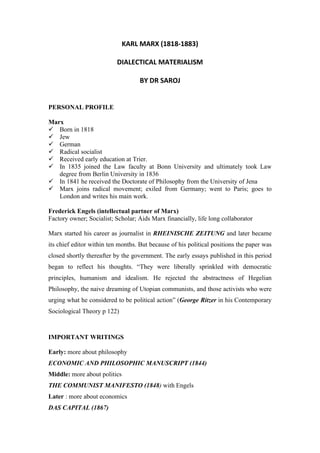
PERSONAL PROFILE
Marx
 Born in 1818
 Jew
 German
 Radical socialist
 Received early education at Trier.
 In 1835 joined the Law faculty at Bonn University and ultimately took Law
degree from Berlin University in 1836
 In 1841 he received the Doctorate of Philosophy from the University of Jena
 Marx joins radical movement; exiled from Germany; went to Paris; goes to
London and writes his main work.
Frederick Engels (intellectual partner of Marx)
Factory owner; Socialist; Scholar; Aids Marx financially, life long collaborator
Marx started his career as journalist in RHEINISCHE ZEITUNG and later became
its chief editor within ten months. But because of his political positions the paper was
closed shortly thereafter by the government. The early essays published in this period
began to reflect his thoughts. “They were liberally sprinkled with democratic
principles, humanism and idealism. He rejected the abstractness of Hegelian
Philosophy, the naive dreaming of Utopian communists, and those activists who were
urging what he considered to be political action” (George Ritzer in his Contemporary
Sociological Theory p 122)
IMPORTANT WRITINGS
Early: more about philosophy
ECONOMIC AND PHILOSOPHIC MANUSCRIPT (1844)
Middle: more about politics
THE COMMUNIST MANIFESTO (1848) with Engels
Later : more about economics
DAS CAPITAL (1867)
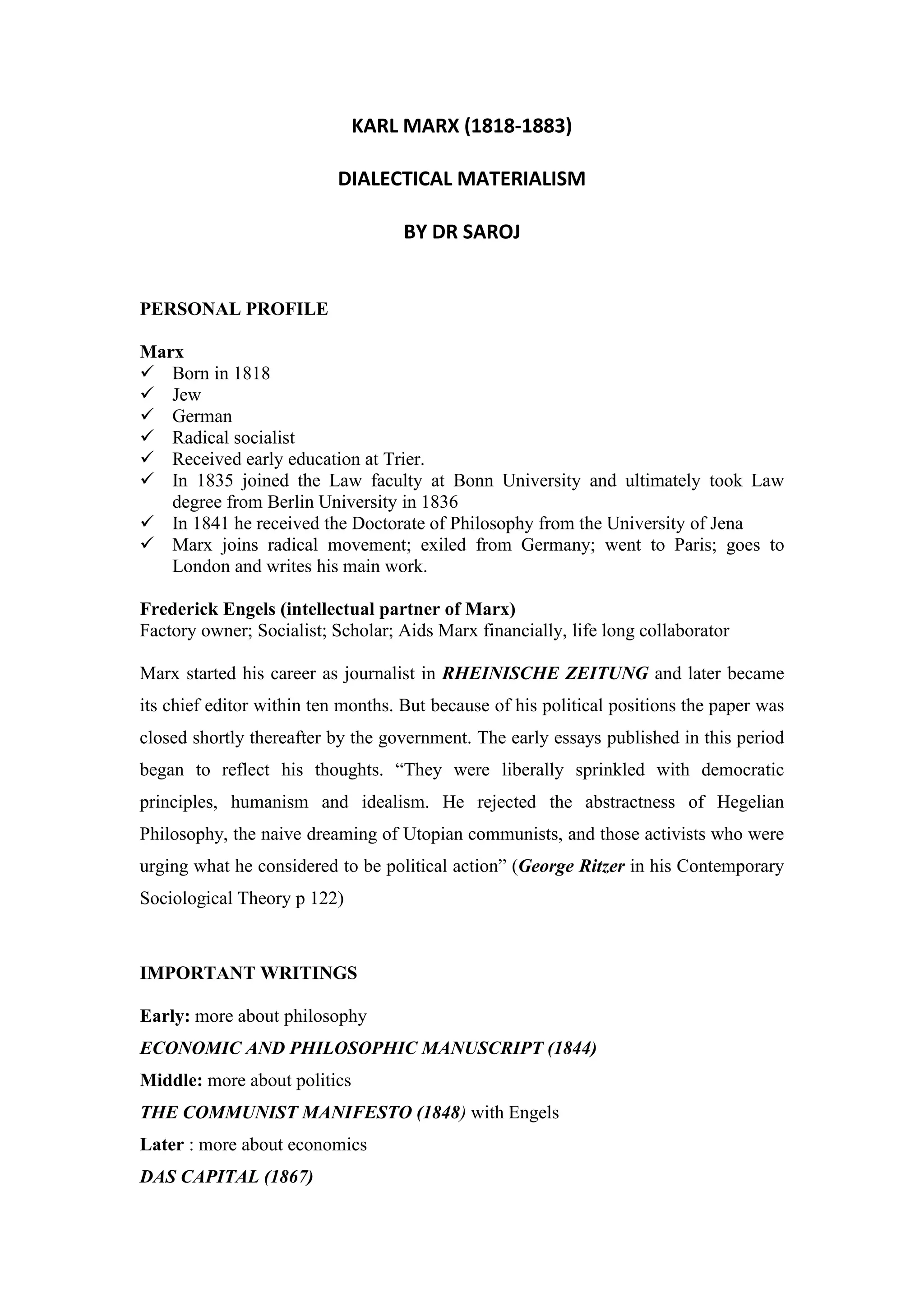
INFLUENCES
GERMAN INTELLECTUAL
TRADITION
From here he borrowed the
Hegelian Method of Dialectic
and applied it to material
world
German Philosophy: Hegel-
social change comes through
class struggle and conflicts
(dialectics)
Feuerbach: deal with the
“real” world not just ideas
about it (Materialism)
PHILOSOPHY (DIALIECTICS)
FRENCH REVOLUTIONARY
TRADITION
Accepted the idea that
Apocalyptic change (total
destruction of existing structure)
motivated by messianic ideas
was not only desirable but also
feasible. He applied this with a
view to bring large scale change
in industrialized economy.
Saint Simon: must create a new
society based on cooperation
between classed not conflict.
POLITICAL THOUGHT
INDUSTRALIZED
CAPITALIST ECONOMY OF
ENGLAND
He used the writings of
classical economist Adam
Smith to understand the
dialectics of capitalism.
Industrial revolution
Division of labour
ECONOMICS
Millions of people accept his theories with almost religious fervour, and modern socialist and
communist movements owe their inspiration directly to him. it is important to realize, however
that Marxism is not the same as communism. Marx would probable be dismayed at many of
the practices of communist movements and he cannot be held responsible or policies pursued
in his name decades after his death. (ref Ian Robertson in his Sociology p 13)
 According to Hegel the essence of Reality is Reason
 This Reason manifests and evolve itself gradually.
 History is the growth of reason to consciousness of itself
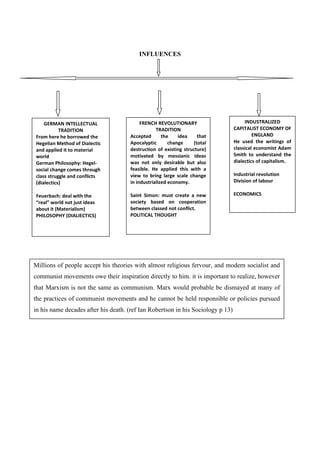
 According to Hegel : Each statement of Truth (Thesis) has its opposite statement
(Antithesis) which is also true. This Thesis and Antithesis may be reconciled on a
higher level of Synthesis, but this is not the end of dialectical process.
 The Synthesis becomes the new Thesis with its Antithesis and so on.
THESIS (NEGATION) ANTITHESIS
(opposing ideas)
SYNTHESIS
(BECOMES THE NEW THESIS) ANTITHESIS
SYNTHESIS ANTITHESIS
(NEW THEISIS) (OPPOSING REACTION)
SYNTHESIS
(DIALECTICAL IDEALISM: HEGEL)
But for Marx a MATERIALISTIC ANALYSIS rather than an idealistic approach to history
would bring the truth.
He turned Hegel upside down/ standing Hegel on his head
DIALECTICAL MATERIALISM : Philosophy of Karl Marx
Formulated the theory by taking the -----dialectic of Hegel
Materialism (Matter from Feuerbach)
Dialectical Materialism originates from two major aspects of Marx:
Hegel’s idealistic explanation of
History
Marx Materialistic explanation of
History
Changes Hegel’s
idealistic understanding
of dialectics into a
material understanding
The core idea that the
history of all hitherto
existing society is the
history of class
struggle
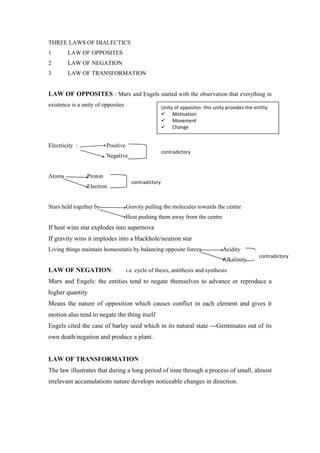
THREE LAWS OF DIALECTICS
1 LAW OF OPPOSITES
2 LAW OF NEGATION
3 LAW OF TRANSFORMATION
LAW OF OPPOSITES : Marx and Engels started with the observation that everything in
existence is a unity of opposites
Electricity : Positive
Negative
Atoms Proton
Electron
Stars held together by Gravity pulling the molecules towards the centre
Heat pushing them away from the centre
If heat wins star explodes into supernova
If gravity wins it implodes into a blackhole/neutron star
Living things maintain homeostatis by balancing opposite forces Acidity
Alkalinity
LAW OF NEGATION: i.e. cycle of thesis, antithesis and synthesis
Marx and Engels: the entities tend to negate themselves to advance or reproduce a
higher quantity
Means the nature of opposition which causes conflict in each element and gives it
motion also tend to negate the thing itself
Engels cited the case of barley seed which in its natural state ---Germinates out of its
own death/negation and produce a plant.
LAW OF TRANSFORMATION
The law illustrates that during a long period of time through a process of small, almost
irrelevant accumulations nature develops noticeable changes in direction.
Unity of opposites: this unity provides the entitiy
 Motivation
 Movement
 Change
contradictory
contradictory
contradictory
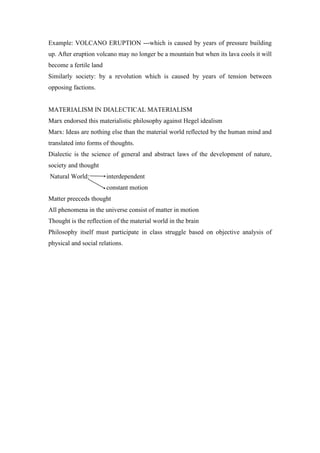
Example: VOLCANO ERUPTION ---which is caused by years of pressure building
up. After eruption volcano may no longer be a mountain but when its lava cools it will
become a fertile land
Similarly society: by a revolution which is caused by years of tension between
opposing factions.
MATERIALISM IN DIALECTICAL MATERIALISM
Marx endorsed this materialistic philosophy against Hegel idealism
Marx: Ideas are nothing else than the material world reflected by the human mind and
translated into forms of thoughts.
Dialectic is the science of general and abstract laws of the development of nature,
society and thought
Natural World: interdependent
constant motion
Matter preeceds thought
All phenomena in the universe consist of matter in motion
Thought is the reflection of the material world in the brain
Philosophy itself must participate in class struggle based on objective analysis of
physical and social relations.

KARL MARX DIALECTICAL MATERIALISM BY DR SAROJ.pdf

  • 1.
    KARL MARX (1818-1883) DIALECTICALMATERIALISM BY DR SAROJ PERSONAL PROFILE Marx  Born in 1818  Jew  German  Radical socialist  Received early education at Trier.  In 1835 joined the Law faculty at Bonn University and ultimately took Law degree from Berlin University in 1836  In 1841 he received the Doctorate of Philosophy from the University of Jena  Marx joins radical movement; exiled from Germany; went to Paris; goes to London and writes his main work. Frederick Engels (intellectual partner of Marx) Factory owner; Socialist; Scholar; Aids Marx financially, life long collaborator Marx started his career as journalist in RHEINISCHE ZEITUNG and later became its chief editor within ten months. But because of his political positions the paper was closed shortly thereafter by the government. The early essays published in this period began to reflect his thoughts. “They were liberally sprinkled with democratic principles, humanism and idealism. He rejected the abstractness of Hegelian Philosophy, the naive dreaming of Utopian communists, and those activists who were urging what he considered to be political action” (George Ritzer in his Contemporary Sociological Theory p 122) IMPORTANT WRITINGS Early: more about philosophy ECONOMIC AND PHILOSOPHIC MANUSCRIPT (1844) Middle: more about politics THE COMMUNIST MANIFESTO (1848) with Engels Later : more about economics DAS CAPITAL (1867)
  • 2.
    INFLUENCES GERMAN INTELLECTUAL TRADITION From herehe borrowed the Hegelian Method of Dialectic and applied it to material world German Philosophy: Hegel- social change comes through class struggle and conflicts (dialectics) Feuerbach: deal with the “real” world not just ideas about it (Materialism) PHILOSOPHY (DIALIECTICS) FRENCH REVOLUTIONARY TRADITION Accepted the idea that Apocalyptic change (total destruction of existing structure) motivated by messianic ideas was not only desirable but also feasible. He applied this with a view to bring large scale change in industrialized economy. Saint Simon: must create a new society based on cooperation between classed not conflict. POLITICAL THOUGHT INDUSTRALIZED CAPITALIST ECONOMY OF ENGLAND He used the writings of classical economist Adam Smith to understand the dialectics of capitalism. Industrial revolution Division of labour ECONOMICS Millions of people accept his theories with almost religious fervour, and modern socialist and communist movements owe their inspiration directly to him. it is important to realize, however that Marxism is not the same as communism. Marx would probable be dismayed at many of the practices of communist movements and he cannot be held responsible or policies pursued in his name decades after his death. (ref Ian Robertson in his Sociology p 13)
  • 3.
     According toHegel the essence of Reality is Reason  This Reason manifests and evolve itself gradually.  History is the growth of reason to consciousness of itself  According to Hegel : Each statement of Truth (Thesis) has its opposite statement (Antithesis) which is also true. This Thesis and Antithesis may be reconciled on a higher level of Synthesis, but this is not the end of dialectical process.  The Synthesis becomes the new Thesis with its Antithesis and so on. THESIS (NEGATION) ANTITHESIS (opposing ideas) SYNTHESIS (BECOMES THE NEW THESIS) ANTITHESIS SYNTHESIS ANTITHESIS (NEW THEISIS) (OPPOSING REACTION) SYNTHESIS (DIALECTICAL IDEALISM: HEGEL) But for Marx a MATERIALISTIC ANALYSIS rather than an idealistic approach to history would bring the truth. He turned Hegel upside down/ standing Hegel on his head DIALECTICAL MATERIALISM : Philosophy of Karl Marx Formulated the theory by taking the -----dialectic of Hegel Materialism (Matter from Feuerbach) Dialectical Materialism originates from two major aspects of Marx: Hegel’s idealistic explanation of History Marx Materialistic explanation of History Changes Hegel’s idealistic understanding of dialectics into a material understanding The core idea that the history of all hitherto existing society is the history of class struggle
  • 4.
    THREE LAWS OFDIALECTICS 1 LAW OF OPPOSITES 2 LAW OF NEGATION 3 LAW OF TRANSFORMATION LAW OF OPPOSITES : Marx and Engels started with the observation that everything in existence is a unity of opposites Electricity : Positive Negative Atoms Proton Electron Stars held together by Gravity pulling the molecules towards the centre Heat pushing them away from the centre If heat wins star explodes into supernova If gravity wins it implodes into a blackhole/neutron star Living things maintain homeostatis by balancing opposite forces Acidity Alkalinity LAW OF NEGATION: i.e. cycle of thesis, antithesis and synthesis Marx and Engels: the entities tend to negate themselves to advance or reproduce a higher quantity Means the nature of opposition which causes conflict in each element and gives it motion also tend to negate the thing itself Engels cited the case of barley seed which in its natural state ---Germinates out of its own death/negation and produce a plant. LAW OF TRANSFORMATION The law illustrates that during a long period of time through a process of small, almost irrelevant accumulations nature develops noticeable changes in direction. Unity of opposites: this unity provides the entitiy  Motivation  Movement  Change contradictory contradictory contradictory
  • 5.
    Example: VOLCANO ERUPTION---which is caused by years of pressure building up. After eruption volcano may no longer be a mountain but when its lava cools it will become a fertile land Similarly society: by a revolution which is caused by years of tension between opposing factions. MATERIALISM IN DIALECTICAL MATERIALISM Marx endorsed this materialistic philosophy against Hegel idealism Marx: Ideas are nothing else than the material world reflected by the human mind and translated into forms of thoughts. Dialectic is the science of general and abstract laws of the development of nature, society and thought Natural World: interdependent constant motion Matter preeceds thought All phenomena in the universe consist of matter in motion Thought is the reflection of the material world in the brain Philosophy itself must participate in class struggle based on objective analysis of physical and social relations.