Citizenship and the Welfare State
Can we wake from complacency?
Dr Simon Duffy, Centre for Welfare Reform
Birmingham, June 2016
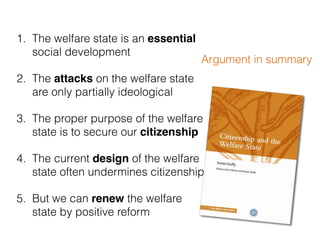
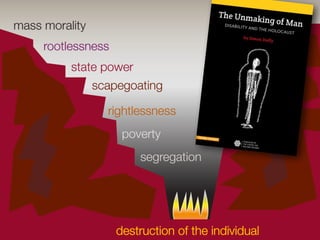
1. The welfare state is an essential
social development
2. The attacks on the welfare state
are only partially ideological
3. The proper purpose of the welfare
state is to secure our citizenship
4. The current design of the welfare
state often undermines citizenship
5. But we can renew the welfare
state by positive reform
Argument in summary
1. The welfare state is
essential
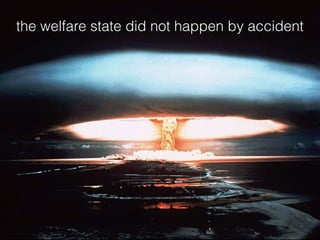
the welfare state did not happen by accident
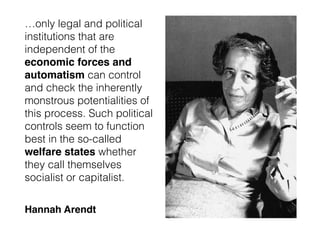
…only legal and political
institutions that are
independent of the
economic forces and
automatism can control
and check the inherently
monstrous potentialities of
this process. Such political
controls seem to function
best in the so-called
welfare states whether
they call themselves
socialist or capitalist.
Hannah Arendt
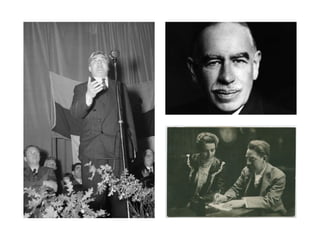
• The welfare state emerged as a response to the
crises that led to World War II and the Holocaust
• In the UK its designers were led by Fabians,
reformist liberals and socialists, like Keynes,
Beveridge, the Webbs and Bevan
• There was great confidence in the benign role of
the state to balance the injustices of the free
market
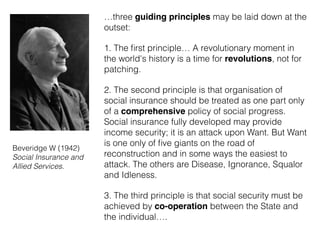
…three guiding principles may be laid down at the
outset:
1. The first principle… A revolutionary moment in
the world's history is a time for revolutions, not for
patching.
2. The second principle is that organisation of
social insurance should be treated as one part only
of a comprehensive policy of social progress.
Social insurance fully developed may provide
income security; it is an attack upon Want. But Want
is one only of five giants on the road of
reconstruction and in some ways the easiest to
attack. The others are Disease, Ignorance, Squalor
and Idleness.
3. The third principle is that social security must be
achieved by co-operation between the State and
the individual….
Beveridge W (1942)
Social Insurance and
Allied Services.
• They believed the state would be rational and that
democratic control would be sufficient to ensure
the positive development of the welfare state.
• There was also a powerful assumptions that an
intellectual elite could be trusted to solve social
problems.
• “We have little faith in the 'average sensual man',
we do not believe that he can do more than
describe his grievances, we do not think he can
prescribe the remedies.” [Beatrice Webb]
but there was an
alternative vision
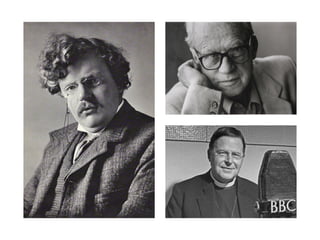
• The design of the welfare state reflected the spirit of the
times and assumptions of dominant intellectuals, yet
there were other strands of progressive thought.
• G K Chesterton and the Catholic church advocated
distributism and subsidiarity - less centralised
approaches to social justice.
• Archbishop Temple, who coined the term ‘welfare state’,
advocated an approach which made love and human
development central.
• Michael Young warned the Left of the dangers of
‘meritocracy’ and the advocated equality and creativity.
“Today we frankly recognise that
democracy can be no more than
an aspiration, and have rule not
so much by the people as by
the cleverest people; not an
aristocracy of birth, not a
plutocracy of wealth, but a true
meritocracy of talent.” [1958]
Yesterday’s satire feels
like today’s tragedy
2. The welfare state is
under attack
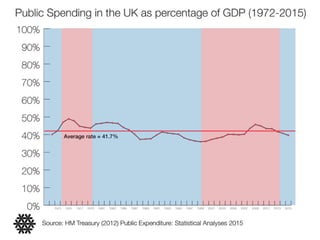
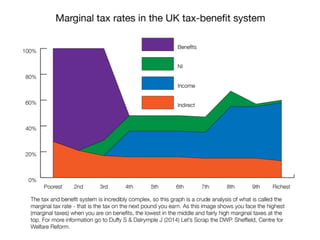
• Public discussion of the welfare state is often
simplistic and focuses simply on income tax and
overall spending levels.
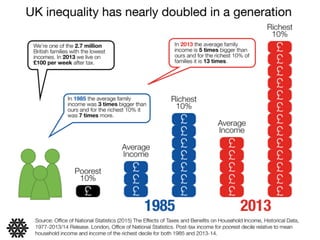
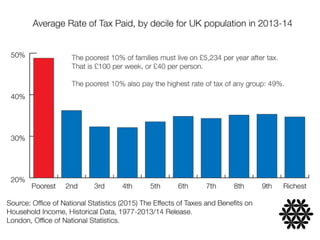
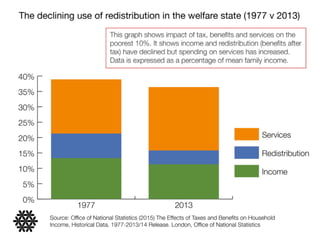
• Spending levels do vary - but not so dramatically
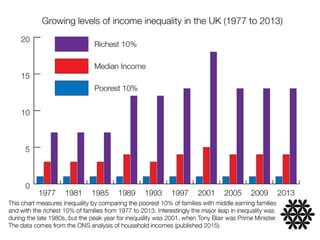
• What has been dramatic has been our decreasing
commitment to equality and justice
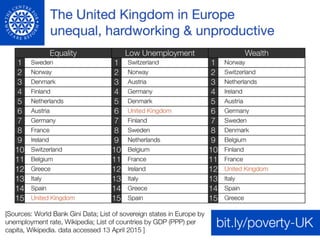
• There are similar trends in many other welfare
states, but the UK’s interest in justice seems to be
declining more quickly than most.
• Strangely the UK has managed to combine high
levels of inequality with high levels of employment
with low levels of productivity.
Decline in justice has accelerated under recent
Coalition and Conservative Governments:
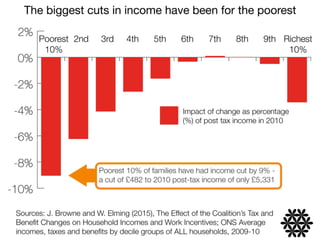
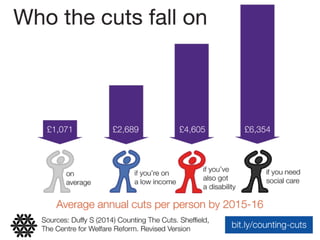
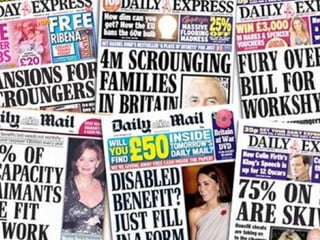
• Poorest have been targeted for cuts
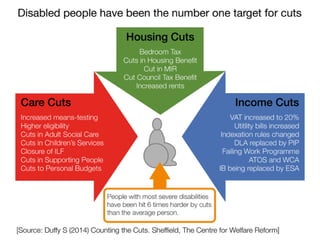
• Disabled people have been targeted for cuts
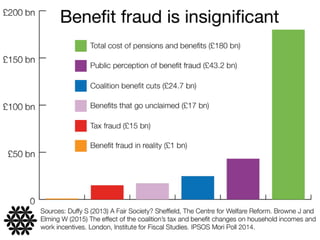
• Stigmatising language and misuse of statistics
(e.g. benefit fraud) has grown
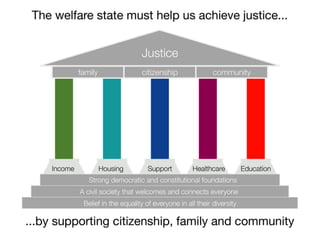
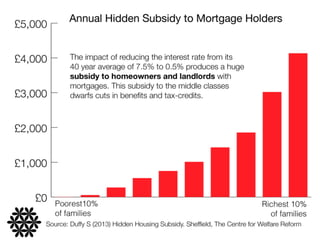
• Hidden subsidies to the better off have grown
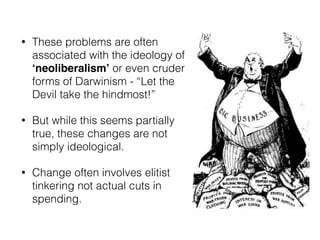
• These problems are often
associated with the ideology of
‘neoliberalism’ or even cruder
forms of Darwinism - “Let the
Devil take the hindmost!”
• But while this seems partially
true, these changes are not
simply ideological.
• Change often involves elitist
tinkering not actual cuts in
spending.
• Benefits are distributed to groups with good advocacy or voter impact
e.g. disabled people vs. pensioners
• Blame shifted to scapegoat groups e.g. immigrants vs. bankers
• Universal services protected e.g. social care vs. NHS
• Self-serving influence of commercial interests e.g. think tanks funding
• Some services are more powerfully defended e.g. BMA vs. LGA
• Hubris of politicians trying to make an impact e.g. every ‘reform’ of the
NHS
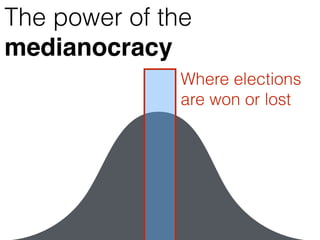
• Attempts to buy the swing voter
Other explanations include…
The power of the
medianocracy
Where elections

are won or lost
3. The welfare state is
for citizenship
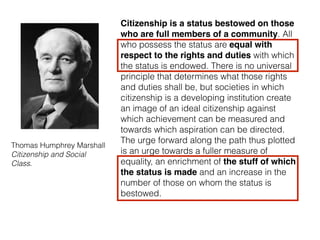
Thomas Humphrey Marshall

Citizenship and Social
Class.
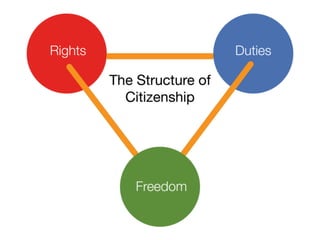
Citizenship is a status bestowed on those
who are full members of a community. All
who possess the status are equal with
respect to the rights and duties with which
the status is endowed. There is no universal
principle that determines what those rights
and duties shall be, but societies in which
citizenship is a developing institution create
an image of an ideal citizenship against
which achievement can be measured and
towards which aspiration can be directed.
The urge forward along the path thus plotted
is an urge towards a fuller measure of
equality, an enrichment of the stuff of which
the status is made and an increase in the
number of those on whom the status is
bestowed.
Marshall correctly makes
citizenship the central purpose of
the welfare state. But note his
dangerous fallacy…
For, while it is true that our rights
need to be matched by our
duties (across a whole society)…
but that does not mean 

my rights and my duties
should be identical.
The welfare state exists to distribute
rights and duties unequally - to protect
the weak and to discipline the powerful.
We do not want citizenship to be
restricted to a club of the clever,
the wealthy or the normal.
True citizenship is for
everyone
We don’t want a narrow
passport citizenship.
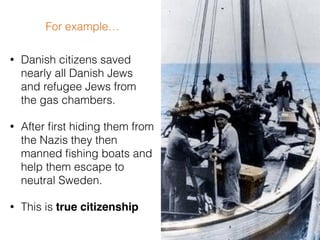
• Danish citizens saved
nearly all Danish Jews
and refugee Jews from
the gas chambers.
• After first hiding them from
the Nazis they then
manned fishing boats and
help them escape to
neutral Sweden.
• This is true citizenship
For example…
True citizenship is
inclusive

and welcomes 

human diversity
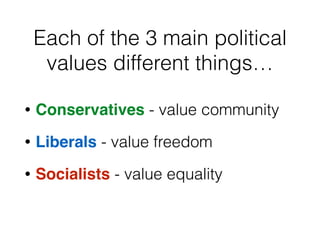
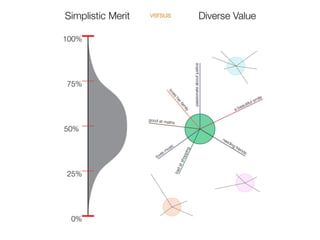
Each of the 3 main political
values different things…
• Conservatives - value community
• Liberals - value freedom
• Socialists - value equality
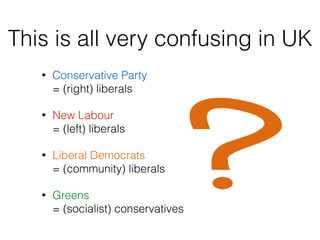
This is all very confusing in UK
• Conservative Party 

= (right) liberals
• New Labour 

= (left) liberals
• Liberal Democrats 

= (community) liberals
• Greens 

= (socialist) conservatives
?
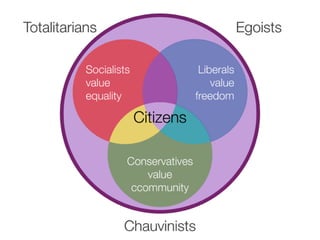
But each tradition - at
its best - should value
citizenship
Conservatives (unless
they are chauvinists)
should value true
citizenship…
because citizenship requires
welcomes our diverse
loyalties to family, civil
society, place and to country.
Liberals (unless they
worship the right to
property) should value true
citizenship…
because citizenship
defines our rights and
gives us our reason to fulfil
our duties.
Socialists (unless they are
totalitarians) should value
true citizenship…
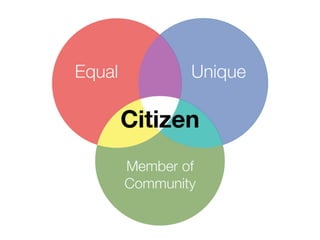
because citizenship is our
valued status as an equal
member of the community.
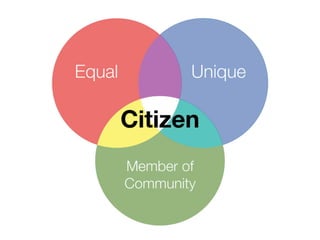
Citizenship allows us
to achieve equality, in
all our diversity by
membership in
community.
A polis [community] is not
just a larger scale village.
In ‘having reached the
limits of self-sufficiency’, it
forms a framework for the
exercise of all human
capacities. And so, ‘while
coming into being for the
sake of life’, the polis
exists ‘for the sake of the
good life’ (1252b). It
constitutes the telos, the
final end, of human of
association.
Aristotle (384-322 BC)
“Aristotle explains that a
community is not made out of
equals, but on the contrary of
people who are different and
unequal. The community
comes into being through
equalising, isathenai.” 

[Nichomean Ethics 1133a 14]
Hannah Arendt (1906-1975)
“Above all, I think the
idea of citizenship
should remain at the
centre of modern political
debates about social and
economic arrangements.
The concept of a citizen
is that of a person who
can hold [their] head
high and participate
fully and with dignity in
the life of [their]
society.”
Jeremy Waldron (1953 - )
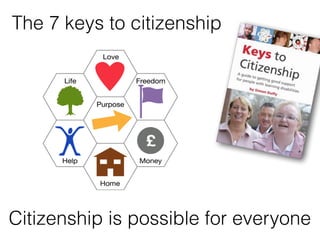
The 7 keys to citizenship
Citizenship is possible for everyone
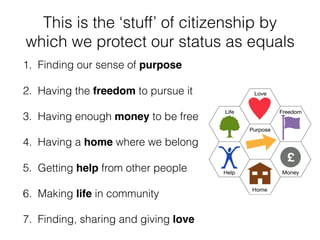
This is the ‘stuff’ of citizenship by
which we protect our status as equals
1. Finding our sense of purpose
2. Having the freedom to pursue it
3. Having enough money to be free
4. Having a home where we belong
5. Getting help from other people
6. Making life in community
7. Finding, sharing and giving love
4. The welfare state is a
good thing - but it’s not
designed right
• The welfare state has not
been designed for citizenship.
• At its worst the welfare state
weakens our ability to act as
citizens.
• It often undermines family or
civil society structures.
• Often it excludes those who
should be welcomed and
included.
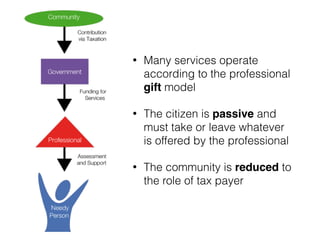
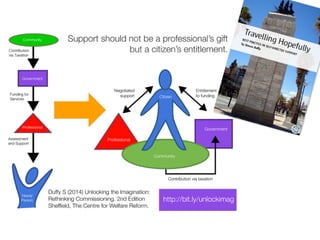
• Many services operate
according to the professional
gift model
• The citizen is passive and
must take or leave whatever
is offered by the professional
• The community is reduced to
the role of tax payer
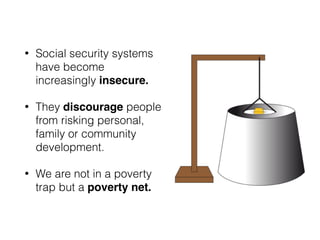
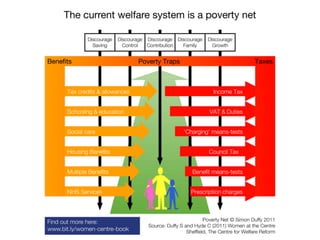
• Social security systems
have become
increasingly insecure.
• They discourage people
from risking personal,
family or community
development.
• We are not in a poverty
trap but a poverty net.
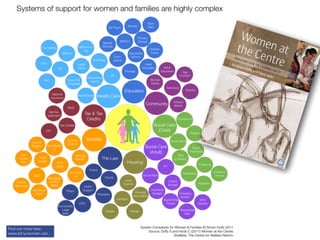
• There is an every growing array of services, but…
• as power has been centralised the complexity of
services has increased, while innovation and
responsiveness is made more difficult.
• Despite, in fact because of, the complexity of
services those in greatest need are often the first to
be excluded.
• For all the talk of localism or devolution (a theme
that has run for at least as long as central
government started the process of constantly
reorganising and weakening local government)
power and money have been centralised.
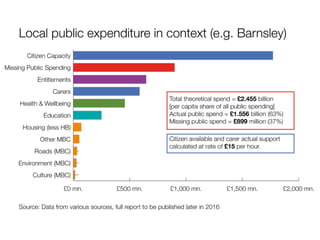
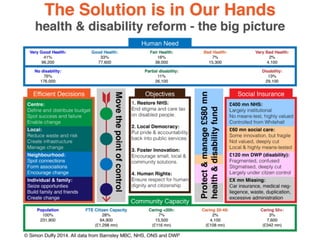
• One of the mysterious symptoms of this fact is the
enormous amount of money and capacity goes
‘missing’.
• We also fail to attend to the vast reserves of
energy, activity and untapped capacity available to
our communities.
5. The welfare state is
renewable
Some examples of
upstream solutions…
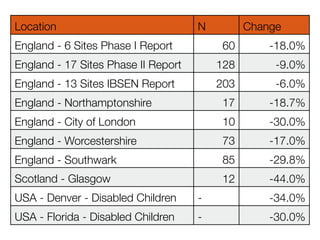
Citizen controlled
support can be
extraordinarily efficient
Location N Change
England - 6 Sites Phase I Report 60 -18.0%
England - 17 Sites Phase II Report 128 -9.0%
England - 13 Sites IBSEN Report 203 -6.0%
England - Northamptonshire 17 -18.7%
England - City of London 10 -30.0%
England - Worcestershire 73 -17.0%
England - Southwark 85 -29.8%
Scotland - Glasgow 12 -44.0%
USA - Denver - Disabled Children - -34.0%
USA - Florida - Disabled Children - -30.0%
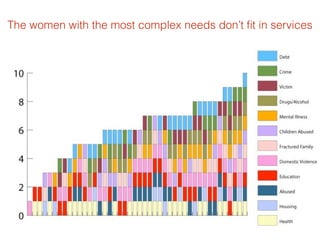
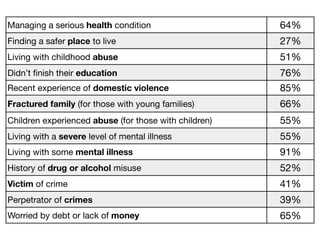
The women with the most complex needs don’t fit in services
Managing a serious health condition 64%
Finding a safer place to live 27%
Living with childhood abuse 51%
Didn’t finish their education 76%
Recent experience of domestic violence 85%
Fractured family (for those with young families) 66%
Children experienced abuse (for those with children) 55%
Living with a severe level of mental illness 55%
Living with some mental illness 91%
History of drug or alcohol misuse 52%
Victim of crime 41%
Perpetrator of crimes 39%
Worried by debt or lack of money 65%
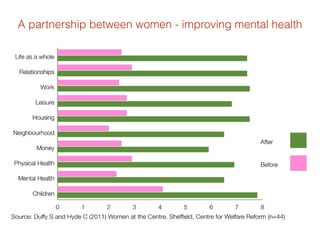
A partnership between women - improving mental health
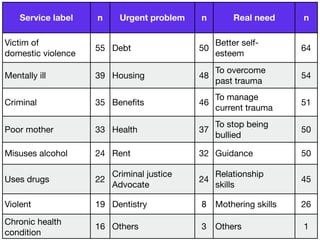
Service label n Urgent problem n Real need n
Victim of
domestic violence
55 Debt 50
Better self-
esteem
64
Mentally ill 39 Housing 48
To overcome
past trauma
54
Criminal 35 Benefits 46
To manage
current trauma
51
Poor mother 33 Health 37
To stop being
bullied
50
Misuses alcohol 24 Rent 32 Guidance 50
Uses drugs 22
Criminal justice
Advocate
24
Relationship
skills
45
Violent 19 Dentistry 8 Mothering skills 26
Chronic health
condition
16 Others 3 Others 1
Supporting families
starts by respecting
families
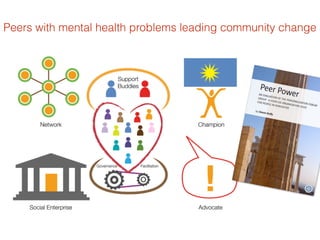
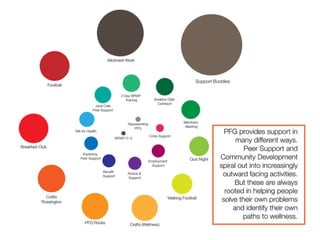
Peers with mental health problems leading community change
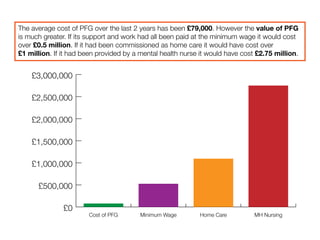
£0
£500,000
£1,000,000
£1,500,000
£2,000,000
£2,500,000
£3,000,000
MH NursingHome CareMinimum WageCost of PFG
The average cost of PFG over the last 2 years has been £79,000. However the value of PFG
is much greater. If its support and work had all been paid at the minimum wage it would cost
over £0.5 million. If it had been commissioned as home care it would have cost over
£1 million. If it had been provided by a mental health nurse it would have cost £2.75 million.
Peer support trumps
professional support
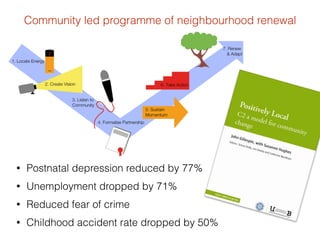
• Postnatal depression reduced by 77%
• Unemployment dropped by 71%
• Reduced fear of crime
• Childhood accident rate dropped by 50%
Community led programme of neighbourhood renewal
Communities can take
charge of their destiny
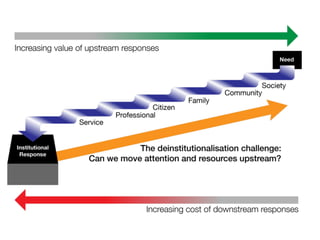
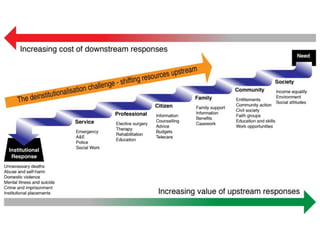
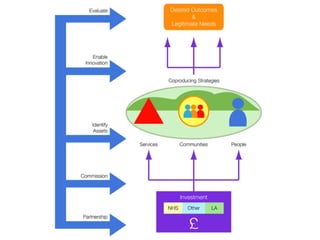
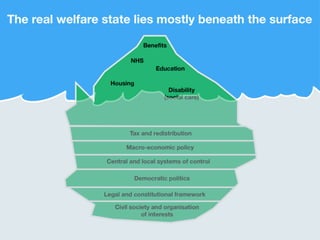
We need to think
beyond services
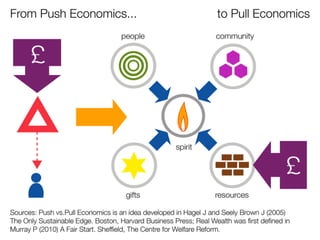
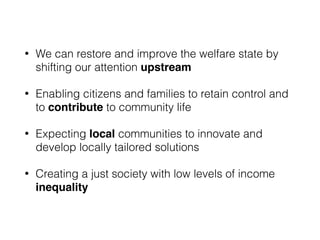
• We can restore and improve the welfare state by
shifting our attention upstream
• Enabling citizens and families to retain control and
to contribute to community life
• Expecting local communities to innovate and
develop locally tailored solutions
• Creating a just society with low levels of income
inequality
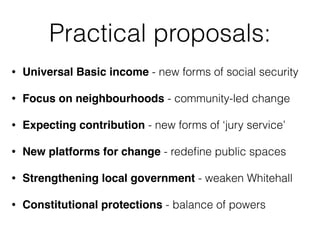
• Universal Basic income - new forms of social security
• Focus on neighbourhoods - community-led change
• Expecting contribution - new forms of ‘jury service’
• New platforms for change - redefine public spaces
• Strengthening local government - weaken Whitehall
• Constitutional protections - balance of powers
Practical proposals:
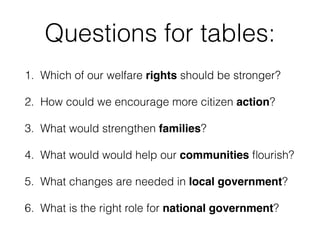
Questions for tables:
1. Which of our welfare rights should be stronger?
2. How could we encourage more citizen action?
3. What would strengthen families?
4. What would would help our communities flourish?
5. What changes are needed in local government?
6. What is the right role for national government?

Citizenship and the Welfare State

  • 1.
    Citizenship and theWelfare State Can we wake from complacency? Dr Simon Duffy, Centre for Welfare Reform Birmingham, June 2016
  • 2.
    1. The welfarestate is an essential social development 2. The attacks on the welfare state are only partially ideological 3. The proper purpose of the welfare state is to secure our citizenship 4. The current design of the welfare state often undermines citizenship 5. But we can renew the welfare state by positive reform Argument in summary
  • 3.
    1. The welfarestate is essential
  • 4.
    the welfare statedid not happen by accident
  • 6.
    …only legal andpolitical institutions that are independent of the economic forces and automatism can control and check the inherently monstrous potentialities of this process. Such political controls seem to function best in the so-called welfare states whether they call themselves socialist or capitalist. Hannah Arendt
  • 8.
    • The welfarestate emerged as a response to the crises that led to World War II and the Holocaust • In the UK its designers were led by Fabians, reformist liberals and socialists, like Keynes, Beveridge, the Webbs and Bevan • There was great confidence in the benign role of the state to balance the injustices of the free market
  • 9.
    …three guiding principlesmay be laid down at the outset: 1. The first principle… A revolutionary moment in the world's history is a time for revolutions, not for patching. 2. The second principle is that organisation of social insurance should be treated as one part only of a comprehensive policy of social progress. Social insurance fully developed may provide income security; it is an attack upon Want. But Want is one only of five giants on the road of reconstruction and in some ways the easiest to attack. The others are Disease, Ignorance, Squalor and Idleness. 3. The third principle is that social security must be achieved by co-operation between the State and the individual…. Beveridge W (1942) Social Insurance and Allied Services.
  • 10.
    • They believedthe state would be rational and that democratic control would be sufficient to ensure the positive development of the welfare state. • There was also a powerful assumptions that an intellectual elite could be trusted to solve social problems. • “We have little faith in the 'average sensual man', we do not believe that he can do more than describe his grievances, we do not think he can prescribe the remedies.” [Beatrice Webb]
  • 11.
    but there wasan alternative vision
  • 13.
    • The designof the welfare state reflected the spirit of the times and assumptions of dominant intellectuals, yet there were other strands of progressive thought. • G K Chesterton and the Catholic church advocated distributism and subsidiarity - less centralised approaches to social justice. • Archbishop Temple, who coined the term ‘welfare state’, advocated an approach which made love and human development central. • Michael Young warned the Left of the dangers of ‘meritocracy’ and the advocated equality and creativity.
  • 14.
    “Today we franklyrecognise that democracy can be no more than an aspiration, and have rule not so much by the people as by the cleverest people; not an aristocracy of birth, not a plutocracy of wealth, but a true meritocracy of talent.” [1958] Yesterday’s satire feels like today’s tragedy
  • 15.
    2. The welfarestate is under attack
  • 17.
    • Public discussionof the welfare state is often simplistic and focuses simply on income tax and overall spending levels. • Spending levels do vary - but not so dramatically • What has been dramatic has been our decreasing commitment to equality and justice
  • 24.
    • There aresimilar trends in many other welfare states, but the UK’s interest in justice seems to be declining more quickly than most. • Strangely the UK has managed to combine high levels of inequality with high levels of employment with low levels of productivity.
  • 26.
    Decline in justicehas accelerated under recent Coalition and Conservative Governments: • Poorest have been targeted for cuts • Disabled people have been targeted for cuts • Stigmatising language and misuse of statistics (e.g. benefit fraud) has grown • Hidden subsidies to the better off have grown
  • 33.
    • These problemsare often associated with the ideology of ‘neoliberalism’ or even cruder forms of Darwinism - “Let the Devil take the hindmost!” • But while this seems partially true, these changes are not simply ideological. • Change often involves elitist tinkering not actual cuts in spending.
  • 34.
    • Benefits aredistributed to groups with good advocacy or voter impact e.g. disabled people vs. pensioners • Blame shifted to scapegoat groups e.g. immigrants vs. bankers • Universal services protected e.g. social care vs. NHS • Self-serving influence of commercial interests e.g. think tanks funding • Some services are more powerfully defended e.g. BMA vs. LGA • Hubris of politicians trying to make an impact e.g. every ‘reform’ of the NHS • Attempts to buy the swing voter Other explanations include…
  • 36.
    The power ofthe medianocracy Where elections
 are won or lost
  • 37.
    3. The welfarestate is for citizenship
  • 38.
    Thomas Humphrey Marshall
 Citizenshipand Social Class. Citizenship is a status bestowed on those who are full members of a community. All who possess the status are equal with respect to the rights and duties with which the status is endowed. There is no universal principle that determines what those rights and duties shall be, but societies in which citizenship is a developing institution create an image of an ideal citizenship against which achievement can be measured and towards which aspiration can be directed. The urge forward along the path thus plotted is an urge towards a fuller measure of equality, an enrichment of the stuff of which the status is made and an increase in the number of those on whom the status is bestowed.
  • 39.
    Marshall correctly makes citizenshipthe central purpose of the welfare state. But note his dangerous fallacy…
  • 40.
    For, while itis true that our rights need to be matched by our duties (across a whole society)…
  • 41.
    but that doesnot mean 
 my rights and my duties should be identical.
  • 42.
    The welfare stateexists to distribute rights and duties unequally - to protect the weak and to discipline the powerful.
  • 43.
    We do notwant citizenship to be restricted to a club of the clever, the wealthy or the normal.
  • 44.
    True citizenship isfor everyone
  • 45.
    We don’t wanta narrow passport citizenship.
  • 46.
    • Danish citizenssaved nearly all Danish Jews and refugee Jews from the gas chambers. • After first hiding them from the Nazis they then manned fishing boats and help them escape to neutral Sweden. • This is true citizenship For example…
  • 47.
    True citizenship is inclusive
 andwelcomes 
 human diversity
  • 48.
    Each of the3 main political values different things… • Conservatives - value community • Liberals - value freedom • Socialists - value equality
  • 49.
    This is allvery confusing in UK • Conservative Party 
 = (right) liberals • New Labour 
 = (left) liberals • Liberal Democrats 
 = (community) liberals • Greens 
 = (socialist) conservatives ?
  • 50.
    But each tradition- at its best - should value citizenship
  • 52.
    Conservatives (unless they arechauvinists) should value true citizenship…
  • 53.
    because citizenship requires welcomesour diverse loyalties to family, civil society, place and to country.
  • 55.
    Liberals (unless they worshipthe right to property) should value true citizenship…
  • 56.
    because citizenship defines ourrights and gives us our reason to fulfil our duties.
  • 58.
    Socialists (unless theyare totalitarians) should value true citizenship…
  • 59.
    because citizenship isour valued status as an equal member of the community.
  • 61.
    Citizenship allows us toachieve equality, in all our diversity by membership in community.
  • 63.
    A polis [community]is not just a larger scale village. In ‘having reached the limits of self-sufficiency’, it forms a framework for the exercise of all human capacities. And so, ‘while coming into being for the sake of life’, the polis exists ‘for the sake of the good life’ (1252b). It constitutes the telos, the final end, of human of association. Aristotle (384-322 BC)
  • 64.
    “Aristotle explains thata community is not made out of equals, but on the contrary of people who are different and unequal. The community comes into being through equalising, isathenai.” 
 [Nichomean Ethics 1133a 14] Hannah Arendt (1906-1975)
  • 65.
    “Above all, Ithink the idea of citizenship should remain at the centre of modern political debates about social and economic arrangements. The concept of a citizen is that of a person who can hold [their] head high and participate fully and with dignity in the life of [their] society.” Jeremy Waldron (1953 - )
  • 66.
    The 7 keysto citizenship Citizenship is possible for everyone
  • 67.
    This is the‘stuff’ of citizenship by which we protect our status as equals 1. Finding our sense of purpose 2. Having the freedom to pursue it 3. Having enough money to be free 4. Having a home where we belong 5. Getting help from other people 6. Making life in community 7. Finding, sharing and giving love
  • 68.
    4. The welfarestate is a good thing - but it’s not designed right
  • 69.
    • The welfarestate has not been designed for citizenship. • At its worst the welfare state weakens our ability to act as citizens. • It often undermines family or civil society structures. • Often it excludes those who should be welcomed and included.
  • 70.
    • Many servicesoperate according to the professional gift model • The citizen is passive and must take or leave whatever is offered by the professional • The community is reduced to the role of tax payer
  • 71.
    • Social securitysystems have become increasingly insecure. • They discourage people from risking personal, family or community development. • We are not in a poverty trap but a poverty net.
  • 73.
    • There isan every growing array of services, but… • as power has been centralised the complexity of services has increased, while innovation and responsiveness is made more difficult. • Despite, in fact because of, the complexity of services those in greatest need are often the first to be excluded.
  • 75.
    • For allthe talk of localism or devolution (a theme that has run for at least as long as central government started the process of constantly reorganising and weakening local government) power and money have been centralised. • One of the mysterious symptoms of this fact is the enormous amount of money and capacity goes ‘missing’. • We also fail to attend to the vast reserves of energy, activity and untapped capacity available to our communities.
  • 77.
    5. The welfarestate is renewable
  • 80.
  • 83.
    Citizen controlled support canbe extraordinarily efficient
  • 84.
    Location N Change England- 6 Sites Phase I Report 60 -18.0% England - 17 Sites Phase II Report 128 -9.0% England - 13 Sites IBSEN Report 203 -6.0% England - Northamptonshire 17 -18.7% England - City of London 10 -30.0% England - Worcestershire 73 -17.0% England - Southwark 85 -29.8% Scotland - Glasgow 12 -44.0% USA - Denver - Disabled Children - -34.0% USA - Florida - Disabled Children - -30.0%
  • 85.
    The women withthe most complex needs don’t fit in services
  • 86.
    Managing a serioushealth condition 64% Finding a safer place to live 27% Living with childhood abuse 51% Didn’t finish their education 76% Recent experience of domestic violence 85% Fractured family (for those with young families) 66% Children experienced abuse (for those with children) 55% Living with a severe level of mental illness 55% Living with some mental illness 91% History of drug or alcohol misuse 52% Victim of crime 41% Perpetrator of crimes 39% Worried by debt or lack of money 65%
  • 88.
    A partnership betweenwomen - improving mental health
  • 89.
    Service label nUrgent problem n Real need n Victim of domestic violence 55 Debt 50 Better self- esteem 64 Mentally ill 39 Housing 48 To overcome past trauma 54 Criminal 35 Benefits 46 To manage current trauma 51 Poor mother 33 Health 37 To stop being bullied 50 Misuses alcohol 24 Rent 32 Guidance 50 Uses drugs 22 Criminal justice Advocate 24 Relationship skills 45 Violent 19 Dentistry 8 Mothering skills 26 Chronic health condition 16 Others 3 Others 1
  • 90.
    Supporting families starts byrespecting families
  • 91.
    Peers with mentalhealth problems leading community change
  • 93.
    £0 £500,000 £1,000,000 £1,500,000 £2,000,000 £2,500,000 £3,000,000 MH NursingHome CareMinimumWageCost of PFG The average cost of PFG over the last 2 years has been £79,000. However the value of PFG is much greater. If its support and work had all been paid at the minimum wage it would cost over £0.5 million. If it had been commissioned as home care it would have cost over £1 million. If it had been provided by a mental health nurse it would have cost £2.75 million.
  • 94.
  • 95.
    • Postnatal depressionreduced by 77% • Unemployment dropped by 71% • Reduced fear of crime • Childhood accident rate dropped by 50% Community led programme of neighbourhood renewal
  • 96.
  • 99.
    We need tothink beyond services
  • 101.
    • We canrestore and improve the welfare state by shifting our attention upstream • Enabling citizens and families to retain control and to contribute to community life • Expecting local communities to innovate and develop locally tailored solutions • Creating a just society with low levels of income inequality
  • 103.
    • Universal Basicincome - new forms of social security • Focus on neighbourhoods - community-led change • Expecting contribution - new forms of ‘jury service’ • New platforms for change - redefine public spaces • Strengthening local government - weaken Whitehall • Constitutional protections - balance of powers Practical proposals:
  • 105.
    Questions for tables: 1.Which of our welfare rights should be stronger? 2. How could we encourage more citizen action? 3. What would strengthen families? 4. What would would help our communities flourish? 5. What changes are needed in local government? 6. What is the right role for national government?