MONEY
A SHORT BRIEF REGARDING IT’S ORIGIN,
MEANNG, FUNCTIONS AND TYPES
REFERENCES
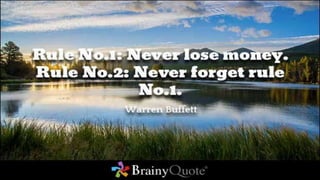
• Buffett, W. (2017). Warren Buffett Quotes. BrainyQuote. Retrieved 26


March 2017, from
https://www.brainyquote.com/quotes/quotes/w/warrenbuff149683.html?sr
c=t_money
• Back to Basics: What Is Money? - Finance & Development, September
2012. (2017). Imf.org. Retrieved 26 March 2017, from
http://www.imf.org/external/pubs/ft/fandd/2012/09/basics.htm
REFERENCES
• What is money? definition and meaning. (2017). BusinessDictionary.com.
Retrieved 26 March 2017, from
http://www.businessdictionary.com/definition/money.html
• Mankiw, N. (2012). Principles of Macroeconomics (6th ed., p. 324). Mason,
OH: South-Western Cengage Learning.
REFERENCES
• A Brief History of Money. (2017). Archaic-jade.com. Retrieved 26 March
2017, from http://www.archaicjade.com/papermoney/money.htm
• Beattie, A. (2017). The History Of Money: From Barter To Banknotes.
Investopedia. Retrieved 24 March 2017, from
http://www.investopedia.com/articles/07/roots_of_money.asp
REFERENCES
• Staff, I. (2017). What Is Money?. Investopedia. Retrieved 24 March 2017,
from http://www.investopedia.com/articles/basics/03/061303.asp
• What is Money?. (2017). Economics and Liberty. Retrieved 26 March
2017, from https://economicsandliberty.wordpress.com/what-is-money/
REFERENCES
• Types of Money, Definition and Types. (2017). World Finance. Retrieved
24 March 2017, from http://finance.mapsofworld.com/money/types/
• Solman, P. (2017). What Would Happen to Money Supply if We Returned
to the Gold Standard?. PBS NewsHour. Retrieved 27 March 2017, from
http://www.pbs.org/newshour/rundown/what-would-happen-to-money-
supply-if-we-returned-to-the-gold-standard/
REFERENCES
• Suman, S. (2017). Top 6 Functions of Money –Discussed. Economics
Discussion. Retrieved 24 March 2017, from
http://www.economicsdiscussion.net/money/functions-money/top-6-
functions-of-money-discussed/12710
OBJECTIVES
•Explaining the
History of money
Meaning of money
Functions of money
Kinds of money
METHODOLOGY
•All the presentation and assignment has
been written based on the
SECONDARY DATA.
LIMITATIONS
•No use of PRIMARY SOURCE of Data
• Absence of SPECIFIC STATISTICS about
the number of user of money in several
decades.
INTRODUCTION
WHAT IS MONEY
• According to IMF,
Money is something which helps to run the modern
economy and without it, modern economy could not
function.
("Back to Basics: What Is Money? - Finance & Development, September 2012", 2017)
WHAT IS MONEY
• According to Business Dictionary,
Anything of value that serves as a (1) generally accepted medium of
financial exchange, (2) legal tender for repayment of debt, (3) standard of
value, (4) unit of accounting measure, and (5) means to save or store
purchasing power.
("What is money? definition and meaning", 2017)
WHAT IS MONEY
• According to Mankiw,
Money is the set of assets in an economy that people regularly
use to buy goods and services from other people.
(Mankiw 2012)
HISTORY
HISTORY
• Cattle as money dates back to 9000 B.C. - the oldest of all forms of money.
Still used as money in parts of Africa in the middle of the 20th century.
("A Brief History of Money", 2017)
• The first coins, pieces of bronze shaped, appeared around 2000 B.C. Their
value was determined by their weight. (Ibid)
• Coins with their value imprinted on them were first produced in Lydia
(present day Turkey) around 650 B.C (Ibid)
HISTORY
• Chinese invented paper currency around A.D. 806. (Ibid)
• The first consistent use of paper money in Europe was by the French in
the 18th century. (Ibid)
• The Massachusetts Bay Colony issued the first paper money in America in
1690. (Ibid)
HISTORY
• On April 2, 1792, Congress created the U. S. Mint which produced its first
circulating coins -- 11,178 copper cents -- in March 1793.
• Parker Brothers printed more money for its Monopoly games than the
Federal Reserve has issued in real money for the United States.
• Bitcoin came in 2009 as a Virtual currency with LOWER TRANSACTION
FEES
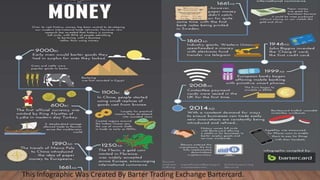
This Infographic Was Created By Barter Trading Exchange Bartercard.
MEANING OF MONEY
MEANING OF MONEY
• Money means more than the coin, paper or plastic to acquire
goods and services. ("Meaning of Money", 2017)
• Money is linked to complex emotions, feelings and behaviors.
(Ibid)
• Money and what one can do with money, is a measure of their
identity and self-worth. (Ibid)
MEANING OF MONEY
• Each person has "money messages" that are based on past
experiences, what you observed and what you were taught.
These money messages reflect the attitudes, perceptions and
expectations that influence your financial behaviors today. (Ibid)
• In personal relationships, money is often a source of conflict.
(Ibid)
WHY A NUMBER OF CURRENCIES HAD
BEEN CHANGED WITH THE PASSAGE OF
TIME
• Scarcity
•Practical reasons
•Policy reasons
FUNCTION OF MONEY
FUNCTIONS OF MONEY
• Function # 1. A Medium of Exchange (Suman, 2017)
• Function # 2. A Measure of Value (Ibid)
• Function # 3. A Store of Value (Purchasing Power) (Ibid)
FUNCTIONS OF MONEY
• Function # 4. The Basis of Credit. (Ibid)
• Function # 5. A Unit of Account. (Ibid)
• Function # 6. A Standard of Postponed Payment. (Ibid)
TYPES OF MONEY
TYPES OF MONEY
• Commodity Money - It is the simplest kind of money which is used in
barter system where the valuable resources fulfill the functions of money.
("Types of Money, Definition and Types", 2017)
• Fiat Money- Fiat currency is the kind of money which don’t have any
intrinsic value and it can’t converted into valuable resource. (Ibid)
TYPES OF MONEY
• Fiduciary Money - Whenever, any bank assures the customers to pay in
different types of money and when the customer can sell the promise or
transfer it to somebody else, it is called the fiduciary money. (Ibid)
• Commercial Bank Money - Commercial Bank money or demand
deposits are claims against financial institutions that can be used for the
purchase of goods and services. (Ibid)
TYPES OF MONEY
• There are also various other types of money those are discussed below :
• FRACTIONAL MONEY - is a hybrid type of money which is partly backed
by a commodity and has a fiat money transaction purpose. (Ibid)
• REPRESENTATIVE MONEY - It represents a claim on commodity and it
can be redeemed for that commodity at a bank . It is a token or paper
money that can be exchanged for a fixed quantity of commodity. (Ibid)
TYPES OF MONEY
• COINS - Metals of particular weight are stamped into coins. There are
various precious metals like gold, silver, bronze , copper whose coins are
already used in human history. The minting of coins is controlled by the
state.
• PAPER MONEY - Paper money don’t have any intrinsic value , as a fiat
money it is approved by government order to be treated as legal tender
through which value exchange can happen. (Ibid)
INTERESTING FACTS ABOUT
MONEY
INTERESTING FACTS ABOUT
MONEY
• In China cowry shells are regarded as money during 1000 B.C to
1200 B.C.
• Leather bags are treated as money in the ancient city of Carthage.
• Copper coins are treated as money by Romans 600B.C.
INTERESTING FACTS ABOUT
MONEY
• Silver coins are treated as money by Ancient Persians between 600-
300 B.C.
• Gold Coins are treated as money in 600 B.C in Anatolia (Asian
Turkey or Asia Minor )
• Paper Money first appeared in China about 800 AD . In Europe,
Sweden is the First country to issue Paper Money in 1661.
ANY QUESTONS?
THANK YOU

Money - A Brief Elucidation

  • 1.
    MONEY A SHORT BRIEFREGARDING IT’S ORIGIN, MEANNG, FUNCTIONS AND TYPES
  • 2.
    REFERENCES • Buffett, W.(2017). Warren Buffett Quotes. BrainyQuote. Retrieved 26 March 2017, from https://www.brainyquote.com/quotes/quotes/w/warrenbuff149683.html?sr c=t_money • Back to Basics: What Is Money? - Finance & Development, September 2012. (2017). Imf.org. Retrieved 26 March 2017, from http://www.imf.org/external/pubs/ft/fandd/2012/09/basics.htm
  • 3.
    REFERENCES • What ismoney? definition and meaning. (2017). BusinessDictionary.com. Retrieved 26 March 2017, from http://www.businessdictionary.com/definition/money.html • Mankiw, N. (2012). Principles of Macroeconomics (6th ed., p. 324). Mason, OH: South-Western Cengage Learning.
  • 4.
    REFERENCES • A BriefHistory of Money. (2017). Archaic-jade.com. Retrieved 26 March 2017, from http://www.archaicjade.com/papermoney/money.htm • Beattie, A. (2017). The History Of Money: From Barter To Banknotes. Investopedia. Retrieved 24 March 2017, from http://www.investopedia.com/articles/07/roots_of_money.asp
  • 5.
    REFERENCES • Staff, I.(2017). What Is Money?. Investopedia. Retrieved 24 March 2017, from http://www.investopedia.com/articles/basics/03/061303.asp • What is Money?. (2017). Economics and Liberty. Retrieved 26 March 2017, from https://economicsandliberty.wordpress.com/what-is-money/
  • 6.
    REFERENCES • Types ofMoney, Definition and Types. (2017). World Finance. Retrieved 24 March 2017, from http://finance.mapsofworld.com/money/types/ • Solman, P. (2017). What Would Happen to Money Supply if We Returned to the Gold Standard?. PBS NewsHour. Retrieved 27 March 2017, from http://www.pbs.org/newshour/rundown/what-would-happen-to-money- supply-if-we-returned-to-the-gold-standard/
  • 7.
    REFERENCES • Suman, S.(2017). Top 6 Functions of Money –Discussed. Economics Discussion. Retrieved 24 March 2017, from http://www.economicsdiscussion.net/money/functions-money/top-6- functions-of-money-discussed/12710
  • 8.
    OBJECTIVES •Explaining the History ofmoney Meaning of money Functions of money Kinds of money
  • 9.
    METHODOLOGY •All the presentationand assignment has been written based on the SECONDARY DATA.
  • 10.
    LIMITATIONS •No use ofPRIMARY SOURCE of Data • Absence of SPECIFIC STATISTICS about the number of user of money in several decades.
  • 11.
  • 13.
    WHAT IS MONEY •According to IMF, Money is something which helps to run the modern economy and without it, modern economy could not function. ("Back to Basics: What Is Money? - Finance & Development, September 2012", 2017)
  • 14.
    WHAT IS MONEY •According to Business Dictionary, Anything of value that serves as a (1) generally accepted medium of financial exchange, (2) legal tender for repayment of debt, (3) standard of value, (4) unit of accounting measure, and (5) means to save or store purchasing power. ("What is money? definition and meaning", 2017)
  • 15.
    WHAT IS MONEY •According to Mankiw, Money is the set of assets in an economy that people regularly use to buy goods and services from other people. (Mankiw 2012)
  • 17.
  • 18.
    HISTORY • Cattle asmoney dates back to 9000 B.C. - the oldest of all forms of money. Still used as money in parts of Africa in the middle of the 20th century. ("A Brief History of Money", 2017) • The first coins, pieces of bronze shaped, appeared around 2000 B.C. Their value was determined by their weight. (Ibid) • Coins with their value imprinted on them were first produced in Lydia (present day Turkey) around 650 B.C (Ibid)
  • 19.
    HISTORY • Chinese inventedpaper currency around A.D. 806. (Ibid) • The first consistent use of paper money in Europe was by the French in the 18th century. (Ibid) • The Massachusetts Bay Colony issued the first paper money in America in 1690. (Ibid)
  • 20.
    HISTORY • On April2, 1792, Congress created the U. S. Mint which produced its first circulating coins -- 11,178 copper cents -- in March 1793. • Parker Brothers printed more money for its Monopoly games than the Federal Reserve has issued in real money for the United States. • Bitcoin came in 2009 as a Virtual currency with LOWER TRANSACTION FEES
  • 21.
    This Infographic WasCreated By Barter Trading Exchange Bartercard.
  • 22.
  • 23.
    MEANING OF MONEY •Money means more than the coin, paper or plastic to acquire goods and services. ("Meaning of Money", 2017) • Money is linked to complex emotions, feelings and behaviors. (Ibid) • Money and what one can do with money, is a measure of their identity and self-worth. (Ibid)
  • 24.
    MEANING OF MONEY •Each person has "money messages" that are based on past experiences, what you observed and what you were taught. These money messages reflect the attitudes, perceptions and expectations that influence your financial behaviors today. (Ibid) • In personal relationships, money is often a source of conflict. (Ibid)
  • 25.
    WHY A NUMBEROF CURRENCIES HAD BEEN CHANGED WITH THE PASSAGE OF TIME • Scarcity •Practical reasons •Policy reasons
  • 26.
  • 27.
    FUNCTIONS OF MONEY •Function # 1. A Medium of Exchange (Suman, 2017) • Function # 2. A Measure of Value (Ibid) • Function # 3. A Store of Value (Purchasing Power) (Ibid)
  • 28.
    FUNCTIONS OF MONEY •Function # 4. The Basis of Credit. (Ibid) • Function # 5. A Unit of Account. (Ibid) • Function # 6. A Standard of Postponed Payment. (Ibid)
  • 29.
  • 30.
    TYPES OF MONEY •Commodity Money - It is the simplest kind of money which is used in barter system where the valuable resources fulfill the functions of money. ("Types of Money, Definition and Types", 2017) • Fiat Money- Fiat currency is the kind of money which don’t have any intrinsic value and it can’t converted into valuable resource. (Ibid)
  • 31.
    TYPES OF MONEY •Fiduciary Money - Whenever, any bank assures the customers to pay in different types of money and when the customer can sell the promise or transfer it to somebody else, it is called the fiduciary money. (Ibid) • Commercial Bank Money - Commercial Bank money or demand deposits are claims against financial institutions that can be used for the purchase of goods and services. (Ibid)
  • 32.
    TYPES OF MONEY •There are also various other types of money those are discussed below : • FRACTIONAL MONEY - is a hybrid type of money which is partly backed by a commodity and has a fiat money transaction purpose. (Ibid) • REPRESENTATIVE MONEY - It represents a claim on commodity and it can be redeemed for that commodity at a bank . It is a token or paper money that can be exchanged for a fixed quantity of commodity. (Ibid)
  • 33.
    TYPES OF MONEY •COINS - Metals of particular weight are stamped into coins. There are various precious metals like gold, silver, bronze , copper whose coins are already used in human history. The minting of coins is controlled by the state. • PAPER MONEY - Paper money don’t have any intrinsic value , as a fiat money it is approved by government order to be treated as legal tender through which value exchange can happen. (Ibid)
  • 34.
  • 35.
    INTERESTING FACTS ABOUT MONEY •In China cowry shells are regarded as money during 1000 B.C to 1200 B.C. • Leather bags are treated as money in the ancient city of Carthage. • Copper coins are treated as money by Romans 600B.C.
  • 36.
    INTERESTING FACTS ABOUT MONEY •Silver coins are treated as money by Ancient Persians between 600- 300 B.C. • Gold Coins are treated as money in 600 B.C in Anatolia (Asian Turkey or Asia Minor ) • Paper Money first appeared in China about 800 AD . In Europe, Sweden is the First country to issue Paper Money in 1661.
  • 37.
  • 38.