The
Welfare
State
and its 

Citizens
Dr Simon Duffy of the Centre for Welfare Reform
on behalf of Leadership for Change
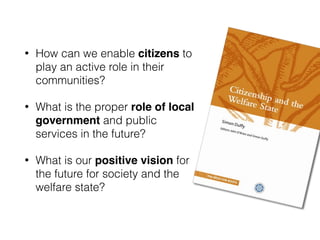
• How can we enable citizens to
play an active role in their
communities?
• What is the proper role of local
government and public
services in the future?
• What is our positive vision for
the future for society and the
welfare state?
What’s going wrong?
• Shrinking state hypothesis - we can no longer
afford the welfare state - FALSE
• Paternalistic design hypothesis - we need to design
a pro-citizenship welfare state - TRUE
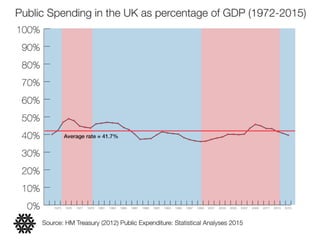
There is no evidence that the welfare state is
unaffordable. We have spent roughly the same
amount of GDP on the welfare state for over 50 years.
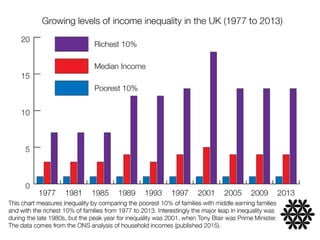
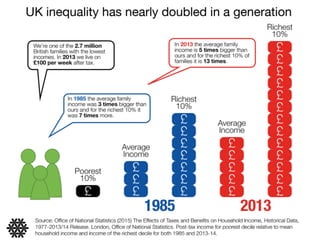
What has changed is our commitment to equality and
justice. Inequality has nearly doubled in a generation.
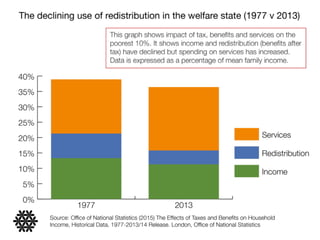
We now spend much less on redistribution but spend
much more on services.
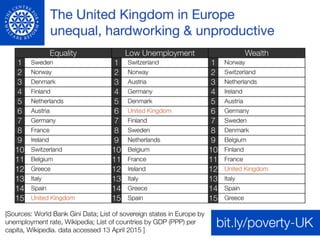
These trends seem particularly severe in the UK
where we have pulled off the unenviable trick of
being (a) the most unequal country in Europe (b)
very hard working and (c) very unproductive.
[In economic terms it seems that our policy of
shrinking wages and benefits has had the perverse
impact of making labour cheap and so discouraging
investments to increase efficiency.]
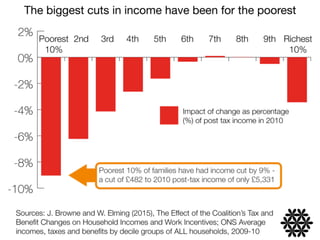
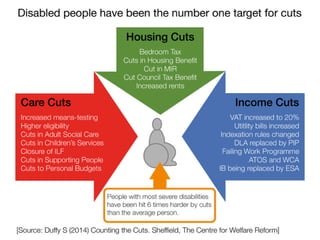
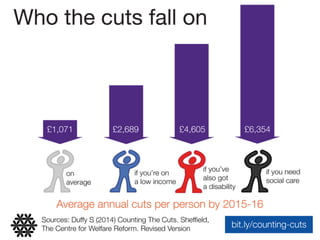
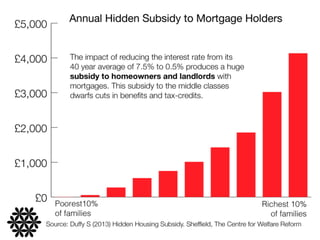
Since the banking crisis and 2010 election things
have got even worse.
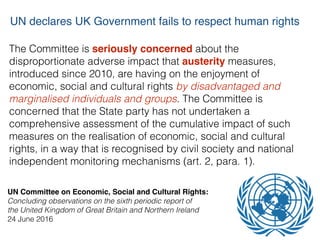
The Committee is seriously concerned about the
disproportionate adverse impact that austerity measures,
introduced since 2010, are having on the enjoyment of
economic, social and cultural rights by disadvantaged and
marginalised individuals and groups. The Committee is
concerned that the State party has not undertaken a
comprehensive assessment of the cumulative impact of such
measures on the realisation of economic, social and cultural
rights, in a way that is recognised by civil society and national
independent monitoring mechanisms (art. 2, para. 1).
UN Committee on Economic, Social and Cultural Rights:
Concluding observations on the sixth periodic report of 

the United Kingdom of Great Britain and Northern Ireland

24 June 2016
UN declares UK Government fails to respect human rights
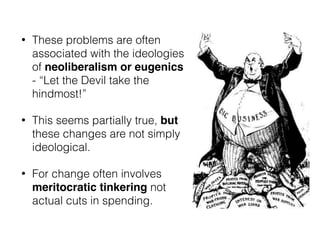
• These problems are often
associated with the ideologies
of neoliberalism or eugenics
- “Let the Devil take the
hindmost!”
• This seems partially true, but
these changes are not simply
ideological.
• For change often involves
meritocratic tinkering not
actual cuts in spending.
• Benefits are distributed to groups with good advocacy or voter
impact e.g. disabled people vs. pensioners
• Blame shifted to scapegoat groups e.g. immigrants vs. bankers
• Universal services protected e.g. social care vs. NHS
• Self-serving influence of commercial interests e.g. think tanks
funding
• Some services are more powerfully defended e.g. BMA vs. LGA
• Hubris of politicians trying to make an impact e.g. every ‘reform’ of
the NHS
• Attempts to buy the swing voter e.g real marginal tax rate
Other explanations include…
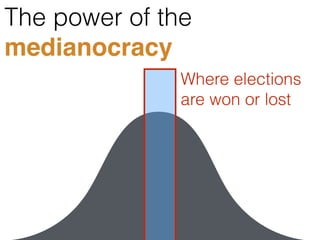
The power of the
medianocracy
Where elections

are won or lost
The welfare state is a
good thing, it’s just
designed wrong…
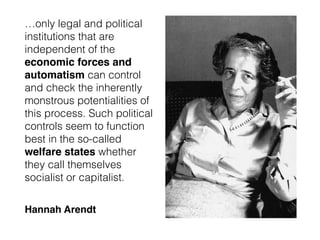
…only legal and political
institutions that are
independent of the
economic forces and
automatism can control
and check the inherently
monstrous potentialities of
this process. Such political
controls seem to function
best in the so-called
welfare states whether
they call themselves
socialist or capitalist.
Hannah Arendt
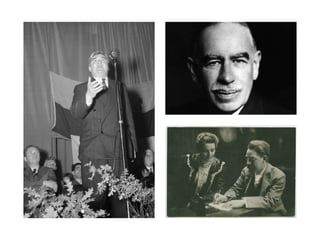
• The welfare state emerged as a response to the
crises that led to World War II and the Holocaust
• In the UK its designers were led by Fabians,
reformist liberals and socialists, like Keynes,
Beveridge, the Webbs and Bevan
• There was great confidence in the benign role of
the state to balance the injustices of the free
market
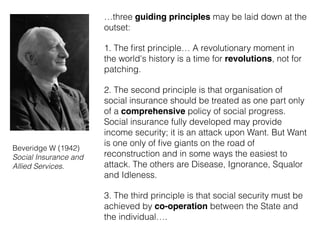
…three guiding principles may be laid down at the
outset:
1. The first principle… A revolutionary moment in
the world's history is a time for revolutions, not for
patching.
2. The second principle is that organisation of
social insurance should be treated as one part only
of a comprehensive policy of social progress.
Social insurance fully developed may provide
income security; it is an attack upon Want. But Want
is one only of five giants on the road of
reconstruction and in some ways the easiest to
attack. The others are Disease, Ignorance, Squalor
and Idleness.
3. The third principle is that social security must be
achieved by co-operation between the State and
the individual….
Beveridge W (1942)
Social Insurance and
Allied Services.
• They believed the state would be rational and that
democratic control would be sufficient to ensure
the positive development of the welfare state.
• There was also a powerful assumptions that an
intellectual elite could be trusted to solve social
problems.
• “We have little faith in the 'average sensual man',
we do not believe that he can do more than
describe his grievances, we do not think he can
prescribe the remedies.” [Beatrice Webb]
but there was an
alternative vision
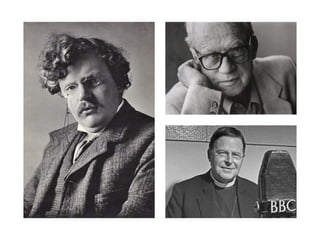
• The design of the welfare state reflected the spirit of the
times and assumptions of dominant intellectuals, yet
there were other strands of progressive thought.
• G K Chesterton and the Catholic church advocated
distributism and subsidiarity - less centralised
approaches to social justice.
• Archbishop Temple, who coined the term ‘welfare state’,
advocated an approach which made love and human
development central.
• Michael Young warned the Left of the dangers of
‘meritocracy’ and the advocated equality and creativity.
“Today we frankly recognise that
democracy can be no more than
an aspiration, and have rule not
so much by the people as by
the cleverest people; not an
aristocracy of birth, not a
plutocracy of wealth, but a true
meritocracy of talent.” [1958]
Yesterday’s satire feels
like today’s tragedy
and there are places where
this alternative vision of
welfare flickers into life
I. Citizenship is Key
• Prevention - e.g. Local Area Coordination
• Personal budgets and direct payments - e.g.
Inclusion Glasgow
• Peer support - e.g. PFG Doncaster
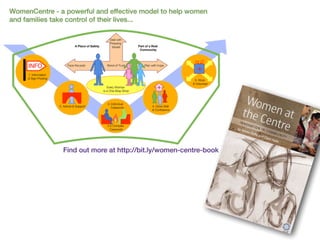
• Family-focused work - e.g. WomenCentre
• Place-based approaches e.g. C2 Community
Development
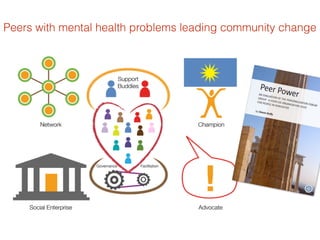
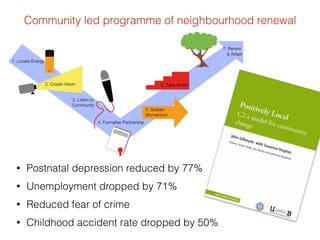
Peers with mental health problems leading community change
• Postnatal depression reduced by 77%
• Unemployment dropped by 71%
• Reduced fear of crime
• Childhood accident rate dropped by 50%
Community led programme of neighbourhood renewal
II. Heading Upstream
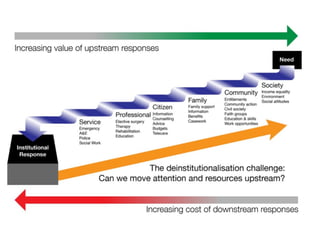
• We need to move our attention upstream - beyond
services, treatments and institutions
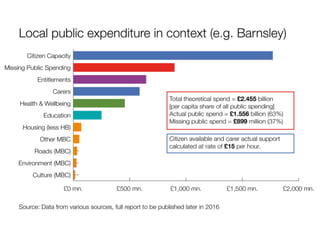
• Local government can play a critical leadership
e.g changing governance in Barnsley
• This will require a change in our thinking about own
roles - a need for humility
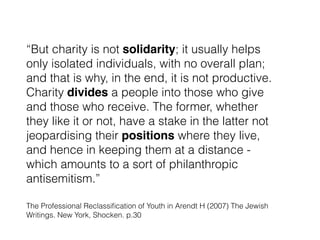
The Professional Reclassification of Youth in Arendt H (2007) The Jewish
Writings. New York, Shocken. p.30
“But charity is not solidarity; it usually helps
only isolated individuals, with no overall plan;
and that is why, in the end, it is not productive.
Charity divides a people into those who give
and those who receive. The former, whether
they like it or not, have a stake in the latter not
jeopardising their positions where they live,
and hence in keeping them at a distance -
which amounts to a sort of philanthropic
antisemitism.”
III. A New Vision
• Our challenge is to redesign the welfare state from
within
• To make the case for constitutional change, and
• To reflect on our own roles within this process
The problems of life are insoluble on the surface… Getting hold of the
difficulty deep down is what is hard. Because if it is grasped near the
surface it simply remains the difficulty it was. It has to be pulled out by the
roots; and that involves us beginning to think about things in a new way… If
we clothe ourselves in a new form of expression, the old problems are
discarded along with the old garment. [Wittgenstein]
Lao Tzu
True leaders
are hardly known to their followers.
Next after them are the leaders
people know and admire;
after them, those they fear;
after them, those they despise.
To give no trust
is to get no trust.
When the work's done right,
with no fuss or boasting,
ordinary people say,
Oh, we did it.
FIND OUT MORE:
www.centreforwelfarereform.org
@CforWR @simonjduffy
https://www.facebook.com/centreforwelfarereform

The Welfare State and its Citizens

  • 1.
    The Welfare State and its 
 Citizens DrSimon Duffy of the Centre for Welfare Reform on behalf of Leadership for Change
  • 2.
    • How canwe enable citizens to play an active role in their communities? • What is the proper role of local government and public services in the future? • What is our positive vision for the future for society and the welfare state?
  • 3.
    What’s going wrong? •Shrinking state hypothesis - we can no longer afford the welfare state - FALSE • Paternalistic design hypothesis - we need to design a pro-citizenship welfare state - TRUE
  • 4.
    There is noevidence that the welfare state is unaffordable. We have spent roughly the same amount of GDP on the welfare state for over 50 years.
  • 6.
    What has changedis our commitment to equality and justice. Inequality has nearly doubled in a generation.
  • 9.
    We now spendmuch less on redistribution but spend much more on services.
  • 11.
    These trends seemparticularly severe in the UK where we have pulled off the unenviable trick of being (a) the most unequal country in Europe (b) very hard working and (c) very unproductive. [In economic terms it seems that our policy of shrinking wages and benefits has had the perverse impact of making labour cheap and so discouraging investments to increase efficiency.]
  • 13.
    Since the bankingcrisis and 2010 election things have got even worse.
  • 20.
    The Committee isseriously concerned about the disproportionate adverse impact that austerity measures, introduced since 2010, are having on the enjoyment of economic, social and cultural rights by disadvantaged and marginalised individuals and groups. The Committee is concerned that the State party has not undertaken a comprehensive assessment of the cumulative impact of such measures on the realisation of economic, social and cultural rights, in a way that is recognised by civil society and national independent monitoring mechanisms (art. 2, para. 1). UN Committee on Economic, Social and Cultural Rights: Concluding observations on the sixth periodic report of 
 the United Kingdom of Great Britain and Northern Ireland
 24 June 2016 UN declares UK Government fails to respect human rights
  • 21.
    • These problemsare often associated with the ideologies of neoliberalism or eugenics - “Let the Devil take the hindmost!” • This seems partially true, but these changes are not simply ideological. • For change often involves meritocratic tinkering not actual cuts in spending.
  • 22.
    • Benefits aredistributed to groups with good advocacy or voter impact e.g. disabled people vs. pensioners • Blame shifted to scapegoat groups e.g. immigrants vs. bankers • Universal services protected e.g. social care vs. NHS • Self-serving influence of commercial interests e.g. think tanks funding • Some services are more powerfully defended e.g. BMA vs. LGA • Hubris of politicians trying to make an impact e.g. every ‘reform’ of the NHS • Attempts to buy the swing voter e.g real marginal tax rate Other explanations include…
  • 23.
    The power ofthe medianocracy Where elections
 are won or lost
  • 24.
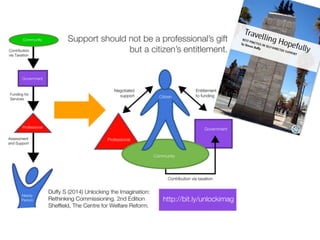
    The welfare stateis a good thing, it’s just designed wrong…
  • 25.
    …only legal andpolitical institutions that are independent of the economic forces and automatism can control and check the inherently monstrous potentialities of this process. Such political controls seem to function best in the so-called welfare states whether they call themselves socialist or capitalist. Hannah Arendt
  • 27.
    • The welfarestate emerged as a response to the crises that led to World War II and the Holocaust • In the UK its designers were led by Fabians, reformist liberals and socialists, like Keynes, Beveridge, the Webbs and Bevan • There was great confidence in the benign role of the state to balance the injustices of the free market
  • 28.
    …three guiding principlesmay be laid down at the outset: 1. The first principle… A revolutionary moment in the world's history is a time for revolutions, not for patching. 2. The second principle is that organisation of social insurance should be treated as one part only of a comprehensive policy of social progress. Social insurance fully developed may provide income security; it is an attack upon Want. But Want is one only of five giants on the road of reconstruction and in some ways the easiest to attack. The others are Disease, Ignorance, Squalor and Idleness. 3. The third principle is that social security must be achieved by co-operation between the State and the individual…. Beveridge W (1942) Social Insurance and Allied Services.
  • 29.
    • They believedthe state would be rational and that democratic control would be sufficient to ensure the positive development of the welfare state. • There was also a powerful assumptions that an intellectual elite could be trusted to solve social problems. • “We have little faith in the 'average sensual man', we do not believe that he can do more than describe his grievances, we do not think he can prescribe the remedies.” [Beatrice Webb]
  • 30.
    but there wasan alternative vision
  • 32.
    • The designof the welfare state reflected the spirit of the times and assumptions of dominant intellectuals, yet there were other strands of progressive thought. • G K Chesterton and the Catholic church advocated distributism and subsidiarity - less centralised approaches to social justice. • Archbishop Temple, who coined the term ‘welfare state’, advocated an approach which made love and human development central. • Michael Young warned the Left of the dangers of ‘meritocracy’ and the advocated equality and creativity.
  • 33.
    “Today we franklyrecognise that democracy can be no more than an aspiration, and have rule not so much by the people as by the cleverest people; not an aristocracy of birth, not a plutocracy of wealth, but a true meritocracy of talent.” [1958] Yesterday’s satire feels like today’s tragedy
  • 34.
    and there areplaces where this alternative vision of welfare flickers into life
  • 35.
  • 36.
    • Prevention -e.g. Local Area Coordination • Personal budgets and direct payments - e.g. Inclusion Glasgow • Peer support - e.g. PFG Doncaster • Family-focused work - e.g. WomenCentre • Place-based approaches e.g. C2 Community Development
  • 39.
    Peers with mentalhealth problems leading community change
  • 41.
    • Postnatal depressionreduced by 77% • Unemployment dropped by 71% • Reduced fear of crime • Childhood accident rate dropped by 50% Community led programme of neighbourhood renewal
  • 42.
  • 43.
    • We needto move our attention upstream - beyond services, treatments and institutions • Local government can play a critical leadership e.g changing governance in Barnsley • This will require a change in our thinking about own roles - a need for humility
  • 46.
    The Professional Reclassificationof Youth in Arendt H (2007) The Jewish Writings. New York, Shocken. p.30 “But charity is not solidarity; it usually helps only isolated individuals, with no overall plan; and that is why, in the end, it is not productive. Charity divides a people into those who give and those who receive. The former, whether they like it or not, have a stake in the latter not jeopardising their positions where they live, and hence in keeping them at a distance - which amounts to a sort of philanthropic antisemitism.”
  • 47.
    III. A NewVision
  • 48.
    • Our challengeis to redesign the welfare state from within • To make the case for constitutional change, and • To reflect on our own roles within this process
  • 49.
    The problems oflife are insoluble on the surface… Getting hold of the difficulty deep down is what is hard. Because if it is grasped near the surface it simply remains the difficulty it was. It has to be pulled out by the roots; and that involves us beginning to think about things in a new way… If we clothe ourselves in a new form of expression, the old problems are discarded along with the old garment. [Wittgenstein]
  • 52.
    Lao Tzu True leaders arehardly known to their followers. Next after them are the leaders people know and admire; after them, those they fear; after them, those they despise. To give no trust is to get no trust. When the work's done right, with no fuss or boasting, ordinary people say, Oh, we did it.
  • 53.
    FIND OUT MORE: www.centreforwelfarereform.org @CforWR@simonjduffy https://www.facebook.com/centreforwelfarereform