Rembrandt van Rijn


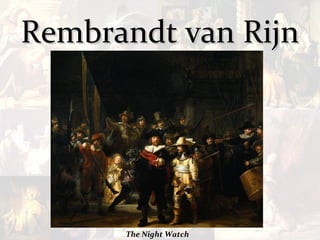
      The Night Watch
Background
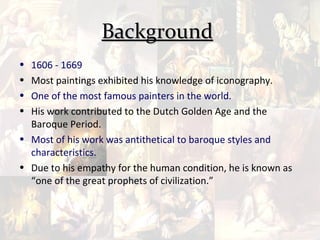
• 1606 - 1669
• Most paintings exhibited his knowledge of iconography.
• One of the most famous painters in the world.
• His work contributed to the Dutch Golden Age and the
  Baroque Period.
• Most of his work was antithetical to baroque styles and
  characteristics.
• Due to his empathy for the human condition, he is known as
  “one of the great prophets of civilization.”
Works


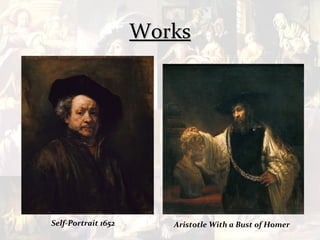
Self-Portrait 1652      Aristotle With a Bust of Homer
Works


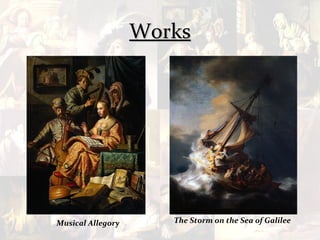
Musical Allegory      The Storm on the Sea of Galilee
Works


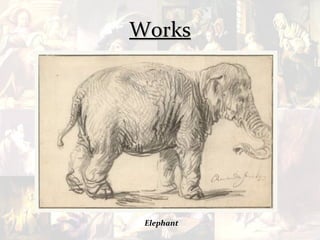
 Elephant
Characteristics
1. Visual Aspects

 - optical theory (stereo blindness)
 - strong contrasts of light and shadow
 - rich colors and strong brushstrokes
 - smooth painting style in his early career
 - rough painting style toward the end of his career
 - left large areas of white to suggest space
 - evidence of well handling of light
 - great variety of paint application
Characteristics
2. Thematic aspects

 - typical kinds of paintings for his day
 - natural drama & quiet Dutch rural scenes (etchings)
 - style similar to Titian toward the end of his life
 - strong Biblical themes
  ^shifted from group scenes to reflective portraits
 - strong Greco-Roman mythical themes
  ^mostly portraits as opposed to group scenes
 - coarse painting style
  ^frowned upon by critics
  ^even dissuaded viewers from looking too closely
Leo Yang
L. Greenburg
   Art 103
 12.06.2012

Rembrandt van rijn

  • 1.
    Rembrandt van Rijn The Night Watch
  • 2.
    Background • 1606 -1669 • Most paintings exhibited his knowledge of iconography. • One of the most famous painters in the world. • His work contributed to the Dutch Golden Age and the Baroque Period. • Most of his work was antithetical to baroque styles and characteristics. • Due to his empathy for the human condition, he is known as “one of the great prophets of civilization.”
  • 3.
    Works Self-Portrait 1652 Aristotle With a Bust of Homer
  • 4.
    Works Musical Allegory The Storm on the Sea of Galilee
  • 5.
  • 6.
    Characteristics 1. Visual Aspects - optical theory (stereo blindness) - strong contrasts of light and shadow - rich colors and strong brushstrokes - smooth painting style in his early career - rough painting style toward the end of his career - left large areas of white to suggest space - evidence of well handling of light - great variety of paint application
  • 7.
    Characteristics 2. Thematic aspects - typical kinds of paintings for his day - natural drama & quiet Dutch rural scenes (etchings) - style similar to Titian toward the end of his life - strong Biblical themes ^shifted from group scenes to reflective portraits - strong Greco-Roman mythical themes ^mostly portraits as opposed to group scenes - coarse painting style ^frowned upon by critics ^even dissuaded viewers from looking too closely
  • 8.
    Leo Yang L. Greenburg Art 103 12.06.2012