Lesson 4 REP: Annotated BibliographyMaterial for the presentation comes from G124/Enc1101 © Rasmussen CollegeAdapted from material developed by:Teresa Marie Kelly, MATG124Rasmussen College Online
Lesson  4: Annotated BibliographyThe annotated bibliography is a discovery tool used by a reader or researcher to learn about resources on a topic with which they may be otherwise unfamiliar. An annotated bibliography has two distinct parts, although they are combined in the actual document.
What is a bibliography?The bibliography part is a list of citations of your resources. A citation provides the information necessary to locate the work. APA editorial style guidelines dictate both the types of information required for a citation and the order and formatting of that information within the citation itself.
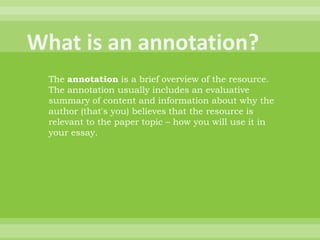
What is an annotation?The annotation is a brief overview of the resource. The annotation usually includes an evaluative summary of content and information about why the author (that's you) believes that the resource is relevant to the paper topic – how you will use it in your essay.
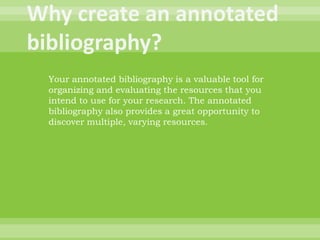
Why create an annotated bibliography?Your annotated bibliography is a valuable tool for organizing and evaluating the resources that you intend to use for your research. The annotated bibliography also provides a great opportunity to discover multiple, varying resources.
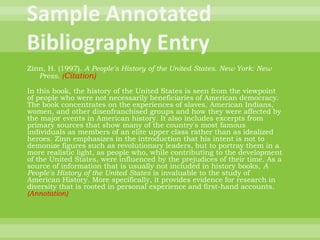
Sample Annotated Bibliography EntryZinn, H. (1997). A People's History of the United States. New York: New Press. (Citation)In this book, the history of the United States is seen from the viewpoint of people who were not necessarily beneficiaries of American democracy. The book concentrates on the experiences of slaves, American Indians, women, and other disenfranchised groups and how they were affected by the major events in American history. It also includes excerpts from primary sources that show many of the country's most famous individuals as members of an elite upper class rather than as idealized heroes. Zinn emphasizes in the introduction that his intent is not to demonize figures such as revolutionary leaders, but to portray them in a more realistic light, as people who, while contributing to the development of the United States, were influenced by the prejudices of their time. As a source of information that is usually not included in history books, A People's History of the United States is invaluable to the study of American History. More specifically, it provides evidence for research in diversity that is rooted in personal experience and first-hand accounts. (Annotation)
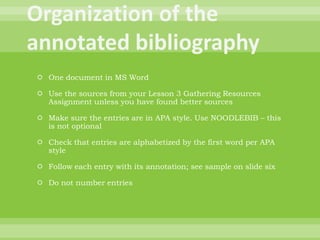
Organization of the annotated bibliographyOne document in MS WordUse the sources from your Lesson 3 Gathering Resources Assignment unless you have found better sourcesMake sure the entries are in APA style. Use NOODLEBIB – this is not optionalCheck that entries are alphabetized by the first word per APA style Follow each entry with its annotation; see sample on slide sixDo not number entries
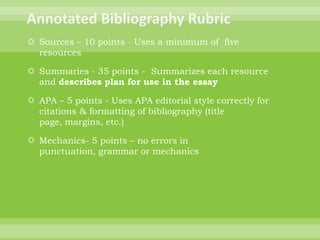
Annotated Bibliography RubricSources – 10 points - Uses a minimum of  five resourcesSummaries - 35 points -  Summarizes each resource and describes plan for use in the essayAPA – 5 points - Uses APA editorial style correctly for citations & formatting of bibliography (title page, margins, etc.)Mechanics- 5 points – no errors in punctuation, grammar or mechanics 

Week 4 annotated bibliography

  • 1.
    Lesson 4 REP:Annotated BibliographyMaterial for the presentation comes from G124/Enc1101 © Rasmussen CollegeAdapted from material developed by:Teresa Marie Kelly, MATG124Rasmussen College Online
  • 2.
    Lesson 4:Annotated BibliographyThe annotated bibliography is a discovery tool used by a reader or researcher to learn about resources on a topic with which they may be otherwise unfamiliar. An annotated bibliography has two distinct parts, although they are combined in the actual document.
  • 3.
    What is abibliography?The bibliography part is a list of citations of your resources. A citation provides the information necessary to locate the work. APA editorial style guidelines dictate both the types of information required for a citation and the order and formatting of that information within the citation itself.
  • 4.
    What is anannotation?The annotation is a brief overview of the resource. The annotation usually includes an evaluative summary of content and information about why the author (that's you) believes that the resource is relevant to the paper topic – how you will use it in your essay.
  • 5.
    Why create anannotated bibliography?Your annotated bibliography is a valuable tool for organizing and evaluating the resources that you intend to use for your research. The annotated bibliography also provides a great opportunity to discover multiple, varying resources.
  • 6.
    Sample Annotated BibliographyEntryZinn, H. (1997). A People's History of the United States. New York: New Press. (Citation)In this book, the history of the United States is seen from the viewpoint of people who were not necessarily beneficiaries of American democracy. The book concentrates on the experiences of slaves, American Indians, women, and other disenfranchised groups and how they were affected by the major events in American history. It also includes excerpts from primary sources that show many of the country's most famous individuals as members of an elite upper class rather than as idealized heroes. Zinn emphasizes in the introduction that his intent is not to demonize figures such as revolutionary leaders, but to portray them in a more realistic light, as people who, while contributing to the development of the United States, were influenced by the prejudices of their time. As a source of information that is usually not included in history books, A People's History of the United States is invaluable to the study of American History. More specifically, it provides evidence for research in diversity that is rooted in personal experience and first-hand accounts. (Annotation)
  • 7.
    Organization of theannotated bibliographyOne document in MS WordUse the sources from your Lesson 3 Gathering Resources Assignment unless you have found better sourcesMake sure the entries are in APA style. Use NOODLEBIB – this is not optionalCheck that entries are alphabetized by the first word per APA style Follow each entry with its annotation; see sample on slide sixDo not number entries
  • 8.
    Annotated Bibliography RubricSources– 10 points - Uses a minimum of five resourcesSummaries - 35 points - Summarizes each resource and describes plan for use in the essayAPA – 5 points - Uses APA editorial style correctly for citations & formatting of bibliography (title page, margins, etc.)Mechanics- 5 points – no errors in punctuation, grammar or mechanics