Primary Sources in the Social Studies Classroom Glenn Wiebe ESSDACK [email_address]
 
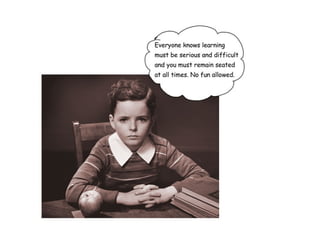
Sticky ideas
Big ideas Primary sources encourage high levels of learning
Lots of resources & activities exist for teachers to use
Using technology is important as part of instruction
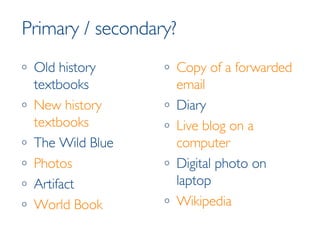
Primary / secondary? Old history textbooks New history textbooks The Wild Blue Photos Artifact World Book Copy of a forwarded email Diary Live blog on a computer Digital photo on laptop Wikipedia
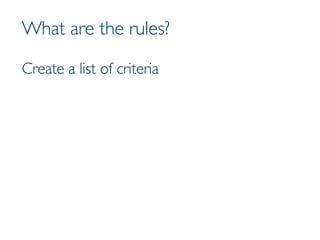
What are the rules?  Create a list of criteria
Criteria?
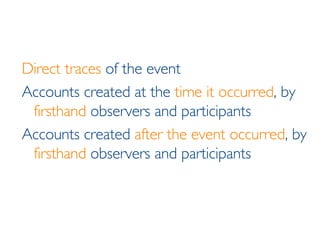
Direct traces  of the event Accounts created at the  time it occurred , by  firsthand  observers and participants Accounts created  after the event occurred , by  firsthand  observers and participants
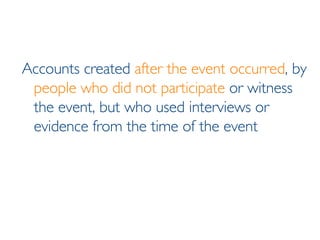
Accounts created  after the event occurred , by  people who did not participate  or witness the event, but who used interviews or evidence from the time of the event
Do you need to change any of your dots?
Definitions? What are  primary sources? Contemporary accounts of an event, created by someone who experienced or witnessed the event in question “a first-hand account of an event, person, or place”  (Kansas State Standards)
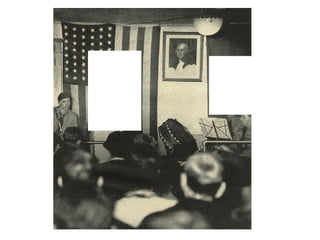
What are  secondary sources? Materials that interpret, assign value to, conjecture upon, and draw conclusions about the events reported in primary sources “An account of an event, person, or place that is not first-hand” (Kansas State Standards)
Tertiary sources? Materials that list, compile, digest, or index primary and / or secondary sources
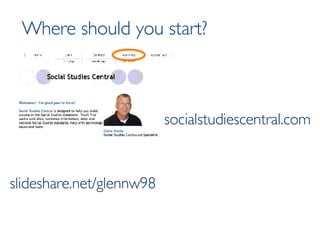
Where should you start? socialstudiescentral.com slideshare.net/glennw98
Three stage media analysis See Sims & Differences Why
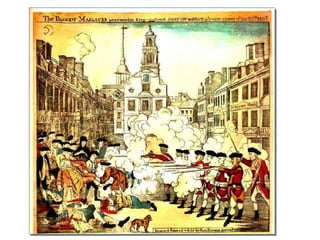
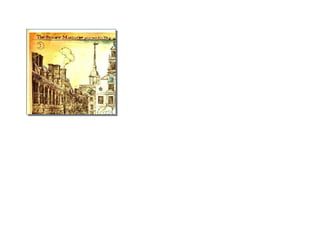
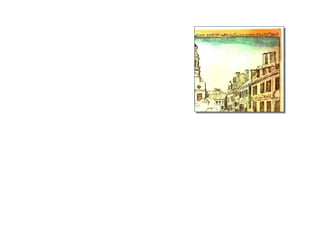
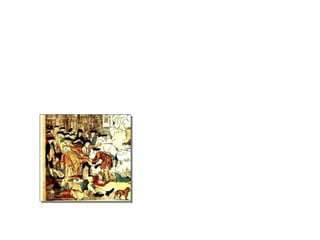
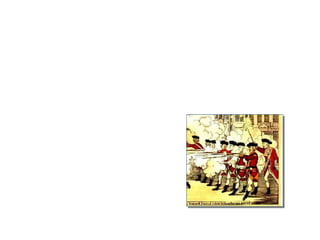
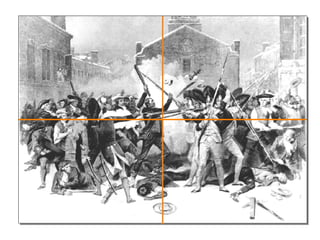
Three stage media analysis Boston Massacre


Paul Revere 1770 Alonzo Chappel 1868
Training kids to analyze “ What really happened  in Boston on March 5, 1770?”
Who 1st / 2nd / 3rd person? 5 W’s and credibility
What format?
Why audience?
Where on-site?
When written / created?
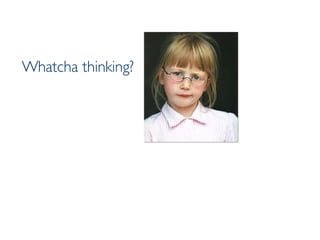
Whatcha thinking?
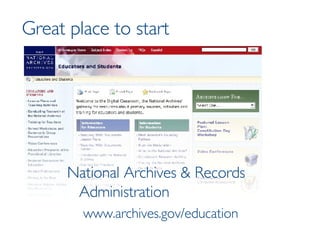
Great place to start National Archives & Records Administration www.archives.gov/education
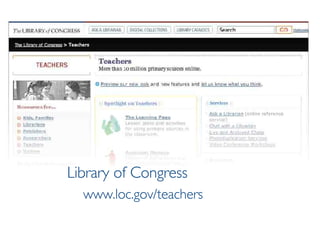
Library of Congress www.loc.gov/teachers
Our Documents www.ourdocuments.gov
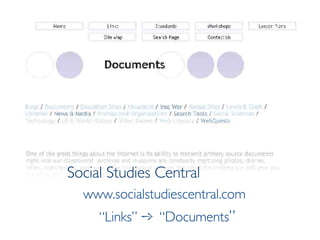
Social Studies Central www.socialstudiescentral.com “ Links”    “Documents ”
Browse  through lesson plan archives Select  a lesson you can adapt How might it look different?
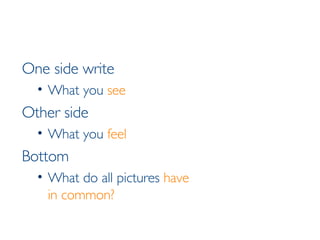
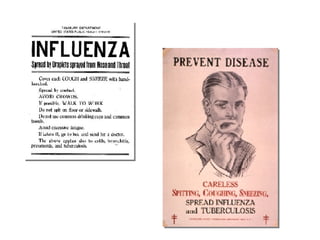
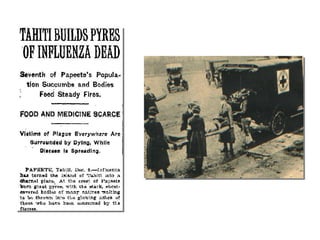
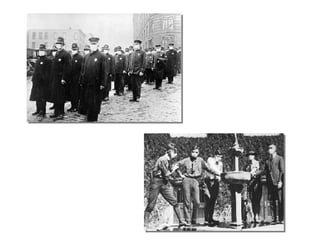
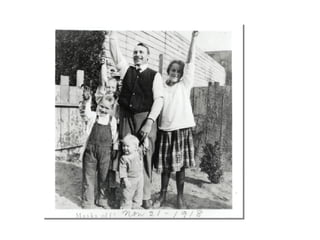
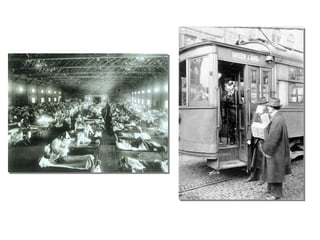
One side write What you  see Other side What you  feel Bottom What do all pictures  have in common?


Masks off!
See
Feel
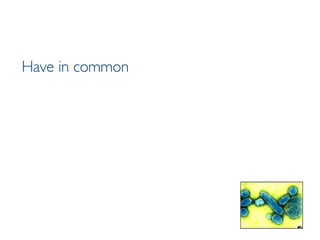
Have in common
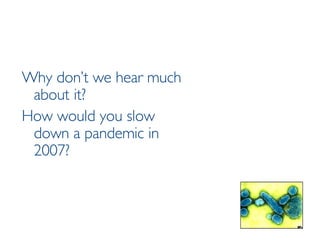
Why don’t we hear much about it? How would you slow down a pandemic in 2007?
Problems / Myths?
Problems? Time  in planning Time  in class Validity  of source Training  of teacher and students Reading level  of students
Myths? Jigsaw: “Primary Sources in History: Breaking Through the Myths”
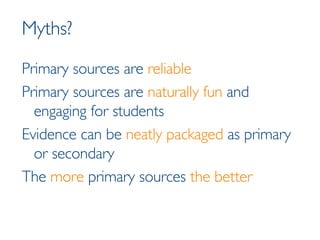
Myths? Primary sources are  reliable Primary sources are  naturally fun  and engaging for students Evidence can be  neatly packaged  as primary or secondary The  more  primary sources  the better
Why primary sources?
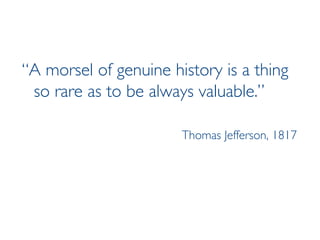
“ A morsel of genuine history is a thing so rare as to be always valuable.” Thomas Jefferson, 1817
Why primary sources? It’s in the  state standards www.ksde.org Yeah, but . . .
Students develop critical thinking skills Primary sources are 3rd story stuff Kids must make own conclusions
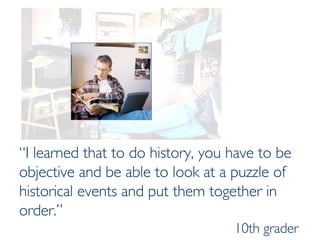
“ I learned that to do history, you have to be objective and be able to look at a puzzle of historical events and put them together in order.”   10th grader
Students acquire empathy for the human condition See history as events that happen to actual people
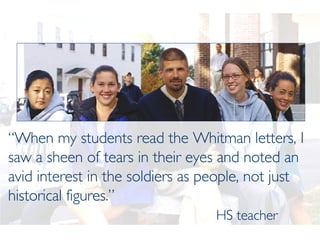
“ When my students read the Whitman letters, I saw a sheen of tears in their eyes and noted an avid interest in the soldiers as people, not just historical figures.”   HS teacher
Students consider different points of view Must move from making observations to making inferences Realize that both creation & interpretation is biased
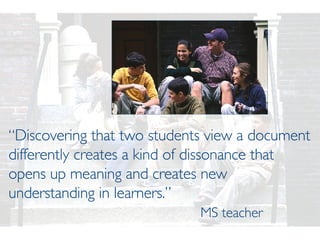
“ Discovering that two students view a document differently creates a kind of dissonance that opens up meaning and creates new understanding in learners.”   MS teacher
Students understand the continuum of history See cause and effect / time / place / people relationships over time
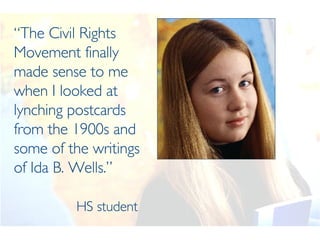
“ The Civil Rights Movement finally made sense to me when I looked at lynching postcards from the 1900s and some of the writings of Ida B. Wells.”   HS student
Basic assumptions  History is  incomplete & open to interpretation Use   raw evidence  as much as possible Activity should be  “ill structured” Don’t  get too involved
Use   provocative  problems Provide  scaffolding Incorporate  collaboration The  process is the key  / not the “correct” answer
Give One to Get One   Your best lesson / resource?
What do you  already do?    Check  off those things that you have done or are already doing
What  will you do? Circle or  highlight  those things that you might want to try
What can be  changed? Underline  those things that would need to be adapted
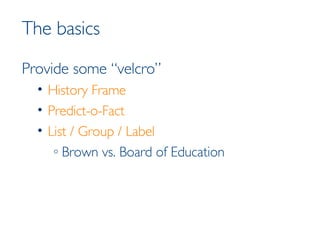
The basics Provide some “velcro” History Frame Predict-o-Fact List / Group / Label  Brown vs. Board of Education
Use  analysis worksheets Use  NARA / LOC  kits NCSS  lesson plans
Use  analysis worksheets
Technology suggestions Use  Google Earth Kids create tour of US import countries Tours of explorer routes List of natural resources Provide placemarks / good area to settle? City scavenger hunts
Resources: <www.shambles.net/pages/learning/GeogP/ gearthplan> <bbs.keyhole.com> <gelessons.com> <www.teachinghacks.com/wiki>
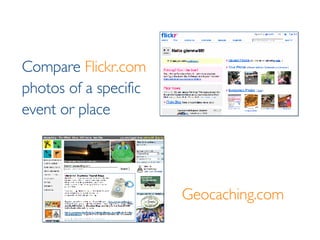
Compare  Flickr.com   photos of a specific  event or place Geocaching.com
Use  spreadsheet program   slaves per colony USSR vs. US casualties during WWII
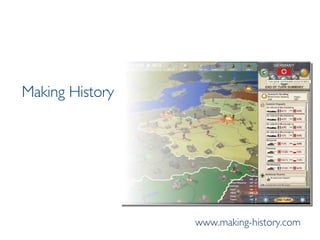
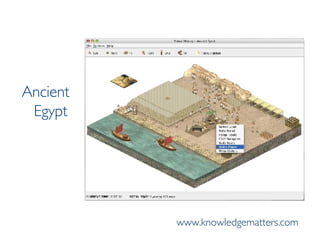
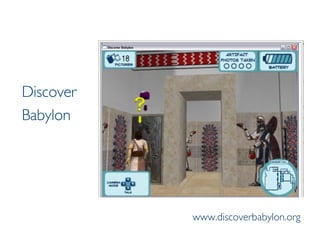
Play  video games
Making History www.making-history.com
Ancient Egypt www.knowledgematters.com
Discover Babylon www.discoverbabylon.org
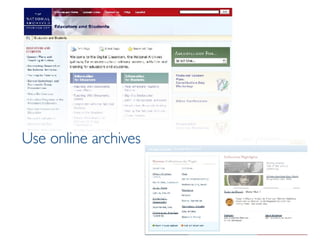
Use online archives
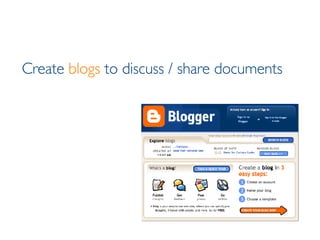
Create  blogs  to discuss / share documents
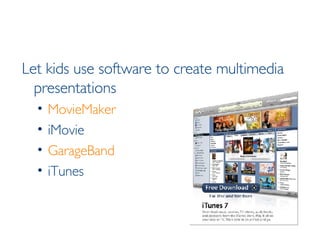
Let kids use software to create multimedia presentations MovieMaker iMovie GarageBand iTunes
Online activities Who Killed William Robinson? You are the Historian Social Studies Central Lesson Plans <www.socialstudiescentral.com>
Technology What do you do?
Objects Use old photos to trace the development of specific  types of technology or inventions Predict what the technology might look like 50 or 100 years from now
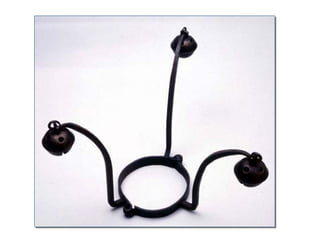
Objects Use a spreadsheet program to document deaths and births based on  tombstone data Predict use of  unknown object  / research and present findings
 
Objects Kiel Hileman 2004 Kansas teacher of the year Keil's room See handout
Objects What do you do?
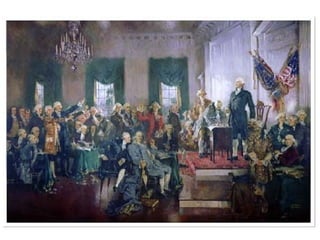
Images Select a  historical photo  / have kids predict what was happening one hour before or after it was taken Have kids use  fine art  to reveal info about artist, time period, attitudes of the period
Images Compare  Hollywood movies  with actual events Use  visual DEIs  (Discrepant Event Inquiry) to engage kids


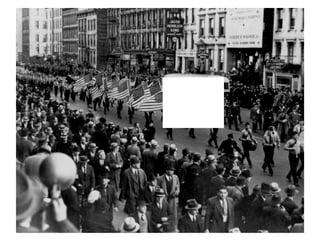
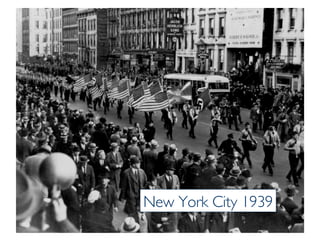
New York City 1939


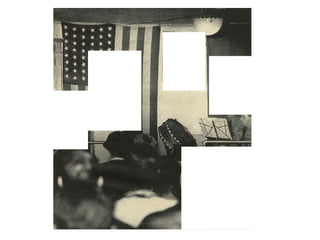
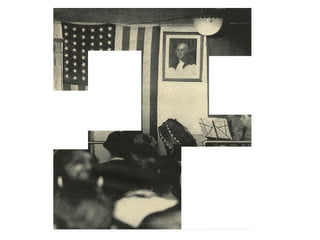
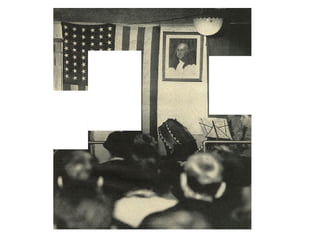
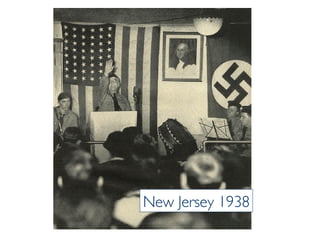
New Jersey 1938
“ Backwards” DEI Student stands facing class Project picture on wall Student must ask the questions
 
Images What do you do?
Audio Record  oral interviews  with family or community members Study  lyrics of popular music  from WWI, WWII, the Vietnam War, and Iraq Compare with interviews with vets
Audio Compare transcripts or newspaper accounts of  famous speeches  to the actual speech www.newspaperarchive.org
Use music with images to create an emotional engagement Civil War Photos
Audio What do you do?
Statistics Study historical  maps  of city or region /  document evidence of change Use  census  data to  predict future problems  facing community
Statistics Contrast  present sports to past Who was better? Why? Baseball cards / Madden 2007? Research  blueprints  of public building What changes  have been made and why?
Statistics What do you do?
Text Use  newspapers/magazines to analyze advertising  of specific product over time Select  cookbooks  from different periods  Read  letters  to analyze point of view
“ Famous”  quotes
Text What do you do?
Assessment?
Document Based Questions  (DBQs) A  series of short answers or an essay  based on prior knowledge and a select set of documents Designed to enable students to  work like historians For  all levels Formative  or  summative
Was Christopher Columbus good or bad?
Assess whether or not imperialism helped or harmed colonial societies.
When? Where? What?


Perhaps more important . . .  So what?
 
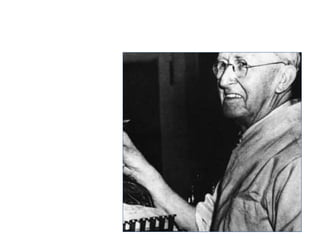
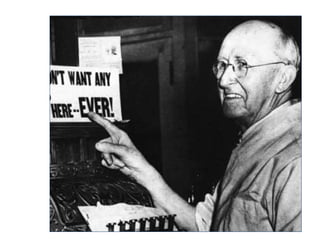
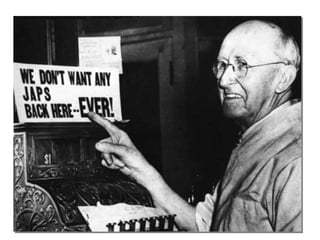
What cost security? Guiding question “Is it ever okay for the government to violate the Bill of Rights?”
Documents & white gloves &quot;Conference with General De Witt&quot; at Office of Commanding General, Headquarters Western Defense Command and Fourth Army; January 4, 1942 Executive Order 9066 Exclusion Order and exclusion area Photographs of internment process / camps
Complete  student response sheet Use photo & document analysis sheets Complete  History Frame graphic organizer  to summarize your work
Using evidence  from the WWII Japanese American experience and contemporary documents,  defend or refute the following statement: “Descendants of those interned during WWII should be entitled to financial compensation from the federal government.”
Or . . . using evidence  from the WWII Japanese American experience and contemporary documents,  complete the following task: “Make a scale drawing of an 8´ x 20´ room. Put furnishings drawn to scale for your own family (beds, closets, chests, etc.) in the drawing”
Or . . . using evidence  from the WWII Japanese American experience and contemporary documents,  complete the following task: “Pretend your best friend had to go to the internment camp. Write a letter to that friend”
What would you change?
Create your own Using the Library of Congress framework,  begin developing  your own primary sources activity Be sure to use the Three Story Intellect Start with the  end in mind Develop an  assessment   Create the  activity
Where should you end? slideshare.net/glennw98
Sticky ideas?
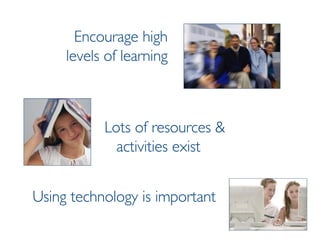
Encourage high levels of learning Lots of resources & activities exist Using technology is important
Web resources Social Studies Central <www.socialstudiescentral.com> Click “Links” then “Documents” NARA Digital Classroom <www.archives.gov/education>   Library of Congress American Memory <memory.loc.gov/learn>
Our Documents <www.ourdocuments.gov>   America’s Library <www.americaslibrary.org> Authentic History Center <authentic history.com>
Reading Quest: Making Sense in Social Studies <www.readingquest.org>   National Council for the Social Studies <www.socialstudies.org> Marco Polo <marcopolo-education.org>
Edsitement  <edsitement.neh.gov> History Matters!   <historymatters.gmu.edu> Kansas Educational Resource Center <www.kerc-ks.org>
Language Strategies for Social Science <www.stanford.edu/group/step/resources/ LanguageSite/History_Strategies.html> Digital History <www.digitalhistory.uh.edu> Smithsonian Institute <www.smithsonianeducation.org/ educators>
Internet History Sourcebook Project <www.fordham.edu/halsall> National Park Service / Links to the Past <www.cr.nps.gov> Using Primary Sources with Teachers <www.whyy.org/generations/primary.html>
Center for History and the New Media <chnm.gmu.edu> Teaching History with Technology <www.thwt.org> Best of History Web Sites <www.besthistorysites.net>
Print resources Kobrin, David. (1996)  Beyond the Textbook: Teaching History Using Documents & Primary Sources .  Portsmouth, New Hampshire: Heinemann.  Lewin, Larry; Betty Jean Shoemaker. (1998)  Great Performances: Creating Classroom-Based Assessment Tasks .  Alexandria, Virginia: Association of Supervision and Curriculum Development.
Lindquist, Tarry. (1997)  Ways That Work: Putting Social Studies Standards into Practice .  Portsmouth, New Hampshire: Heinemann. Steffey, Stephanie; Wendy Hood. (1994)  If This is Social Studies, Why isn’t it Boring?   York, Maine: Stenhouse Publishers.
Zemelman, Steven, et al. (1998)  Best Practice: New Standards for Teaching & Learning in America’s Schools .  Portsmouth, New Hampshire: Heinemann. Zull, James. (2002)  The Art of Changing the Brain.  Sterling, VA. Stylus Publishing.
Fischer, Max W. (1993)  American History Simulations .  Westminster, CA: Teacher Created Materials. Levstick, Linda, Barton, Keith. (2001)  Doing History: Investigating with Children in Elementary & Middle Schools .  Mahwah, NJ: Lawrence Erlbaum Associates.
Irvin, Judith (2002)  Reading Strategies for the Social Studies Classroom.  Holt, Rinehart and Winston.
Citation of resources Citing Electronic Information in History Papers <cas.memphis.edu/~mcrouse/elcite.html> Columbia Guide to Online Style <www.columbia.edu/cu/cup/cgos/idx_basic.html> Online! A Reference Guide to Using Internet Resources <www.bedfordstmartins.com/online/index.html>
Research and Documentation Online <www.dianahacker.com/resdoc> Sources: Their Use and Acknowledgement <www.dartmouth.edu/~sources> Easy Bib <easybib.com> Notestar <notestar.4teachers.org>

Primary Sources 2007

  • 1.
    Primary Sources inthe Social Studies Classroom Glenn Wiebe ESSDACK [email_address]
  • 2.
  • 3.
  • 4.
    Big ideas Primarysources encourage high levels of learning
  • 5.
    Lots of resources& activities exist for teachers to use
  • 6.
    Using technology isimportant as part of instruction
  • 7.
    Primary / secondary?Old history textbooks New history textbooks The Wild Blue Photos Artifact World Book Copy of a forwarded email Diary Live blog on a computer Digital photo on laptop Wikipedia
  • 8.
    What are therules? Create a list of criteria
  • 9.
  • 10.
    Direct traces of the event Accounts created at the time it occurred , by firsthand observers and participants Accounts created after the event occurred , by firsthand observers and participants
  • 11.
    Accounts created after the event occurred , by people who did not participate or witness the event, but who used interviews or evidence from the time of the event
  • 12.
    Do you needto change any of your dots?
  • 13.
    Definitions? What are primary sources? Contemporary accounts of an event, created by someone who experienced or witnessed the event in question “a first-hand account of an event, person, or place” (Kansas State Standards)
  • 14.
    What are secondary sources? Materials that interpret, assign value to, conjecture upon, and draw conclusions about the events reported in primary sources “An account of an event, person, or place that is not first-hand” (Kansas State Standards)
  • 15.
    Tertiary sources? Materialsthat list, compile, digest, or index primary and / or secondary sources
  • 16.
    Where should youstart? socialstudiescentral.com slideshare.net/glennw98
  • 17.
    Three stage mediaanalysis See Sims & Differences Why
  • 18.
    Three stage mediaanalysis Boston Massacre
  • 19.
  • 20.
  • 21.
  • 22.
  • 23.
  • 24.
  • 25.
    Paul Revere 1770Alonzo Chappel 1868
  • 26.
    Training kids toanalyze “ What really happened in Boston on March 5, 1770?”
  • 27.
    Who 1st /2nd / 3rd person? 5 W’s and credibility
  • 28.
  • 29.
  • 30.
  • 31.
  • 32.
  • 33.
    Great place tostart National Archives & Records Administration www.archives.gov/education
  • 34.
    Library of Congresswww.loc.gov/teachers
  • 35.
  • 36.
    Social Studies Centralwww.socialstudiescentral.com “ Links”  “Documents ”
  • 37.
    Browse throughlesson plan archives Select a lesson you can adapt How might it look different?
  • 38.
    One side writeWhat you see Other side What you feel Bottom What do all pictures have in common?
  • 39.
  • 40.
  • 41.
  • 42.
  • 43.
  • 44.
  • 45.
  • 46.
  • 47.
    Why don’t wehear much about it? How would you slow down a pandemic in 2007?
  • 48.
  • 49.
    Problems? Time in planning Time in class Validity of source Training of teacher and students Reading level of students
  • 50.
    Myths? Jigsaw: “PrimarySources in History: Breaking Through the Myths”
  • 51.
    Myths? Primary sourcesare reliable Primary sources are naturally fun and engaging for students Evidence can be neatly packaged as primary or secondary The more primary sources the better
  • 52.
  • 53.
    “ A morselof genuine history is a thing so rare as to be always valuable.” Thomas Jefferson, 1817
  • 54.
    Why primary sources?It’s in the state standards www.ksde.org Yeah, but . . .
  • 55.
    Students develop criticalthinking skills Primary sources are 3rd story stuff Kids must make own conclusions
  • 56.
    “ I learnedthat to do history, you have to be objective and be able to look at a puzzle of historical events and put them together in order.” 10th grader
  • 57.
    Students acquire empathyfor the human condition See history as events that happen to actual people
  • 58.
    “ When mystudents read the Whitman letters, I saw a sheen of tears in their eyes and noted an avid interest in the soldiers as people, not just historical figures.” HS teacher
  • 59.
    Students consider differentpoints of view Must move from making observations to making inferences Realize that both creation & interpretation is biased
  • 60.
    “ Discovering thattwo students view a document differently creates a kind of dissonance that opens up meaning and creates new understanding in learners.” MS teacher
  • 61.
    Students understand thecontinuum of history See cause and effect / time / place / people relationships over time
  • 62.
    “ The CivilRights Movement finally made sense to me when I looked at lynching postcards from the 1900s and some of the writings of Ida B. Wells.” HS student
  • 63.
    Basic assumptions History is incomplete & open to interpretation Use raw evidence as much as possible Activity should be “ill structured” Don’t get too involved
  • 64.
    Use provocative problems Provide scaffolding Incorporate collaboration The process is the key / not the “correct” answer
  • 65.
    Give One toGet One Your best lesson / resource?
  • 66.
    What do you already do?  Check off those things that you have done or are already doing
  • 67.
    What willyou do? Circle or highlight those things that you might want to try
  • 68.
    What can be changed? Underline those things that would need to be adapted
  • 69.
    The basics Providesome “velcro” History Frame Predict-o-Fact List / Group / Label Brown vs. Board of Education
  • 70.
    Use analysisworksheets Use NARA / LOC kits NCSS lesson plans
  • 71.
    Use analysisworksheets
  • 72.
    Technology suggestions Use Google Earth Kids create tour of US import countries Tours of explorer routes List of natural resources Provide placemarks / good area to settle? City scavenger hunts
  • 73.
    Resources: <www.shambles.net/pages/learning/GeogP/ gearthplan><bbs.keyhole.com> <gelessons.com> <www.teachinghacks.com/wiki>
  • 74.
    Compare Flickr.com photos of a specific event or place Geocaching.com
  • 75.
    Use spreadsheetprogram slaves per colony USSR vs. US casualties during WWII
  • 76.
  • 77.
  • 78.
  • 79.
  • 80.
  • 81.
    Create blogs to discuss / share documents
  • 82.
    Let kids usesoftware to create multimedia presentations MovieMaker iMovie GarageBand iTunes
  • 83.
    Online activities WhoKilled William Robinson? You are the Historian Social Studies Central Lesson Plans <www.socialstudiescentral.com>
  • 84.
  • 85.
    Objects Use oldphotos to trace the development of specific types of technology or inventions Predict what the technology might look like 50 or 100 years from now
  • 86.
    Objects Use aspreadsheet program to document deaths and births based on tombstone data Predict use of unknown object / research and present findings
  • 87.
  • 88.
    Objects Kiel Hileman2004 Kansas teacher of the year Keil's room See handout
  • 89.
  • 90.
    Images Select a historical photo / have kids predict what was happening one hour before or after it was taken Have kids use fine art to reveal info about artist, time period, attitudes of the period
  • 91.
    Images Compare Hollywood movies with actual events Use visual DEIs (Discrepant Event Inquiry) to engage kids
  • 92.
  • 93.
  • 94.
  • 95.
  • 96.
  • 97.
  • 98.
  • 99.
  • 100.
  • 101.
  • 102.
    “ Backwards” DEIStudent stands facing class Project picture on wall Student must ask the questions
  • 103.
  • 104.
  • 105.
    Audio Record oral interviews with family or community members Study lyrics of popular music from WWI, WWII, the Vietnam War, and Iraq Compare with interviews with vets
  • 106.
    Audio Compare transcriptsor newspaper accounts of famous speeches to the actual speech www.newspaperarchive.org
  • 107.
    Use music withimages to create an emotional engagement Civil War Photos
  • 108.
  • 109.
    Statistics Study historical maps of city or region / document evidence of change Use census data to predict future problems facing community
  • 110.
    Statistics Contrast present sports to past Who was better? Why? Baseball cards / Madden 2007? Research blueprints of public building What changes have been made and why?
  • 111.
  • 112.
    Text Use newspapers/magazines to analyze advertising of specific product over time Select cookbooks from different periods Read letters to analyze point of view
  • 113.
  • 114.
    Text What doyou do?
  • 115.
  • 116.
    Document Based Questions (DBQs) A series of short answers or an essay based on prior knowledge and a select set of documents Designed to enable students to work like historians For all levels Formative or summative
  • 117.
  • 118.
    Assess whether ornot imperialism helped or harmed colonial societies.
  • 119.
  • 120.
  • 121.
  • 122.
  • 123.
    Perhaps more important. . . So what?
  • 124.
  • 125.
    What cost security?Guiding question “Is it ever okay for the government to violate the Bill of Rights?”
  • 126.
    Documents & whitegloves &quot;Conference with General De Witt&quot; at Office of Commanding General, Headquarters Western Defense Command and Fourth Army; January 4, 1942 Executive Order 9066 Exclusion Order and exclusion area Photographs of internment process / camps
  • 127.
    Complete studentresponse sheet Use photo & document analysis sheets Complete History Frame graphic organizer to summarize your work
  • 128.
    Using evidence from the WWII Japanese American experience and contemporary documents, defend or refute the following statement: “Descendants of those interned during WWII should be entitled to financial compensation from the federal government.”
  • 129.
    Or . .. using evidence from the WWII Japanese American experience and contemporary documents, complete the following task: “Make a scale drawing of an 8´ x 20´ room. Put furnishings drawn to scale for your own family (beds, closets, chests, etc.) in the drawing”
  • 130.
    Or . .. using evidence from the WWII Japanese American experience and contemporary documents, complete the following task: “Pretend your best friend had to go to the internment camp. Write a letter to that friend”
  • 131.
  • 132.
    Create your ownUsing the Library of Congress framework, begin developing your own primary sources activity Be sure to use the Three Story Intellect Start with the end in mind Develop an assessment Create the activity
  • 133.
    Where should youend? slideshare.net/glennw98
  • 134.
  • 135.
    Encourage high levelsof learning Lots of resources & activities exist Using technology is important
  • 136.
    Web resources SocialStudies Central <www.socialstudiescentral.com> Click “Links” then “Documents” NARA Digital Classroom <www.archives.gov/education> Library of Congress American Memory <memory.loc.gov/learn>
  • 137.
    Our Documents <www.ourdocuments.gov> America’s Library <www.americaslibrary.org> Authentic History Center <authentic history.com>
  • 138.
    Reading Quest: MakingSense in Social Studies <www.readingquest.org> National Council for the Social Studies <www.socialstudies.org> Marco Polo <marcopolo-education.org>
  • 139.
    Edsitement <edsitement.neh.gov>History Matters! <historymatters.gmu.edu> Kansas Educational Resource Center <www.kerc-ks.org>
  • 140.
    Language Strategies forSocial Science <www.stanford.edu/group/step/resources/ LanguageSite/History_Strategies.html> Digital History <www.digitalhistory.uh.edu> Smithsonian Institute <www.smithsonianeducation.org/ educators>
  • 141.
    Internet History SourcebookProject <www.fordham.edu/halsall> National Park Service / Links to the Past <www.cr.nps.gov> Using Primary Sources with Teachers <www.whyy.org/generations/primary.html>
  • 142.
    Center for Historyand the New Media <chnm.gmu.edu> Teaching History with Technology <www.thwt.org> Best of History Web Sites <www.besthistorysites.net>
  • 143.
    Print resources Kobrin,David. (1996) Beyond the Textbook: Teaching History Using Documents & Primary Sources . Portsmouth, New Hampshire: Heinemann. Lewin, Larry; Betty Jean Shoemaker. (1998) Great Performances: Creating Classroom-Based Assessment Tasks . Alexandria, Virginia: Association of Supervision and Curriculum Development.
  • 144.
    Lindquist, Tarry. (1997) Ways That Work: Putting Social Studies Standards into Practice . Portsmouth, New Hampshire: Heinemann. Steffey, Stephanie; Wendy Hood. (1994) If This is Social Studies, Why isn’t it Boring? York, Maine: Stenhouse Publishers.
  • 145.
    Zemelman, Steven, etal. (1998) Best Practice: New Standards for Teaching & Learning in America’s Schools . Portsmouth, New Hampshire: Heinemann. Zull, James. (2002) The Art of Changing the Brain. Sterling, VA. Stylus Publishing.
  • 146.
    Fischer, Max W.(1993) American History Simulations . Westminster, CA: Teacher Created Materials. Levstick, Linda, Barton, Keith. (2001) Doing History: Investigating with Children in Elementary & Middle Schools . Mahwah, NJ: Lawrence Erlbaum Associates.
  • 147.
    Irvin, Judith (2002) Reading Strategies for the Social Studies Classroom. Holt, Rinehart and Winston.
  • 148.
    Citation of resourcesCiting Electronic Information in History Papers <cas.memphis.edu/~mcrouse/elcite.html> Columbia Guide to Online Style <www.columbia.edu/cu/cup/cgos/idx_basic.html> Online! A Reference Guide to Using Internet Resources <www.bedfordstmartins.com/online/index.html>
  • 149.
    Research and DocumentationOnline <www.dianahacker.com/resdoc> Sources: Their Use and Acknowledgement <www.dartmouth.edu/~sources> Easy Bib <easybib.com> Notestar <notestar.4teachers.org>