Week 2
Barriers to critical thinking
Characteristics of a critical thinker
What prevents you from thinking critically?
1. Egocentrism
2. Sociocentrism
3. Unwarranted assumptions and stereotypes
4. Relativistic thinking
5. Wishful thinking
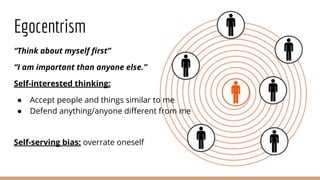
Egocentrism
“Think about myself first”
“I am important than anyone else.”
Self-interested thinking:
● Accept people and things similar to me
● Defend anything/anyone different from me
Self-serving bias: overrate oneself
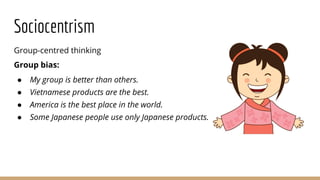
Sociocentrism
Group-centred thinking
Group bias:
● My group is better than others.
● Vietnamese products are the best.
● America is the best place in the world.
● Some Japanese people use only Japanese products.
Sociocentrism
Group-centred thinking
If you bought a new motorbike, what brand would you choose? Why?
If you bought a new mobile phone, what brand would you choose? Why?
Following the crowd (unconsciously): conformism
Assumption
A belief without sound evidence or proof.
● Wearing glasses - a nerd
● Wearing white blouses - a doctor
● Being a student - do not ask questions in lectures
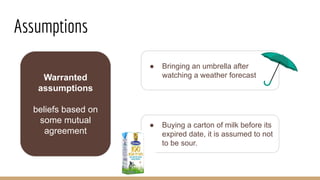
Assumptions
● Bringing an umbrella after
watching a weather forecast
● Buying a carton of milk before its
expired date, it is assumed to not
to be sour.
Warranted
assumptions
beliefs based on
some mutual
agreement
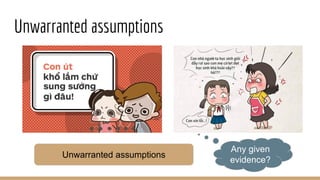
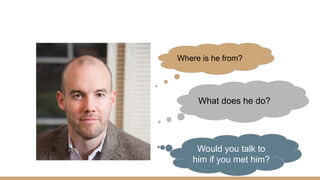
Unwarranted assumptions
Any given
evidence?
Where is he from?
What does he do?
Would you talk to
him if you met him?
Unwarranted assumptions and stereotypes
Stereotypes: hasty generalization
Africa
What do you think about
her personality?
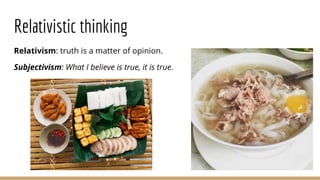
Relativistic thinking
Relativism: truth is a matter of opinion.
Subjectivism: What I believe is true, it is true.
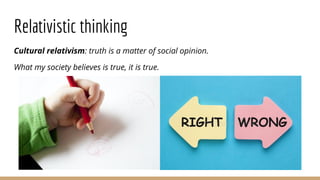
Relativistic thinking
Cultural relativism: truth is a matter of social opinion.
What my society believes is true, it is true.
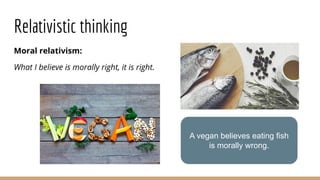
Relativistic thinking
Moral relativism:
What I believe is morally right, it is right.
A vegan believes eating fish
is morally wrong.
Relativistic thinking
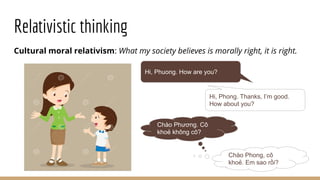
Cultural moral relativism: What my society believes is morally right, it is right.
Hi, Phuong. How are you?
Hi, Phong. Thanks, I’m good.
How about you?
Chào Phương. Cô
khoẻ không cô?
Chào Phong, cô
khoẻ. Em sao rồi?
Wishful thinking
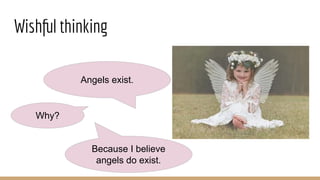
Because I believe
angels do exist.
Why?
Angels exist.
Wishful thinking
Believe in something that you want to be true
You do not have any evidence for it, but you wish it were true, so it is true.
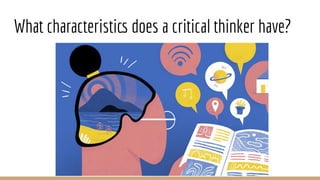
What characteristics does a critical thinker have?
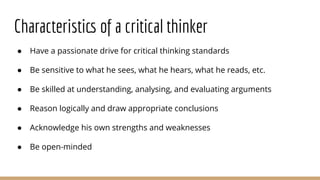
Characteristics of a critical thinker
● Have a passionate drive for critical thinking standards
● Be sensitive to what he sees, what he hears, what he reads, etc.
● Be skilled at understanding, analysing, and evaluating arguments
● Reason logically and draw appropriate conclusions
● Acknowledge his own strengths and weaknesses
● Be open-minded

Week 2 - Barriers to critical thinking.pdf

  • 1.
    Week 2 Barriers tocritical thinking Characteristics of a critical thinker
  • 2.
    What prevents youfrom thinking critically? 1. Egocentrism 2. Sociocentrism 3. Unwarranted assumptions and stereotypes 4. Relativistic thinking 5. Wishful thinking
  • 3.
    Egocentrism “Think about myselffirst” “I am important than anyone else.” Self-interested thinking: ● Accept people and things similar to me ● Defend anything/anyone different from me Self-serving bias: overrate oneself
  • 4.
    Sociocentrism Group-centred thinking Group bias: ●My group is better than others. ● Vietnamese products are the best. ● America is the best place in the world. ● Some Japanese people use only Japanese products.
  • 5.
    Sociocentrism Group-centred thinking If youbought a new motorbike, what brand would you choose? Why? If you bought a new mobile phone, what brand would you choose? Why? Following the crowd (unconsciously): conformism
  • 6.
    Assumption A belief withoutsound evidence or proof. ● Wearing glasses - a nerd ● Wearing white blouses - a doctor ● Being a student - do not ask questions in lectures
  • 7.
    Assumptions ● Bringing anumbrella after watching a weather forecast ● Buying a carton of milk before its expired date, it is assumed to not to be sour. Warranted assumptions beliefs based on some mutual agreement
  • 8.
  • 9.
    Where is hefrom? What does he do? Would you talk to him if you met him?
  • 11.
    Unwarranted assumptions andstereotypes Stereotypes: hasty generalization Africa What do you think about her personality?
  • 12.
    Relativistic thinking Relativism: truthis a matter of opinion. Subjectivism: What I believe is true, it is true.
  • 13.
    Relativistic thinking Cultural relativism:truth is a matter of social opinion. What my society believes is true, it is true.
  • 14.
    Relativistic thinking Moral relativism: WhatI believe is morally right, it is right. A vegan believes eating fish is morally wrong.
  • 15.
    Relativistic thinking Cultural moralrelativism: What my society believes is morally right, it is right. Hi, Phuong. How are you? Hi, Phong. Thanks, I’m good. How about you? Chào Phương. Cô khoẻ không cô? Chào Phong, cô khoẻ. Em sao rồi?
  • 16.
    Wishful thinking Because Ibelieve angels do exist. Why? Angels exist.
  • 17.
    Wishful thinking Believe insomething that you want to be true You do not have any evidence for it, but you wish it were true, so it is true.
  • 18.
    What characteristics doesa critical thinker have?
  • 19.
    Characteristics of acritical thinker ● Have a passionate drive for critical thinking standards ● Be sensitive to what he sees, what he hears, what he reads, etc. ● Be skilled at understanding, analysing, and evaluating arguments ● Reason logically and draw appropriate conclusions ● Acknowledge his own strengths and weaknesses ● Be open-minded