FeministCriticism
Chapter 6 in Rhetorical Criticism
Foss, S. (2018). Rhetorical Criticism: Exploration & Practice. 5th
Ed. Long Grove, Il:Waveland Press.
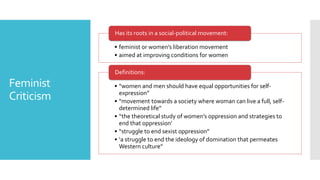
Feminist
Criticism
• feminist or women’s liberation movement
• aimed at improving conditions for women
Has its roots in a social-political movement:
• “women and men should have equal opportunities for self-
expression”
• “movement towards a society where woman can live a full, self-
determined life”
• “the theoretical study of women’s oppression and strategies to
end that oppression’
• “struggle to end sexist oppression”
• ‘a struggle to end the ideology of domination that permeates
Western culture”
Definitions:
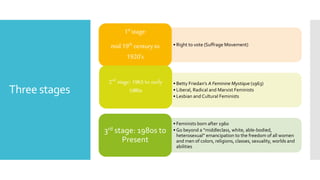
Three stages
• Right to vote (Suffrage Movement)
1st stage:
mid 19th century to
1920’s
• Betty Friedan’s A Feminine Mystique (1963)
• Liberal, Radical and Marxist Feminists
• Lesbian and Cultural Feminists
2nd stage: 1963 to early
1980s
• Feminists born after 1960
• Go beyond a “middleclass, white, able-bodied,
heterosexual” emancipation to the freedom of all women
and men of colors, religions, classes, sexuality, worlds and
abilities
3rd stage: 1980s to
Present
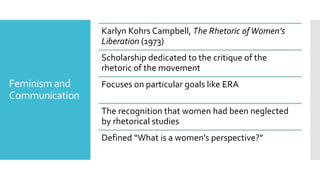
Feminism and
Communication
Karlyn Kohrs Campbell, The Rhetoric ofWomen’s
Liberation (1973)
Scholarship dedicated to the critique of the
rhetoric of the movement
Focuses on particular goals like ERA
The recognition that women had been neglected
by rhetorical studies
Defined “What is a women’s perspective?”
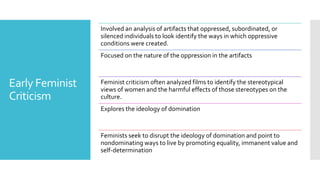
Early Feminist
Criticism
Involved an analysis of artifacts that oppressed, subordinated, or
silenced individuals to look identify the ways in which oppressive
conditions were created.
Focused on the nature of the oppression in the artifacts
Feminist criticism often analyzed films to identify the stereotypical
views of women and the harmful effects of those stereotypes on the
culture.
Explores the ideology of domination
Feminists seek to disrupt the ideology of domination and point to
nondominating ways to live by promoting equality, immanent value and
self-determination
Feminist
Critique
 Emerged as a method to
intervene in the “ideology of
domination.”
 Feminist critics are concerned
with relationships of
dominance of all kinds, not
just women.
 Feminism is equated now with
practices of disruption in
general, practices that
challenge common
assumptions.
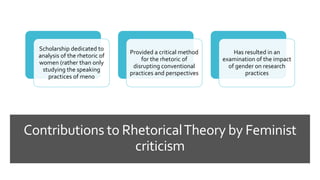
Contributions to RhetoricalTheory by Feminist
criticism
Scholarship dedicated to
analysis of the rhetoric of
women (rather than only
studying the speaking
practices of men0
Provided a critical method
for the rhetoric of
disrupting conventional
practices and perspectives
Has resulted in an
examination of the impact
of gender on research
practices
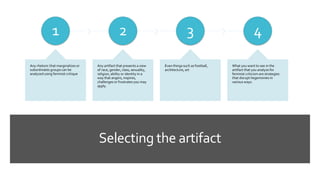
Selecting the artifact
1
Any rhetoric that marginalizes or
subordinates groups can be
analyzed using feminist critique
2
Any artifact that presents a view
of race, gender, class, sexuality,
religion, ability or identity in a
way that angers, inspires,
challenges or frustrates you may
apply.
3
Even things such as football,
architecture, art
4
What you want to see in the
artifact that you analyze for
feminist criticism are strategies
that disrupt hegemonies in
various ways.
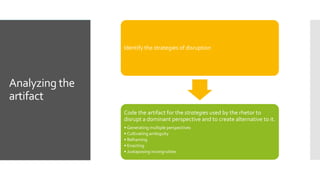
Analyzing the
artifact
Identify the strategies of disruption
Code the artifact for the strategies used by the rhetor to
disrupt a dominant perspective and to create alternative to it.
• Generating multiple perspectives
• Cultivating ambiguity
• Reframing
• Enacting
• Juxtaposing incongruities
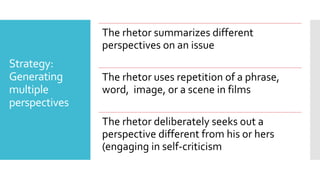
Strategy:
Generating
multiple
perspectives
The rhetor summarizes different
perspectives on an issue
The rhetor uses repetition of a phrase,
word, image, or a scene in films
The rhetor deliberately seeks out a
perspective different from his or hers
(engaging in self-criticism
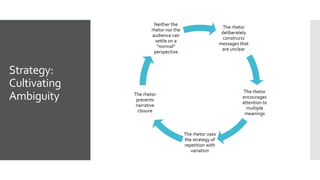
Strategy:
Cultivating
Ambiguity
The rhetor
deliberately
constructs
messages that
are unclear
The rhetor
encourages
attention to
multiple
meanings
The rhetor uses
the strategy of
repetition with
variation
The rhetor
prevents
narrative
closure
Neither the
rhetor nor the
audience can
settle on a
“normal”
perspective
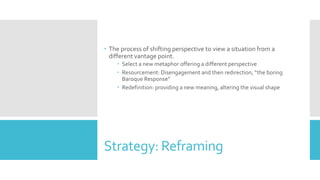
Strategy: Reframing
 The process of shifting perspective to view a situation from a
different vantage point.
 Select a new metaphor offering a different perspective
 Resourcement: Disengagement and then redirection, “the boring
Baroque Response”
 Redefinition: providing a new meaning, altering the visual shape
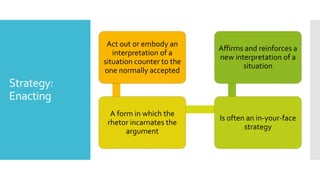
Strategy:
Enacting
Act out or embody an
interpretation of a
situation counter to the
one normally accepted
A form in which the
rhetor incarnates the
argument
Is often an in-your-face
strategy
Affirms and reinforces a
new interpretation of a
situation
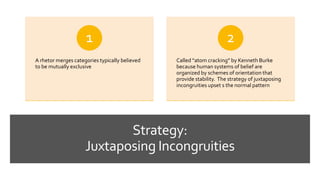
Strategy:
Juxtaposing Incongruities
A rhetor merges categories typically believed
to be mutually exclusive
1
Called “atom cracking” by Kenneth Burke
because human systems of belief are
organized by schemes of orientation that
provide stability. The strategy of juxtaposing
incongruities upset s the normal pattern
2
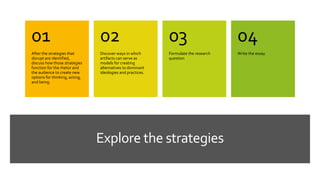
Explore the strategies
After the strategies that
disrupt are identified,
discuss how those strategies
function for the rhetor and
the audience to create new
options for thinking, acting,
and being.
01
Discover ways in which
artifacts can serve as
models for creating
alternatives to dominant
ideologies and practices.
02
Formulate the research
question
03
Write the essay
04

Week 6 lecture notes com350

  • 1.
    FeministCriticism Chapter 6 inRhetorical Criticism Foss, S. (2018). Rhetorical Criticism: Exploration & Practice. 5th Ed. Long Grove, Il:Waveland Press.
  • 2.
    Feminist Criticism • feminist orwomen’s liberation movement • aimed at improving conditions for women Has its roots in a social-political movement: • “women and men should have equal opportunities for self- expression” • “movement towards a society where woman can live a full, self- determined life” • “the theoretical study of women’s oppression and strategies to end that oppression’ • “struggle to end sexist oppression” • ‘a struggle to end the ideology of domination that permeates Western culture” Definitions:
  • 3.
    Three stages • Rightto vote (Suffrage Movement) 1st stage: mid 19th century to 1920’s • Betty Friedan’s A Feminine Mystique (1963) • Liberal, Radical and Marxist Feminists • Lesbian and Cultural Feminists 2nd stage: 1963 to early 1980s • Feminists born after 1960 • Go beyond a “middleclass, white, able-bodied, heterosexual” emancipation to the freedom of all women and men of colors, religions, classes, sexuality, worlds and abilities 3rd stage: 1980s to Present
  • 4.
    Feminism and Communication Karlyn KohrsCampbell, The Rhetoric ofWomen’s Liberation (1973) Scholarship dedicated to the critique of the rhetoric of the movement Focuses on particular goals like ERA The recognition that women had been neglected by rhetorical studies Defined “What is a women’s perspective?”
  • 5.
    Early Feminist Criticism Involved ananalysis of artifacts that oppressed, subordinated, or silenced individuals to look identify the ways in which oppressive conditions were created. Focused on the nature of the oppression in the artifacts Feminist criticism often analyzed films to identify the stereotypical views of women and the harmful effects of those stereotypes on the culture. Explores the ideology of domination Feminists seek to disrupt the ideology of domination and point to nondominating ways to live by promoting equality, immanent value and self-determination
  • 6.
    Feminist Critique  Emerged asa method to intervene in the “ideology of domination.”  Feminist critics are concerned with relationships of dominance of all kinds, not just women.  Feminism is equated now with practices of disruption in general, practices that challenge common assumptions.
  • 7.
    Contributions to RhetoricalTheoryby Feminist criticism Scholarship dedicated to analysis of the rhetoric of women (rather than only studying the speaking practices of men0 Provided a critical method for the rhetoric of disrupting conventional practices and perspectives Has resulted in an examination of the impact of gender on research practices
  • 8.
    Selecting the artifact 1 Anyrhetoric that marginalizes or subordinates groups can be analyzed using feminist critique 2 Any artifact that presents a view of race, gender, class, sexuality, religion, ability or identity in a way that angers, inspires, challenges or frustrates you may apply. 3 Even things such as football, architecture, art 4 What you want to see in the artifact that you analyze for feminist criticism are strategies that disrupt hegemonies in various ways.
  • 9.
    Analyzing the artifact Identify thestrategies of disruption Code the artifact for the strategies used by the rhetor to disrupt a dominant perspective and to create alternative to it. • Generating multiple perspectives • Cultivating ambiguity • Reframing • Enacting • Juxtaposing incongruities
  • 10.
    Strategy: Generating multiple perspectives The rhetor summarizesdifferent perspectives on an issue The rhetor uses repetition of a phrase, word, image, or a scene in films The rhetor deliberately seeks out a perspective different from his or hers (engaging in self-criticism
  • 11.
    Strategy: Cultivating Ambiguity The rhetor deliberately constructs messages that areunclear The rhetor encourages attention to multiple meanings The rhetor uses the strategy of repetition with variation The rhetor prevents narrative closure Neither the rhetor nor the audience can settle on a “normal” perspective
  • 12.
    Strategy: Reframing  Theprocess of shifting perspective to view a situation from a different vantage point.  Select a new metaphor offering a different perspective  Resourcement: Disengagement and then redirection, “the boring Baroque Response”  Redefinition: providing a new meaning, altering the visual shape
  • 13.
    Strategy: Enacting Act out orembody an interpretation of a situation counter to the one normally accepted A form in which the rhetor incarnates the argument Is often an in-your-face strategy Affirms and reinforces a new interpretation of a situation
  • 14.
    Strategy: Juxtaposing Incongruities A rhetormerges categories typically believed to be mutually exclusive 1 Called “atom cracking” by Kenneth Burke because human systems of belief are organized by schemes of orientation that provide stability. The strategy of juxtaposing incongruities upset s the normal pattern 2
  • 15.
    Explore the strategies Afterthe strategies that disrupt are identified, discuss how those strategies function for the rhetor and the audience to create new options for thinking, acting, and being. 01 Discover ways in which artifacts can serve as models for creating alternatives to dominant ideologies and practices. 02 Formulate the research question 03 Write the essay 04