






















PUBLIC RELATIONS PRACTICE

2014
Week 1
!

Dr KANE HOPKINS
About me
Contacting me
k.hopkins@massey.ac.nz
!

(04) 801 5799 extn 62355
!

@kanehopkins
!

khopkins
The boring administration part
Me:

You:
The boring administration part
Me:

• Not to make this paper suck

You:
The boring administration part
Me:

• Not to make this paper suck
• Return assignments within three weeks

You:
The boring administration part
Me:

• Not to make this paper suck
• Return assignments within three weeks
• Provide opportunities for you to learn

You:
The boring administration part
Me:

• Not to make this paper suck
• Return assignments within three weeks
• Provide opportunities for you to learn
• Give you what you need to pass

You:
The boring administration part
Me:

• Not to make this paper suck
• Return assignments within three weeks
• Provide opportunities for you to learn
• Give you what you need to pass

You:
The boring administration part
Me:

• Not to make this paper suck
• Return assignments within three weeks
• Provide opportunities for you to learn
• Give you what you need to pass

You:

• Care
The boring administration part
Me:

• Not to make this paper suck
• Return assignments within three weeks
• Provide opportunities for you to learn
• Give you what you need to pass

You:

• Care
• Admin guide > textbook/readings > Stream > each
other > me
Assignments
1. Writing a Communication Plan
2. Collateral
3. Exam
Tutorials
Thursday 9-10

Friday 9-10

Friday 11-12
Tutorials
Thursday 9-11

Friday 9-12
SHALL WE BEGIN?
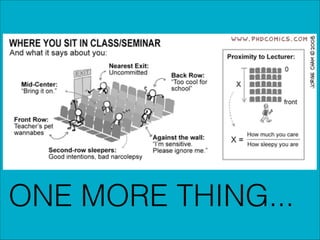
ONE MORE THING...
ONE MORE THING...
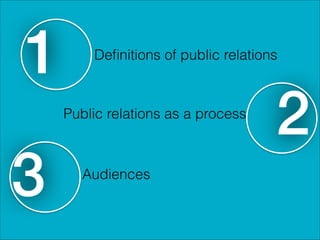
1

Definitions of public relations

Public relations as a process

3

Audiences

2
WHAT IS PUBLIC
RELATIONS?
?

• The art of deception
• Smoke and mirrors
• Spin doctors
• Free marketing
• Propaganda
It’s about...
... relationships.

Duh!

!

Communication is the
oxygen of successful
relationships
What is a relationship?
The state which exists between an organization and its key
publics in which the actions of either entity impact the
economic, social, political and/or cultural well-being of the
other entity.
(Ledingham & Bruning, 1998, p. 62).
!
!
Relationships consist of the transactions that involve the
exchange of resources between organizations.
(Broom, Casey, & Ritchey, 1997, p. 91).
The PRINZ Definition
Public Relations shall be defined as
the deliberate, planned and
sustained effort to establish and
maintain mutual understanding and
excellent communication between an
organisation and its publics.
A definition for the new era of
public relations
Public relations is a strategic communication
process that builds mutually beneficial
relationships between organisations and
their publics.
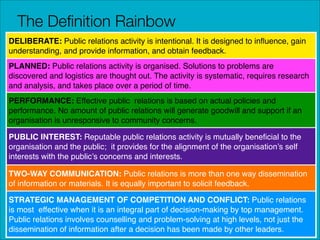
The Definition Rainbow
DELIBERATE: Public relations activity is intentional. It is designed to influence, gain
understanding, and provide information, and obtain feedback.
PLANNED: Public relations activity is organised. Solutions to problems are
discovered and logistics are thought out. The activity is systematic, requires research
and analysis, and takes place over a period of time.
PERFORMANCE: Effective public relations is based on actual policies and
performance. No amount of public relations will generate goodwill and support if an
organisation is unresponsive to community concerns.
PUBLIC INTEREST: Reputable public relations activity is mutually beneficial to the
organisation and the public; it provides for the alignment of the organisation’s self
interests with the public’s concerns and interests.
TWO-WAY COMMUNICATION: Public relations is more than one way dissemination
of information or materials. It is equally important to solicit feedback.
STRATEGIC MANAGEMENT OF COMPETITION AND CONFLICT: Public relations
is most effective when it is an integral part of decision-making by top management.
Public relations involves counselling and problem-solving at high levels, not just the
dissemination of information after a decision has been made by other leaders.
Axioms of
organisation–public relationships
1. Organisation–public relationships are transactional
2. The relationships are dynamic; they change over time
3. They are goal oriented
4. Organisation–public relationships have antecedents and
consequences and can be analysed in terms of
relationship quality, maintenance strategies, relationship
type, and actors in the relationship
5. These relationships are driven by the perceived needs
and wants of interacting organisations and publics
Axioms of
organisation–public relationships
6. The continuation of organisation–public relationships is
dependent on the degree to which expectations are met
7. Those expectations are expressed in interactions between
organisations and publics
8. Such relationships involve communication, but
communication is not the sole instrument of relationship
building
9. These relationships are impacted by relational history, the
nature of the transaction, the frequency of exchange, and
reciprocity
Axioms of
organisation–public relationships
10. Organisation–public relationships can be described by type
(personal, professional, community, symbolic, and
behavioural) independent of the perceptions of those
relationships
11. The proper focus of the domain of public relations is
relationships, not communication.
12. Communication alone cannot sustain long-term relationships
in the absence of supportive organisational behaviour.
13. Effective management of organisation–public relationships
supports mutual understanding and benefit.
14. The relationship perspective is applicable throughout the
public relations process and with regard to all public
relations techniques.
Core components of PR
• Counselling: providing advice to management
concerning policies, relationships, and
communications
• Research: determining the attitudes and behaviours of
groups to planned public relations strategies. Such
research can be used to generate mutual
understanding or influence and persuade publics
• Media Relations: working with mass media by seeking
publicity or responding to the interests in the
organisation
• Publicity: disseminating planned messages through
selected media to further an organisation’s interests
Core components of PR
• Marketing Communications: employing a combination
of activities designed to sell a product, service, or idea,
including advertising, collateral, materials, publicity,
promotion, direct mail, trade shows, and special events
• Fund Raising: demonstrating the need for and
encouraging the public to support charitable
organisations, primarily through financial contributions
• Special Events: stimulating interest in a person,
product, or organisation by means of focused
happenings as well as other activities designed to
encourage interacting with publics and listening to
them
Core components of PR
• Financial relations: creating and maintaining
investor confidence and building good
relationships with the financial community. This
aspect of public relations is also known as
investor relations or shareholder relations
• Government Affairs: relating directly with
legislatures an regulatory agencies on behalf of
an organisation. Lobbying can be part of a
government affairs program
ADVERTISING +
MARKETING ≠ PR
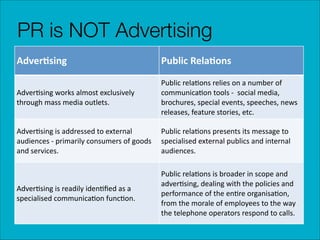
PR is NOT Advertising
Adver&sing

Public	
  Rela&ons

Adver(sing	
  works	
  almost	
  exclusively	
  
through	
  mass	
  media	
  outlets.

Public	
  rela(ons	
  relies	
  on	
  a	
  number	
  of	
  
communica(on	
  tools	
  -­‐	
  	
  social	
  media,	
  
brochures,	
  special	
  events,	
  speeches,	
  news	
  
releases,	
  feature	
  stories,	
  etc.

Adver(sing	
  is	
  addressed	
  to	
  external	
  
Public	
  rela(ons	
  presents	
  its	
  message	
  to	
  
audiences	
  -­‐	
  primarily	
  consumers	
  of	
  goods	
   specialised	
  external	
  publics	
  and	
  internal	
  
and	
  services.
audiences.

Adver(sing	
  is	
  readily	
  iden(fied	
  as	
  a	
  
specialised	
  communica(on	
  func(on.

Public	
  rela(ons	
  is	
  broader	
  in	
  scope	
  and	
  
adver(sing,	
  dealing	
  with	
  the	
  policies	
  and	
  
performance	
  of	
  the	
  en(re	
  organisa(on,	
  
from	
  the	
  morale	
  of	
  employees	
  to	
  the	
  way	
  
the	
  telephone	
  operators	
  respond	
  to	
  calls.
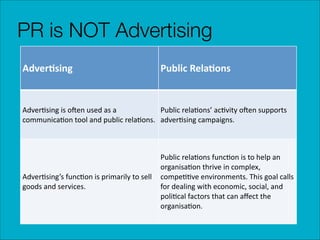
PR is NOT Advertising
Adver&sing

Public	
  Rela&ons

Adver(sing	
  is	
  oAen	
  used	
  as	
  a	
  
Public	
  rela(ons’	
  ac(vity	
  oAen	
  supports	
  
communica(on	
  tool	
  and	
  public	
  rela(ons. adver(sing	
  campaigns.

Public	
  rela(ons	
  func(on	
  is	
  to	
  help	
  an	
  
organisa(on	
  thrive	
  in	
  complex,	
  
Adver(sing’s	
  func(on	
  is	
  primarily	
  to	
  sell	
   compe((ve	
  environments.	
  This	
  goal	
  calls	
  
goods	
  and	
  services.
for	
  dealing	
  with	
  economic,	
  social,	
  and	
  
poli(cal	
  factors	
  that	
  can	
  affect	
  the	
  
organisa(on.
PR is NOT Marketing
The goal of public relations is to attain
and maintain accord and positive behaviours
among social groupings on which an
organisation depends to achieve its mission.
The fundamental responsibility of public
relations as a management process is to
build and maintain a hospitable environment
for an organisation.
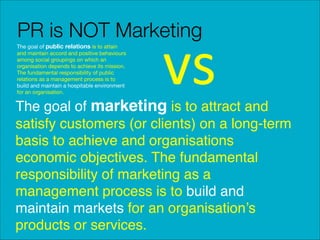
PR is NOT Marketing
The goal of public relations is to attain
and maintain accord and positive behaviours
among social groupings on which an
organisation depends to achieve its mission.
The fundamental responsibility of public
relations as a management process is to
build and maintain a hospitable environment
for an organisation.

vs

The goal of marketing is to attract and
satisfy customers (or clients) on a long-term
basis to achieve and organisations
economic objectives. The fundamental
responsibility of marketing as a
management process is to build and
maintain markets for an organisation’s
products or services.
How PR Contributes to Marketing
1. Develop new prospects for new markets, such as
people who enquire after seeing or hearing a
product release in the news media
2. Provide third-party endorsements - via newspapers,
magazines, radio, and television - through news
releases about a company’s products or services,
community involvement, inventions, and new plans
3. Generate sales leads, usually through articles in the
trade press about new products and services
4. Pave the way for sales calls
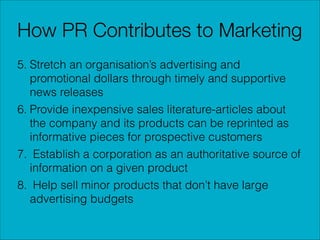
How PR Contributes to Marketing
5. Stretch an organisation’s advertising and
promotional dollars through timely and supportive
news releases
6. Provide inexpensive sales literature-articles about
the company and its products can be reprinted as
informative pieces for prospective customers
7. Establish a corporation as an authoritative source of
information on a given product
8. Help sell minor products that don’t have large
advertising budgets
PUBLIC RELATIONS
AS A PROCESS
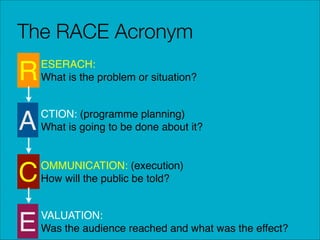
The RACE Acronym

R

ESERACH:!
What is the problem or situation?

A

CTION: (programme planning)!
What is going to be done about it?

C

OMMUNICATION: (execution)!
How will the public be told?

E

VALUATION:!
Was the audience reached and what was the effect?
Working in PR in NZ
•
•
•
•

Good salaries

Rapid promotion – if you are good

Job satisfaction – good fun

Long hours
Loads!

People!
working !
in PR!

Few!

Men!

Women!
A Typical PR Job Description
What	
  you	
  will	
  be	
  expected	
  to	
  do:

everything!!!
no, really
Reality check
If you want to have a career in public
relations, or any job focusing on
communication, and you are not adept and
experienced at using a range of social
media, then you should consider becoming
an accountant.
!

BEFORE YOU CAN BE A COMMUNICATOR,
YOU NEED TO BE A TECHNOLOGIST
AUDIENCES
Audiences
We will break audiences into two sections:
1. Publics - academic term
2. Stakeholders - industry term
Audiences

We will break audiences into two sections:
1. Publics - academic term
2. Stakeholders - industry term

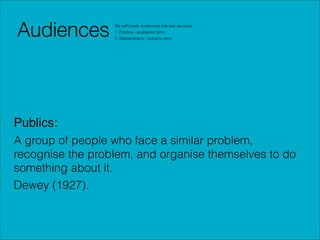
Publics:!
A group of people who face a similar problem,
recognise the problem, and organise themselves to do
something about it.
Dewey (1927).
Audiences

We will break audiences into two sections:
1. Publics - academic term
2. Stakeholders - industry term

Publics:!
A group of people who face a similar problem,
recognise the problem, and organise themselves to do
something about it.
Dewey (1927).

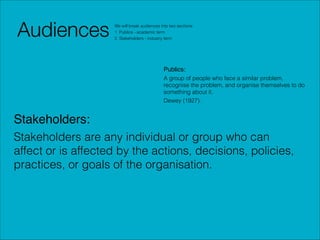
Stakeholders:!
Stakeholders are any individual or group who can
affect or is affected by the actions, decisions, policies,
practices, or goals of the organisation.
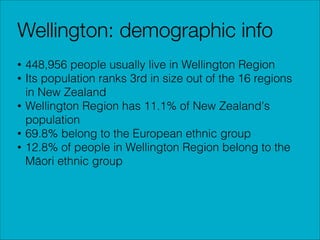
Wellington: demographic info
• 448,956 people usually live in Wellington Region
• Its population ranks 3rd in size out of the 16 regions
in New Zealand
• Wellington Region has 11.1% of New Zealand's
population
• 69.8% belong to the European ethnic group
• 12.8% of people in Wellington Region belong to the
Māori ethnic group
Psychographics
Psychological characteristics that influence the way
people perceive messages
• Psychographics ([psycho]logy + demo[graphics])
behaviours, trends, cultures, and ways of thinking
• Considers beliefs, attitudes and opinions,
- whether deeply held parts of the personality, or
fleeting and inconsequential

• Can be inferred from demographics
• Values and Lifestyles
- consumer segmentation system based on key
attitudes and demographics
Source: Dr Linda Perry
Wellington: psychographic info
... prefer natural products and tend to read
product labels on foods
... value young men with skinny legs wearing
tight black jeans (what is that about?)
... enjoy theatre and cultural entertainment
... liberal on social issues
And that, my new chums,
concludes your first lecture.
!

Don’t forget:
• Workshops start next week
• Read the freakin readings
• Call your mother. She worries about you

Public Relations Practice 2014: Week 1

  • 1.
  • 2.
  • 3.
    Contacting me k.hopkins@massey.ac.nz ! (04) 8015799 extn 62355 ! @kanehopkins ! khopkins
  • 4.
  • 5.
    The boring administrationpart Me: • Not to make this paper suck You:
  • 6.
    The boring administrationpart Me: • Not to make this paper suck • Return assignments within three weeks You:
  • 7.
    The boring administrationpart Me: • Not to make this paper suck • Return assignments within three weeks • Provide opportunities for you to learn You:
  • 8.
    The boring administrationpart Me: • Not to make this paper suck • Return assignments within three weeks • Provide opportunities for you to learn • Give you what you need to pass You:
  • 9.
    The boring administrationpart Me: • Not to make this paper suck • Return assignments within three weeks • Provide opportunities for you to learn • Give you what you need to pass You:
  • 10.
    The boring administrationpart Me: • Not to make this paper suck • Return assignments within three weeks • Provide opportunities for you to learn • Give you what you need to pass You: • Care
  • 11.
    The boring administrationpart Me: • Not to make this paper suck • Return assignments within three weeks • Provide opportunities for you to learn • Give you what you need to pass You: • Care • Admin guide > textbook/readings > Stream > each other > me
  • 12.
    Assignments 1. Writing aCommunication Plan 2. Collateral 3. Exam
  • 13.
  • 14.
  • 15.
  • 16.
  • 17.
  • 18.
    1 Definitions of publicrelations Public relations as a process 3 Audiences 2
  • 19.
  • 20.
    ? • The artof deception • Smoke and mirrors • Spin doctors • Free marketing • Propaganda
  • 21.
    It’s about... ... relationships. Duh! ! Communicationis the oxygen of successful relationships
  • 22.
    What is arelationship? The state which exists between an organization and its key publics in which the actions of either entity impact the economic, social, political and/or cultural well-being of the other entity. (Ledingham & Bruning, 1998, p. 62). ! ! Relationships consist of the transactions that involve the exchange of resources between organizations. (Broom, Casey, & Ritchey, 1997, p. 91).
  • 23.
    The PRINZ Definition PublicRelations shall be defined as the deliberate, planned and sustained effort to establish and maintain mutual understanding and excellent communication between an organisation and its publics.
  • 24.
    A definition forthe new era of public relations Public relations is a strategic communication process that builds mutually beneficial relationships between organisations and their publics.
  • 25.
    The Definition Rainbow DELIBERATE:Public relations activity is intentional. It is designed to influence, gain understanding, and provide information, and obtain feedback. PLANNED: Public relations activity is organised. Solutions to problems are discovered and logistics are thought out. The activity is systematic, requires research and analysis, and takes place over a period of time. PERFORMANCE: Effective public relations is based on actual policies and performance. No amount of public relations will generate goodwill and support if an organisation is unresponsive to community concerns. PUBLIC INTEREST: Reputable public relations activity is mutually beneficial to the organisation and the public; it provides for the alignment of the organisation’s self interests with the public’s concerns and interests. TWO-WAY COMMUNICATION: Public relations is more than one way dissemination of information or materials. It is equally important to solicit feedback. STRATEGIC MANAGEMENT OF COMPETITION AND CONFLICT: Public relations is most effective when it is an integral part of decision-making by top management. Public relations involves counselling and problem-solving at high levels, not just the dissemination of information after a decision has been made by other leaders.
  • 26.
    Axioms of organisation–public relationships 1.Organisation–public relationships are transactional 2. The relationships are dynamic; they change over time 3. They are goal oriented 4. Organisation–public relationships have antecedents and consequences and can be analysed in terms of relationship quality, maintenance strategies, relationship type, and actors in the relationship 5. These relationships are driven by the perceived needs and wants of interacting organisations and publics
  • 27.
    Axioms of organisation–public relationships 6.The continuation of organisation–public relationships is dependent on the degree to which expectations are met 7. Those expectations are expressed in interactions between organisations and publics 8. Such relationships involve communication, but communication is not the sole instrument of relationship building 9. These relationships are impacted by relational history, the nature of the transaction, the frequency of exchange, and reciprocity
  • 28.
    Axioms of organisation–public relationships 10.Organisation–public relationships can be described by type (personal, professional, community, symbolic, and behavioural) independent of the perceptions of those relationships 11. The proper focus of the domain of public relations is relationships, not communication. 12. Communication alone cannot sustain long-term relationships in the absence of supportive organisational behaviour. 13. Effective management of organisation–public relationships supports mutual understanding and benefit. 14. The relationship perspective is applicable throughout the public relations process and with regard to all public relations techniques.
  • 29.
    Core components ofPR • Counselling: providing advice to management concerning policies, relationships, and communications • Research: determining the attitudes and behaviours of groups to planned public relations strategies. Such research can be used to generate mutual understanding or influence and persuade publics • Media Relations: working with mass media by seeking publicity or responding to the interests in the organisation • Publicity: disseminating planned messages through selected media to further an organisation’s interests
  • 30.
    Core components ofPR • Marketing Communications: employing a combination of activities designed to sell a product, service, or idea, including advertising, collateral, materials, publicity, promotion, direct mail, trade shows, and special events • Fund Raising: demonstrating the need for and encouraging the public to support charitable organisations, primarily through financial contributions • Special Events: stimulating interest in a person, product, or organisation by means of focused happenings as well as other activities designed to encourage interacting with publics and listening to them
  • 31.
    Core components ofPR • Financial relations: creating and maintaining investor confidence and building good relationships with the financial community. This aspect of public relations is also known as investor relations or shareholder relations • Government Affairs: relating directly with legislatures an regulatory agencies on behalf of an organisation. Lobbying can be part of a government affairs program
  • 32.
  • 33.
    PR is NOTAdvertising Adver&sing Public  Rela&ons Adver(sing  works  almost  exclusively   through  mass  media  outlets. Public  rela(ons  relies  on  a  number  of   communica(on  tools  -­‐    social  media,   brochures,  special  events,  speeches,  news   releases,  feature  stories,  etc. Adver(sing  is  addressed  to  external   Public  rela(ons  presents  its  message  to   audiences  -­‐  primarily  consumers  of  goods   specialised  external  publics  and  internal   and  services. audiences. Adver(sing  is  readily  iden(fied  as  a   specialised  communica(on  func(on. Public  rela(ons  is  broader  in  scope  and   adver(sing,  dealing  with  the  policies  and   performance  of  the  en(re  organisa(on,   from  the  morale  of  employees  to  the  way   the  telephone  operators  respond  to  calls.
  • 34.
    PR is NOTAdvertising Adver&sing Public  Rela&ons Adver(sing  is  oAen  used  as  a   Public  rela(ons’  ac(vity  oAen  supports   communica(on  tool  and  public  rela(ons. adver(sing  campaigns. Public  rela(ons  func(on  is  to  help  an   organisa(on  thrive  in  complex,   Adver(sing’s  func(on  is  primarily  to  sell   compe((ve  environments.  This  goal  calls   goods  and  services. for  dealing  with  economic,  social,  and   poli(cal  factors  that  can  affect  the   organisa(on.
  • 35.
    PR is NOTMarketing The goal of public relations is to attain and maintain accord and positive behaviours among social groupings on which an organisation depends to achieve its mission. The fundamental responsibility of public relations as a management process is to build and maintain a hospitable environment for an organisation.
  • 36.
    PR is NOTMarketing The goal of public relations is to attain and maintain accord and positive behaviours among social groupings on which an organisation depends to achieve its mission. The fundamental responsibility of public relations as a management process is to build and maintain a hospitable environment for an organisation. vs The goal of marketing is to attract and satisfy customers (or clients) on a long-term basis to achieve and organisations economic objectives. The fundamental responsibility of marketing as a management process is to build and maintain markets for an organisation’s products or services.
  • 37.
    How PR Contributesto Marketing 1. Develop new prospects for new markets, such as people who enquire after seeing or hearing a product release in the news media 2. Provide third-party endorsements - via newspapers, magazines, radio, and television - through news releases about a company’s products or services, community involvement, inventions, and new plans 3. Generate sales leads, usually through articles in the trade press about new products and services 4. Pave the way for sales calls
  • 38.
    How PR Contributesto Marketing 5. Stretch an organisation’s advertising and promotional dollars through timely and supportive news releases 6. Provide inexpensive sales literature-articles about the company and its products can be reprinted as informative pieces for prospective customers 7. Establish a corporation as an authoritative source of information on a given product 8. Help sell minor products that don’t have large advertising budgets
  • 39.
  • 40.
    The RACE Acronym R ESERACH:! Whatis the problem or situation? A CTION: (programme planning)! What is going to be done about it? C OMMUNICATION: (execution)! How will the public be told? E VALUATION:! Was the audience reached and what was the effect?
  • 41.
    Working in PRin NZ • • • • Good salaries Rapid promotion – if you are good Job satisfaction – good fun Long hours
  • 42.
  • 43.
    A Typical PRJob Description What  you  will  be  expected  to  do: everything!!! no, really
  • 44.
    Reality check If youwant to have a career in public relations, or any job focusing on communication, and you are not adept and experienced at using a range of social media, then you should consider becoming an accountant. ! BEFORE YOU CAN BE A COMMUNICATOR, YOU NEED TO BE A TECHNOLOGIST
  • 45.
  • 46.
    Audiences We will breakaudiences into two sections: 1. Publics - academic term 2. Stakeholders - industry term
  • 47.
    Audiences We will breakaudiences into two sections: 1. Publics - academic term 2. Stakeholders - industry term Publics:! A group of people who face a similar problem, recognise the problem, and organise themselves to do something about it. Dewey (1927).
  • 48.
    Audiences We will breakaudiences into two sections: 1. Publics - academic term 2. Stakeholders - industry term Publics:! A group of people who face a similar problem, recognise the problem, and organise themselves to do something about it. Dewey (1927). Stakeholders:! Stakeholders are any individual or group who can affect or is affected by the actions, decisions, policies, practices, or goals of the organisation.
  • 49.
    Wellington: demographic info •448,956 people usually live in Wellington Region • Its population ranks 3rd in size out of the 16 regions in New Zealand • Wellington Region has 11.1% of New Zealand's population • 69.8% belong to the European ethnic group • 12.8% of people in Wellington Region belong to the Māori ethnic group
  • 50.
    Psychographics Psychological characteristics thatinfluence the way people perceive messages • Psychographics ([psycho]logy + demo[graphics]) behaviours, trends, cultures, and ways of thinking • Considers beliefs, attitudes and opinions, - whether deeply held parts of the personality, or fleeting and inconsequential • Can be inferred from demographics • Values and Lifestyles - consumer segmentation system based on key attitudes and demographics Source: Dr Linda Perry
  • 51.
    Wellington: psychographic info ...prefer natural products and tend to read product labels on foods ... value young men with skinny legs wearing tight black jeans (what is that about?) ... enjoy theatre and cultural entertainment ... liberal on social issues
  • 52.
    And that, mynew chums, concludes your first lecture. ! Don’t forget: • Workshops start next week • Read the freakin readings • Call your mother. She worries about you