Martha sucht…
www.alumniportal-deutschland.org
Webinar-Serie zur Nachhaltigkeit
TEIL I: Ökologische Konzepte
•22. April, 18-19 Uhr (UTC+2): Vom Wert der Arten: Biodiversität als
Lebensgrundlage (auf Deutsch)
•26. April, 17-18 Uhr (UTC+2): Plenteous oceans? How we can win
the battle against overfishing (in English)
•29. April, 18-19:30 Uhr (UTC+2): Alumni präsentieren ihre
Forschungsprojekte (auf Deutsch/ Englisch)
Oceans full of Fish?
Small Steps in the Right Direction
Rainer Froese
GEOMAR, Kiel, rfroese@geomar.de
Webinar 26 April 2013
Overview
• Status of global fish stocks and fisheries
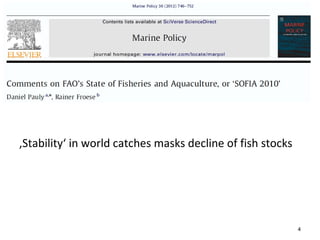
‚Stability‘ in world catches masks decline of fish stocks
4
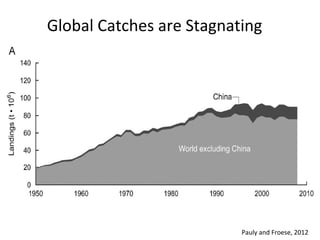
Global Catches are Stagnating
Pauly and Froese, 2012
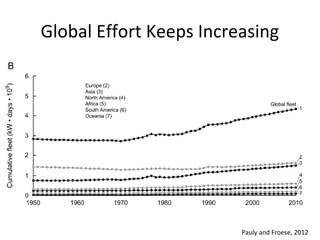
Global Effort Keeps Increasing
Pauly and Froese, 2012
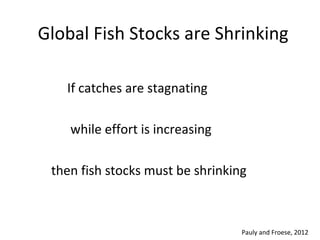
Global Fish Stocks are Shrinking
If catches are stagnating
while effort is increasing
then fish stocks must be shrinking
Pauly and Froese, 2012
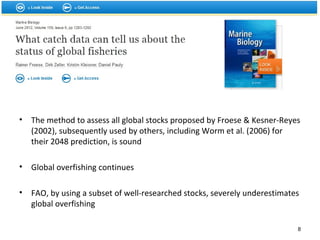
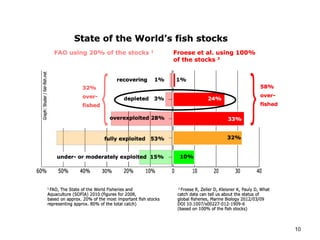
• The method to assess all global stocks proposed by Froese & Kesner-Reyes
(2002), subsequently used by others, including Worm et al. (2006) for
their 2048 prediction, is sound
• Global overfishing continues
• FAO, by using a subset of well-researched stocks, severely underestimates
global overfishing
8
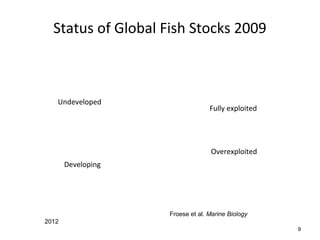
Status of Global Fish Stocks 2009
9
Neue Bestände
Zusammengebrochen
Undeveloped
Developing
Fully exploited
Overexploited
Collapsed
Froese et al. Marine Biology
2012
10
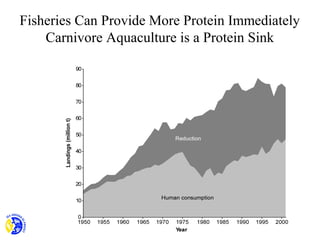
Fisheries Can Provide More Protein Immediately
Carnivore Aquaculture is a Protein Sink
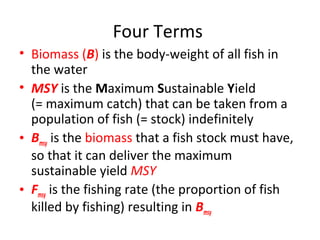
Four Terms
• Biomass (B) is the body-weight of all fish in
the water
• MSY is the Maximum Sustainable Yield
(= maximum catch) that can be taken from a
population of fish (= stock) indefinitely
• Bmsy is the biomass that a fish stock must have,
so that it can deliver the maximum
sustainable yield MSY
• Fmsy is the fishing rate (the proportion of fish
killed by fishing) resulting in Bmsy
MSY Is Good For You
13
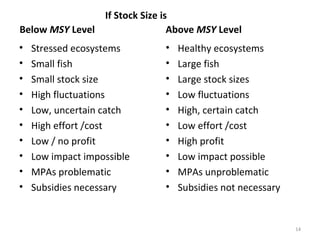
Below MSY Level
• Stressed ecosystems
• Small fish
• Small stock size
• High fluctuations
• Low, uncertain catch
• High effort /cost
• Low / no profit
• Low impact impossible
• MPAs problematic
• Subsidies necessary
Above MSY Level
• Healthy ecosystems
• Large fish
• Large stock sizes
• Low fluctuations
• High, certain catch
• Low effort /cost
• High profit
• Low impact possible
• MPAs unproblematic
• Subsidies not necessary
14
If Stock Size is
European Stocks and Fisheries
15
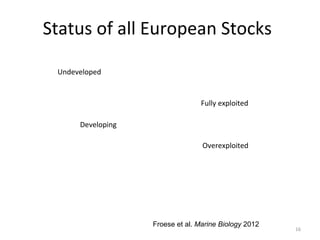
Status of all European Stocks
16
Neue Bestände
Zusammengebrochen
Developing
Fully exploited
Undeveloped
Overexploited
Collapsed
Froese et al. Marine Biology 2012
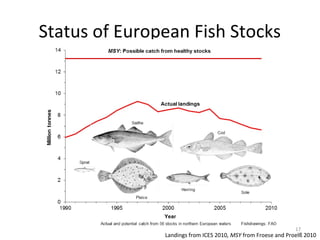
Status of European Fish Stocks
17
Landings from ICES 2010, MSY from Froese and Proelß 2010
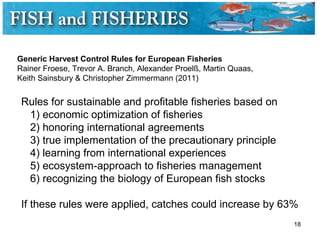
Generic Harvest Control Rules for European Fisheries
Rainer Froese, Trevor A. Branch, Alexander Proelß, Martin Quaas,
Keith Sainsbury & Christopher Zimmermann (2011)
Rules for sustainable and profitable fisheries based on
1) economic optimization of fisheries
2) honoring international agreements
3) true implementation of the precautionary principle
4) learning from international experiences
5) ecosystem-approach to fisheries management
6) recognizing the biology of European fish stocks
If these rules were applied, catches could increase by 63%
18
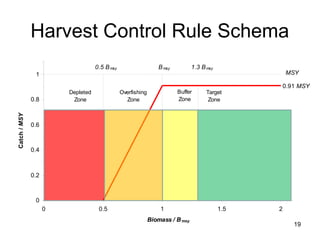
Harvest Control Rule Schema
0
0.2
0.4
0.6
0.8
1
0 0.5 1 1.5 2
Biomass / Bmsy
Catch/MSY
Bmsy0.5 Bmsy 1.3 Bmsy
Depleted
Zone
Overfishing
Zone
Buffer
Zone
Target
Zone
MSY
0.91 MSY
19
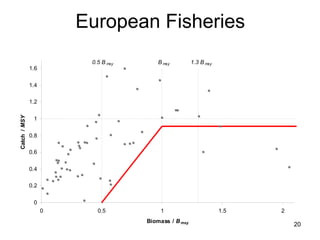
European Fisheries
0
0.2
0.4
0.6
0.8
1
1.2
1.4
1.6
0 0.5 1 1.5 2
Biomass / Bmsy
Catch/MSY
B msy0.5 B msy 1.3 B msy
20
Politics
News from Rio +20
Article 168 of the The Future We Want:
Outcome of the Conference deals with fisheries:
•Governments commit to intensify efforts to
restore stocks at least to MSY levels
•They commit to urgent measures, „including by
reducing or suspending fishing...“
•They commit to ecosystem-based fisheries
management
News from the CFP Reform
• The Commission (Maria Damanaki) has
presented a reasonable CFP reform proposal
(although less than Rio +20)
• The Council of Agriculture Ministers has
decided upon its ‚compromise‘ position
• The European Parlament has agreed on an
ambitious reform proposal
• Now a compromise has to be negotiated
23
The Council Compromise
• Postpones sustainable fishing until 2020
• Proposes an administrative monster for
reduction of discards until 2020
• Introduces lots of loopholes for continued
overfishing, e.g. of not „significant“ species in
mixed fisheries
24
The Fisheries Question
• How much can we safely take from a fish
population?
• How much mortality can we add without
destroying the stock?
The Answer
Principles of Ecosystem-based Fisheries
Management
•Never take more than all other predators
combined (typically 20% of stock)
•To avoid collapse with high certainty, take less
•Catch fish at the optimum size
Growth, Mortality and Reproduction
Froese & Pauly, 2013
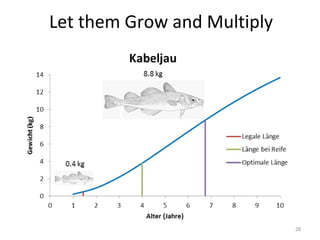
Let them Grow and Multiply
28
How about Data-Poor Stocks?
• Knowing the fraction of the stock that can be
fished is fine, but what about the many stocks
for which no abundance is known?
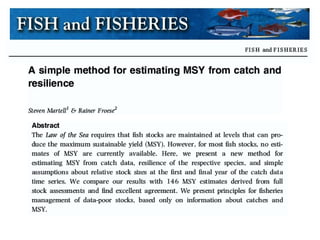
• New method (Martell & Froese 2012)
estimates the maximum sustainable yield
from catch data and resilience
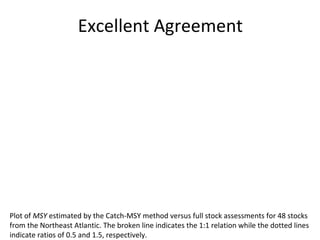
Excellent Agreement
Plot of MSY estimated by the Catch-MSY method versus full stock assessments for 48 stocks
from the Northeast Atlantic. The broken line indicates the 1:1 relation while the dotted lines
indicate ratios of 0.5 and 1.5, respectively.
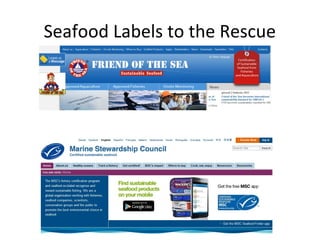
Seafood Labels to the Rescue
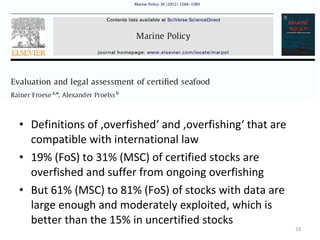
• Definitions of ‚overfished‘ and ‚overfishing‘ that are
compatible with international law
• 19% (FoS) to 31% (MSC) of certified stocks are
overfished and suffer from ongoing overfishing
• But 61% (MSC) to 81% (FoS) of stocks with data are
large enough and moderately exploited, which is
better than the 15% in uncertified stocks
33
Just Out
• Mismanagement of North Sea Cod: rebuilding
was possible if scientific advice had been
followed (Froese & Quaas 2012)
• Taking Rio+20 seriously: 50 – 70% of European
stocks could be rebuilt to MSY-levels by 2015
(Froese & Quaas 2013)
• Is the costly European fisheries management
necessary? Much simpler managgement may
deliver better results (in prep).
Questions?
All paper PDFs are available from
www.fishbase.de/rfroese
Rainer Froese
GEOMAR, Kiel, Germany
rfroese@geomar.de

Webinar260413

  • 1.
    Martha sucht… www.alumniportal-deutschland.org Webinar-Serie zurNachhaltigkeit TEIL I: Ökologische Konzepte •22. April, 18-19 Uhr (UTC+2): Vom Wert der Arten: Biodiversität als Lebensgrundlage (auf Deutsch) •26. April, 17-18 Uhr (UTC+2): Plenteous oceans? How we can win the battle against overfishing (in English) •29. April, 18-19:30 Uhr (UTC+2): Alumni präsentieren ihre Forschungsprojekte (auf Deutsch/ Englisch)
  • 2.
    Oceans full ofFish? Small Steps in the Right Direction Rainer Froese GEOMAR, Kiel, rfroese@geomar.de Webinar 26 April 2013
  • 3.
    Overview • Status ofglobal fish stocks and fisheries
  • 4.
    ‚Stability‘ in worldcatches masks decline of fish stocks 4
  • 5.
    Global Catches areStagnating Pauly and Froese, 2012
  • 6.
    Global Effort KeepsIncreasing Pauly and Froese, 2012
  • 7.
    Global Fish Stocksare Shrinking If catches are stagnating while effort is increasing then fish stocks must be shrinking Pauly and Froese, 2012
  • 8.
    • The methodto assess all global stocks proposed by Froese & Kesner-Reyes (2002), subsequently used by others, including Worm et al. (2006) for their 2048 prediction, is sound • Global overfishing continues • FAO, by using a subset of well-researched stocks, severely underestimates global overfishing 8
  • 9.
    Status of GlobalFish Stocks 2009 9 Neue Bestände Zusammengebrochen Undeveloped Developing Fully exploited Overexploited Collapsed Froese et al. Marine Biology 2012
  • 10.
  • 11.
    Fisheries Can ProvideMore Protein Immediately Carnivore Aquaculture is a Protein Sink
  • 12.
    Four Terms • Biomass(B) is the body-weight of all fish in the water • MSY is the Maximum Sustainable Yield (= maximum catch) that can be taken from a population of fish (= stock) indefinitely • Bmsy is the biomass that a fish stock must have, so that it can deliver the maximum sustainable yield MSY • Fmsy is the fishing rate (the proportion of fish killed by fishing) resulting in Bmsy
  • 13.
    MSY Is GoodFor You 13
  • 14.
    Below MSY Level •Stressed ecosystems • Small fish • Small stock size • High fluctuations • Low, uncertain catch • High effort /cost • Low / no profit • Low impact impossible • MPAs problematic • Subsidies necessary Above MSY Level • Healthy ecosystems • Large fish • Large stock sizes • Low fluctuations • High, certain catch • Low effort /cost • High profit • Low impact possible • MPAs unproblematic • Subsidies not necessary 14 If Stock Size is
  • 15.
    European Stocks andFisheries 15
  • 16.
    Status of allEuropean Stocks 16 Neue Bestände Zusammengebrochen Developing Fully exploited Undeveloped Overexploited Collapsed Froese et al. Marine Biology 2012
  • 17.
    Status of EuropeanFish Stocks 17 Landings from ICES 2010, MSY from Froese and Proelß 2010
  • 18.
    Generic Harvest ControlRules for European Fisheries Rainer Froese, Trevor A. Branch, Alexander Proelß, Martin Quaas, Keith Sainsbury & Christopher Zimmermann (2011) Rules for sustainable and profitable fisheries based on 1) economic optimization of fisheries 2) honoring international agreements 3) true implementation of the precautionary principle 4) learning from international experiences 5) ecosystem-approach to fisheries management 6) recognizing the biology of European fish stocks If these rules were applied, catches could increase by 63% 18
  • 19.
    Harvest Control RuleSchema 0 0.2 0.4 0.6 0.8 1 0 0.5 1 1.5 2 Biomass / Bmsy Catch/MSY Bmsy0.5 Bmsy 1.3 Bmsy Depleted Zone Overfishing Zone Buffer Zone Target Zone MSY 0.91 MSY 19
  • 20.
    European Fisheries 0 0.2 0.4 0.6 0.8 1 1.2 1.4 1.6 0 0.51 1.5 2 Biomass / Bmsy Catch/MSY B msy0.5 B msy 1.3 B msy 20
  • 21.
  • 22.
    News from Rio+20 Article 168 of the The Future We Want: Outcome of the Conference deals with fisheries: •Governments commit to intensify efforts to restore stocks at least to MSY levels •They commit to urgent measures, „including by reducing or suspending fishing...“ •They commit to ecosystem-based fisheries management
  • 23.
    News from theCFP Reform • The Commission (Maria Damanaki) has presented a reasonable CFP reform proposal (although less than Rio +20) • The Council of Agriculture Ministers has decided upon its ‚compromise‘ position • The European Parlament has agreed on an ambitious reform proposal • Now a compromise has to be negotiated 23
  • 24.
    The Council Compromise •Postpones sustainable fishing until 2020 • Proposes an administrative monster for reduction of discards until 2020 • Introduces lots of loopholes for continued overfishing, e.g. of not „significant“ species in mixed fisheries 24
  • 25.
    The Fisheries Question •How much can we safely take from a fish population? • How much mortality can we add without destroying the stock?
  • 26.
    The Answer Principles ofEcosystem-based Fisheries Management •Never take more than all other predators combined (typically 20% of stock) •To avoid collapse with high certainty, take less •Catch fish at the optimum size
  • 27.
    Growth, Mortality andReproduction Froese & Pauly, 2013
  • 28.
    Let them Growand Multiply 28
  • 29.
    How about Data-PoorStocks? • Knowing the fraction of the stock that can be fished is fine, but what about the many stocks for which no abundance is known? • New method (Martell & Froese 2012) estimates the maximum sustainable yield from catch data and resilience
  • 31.
    Excellent Agreement Plot ofMSY estimated by the Catch-MSY method versus full stock assessments for 48 stocks from the Northeast Atlantic. The broken line indicates the 1:1 relation while the dotted lines indicate ratios of 0.5 and 1.5, respectively.
  • 32.
  • 33.
    • Definitions of‚overfished‘ and ‚overfishing‘ that are compatible with international law • 19% (FoS) to 31% (MSC) of certified stocks are overfished and suffer from ongoing overfishing • But 61% (MSC) to 81% (FoS) of stocks with data are large enough and moderately exploited, which is better than the 15% in uncertified stocks 33
  • 34.
    Just Out • Mismanagementof North Sea Cod: rebuilding was possible if scientific advice had been followed (Froese & Quaas 2012) • Taking Rio+20 seriously: 50 – 70% of European stocks could be rebuilt to MSY-levels by 2015 (Froese & Quaas 2013) • Is the costly European fisheries management necessary? Much simpler managgement may deliver better results (in prep).
  • 35.
    Questions? All paper PDFsare available from www.fishbase.de/rfroese Rainer Froese GEOMAR, Kiel, Germany rfroese@geomar.de