Institute for Agricultural and Fisheries Research
www.ilvo.vlaanderen.be
Agriculture and Fisheries Policy Area
Institute for Agricultural and Fisheries Research
From right-based catch shares
to benthic impacts
ALTER-NET Target 4: Ensure the sustainability of fisheries
Gent, Belgium
18 april 2013
Jochen Depestele
Statement 2: Rights-based catch shares can
provide incentives for sustainable harvest that is
less prone to collapse. It can, however, lead to
accumulation of fishery property rights in non-
fishery related companies.
Statement 3: Bottom trawling and the seafloor
disturbance resulting from it enhances fish stock
productivity and is essential for productive fish
stocks and economically viable fisheries.
2 statements: first
ALTER - Net 2
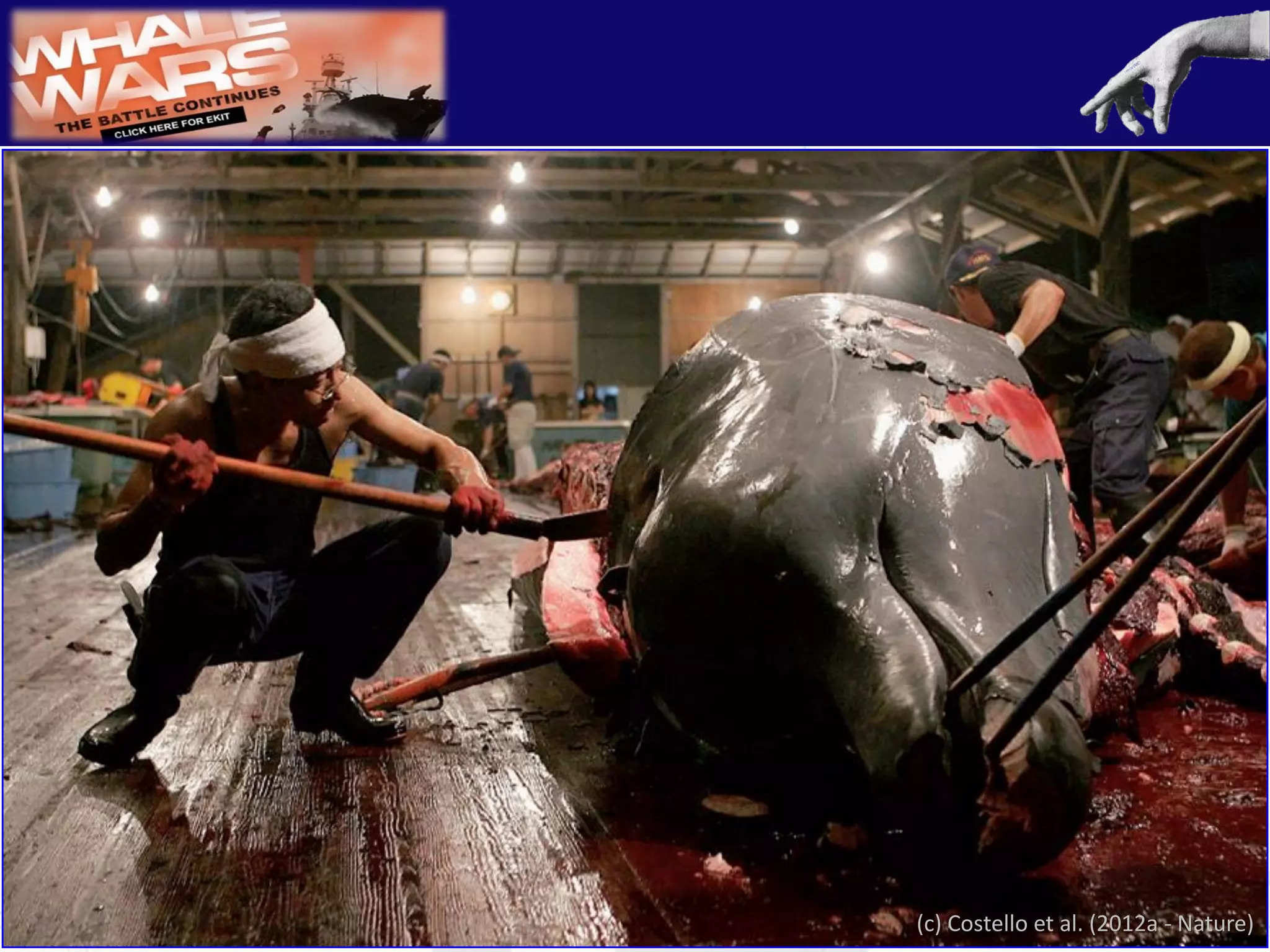
ALTER - Net 3(c) Costello et al. (2012a - Nature)
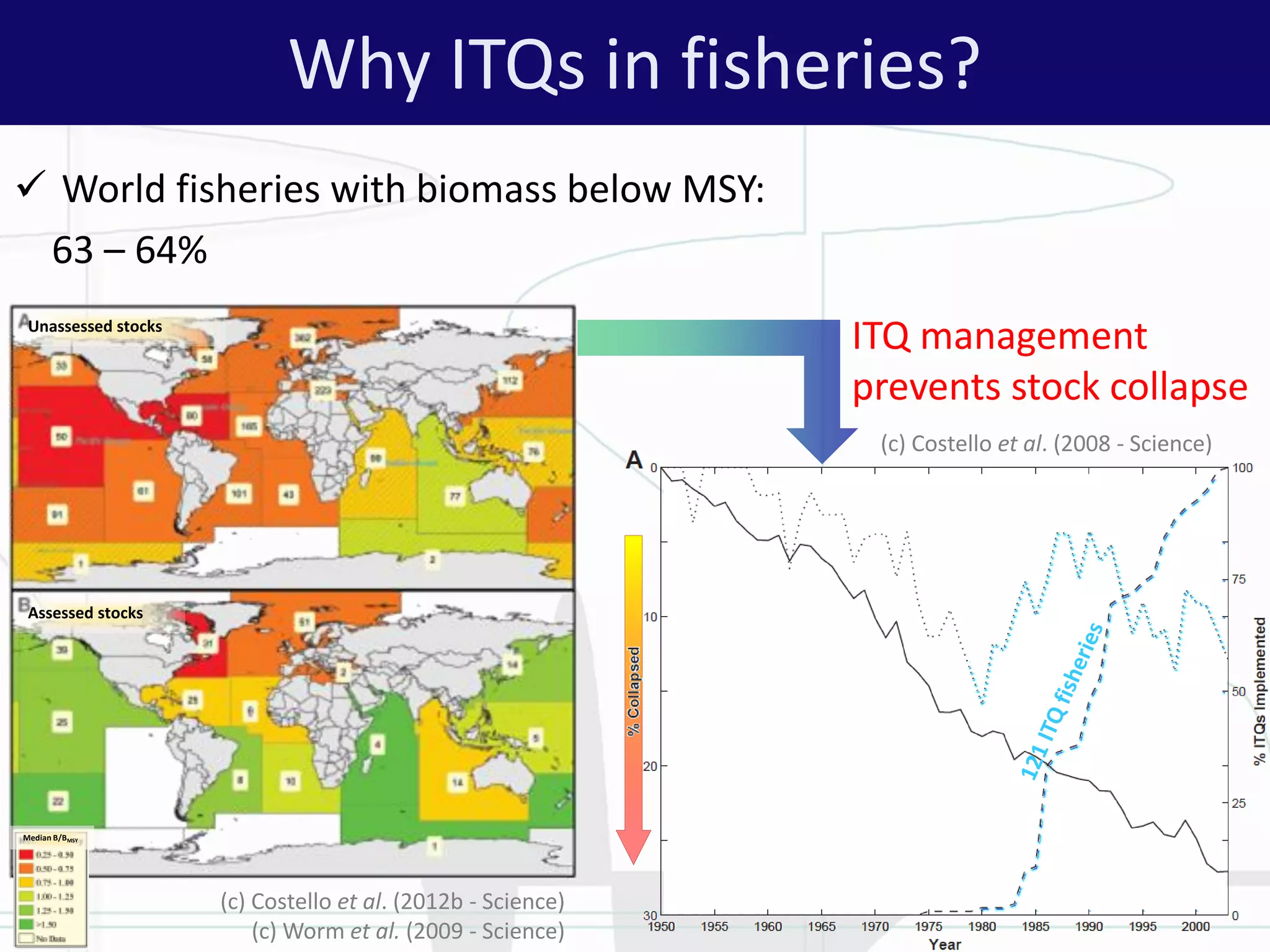
ITQ management
prevents stock collapse
Why ITQs in fisheries?
 World fisheries with biomass below MSY:
63 – 64%
(c) Costello et al. (2012b - Science)
(c) Worm et al. (2009 - Science)
Unassessed stocks
Assessed stocks
Median B/BMSY
(c) Costello et al. (2008 - Science)
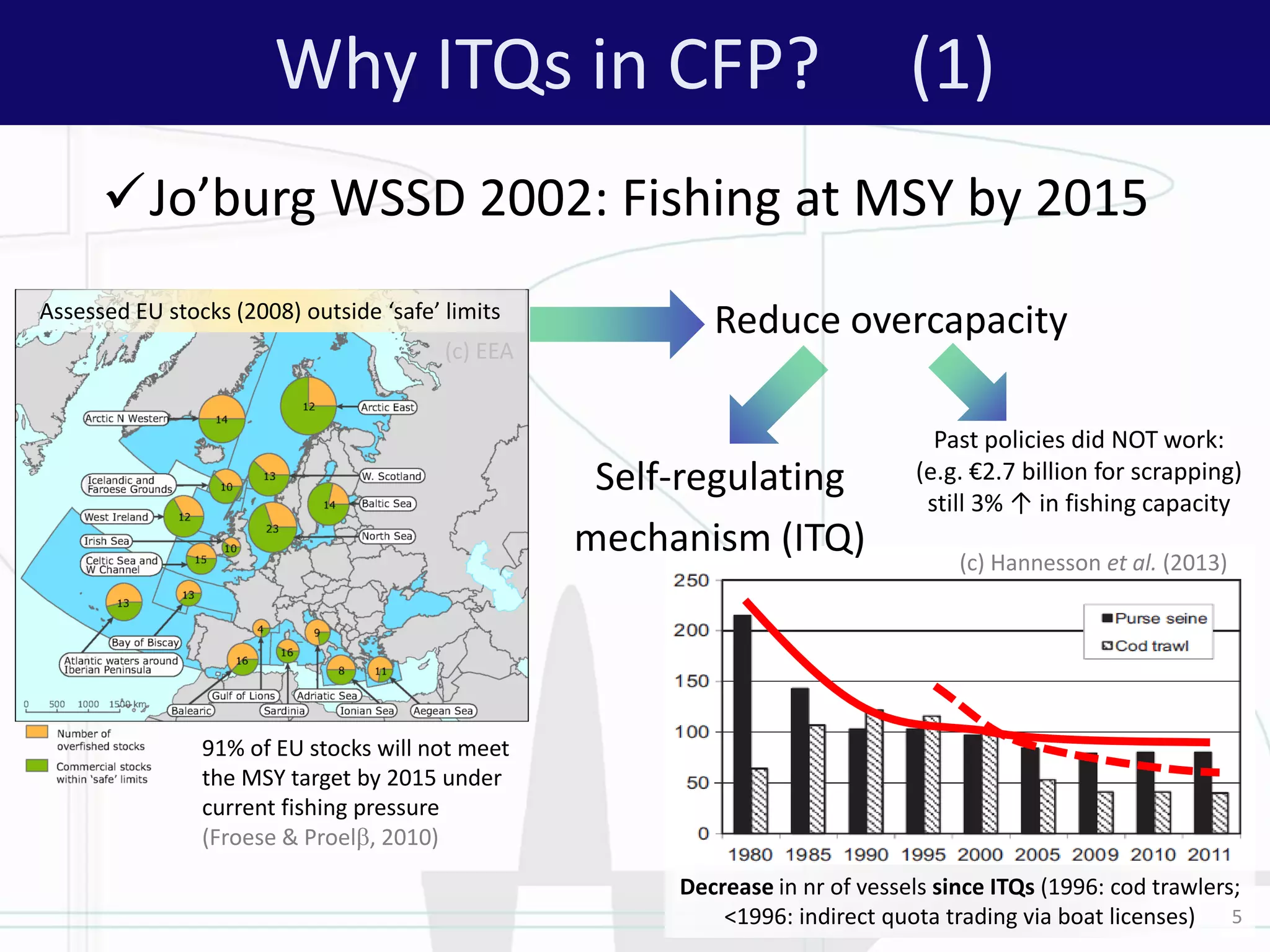
Why ITQs in CFP? (1)
Jo’burg WSSD 2002: Fishing at MSY by 2015
Decrease in nr of vessels since ITQs (1996: cod trawlers;
<1996: indirect quota trading via boat licenses)
(c) Hannesson et al. (2013)
Assessed EU stocks (2008) outside ‘safe’ limits
(c) EEA
Reduce overcapacity
5
Past policies did NOT work:
(e.g. €2.7 billion for scrapping)
still 3% ↑ in fishing capacity
Self-regulating
mechanism (ITQ)
91% of EU stocks will not meet
the MSY target by 2015 under
current fishing pressure
(Froese & Proelb, 2010)
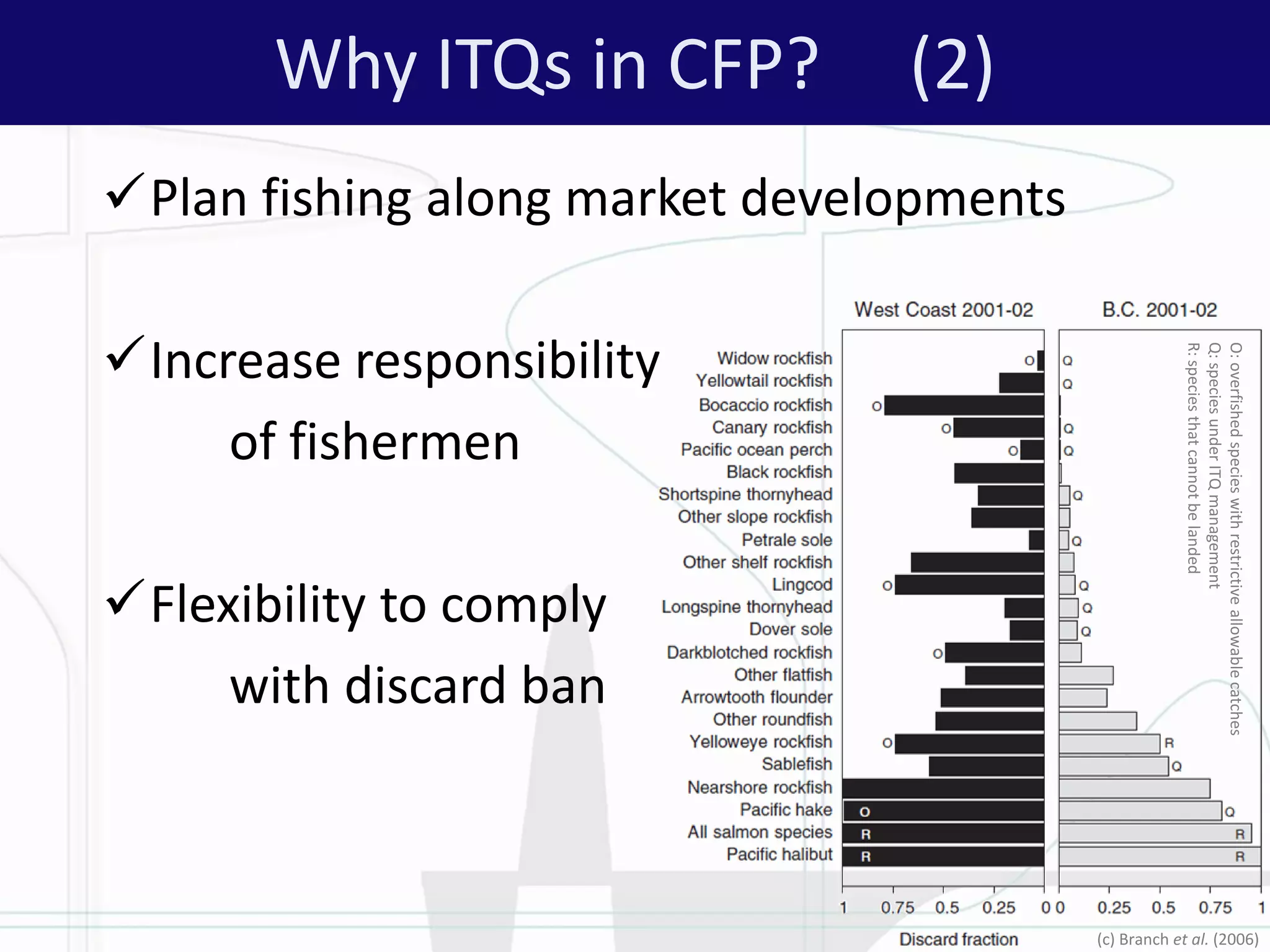
Why ITQs in CFP? (2)
Plan fishing along market developments
Increase responsibility
of fishermen
Flexibility to comply
with discard ban
O:overfishedspecieswithrestrictiveallowablecatches
Q:speciesunderITQmanagement
R:speciesthatcannotbelanded
(c) Branch et al. (2006)
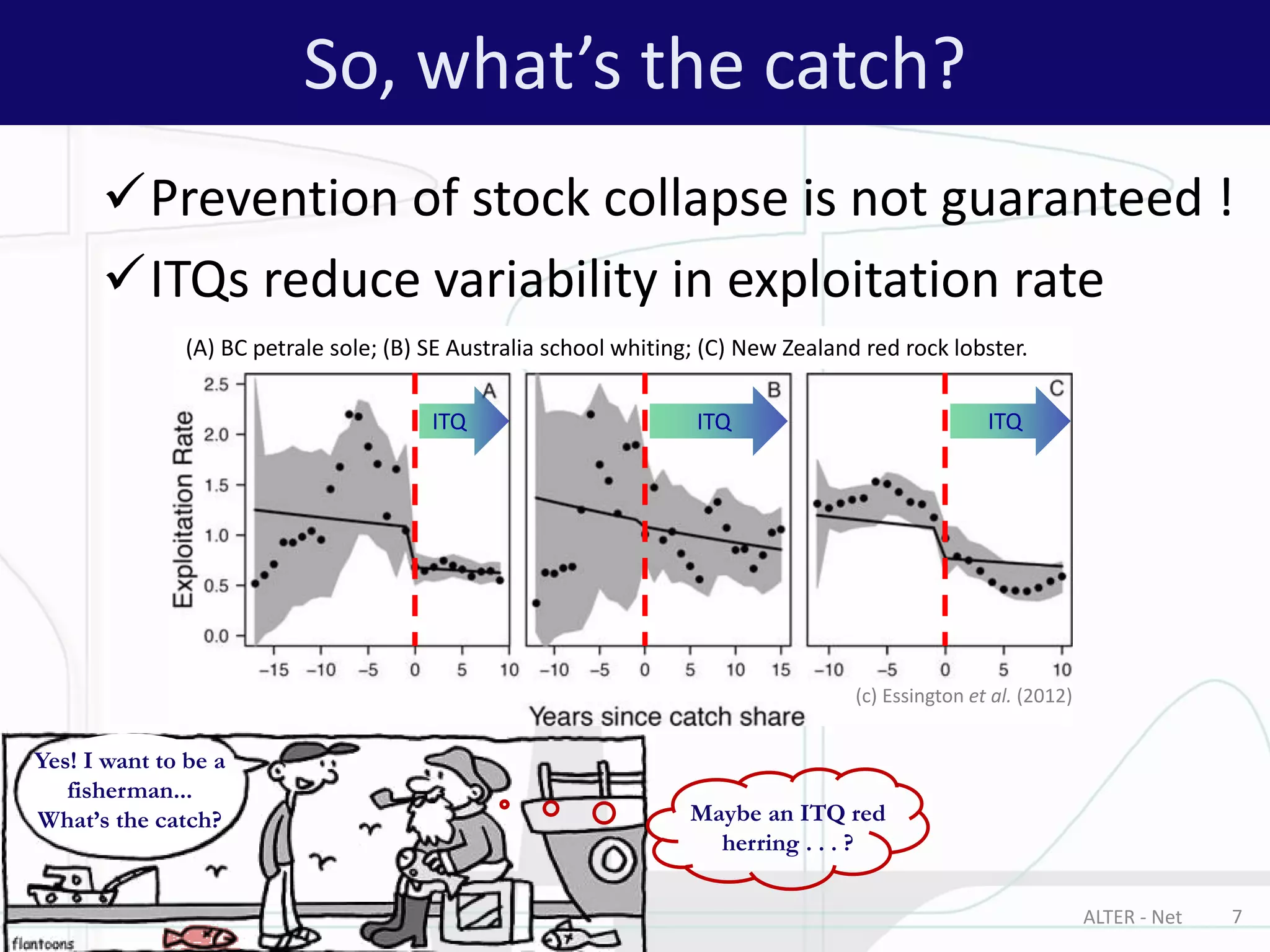
Prevention of stock collapse is not guaranteed !
ITQs reduce variability in exploitation rate
ALTER - Net 7
So, what’s the catch?
Yes! I want to be a
fisherman...
What’s the catch? Maybe an ITQ red
herring . . . ?
(A) BC petrale sole; (B) SE Australia school whiting; (C) New Zealand red rock lobster.
(c) Essington et al. (2012)
ITQ ITQ ITQ
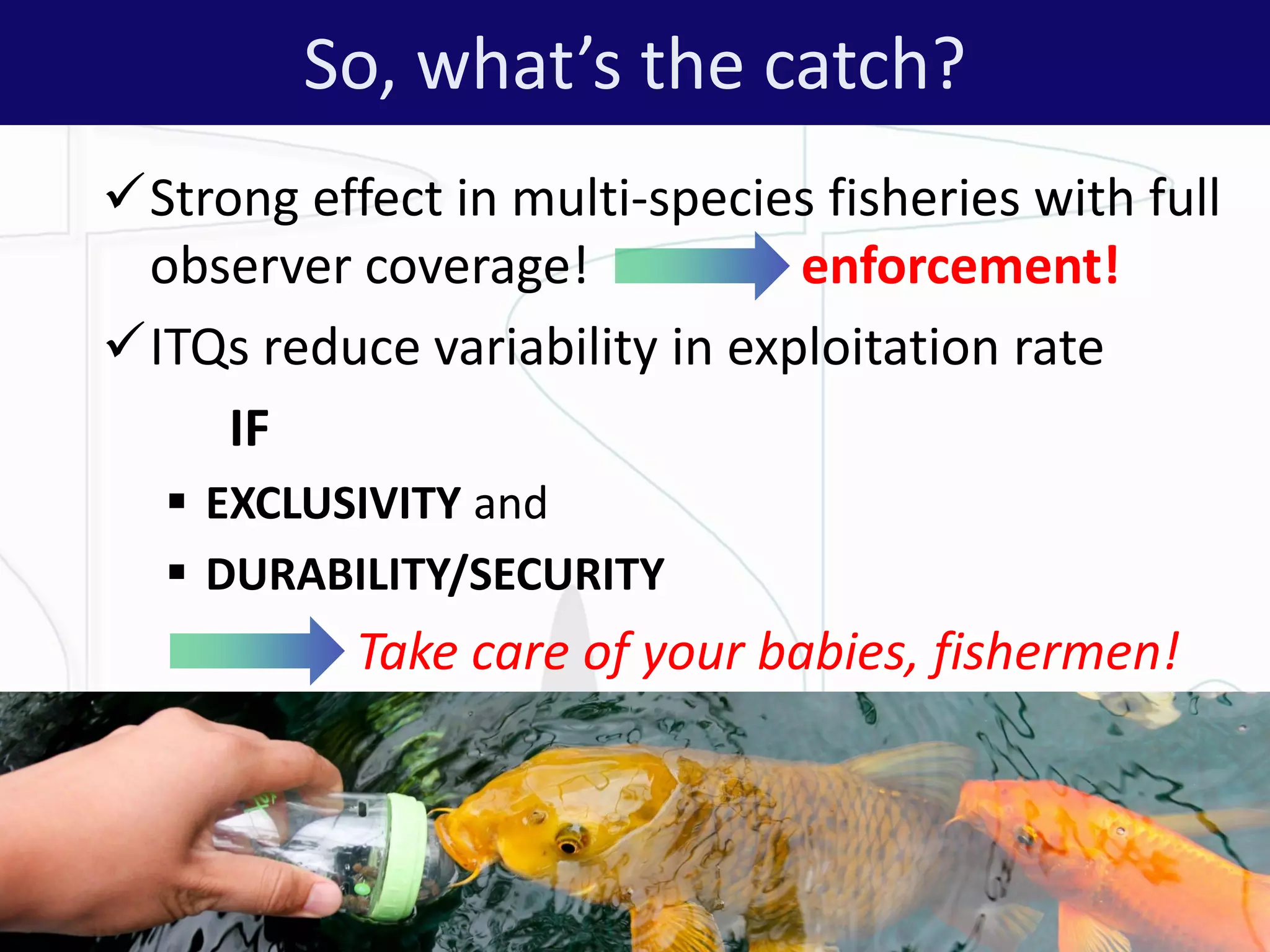
Strong effect in multi-species fisheries with full
observer coverage! enforcement!
ITQs reduce variability in exploitation rate
IF
 EXCLUSIVITY and
 DURABILITY/SECURITY
Take care of your babies, fishermen!
ALTER - Net 8
So, what’s the catch?
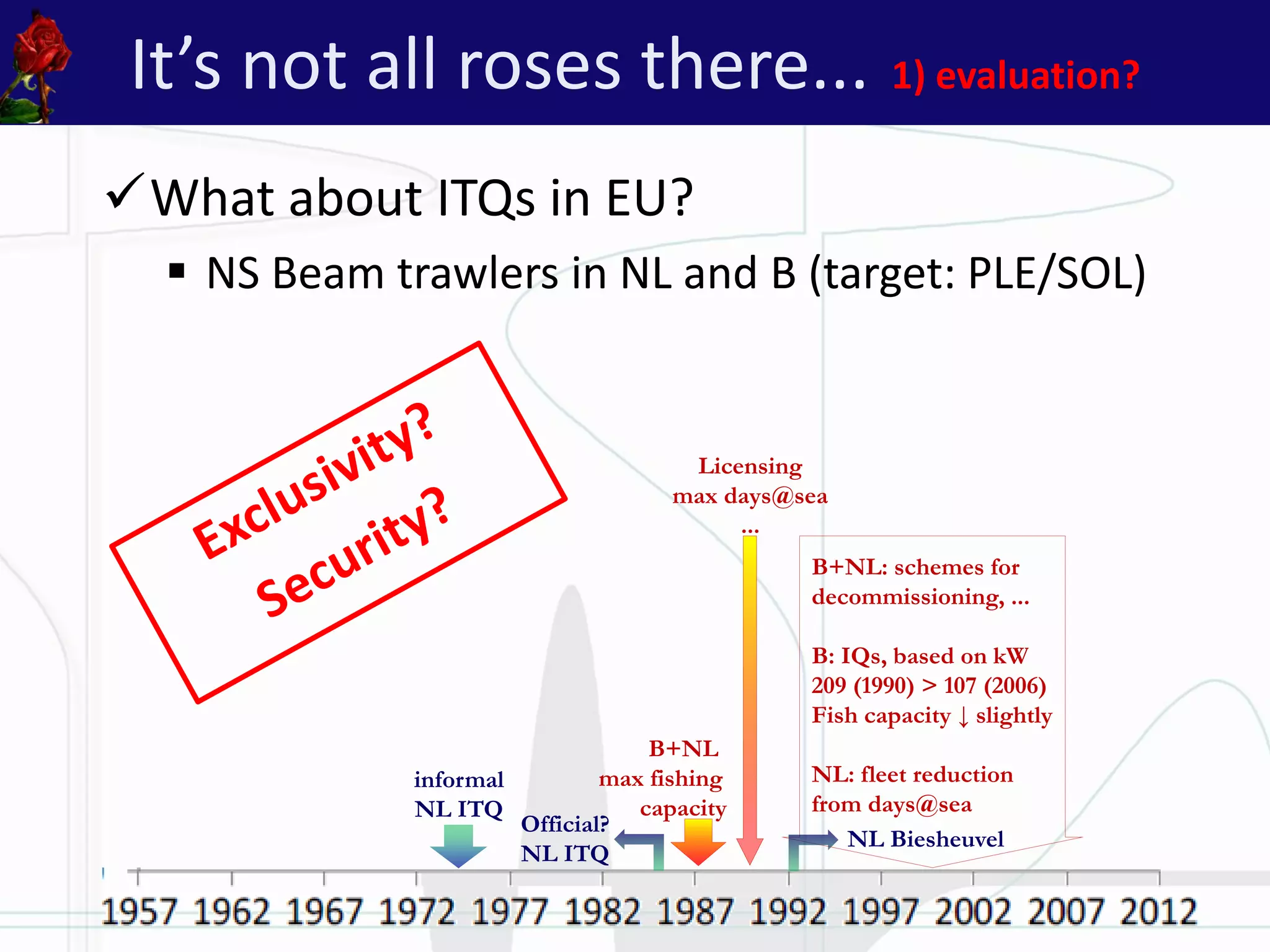
It’s not all roses there... 1) evaluation?
What about ITQs in EU?
 NS Beam trawlers in NL and B (target: PLE/SOL)
Licensing
max days@sea
...
B+NL
max fishing
capacity
NL Biesheuvel
informal
NL ITQ
Official?
NL ITQ
B+NL: schemes for
decommissioning, ...
B: IQs, based on kW
209 (1990) > 107 (2006)
Fish capacity ↓ slightly
NL: fleet reduction
from days@sea
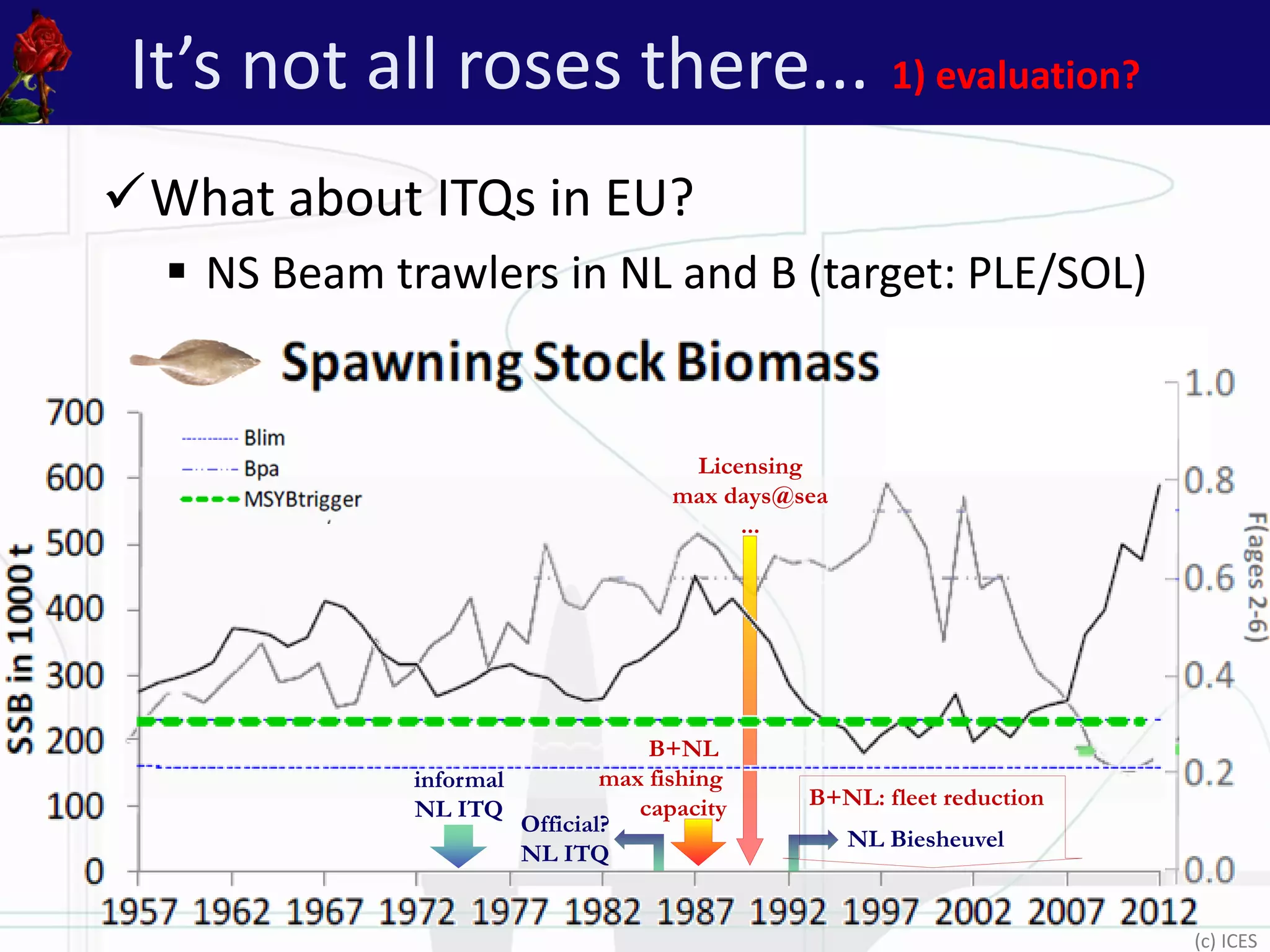
It’s not all roses there... 1) evaluation?
What about ITQs in EU?
 NS Beam trawlers in NL and B (target: PLE/SOL)
Licensing
max days@sea
...
B+NL: fleet reduction
B+NL
max fishing
capacity
(c) ICES
informal
NL ITQ
NL Biesheuvel
Official?
NL ITQ
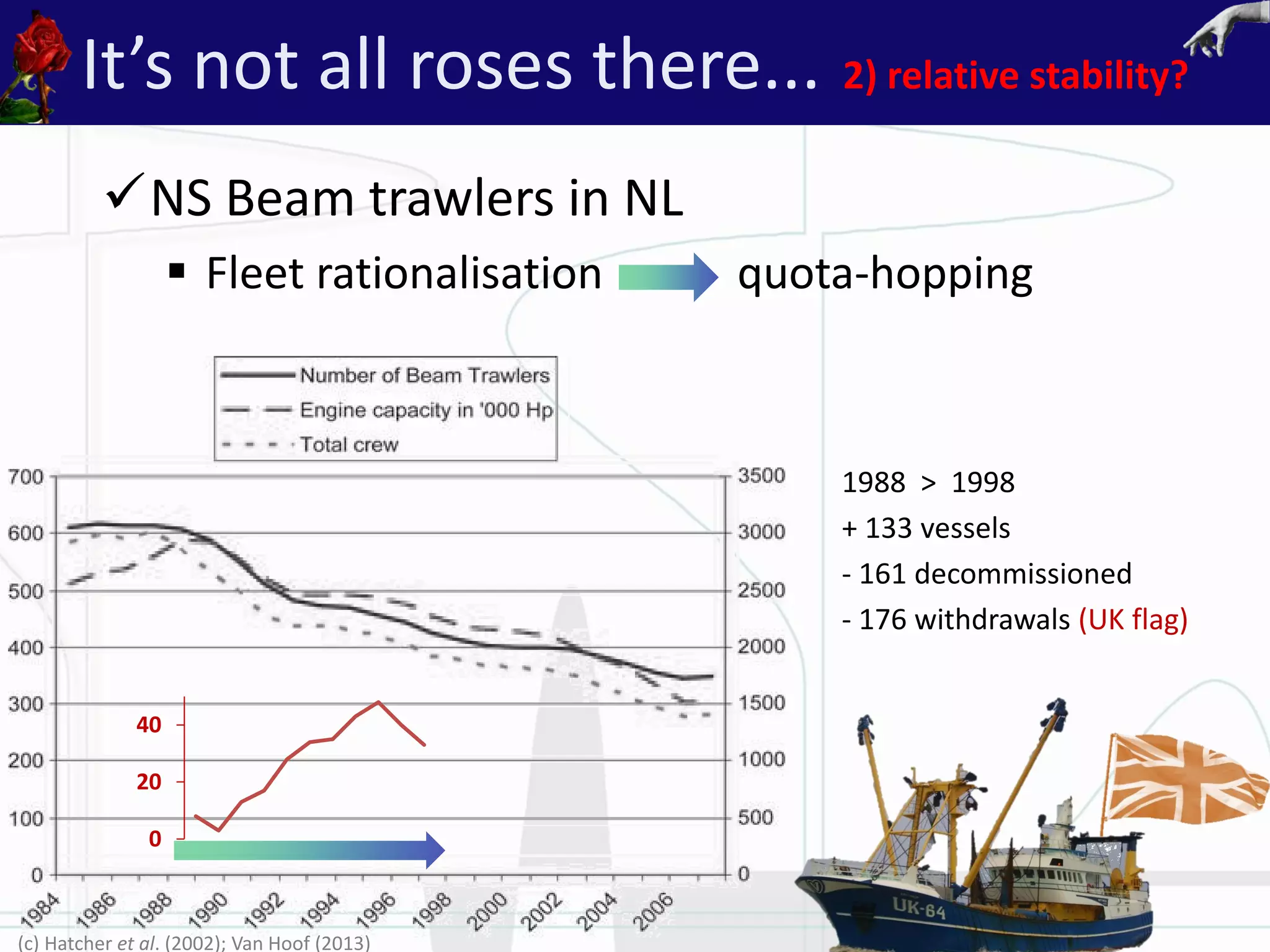
It’s not all roses there... 2) relative stability?
NS Beam trawlers in NL
 Fleet rationalisation quota-hopping
(c) Hatcher et al. (2002); Van Hoof (2013)
1988 > 1998
+ 133 vessels
- 161 decommissioned
- 176 withdrawals (UK flag)
0
20
40
ALTER - Net 12
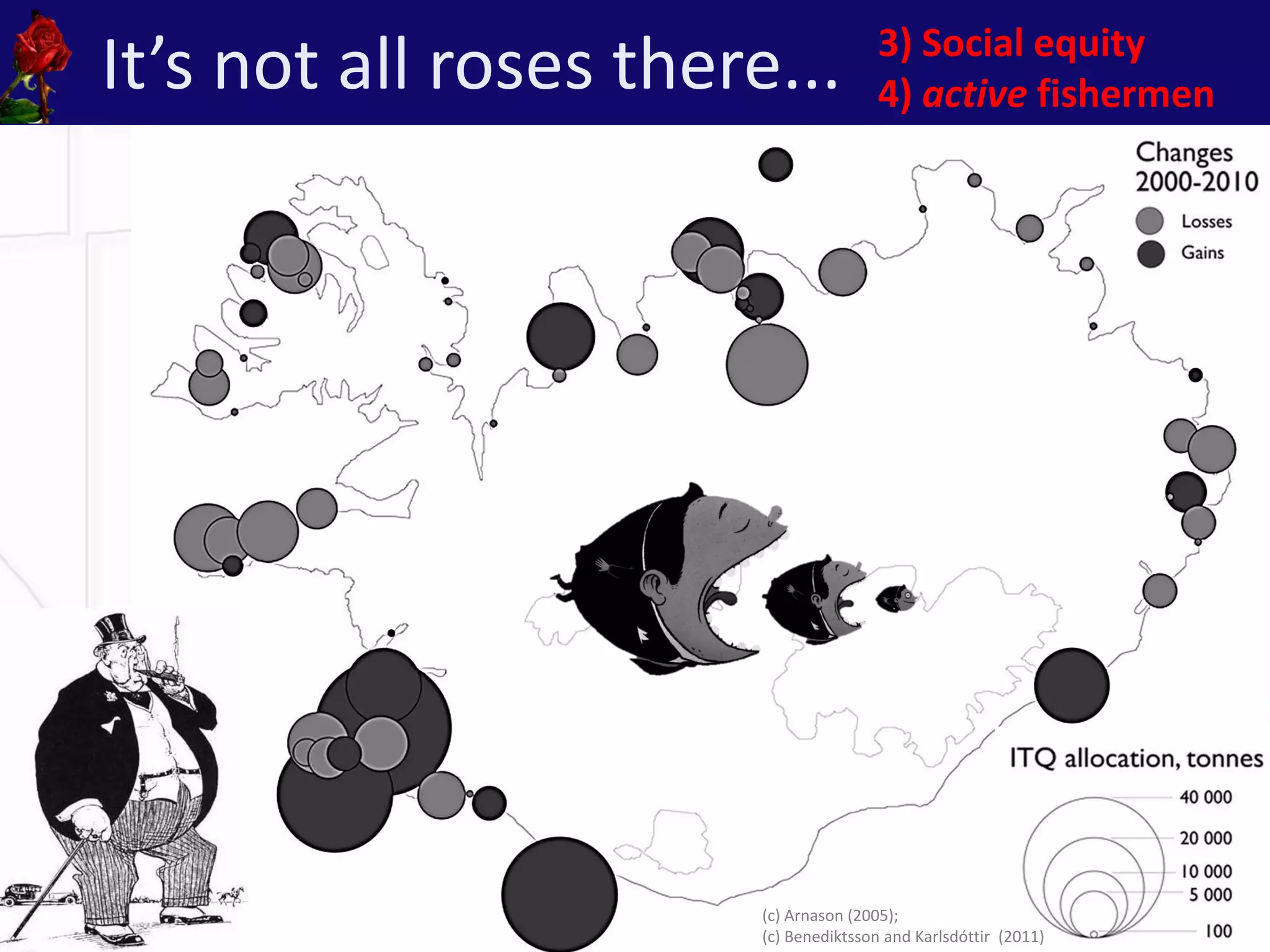
It’s not all roses there...
(c) Arnason (2005);
(c) Benediktsson and Karlsdóttir (2011)
3) Social equity
4) active fishermen
ALTER - Net 13
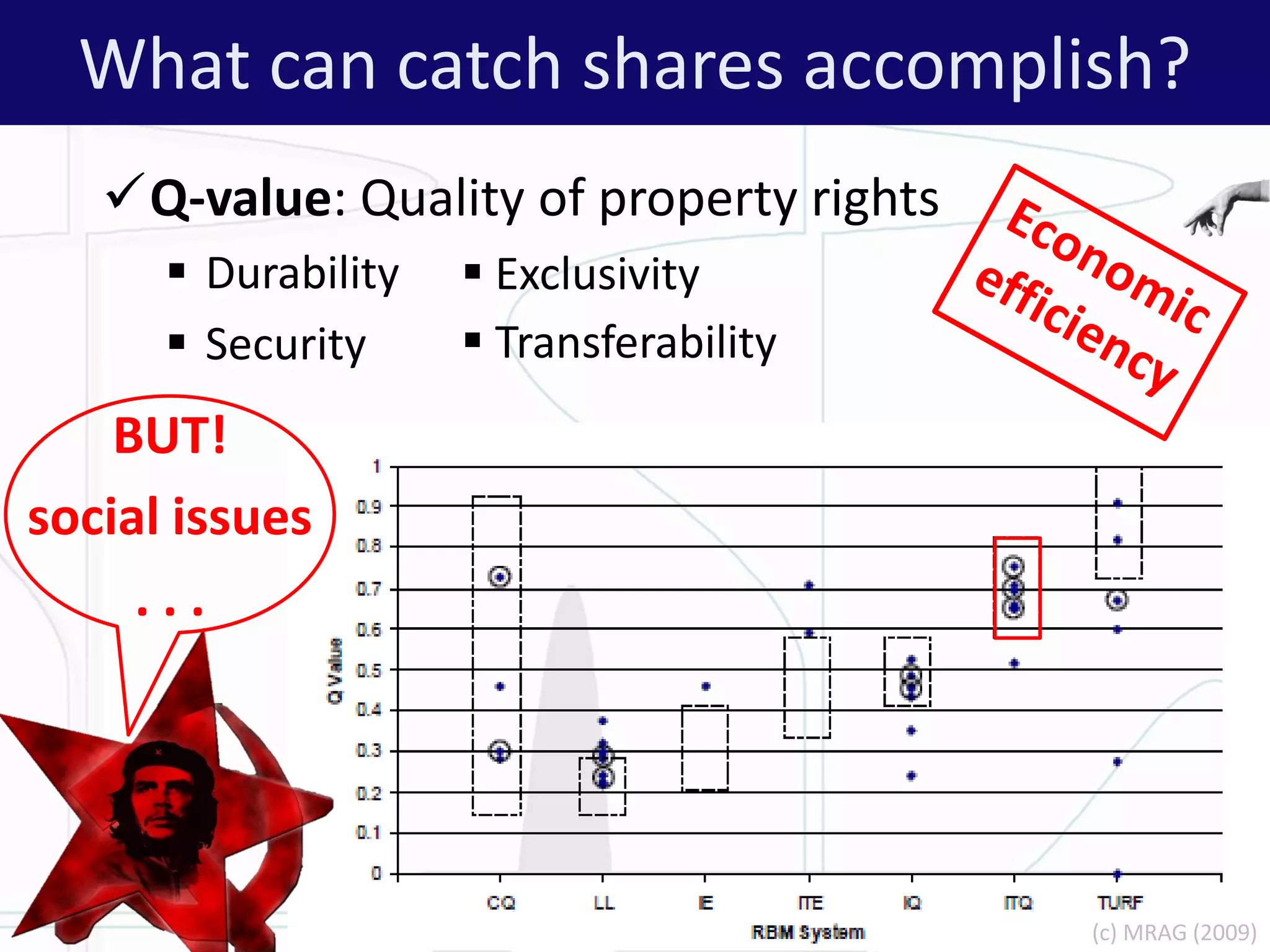
What can catch shares accomplish?
Q-value: Quality of property rights
 Durability
 Security
 Exclusivity
 Transferability
(c) MRAG (2009)
BUT!
social issues
. . .
ALTER - Net 14
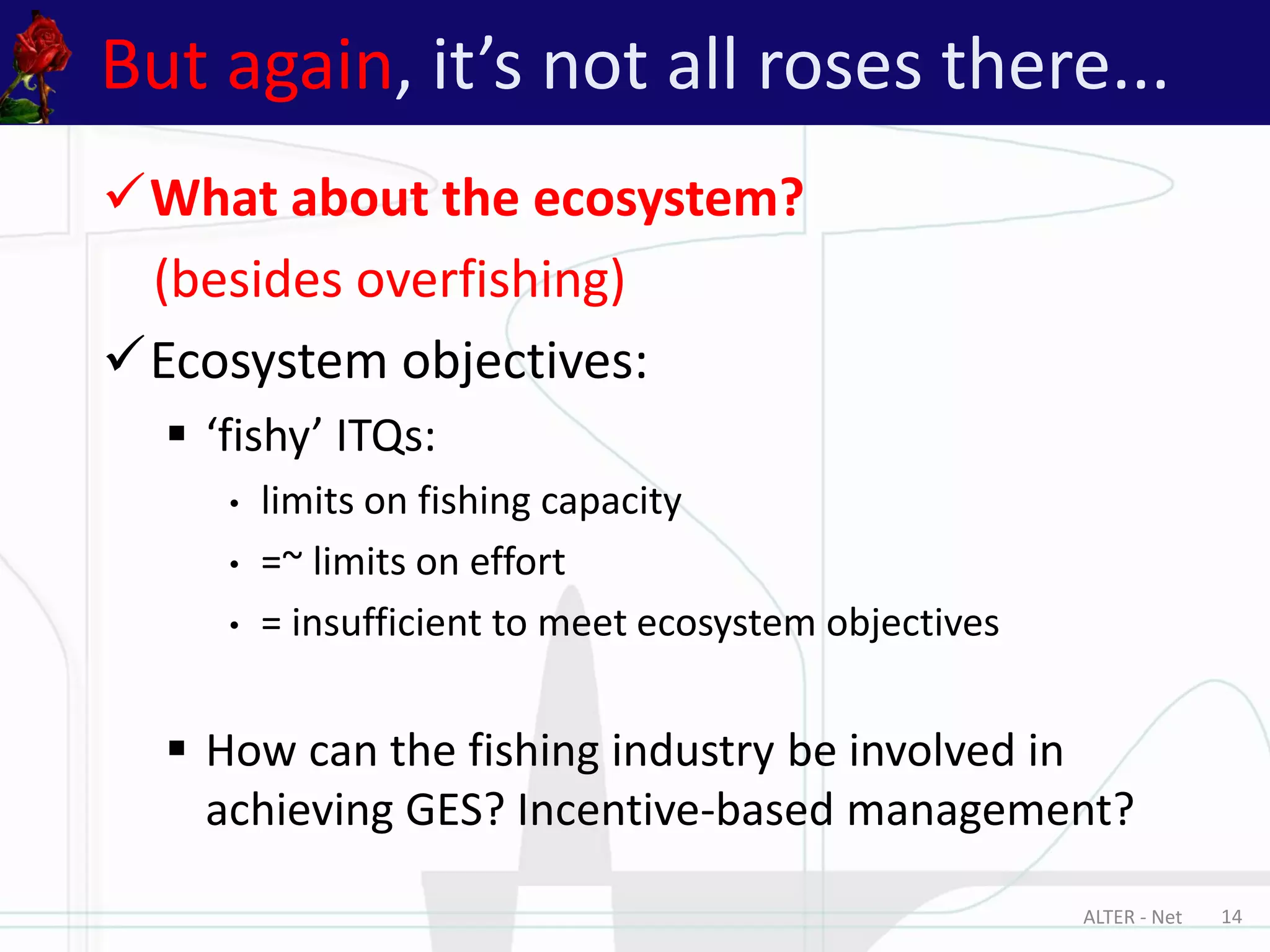
But again, it’s not all roses there...
What about the ecosystem?
(besides overfishing)
Ecosystem objectives:
 ‘fishy’ ITQs:
• limits on fishing capacity
• =~ limits on effort
• = insufficient to meet ecosystem objectives
 How can the fishing industry be involved in
achieving GES? Incentive-based management?
ALTER - Net 15
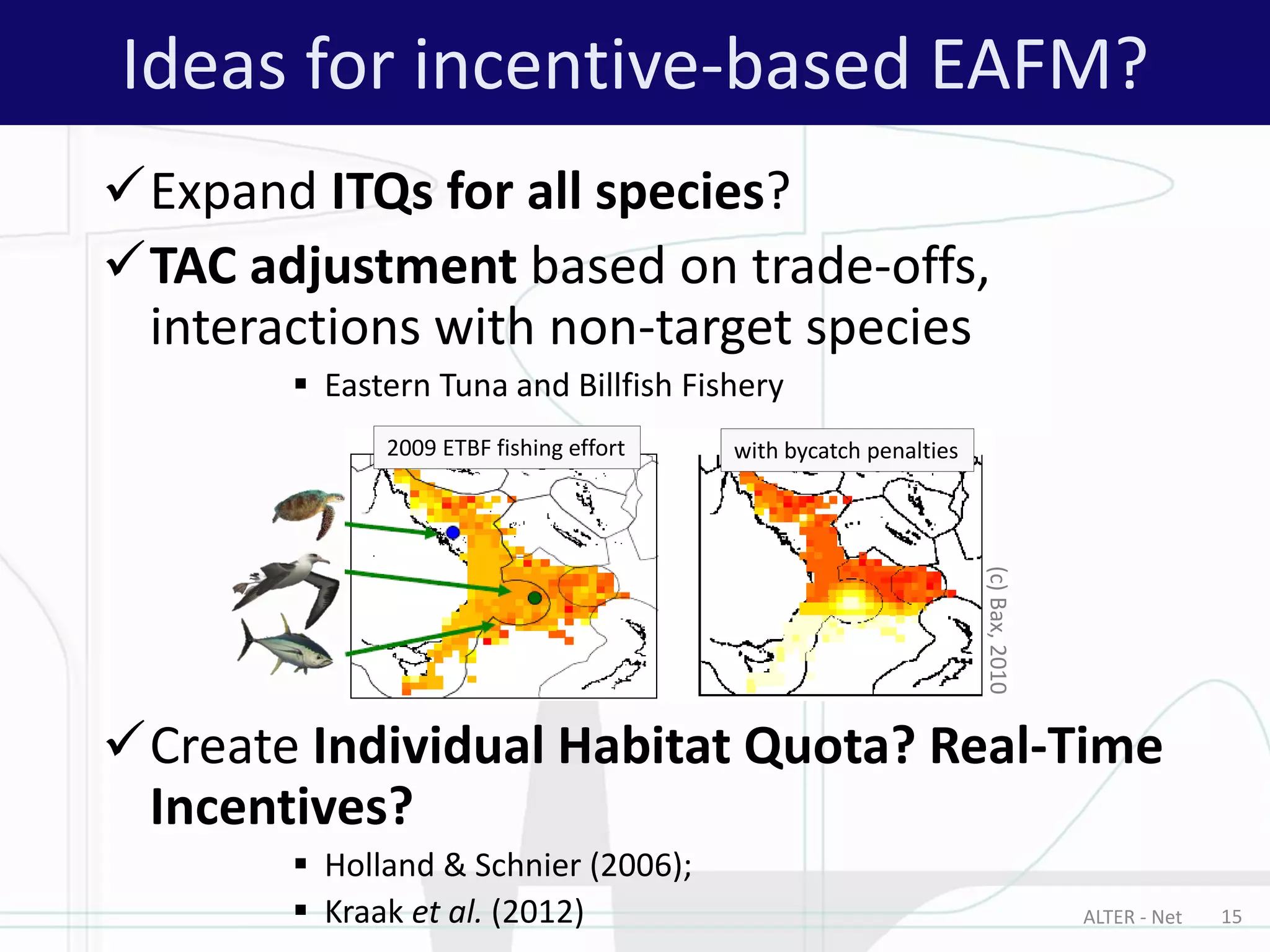
Ideas for incentive-based EAFM?
Expand ITQs for all species?
TAC adjustment based on trade-offs,
interactions with non-target species
 Eastern Tuna and Billfish Fishery
Create Individual Habitat Quota? Real-Time
Incentives?
 Holland & Schnier (2006);
 Kraak et al. (2012)
with bycatch penalties2009 ETBF fishing effort
(c)Bax,2010
Statement 2: Rights-based catch shares can
provide incentives for sustainable harvest that is
less prone to collapse. It can, however, lead to
accumulation of fishery property rights in non-
fishery related companies.
Statement 3: Bottom trawling and the seafloor
disturbance resulting from it enhances fish stock
productivity and is essential for productive fish
stocks and economically viable fisheries.
2 statements: second
ALTER - Net 16
Seafloor impacts
ALTER - Net 17
Seafloor impacts Fishermen’s perspectives
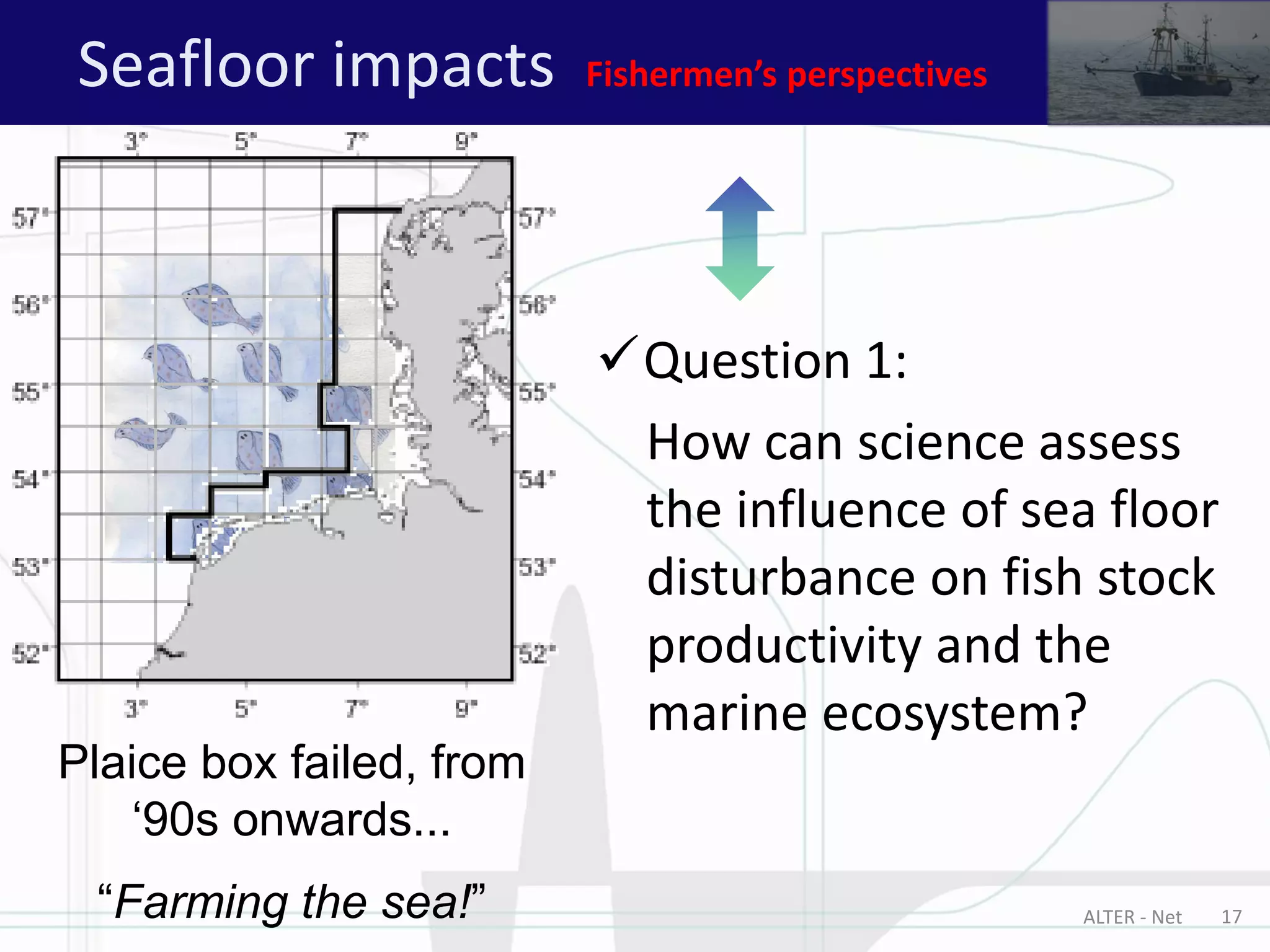
Plaice box failed, from
‘90s onwards...
“Farming the sea!”
Question 1:
How can science assess
the influence of sea floor
disturbance on fish stock
productivity and the
marine ecosystem?
ALTER - Net 18
From short-term to long-term monitoring…
1) BACI-experiments:
Short-term mortality, scavenging, etc.
2) Modelling
Combination of short-term empirical data
through algorithms
3) Effort comparisons
Long-term, historical data
Spatially
Seafloor impacts Scientific assessments
ALTER - Net 19
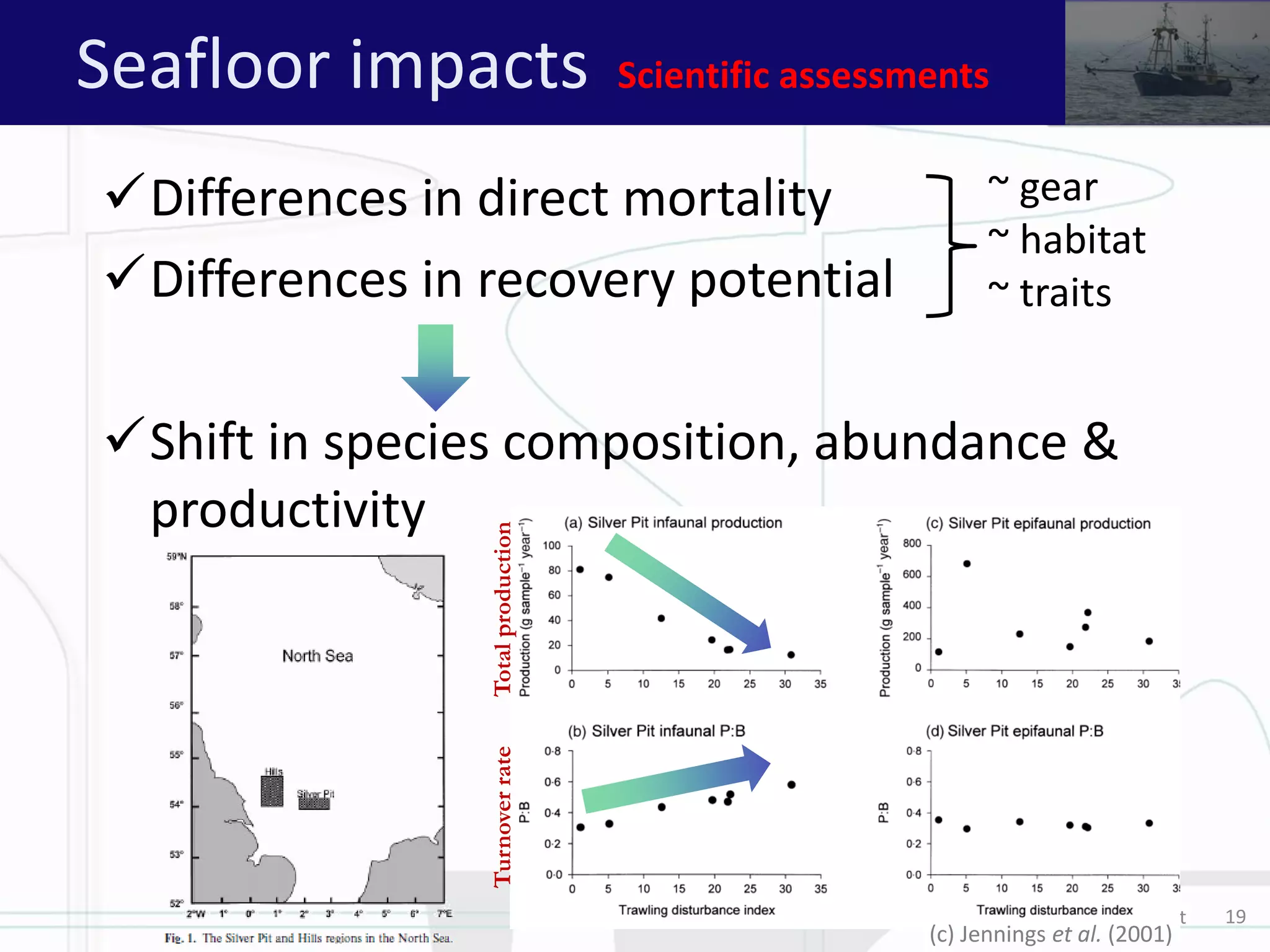
Differences in direct mortality
Differences in recovery potential
Shift in species composition, abundance &
productivity
~ gear
~ habitat
~ traits
TotalproductionTurnoverrate
(c) Jennings et al. (2001)
Seafloor impacts Scientific assessments
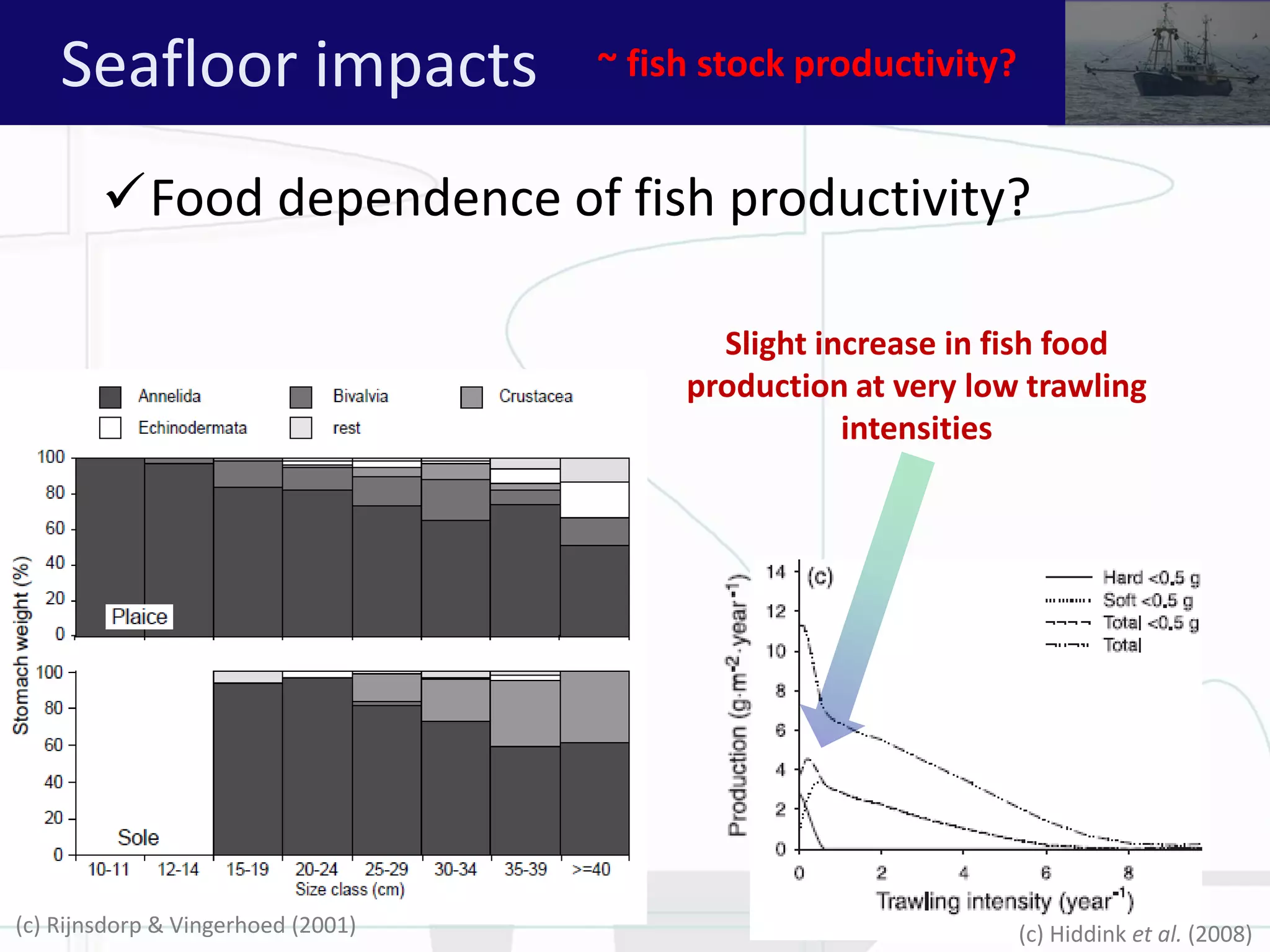
Food dependence of fish productivity?
(c) Rijnsdorp & Vingerhoed (2001)
Slight increase in fish food
production at very low trawling
intensities
(c) Hiddink et al. (2008)
Seafloor impacts ~ fish stock productivity?
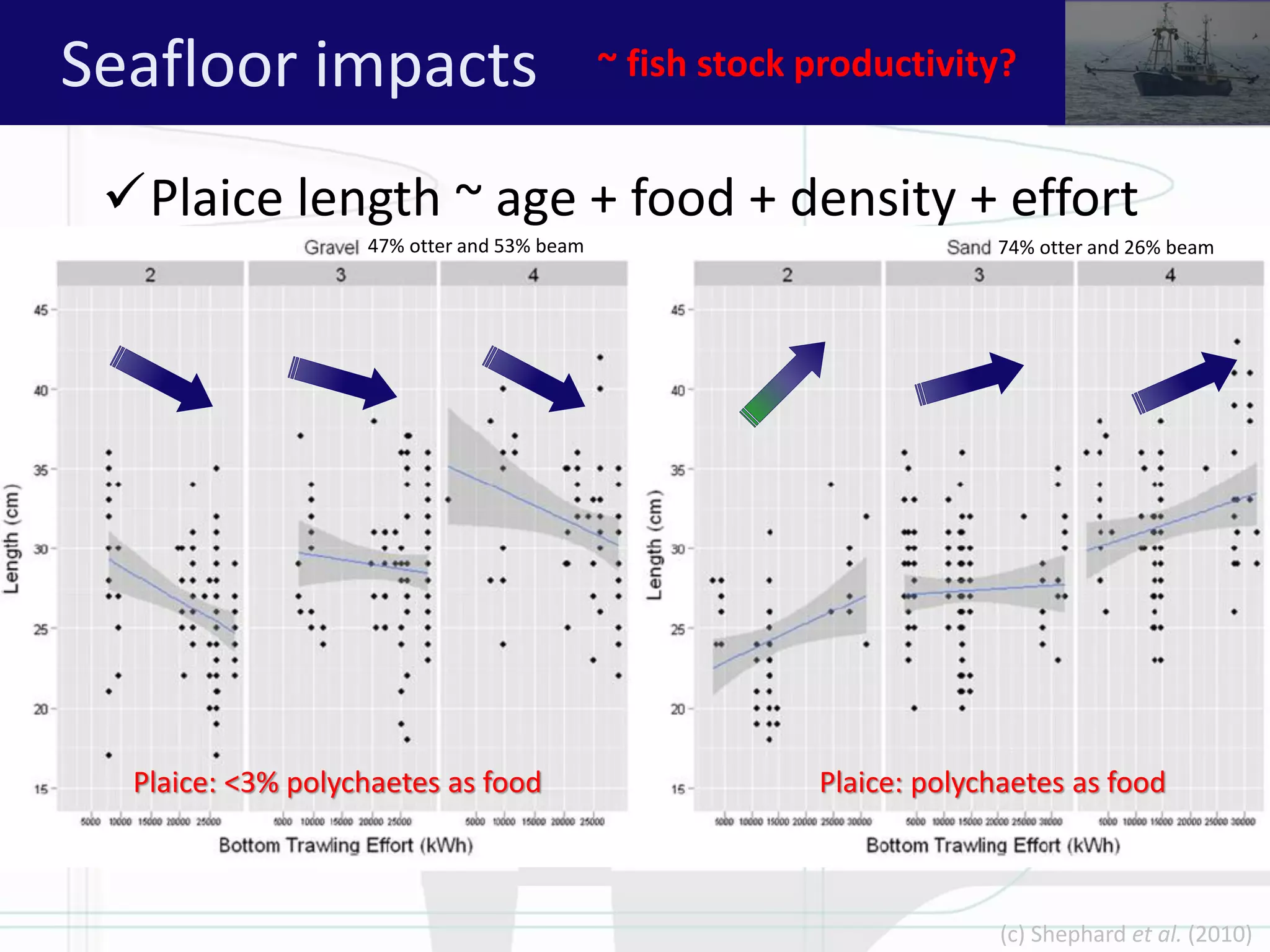
Plaice length ~ age + food + density + effort
(c) Shephard et al. (2010)
74% otter and 26% beam47% otter and 53% beam
Plaice: polychaetes as foodPlaice: <3% polychaetes as food
Seafloor impacts ~ fish stock productivity?
Statement 2: How can ITQs be used to combine
economics, society and ecosystems?
 ITQs = economic efficient
 ITQs = social drama?
 ITQs = What about other ecosystem objectives
besides overfishing?
Statement 3:
 Ploughing the seafloor:
How can we communicate the subtle effects and
the (sometimes contradicting) and ‘difficult’
scientific results on the effects of seafloor
disturbance with fishermen?
2 questions in ‘conclusion’
ALTER - Net 22
Institute for Agricultural and Fisheries Research
www.ilvo.vlaanderen.be
Agriculture and Fisheries Policy Area
Institute for Agricultural and Fisheries Research
From right-based catch shares
to benthic impacts
Jochen.Depestele@ilvo.vlaanderen.be

2013 depestele it_qs-seafloor_v_final

  • 1.
    Institute for Agriculturaland Fisheries Research www.ilvo.vlaanderen.be Agriculture and Fisheries Policy Area Institute for Agricultural and Fisheries Research From right-based catch shares to benthic impacts ALTER-NET Target 4: Ensure the sustainability of fisheries Gent, Belgium 18 april 2013 Jochen Depestele
  • 2.
    Statement 2: Rights-basedcatch shares can provide incentives for sustainable harvest that is less prone to collapse. It can, however, lead to accumulation of fishery property rights in non- fishery related companies. Statement 3: Bottom trawling and the seafloor disturbance resulting from it enhances fish stock productivity and is essential for productive fish stocks and economically viable fisheries. 2 statements: first ALTER - Net 2
  • 3.
    ALTER - Net3(c) Costello et al. (2012a - Nature)
  • 4.
    ITQ management prevents stockcollapse Why ITQs in fisheries?  World fisheries with biomass below MSY: 63 – 64% (c) Costello et al. (2012b - Science) (c) Worm et al. (2009 - Science) Unassessed stocks Assessed stocks Median B/BMSY (c) Costello et al. (2008 - Science)
  • 5.
    Why ITQs inCFP? (1) Jo’burg WSSD 2002: Fishing at MSY by 2015 Decrease in nr of vessels since ITQs (1996: cod trawlers; <1996: indirect quota trading via boat licenses) (c) Hannesson et al. (2013) Assessed EU stocks (2008) outside ‘safe’ limits (c) EEA Reduce overcapacity 5 Past policies did NOT work: (e.g. €2.7 billion for scrapping) still 3% ↑ in fishing capacity Self-regulating mechanism (ITQ) 91% of EU stocks will not meet the MSY target by 2015 under current fishing pressure (Froese & Proelb, 2010)
  • 6.
    Why ITQs inCFP? (2) Plan fishing along market developments Increase responsibility of fishermen Flexibility to comply with discard ban O:overfishedspecieswithrestrictiveallowablecatches Q:speciesunderITQmanagement R:speciesthatcannotbelanded (c) Branch et al. (2006)
  • 7.
    Prevention of stockcollapse is not guaranteed ! ITQs reduce variability in exploitation rate ALTER - Net 7 So, what’s the catch? Yes! I want to be a fisherman... What’s the catch? Maybe an ITQ red herring . . . ? (A) BC petrale sole; (B) SE Australia school whiting; (C) New Zealand red rock lobster. (c) Essington et al. (2012) ITQ ITQ ITQ
  • 8.
    Strong effect inmulti-species fisheries with full observer coverage! enforcement! ITQs reduce variability in exploitation rate IF  EXCLUSIVITY and  DURABILITY/SECURITY Take care of your babies, fishermen! ALTER - Net 8 So, what’s the catch?
  • 9.
    It’s not allroses there... 1) evaluation? What about ITQs in EU?  NS Beam trawlers in NL and B (target: PLE/SOL) Licensing max days@sea ... B+NL max fishing capacity NL Biesheuvel informal NL ITQ Official? NL ITQ B+NL: schemes for decommissioning, ... B: IQs, based on kW 209 (1990) > 107 (2006) Fish capacity ↓ slightly NL: fleet reduction from days@sea
  • 10.
    It’s not allroses there... 1) evaluation? What about ITQs in EU?  NS Beam trawlers in NL and B (target: PLE/SOL) Licensing max days@sea ... B+NL: fleet reduction B+NL max fishing capacity (c) ICES informal NL ITQ NL Biesheuvel Official? NL ITQ
  • 11.
    It’s not allroses there... 2) relative stability? NS Beam trawlers in NL  Fleet rationalisation quota-hopping (c) Hatcher et al. (2002); Van Hoof (2013) 1988 > 1998 + 133 vessels - 161 decommissioned - 176 withdrawals (UK flag) 0 20 40
  • 12.
    ALTER - Net12 It’s not all roses there... (c) Arnason (2005); (c) Benediktsson and Karlsdóttir (2011) 3) Social equity 4) active fishermen
  • 13.
    ALTER - Net13 What can catch shares accomplish? Q-value: Quality of property rights  Durability  Security  Exclusivity  Transferability (c) MRAG (2009) BUT! social issues . . .
  • 14.
    ALTER - Net14 But again, it’s not all roses there... What about the ecosystem? (besides overfishing) Ecosystem objectives:  ‘fishy’ ITQs: • limits on fishing capacity • =~ limits on effort • = insufficient to meet ecosystem objectives  How can the fishing industry be involved in achieving GES? Incentive-based management?
  • 15.
    ALTER - Net15 Ideas for incentive-based EAFM? Expand ITQs for all species? TAC adjustment based on trade-offs, interactions with non-target species  Eastern Tuna and Billfish Fishery Create Individual Habitat Quota? Real-Time Incentives?  Holland & Schnier (2006);  Kraak et al. (2012) with bycatch penalties2009 ETBF fishing effort (c)Bax,2010
  • 16.
    Statement 2: Rights-basedcatch shares can provide incentives for sustainable harvest that is less prone to collapse. It can, however, lead to accumulation of fishery property rights in non- fishery related companies. Statement 3: Bottom trawling and the seafloor disturbance resulting from it enhances fish stock productivity and is essential for productive fish stocks and economically viable fisheries. 2 statements: second ALTER - Net 16
  • 17.
    Seafloor impacts ALTER -Net 17 Seafloor impacts Fishermen’s perspectives Plaice box failed, from ‘90s onwards... “Farming the sea!” Question 1: How can science assess the influence of sea floor disturbance on fish stock productivity and the marine ecosystem?
  • 18.
    ALTER - Net18 From short-term to long-term monitoring… 1) BACI-experiments: Short-term mortality, scavenging, etc. 2) Modelling Combination of short-term empirical data through algorithms 3) Effort comparisons Long-term, historical data Spatially Seafloor impacts Scientific assessments
  • 19.
    ALTER - Net19 Differences in direct mortality Differences in recovery potential Shift in species composition, abundance & productivity ~ gear ~ habitat ~ traits TotalproductionTurnoverrate (c) Jennings et al. (2001) Seafloor impacts Scientific assessments
  • 20.
    Food dependence offish productivity? (c) Rijnsdorp & Vingerhoed (2001) Slight increase in fish food production at very low trawling intensities (c) Hiddink et al. (2008) Seafloor impacts ~ fish stock productivity?
  • 21.
    Plaice length ~age + food + density + effort (c) Shephard et al. (2010) 74% otter and 26% beam47% otter and 53% beam Plaice: polychaetes as foodPlaice: <3% polychaetes as food Seafloor impacts ~ fish stock productivity?
  • 22.
    Statement 2: Howcan ITQs be used to combine economics, society and ecosystems?  ITQs = economic efficient  ITQs = social drama?  ITQs = What about other ecosystem objectives besides overfishing? Statement 3:  Ploughing the seafloor: How can we communicate the subtle effects and the (sometimes contradicting) and ‘difficult’ scientific results on the effects of seafloor disturbance with fishermen? 2 questions in ‘conclusion’ ALTER - Net 22
  • 23.
    Institute for Agriculturaland Fisheries Research www.ilvo.vlaanderen.be Agriculture and Fisheries Policy Area Institute for Agricultural and Fisheries Research From right-based catch shares to benthic impacts Jochen.Depestele@ilvo.vlaanderen.be