

COPING WITH CLOUD
MIGRATION CHALLENGES:
BEST PRACTICES AND
SECURITY CONSIDERATIONS
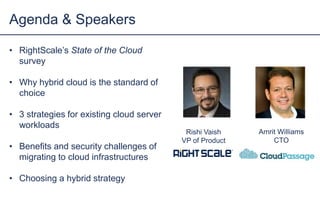
Agenda & Speakers
®
Rishi Vaish
VP of Product
Amrit Williams
CTO
• RightScale’s State of the Cloud
survey
• Why hybrid cloud is the standard of
choice
• 3 strategies for existing cloud server
workloads
• Benefits and security challenges of
migrating to cloud infrastructures
• Choosing a hybrid strategy
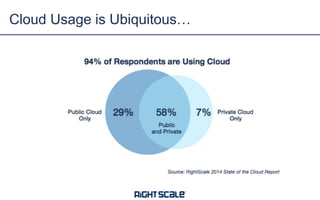
Cloud Usage is Ubiquitous…
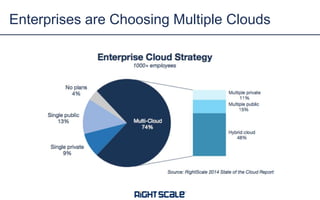
Enterprises are Choosing Multiple Clouds
0%
20%
40%
60%
80%
100%
Cloud Beginners Cloud Explorers Cloud Focused
%ofRespondents
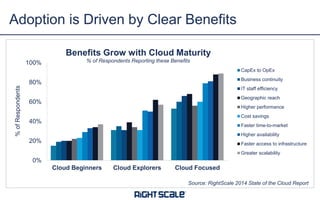
Benefits Grow with Cloud Maturity
% of Respondents Reporting these Benefits
CapEx to OpEx
Business continuity
IT staff efficiency
Geographic reach
Higher performance
Cost savings
Faster time-to-market
Higher availability
Faster access to infrastructure
Greater scalability
Adoption is Driven by Clear Benefits
Source: RightScale 2014 State of the Cloud Report
What about
Existing
Workloads?
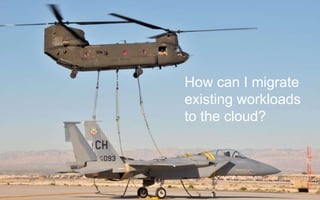
How can I migrate
existing workloads
to the cloud?
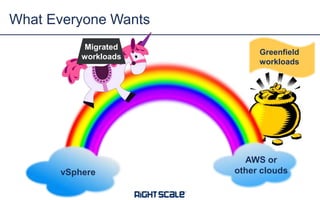
What Everyone Wants
vSphere
AWS or
other clouds
Greenfield
workloads
Migrated
workloads
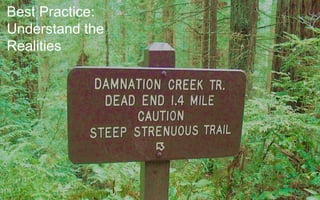
Best Practice 1; Understand the realities
Best Practice:
Understand the
Realities
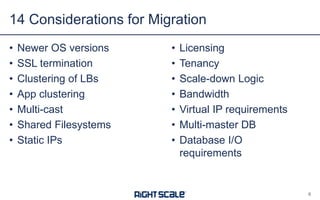
• Newer OS versions
• SSL termination
• Clustering of LBs
• App clustering
• Multi-cast
• Shared Filesystems
• Static IPs
14 Considerations for Migration
8
• Licensing
• Tenancy
• Scale-down Logic
• Bandwidth
• Virtual IP requirements
• Multi-master DB
• Database I/O
requirements
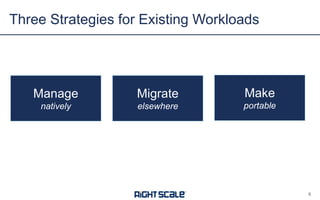
Three Strategies for Existing Workloads
9
Manage
natively
Migrate
elsewhere
Make
portable
Best Practice: Be
Smart about
Strategy
Photo: stevendepolo
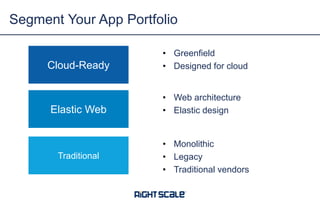
Segment Your App Portfolio
• Web architecture
• Elastic design
• Monolithic
• Legacy
• Traditional vendors
Cloud-Ready
• Greenfield
• Designed for cloud
Elastic Web
Traditional
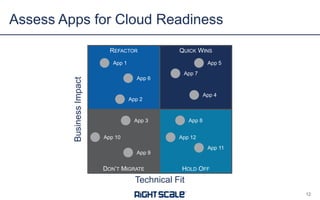
Assess Apps for Cloud Readiness
12
REFACTOR
DON’T MIGRATE HOLD OFF
QUICK WINS
Technical Fit
BusinessImpact
App 1
App 7
App 3
App 12
App 4
App 6
App 2
App 5
App 8
App 11
App 10
App 9
Best Practice 3; Consider portability
Best Practice:
Plan for
Portability
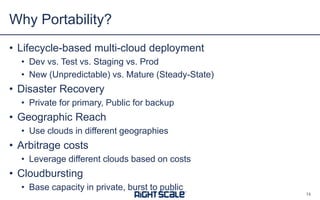
• Lifecycle-based multi-cloud deployment
• Dev vs. Test vs. Staging vs. Prod
• New (Unpredictable) vs. Mature (Steady-State)
• Disaster Recovery
• Private for primary, Public for backup
• Geographic Reach
• Use clouds in different geographies
• Arbitrage costs
• Leverage different clouds based on costs
• Cloudbursting
• Base capacity in private, burst to public
Why Portability?
14
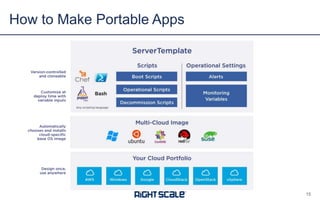
How to Make Portable Apps
15
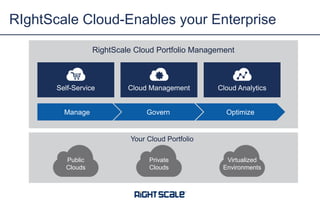
RIghtScale Cloud-Enables your Enterprise
Your Cloud Portfolio
Self-Service Cloud AnalyticsCloud Management
Manage Govern Optimize
RightScale Cloud Portfolio Management
Public
Clouds
Private
Clouds
Virtualized
Environments
What about
Security
and Compliance?
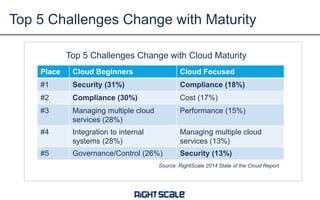
Place Cloud Beginners Cloud Focused
#1 Security (31%) Compliance (18%)
#2 Compliance (30%) Cost (17%)
#3 Managing multiple cloud
services (28%)
Performance (15%)
#4 Integration to internal
systems (28%)
Managing multiple cloud
services (13%)
#5 Governance/Control (26%) Security (13%)
Top 5 Challenges Change with Maturity
Top 5 Challenges Change with Cloud Maturity
Source: RightScale 2014 State of the Cloud Report
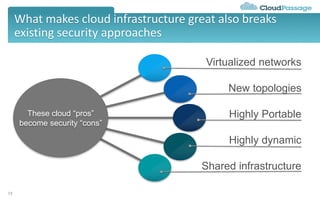
What makes cloud infrastructure great also breaks
existing security approaches
19
Virtualized networks
New topologies
Highly Portable
Highly dynamic
Shared infrastructure
These cloud “pros”
become security “cons”
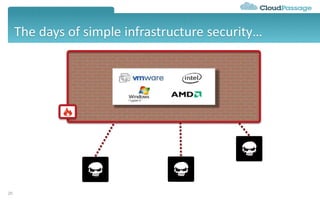
The days of simple infrastructure security…
20
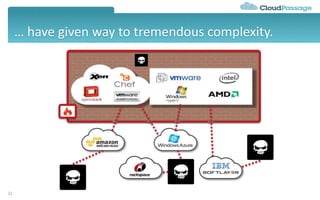
… have given way to tremendous complexity.
21
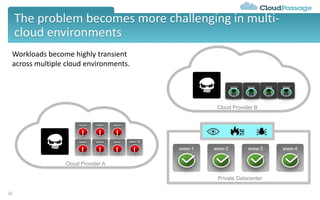
The problem becomes more challenging in multi-
cloud environments
22
Cloud Provider A
Cloud Provider B
Private Datacenter
www-
4
!
www-
5
!
www-
6
!
www-
7
!
www-
8
!
www-
9
!
www-10
!
www-
7
!
www-
8
!
www-
9
!
www-10
!
www-1 www-2 www-3 www-4
Workloads become highly transient
across multiple cloud environments.
ww
w-4
ww
w-4
ww
w-4
ww
w-4
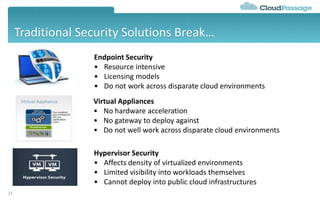
Traditional Security Solutions Break…
23
Endpoint Security
• Resource intensive
• Licensing models
• Do not work across disparate cloud environments
Virtual Appliances
• No hardware acceleration
• No gateway to deploy against
• Do not well work across disparate cloud environments
Hypervisor Security
• Affects density of virtualized environments
• Limited visibility into workloads themselves
• Cannot deploy into public cloud infrastructures
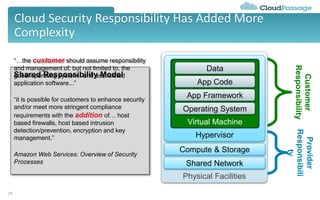
Cloud Security Responsibility Has Added More
Complexity
24
Customer
Responsibility
Provider
Responsibili
ty
Physical Facilities
Compute & Storage
Shared Network
Hypervisor
Virtual Machine
Data
App Code
App Framework
Operating System
“…the customer should assume responsibility
and management of, but not limited to, the
guest operating system.. and associated
application software...”
“it is possible for customers to enhance security
and/or meet more stringent compliance
requirements with the addition of… host
based firewalls, host based intrusion
detection/prevention, encryption and key
management.”
Amazon Web Services: Overview of Security
Processes
Shared Responsibility Model
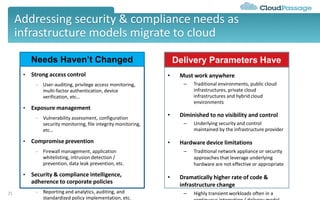
Addressing security & compliance needs as
infrastructure models migrate to cloud
25
• Strong access control
– User-auditing, privilege access monitoring,
multi-factor authentication, device
verification, etc…
• Exposure management
– Vulnerability assessment, configuration
security monitoring, file integrity monitoring,
etc…
• Compromise prevention
– Firewall management, application
whitelisting, intrusion detection /
prevention, data leak prevention, etc.
• Security & compliance intelligence,
adherence to corporate policies
– Reporting and analytics, auditing, and
standardized policy implementation, etc.
Needs Haven’t Changed
• Must work anywhere
– Traditional environments, public cloud
infrastructures, private cloud
infrastructures and hybrid cloud
environments
• Diminished to no visibility and control
– Underlying security and control
maintained by the infrastructure provider
• Hardware device limitations
– Traditional network appliance or security
approaches that leverage underlying
hardware are not effective or appropriate
• Dramatically higher rate of code &
infrastructure change
– Highly transient workloads often in a
Delivery Parameters Have
CloudPassage Halo
26
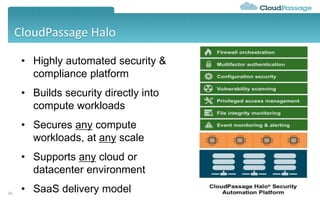
• Highly automated security &
compliance platform
• Builds security directly into
compute workloads
• Secures any compute
workloads, at any scale
• Supports any cloud or
datacenter environment
• SaaS delivery model
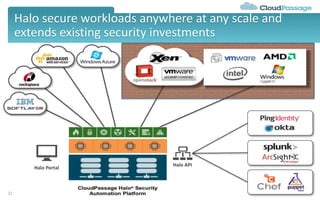
Halo secure workloads anywhere at any scale and
extends existing security investments
27
Halo API
Halo Portal
#28#
#rightscale
Q & A and Resources
Start a Free Trial of Halo
CloudPassage.com/halo
Access the 2014 State of the Cloud Report:
RightScale.com/lp/2014-state-of-the-cloud-report
Check out our blogs
blog.cloudpassage.com
blog.rightscale.com
®

Webinar compiled powerpoint

  • 1.
    COPING WITH CLOUD MIGRATIONCHALLENGES: BEST PRACTICES AND SECURITY CONSIDERATIONS
  • 2.
    Agenda & Speakers ® RishiVaish VP of Product Amrit Williams CTO • RightScale’s State of the Cloud survey • Why hybrid cloud is the standard of choice • 3 strategies for existing cloud server workloads • Benefits and security challenges of migrating to cloud infrastructures • Choosing a hybrid strategy
  • 3.
    Cloud Usage isUbiquitous…
  • 4.
    Enterprises are ChoosingMultiple Clouds
  • 5.
    0% 20% 40% 60% 80% 100% Cloud Beginners CloudExplorers Cloud Focused %ofRespondents Benefits Grow with Cloud Maturity % of Respondents Reporting these Benefits CapEx to OpEx Business continuity IT staff efficiency Geographic reach Higher performance Cost savings Faster time-to-market Higher availability Faster access to infrastructure Greater scalability Adoption is Driven by Clear Benefits Source: RightScale 2014 State of the Cloud Report
  • 6.
    What about Existing Workloads? How canI migrate existing workloads to the cloud?
  • 7.
    What Everyone Wants vSphere AWSor other clouds Greenfield workloads Migrated workloads
  • 8.
    Best Practice 1;Understand the realities Best Practice: Understand the Realities
  • 9.
    • Newer OSversions • SSL termination • Clustering of LBs • App clustering • Multi-cast • Shared Filesystems • Static IPs 14 Considerations for Migration 8 • Licensing • Tenancy • Scale-down Logic • Bandwidth • Virtual IP requirements • Multi-master DB • Database I/O requirements
  • 10.
    Three Strategies forExisting Workloads 9 Manage natively Migrate elsewhere Make portable
  • 11.
    Best Practice: Be Smartabout Strategy Photo: stevendepolo
  • 12.
    Segment Your AppPortfolio • Web architecture • Elastic design • Monolithic • Legacy • Traditional vendors Cloud-Ready • Greenfield • Designed for cloud Elastic Web Traditional
  • 13.
    Assess Apps forCloud Readiness 12 REFACTOR DON’T MIGRATE HOLD OFF QUICK WINS Technical Fit BusinessImpact App 1 App 7 App 3 App 12 App 4 App 6 App 2 App 5 App 8 App 11 App 10 App 9
  • 14.
    Best Practice 3;Consider portability Best Practice: Plan for Portability
  • 15.
    • Lifecycle-based multi-clouddeployment • Dev vs. Test vs. Staging vs. Prod • New (Unpredictable) vs. Mature (Steady-State) • Disaster Recovery • Private for primary, Public for backup • Geographic Reach • Use clouds in different geographies • Arbitrage costs • Leverage different clouds based on costs • Cloudbursting • Base capacity in private, burst to public Why Portability? 14
  • 16.
    How to MakePortable Apps 15
  • 17.
    RIghtScale Cloud-Enables yourEnterprise Your Cloud Portfolio Self-Service Cloud AnalyticsCloud Management Manage Govern Optimize RightScale Cloud Portfolio Management Public Clouds Private Clouds Virtualized Environments
  • 18.
  • 19.
    Place Cloud BeginnersCloud Focused #1 Security (31%) Compliance (18%) #2 Compliance (30%) Cost (17%) #3 Managing multiple cloud services (28%) Performance (15%) #4 Integration to internal systems (28%) Managing multiple cloud services (13%) #5 Governance/Control (26%) Security (13%) Top 5 Challenges Change with Maturity Top 5 Challenges Change with Cloud Maturity Source: RightScale 2014 State of the Cloud Report
  • 20.
    What makes cloudinfrastructure great also breaks existing security approaches 19 Virtualized networks New topologies Highly Portable Highly dynamic Shared infrastructure These cloud “pros” become security “cons”
  • 21.
    The days ofsimple infrastructure security… 20
  • 22.
    … have givenway to tremendous complexity. 21
  • 23.
    The problem becomesmore challenging in multi- cloud environments 22 Cloud Provider A Cloud Provider B Private Datacenter www- 4 ! www- 5 ! www- 6 ! www- 7 ! www- 8 ! www- 9 ! www-10 ! www- 7 ! www- 8 ! www- 9 ! www-10 ! www-1 www-2 www-3 www-4 Workloads become highly transient across multiple cloud environments. ww w-4 ww w-4 ww w-4 ww w-4
  • 24.
    Traditional Security SolutionsBreak… 23 Endpoint Security • Resource intensive • Licensing models • Do not work across disparate cloud environments Virtual Appliances • No hardware acceleration • No gateway to deploy against • Do not well work across disparate cloud environments Hypervisor Security • Affects density of virtualized environments • Limited visibility into workloads themselves • Cannot deploy into public cloud infrastructures
  • 25.
    Cloud Security ResponsibilityHas Added More Complexity 24 Customer Responsibility Provider Responsibili ty Physical Facilities Compute & Storage Shared Network Hypervisor Virtual Machine Data App Code App Framework Operating System “…the customer should assume responsibility and management of, but not limited to, the guest operating system.. and associated application software...” “it is possible for customers to enhance security and/or meet more stringent compliance requirements with the addition of… host based firewalls, host based intrusion detection/prevention, encryption and key management.” Amazon Web Services: Overview of Security Processes Shared Responsibility Model
  • 26.
    Addressing security &compliance needs as infrastructure models migrate to cloud 25 • Strong access control – User-auditing, privilege access monitoring, multi-factor authentication, device verification, etc… • Exposure management – Vulnerability assessment, configuration security monitoring, file integrity monitoring, etc… • Compromise prevention – Firewall management, application whitelisting, intrusion detection / prevention, data leak prevention, etc. • Security & compliance intelligence, adherence to corporate policies – Reporting and analytics, auditing, and standardized policy implementation, etc. Needs Haven’t Changed • Must work anywhere – Traditional environments, public cloud infrastructures, private cloud infrastructures and hybrid cloud environments • Diminished to no visibility and control – Underlying security and control maintained by the infrastructure provider • Hardware device limitations – Traditional network appliance or security approaches that leverage underlying hardware are not effective or appropriate • Dramatically higher rate of code & infrastructure change – Highly transient workloads often in a Delivery Parameters Have
  • 27.
    CloudPassage Halo 26 • Highlyautomated security & compliance platform • Builds security directly into compute workloads • Secures any compute workloads, at any scale • Supports any cloud or datacenter environment • SaaS delivery model
  • 28.
    Halo secure workloadsanywhere at any scale and extends existing security investments 27 Halo API Halo Portal
  • 29.
    #28# #rightscale Q & Aand Resources Start a Free Trial of Halo CloudPassage.com/halo Access the 2014 State of the Cloud Report: RightScale.com/lp/2014-state-of-the-cloud-report Check out our blogs blog.cloudpassage.com blog.rightscale.com ®

Editor's Notes

  • #13 A good place to start is by placing your app portfolio into broad categories The first is cloud native. These are applications that are designed with cloud in mind. You may have some existing applications like this in your portfolio, but you should definitely be adopting cloud-ready architectures for any new applications you create. These are “no brainers” for putting on cloud. The second is elastic web. These are applications that have been build with elastic web architectures, for example, your common 3 tier web apps with web server, app server and DB. There may be some refactoring required, but these are good potential candidates for cloud. The third category includes your traditional legacy applications that may include specialty, proprietary technology and are not designed to scale. These may require more significant rework – so you want to make sure that you will get significant business value from moving them to the cloud
  • #18 RightScale has taken cloud management to the next level with a new category that we call cloud portfolio management. Or CPM The RightScale product suite includes two products – Cloud Management and Cloud Analytics. Cloud Management provides deployment and management of applications for your technical teams. Cloud Analytics helps technical, business and financial users visualize and optimize cloud costs We are introducing a new module to our suite or products, Self-Service, which provides governed, curated and simplified on-demand access to complex application stacks to your IT end users through a Service Catalog. Together, these products help you manage, govern and optimize your applications across your entire cloud portfolio – public, private or virtualized.