#rightscale
Key Design Considerations for
Private and Hybrid Clouds
Watch the video of this presentation
#2
#rightscale
Your Panel Today
Presenting
• Utpal Thakrar, Sr. Product Manager, RightScale
• Ryan Geyer, Cloud Solutions Engineer, RightScale
Q&A
• Cory Smith, Account Manager, RightScale
Please use the “Questions” window
to ask questions as any time!
#3
#rightscale
Agenda
• Definitions and terminology
• Infrastructure evolution
• Why would you build a private cloud?
• Use cases + demo
• Hardware and software considerations
• Best practices for design and implementation
• Conclusion/Q&A
#rightscale
Terminology: Quick Recap
#5
#rightscale
Terminology
Virtualization
• Division of one physical server into multiple isolated virtual environments
Public Cloud
• Hosted by cloud provider
• On-demand, pay-as-you-go, accessible via API
Private Cloud
• Typically single-tenant
• Hosted on-premises or co-lo facility
Hybrid Cloud
• Spans more than one private or public clouds
• Extending the definition to include private virtualized environments
#6
#rightscale
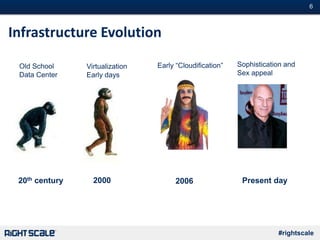
Infrastructure Evolution
Old School
Data Center
Virtualization
Early days
Early “Cloudification” Sophistication and
Sex appeal
20th century 2000 2006 Present day
#rightscale
State of the Cloud Report
#8
#rightscale
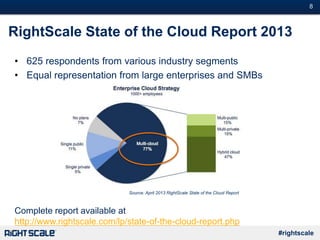
RightScale State of the Cloud Report 2013
• 625 respondents from various industry segments
• Equal representation from large enterprises and SMBs
Complete report available at
http://www.rightscale.com/lp/state-of-the-cloud-report.php
Source: April 2013 RightScale State of the Cloud Report
#rightscale
Why Do You Need
Private or Hybrid Cloud?
#10
#rightscale
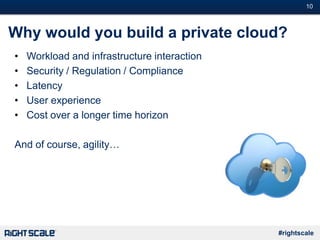
Why would you build a private cloud?
• Workload and infrastructure interaction
• Security / Regulation / Compliance
• Latency
• User experience
• Cost over a longer time horizon
And of course, agility…
#11
#rightscale
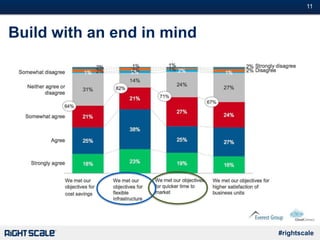
Build with an end in mind
#12
#rightscale
When would you need a hybrid or multi-cloud?
• What if your application outgrows the private cloud?
• Common desire is for “cloud-bursting”
• Regulation / Compliance for parts of the application
• Most common:
• Multiple clouds used by different parts of the same organization for
different applications, with each app in one cloud
#rightscale
Use Cases
#14
#rightscale
Use Case: Untested Workloads
• Scalable applications with uncertain demand
• Public cloud used as “proving ground” for new applications
• If applications fail, they are allowed to run their course in the
public cloud until they are end-of-lifed
• If an application gains traction, it remains in the public cloud
during its growth phase
• When stability of workload is reached, the application is
transitioned into the private cloud
#15
#rightscale
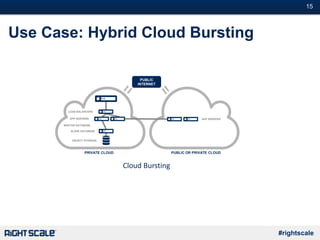
Use Case: Hybrid Cloud Bursting
PRIVATE CLOUD PUBLIC OR PRIVATE CLOUD
LOAD BALANCERS
APP SERVERS
MASTER DATABASE
SLAVE DATABASE
OBJECT STORAGE
APP SERVERS
PUBLIC
INTERNET
Cloud Bursting
#16
#rightscale
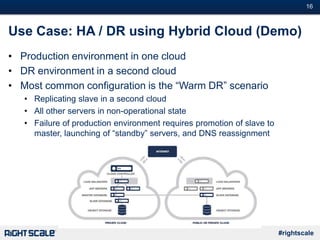
Use Case: HA / DR using Hybrid Cloud (Demo)
• Production environment in one cloud
• DR environment in a second cloud
• Most common configuration is the “Warm DR” scenario
• Replicating slave in a second cloud
• All other servers in non-operational state
• Failure of production environment requires promotion of slave to
master, launching of “standby” servers, and DNS reassignment
#17
#rightscale
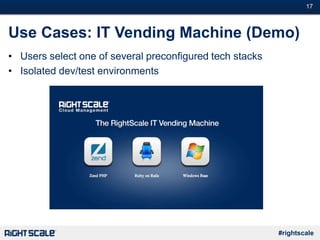
Use Cases: IT Vending Machine (Demo)
• Users select one of several preconfigured tech stacks
• Isolated dev/test environments
#18
#rightscale
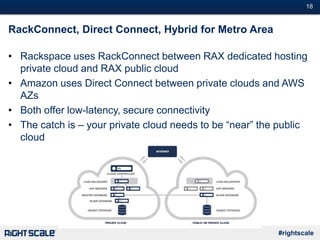
RackConnect, Direct Connect, Hybrid for Metro Area
• Rackspace uses RackConnect between RAX dedicated hosting
private cloud and RAX public cloud
• Amazon uses Direct Connect between private clouds and AWS
AZs
• Both offer low-latency, secure connectivity
• The catch is – your private cloud needs to be “near” the public
cloud
#rightscale
Hardware and Software
Considerations
#20
#rightscale
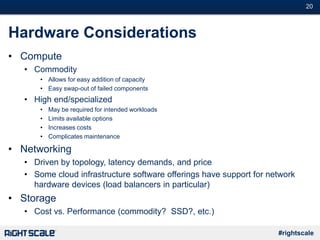
Hardware Considerations
• Compute
• Commodity
• Allows for easy addition of capacity
• Easy swap-out of failed components
• High end/specialized
• May be required for intended workloads
• Limits available options
• Increases costs
• Complicates maintenance
• Networking
• Driven by topology, latency demands, and price
• Some cloud infrastructure software offerings have support for network
hardware devices (load balancers in particular)
• Storage
• Cost vs. Performance (commodity? SSD?, etc.)
#21
#rightscale
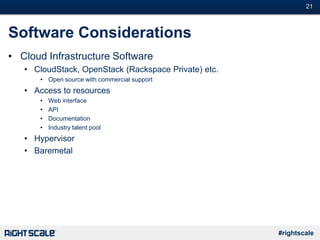
Software Considerations
• Cloud Infrastructure Software
• CloudStack, OpenStack (Rackspace Private) etc.
• Open source with commercial support
• Access to resources
• Web interface
• API
• Documentation
• Industry talent pool
• Hypervisor
• Baremetal
#22
#rightscale
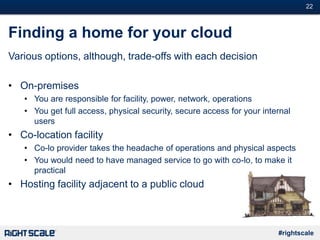
Finding a home for your cloud
Various options, although, trade-offs with each decision
• On-premises
• You are responsible for facility, power, network, operations
• You get full access, physical security, secure access for your internal
users
• Co-location facility
• Co-lo provider takes the headache of operations and physical aspects
• You would need to have managed service to go with co-lo, to make it
practical
• Hosting facility adjacent to a public cloud
#rightscale
Implementation Process
#24
#rightscale
Implementation Process
• Design
• Know the workload / performance requirements
• Keep HA in mind
• Capacity Planning
• Monitor and Automate
• Access Control
• Manage
• Test (and test again)
#25
#rightscale
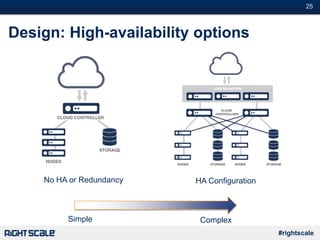
Design: High-availability options
No HA or Redundancy HA Configuration
Simple Complex
#26
#rightscale
OpenStack Infrastructure HA (example)
Several single points of failure in OpenStack deployment
• OpenStack API services
• MySQL
• RabbitMQ
Solved in various ways
• Pacemaker cluster management
• Keepalived (e.g: RAX Private Cloud)
• MySQL (Galera), RabbitMQ (active-active mirrored queues)
Eliminate SPoFs as best as you can.
#27
#rightscale
Design: Network Options
• OpenStack
• FlatDHCP – Typical for single tenant
• VLAN manager – Typical for multi-tenant env
• CloudStack
• Basic Zone – Typical for single tenant
• Advanced Zone – Typical for multi-tenant env
#28
#rightscale
Design: Capacity Planning – it’s simple!
• Don’t have a blank check backed by limitless funds or perfectly
clear expectations from your user that never change? Well, you
need capacity planning!
• Capacity planning is also budget planning and is directly related
to SLA you offer
• Know your workload, determine the difference between spike
and trend
• Monitor, tweak capacity, rinse, repeat …
• Check out http://www.planforcloud.com
#29
#rightscale
Monitor and Automate
• Understand your workload
• Number of VMs requested
• Allocated CPU, Memory, Disk capacity
• Actual utilization of resources
• Monitor using tools like Gaglia + Nagios
• Hypervisor hosts
• VM containers
• Resources consumed by the app
• Automate
• Chef, Puppet, Fuel etc..
#30
#rightscale
Access Control and Tenant Management
• Each cloud platform is slightly different but follows similar
principles
• Most clouds have option of integrating with existing
authentication and authorization system
#31
#rightscale
Separate Management Layer from Infrastructure
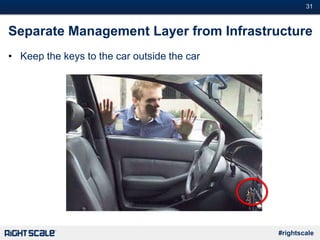
• Keep the keys to the car outside the car
#32
#rightscale
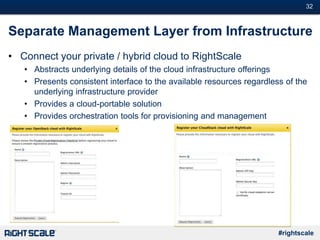
Separate Management Layer from Infrastructure
• Connect your private / hybrid cloud to RightScale
• Abstracts underlying details of the cloud infrastructure offerings
• Presents consistent interface to the available resources regardless of the
underlying infrastructure provider
• Provides a cloud-portable solution
• Provides orchestration tools for provisioning and management
#33
#rightscale
Always keep the application in mind!
#34
#rightscale
Summary/Conclusions
• Private (and therefore hybrid) clouds were originally thought of
as an academic exercise or science project
• Recent advances (particularly in cloud infrastructure software)
have shown private and hybrid clouds to be viable IT delivery
models
• Many considerations come into play
• Design
• Hardware
• Software
• Implementation Details
• No “one size fits all”
• Do your research. Find the right fit.
Contact RightScale
(866) 720-0208
sales@rightscale.com
www.rightscale.com

Rightscale webinar-key-design-considerations-private-hybrid-clouds

  • 1.
    #rightscale Key Design Considerationsfor Private and Hybrid Clouds Watch the video of this presentation
  • 2.
    #2 #rightscale Your Panel Today Presenting •Utpal Thakrar, Sr. Product Manager, RightScale • Ryan Geyer, Cloud Solutions Engineer, RightScale Q&A • Cory Smith, Account Manager, RightScale Please use the “Questions” window to ask questions as any time!
  • 3.
    #3 #rightscale Agenda • Definitions andterminology • Infrastructure evolution • Why would you build a private cloud? • Use cases + demo • Hardware and software considerations • Best practices for design and implementation • Conclusion/Q&A
  • 4.
  • 5.
    #5 #rightscale Terminology Virtualization • Division ofone physical server into multiple isolated virtual environments Public Cloud • Hosted by cloud provider • On-demand, pay-as-you-go, accessible via API Private Cloud • Typically single-tenant • Hosted on-premises or co-lo facility Hybrid Cloud • Spans more than one private or public clouds • Extending the definition to include private virtualized environments
  • 6.
    #6 #rightscale Infrastructure Evolution Old School DataCenter Virtualization Early days Early “Cloudification” Sophistication and Sex appeal 20th century 2000 2006 Present day
  • 7.
  • 8.
    #8 #rightscale RightScale State ofthe Cloud Report 2013 • 625 respondents from various industry segments • Equal representation from large enterprises and SMBs Complete report available at http://www.rightscale.com/lp/state-of-the-cloud-report.php Source: April 2013 RightScale State of the Cloud Report
  • 9.
    #rightscale Why Do YouNeed Private or Hybrid Cloud?
  • 10.
    #10 #rightscale Why would youbuild a private cloud? • Workload and infrastructure interaction • Security / Regulation / Compliance • Latency • User experience • Cost over a longer time horizon And of course, agility…
  • 11.
  • 12.
    #12 #rightscale When would youneed a hybrid or multi-cloud? • What if your application outgrows the private cloud? • Common desire is for “cloud-bursting” • Regulation / Compliance for parts of the application • Most common: • Multiple clouds used by different parts of the same organization for different applications, with each app in one cloud
  • 13.
  • 14.
    #14 #rightscale Use Case: UntestedWorkloads • Scalable applications with uncertain demand • Public cloud used as “proving ground” for new applications • If applications fail, they are allowed to run their course in the public cloud until they are end-of-lifed • If an application gains traction, it remains in the public cloud during its growth phase • When stability of workload is reached, the application is transitioned into the private cloud
  • 15.
    #15 #rightscale Use Case: HybridCloud Bursting PRIVATE CLOUD PUBLIC OR PRIVATE CLOUD LOAD BALANCERS APP SERVERS MASTER DATABASE SLAVE DATABASE OBJECT STORAGE APP SERVERS PUBLIC INTERNET Cloud Bursting
  • 16.
    #16 #rightscale Use Case: HA/ DR using Hybrid Cloud (Demo) • Production environment in one cloud • DR environment in a second cloud • Most common configuration is the “Warm DR” scenario • Replicating slave in a second cloud • All other servers in non-operational state • Failure of production environment requires promotion of slave to master, launching of “standby” servers, and DNS reassignment
  • 17.
    #17 #rightscale Use Cases: ITVending Machine (Demo) • Users select one of several preconfigured tech stacks • Isolated dev/test environments
  • 18.
    #18 #rightscale RackConnect, Direct Connect,Hybrid for Metro Area • Rackspace uses RackConnect between RAX dedicated hosting private cloud and RAX public cloud • Amazon uses Direct Connect between private clouds and AWS AZs • Both offer low-latency, secure connectivity • The catch is – your private cloud needs to be “near” the public cloud
  • 19.
  • 20.
    #20 #rightscale Hardware Considerations • Compute •Commodity • Allows for easy addition of capacity • Easy swap-out of failed components • High end/specialized • May be required for intended workloads • Limits available options • Increases costs • Complicates maintenance • Networking • Driven by topology, latency demands, and price • Some cloud infrastructure software offerings have support for network hardware devices (load balancers in particular) • Storage • Cost vs. Performance (commodity? SSD?, etc.)
  • 21.
    #21 #rightscale Software Considerations • CloudInfrastructure Software • CloudStack, OpenStack (Rackspace Private) etc. • Open source with commercial support • Access to resources • Web interface • API • Documentation • Industry talent pool • Hypervisor • Baremetal
  • 22.
    #22 #rightscale Finding a homefor your cloud Various options, although, trade-offs with each decision • On-premises • You are responsible for facility, power, network, operations • You get full access, physical security, secure access for your internal users • Co-location facility • Co-lo provider takes the headache of operations and physical aspects • You would need to have managed service to go with co-lo, to make it practical • Hosting facility adjacent to a public cloud
  • 23.
  • 24.
    #24 #rightscale Implementation Process • Design •Know the workload / performance requirements • Keep HA in mind • Capacity Planning • Monitor and Automate • Access Control • Manage • Test (and test again)
  • 25.
    #25 #rightscale Design: High-availability options NoHA or Redundancy HA Configuration Simple Complex
  • 26.
    #26 #rightscale OpenStack Infrastructure HA(example) Several single points of failure in OpenStack deployment • OpenStack API services • MySQL • RabbitMQ Solved in various ways • Pacemaker cluster management • Keepalived (e.g: RAX Private Cloud) • MySQL (Galera), RabbitMQ (active-active mirrored queues) Eliminate SPoFs as best as you can.
  • 27.
    #27 #rightscale Design: Network Options •OpenStack • FlatDHCP – Typical for single tenant • VLAN manager – Typical for multi-tenant env • CloudStack • Basic Zone – Typical for single tenant • Advanced Zone – Typical for multi-tenant env
  • 28.
    #28 #rightscale Design: Capacity Planning– it’s simple! • Don’t have a blank check backed by limitless funds or perfectly clear expectations from your user that never change? Well, you need capacity planning! • Capacity planning is also budget planning and is directly related to SLA you offer • Know your workload, determine the difference between spike and trend • Monitor, tweak capacity, rinse, repeat … • Check out http://www.planforcloud.com
  • 29.
    #29 #rightscale Monitor and Automate •Understand your workload • Number of VMs requested • Allocated CPU, Memory, Disk capacity • Actual utilization of resources • Monitor using tools like Gaglia + Nagios • Hypervisor hosts • VM containers • Resources consumed by the app • Automate • Chef, Puppet, Fuel etc..
  • 30.
    #30 #rightscale Access Control andTenant Management • Each cloud platform is slightly different but follows similar principles • Most clouds have option of integrating with existing authentication and authorization system
  • 31.
    #31 #rightscale Separate Management Layerfrom Infrastructure • Keep the keys to the car outside the car
  • 32.
    #32 #rightscale Separate Management Layerfrom Infrastructure • Connect your private / hybrid cloud to RightScale • Abstracts underlying details of the cloud infrastructure offerings • Presents consistent interface to the available resources regardless of the underlying infrastructure provider • Provides a cloud-portable solution • Provides orchestration tools for provisioning and management
  • 33.
    #33 #rightscale Always keep theapplication in mind!
  • 34.
    #34 #rightscale Summary/Conclusions • Private (andtherefore hybrid) clouds were originally thought of as an academic exercise or science project • Recent advances (particularly in cloud infrastructure software) have shown private and hybrid clouds to be viable IT delivery models • Many considerations come into play • Design • Hardware • Software • Implementation Details • No “one size fits all” • Do your research. Find the right fit. Contact RightScale (866) 720-0208 sales@rightscale.com www.rightscale.com

Editor's Notes

  • #2 Good morning, folks. Welcome again to this webinar...I am utpalthakrar, product manager for cloud integration.. One of my areas of focus has been around private and hybrid cloud..Today we will talk about, u guessed it, private and hybrid clouds..
  • #5 Good morning, folks. Welcome again to this webinar...I am utpalthakrar, product manager for cloud integration.. One of my areas of focus has been around private and hybrid cloud..Today we will talk about, u guessed it, private and hybrid clouds..
  • #7 Old school DatacentersRacks of physical nodes, one application per nodeIt’s all we knew, it worked, and it was fine.Virtualization – The Early YearsCapability of a node outgrew the needs of any single applicationLots of idle resources on each nodeVirtualization provided the ability to have a many-to-one (servers per node) relationshipThis was betterCloudification (Virtualization grows up)Automated provisioning and management via an API appearsThis is much, much better
  • #8 Good morning, folks. Welcome again to this webinar...I am utpalthakrar, product manager for cloud integration.. One of my areas of focus has been around private and hybrid cloud..Today we will talk about, u guessed it, private and hybrid clouds..
  • #9 RightScale conducted this survey earlier this spring with about 600+ participants from various industries big and small and various technical to business roles. Overall, about 77% expressed interest in using multiple clouds within the next 12 months. Of which, 47% expressed interest in using hybrid cloud
  • #10 Good morning, folks. Welcome again to this webinar...I am utpalthakrar, product manager for cloud integration.. One of my areas of focus has been around private and hybrid cloud..Today we will talk about, u guessed it, private and hybrid clouds..
  • #11 Workload and Infrastructure InteractionApplications have different resource needsChoose the right fit for your application and your infrastructureSecurityData may be contained within the private cloud, thus allowing for stricter security complianceLatencyConsumers of the private cloud resources are generally “closer” to the private cloud, which reduces latencyUser ExperienceRelated to latency, end user experience is enhanced due to proximity to resources.CostOPEX is generally reduced. (CAPEX is another story )
  • #13 When private cloud resources are exhausted, a server tier expands into the public cloud to tap into the “infinite” resourcesConsiderations:Security – public Internet is traversedLatency – traversal of public Internet involves the Great UnknownCost – bandwidth charges for public Internet traversalComplexity – setting up a secure environment is not a trivial taskWe will explore use-cases for hybrid cloud
  • #14 Good morning, folks. Welcome again to this webinar...I am utpalthakrar, product manager for cloud integration.. One of my areas of focus has been around private and hybrid cloud..Today we will talk about, u guessed it, private and hybrid clouds..
  • #16 Considerations:Security – public Internet is traversedLatency – traversal of public Internet involves the Great UnknownCost – bandwidth charges for public Internet traversalComplexity – setting up a secure environment is not a trivial task
  • #18 Brian
  • #20 Good morning, folks. Welcome again to this webinar...I am utpalthakrar, product manager for cloud integration.. One of my areas of focus has been around private and hybrid cloud..Today we will talk about, u guessed it, private and hybrid clouds..
  • #22 Various open source / commercially supported cloud orchestration platforms available.OpenStack and CloudStack are the two leading platforms we recommend.They both have flexible options, typically support various hypervisors
  • #24 Good morning, folks. Welcome again to this webinar...I am utpalthakrar, product manager for cloud integration.. One of my areas of focus has been around private and hybrid cloud..Today we will talk about, u guessed it, private and hybrid clouds..
  • #25 Hardware ProcurementPre-existing or new?Pre-existing limits ability to tailor infrastructure to workloadsCloud Infrastructure SoftwareThis decision will dictate/limit many future decisionsResearch options, and choose wisely!Cloud TopologyZones, regions, storage allocation, HA considerations, etc.Build or BuyUse in-house resources if expertise existsThird-party resourcesBuild using existing resourcesBuild using new preconfigured hardwareDesign – Design for HA, use uniform hypervisor, Network is a key consideration – switching from basic zone or FlatDHCP to advanced zone or quantum isn’t that simple.. Make use of hypervisors uniformly..Compute density is key factor in capacot planning.. You will need to incorporate physical CPU cores, RAM, oversubscription ration and instance storage.. Storage options, object storage, block storageScalability and HA of the cloud itself – controller nodes, api end point redundancy, Automate – crowbar, chef, puppet, fuel etcMonitoring – Is usually an after thought but it shouldn’t be.. It is important to establish so,etrendig so that you can forecast capacity and plan accordingly
  • #28 Understand your workloadMonitorBe ready to grow or cloud burst
  • #29 Understand your workloadMonitorBe ready to grow or cloud burstAutomate
  • #30 Monitor how your app is using the cloud and automate..Spare capacity or cloud bursting.Automation plan – if a host goes down, it needs to get up..
  • #31 This is around configuring the cloud itself.. Separating tenant, dividing resources, projects..
  • #32 If both go down, u have no where to go..if the disaster hits management, u still have the app,if the disaster hit app u can execute on DR scenarios..
  • #33 If both goes down, u have no where to go..if the disaster hits management, u still have the app,if the disaster hit app u can execute on DR scenarios..
  • #34 If both goes down, u have no where to go..if the disaster hits management, u still have the app,if the disaster hit app u can execute on DR scenarios..