Security & Compliance for
Enterprise Cloud Infrastructure
Carson Sweet
CEO, CloudPassage
carson@cloudpassage.com
Agenda
• Evolving cloud use cases and trends
• System and data protection, then and now
• Pros and cons of common “next-generation”
system and data protection approaches
• CloudPassage approach to cloud application
infrastructure protection
• Discussion, Q&A
2
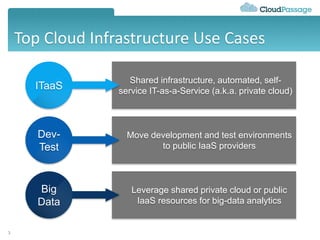
Top Cloud Infrastructure Use Cases
3
Dev-
Test
Big
Data
ITaaS
Shared infrastructure, automated, self-
service IT-as-a-Service (a.k.a. private cloud)
Move development and test environments
to public IaaS providers
Leverage shared private cloud or public
IaaS resources for big-data analytics
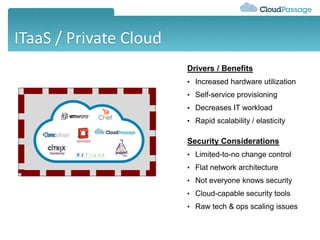
ITaaS / Private Cloud
Drivers / Benefits
• Increased hardware utilization
• Self-service provisioning
• Decreases IT workload
• Rapid scalability / elasticity
Security Considerations
• Limited-to-no change control
• Flat network architecture
• Not everyone knows security
• Cloud-capable security tools
• Raw tech & ops scaling issues
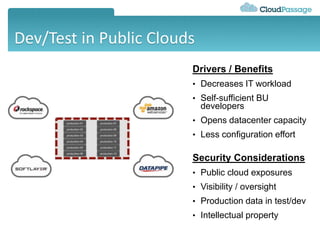
Dev/Test in Public Clouds
Drivers / Benefits
• Decreases IT workload
• Self-sufficient BU
developers
• Opens datacenter capacity
• Less configuration effort
Security Considerations
• Public cloud exposures
• Visibility / oversight
• Production data in test/dev
• Intellectual property
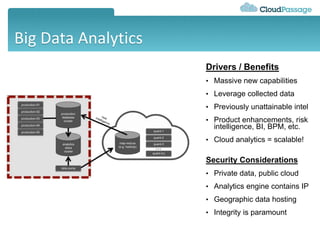
Big Data Analytics
Drivers / Benefits
• Massive new capabilities
• Leverage collected data
• Previously unattainable intel
• Product enhancements, risk
intelligence, BI, BPM, etc.
• Cloud analytics = scalable!
Security Considerations
• Private data, public cloud
• Analytics engine contains IP
• Geographic data hosting
• Integrity is paramount
Cloud Infrastructure
Security Challenges
7
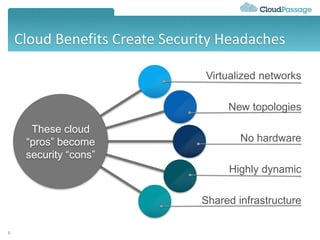
Cloud Benefits Create Security Headaches
8
Virtualized networks
New topologies
No hardware
Highly dynamic
Shared infrastructure
These cloud
“pros” become
security “cons”
What Infrastructure Looked Like
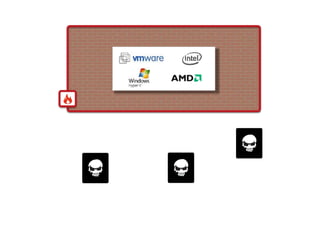
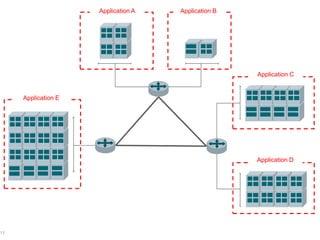
• Traditional datacenter infrastructure model
–Vertical application scalability
–Apps running on hardware “islands”
–Few environments to contend with
• Vertical application architectures
–Scalability via hardware choices & optimization
–Topology and hardware essentially arbitrary
–Physical proximity of application components
9
11
Application A Application B
Application C
Application D
Application E
12
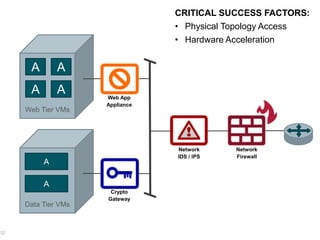
Web Tier VMs
A A
A A
Data Tier VMs
A
A
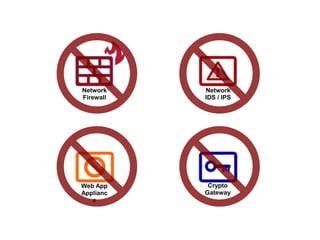
Web App
Appliance
Crypto
Gateway
Network
Firewall
CRITICAL SUCCESS FACTORS:
• Physical Topology Access
• Hardware Acceleration
Network
IDS / IPS
Where Infrastructure Is Going
13
• Infrastructure-as-a-Service (public or private)
– Virtualized sharing of commodity hardware
– ITaaS (opex, scalable, dynamic, self-service)
– Flat physical network, distributed topologies
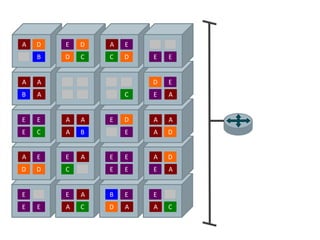
• Horizontal application architectures
– Scale achieved through cloning workloads
– Physical topology, hardware abstracted
– Wide dispersion of application & data components is
desirable
A
A A A
A A A
A
A A
A
A A
A
A A
A A
A A
B
B
B
B
C C
C
C
C
C C
D
D D
D
D
D
D D
D D
D
E
E E
E E E
E E E E
E E E
E E
E
E
E
E
E
E E
E E
Web App
Applianc
e
Crypto
Gateway
Network
Firewall
Network
IDS / IPS
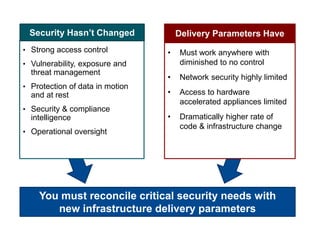
You must reconcile critical security needs with
new infrastructure delivery parameters
• Strong access control
• Vulnerability, exposure and
threat management
• Protection of data in motion
and at rest
• Security & compliance
intelligence
• Operational oversight
Security Hasn’t Changed
• Must work anywhere with
diminished to no control
• Network security highly limited
• Access to hardware
accelerated appliances limited
• Dramatically higher rate of
code & infrastructure change
Delivery Parameters Have
“Next-Generation”
Infrastructure Security
18
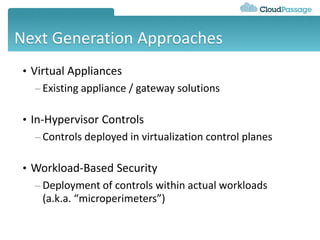
Next Generation Approaches
• Virtual Appliances
– Existing appliance / gateway solutions
• In-Hypervisor Controls
– Controls deployed in virtualization control planes
• Workload-Based Security
– Deployment of controls within actual workloads
(a.k.a. “microperimeters”)
Virtual Appliances
• Benefits
– Mirrors existing models, easy to understand
– Existing vendors may offer this model
• Pitfalls
– No hardware acceleration = scalability challenges
– Topological dependencies hinder workload distribution
– Limited functionality, for the same reasons
• Field Observations
– We’ve only seen network security / WAF appliances, none
operating at significant scale
In-Hypervisor Controls
• Benefits
– Services available to all VMs on protected hypervisors
– Cannot be modified from within guest VMs
• Pitfalls
– Often hypervisor-specific, cannot be used in public IaaS
– Significant impact to VM density & performance
• Field Observations
– Useful in data centers / private clouds, not hybrid
– Performance and operational challenges abound
Workload-Based Security
• Benefits
– Workload is the intersection of scale, portability, control
– Moves security close to application & data constructs
• Pitfalls
– Resource and performance impacted unless done right
– Not operationally scalable without control automation
• Field Observations
– The model that CloudPassage chose as core design
– Being implemented at large scale in finserv, software
CloudPassage Approach to
Workload-Based Security
23
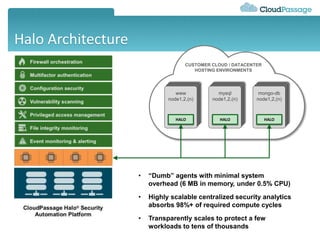
CUSTOMER CLOUD / DATACENTER
HOSTING ENVIRONMENTS
www
node1,2,(n)
mysql
node1,2,(n)
mongo-db
node1,2,(n)
HALO HALO HALO
• “Dumb” agents with minimal system
overhead (6 MB in memory, under 0.5% CPU)
• Highly scalable centralized security analytics
absorbs 98%+ of required compute cycles
• Transparently scales to protect a few
workloads to tens of thousands
Halo Architecture
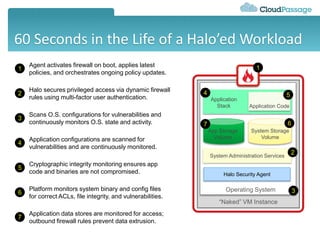
“Naked” VM Instance
Operating System
Application Code
System Administration Services
Application
Stack
App Storage
Volume
System Storage
Volume
Halo Security Agent
1
2
4 5
67
Agent activates firewall on boot, applies latest
policies, and orchestrates ongoing policy updates.
1
Halo secures privileged access via dynamic firewall
rules using multi-factor user authentication.
2
Scans O.S. configurations for vulnerabilities and
continuously monitors O.S. state and activity.
3
Application configurations are scanned for
vulnerabilities and are continuously monitored.
4
Cryptographic integrity monitoring ensures app
code and binaries are not compromised.
5
Platform monitors system binary and config files
for correct ACLs, file integrity, and vulnerabilities.
6 3
Application data stores are monitored for access;
outbound firewall rules prevent data extrusion.
7
60 Seconds in the Life of a Halo’ed Workload
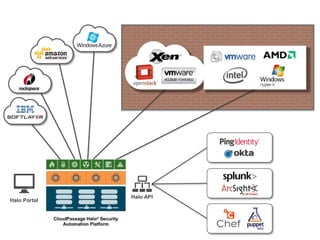
Halo API
Halo Portal
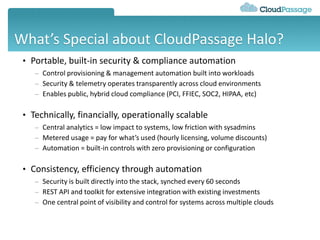
What’s Special about CloudPassage Halo?
• Portable, built-in security & compliance automation
– Control provisioning & management automation built into workloads
– Security & telemetry operates transparently across cloud environments
– Enables public, hybrid cloud compliance (PCI, FFIEC, SOC2, HIPAA, etc)
• Technically, financially, operationally scalable
– Central analytics = low impact to systems, low friction with sysadmins
– Metered usage = pay for what’s used (hourly licensing, volume discounts)
– Automation = built-in controls with zero provisioning or configuration
• Consistency, efficiency through automation
– Security is built directly into the stack, synched every 60 seconds
– REST API and toolkit for extensive integration with existing investments
– One central point of visibility and control for systems across multiple clouds
Wrapping Up
• Infrastructure-centric security doesn’t work for cloud
– Your cloud migration will demand new approaches
– Next-generation alternatives have pros and cons
• Workload-based security offers distinct advantages
– Moves security closer to applications
– Enables greater scalability and portability
– Can operate in any infrastructure environment
• Talk to your team and start the process now
– Visit cloudpassage.com for white papers, etc.
www.cloudpassage.com

Security and Compliance for Enterprise Cloud Infrastructure

  • 1.
    Security & Compliancefor Enterprise Cloud Infrastructure Carson Sweet CEO, CloudPassage carson@cloudpassage.com
  • 2.
    Agenda • Evolving clouduse cases and trends • System and data protection, then and now • Pros and cons of common “next-generation” system and data protection approaches • CloudPassage approach to cloud application infrastructure protection • Discussion, Q&A 2
  • 3.
    Top Cloud InfrastructureUse Cases 3 Dev- Test Big Data ITaaS Shared infrastructure, automated, self- service IT-as-a-Service (a.k.a. private cloud) Move development and test environments to public IaaS providers Leverage shared private cloud or public IaaS resources for big-data analytics
  • 4.
    ITaaS / PrivateCloud Drivers / Benefits • Increased hardware utilization • Self-service provisioning • Decreases IT workload • Rapid scalability / elasticity Security Considerations • Limited-to-no change control • Flat network architecture • Not everyone knows security • Cloud-capable security tools • Raw tech & ops scaling issues
  • 5.
    Dev/Test in PublicClouds Drivers / Benefits • Decreases IT workload • Self-sufficient BU developers • Opens datacenter capacity • Less configuration effort Security Considerations • Public cloud exposures • Visibility / oversight • Production data in test/dev • Intellectual property
  • 6.
    Big Data Analytics Drivers/ Benefits • Massive new capabilities • Leverage collected data • Previously unattainable intel • Product enhancements, risk intelligence, BI, BPM, etc. • Cloud analytics = scalable! Security Considerations • Private data, public cloud • Analytics engine contains IP • Geographic data hosting • Integrity is paramount
  • 7.
  • 8.
    Cloud Benefits CreateSecurity Headaches 8 Virtualized networks New topologies No hardware Highly dynamic Shared infrastructure These cloud “pros” become security “cons”
  • 9.
    What Infrastructure LookedLike • Traditional datacenter infrastructure model –Vertical application scalability –Apps running on hardware “islands” –Few environments to contend with • Vertical application architectures –Scalability via hardware choices & optimization –Topology and hardware essentially arbitrary –Physical proximity of application components 9
  • 11.
    11 Application A ApplicationB Application C Application D Application E
  • 12.
    12 Web Tier VMs AA A A Data Tier VMs A A Web App Appliance Crypto Gateway Network Firewall CRITICAL SUCCESS FACTORS: • Physical Topology Access • Hardware Acceleration Network IDS / IPS
  • 13.
    Where Infrastructure IsGoing 13 • Infrastructure-as-a-Service (public or private) – Virtualized sharing of commodity hardware – ITaaS (opex, scalable, dynamic, self-service) – Flat physical network, distributed topologies • Horizontal application architectures – Scale achieved through cloning workloads – Physical topology, hardware abstracted – Wide dispersion of application & data components is desirable
  • 15.
    A A A A AA A A A A A A A A A A A A A A B B B B C C C C C C C D D D D D D D D D D D E E E E E E E E E E E E E E E E E E E E E E E E
  • 16.
  • 17.
    You must reconcilecritical security needs with new infrastructure delivery parameters • Strong access control • Vulnerability, exposure and threat management • Protection of data in motion and at rest • Security & compliance intelligence • Operational oversight Security Hasn’t Changed • Must work anywhere with diminished to no control • Network security highly limited • Access to hardware accelerated appliances limited • Dramatically higher rate of code & infrastructure change Delivery Parameters Have
  • 18.
  • 19.
    Next Generation Approaches •Virtual Appliances – Existing appliance / gateway solutions • In-Hypervisor Controls – Controls deployed in virtualization control planes • Workload-Based Security – Deployment of controls within actual workloads (a.k.a. “microperimeters”)
  • 20.
    Virtual Appliances • Benefits –Mirrors existing models, easy to understand – Existing vendors may offer this model • Pitfalls – No hardware acceleration = scalability challenges – Topological dependencies hinder workload distribution – Limited functionality, for the same reasons • Field Observations – We’ve only seen network security / WAF appliances, none operating at significant scale
  • 21.
    In-Hypervisor Controls • Benefits –Services available to all VMs on protected hypervisors – Cannot be modified from within guest VMs • Pitfalls – Often hypervisor-specific, cannot be used in public IaaS – Significant impact to VM density & performance • Field Observations – Useful in data centers / private clouds, not hybrid – Performance and operational challenges abound
  • 22.
    Workload-Based Security • Benefits –Workload is the intersection of scale, portability, control – Moves security close to application & data constructs • Pitfalls – Resource and performance impacted unless done right – Not operationally scalable without control automation • Field Observations – The model that CloudPassage chose as core design – Being implemented at large scale in finserv, software
  • 23.
  • 24.
    CUSTOMER CLOUD /DATACENTER HOSTING ENVIRONMENTS www node1,2,(n) mysql node1,2,(n) mongo-db node1,2,(n) HALO HALO HALO • “Dumb” agents with minimal system overhead (6 MB in memory, under 0.5% CPU) • Highly scalable centralized security analytics absorbs 98%+ of required compute cycles • Transparently scales to protect a few workloads to tens of thousands Halo Architecture
  • 25.
    “Naked” VM Instance OperatingSystem Application Code System Administration Services Application Stack App Storage Volume System Storage Volume Halo Security Agent 1 2 4 5 67 Agent activates firewall on boot, applies latest policies, and orchestrates ongoing policy updates. 1 Halo secures privileged access via dynamic firewall rules using multi-factor user authentication. 2 Scans O.S. configurations for vulnerabilities and continuously monitors O.S. state and activity. 3 Application configurations are scanned for vulnerabilities and are continuously monitored. 4 Cryptographic integrity monitoring ensures app code and binaries are not compromised. 5 Platform monitors system binary and config files for correct ACLs, file integrity, and vulnerabilities. 6 3 Application data stores are monitored for access; outbound firewall rules prevent data extrusion. 7 60 Seconds in the Life of a Halo’ed Workload
  • 26.
  • 27.
    What’s Special aboutCloudPassage Halo? • Portable, built-in security & compliance automation – Control provisioning & management automation built into workloads – Security & telemetry operates transparently across cloud environments – Enables public, hybrid cloud compliance (PCI, FFIEC, SOC2, HIPAA, etc) • Technically, financially, operationally scalable – Central analytics = low impact to systems, low friction with sysadmins – Metered usage = pay for what’s used (hourly licensing, volume discounts) – Automation = built-in controls with zero provisioning or configuration • Consistency, efficiency through automation – Security is built directly into the stack, synched every 60 seconds – REST API and toolkit for extensive integration with existing investments – One central point of visibility and control for systems across multiple clouds
  • 28.
    Wrapping Up • Infrastructure-centricsecurity doesn’t work for cloud – Your cloud migration will demand new approaches – Next-generation alternatives have pros and cons • Workload-based security offers distinct advantages – Moves security closer to applications – Enables greater scalability and portability – Can operate in any infrastructure environment • Talk to your team and start the process now – Visit cloudpassage.com for white papers, etc.
  • 29.

Editor's Notes

  • #25  ----- Meeting Notes (1/13/14 14:01) ----- They are doing hosting in the cloud, some test-dev and some production; this is very early, may not make sense for them.