


Lecture 03
Design Patterns
Agenda
 Patterns
– History, classification, structure
 Patterns covered
– Observer
 Design Principles
– Loosley Coupled Design Principle
– Open-Close Principle
– Liskov Substitution Principle
Reading
 Fowler Introduction
– Section on Patterns, page 9-11
 Design Patterns
 Observer pattern
 Factory pattern
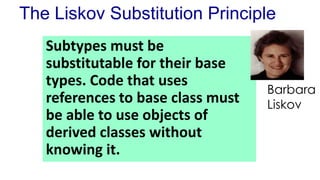
 The Liskov Substitution Principle
 The Open-Closed Principle
Pattern Catalog
 Catalog of Patterns of Enterprise Application
Architecture
– Patterns in PoEAA
– http://www.martinfowler.com/eaaCatalog/
Patterns
Design Patterns
 Design pattern is a general solution to a common
problem in software design
– Systematic approach for problems that reoccur in software
development
– Not complete solution but starting point for design
– Not code ready to use
– Patterns have names and definitions
– Built on common practices
 Patterns should not be language dependant
– However patterns apply for types of programming
languages
History
 Patterns originated as an architectural concept
“Each pattern describes a problem which occurs over
and over again in our environment, and then
describes the core of the solution to that problem, in
such a way that you can use this solution a million
times over, without ever doing it the same way twice”
- Christopher Alexander
History
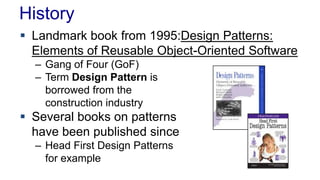
 Landmark book from 1995:Design Patterns:
Elements of Reusable Object-Oriented Software
– Gang of Four (GoF)
– Term Design Pattern is
borrowed from the
construction industry
 Several books on patterns
have been published since
– Head First Design Patterns
for example
Vintage Design Patterns
 Design Patterns are like good red wine
– You cannot appreciate them at first
– As you study them you learn the
difference between plonk and vintage,
or bad and good designs
– As you become a connoisseur you experience the
various textures you didn’t notice before
 Warning:
– Once you are hooked, you will no longer be satisfied
with inferior designs
Dr. Heinz Kabutz (http://www.javaspecialists.co.za)
Pattern Classification
 Design patterns can be classified based on
multiple criteria
– Basic underlying problem they solve
 Classification
– Fundamental patterns
– Creational patterns
– Structural patterns
– Behavioral patterns
– Concurrency patterns
Enterprise Patterns Classification
 Domain Logic Patterns
 Data Source Architectural Patterns
 Object-Relational Behavioral Patterns
 Object-Relational Structural Patterns
 Object-Relational Metadata Mapping Patterns
 Web Presentation Patterns
 Distribution Patterns
 Offline Concurrency Patterns
 Session State Patterns
 Base Patterns
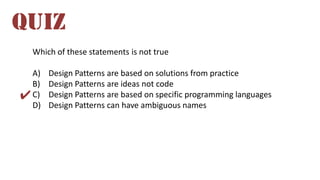
Which of these statements is not true
A) Design Patterns are based on solutions from practice
B) Design Patterns are ideas not code
C) Design Patterns are based on specific programming languages
D) Design Patterns can have ambiguous names
QUIZ
✔
Structure of Patterns
 Name
 The Intent
 The Sketch
 Motivation
 How it Works
 When to Use it
 Further Reading
 Examples
The Name
 Pattern names are important
– Need to create a vocabulary
– Need to describe the pattern well
– Avoid ambiguity and misunderstanding
 Problems with names
– Authors are using different names for same pattern
• Data Access Object and Table Data Gateway
• Dependency Injection and Inversion of Control
– Authors are using same name for different patterns
• Example: Value Object is used for two similar patterns
The Intent
 Sums up the pattern in a sentence or two
– Value Object:
A small simple object, like money or date range, whose
equality isn’t based on identity
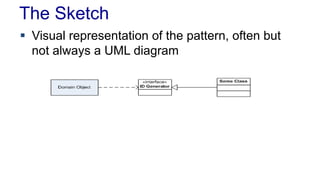
The Sketch
 Visual representation of the pattern, often but
not always a UML diagram
Motivation
 Description of a motivating problem for the
pattern
– Problem description
– May not be the only problem for the pattern
 Example:
– Layered supertype
It’s not uncommon for all the objects in a layer to have
methods you don’t want to have duplicated
throughout the system. You can move this behavior
into a common Layer Supertype
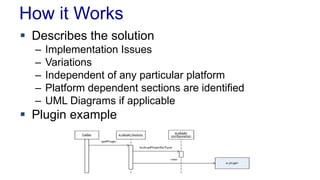
How it Works
 Describes the solution
– Implementation Issues
– Variations
– Independent of any particular platform
– Platform dependent sections are identified
– UML Diagrams if applicable
 Plugin example
When to Use It
 Describes when the pattern should be used
– Trade-offs
– Comparisons
 Layered Supertype example
– Use Layer Supertype when you have common
features from all objects in a layer
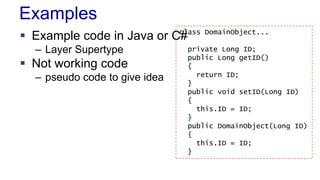
Examples
 Example code in Java or C#
– Layer Supertype
 Not working code
– pseudo code to give idea
class DomainObject...
private Long ID;
public Long getID()
{
return ID;
}
public void setID(Long ID)
{
this.ID = ID;
}
public DomainObject(Long ID)
{
this.ID = ID;
}
Using Design Patterns
 How to use design patterns?
– Problem is the patterns can be complex and detailed
– Usually they are generic and abstract
 Ways to study patterns
– Implement them in test code
– Sketch a class diagram in your context to see the
class dependencies
– Form a “Study group” to discuss the patterns
– Learn the vocabulary
– Practice, practice, practice
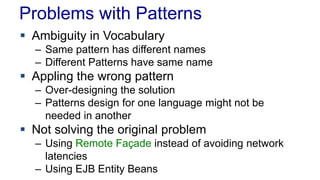
Problems with Patterns
 Ambiguity in Vocabulary
– Same pattern has different names
– Different Patterns have same name
 Appling the wrong pattern
– Over-designing the solution
– Patterns design for one language might not be
needed in another
 Not solving the original problem
– Using Remote Façade instead of avoiding network
latencies
– Using EJB Entity Beans
Job interview question
You are given the assignment of creating a component that needs to
know sales statistics of Lottery tickets. You know that there is a
another component in the system, Sale Server, that handles the sale.
You need real-time information. What would you suggest?
EXERCISE
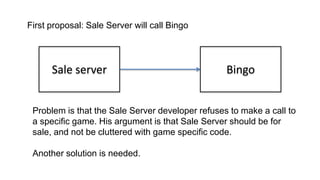
Sale server Bingo
First proposal: Sale Server will call Bingo
Problem is that the Sale Server developer refuses to make a call to
a specific game. His argument is that Sale Server should be for
sale, and not be cluttered with game specific code.
Another solution is needed.
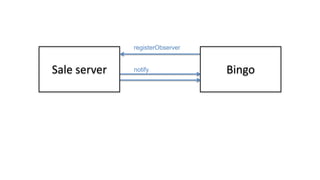
Sale server Bingo
registerObserver
notify
The Observer Pattern
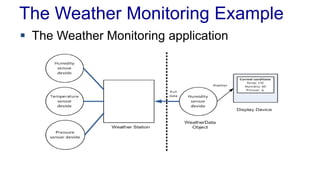
The Weather Monitoring Example
 The Weather Monitoring application
The Weather Monitoring Example
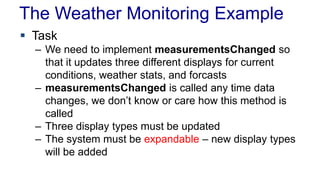
 Task
– We need to implement measurementsChanged so
that it updates three different displays for current
conditions, weather stats, and forcasts
– measurementsChanged is called any time data
changes, we don’t know or care how this method is
called
– Three display types must be updated
– The system must be expandable – new display types
will be added
The Weather Monitoring Example
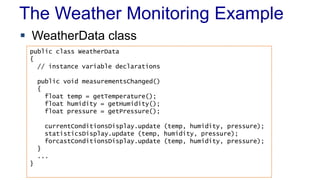
 WeatherData class
public class WeatherData
{
// instance variable declarations
public void measurementsChanged()
{
float temp = getTemperature();
float humidity = getHumidity();
float pressure = getPressure();
currentConditionsDisplay.update (temp, humidity, pressure);
statisticsDisplay.update (temp, humidity, pressure);
forcastConditionsDisplay.update (temp, humidity, pressure);
}
...
}
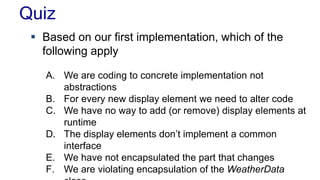
Quiz
 Based on our first implementation, which of the
following apply
A. We are coding to concrete implementation not
abstractions
B. For every new display element we need to alter code
C. We have no way to add (or remove) display elements at
runtime
D. The display elements don’t implement a common
interface
E. We have not encapsulated the part that changes
F. We are violating encapsulation of the WeatherData
The Weather Monitoring Example
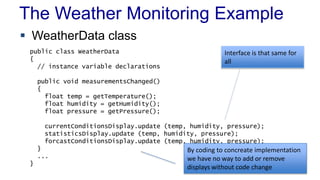
 WeatherData class
public class WeatherData
{
// instance variable declarations
public void measurementsChanged()
{
float temp = getTemperature();
float humidity = getHumidity();
float pressure = getPressure();
currentConditionsDisplay.update (temp, humidity, pressure);
statisticsDisplay.update (temp, humidity, pressure);
forcastConditionsDisplay.update (temp, humidity, pressure);
}
...
}
By coding to concreate implementation
we have no way to add or remove
displays without code change
Interface is that same for
all
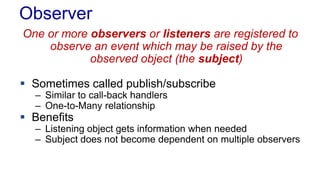
Observer
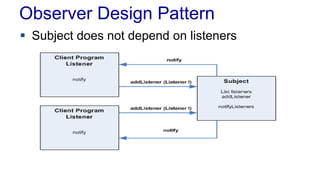
One or more observers or listeners are registered to
observe an event which may be raised by the
observed object (the subject)
 Sometimes called publish/subscribe
– Similar to call-back handlers
– One-to-Many relationship
 Benefits
– Listening object gets information when needed
– Subject does not become dependent on multiple observers
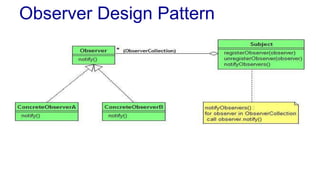
Observer Design Pattern
 Subject does not depend on listeners
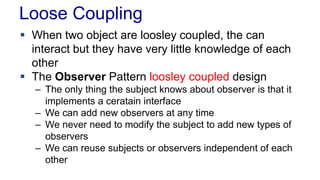
Loose Coupling
 When two object are loosley coupled, the can
interact but they have very little knowledge of each
other
 The Observer Pattern loosley coupled design
– The only thing the subject knows about observer is that it
implements a ceratain interface
– We can add new observers at any time
– We never need to modify the subject to add new types of
observers
– We can reuse subjects or observers independent of each
other
Loosley Coupled Principle
Strive for loosely coupled
designs between objects
that interact
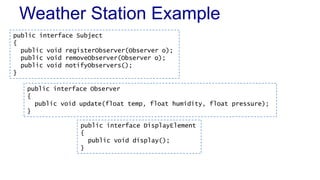
Weather Station Example
public interface Subject
{
public void registerObserver(Observer o);
public void removeObserver(Observer o);
public void notifyObservers();
}
public interface DisplayElement
{
public void display();
}
public interface Observer
{
public void update(float temp, float humidity, float pressure);
}
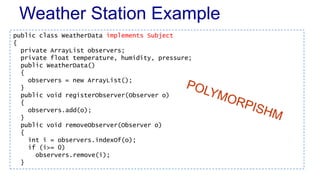
Weather Station Example
public class WeatherData implements Subject
{
private ArrayList observers;
private float temperature, humidity, pressure;
public WeatherData()
{
observers = new ArrayList();
}
public void registerObserver(Observer o)
{
observers.add(o);
}
public void removeObserver(Observer o)
{
int i = observers.indexOf(o);
if (i>= 0)
observers.remove(i);
}
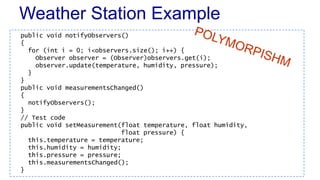
Weather Station Example
public void notifyObservers()
{
for (int i = 0; i<observers.size(); i++) {
Observer observer = (Observer)observers.get(i);
observer.update(temperature, humidity, pressure);
}
}
public void measurementsChanged()
{
notifyObservers();
}
// Test code
public void setMeasurement(float temperature, float humidity,
float pressure) {
this.temperature = temperature;
this.humidity = humidity;
this.pressure = pressure;
this.measurementsChanged();
}
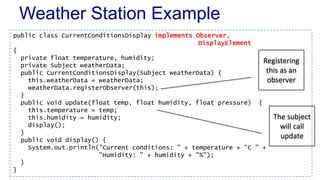
Weather Station Example
public class CurrentConditionsDisplay implements Observer,
DisplayElement
{
private float temperature, humidity;
private Subject weatherData;
public CurrentConditionsDisplay(Subject weatherData) {
this.weatherData = weatherData;
weatherData.registerObserver(this);
}
public void update(float temp, float humidity, float pressure) {
this.temperature = temp;
this.humidity = humidity;
display();
}
public void display() {
System.out.println("Current conditions: " + temperature + "C " +
"Humidity: " + humidity + "%");
}
}
Registering
this as an
observer
The subject
will call
update
Weather Station Example
public class WeatherStation
{
public static void main(String[] args)
{
WeatherData weatherData = new WeatherData();
CurrentConditionsDisplay currentDisplay = new
CurrentConditionsDisplay(weatherData);
weatherData.setMeasurement(15, 50, 30);
}
}
Current conditions: 15.0C Humidity: 50.0%
Loose Coupling
 When two object are loosley coupled, the can
interact but they have very little knowledge of each
other
 The Observer Pattern loosley coupled design
– The only thing the subject knows about observer is that it
implements a ceratain interface
– We can add new observers at any time
– We never need to modify the subject to add new types of
observers
– We can reuse subjects or observers independent of each
other
Loosley Coupled Principle
Strive for loosely coupled
designs between objects
that interact
Liskov Substitution Principle
Overriding Behavior
 RubberDuck overwrote fly to do nothing
– Any use of Duck that expects fly behavior will not
work correctly
– Users of the base class (Duck) should expect same
functionality
– Violation of the Liskov Substitution Principle
The Liskov Substitution Principle
Subtypes must be
substitutable for their base
types. Code that uses
references to base class must
be able to use objects of
derived classes without
knowing it.
Barbara
Liskov
The Liskov Substitution Principle
 All code operating with reference to the base
class should be completely transparent to the
type of the inherited object
 It should be possible to substitute an object of
one type with another within the same class
hierarchy
 Inheriting classes should not perform any
actions that will invalidate the assumptions
made by the base class
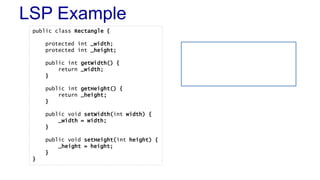
LSP Example
public class Rectangle {
protected int _width;
protected int _height;
public int getWidth() {
return _width;
}
public int getHeight() {
return _height;
}
public void setWidth(int width) {
_width = width;
}
public void setHeight(int height) {
_height = height;
}
}
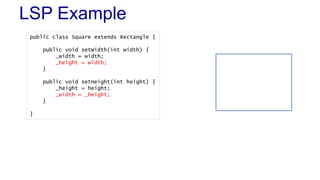
LSP Example
public class Square extends Rectangle {
public void setWidth(int width) {
_width = width;
_height = width;
}
public void setHeight(int height) {
_height = height;
_width = _height;
}
}
Implementation convenience
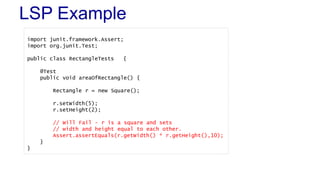
LSP Example
import junit.framework.Assert;
import org.junit.Test;
public class RectangleTests {
@Test
public void areaOfRectangle() {
Rectangle r = new Square();
r.setWidth(5);
r.setHeight(2);
// Will Fail - r is a square and sets
// width and height equal to each other.
Assert.assertEquals(r.getWidth() * r.getHeight(),10);
}
}
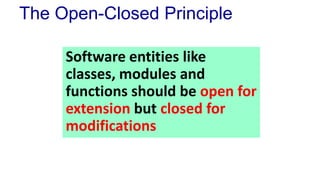
The Open-Closed Principle
Software entities like
classes, modules and
functions should be open for
extension but closed for
modifications
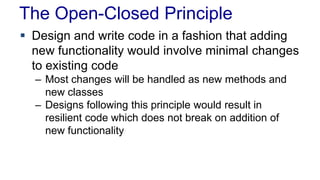
The Open-Closed Principle
 Design and write code in a fashion that adding
new functionality would involve minimal changes
to existing code
– Most changes will be handled as new methods and
new classes
– Designs following this principle would result in
resilient code which does not break on addition of
new functionality
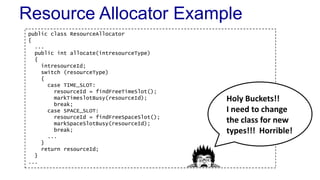
public class ResourceAllocator
{
...
public int allocate(intresourceType)
{
intresourceId;
switch (resourceType)
{
case TIME_SLOT:
resourceId = findFreeTimeSlot();
markTimeslotBusy(resourceId);
break;
case SPACE_SLOT:
resourceId = findFreeSpaceSlot();
markSpaceSlotBusy(resourceId);
break;
...
}
return resourceId;
}
...
Resource Allocator Example
Holy Buckets!!
I need to change
the class for new
types!!! Horrible!
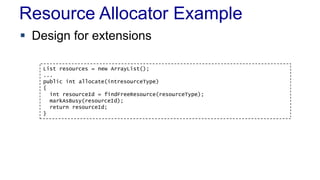
Resource Allocator Example
 Design for extensions
List resources = new ArrayList();
...
public int allocate(intresourceType)
{
int resourceId = findFreeResource(resourceType);
markAsBusy(resourceId);
return resourceId;
}
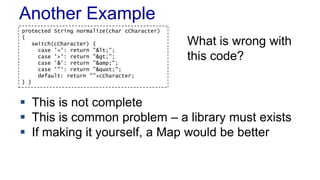
Another Example
protected String normalize(char cCharacter)
{
switch(cCharacter) {
case '<': return "&lt;";
case '>': return "&gt;";
case '&’: return "&amp;";
case '"’: return "&quot;";
default: return ""+cCharacter;
} }
 This is not complete
 This is common problem – a library must exists
 If making it yourself, a Map would be better
What is wrong with
this code?
Creating Objects Revisted
Task
We need to create program that reads feeds
Feed can be RSS news, XML or what ever
The program must be loosely coupled
New feed types will come
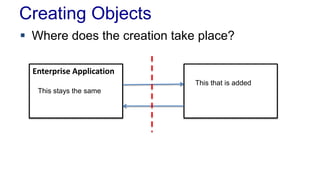
Creating Objects
 Where does the creation take place?
Enterprise Application
This stays the same
This that is added
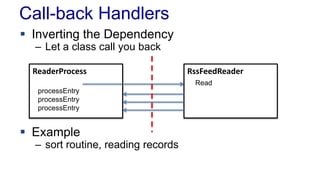
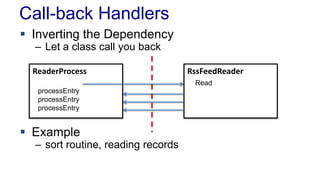
Call-back Handlers
 Inverting the Dependency
– Let a class call you back
 Example
– sort routine, reading records
ReaderProcess RssFeedReader
processEntry
processEntry
processEntry
Read
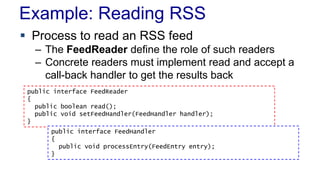
Example: Reading RSS
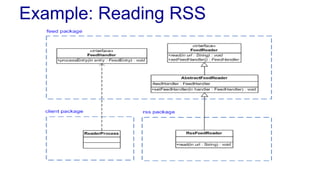
 Process to read an RSS feed
– The FeedReader define the role of such readers
– Concrete readers must implement read and accept a
call-back handler to get the results back
public interface FeedReader
{
public boolean read();
public void setFeedHandler(FeedHandler handler);
}
public interface FeedHandler
{
public void processEntry(FeedEntry entry);
}
Example: Reading RSS
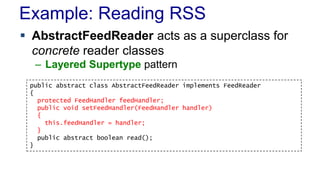
 AbstractFeedReader acts as a superclass for
concrete reader classes
– Layered Supertype pattern
public abstract class AbstractFeedReader implements FeedReader
{
protected FeedHandler feedHandler;
public void setFeedHandler(FeedHandler handler)
{
this.feedHandler = handler;
}
public abstract boolean read();
}
Example: Reading RSS
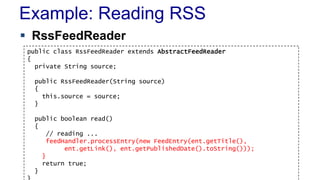
 RssFeedReader
public class RssFeedReader extends AbstractFeedReader
{
private String source;
public RssFeedReader(String source)
{
this.source = source;
}
public boolean read()
{
// reading ...
feedHandler.processEntry(new FeedEntry(ent.getTitle(),
ent.getLink(), ent.getPublishedDate().toString()));
}
return true;
}
Example: Reading RSS
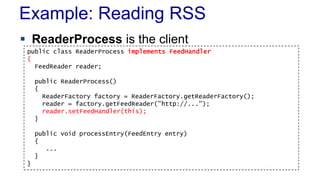
 ReaderProcess is the client
public class ReaderProcess implements FeedHandler
{
FeedReader reader;
public ReaderProcess()
{
ReaderFactory factory = ReaderFactory.getReaderFactory();
reader = factory.getFeedReader("http://...");
reader.setFeedHandler(this);
}
public void processEntry(FeedEntry entry)
{
...
}
}
Example: Reading RSS
Call-back Handlers
 Inverting the Dependency
– Let a class call you back
 Example
– sort routine, reading records
ReaderProcess RssFeedReader
processEntry
processEntry
processEntry
Read
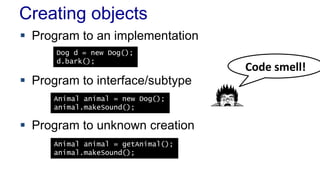
Creating objects
 Program to an implementation
 Program to interface/subtype
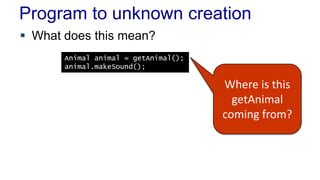
 Program to unknown creation
Dog d = new Dog();
d.bark();
Animal animal = new Dog();
animal.makeSound();
Animal animal = getAnimal();
animal.makeSound();
Code smell!
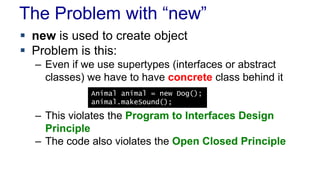
The Problem with “new”
 new is used to create object
 Problem is this:
– Even if we use supertypes (interfaces or abstract
classes) we have to have concrete class behind it
– This violates the Program to Interfaces Design
Principle
– The code also violates the Open Closed Principle
Animal animal = new Dog();
animal.makeSound();
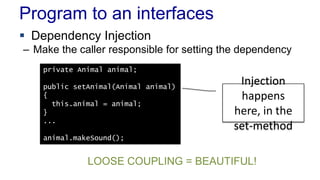
Program to an interfaces
 Dependency Injection
– Make the caller responsible for setting the dependency
private Animal animal;
public setAnimal(Animal animal)
{
this.animal = animal;
}
...
animal.makeSound();
Injection
happens
here, in the
set-method
LOOSE COUPLING = BEAUTIFUL!
Program to unknown creation
 What does this mean?
Animal animal = getAnimal();
animal.makeSound();
Where is this
getAnimal
coming from?
Factory
FeedReader
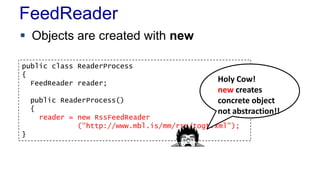
 Objects are created with new
public class ReaderProcess
{
FeedReader reader;
public ReaderProcess()
{
reader = new RssFeedReader
("http://www.mbl.is/mm/rss/togt.xml");
}
Holy Cow!
new creates
concrete object
not abstraction!!
FeedReader
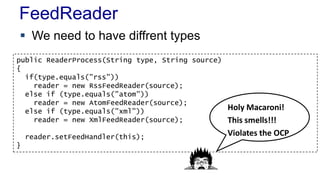
 We need to have diffrent types
public ReaderProcess(String type, String source)
{
if(type.equals("rss"))
reader = new RssFeedReader(source);
else if (type.equals("atom"))
reader = new AtomFeedReader(source);
else if (type.equals("xml"))
reader = new XmlFeedReader(source);
reader.setFeedHandler(this);
}
Holy Macaroni!
This smells!!!
Violates the OCP
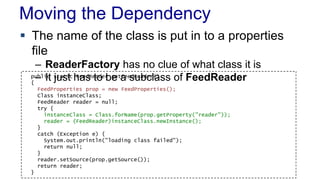
Moving the Dependency
 The name of the class is put in to a properties
file
– ReaderFactory has no clue of what class it is
– It just has to be a subclass of FeedReaderpublic static FeedReader getFeedReader()
{
FeedProperties prop = new FeedProperties();
Class instanceClass;
FeedReader reader = null;
try {
instanceClass = Class.forName(prop.getProperty("reader"));
reader = (FeedReader)instanceClass.newInstance();
}
catch (Exception e) {
System.out.println("loading class failed");
return null;
}
reader.setSource(prop.getSource());
return reader;
}
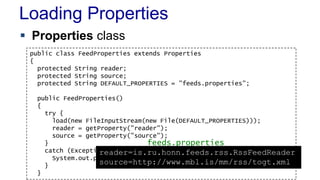
Loading Properties
 Properties class
public class FeedProperties extends Properties
{
protected String reader;
protected String source;
protected String DEFAULT_PROPERTIES = "feeds.properties";
public FeedProperties()
{
try {
load(new FileInputStream(new File(DEFAULT_PROPERTIES)));
reader = getProperty("reader");
source = getProperty("source");
}
catch (Exception e) {
System.out.println("Loading properties failed");
}
}
feeds.properties
reader=is.ru.honn.feeds.rss.RssFeedReader
source=http://www.mbl.is/mm/rss/togt.xml
Summary
 Patterns are lessons from practice
– History, classification, structure
 Observer Pattern is useful for loose coupling
 Design Principles
– Loosley Coupled Principle
– Open-Close Principle
– Liskov Substitution Principle
Next
 Base Patterns
 Read Fowler chapter 18

L03 Design Patterns

  • 1.
  • 2.
    Agenda  Patterns – History,classification, structure  Patterns covered – Observer  Design Principles – Loosley Coupled Design Principle – Open-Close Principle – Liskov Substitution Principle
  • 3.
    Reading  Fowler Introduction –Section on Patterns, page 9-11  Design Patterns  Observer pattern  Factory pattern  The Liskov Substitution Principle  The Open-Closed Principle
  • 4.
    Pattern Catalog  Catalogof Patterns of Enterprise Application Architecture – Patterns in PoEAA – http://www.martinfowler.com/eaaCatalog/
  • 5.
  • 6.
    Design Patterns  Designpattern is a general solution to a common problem in software design – Systematic approach for problems that reoccur in software development – Not complete solution but starting point for design – Not code ready to use – Patterns have names and definitions – Built on common practices  Patterns should not be language dependant – However patterns apply for types of programming languages
  • 7.
    History  Patterns originatedas an architectural concept “Each pattern describes a problem which occurs over and over again in our environment, and then describes the core of the solution to that problem, in such a way that you can use this solution a million times over, without ever doing it the same way twice” - Christopher Alexander
  • 8.
    History  Landmark bookfrom 1995:Design Patterns: Elements of Reusable Object-Oriented Software – Gang of Four (GoF) – Term Design Pattern is borrowed from the construction industry  Several books on patterns have been published since – Head First Design Patterns for example
  • 9.
    Vintage Design Patterns Design Patterns are like good red wine – You cannot appreciate them at first – As you study them you learn the difference between plonk and vintage, or bad and good designs – As you become a connoisseur you experience the various textures you didn’t notice before  Warning: – Once you are hooked, you will no longer be satisfied with inferior designs Dr. Heinz Kabutz (http://www.javaspecialists.co.za)
  • 10.
    Pattern Classification  Designpatterns can be classified based on multiple criteria – Basic underlying problem they solve  Classification – Fundamental patterns – Creational patterns – Structural patterns – Behavioral patterns – Concurrency patterns
  • 11.
    Enterprise Patterns Classification Domain Logic Patterns  Data Source Architectural Patterns  Object-Relational Behavioral Patterns  Object-Relational Structural Patterns  Object-Relational Metadata Mapping Patterns  Web Presentation Patterns  Distribution Patterns  Offline Concurrency Patterns  Session State Patterns  Base Patterns
  • 12.
    Which of thesestatements is not true A) Design Patterns are based on solutions from practice B) Design Patterns are ideas not code C) Design Patterns are based on specific programming languages D) Design Patterns can have ambiguous names QUIZ ✔
  • 13.
  • 14.
    Structure of Patterns Name  The Intent  The Sketch  Motivation  How it Works  When to Use it  Further Reading  Examples
  • 15.
    The Name  Patternnames are important – Need to create a vocabulary – Need to describe the pattern well – Avoid ambiguity and misunderstanding  Problems with names – Authors are using different names for same pattern • Data Access Object and Table Data Gateway • Dependency Injection and Inversion of Control – Authors are using same name for different patterns • Example: Value Object is used for two similar patterns
  • 16.
    The Intent  Sumsup the pattern in a sentence or two – Value Object: A small simple object, like money or date range, whose equality isn’t based on identity
  • 17.
    The Sketch  Visualrepresentation of the pattern, often but not always a UML diagram
  • 18.
    Motivation  Description ofa motivating problem for the pattern – Problem description – May not be the only problem for the pattern  Example: – Layered supertype It’s not uncommon for all the objects in a layer to have methods you don’t want to have duplicated throughout the system. You can move this behavior into a common Layer Supertype
  • 19.
    How it Works Describes the solution – Implementation Issues – Variations – Independent of any particular platform – Platform dependent sections are identified – UML Diagrams if applicable  Plugin example
  • 20.
    When to UseIt  Describes when the pattern should be used – Trade-offs – Comparisons  Layered Supertype example – Use Layer Supertype when you have common features from all objects in a layer
  • 21.
    Examples  Example codein Java or C# – Layer Supertype  Not working code – pseudo code to give idea class DomainObject... private Long ID; public Long getID() { return ID; } public void setID(Long ID) { this.ID = ID; } public DomainObject(Long ID) { this.ID = ID; }
  • 22.
    Using Design Patterns How to use design patterns? – Problem is the patterns can be complex and detailed – Usually they are generic and abstract  Ways to study patterns – Implement them in test code – Sketch a class diagram in your context to see the class dependencies – Form a “Study group” to discuss the patterns – Learn the vocabulary – Practice, practice, practice
  • 23.
    Problems with Patterns Ambiguity in Vocabulary – Same pattern has different names – Different Patterns have same name  Appling the wrong pattern – Over-designing the solution – Patterns design for one language might not be needed in another  Not solving the original problem – Using Remote Façade instead of avoiding network latencies – Using EJB Entity Beans
  • 24.
    Job interview question Youare given the assignment of creating a component that needs to know sales statistics of Lottery tickets. You know that there is a another component in the system, Sale Server, that handles the sale. You need real-time information. What would you suggest? EXERCISE
  • 25.
    Sale server Bingo Firstproposal: Sale Server will call Bingo Problem is that the Sale Server developer refuses to make a call to a specific game. His argument is that Sale Server should be for sale, and not be cluttered with game specific code. Another solution is needed.
  • 27.
  • 28.
  • 29.
    The Weather MonitoringExample  The Weather Monitoring application
  • 30.
    The Weather MonitoringExample  Task – We need to implement measurementsChanged so that it updates three different displays for current conditions, weather stats, and forcasts – measurementsChanged is called any time data changes, we don’t know or care how this method is called – Three display types must be updated – The system must be expandable – new display types will be added
  • 31.
    The Weather MonitoringExample  WeatherData class public class WeatherData { // instance variable declarations public void measurementsChanged() { float temp = getTemperature(); float humidity = getHumidity(); float pressure = getPressure(); currentConditionsDisplay.update (temp, humidity, pressure); statisticsDisplay.update (temp, humidity, pressure); forcastConditionsDisplay.update (temp, humidity, pressure); } ... }
  • 32.
    Quiz  Based onour first implementation, which of the following apply A. We are coding to concrete implementation not abstractions B. For every new display element we need to alter code C. We have no way to add (or remove) display elements at runtime D. The display elements don’t implement a common interface E. We have not encapsulated the part that changes F. We are violating encapsulation of the WeatherData
  • 33.
    The Weather MonitoringExample  WeatherData class public class WeatherData { // instance variable declarations public void measurementsChanged() { float temp = getTemperature(); float humidity = getHumidity(); float pressure = getPressure(); currentConditionsDisplay.update (temp, humidity, pressure); statisticsDisplay.update (temp, humidity, pressure); forcastConditionsDisplay.update (temp, humidity, pressure); } ... } By coding to concreate implementation we have no way to add or remove displays without code change Interface is that same for all
  • 34.
    Observer One or moreobservers or listeners are registered to observe an event which may be raised by the observed object (the subject)  Sometimes called publish/subscribe – Similar to call-back handlers – One-to-Many relationship  Benefits – Listening object gets information when needed – Subject does not become dependent on multiple observers
  • 35.
  • 36.
    Observer Design Pattern Subject does not depend on listeners
  • 37.
    Loose Coupling  Whentwo object are loosley coupled, the can interact but they have very little knowledge of each other  The Observer Pattern loosley coupled design – The only thing the subject knows about observer is that it implements a ceratain interface – We can add new observers at any time – We never need to modify the subject to add new types of observers – We can reuse subjects or observers independent of each other
  • 38.
    Loosley Coupled Principle Strivefor loosely coupled designs between objects that interact
  • 39.
    Weather Station Example publicinterface Subject { public void registerObserver(Observer o); public void removeObserver(Observer o); public void notifyObservers(); } public interface DisplayElement { public void display(); } public interface Observer { public void update(float temp, float humidity, float pressure); }
  • 40.
    Weather Station Example publicclass WeatherData implements Subject { private ArrayList observers; private float temperature, humidity, pressure; public WeatherData() { observers = new ArrayList(); } public void registerObserver(Observer o) { observers.add(o); } public void removeObserver(Observer o) { int i = observers.indexOf(o); if (i>= 0) observers.remove(i); }
  • 41.
    Weather Station Example publicvoid notifyObservers() { for (int i = 0; i<observers.size(); i++) { Observer observer = (Observer)observers.get(i); observer.update(temperature, humidity, pressure); } } public void measurementsChanged() { notifyObservers(); } // Test code public void setMeasurement(float temperature, float humidity, float pressure) { this.temperature = temperature; this.humidity = humidity; this.pressure = pressure; this.measurementsChanged(); }
  • 42.
    Weather Station Example publicclass CurrentConditionsDisplay implements Observer, DisplayElement { private float temperature, humidity; private Subject weatherData; public CurrentConditionsDisplay(Subject weatherData) { this.weatherData = weatherData; weatherData.registerObserver(this); } public void update(float temp, float humidity, float pressure) { this.temperature = temp; this.humidity = humidity; display(); } public void display() { System.out.println("Current conditions: " + temperature + "C " + "Humidity: " + humidity + "%"); } } Registering this as an observer The subject will call update
  • 43.
    Weather Station Example publicclass WeatherStation { public static void main(String[] args) { WeatherData weatherData = new WeatherData(); CurrentConditionsDisplay currentDisplay = new CurrentConditionsDisplay(weatherData); weatherData.setMeasurement(15, 50, 30); } } Current conditions: 15.0C Humidity: 50.0%
  • 44.
    Loose Coupling  Whentwo object are loosley coupled, the can interact but they have very little knowledge of each other  The Observer Pattern loosley coupled design – The only thing the subject knows about observer is that it implements a ceratain interface – We can add new observers at any time – We never need to modify the subject to add new types of observers – We can reuse subjects or observers independent of each other
  • 45.
    Loosley Coupled Principle Strivefor loosely coupled designs between objects that interact
  • 46.
  • 47.
    Overriding Behavior  RubberDuckoverwrote fly to do nothing – Any use of Duck that expects fly behavior will not work correctly – Users of the base class (Duck) should expect same functionality – Violation of the Liskov Substitution Principle
  • 48.
    The Liskov SubstitutionPrinciple Subtypes must be substitutable for their base types. Code that uses references to base class must be able to use objects of derived classes without knowing it. Barbara Liskov
  • 49.
    The Liskov SubstitutionPrinciple  All code operating with reference to the base class should be completely transparent to the type of the inherited object  It should be possible to substitute an object of one type with another within the same class hierarchy  Inheriting classes should not perform any actions that will invalidate the assumptions made by the base class
  • 50.
    LSP Example public classRectangle { protected int _width; protected int _height; public int getWidth() { return _width; } public int getHeight() { return _height; } public void setWidth(int width) { _width = width; } public void setHeight(int height) { _height = height; } }
  • 51.
    LSP Example public classSquare extends Rectangle { public void setWidth(int width) { _width = width; _height = width; } public void setHeight(int height) { _height = height; _width = _height; } } Implementation convenience
  • 52.
    LSP Example import junit.framework.Assert; importorg.junit.Test; public class RectangleTests { @Test public void areaOfRectangle() { Rectangle r = new Square(); r.setWidth(5); r.setHeight(2); // Will Fail - r is a square and sets // width and height equal to each other. Assert.assertEquals(r.getWidth() * r.getHeight(),10); } }
  • 53.
  • 54.
    The Open-Closed Principle Softwareentities like classes, modules and functions should be open for extension but closed for modifications
  • 55.
    The Open-Closed Principle Design and write code in a fashion that adding new functionality would involve minimal changes to existing code – Most changes will be handled as new methods and new classes – Designs following this principle would result in resilient code which does not break on addition of new functionality
  • 56.
    public class ResourceAllocator { ... publicint allocate(intresourceType) { intresourceId; switch (resourceType) { case TIME_SLOT: resourceId = findFreeTimeSlot(); markTimeslotBusy(resourceId); break; case SPACE_SLOT: resourceId = findFreeSpaceSlot(); markSpaceSlotBusy(resourceId); break; ... } return resourceId; } ... Resource Allocator Example Holy Buckets!! I need to change the class for new types!!! Horrible!
  • 57.
    Resource Allocator Example Design for extensions List resources = new ArrayList(); ... public int allocate(intresourceType) { int resourceId = findFreeResource(resourceType); markAsBusy(resourceId); return resourceId; }
  • 58.
    Another Example protected Stringnormalize(char cCharacter) { switch(cCharacter) { case '<': return "&lt;"; case '>': return "&gt;"; case '&’: return "&amp;"; case '"’: return "&quot;"; default: return ""+cCharacter; } }  This is not complete  This is common problem – a library must exists  If making it yourself, a Map would be better What is wrong with this code?
  • 59.
  • 60.
    Task We need tocreate program that reads feeds Feed can be RSS news, XML or what ever The program must be loosely coupled New feed types will come
  • 61.
    Creating Objects  Wheredoes the creation take place? Enterprise Application This stays the same This that is added
  • 62.
    Call-back Handlers  Invertingthe Dependency – Let a class call you back  Example – sort routine, reading records ReaderProcess RssFeedReader processEntry processEntry processEntry Read
  • 63.
    Example: Reading RSS Process to read an RSS feed – The FeedReader define the role of such readers – Concrete readers must implement read and accept a call-back handler to get the results back public interface FeedReader { public boolean read(); public void setFeedHandler(FeedHandler handler); } public interface FeedHandler { public void processEntry(FeedEntry entry); }
  • 64.
    Example: Reading RSS AbstractFeedReader acts as a superclass for concrete reader classes – Layered Supertype pattern public abstract class AbstractFeedReader implements FeedReader { protected FeedHandler feedHandler; public void setFeedHandler(FeedHandler handler) { this.feedHandler = handler; } public abstract boolean read(); }
  • 65.
    Example: Reading RSS RssFeedReader public class RssFeedReader extends AbstractFeedReader { private String source; public RssFeedReader(String source) { this.source = source; } public boolean read() { // reading ... feedHandler.processEntry(new FeedEntry(ent.getTitle(), ent.getLink(), ent.getPublishedDate().toString())); } return true; }
  • 66.
    Example: Reading RSS ReaderProcess is the client public class ReaderProcess implements FeedHandler { FeedReader reader; public ReaderProcess() { ReaderFactory factory = ReaderFactory.getReaderFactory(); reader = factory.getFeedReader("http://..."); reader.setFeedHandler(this); } public void processEntry(FeedEntry entry) { ... } }
  • 67.
  • 68.
    Call-back Handlers  Invertingthe Dependency – Let a class call you back  Example – sort routine, reading records ReaderProcess RssFeedReader processEntry processEntry processEntry Read
  • 69.
    Creating objects  Programto an implementation  Program to interface/subtype  Program to unknown creation Dog d = new Dog(); d.bark(); Animal animal = new Dog(); animal.makeSound(); Animal animal = getAnimal(); animal.makeSound(); Code smell!
  • 70.
    The Problem with“new”  new is used to create object  Problem is this: – Even if we use supertypes (interfaces or abstract classes) we have to have concrete class behind it – This violates the Program to Interfaces Design Principle – The code also violates the Open Closed Principle Animal animal = new Dog(); animal.makeSound();
  • 71.
    Program to aninterfaces  Dependency Injection – Make the caller responsible for setting the dependency private Animal animal; public setAnimal(Animal animal) { this.animal = animal; } ... animal.makeSound(); Injection happens here, in the set-method LOOSE COUPLING = BEAUTIFUL!
  • 72.
    Program to unknowncreation  What does this mean? Animal animal = getAnimal(); animal.makeSound(); Where is this getAnimal coming from?
  • 73.
  • 74.
    FeedReader  Objects arecreated with new public class ReaderProcess { FeedReader reader; public ReaderProcess() { reader = new RssFeedReader ("http://www.mbl.is/mm/rss/togt.xml"); } Holy Cow! new creates concrete object not abstraction!!
  • 75.
    FeedReader  We needto have diffrent types public ReaderProcess(String type, String source) { if(type.equals("rss")) reader = new RssFeedReader(source); else if (type.equals("atom")) reader = new AtomFeedReader(source); else if (type.equals("xml")) reader = new XmlFeedReader(source); reader.setFeedHandler(this); } Holy Macaroni! This smells!!! Violates the OCP
  • 76.
    Moving the Dependency The name of the class is put in to a properties file – ReaderFactory has no clue of what class it is – It just has to be a subclass of FeedReaderpublic static FeedReader getFeedReader() { FeedProperties prop = new FeedProperties(); Class instanceClass; FeedReader reader = null; try { instanceClass = Class.forName(prop.getProperty("reader")); reader = (FeedReader)instanceClass.newInstance(); } catch (Exception e) { System.out.println("loading class failed"); return null; } reader.setSource(prop.getSource()); return reader; }
  • 77.
    Loading Properties  Propertiesclass public class FeedProperties extends Properties { protected String reader; protected String source; protected String DEFAULT_PROPERTIES = "feeds.properties"; public FeedProperties() { try { load(new FileInputStream(new File(DEFAULT_PROPERTIES))); reader = getProperty("reader"); source = getProperty("source"); } catch (Exception e) { System.out.println("Loading properties failed"); } } feeds.properties reader=is.ru.honn.feeds.rss.RssFeedReader source=http://www.mbl.is/mm/rss/togt.xml
  • 78.
    Summary  Patterns arelessons from practice – History, classification, structure  Observer Pattern is useful for loose coupling  Design Principles – Loosley Coupled Principle – Open-Close Principle – Liskov Substitution Principle
  • 79.
    Next  Base Patterns Read Fowler chapter 18