Helixa
Tech Leader’s Guide to
Effective Building of
Machine Learning
Products
Gianmario Spacagna
Chief Scientist @ Helixa
ML for Enterprises Conference
Rome, 28th October 2019
About Me
7+ years experience in building Machine Learning products
Currently leading a team of ML Scientists and ML Engineers
Background in Software Engineering of Distributed Systems
MBA Candidate
Co-author of Python Deep Learning
Contributor of the Professional Data Science Manifesto
Blogger of Data Science Vademecum
Founder of the DataScienceMilan.org community
Stockholm, London, Milan
Gianmario Spacagna
Chief Scientist, Helixa
gspacagna@helixa.ai
Agenda
Manager’s guide (40 minutes)
1. Introducing ML in the Enterprises
2. Defining the ML Product Specifications
3. Planning Under Uncertainty
4. Building a balanced ML Team
Tech Leaders’ guide (20 minutes)
5. ML Product Lifecycle
6. Serverless architectures
5. ML Product Lifecycle
Cloud Providers Disclaimer
The following examples will focus on AWS stack but consider
that other cloud providers offers similar services.
It is not part of this talk to compare different cloud solutions.
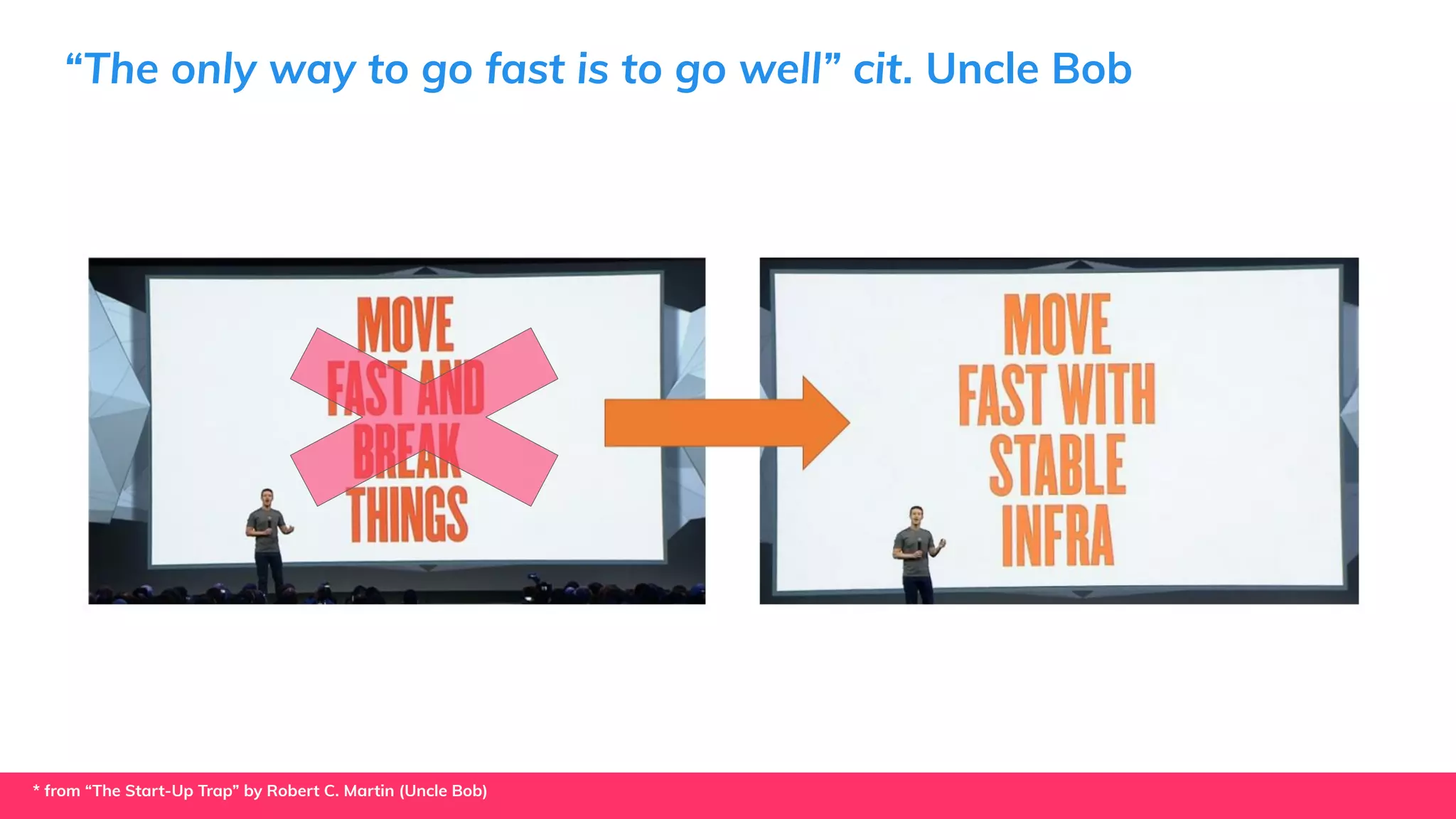
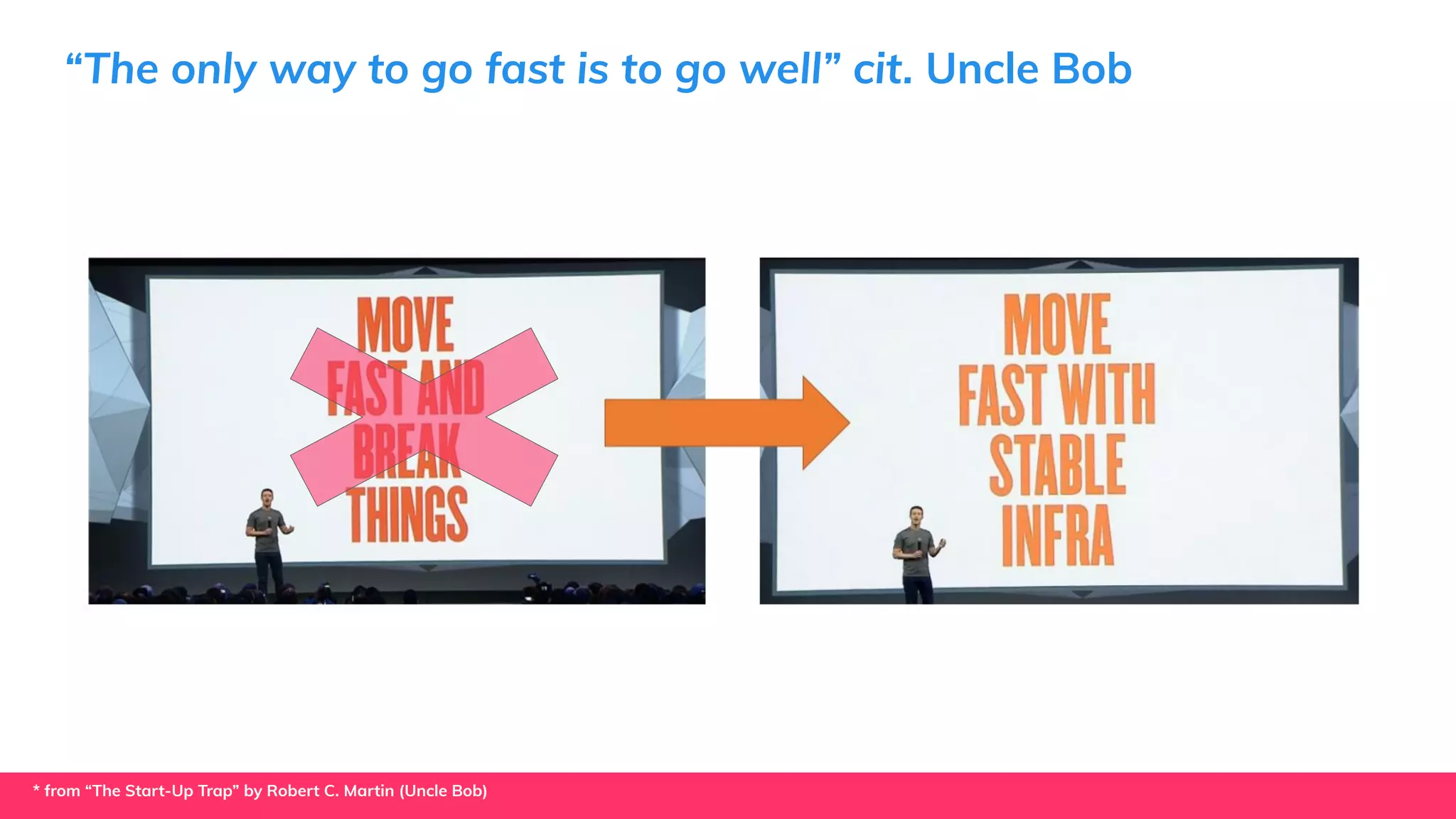
* from “The Start-Up Trap” by Robert C. Martin (Uncle Bob)
“The only way to go fast is to go well” cit. Uncle Bob
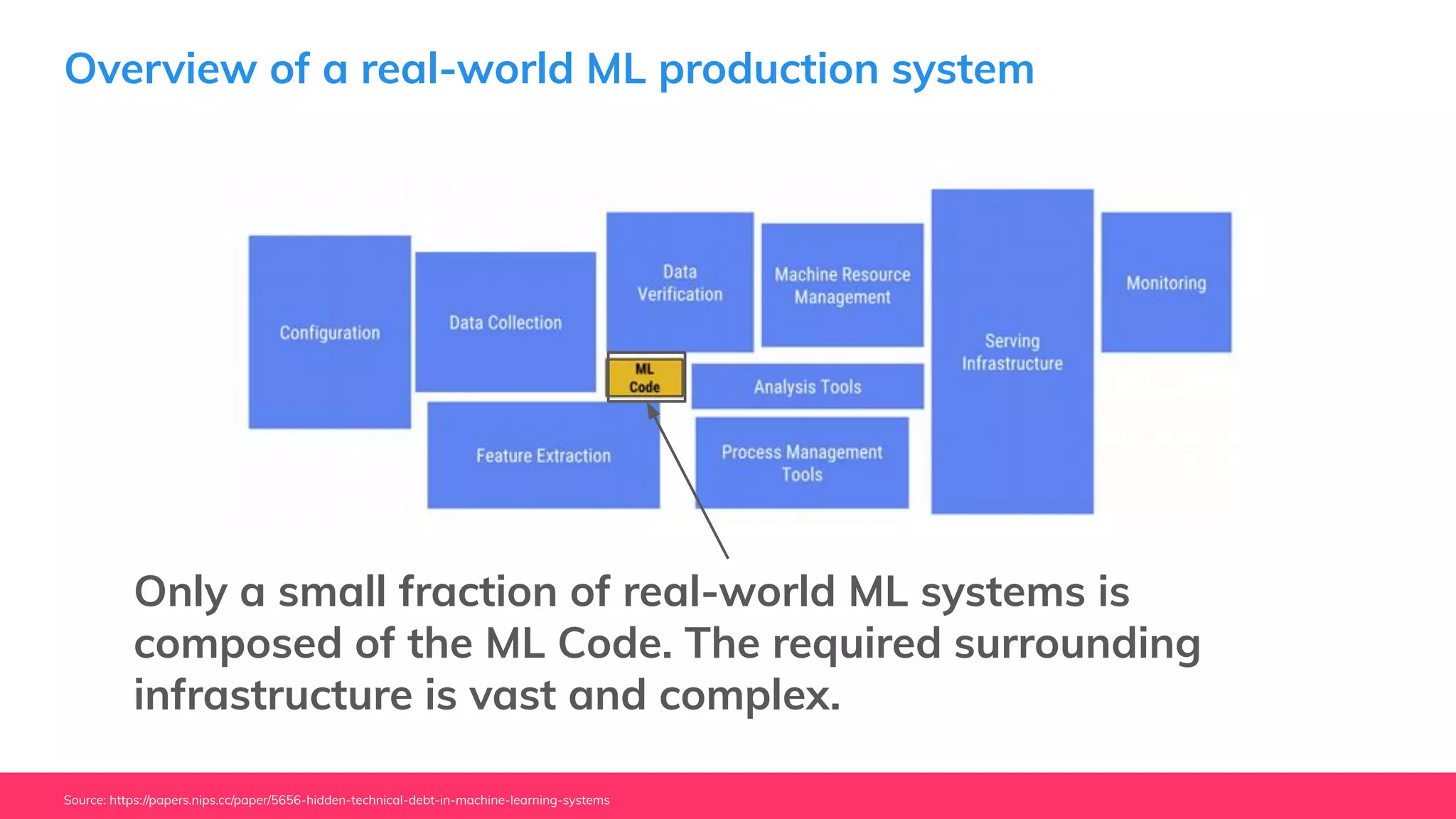
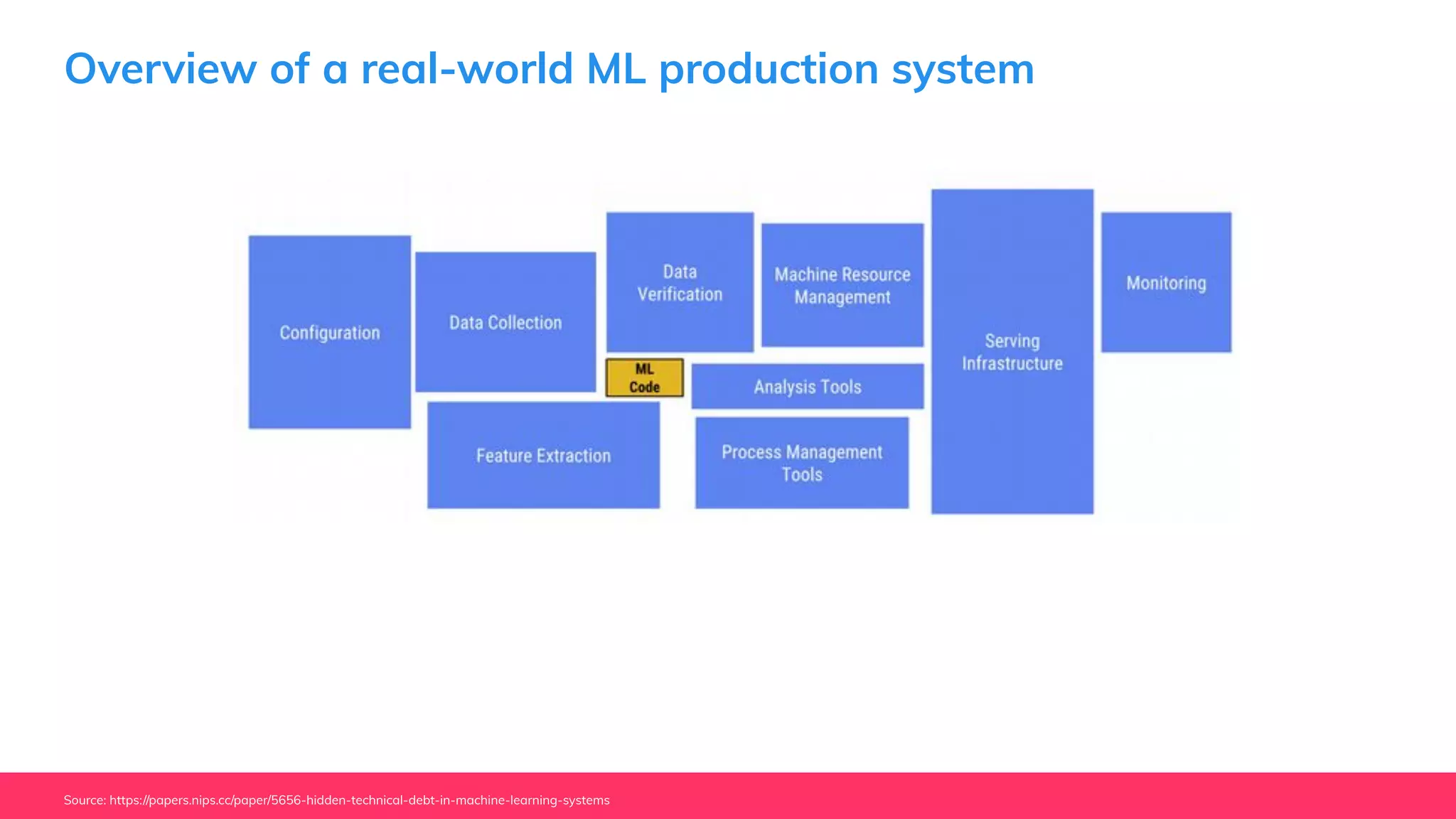
Overview of a real-world ML production system
Source: https://papers.nips.cc/paper/5656-hidden-technical-debt-in-machine-learning-systems
Only a small fraction of real-world ML systems is
composed of the ML Code. The required surrounding
infrastructure is vast and complex.
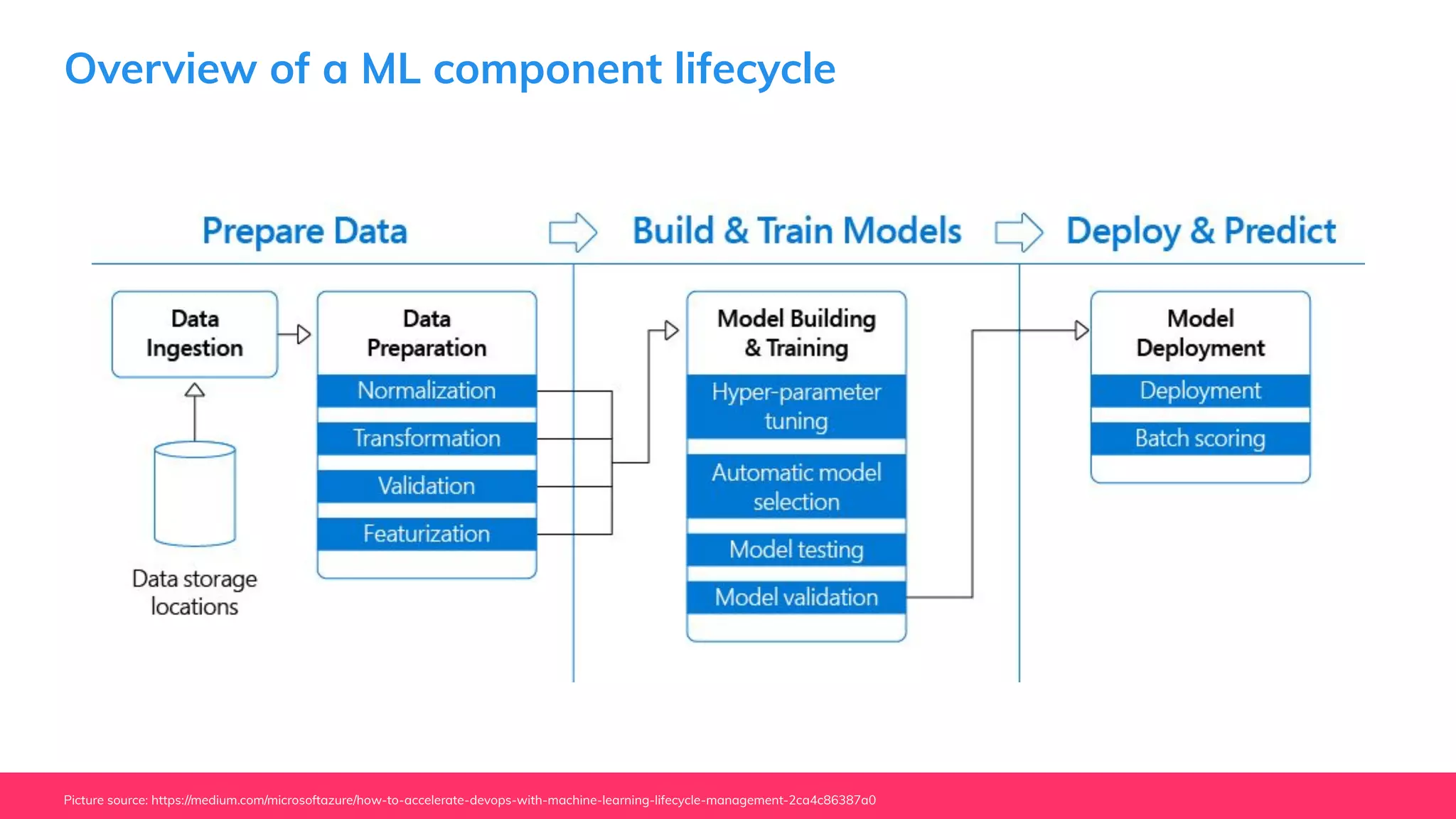
Overview of a ML component lifecycle
Picture source: https://medium.com/microsoftazure/how-to-accelerate-devops-with-machine-learning-lifecycle-management-2ca4c86387a0
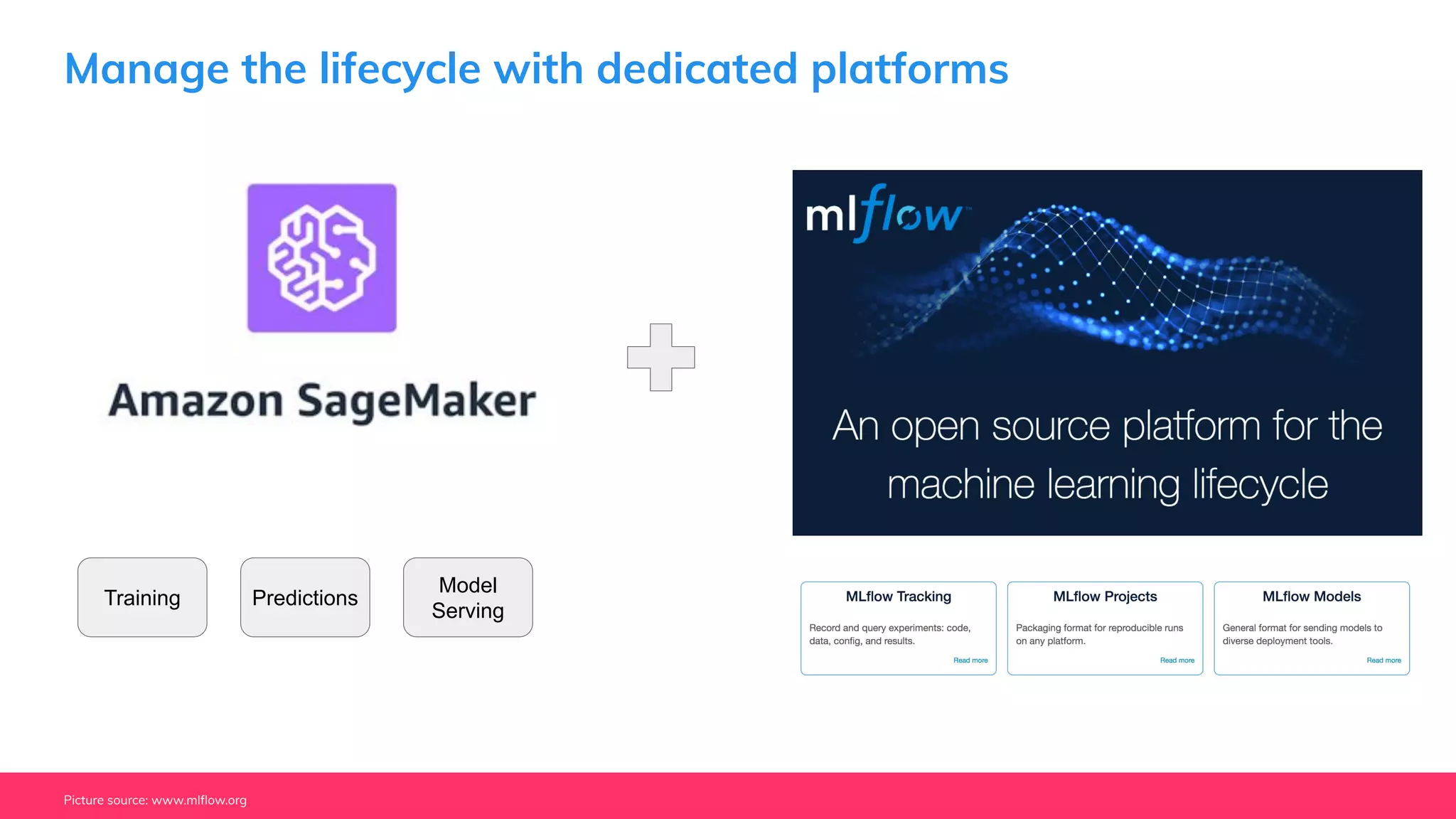
Manage the lifecycle with dedicated platforms
Picture source: www.mlflow.org
Predictions
Model
Serving
Training
Other Machine Learning lifecycle platforms and tools
Picture source: www.mlflow.org
TensorFlow Extended (TFX)
Data Version Control
HopsWorks
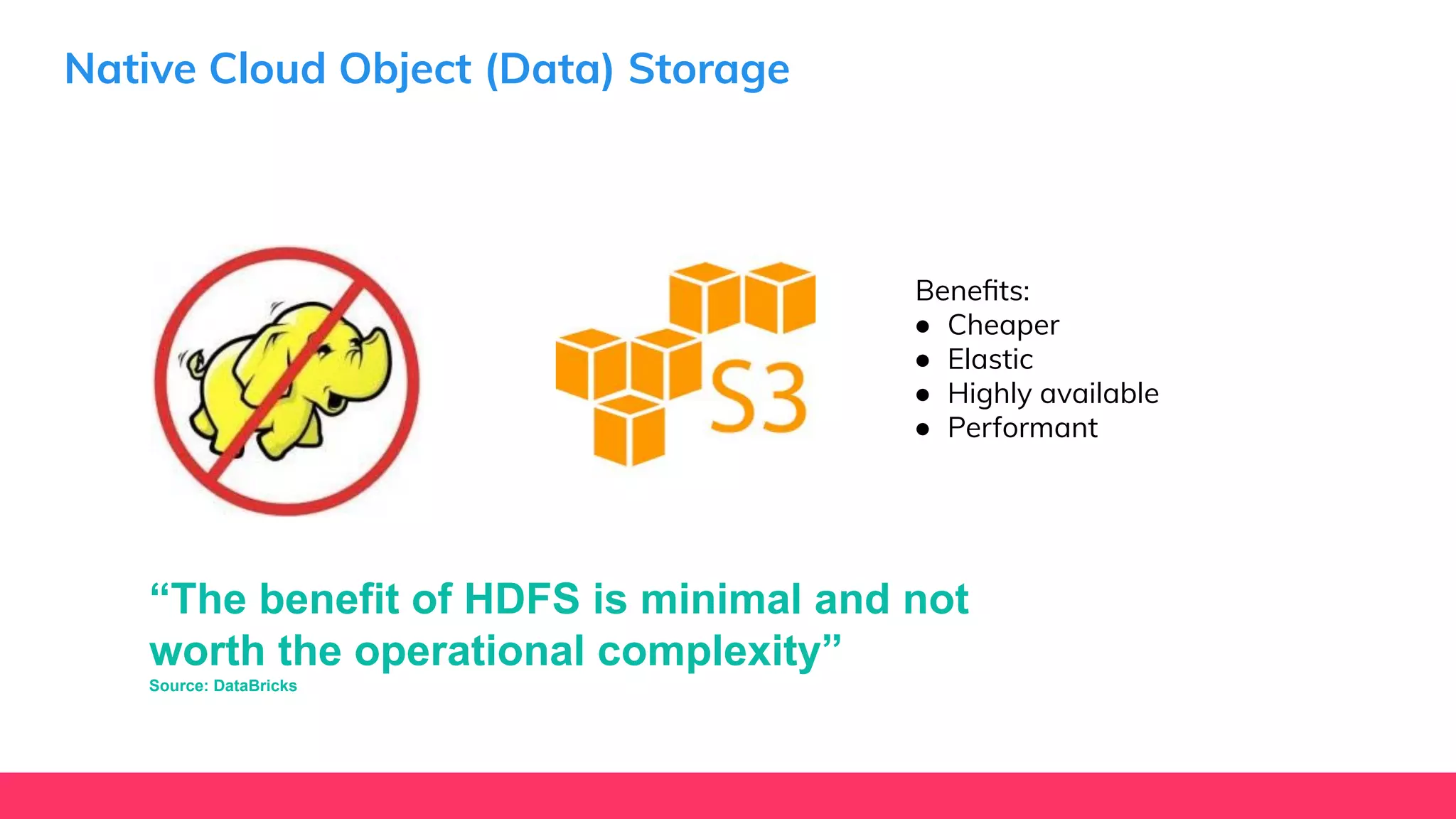
Native Cloud Object (Data) Storage
Benefits:
● Cheaper
● Elastic
● Highly available
● Performant
“The benefit of HDFS is minimal and not
worth the operational complexity”
Source: DataBricks
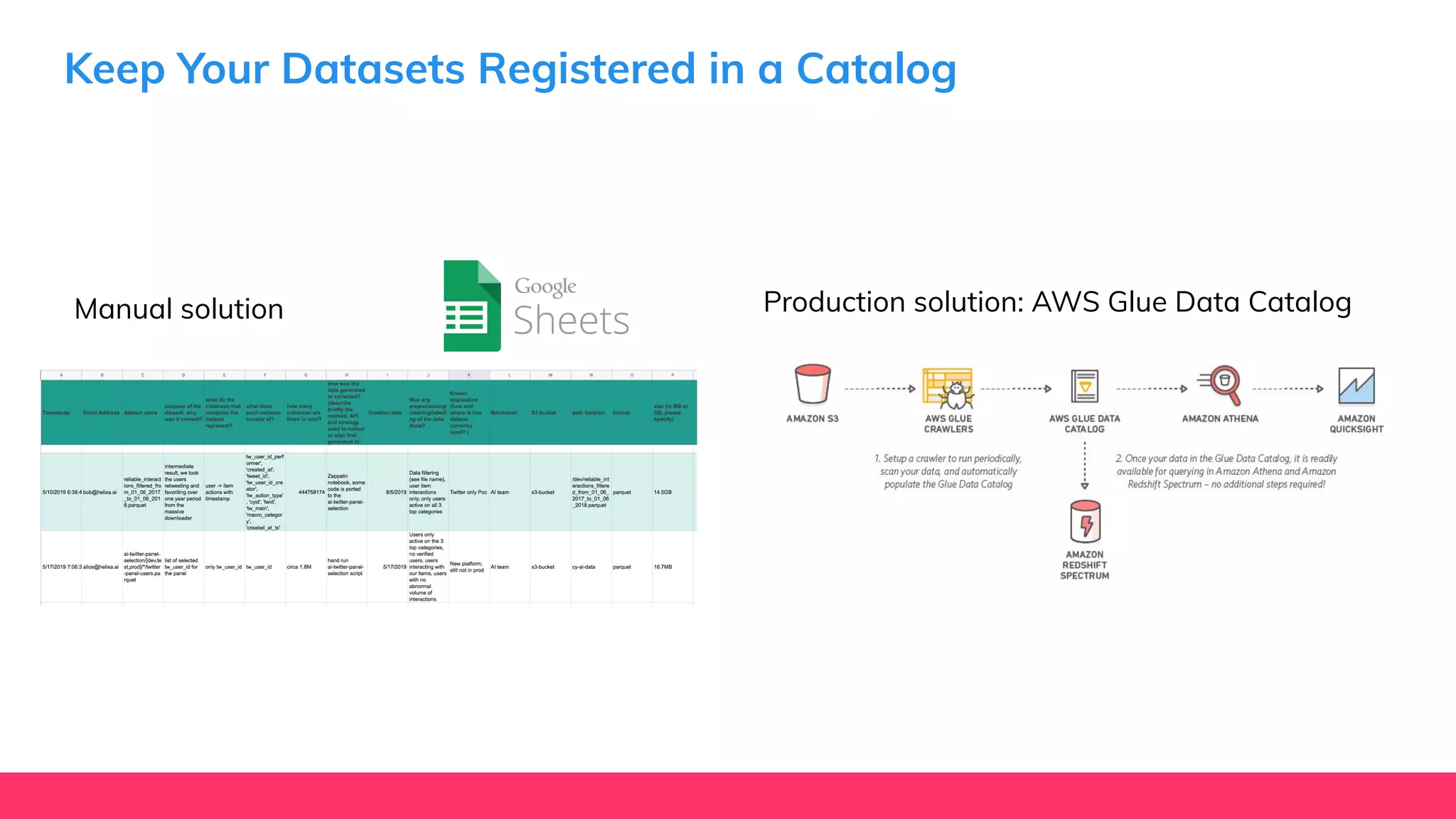
Keep Your Datasets Registered in a Catalog
Production solution: AWS Glue Data CatalogManual solution
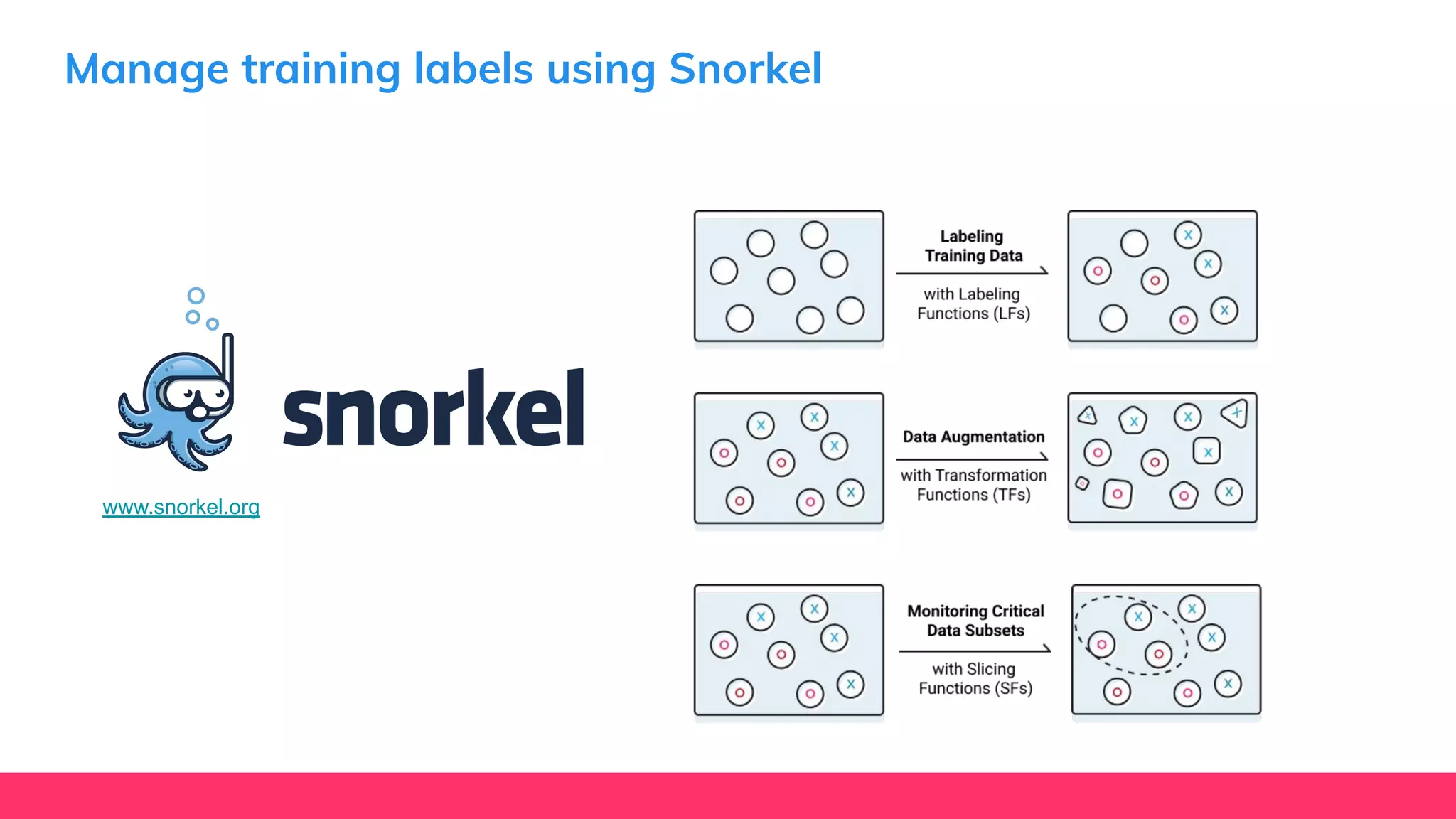
Manage training labels using Snorkel
www.snorkel.org
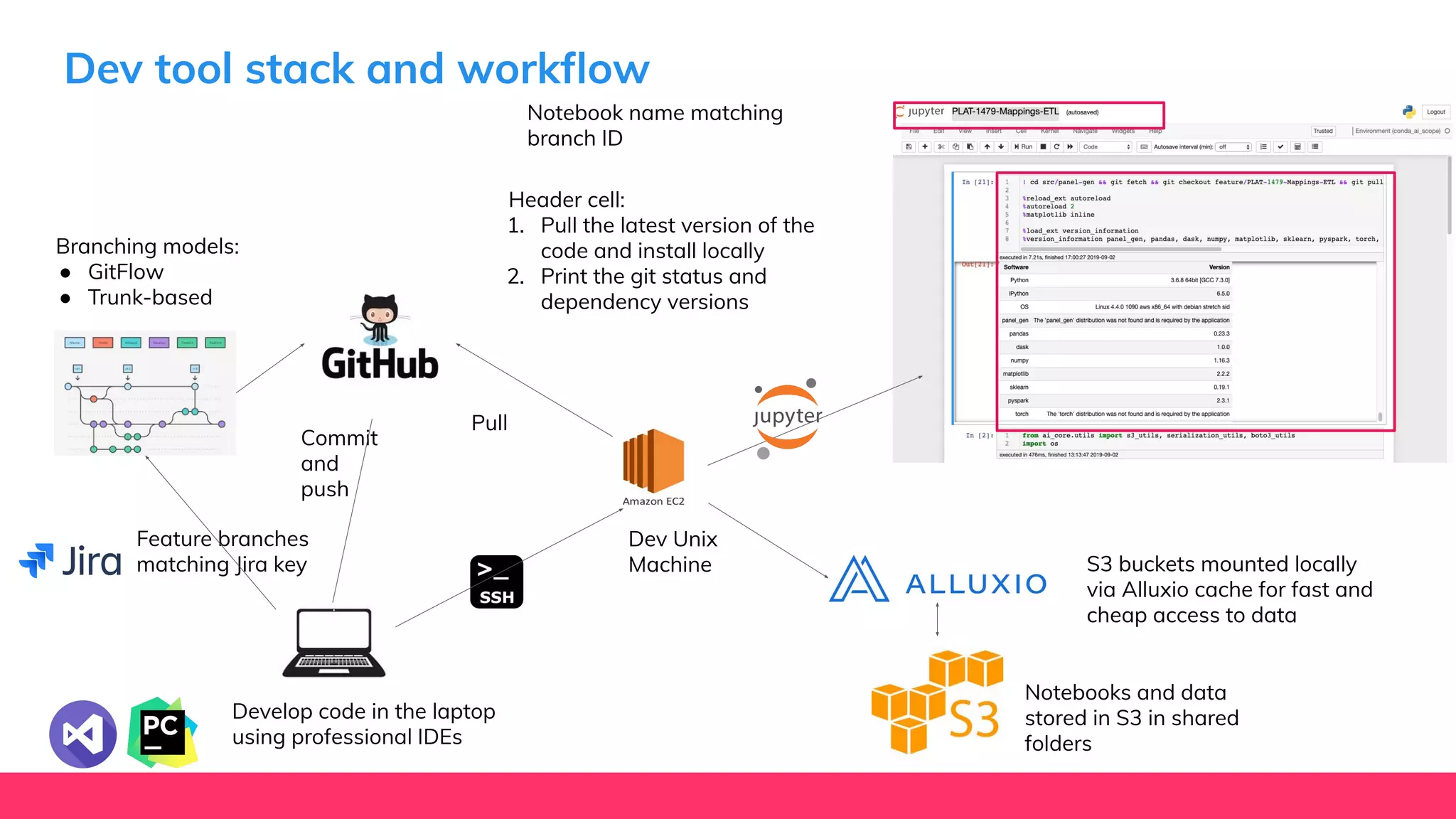
Dev tool stack and workflow
Pull
Notebooks and data
stored in S3 in shared
folders
S3 buckets mounted locally
via Alluxio cache for fast and
cheap access to data
Commit
and
push
Dev Unix
Machine
Notebook name matching
branch ID
Header cell:
1. Pull the latest version of the
code and install locally
2. Print the git status and
dependency versions
Develop code in the laptop
using professional IDEs
Feature branches
matching Jira key
Branching models:
● GitFlow
● Trunk-based
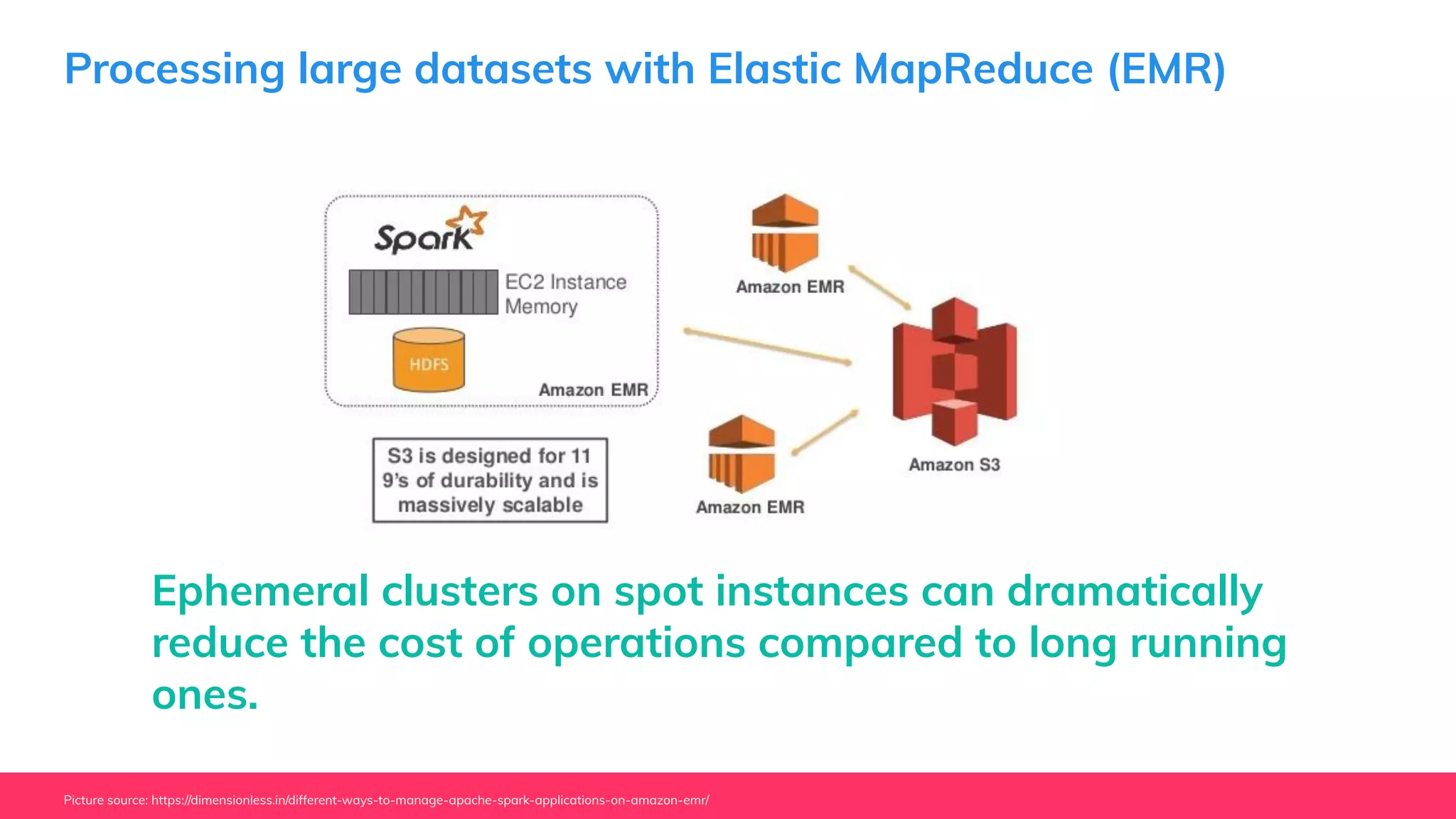
Processing large datasets with Elastic MapReduce (EMR)
Picture source: https://dimensionless.in/different-ways-to-manage-apache-spark-applications-on-amazon-emr/
Ephemeral clusters on spot instances can dramatically
reduce the cost of operations compared to long running
ones.
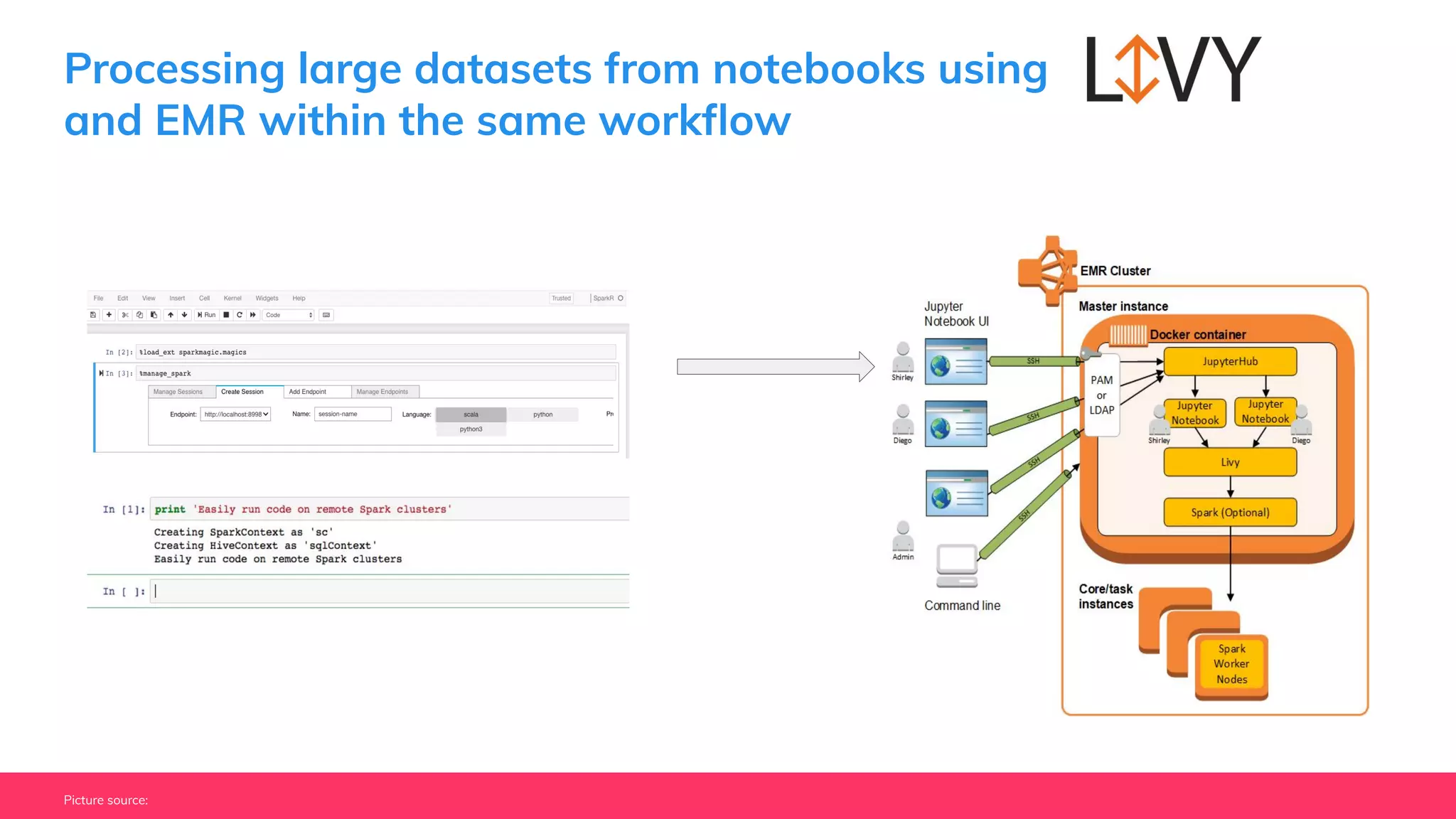
Processing large datasets from notebooks using
and EMR within the same workflow
Picture source:
Port analysis findings into a production-quality modules with a
task-oriented design and entry points declared in makefiles
Picture source: https://medium.com/@davidstevens_16424/make-my-day-ta-science-easier-e16bc50e719c
Task:
1. Read
2. Transform
3. Write
Deliver jobs inside containers whenever is possible
Advantages:
● Isolated environment
● Different library requirements
● Different resources (memory, CPUs, GPUs)
● Simplified load balancing
● Scalable model serving
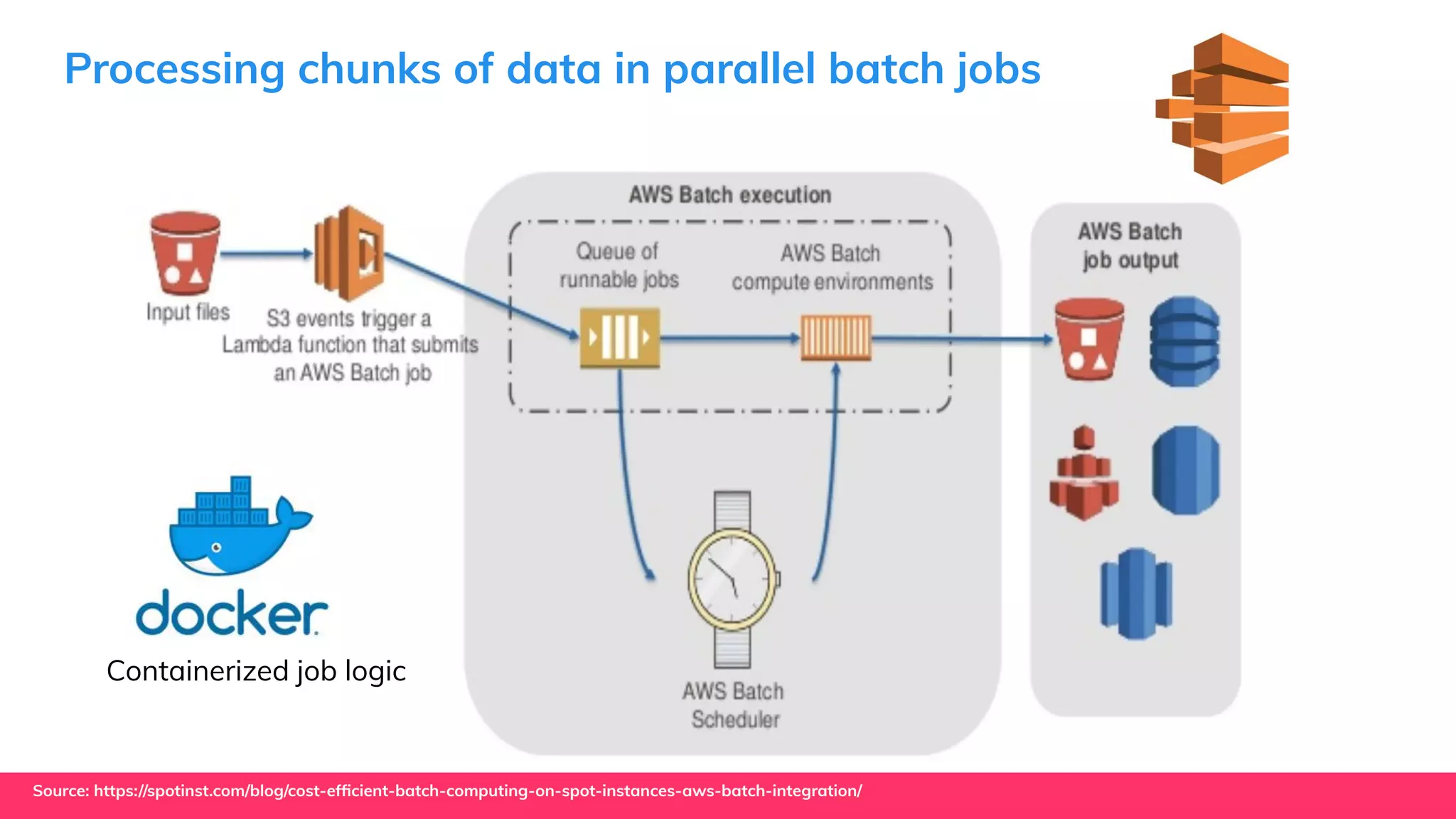
Processing chunks of data in parallel batch jobs
Source: https://spotinst.com/blog/cost-efficient-batch-computing-on-spot-instances-aws-batch-integration/
Containerized job logic
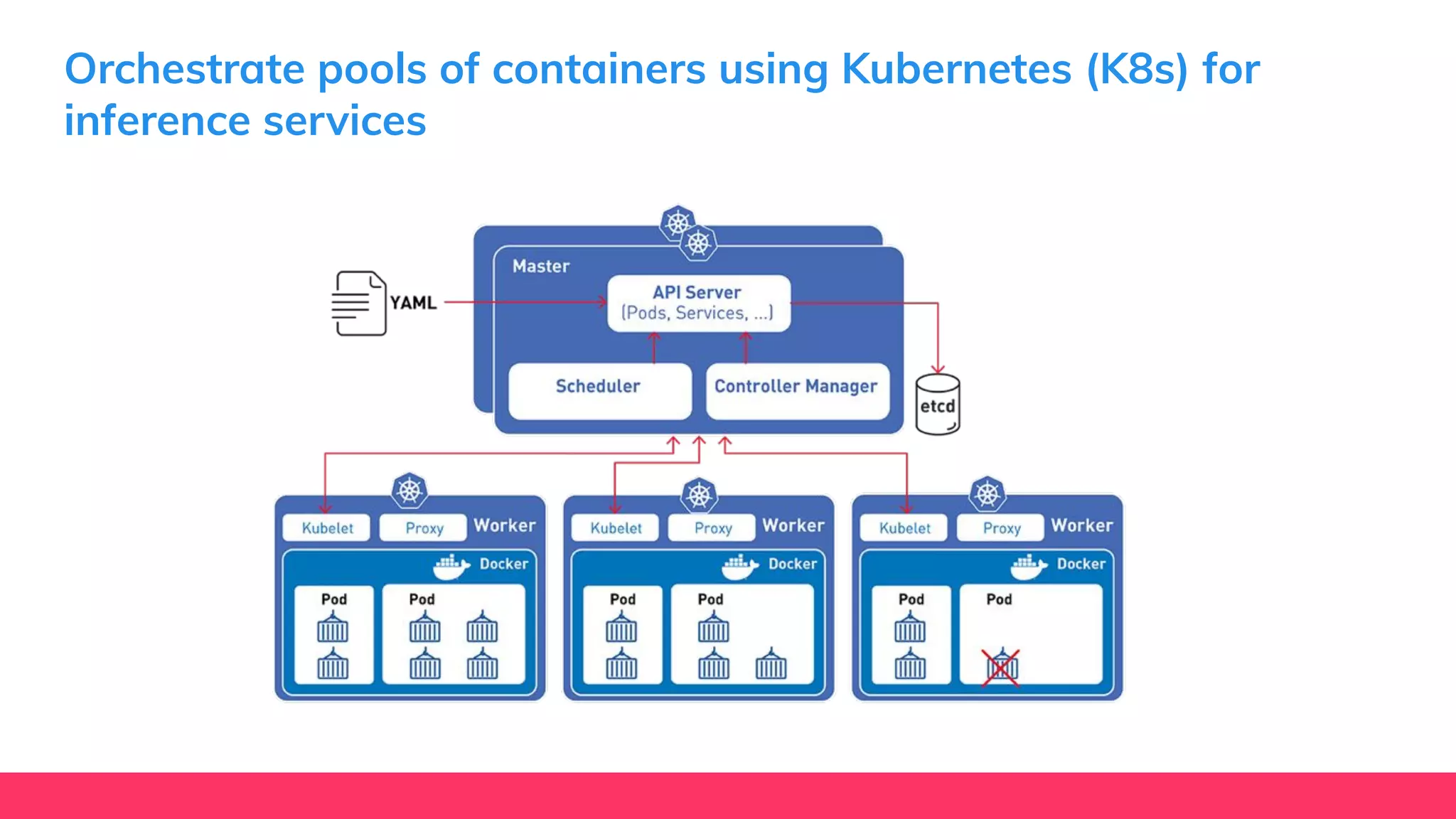
Orchestrate pools of containers using Kubernetes (K8s) for
inference services
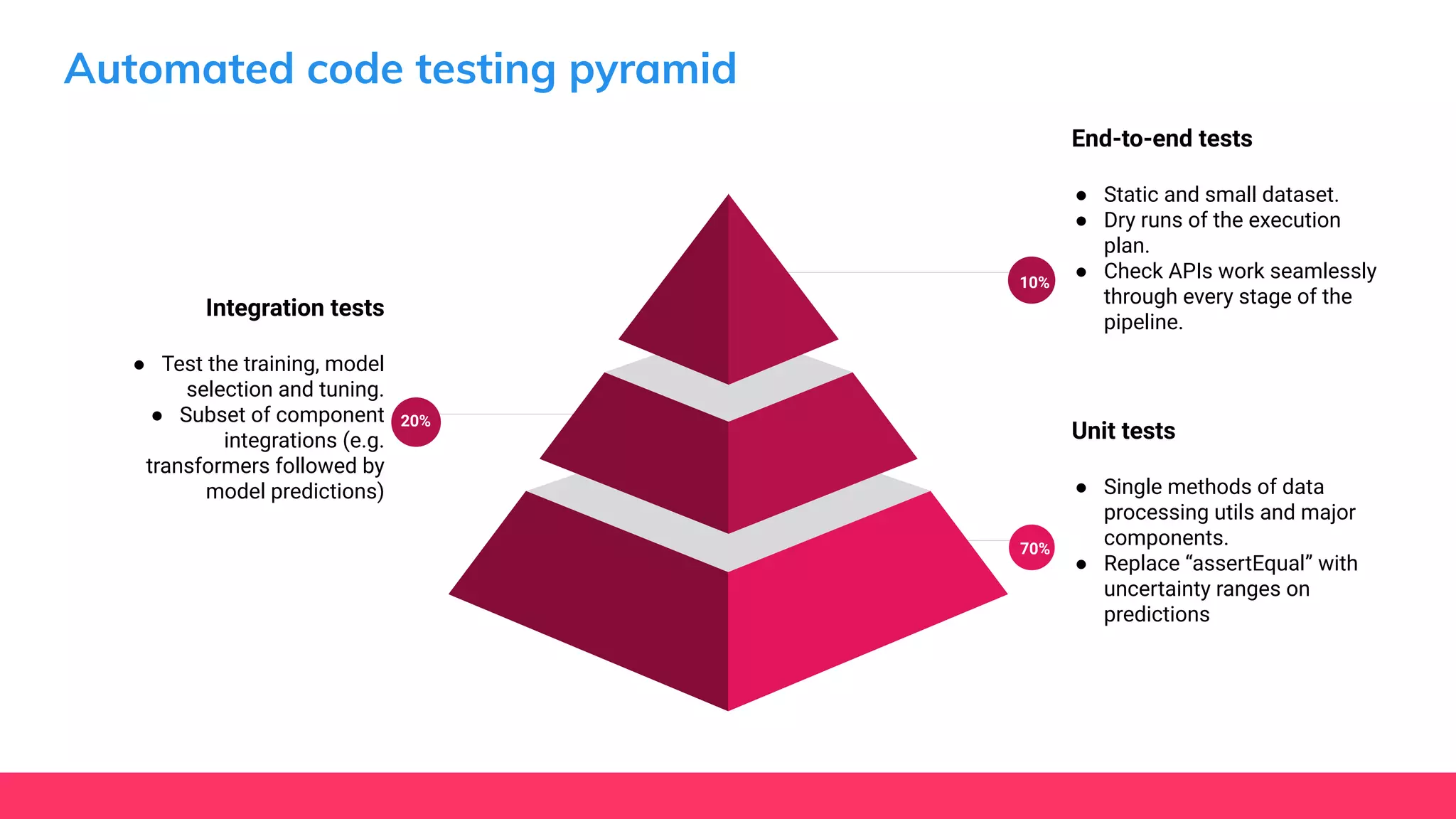
Automated code testing pyramid
Unit tests
● Single methods of data
processing utils and major
components.
● Replace “assertEqual” with
uncertainty ranges on
predictions
70%
Integration tests
● Test the training, model
selection and tuning.
● Subset of component
integrations (e.g.
transformers followed by
model predictions)
20%
End-to-end tests
● Static and small dataset.
● Dry runs of the execution
plan.
● Check APIs work seamlessly
through every stage of the
pipeline.
10%
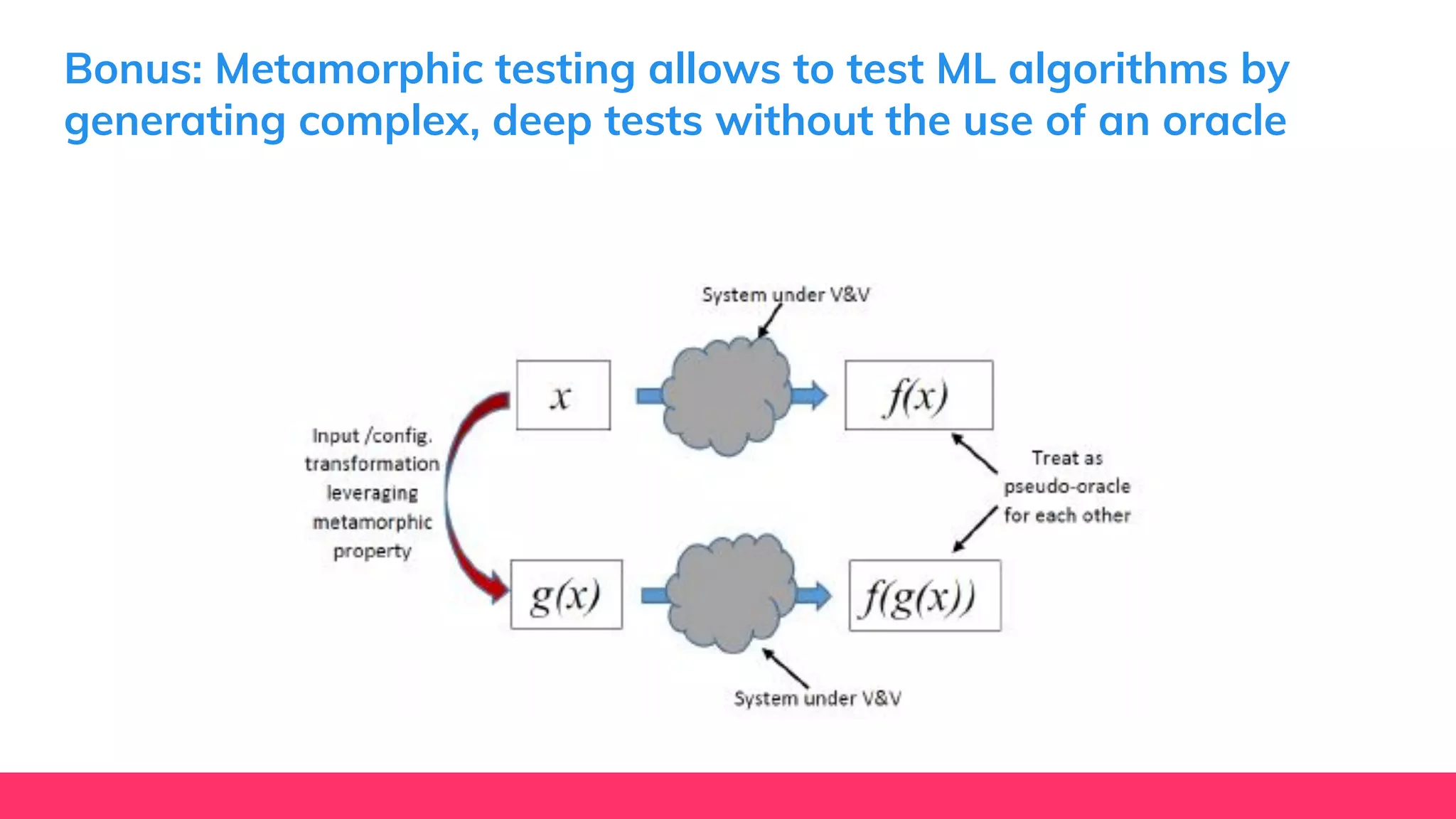
Bonus: Metamorphic testing allows to test ML algorithms by
generating complex, deep tests without the use of an oracle
Infrastructure-as-Code (IaC) is fundamental in order to have
fully-portable and consistent replicas of environments
Benefits:
● Reduced labor cost
● Speed of provisioning
● Minimizes errors and security violations
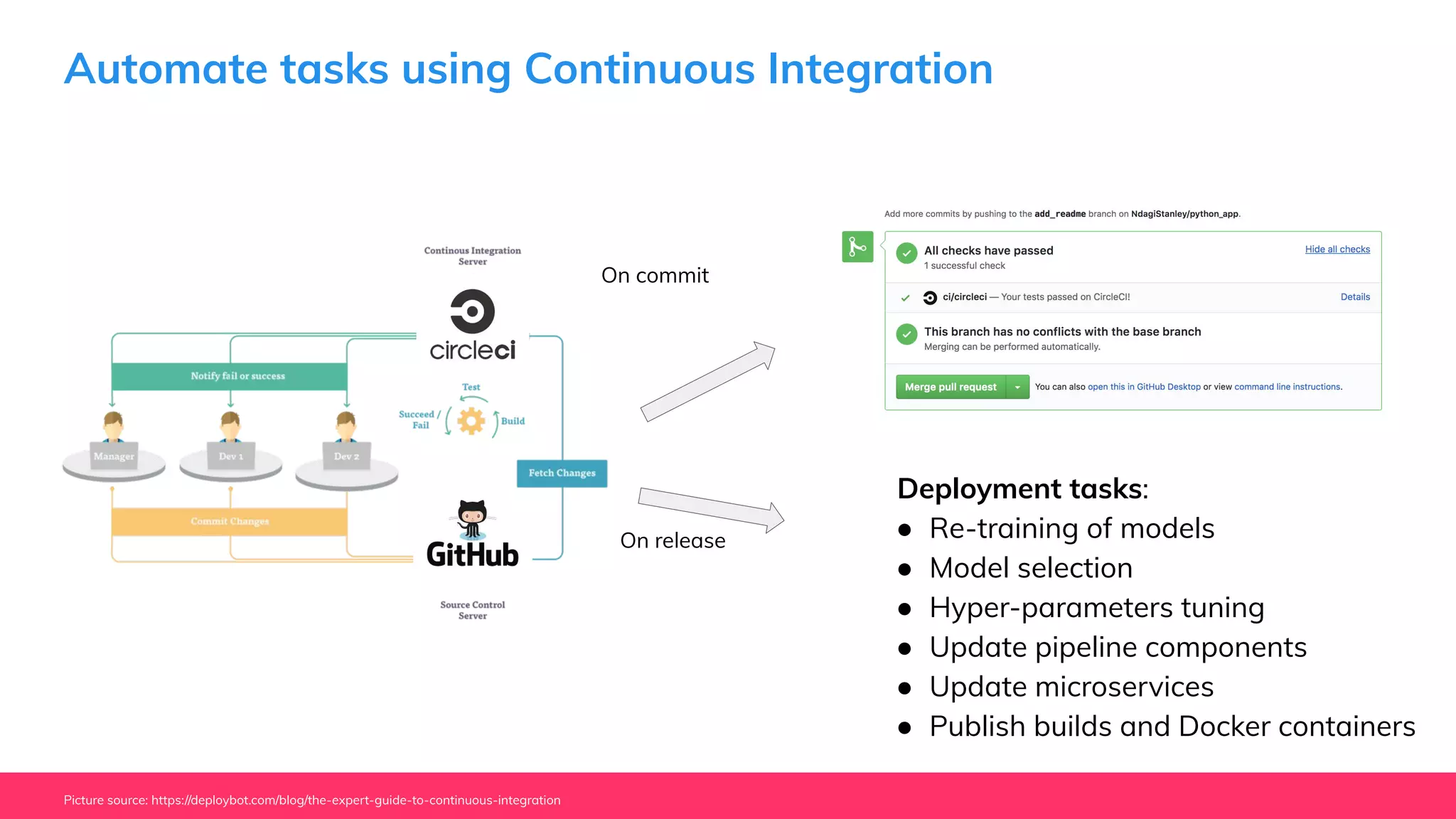
Automate tasks using Continuous Integration
On commit
Deployment tasks:
● Re-training of models
● Model selection
● Hyper-parameters tuning
● Update pipeline components
● Update microservices
● Publish builds and Docker containers
On release
Picture source: https://deploybot.com/blog/the-expert-guide-to-continuous-integration
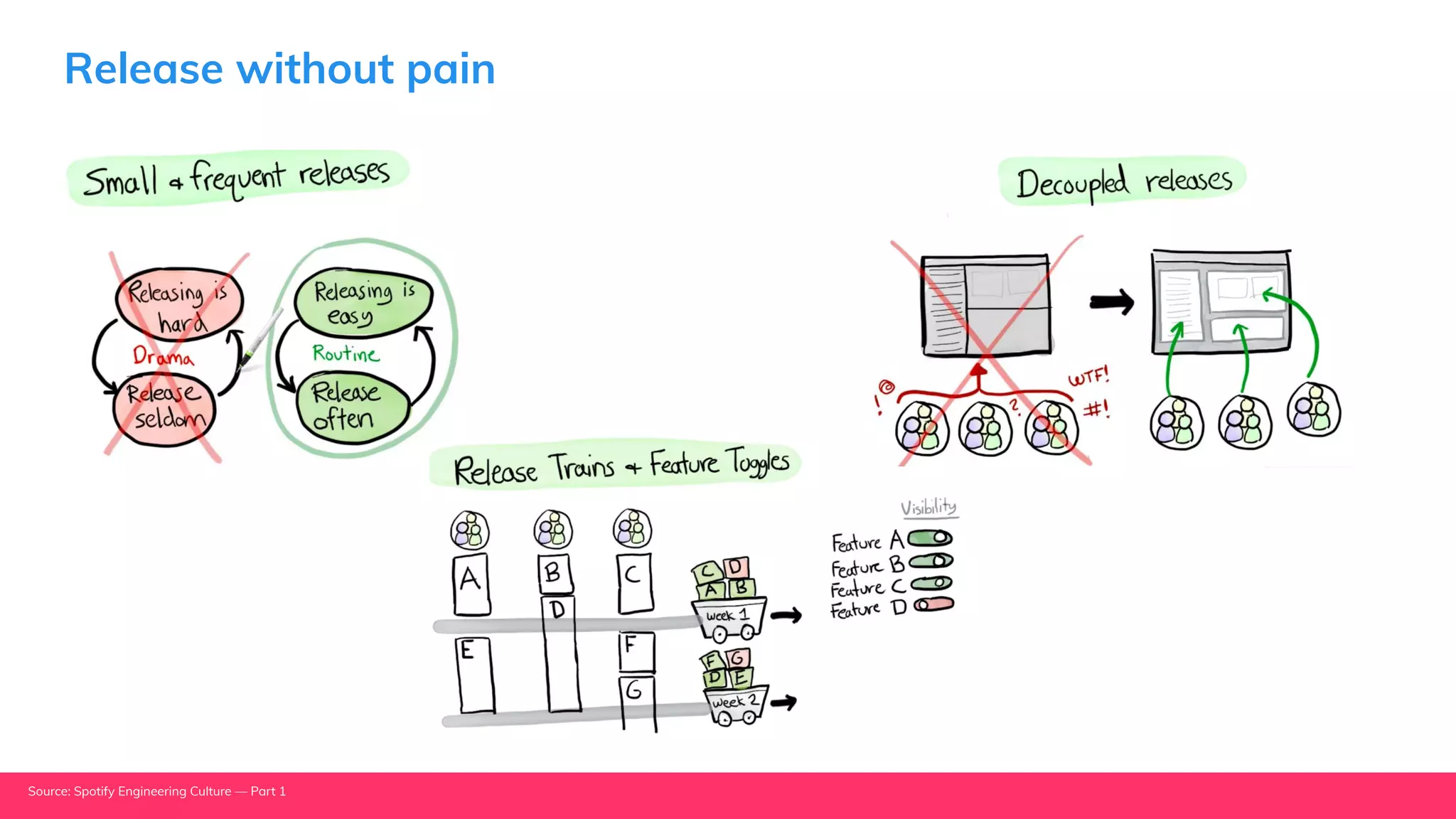
Release without pain
Source: Spotify Engineering Culture — Part 1
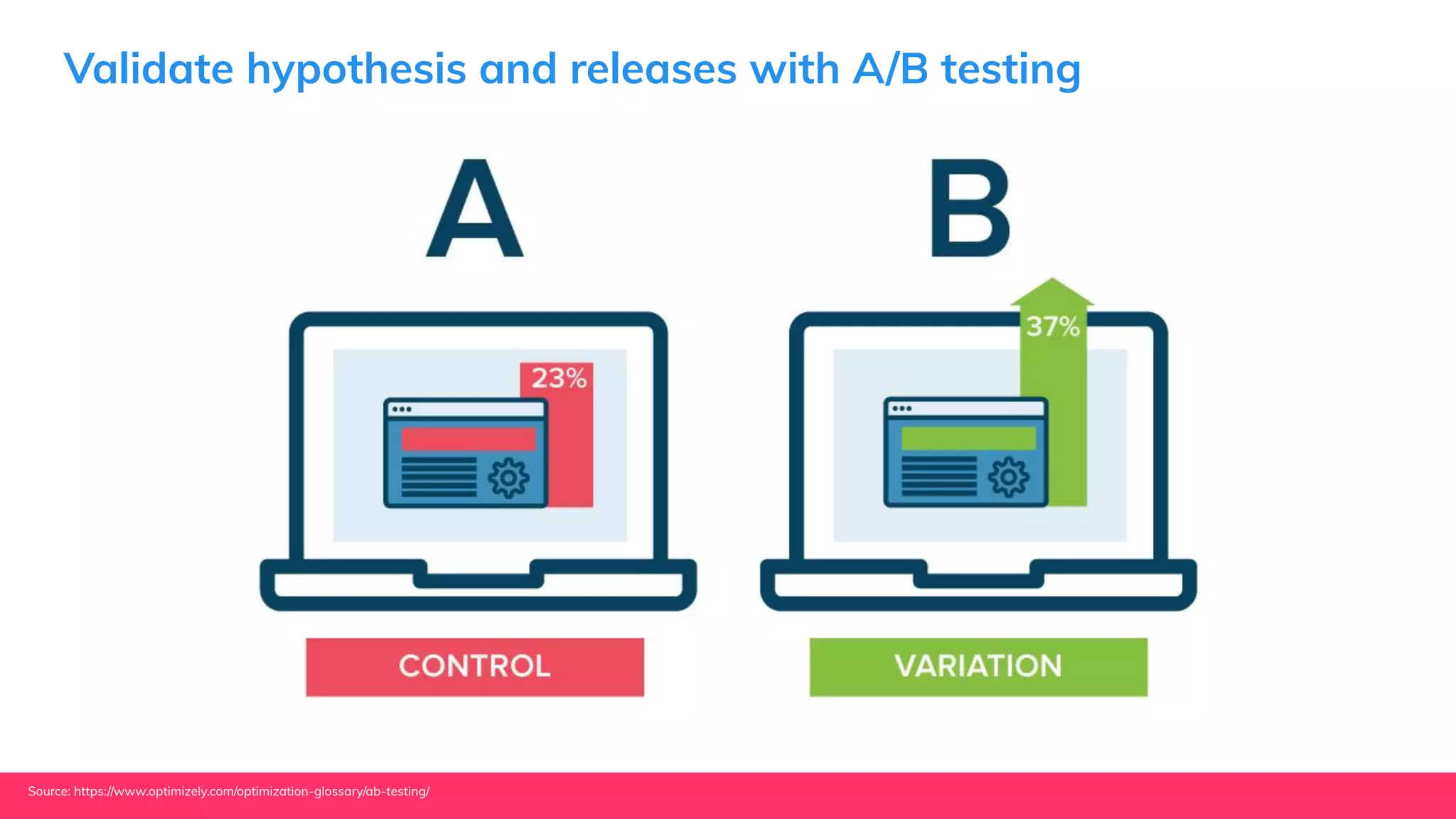
Validate hypothesis and releases with A/B testing
Source: https://www.optimizely.com/optimization-glossary/ab-testing/
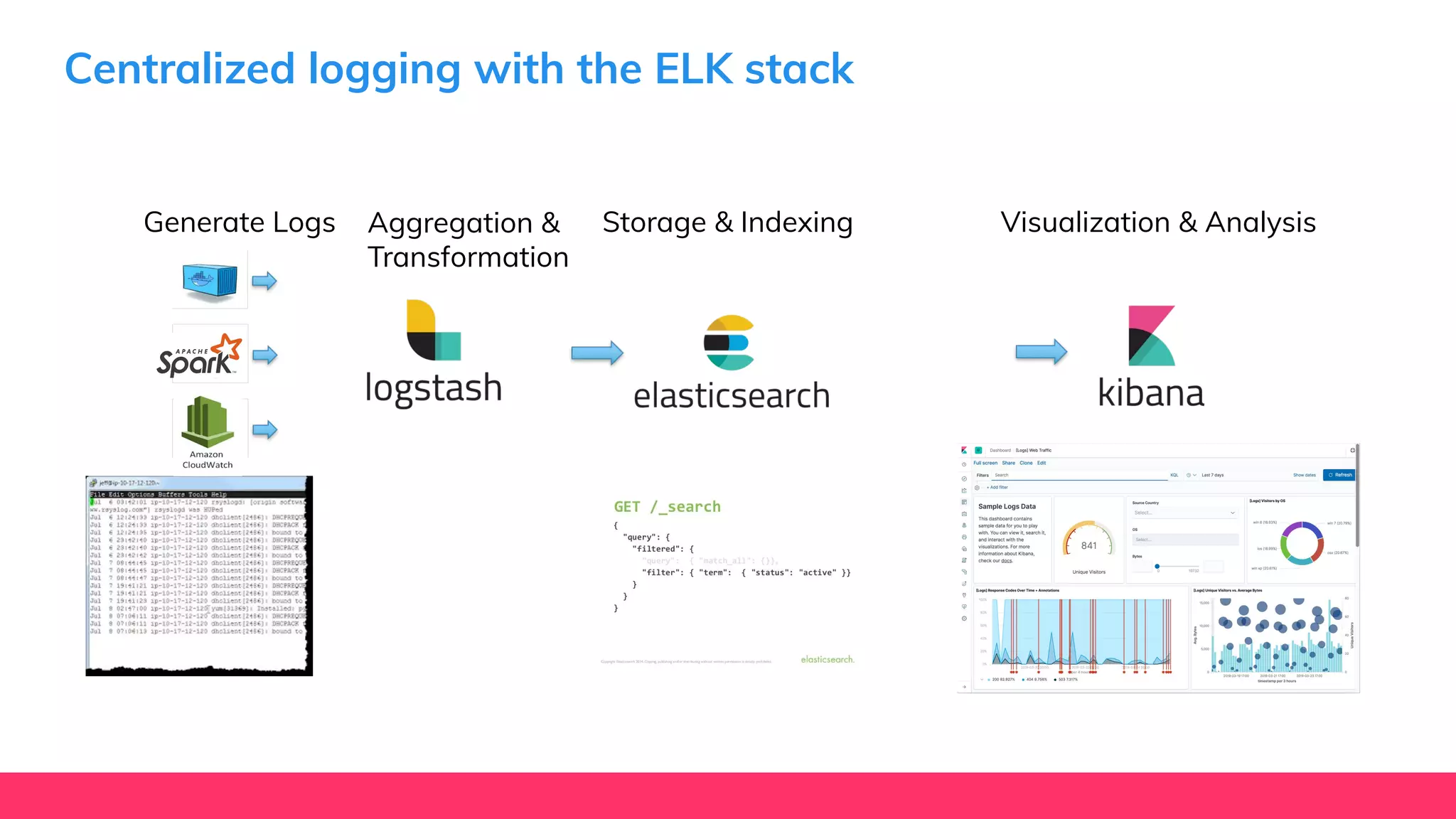
Centralized logging with the ELK stack
Generate Logs Aggregation &
Transformation
Storage & Indexing Visualization & Analysis
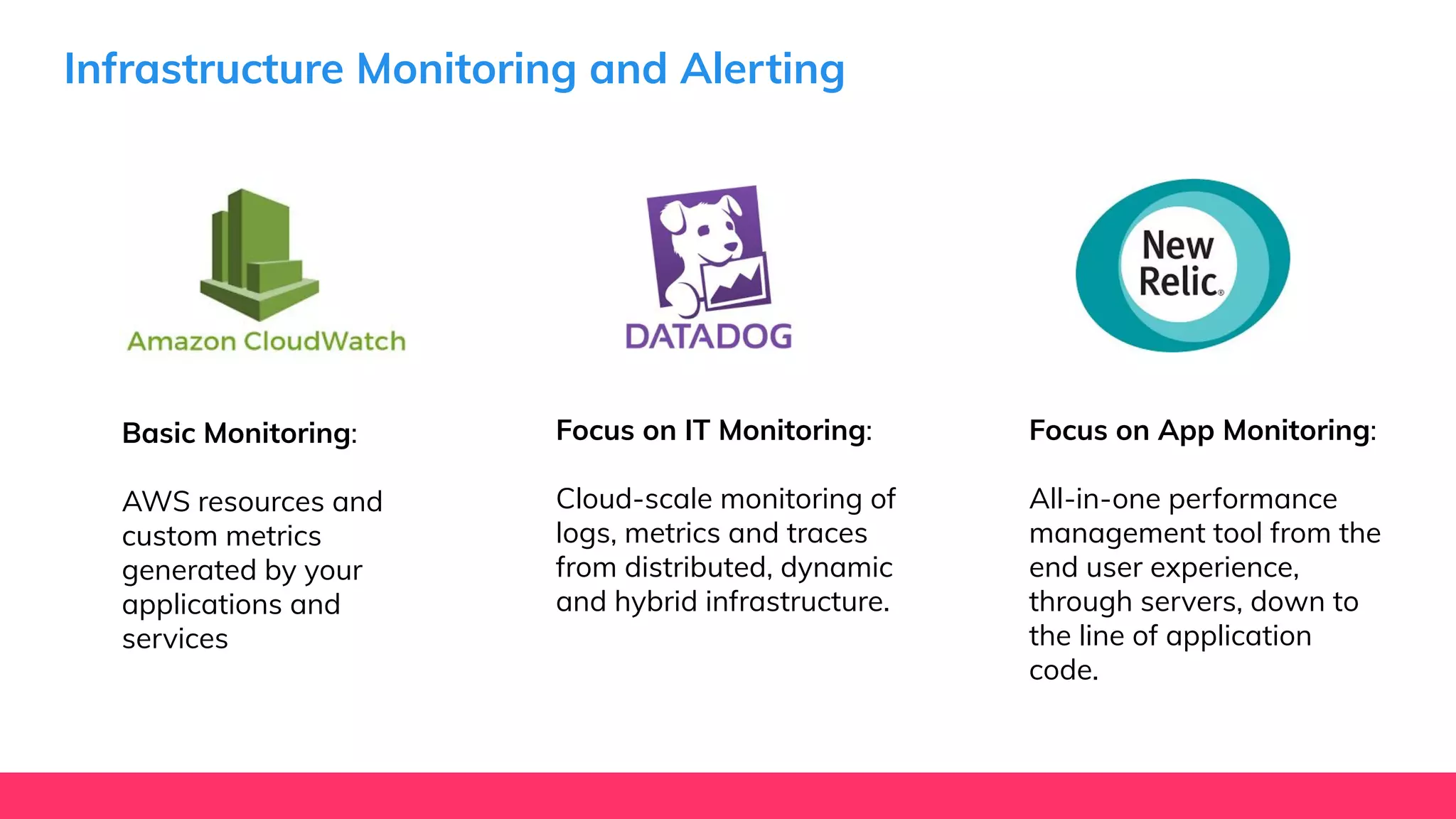
Infrastructure Monitoring and Alerting
Basic Monitoring:
AWS resources and
custom metrics
generated by your
applications and
services
Focus on IT Monitoring:
Cloud-scale monitoring of
logs, metrics and traces
from distributed, dynamic
and hybrid infrastructure.
Focus on App Monitoring:
All-in-one performance
management tool from the
end user experience,
through servers, down to
the line of application
code.
Governance and Auditability
Audit changes in the
configuration of resources.
Track account activity by
recording AWS console actions
and API calls.
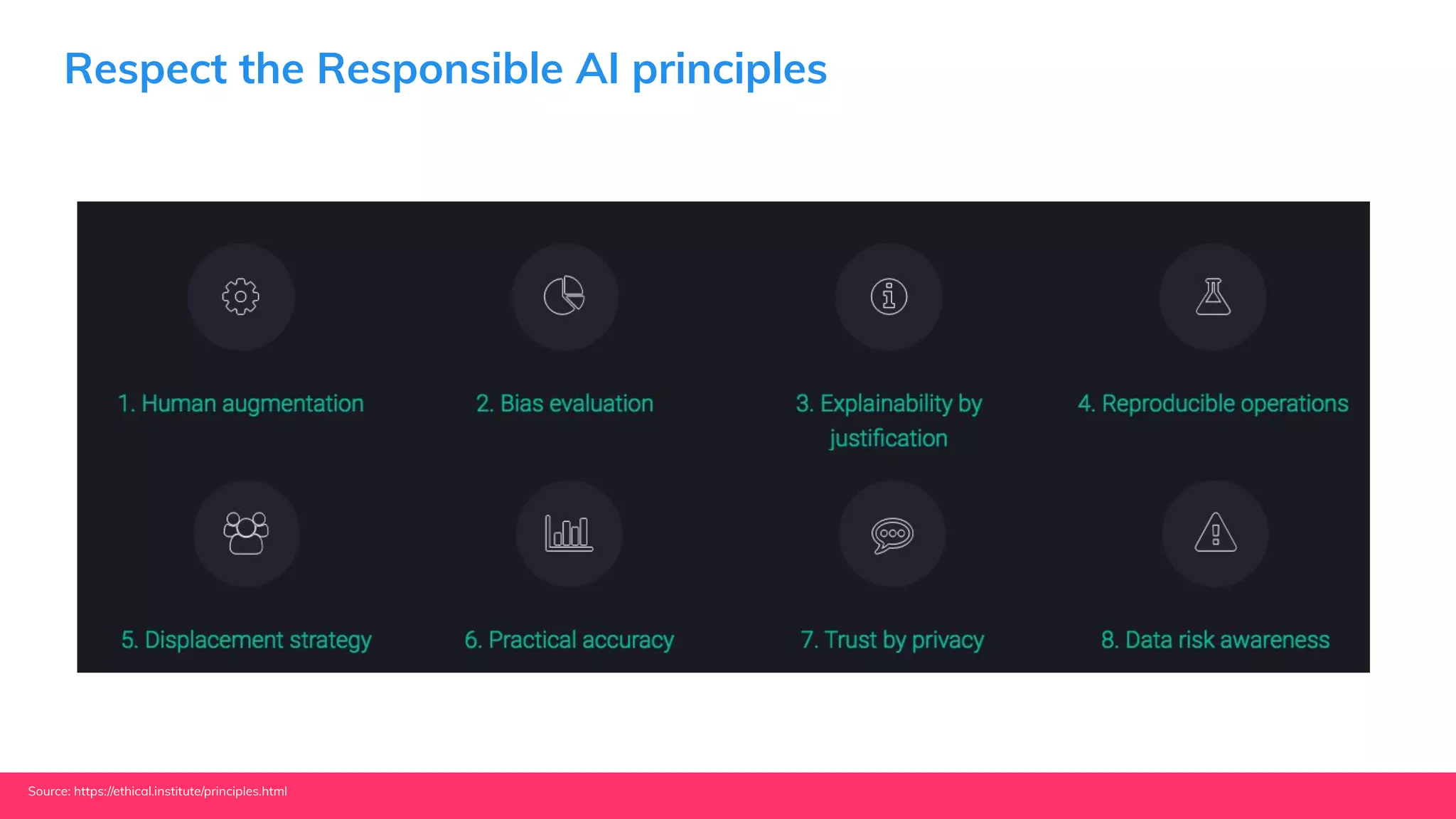
Respect the Responsible AI principles
Source: https://ethical.institute/principles.html
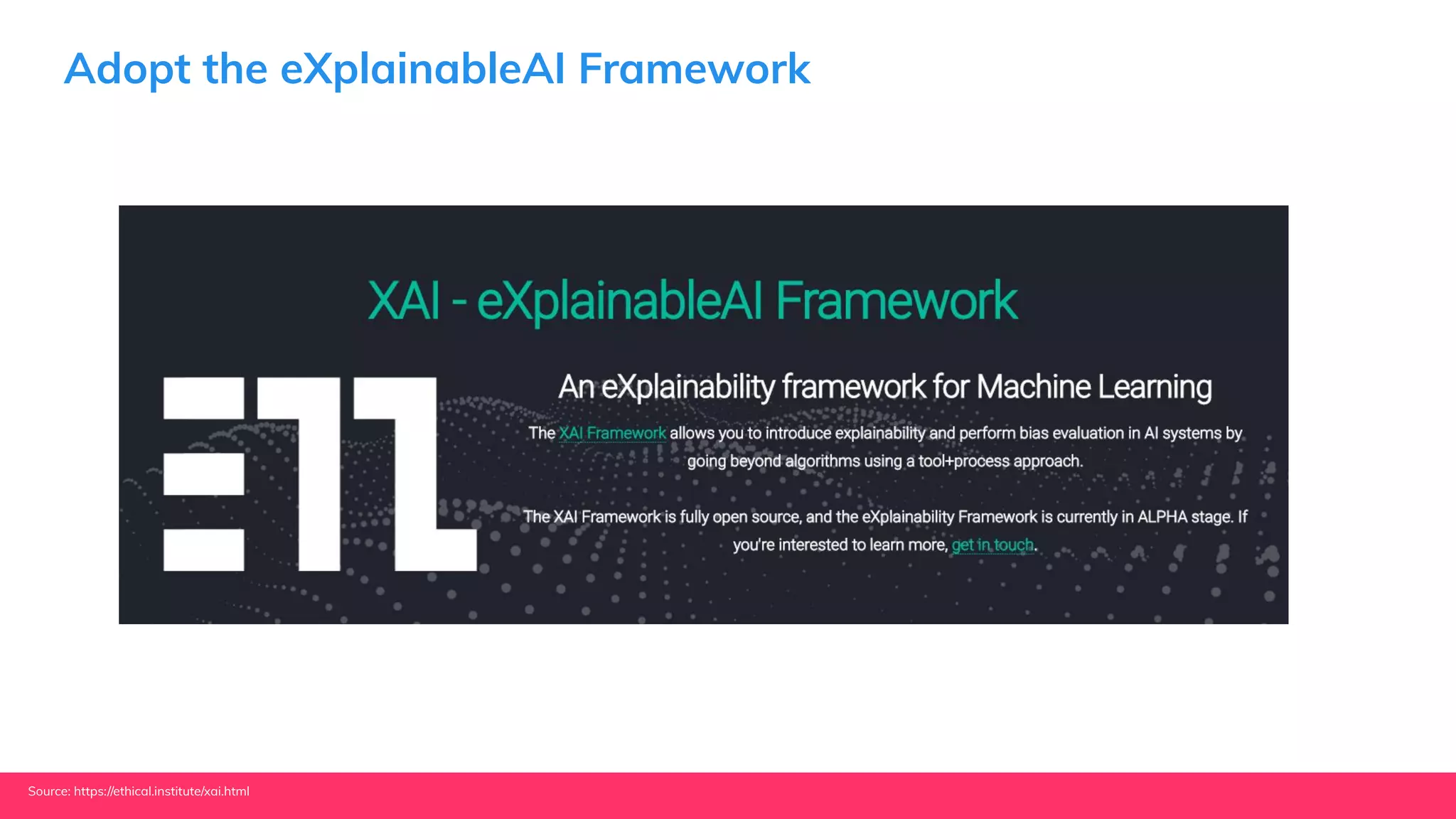
Adopt the eXplainableAI Framework
Source: https://ethical.institute/xai.html
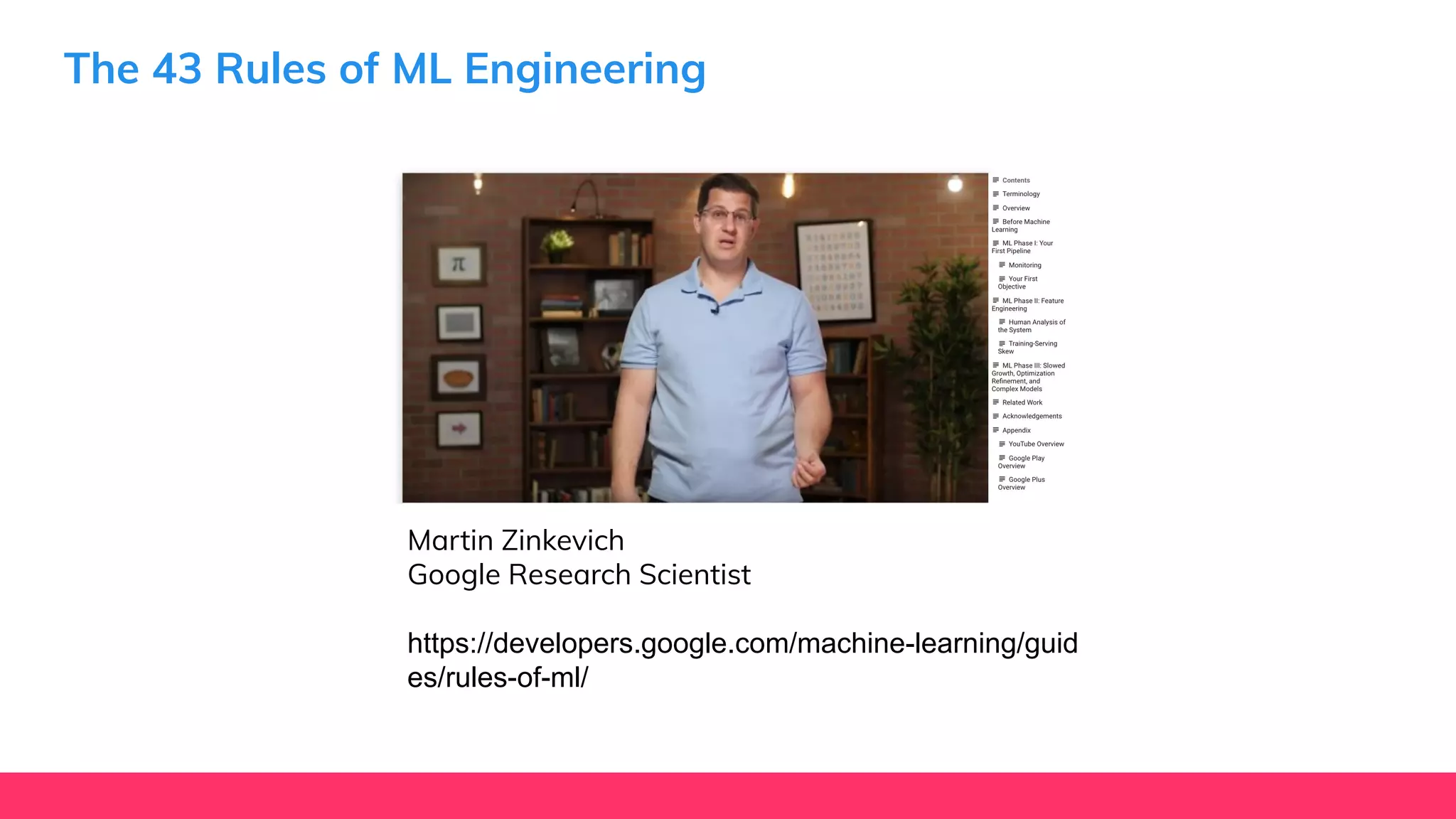
The 43 Rules of ML Engineering
Martin Zinkevich
Google Research Scientist
https://developers.google.com/machine-learning/guid
es/rules-of-ml/
6. Serverless
Serverless, or how to
build and run
applications without
thinking about
servers
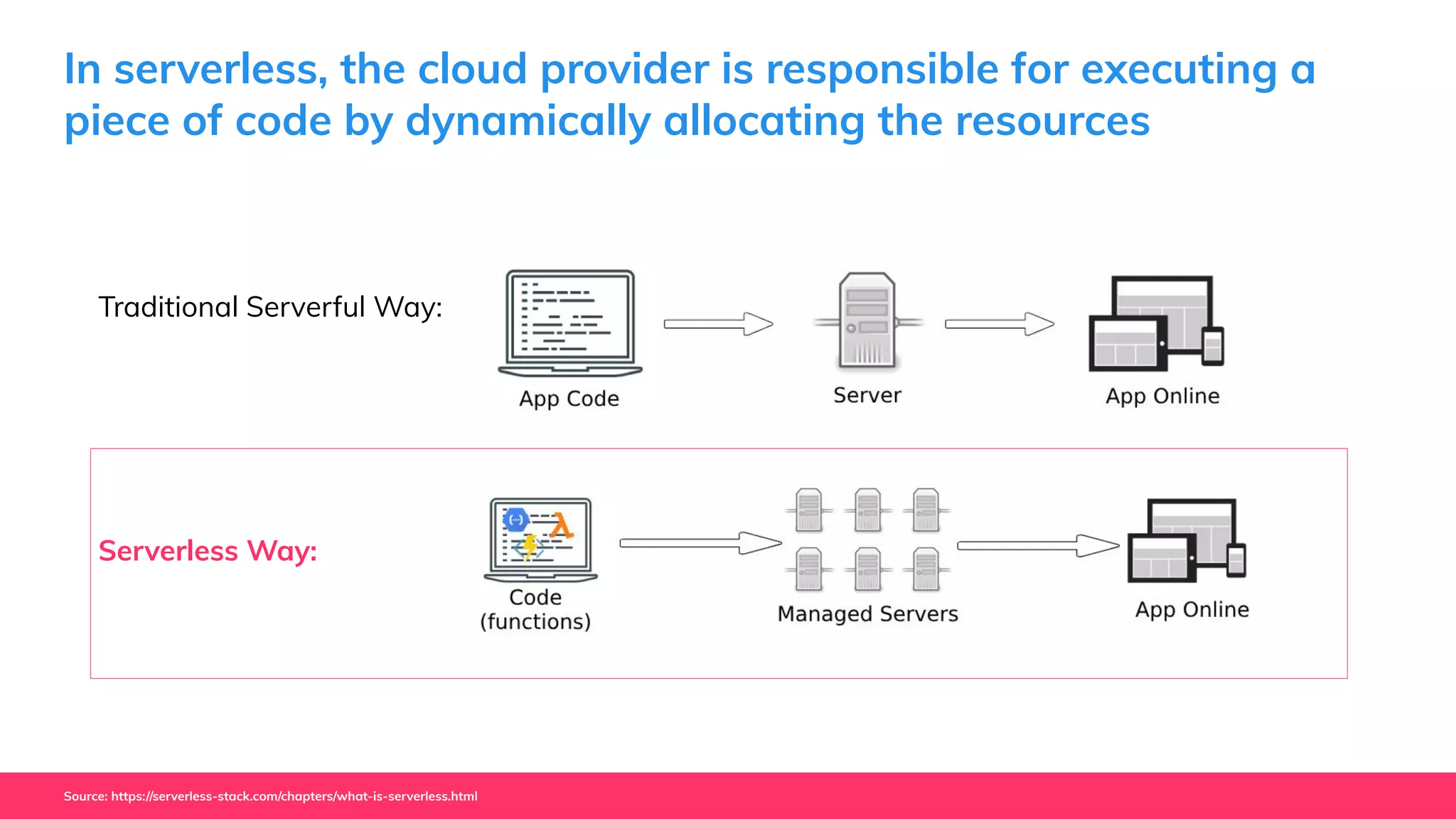
In serverless, the cloud provider is responsible for executing a
piece of code by dynamically allocating the resources
Traditional Serverful Way:
Serverless Way:
Source: https://serverless-stack.com/chapters/what-is-serverless.html
Philosophy behind Serverless
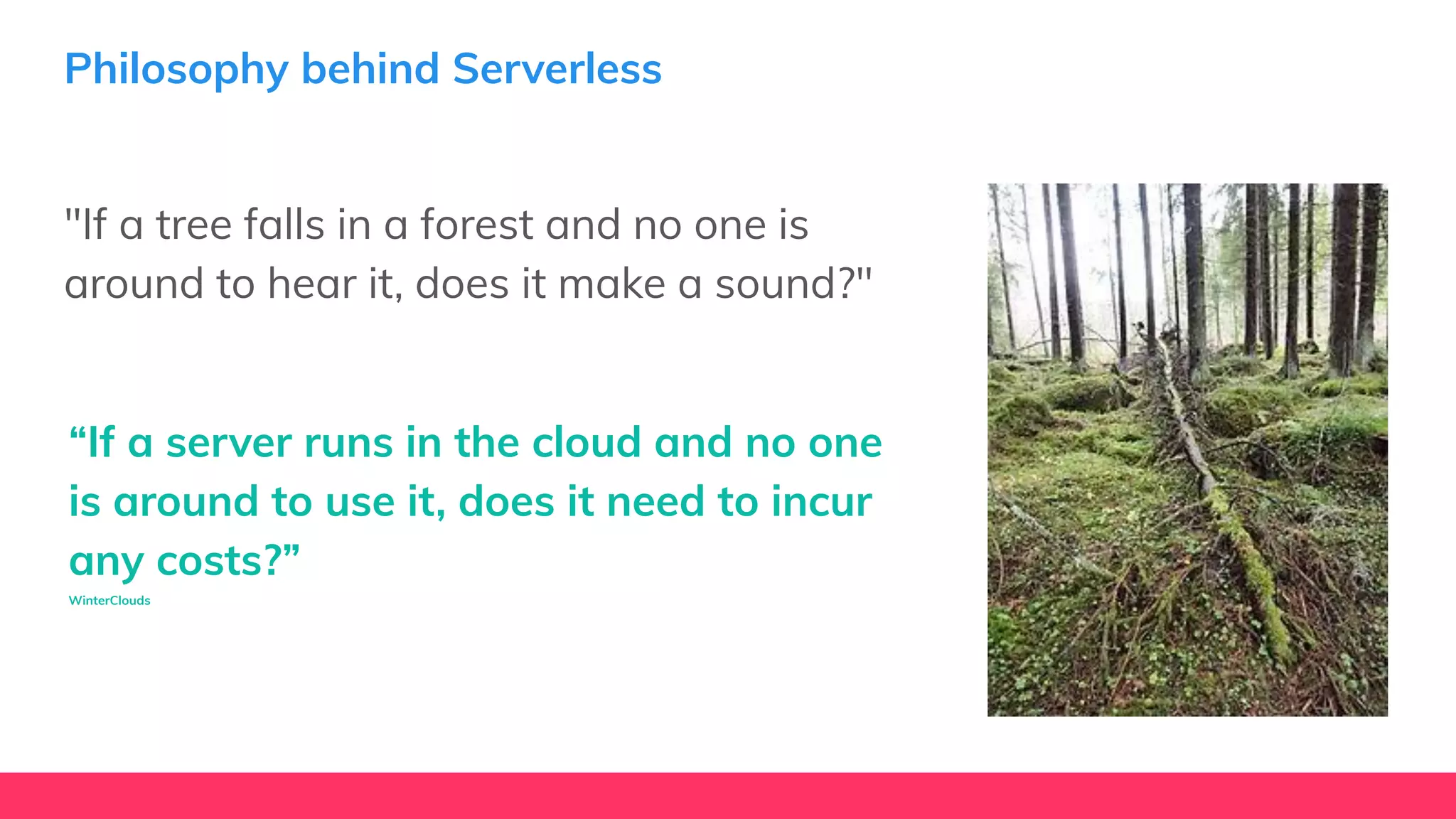
"If a tree falls in a forest and no one is
around to hear it, does it make a sound?"
“If a server runs in the cloud and no one
is around to use it, does it need to incur
any costs?”
WinterClouds
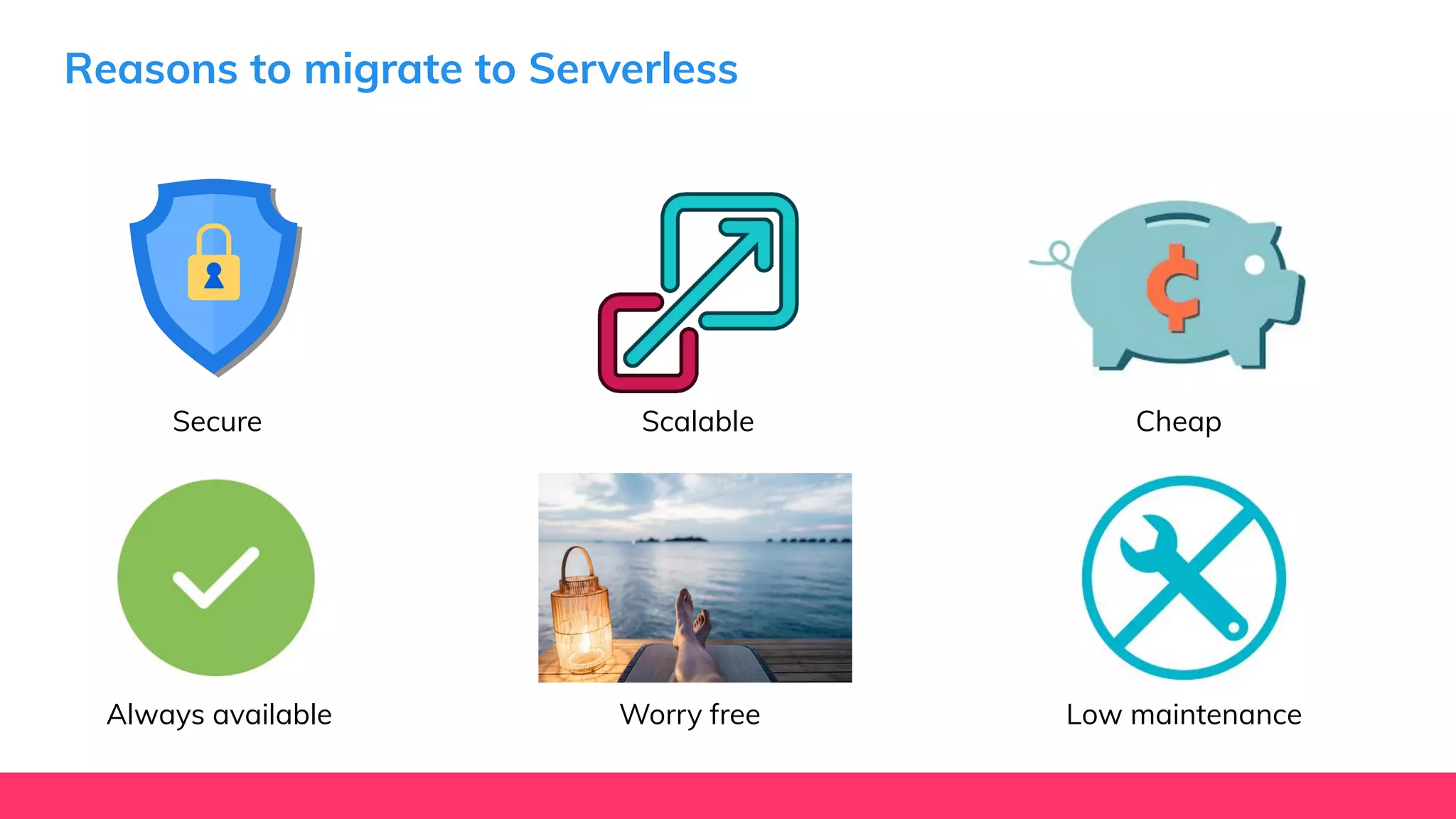
Reasons to migrate to Serverless
Secure Scalable Cheap
Always available Worry free Low maintenance
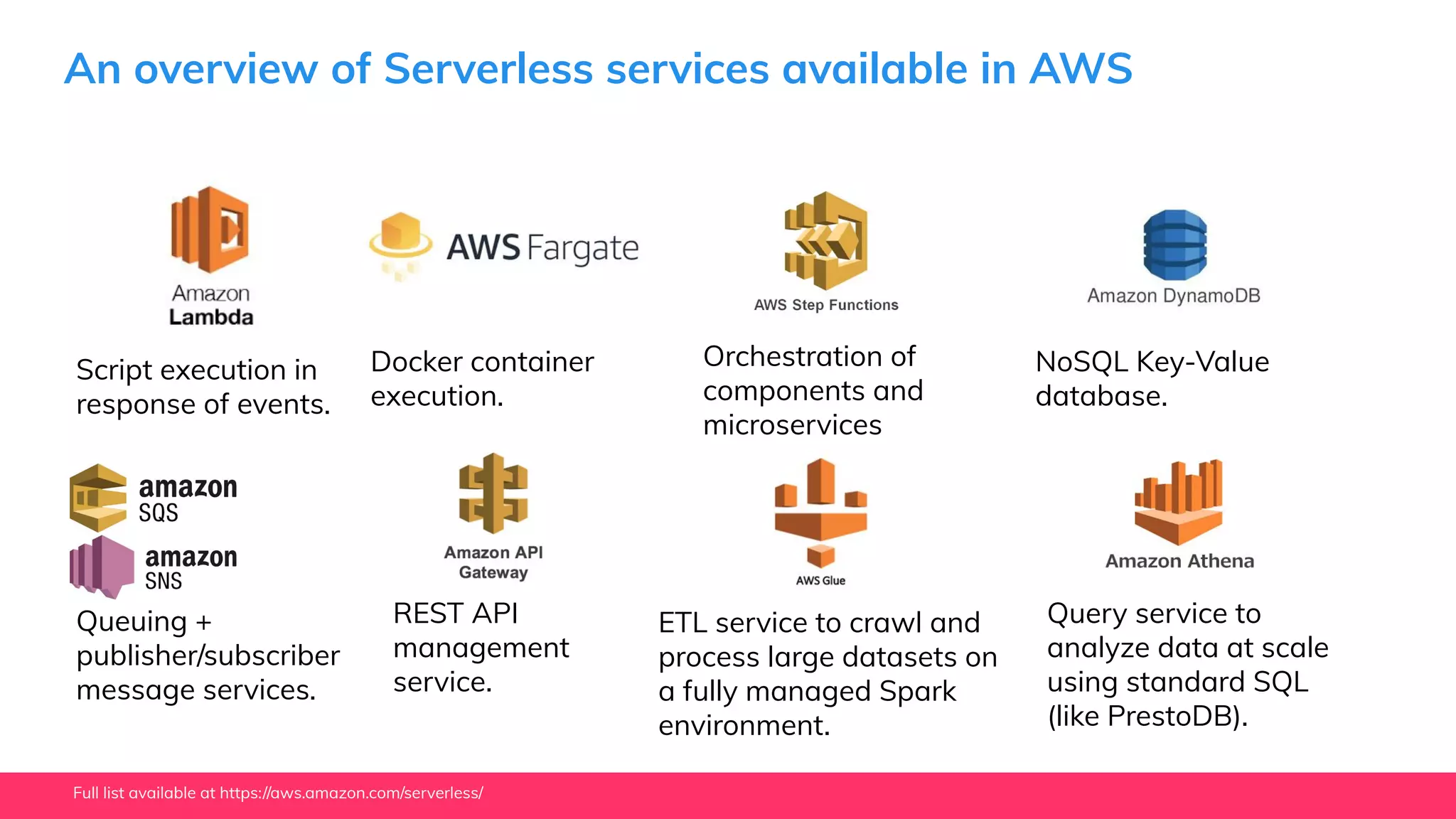
An overview of Serverless services available in AWS
Docker container
execution.
Script execution in
response of events.
Full list available at https://aws.amazon.com/serverless/
Orchestration of
components and
microservices
Queuing +
publisher/subscriber
message services.
NoSQL Key-Value
database.
REST API
management
service.
Query service to
analyze data at scale
using standard SQL
(like PrestoDB).
ETL service to crawl and
process large datasets on
a fully managed Spark
environment.
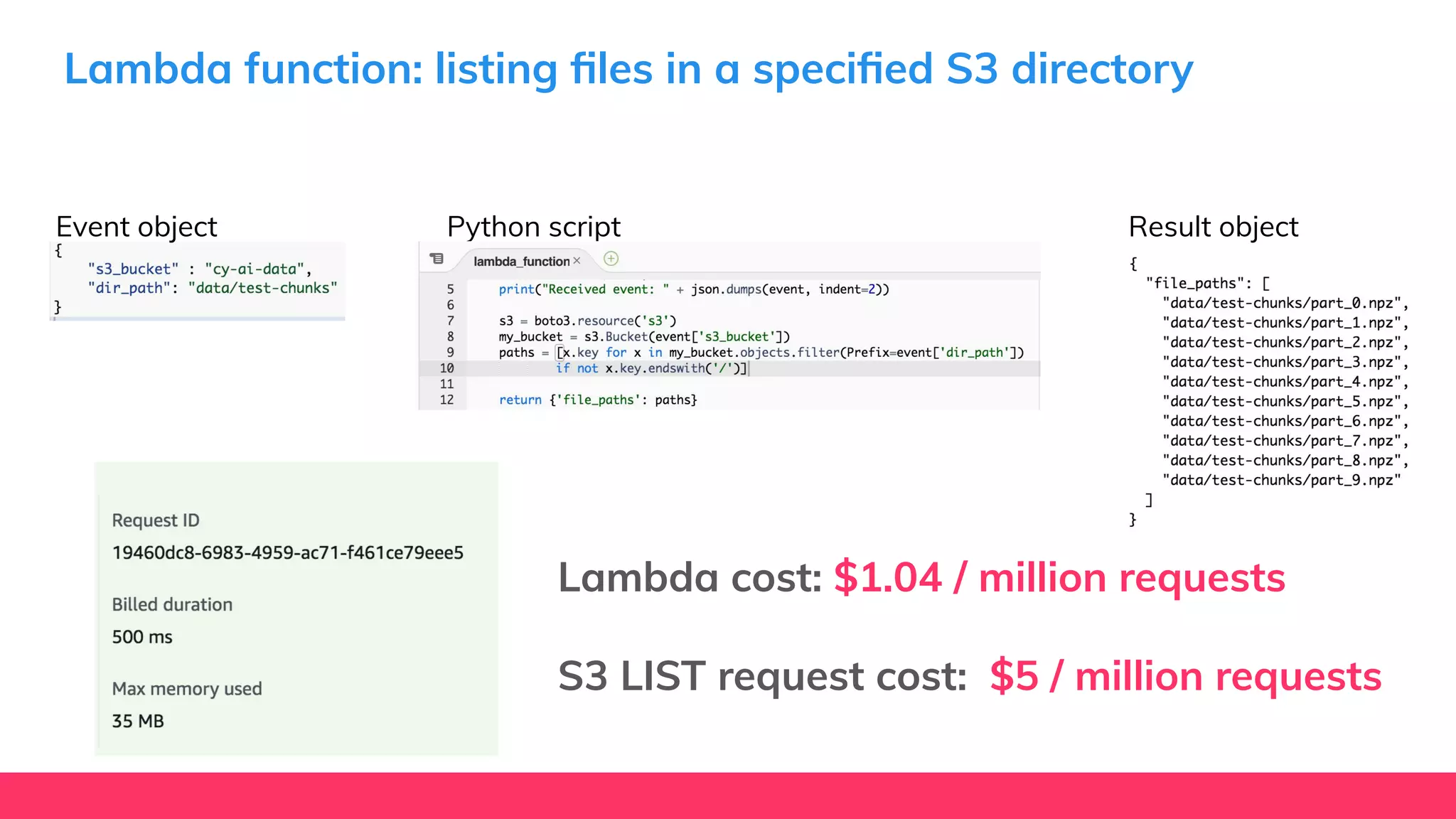
Lambda function: listing files in a specified S3 directory
Event object Result objectPython script
Lambda cost: $1.04 / million requests
S3 LIST request cost: $5 / million requests
Serverless.com application framework
Hybrid solution for:
Orchestrating functions using state machines via Step Functions
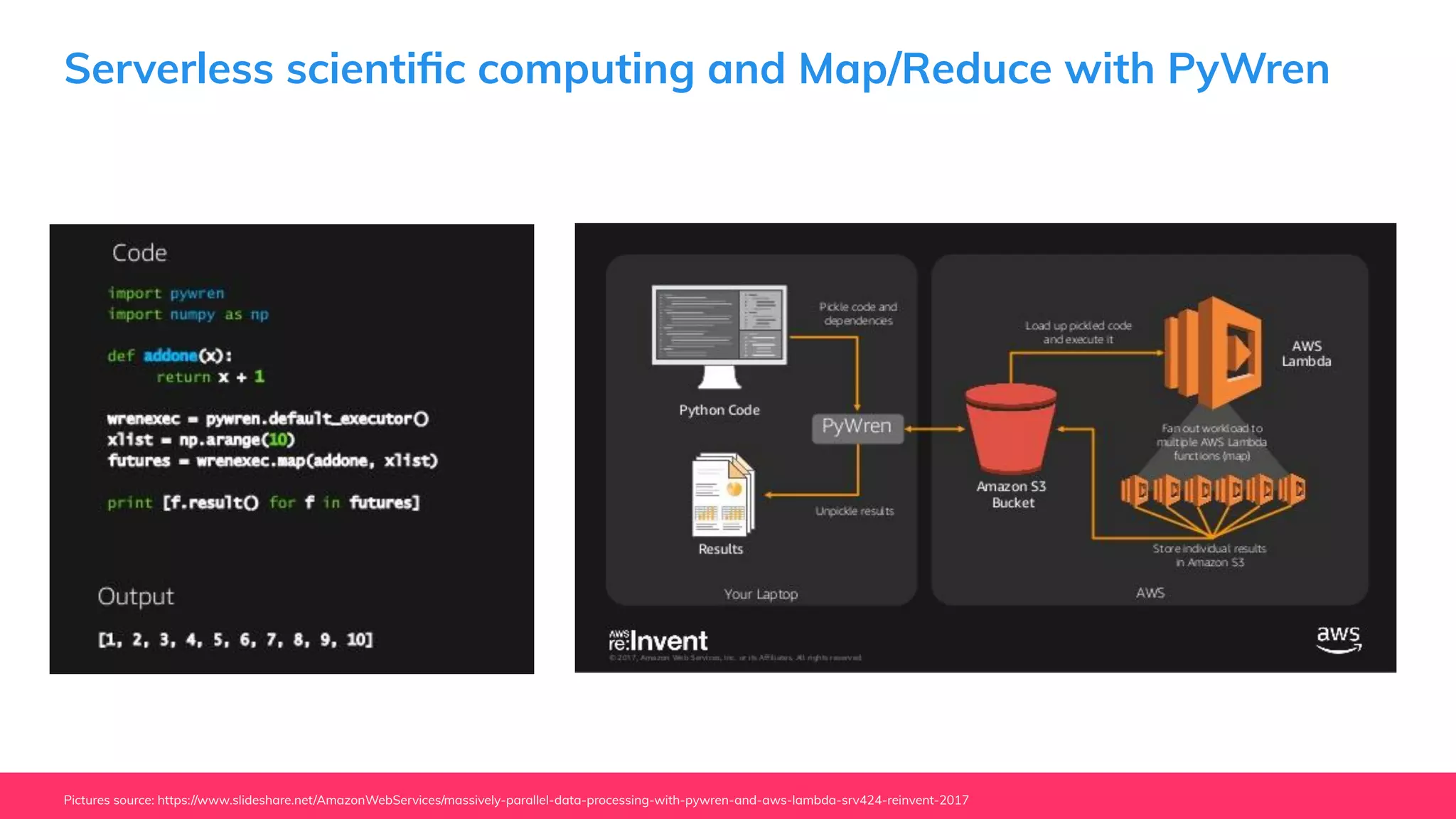
Serverless scientific computing and Map/Reduce with PyWren
Pictures source: https://www.slideshare.net/AmazonWebServices/massively-parallel-data-processing-with-pywren-and-aws-lambda-srv424-reinvent-2017
Final Remarks
* from “The Start-Up Trap” by Robert C. Martin (Uncle Bob)
“The only way to go fast is to go well” cit. Uncle Bob
Overview of a real-world ML production system
Source: https://papers.nips.cc/paper/5656-hidden-technical-debt-in-machine-learning-systems
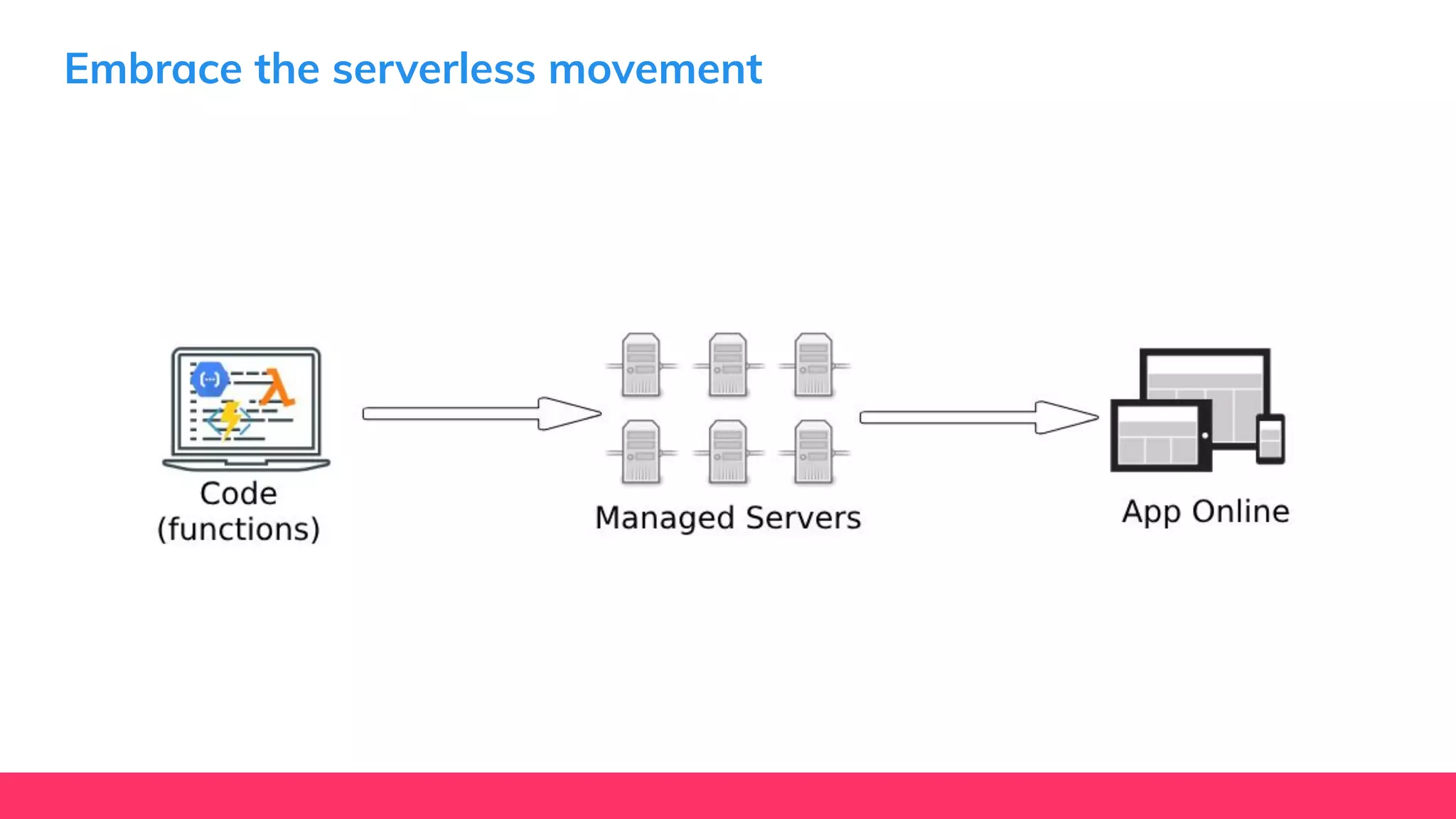
Embrace the serverless movement
Read the
Manager’s Guide
(first part)
Gianmario Spacagna
Chief Scientist at Helixa.ai
gspacagna@helixa.ai
@gm_spacagna
Appendix A:
Summary Steps
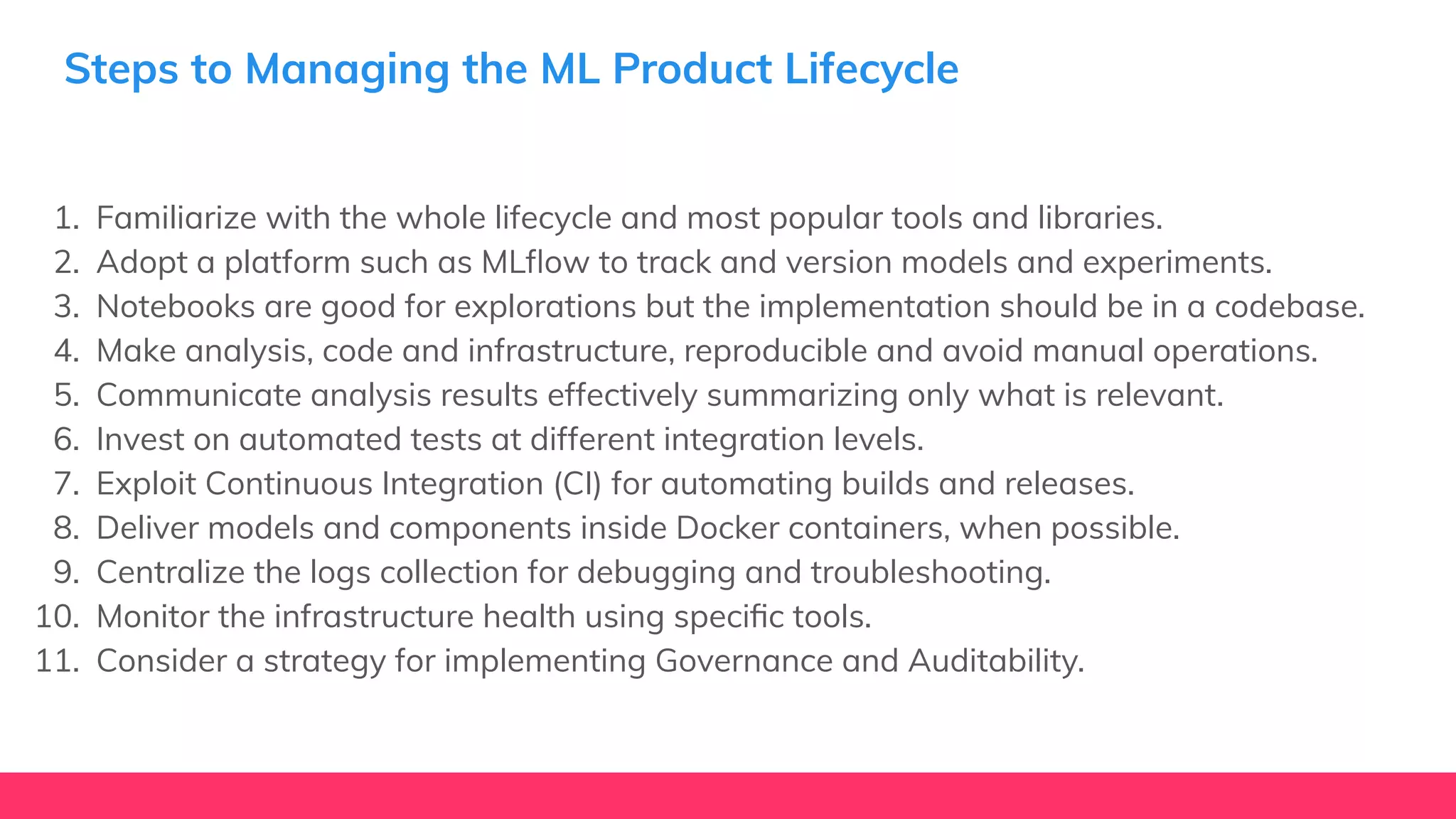
Steps to Managing the ML Product Lifecycle
1. Familiarize with the whole lifecycle and most popular tools and libraries.
2. Adopt a platform such as MLflow to track and version models and experiments.
3. Notebooks are good for explorations but the implementation should be in a codebase.
4. Make analysis, code and infrastructure, reproducible and avoid manual operations.
5. Communicate analysis results effectively summarizing only what is relevant.
6. Invest on automated tests at different integration levels.
7. Exploit Continuous Integration (CI) for automating builds and releases.
8. Deliver models and components inside Docker containers, when possible.
9. Centralize the logs collection for debugging and troubleshooting.
10. Monitor the infrastructure health using specific tools.
11. Consider a strategy for implementing Governance and Auditability.
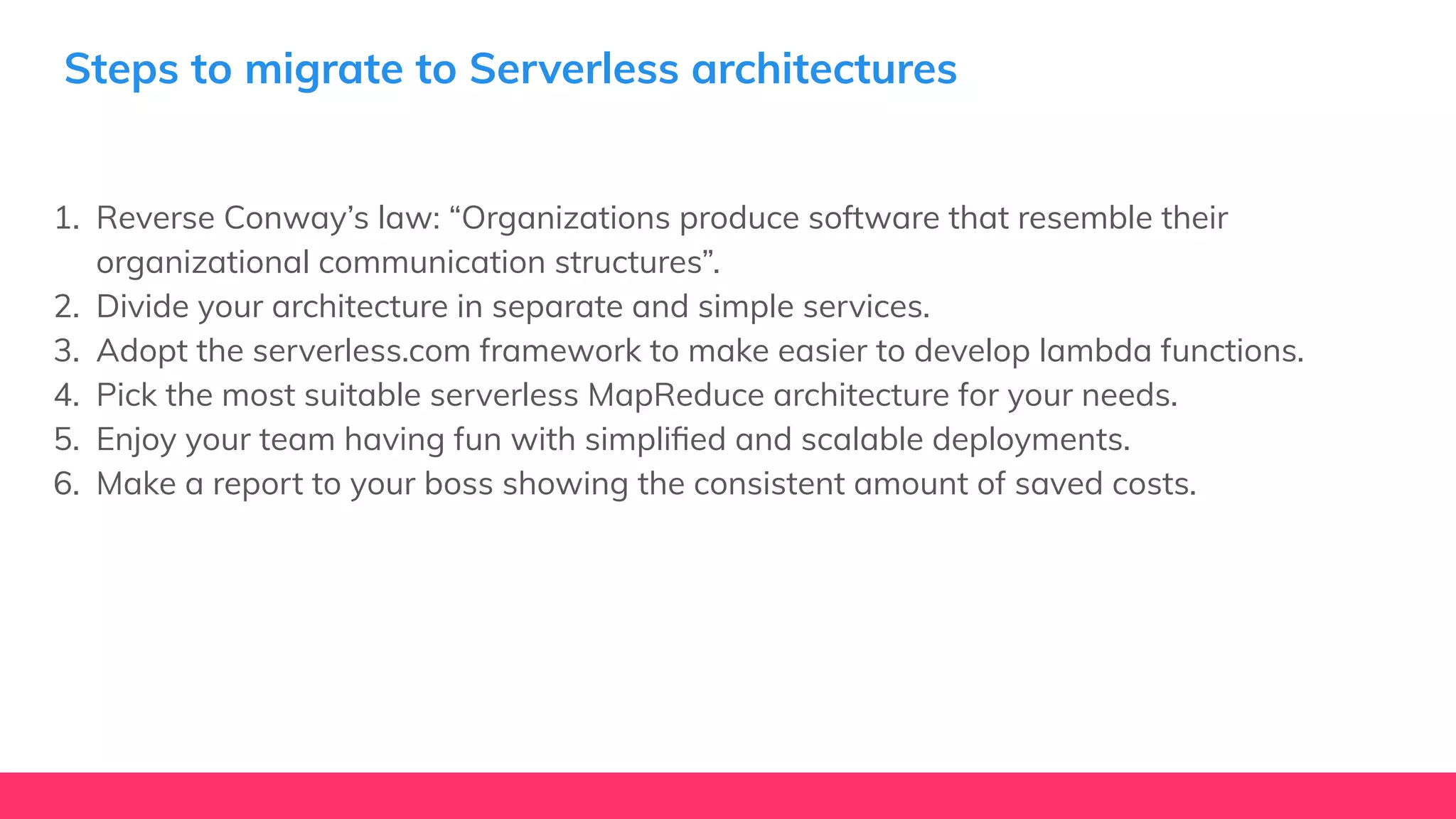
Steps to migrate to Serverless architectures
1. Reverse Conway’s law: “Organizations produce software that resemble their
organizational communication structures”.
2. Divide your architecture in separate and simple services.
3. Adopt the serverless.com framework to make easier to develop lambda functions.
4. Pick the most suitable serverless MapReduce architecture for your needs.
5. Enjoy your team having fun with simplified and scalable deployments.
6. Make a report to your boss showing the consistent amount of saved costs.
Appendix B:
Serverless MapReduce
How can I process
large datasets using
serverless?
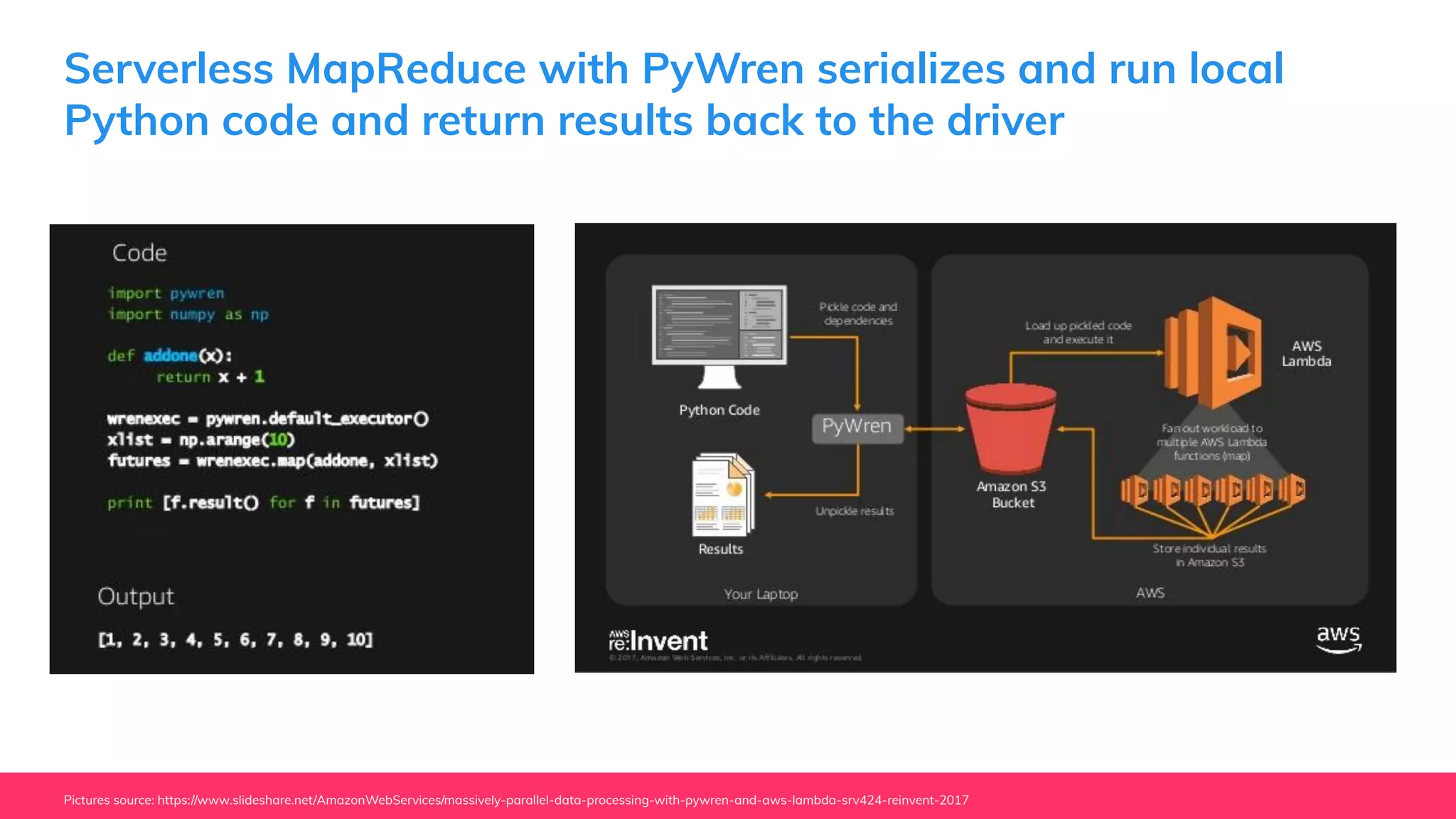
Serverless MapReduce with PyWren serializes and run local
Python code and return results back to the driver
Pictures source: https://www.slideshare.net/AmazonWebServices/massively-parallel-data-processing-with-pywren-and-aws-lambda-srv424-reinvent-2017
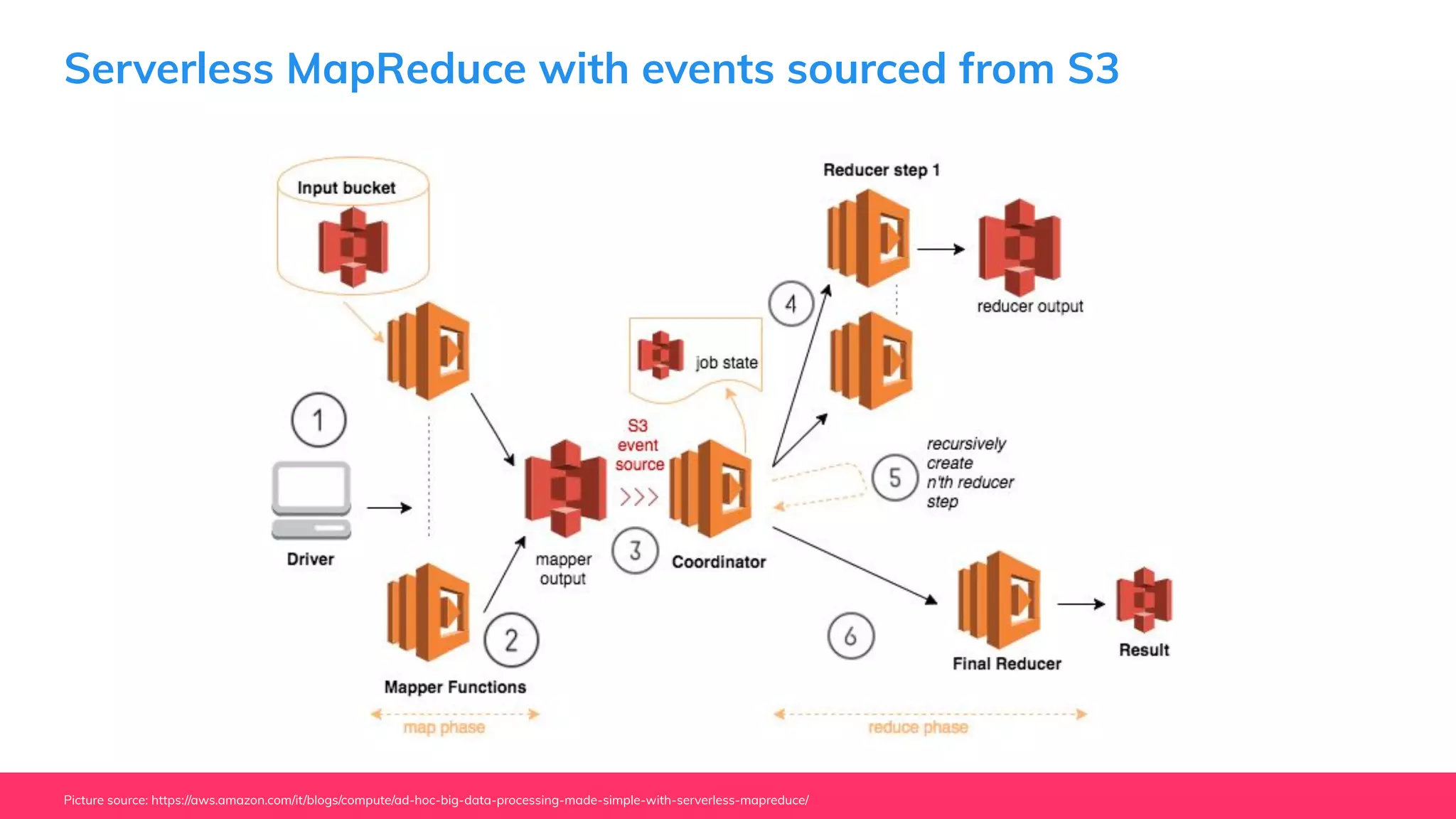
Serverless MapReduce with events sourced from S3
Picture source: https://aws.amazon.com/it/blogs/compute/ad-hoc-big-data-processing-made-simple-with-serverless-mapreduce/
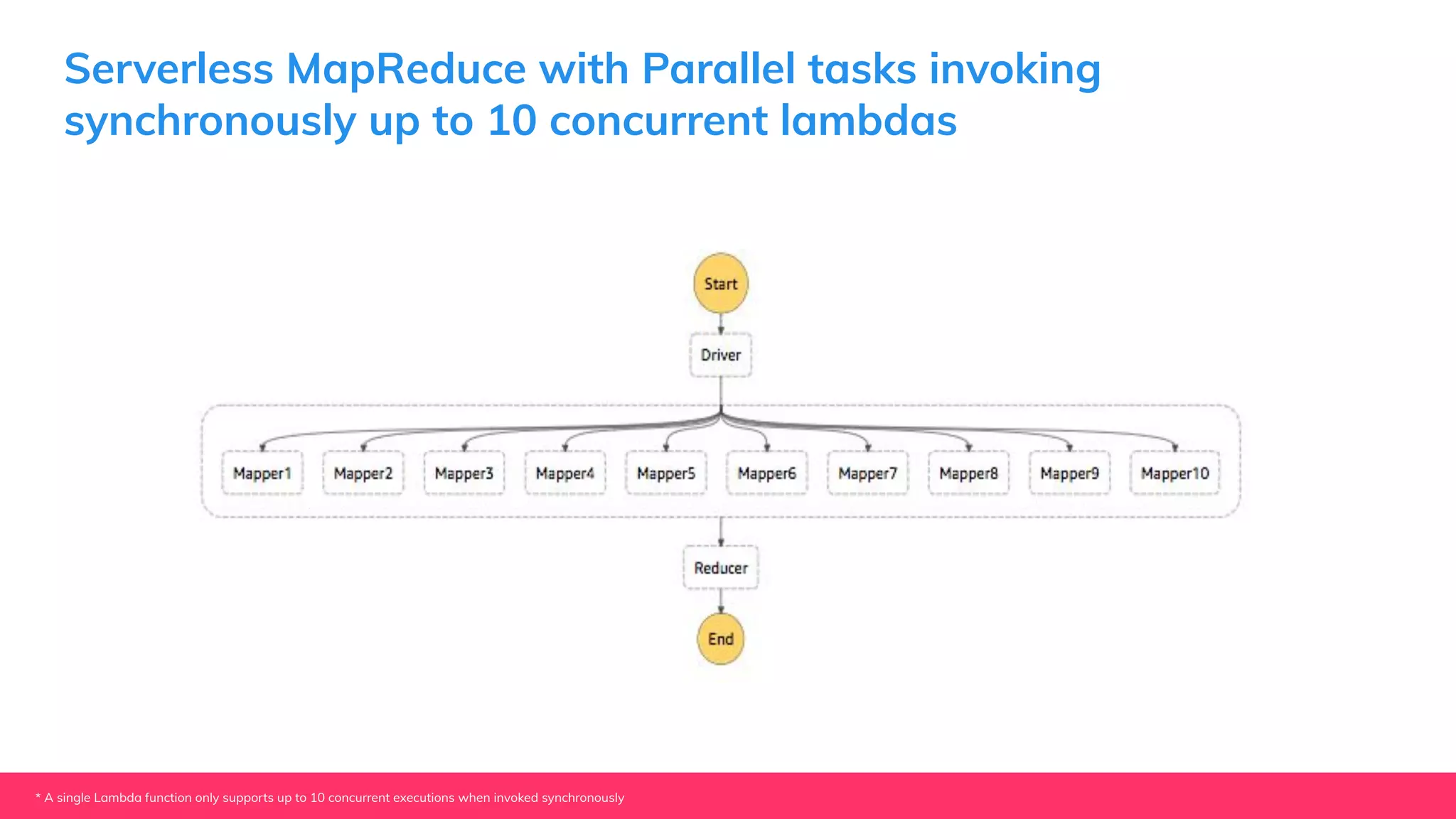
Serverless MapReduce with Parallel tasks invoking
synchronously up to 10 concurrent lambdas
* A single Lambda function only supports up to 10 concurrent executions when invoked synchronously
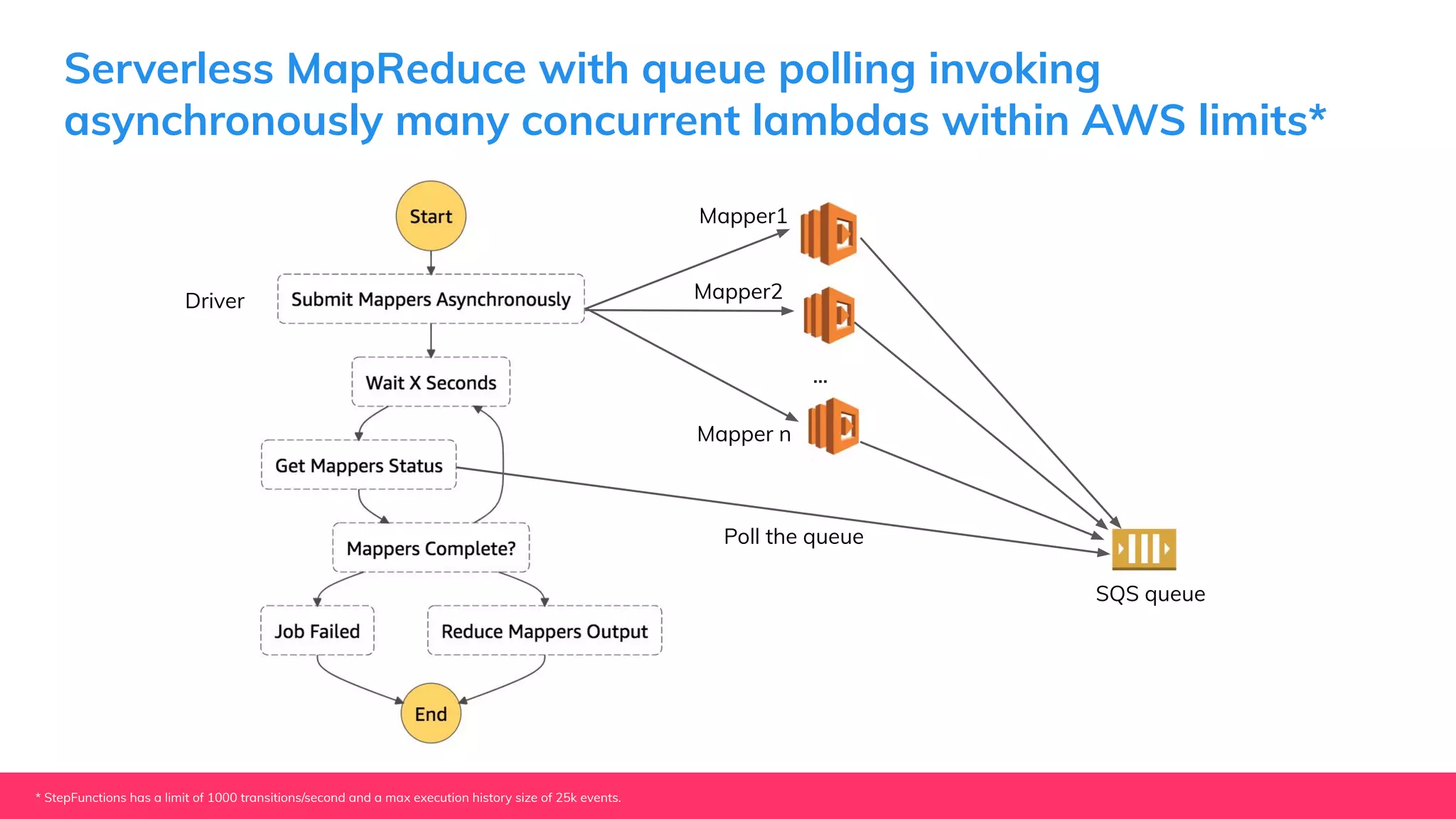
Serverless MapReduce with queue polling invoking
asynchronously many concurrent lambdas within AWS limits*
...
Mapper2
Mapper1
Mapper n
SQS queue
Poll the queue
Driver
* StepFunctions has a limit of 1000 transitions/second and a max execution history size of 25k events.
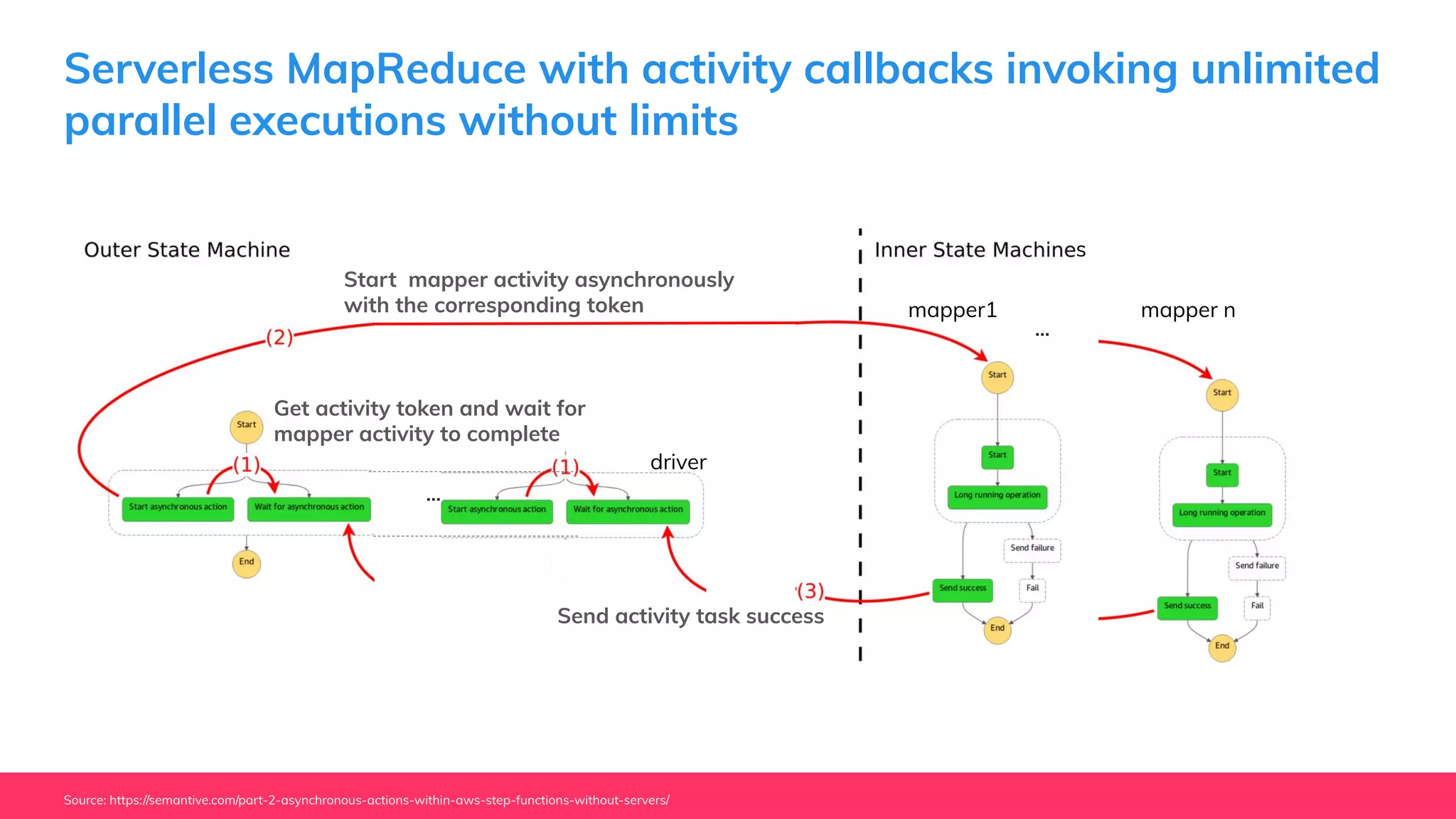
Serverless MapReduce with activity callbacks invoking unlimited
parallel executions without limits
Source: https://semantive.com/part-2-asynchronous-actions-within-aws-step-functions-without-servers/
...
...
mapper1 mapper n
Get activity token and wait for
mapper activity to complete
Start mapper activity asynchronously
with the corresponding token
Send activity task success
s
driver

Tech leaders guide to effective building of machine learning products

  • 1.
    Helixa Tech Leader’s Guideto Effective Building of Machine Learning Products Gianmario Spacagna Chief Scientist @ Helixa ML for Enterprises Conference Rome, 28th October 2019
  • 2.
    About Me 7+ yearsexperience in building Machine Learning products Currently leading a team of ML Scientists and ML Engineers Background in Software Engineering of Distributed Systems MBA Candidate Co-author of Python Deep Learning Contributor of the Professional Data Science Manifesto Blogger of Data Science Vademecum Founder of the DataScienceMilan.org community Stockholm, London, Milan Gianmario Spacagna Chief Scientist, Helixa gspacagna@helixa.ai
  • 3.
    Agenda Manager’s guide (40minutes) 1. Introducing ML in the Enterprises 2. Defining the ML Product Specifications 3. Planning Under Uncertainty 4. Building a balanced ML Team Tech Leaders’ guide (20 minutes) 5. ML Product Lifecycle 6. Serverless architectures
  • 4.
    5. ML ProductLifecycle
  • 5.
    Cloud Providers Disclaimer Thefollowing examples will focus on AWS stack but consider that other cloud providers offers similar services. It is not part of this talk to compare different cloud solutions.
  • 6.
    * from “TheStart-Up Trap” by Robert C. Martin (Uncle Bob) “The only way to go fast is to go well” cit. Uncle Bob
  • 7.
    Overview of areal-world ML production system Source: https://papers.nips.cc/paper/5656-hidden-technical-debt-in-machine-learning-systems Only a small fraction of real-world ML systems is composed of the ML Code. The required surrounding infrastructure is vast and complex.
  • 8.
    Overview of aML component lifecycle Picture source: https://medium.com/microsoftazure/how-to-accelerate-devops-with-machine-learning-lifecycle-management-2ca4c86387a0
  • 9.
    Manage the lifecyclewith dedicated platforms Picture source: www.mlflow.org Predictions Model Serving Training
  • 10.
    Other Machine Learninglifecycle platforms and tools Picture source: www.mlflow.org TensorFlow Extended (TFX) Data Version Control HopsWorks
  • 11.
    Native Cloud Object(Data) Storage Benefits: ● Cheaper ● Elastic ● Highly available ● Performant “The benefit of HDFS is minimal and not worth the operational complexity” Source: DataBricks
  • 12.
    Keep Your DatasetsRegistered in a Catalog Production solution: AWS Glue Data CatalogManual solution
  • 13.
    Manage training labelsusing Snorkel www.snorkel.org
  • 14.
    Dev tool stackand workflow Pull Notebooks and data stored in S3 in shared folders S3 buckets mounted locally via Alluxio cache for fast and cheap access to data Commit and push Dev Unix Machine Notebook name matching branch ID Header cell: 1. Pull the latest version of the code and install locally 2. Print the git status and dependency versions Develop code in the laptop using professional IDEs Feature branches matching Jira key Branching models: ● GitFlow ● Trunk-based
  • 15.
    Processing large datasetswith Elastic MapReduce (EMR) Picture source: https://dimensionless.in/different-ways-to-manage-apache-spark-applications-on-amazon-emr/ Ephemeral clusters on spot instances can dramatically reduce the cost of operations compared to long running ones.
  • 16.
    Processing large datasetsfrom notebooks using and EMR within the same workflow Picture source:
  • 17.
    Port analysis findingsinto a production-quality modules with a task-oriented design and entry points declared in makefiles Picture source: https://medium.com/@davidstevens_16424/make-my-day-ta-science-easier-e16bc50e719c Task: 1. Read 2. Transform 3. Write
  • 18.
    Deliver jobs insidecontainers whenever is possible Advantages: ● Isolated environment ● Different library requirements ● Different resources (memory, CPUs, GPUs) ● Simplified load balancing ● Scalable model serving
  • 19.
    Processing chunks ofdata in parallel batch jobs Source: https://spotinst.com/blog/cost-efficient-batch-computing-on-spot-instances-aws-batch-integration/ Containerized job logic
  • 20.
    Orchestrate pools ofcontainers using Kubernetes (K8s) for inference services
  • 21.
    Automated code testingpyramid Unit tests ● Single methods of data processing utils and major components. ● Replace “assertEqual” with uncertainty ranges on predictions 70% Integration tests ● Test the training, model selection and tuning. ● Subset of component integrations (e.g. transformers followed by model predictions) 20% End-to-end tests ● Static and small dataset. ● Dry runs of the execution plan. ● Check APIs work seamlessly through every stage of the pipeline. 10%
  • 22.
    Bonus: Metamorphic testingallows to test ML algorithms by generating complex, deep tests without the use of an oracle
  • 23.
    Infrastructure-as-Code (IaC) isfundamental in order to have fully-portable and consistent replicas of environments Benefits: ● Reduced labor cost ● Speed of provisioning ● Minimizes errors and security violations
  • 24.
    Automate tasks usingContinuous Integration On commit Deployment tasks: ● Re-training of models ● Model selection ● Hyper-parameters tuning ● Update pipeline components ● Update microservices ● Publish builds and Docker containers On release Picture source: https://deploybot.com/blog/the-expert-guide-to-continuous-integration
  • 25.
    Release without pain Source:Spotify Engineering Culture — Part 1
  • 26.
    Validate hypothesis andreleases with A/B testing Source: https://www.optimizely.com/optimization-glossary/ab-testing/
  • 27.
    Centralized logging withthe ELK stack Generate Logs Aggregation & Transformation Storage & Indexing Visualization & Analysis
  • 28.
    Infrastructure Monitoring andAlerting Basic Monitoring: AWS resources and custom metrics generated by your applications and services Focus on IT Monitoring: Cloud-scale monitoring of logs, metrics and traces from distributed, dynamic and hybrid infrastructure. Focus on App Monitoring: All-in-one performance management tool from the end user experience, through servers, down to the line of application code.
  • 29.
    Governance and Auditability Auditchanges in the configuration of resources. Track account activity by recording AWS console actions and API calls.
  • 30.
    Respect the ResponsibleAI principles Source: https://ethical.institute/principles.html
  • 31.
    Adopt the eXplainableAIFramework Source: https://ethical.institute/xai.html
  • 32.
    The 43 Rulesof ML Engineering Martin Zinkevich Google Research Scientist https://developers.google.com/machine-learning/guid es/rules-of-ml/
  • 33.
  • 34.
    Serverless, or howto build and run applications without thinking about servers
  • 35.
    In serverless, thecloud provider is responsible for executing a piece of code by dynamically allocating the resources Traditional Serverful Way: Serverless Way: Source: https://serverless-stack.com/chapters/what-is-serverless.html
  • 36.
    Philosophy behind Serverless "Ifa tree falls in a forest and no one is around to hear it, does it make a sound?" “If a server runs in the cloud and no one is around to use it, does it need to incur any costs?” WinterClouds
  • 37.
    Reasons to migrateto Serverless Secure Scalable Cheap Always available Worry free Low maintenance
  • 38.
    An overview ofServerless services available in AWS Docker container execution. Script execution in response of events. Full list available at https://aws.amazon.com/serverless/ Orchestration of components and microservices Queuing + publisher/subscriber message services. NoSQL Key-Value database. REST API management service. Query service to analyze data at scale using standard SQL (like PrestoDB). ETL service to crawl and process large datasets on a fully managed Spark environment.
  • 39.
    Lambda function: listingfiles in a specified S3 directory Event object Result objectPython script Lambda cost: $1.04 / million requests S3 LIST request cost: $5 / million requests
  • 40.
  • 41.
    Orchestrating functions usingstate machines via Step Functions
  • 42.
    Serverless scientific computingand Map/Reduce with PyWren Pictures source: https://www.slideshare.net/AmazonWebServices/massively-parallel-data-processing-with-pywren-and-aws-lambda-srv424-reinvent-2017
  • 43.
  • 44.
    * from “TheStart-Up Trap” by Robert C. Martin (Uncle Bob) “The only way to go fast is to go well” cit. Uncle Bob
  • 45.
    Overview of areal-world ML production system Source: https://papers.nips.cc/paper/5656-hidden-technical-debt-in-machine-learning-systems
  • 46.
  • 47.
  • 48.
    Gianmario Spacagna Chief Scientistat Helixa.ai gspacagna@helixa.ai @gm_spacagna
  • 49.
  • 50.
    Steps to Managingthe ML Product Lifecycle 1. Familiarize with the whole lifecycle and most popular tools and libraries. 2. Adopt a platform such as MLflow to track and version models and experiments. 3. Notebooks are good for explorations but the implementation should be in a codebase. 4. Make analysis, code and infrastructure, reproducible and avoid manual operations. 5. Communicate analysis results effectively summarizing only what is relevant. 6. Invest on automated tests at different integration levels. 7. Exploit Continuous Integration (CI) for automating builds and releases. 8. Deliver models and components inside Docker containers, when possible. 9. Centralize the logs collection for debugging and troubleshooting. 10. Monitor the infrastructure health using specific tools. 11. Consider a strategy for implementing Governance and Auditability.
  • 51.
    Steps to migrateto Serverless architectures 1. Reverse Conway’s law: “Organizations produce software that resemble their organizational communication structures”. 2. Divide your architecture in separate and simple services. 3. Adopt the serverless.com framework to make easier to develop lambda functions. 4. Pick the most suitable serverless MapReduce architecture for your needs. 5. Enjoy your team having fun with simplified and scalable deployments. 6. Make a report to your boss showing the consistent amount of saved costs.
  • 52.
  • 53.
    How can Iprocess large datasets using serverless?
  • 54.
    Serverless MapReduce withPyWren serializes and run local Python code and return results back to the driver Pictures source: https://www.slideshare.net/AmazonWebServices/massively-parallel-data-processing-with-pywren-and-aws-lambda-srv424-reinvent-2017
  • 55.
    Serverless MapReduce withevents sourced from S3 Picture source: https://aws.amazon.com/it/blogs/compute/ad-hoc-big-data-processing-made-simple-with-serverless-mapreduce/
  • 56.
    Serverless MapReduce withParallel tasks invoking synchronously up to 10 concurrent lambdas * A single Lambda function only supports up to 10 concurrent executions when invoked synchronously
  • 57.
    Serverless MapReduce withqueue polling invoking asynchronously many concurrent lambdas within AWS limits* ... Mapper2 Mapper1 Mapper n SQS queue Poll the queue Driver * StepFunctions has a limit of 1000 transitions/second and a max execution history size of 25k events.
  • 58.
    Serverless MapReduce withactivity callbacks invoking unlimited parallel executions without limits Source: https://semantive.com/part-2-asynchronous-actions-within-aws-step-functions-without-servers/ ... ... mapper1 mapper n Get activity token and wait for mapper activity to complete Start mapper activity asynchronously with the corresponding token Send activity task success s driver