Simon SOBAIM
Communication Arts
Department (Yr.3)
Outline:
• What are web tools
• Types of web tools and examples
• Summary
• references
What are Web tools?
• Web tools is a web interface that allows you to add content to your website with minimal
technical knowledge.
• What purpose does it serve?
It serves to:
i. Provide access to creating and modifying content across the websites of UCLA International
Institute and its centers and programs;
ii. Fulfill administrative and logistical functions, including but not limited to staff information,
equipment reservations, grant tracking, and fellowship applications;
iii. Hold a record and archive of web content including text, images, video, and audio;
iv. Provide IT related resources and support (i.e. how-to guides, tutorials, useful links).
Furthermore; Web tools is an application that complies with Content Management System (CMS).
Types of Web tools
• There are two types of Web
tools;
1. Web 1.0
2. Web 2.0
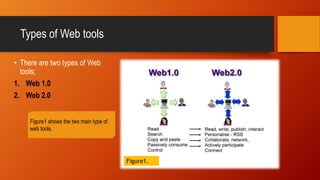
Figure1.
Figure1 shows the two main type of
web tools.
Web 1.0
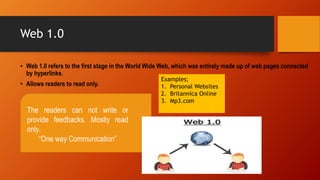
• Web 1.0 refers to the first stage in the World Wide Web, which was entirely made up of web pages connected
by hyperlinks.
• Allows readers to read only.
The readers can not write or
provide feedbacks. Mostly read
only.
“One way Communication”
Examples;
1. Personal Websites
2. Britannica Online
3. Mp3.com
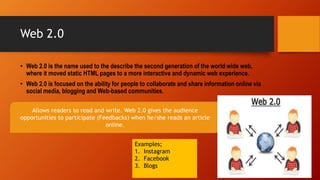
Allows readers to read and write. Web 2.0 gives the audience
opportunities to participate (Feedbacks) when he/she reads an article
online.
Web 2.0
• Web 2.0 is the name used to the describe the second generation of the world wide web,
where it moved static HTML pages to a more interactive and dynamic web experience.
• Web 2.0 is focused on the ability for people to collaborate and share information online via
social media, blogging and Web-based communities.
Examples;
1. Instagram
2. Facebook
3. Blogs
Thank you!!
Reference
• https://www.international.ucla.edu/Institute/Article/154862#purpose
• https://www.techopedia.com/definition/27960/web-10
• https://www.google.com/search?q=web&client=firefox-b-
d&sxsrf=ACYBGNStxUPx6aBygCwg3fRx70oEP3DvCw:1569895500960&source=lnms&tbm=isch&sa=X&ved=0ahUKEwjW
8qy9_PnkAhXSIVAKHa3NBc8Q_AUIEigC&biw=1366&bih=693#imgrc=JWp6rneDqC6BaM:
• https://www.google.com/search?q=web+1.0+and+2.0&client=firefox-b-
d&sxsrf=ACYBGNQX0fkkXB703WFztLCiSFxHSnAU2A:1569900039765&source=lnms&tbm=isch&sa=X&ved=0ahUKEwjfus
-xjfrkAhVIPFAKHenSB74Q_AUIESgB&biw=1366&bih=693#imgdii=XtqfB3gLGTCh5M:&imgrc=QUMkYk54iBSiTM:
• https://www.techopedia.com/definition/27960/web-10
• https://www.techopedia.com/definition/4922/web-20

Web tools

  • 1.
  • 2.
    Outline: • What areweb tools • Types of web tools and examples • Summary • references
  • 3.
    What are Webtools? • Web tools is a web interface that allows you to add content to your website with minimal technical knowledge. • What purpose does it serve? It serves to: i. Provide access to creating and modifying content across the websites of UCLA International Institute and its centers and programs; ii. Fulfill administrative and logistical functions, including but not limited to staff information, equipment reservations, grant tracking, and fellowship applications; iii. Hold a record and archive of web content including text, images, video, and audio; iv. Provide IT related resources and support (i.e. how-to guides, tutorials, useful links). Furthermore; Web tools is an application that complies with Content Management System (CMS).
  • 4.
    Types of Webtools • There are two types of Web tools; 1. Web 1.0 2. Web 2.0 Figure1. Figure1 shows the two main type of web tools.
  • 5.
    Web 1.0 • Web1.0 refers to the first stage in the World Wide Web, which was entirely made up of web pages connected by hyperlinks. • Allows readers to read only. The readers can not write or provide feedbacks. Mostly read only. “One way Communication” Examples; 1. Personal Websites 2. Britannica Online 3. Mp3.com
  • 6.
    Allows readers toread and write. Web 2.0 gives the audience opportunities to participate (Feedbacks) when he/she reads an article online. Web 2.0 • Web 2.0 is the name used to the describe the second generation of the world wide web, where it moved static HTML pages to a more interactive and dynamic web experience. • Web 2.0 is focused on the ability for people to collaborate and share information online via social media, blogging and Web-based communities. Examples; 1. Instagram 2. Facebook 3. Blogs
  • 7.
  • 8.
    Reference • https://www.international.ucla.edu/Institute/Article/154862#purpose • https://www.techopedia.com/definition/27960/web-10 •https://www.google.com/search?q=web&client=firefox-b- d&sxsrf=ACYBGNStxUPx6aBygCwg3fRx70oEP3DvCw:1569895500960&source=lnms&tbm=isch&sa=X&ved=0ahUKEwjW 8qy9_PnkAhXSIVAKHa3NBc8Q_AUIEigC&biw=1366&bih=693#imgrc=JWp6rneDqC6BaM: • https://www.google.com/search?q=web+1.0+and+2.0&client=firefox-b- d&sxsrf=ACYBGNQX0fkkXB703WFztLCiSFxHSnAU2A:1569900039765&source=lnms&tbm=isch&sa=X&ved=0ahUKEwjfus -xjfrkAhVIPFAKHenSB74Q_AUIESgB&biw=1366&bih=693#imgdii=XtqfB3gLGTCh5M:&imgrc=QUMkYk54iBSiTM: • https://www.techopedia.com/definition/27960/web-10 • https://www.techopedia.com/definition/4922/web-20