INFORMATION AND
COMMUNICATION
TECHNOLOGY
EMPOWERMENTTECHNOLOGY
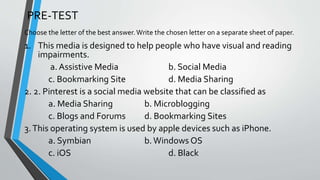
PRE-TEST
Choose the letter of the best answer.Write the chosen letter on a separate sheet of paper.
1. This media is designed to help people who have visual and reading
impairments.
a. Assistive Media b. Social Media
c. Bookmarking Site d. Media Sharing
2. 2. Pinterest is a social media website that can be classified as
a. Media Sharing b. Microblogging
c. Blogs and Forums d. Bookmarking Sites
3.This operating system is used by apple devices such as iPhone.
a. Symbian b.Windows OS
c. iOS d. Black
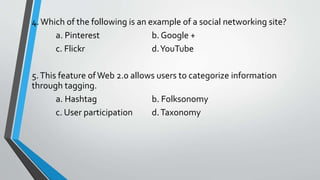
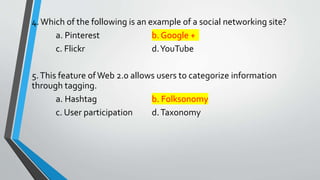
4.Which of the following is an example of a social networking site?
a. Pinterest b. Google +
c. Flickr d.YouTube
5.This feature ofWeb 2.0 allows users to categorize information
through tagging.
a. Hashtag b. Folksonomy
c. User participation d.Taxonomy
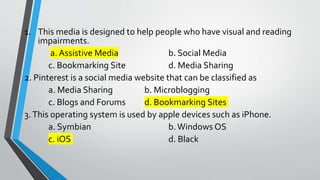
1. This media is designed to help people who have visual and reading
impairments.
a. Assistive Media b. Social Media
c. Bookmarking Site d. Media Sharing
2. Pinterest is a social media website that can be classified as
a. Media Sharing b. Microblogging
c. Blogs and Forums d. Bookmarking Sites
3.This operating system is used by apple devices such as iPhone.
a. Symbian b.Windows OS
c. iOS d. Black
4.Which of the following is an example of a social networking site?
a. Pinterest b. Google +
c. Flickr d.YouTube
5.This feature ofWeb 2.0 allows users to categorize information
through tagging.
a. Hashtag b. Folksonomy
c. User participation d.Taxonomy
At the end of the lessons, students are
expected to:
1.differentiateWeb 1.0,Web 2.0 and 3.0; and
2.compare and contrast the nuances of varied
online platforms, sites and content.
WHAT IS INFORMATION AND
COMMUNICATIONTECHNOLOGY OR ICT?
It deals with the use of different
communication technologies that can
locate, store, create, and share or exchange
of information.
Example:
mobile phones, Internet
WORLDWIDE WEB
•commonly referred to as WWW, W3, or
simply the Web is an interconnected system
of public webpages accessible through the
Internet. It was invented by Sir Tim Berners-
Lee in 1989
•world wide web can be either static or
dynamic.
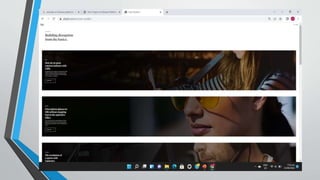
WEB 1.0
•Web pages are static and not interactive.You
can’t post comments or create an account.
Examples ofWebsites inWeb 1.0
1.Jekyll.com
2.Getpelican.com
3.Brunch.io
WEB 2.0
•term used to describe the present generation
of theWorldWideWeb that concentrates on
its capability of providing people the means
to collaborate and share information online.
•The second stage inWorldWideWeb
•DynamicWebsite
• The content of the website changes
WEB 2.0
•Interactive
•enables an increased user participation in the
web
•The term was popularized by Tim O'Reilly and
Dale Dougherty at the O'Reilly Media Web 2.0
Conference in late 2004 (TechTarget, 2015).
FEAUTURES OF WEB 2.0
•FOLKSONOMY
- It allows users to categorize and
classify/arrange information using freely
chosen keywords (e.g., tagging).
FOLKSONOMY
Popular social networking sites that uses hashtags
areTwitter, Instagram, Facebook, etc. use tags that
start with the pound sign (#).This is also referred to
as hashtag.
RICH USER EXPERIENCE
-Content is dynamic and is responsive to user’s
input. An example would be a website that
shows local content. In the case of social
networking sites, when logged on, your
account is used to modify what you see in
their website.
FEAUTURES OF WEB 2.0
USER PARTICIPATION
- The owner of the website is not the only one
who is able to put content. Others are able to
place a content of their own by means of
comment, reviews, and evaluation. Some
websites allow readers to comment on an
article, participate in a poll, or review a specific
product (e.g., Amazon.com).
FEAUTURES OF WEB 2.0
SOFTWARE AS A SERVICE
- Users will subscribe to a software only when needed
rather than purchasing them.This is a cheaper option if
you do not always need to use a software.
- Software as a service allows you to “rent” a software for
a minimal fee
FEAUTURES OF WEB 2.0
MASS PARTICIPATION
- It is a diverse information sharing through
universal web access. Since most users can use
the Internet,Web 2.0’s content is based on
people from various cultures.
FEAUTURES OF WEB 2.0
WEB 3.0
•also called as SemanticWeb
• Semantics – ability ofWeb technologies to
understand and interpret human generated content
•The aim of Web 3.0 is to have machines understand
the user’s preferences to be able to deliver web
content specifically targeting the user.
•The Internet is able to predict the best possible
answers to your question by “learning from your
previous choices
TRENDS IN ICT
1. CONVERGENCE
Technological convergence is the synergy of
technological advancements to work on a
similar goal or task.
Example: besides using your personal
computer to create word documents, you can
now use smartphone.
2. Social Media
-It is a website, application, or online channel
that enables web users to create, co-create,
modify, and exchange user-generated content.
TYPES OF SOCIAL MEDIA
1. Social Networks - sites that allow you
to connect with other people with
same interests or background.
Examples: Facebook, Google+
TYPES OF SOCIAL MEDIA
2. Bookmarking Sites - sites that allow users
to store and manage links to various websites
and resources, and to tag.
Examples: StumbleUpon, Pinterest
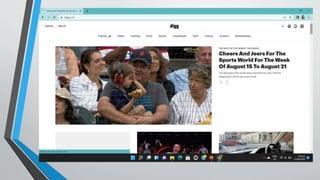
3. Social News - sites that allow users to post
their own news items or links to other news
sources.
Examples: reddit, digg
TYPES OF SOCIAL MEDIA
4. Media Sharing - sites that allow you to
upload and share media content like images,
music, and video.
Examples: Flickr,YouTube, and Instagram
5. Microblogging - sites that focus on short
updates from the user.Those who are
subscribed will receive updates. Examples:
Twitter Plurk
5. Microblogging - sites that focus on short
updates from the user.Those who are
subscribed will receive updates.
Examples:Twitter
TYPES OF SOCIAL MEDIA
6. Blogs and Forums - sites that allow users to
post their content.
Examples: Blogger,WordPress,Tumblr
3. MobileTechnologies
The popularity of smartphones and tablets has
taken a major rise over the years.This is largely
because of the devices’ capability to do tasks
that were originally found in personal
computers.
TRENDS IN ICT
Different types of mobile operating systems:
1. iOS – used in Apple devices such as the iPhone
and iPad
2. Android – an open source operating system
developed by Google. Being open source means
several mobile phone companies use this OS for
free.
3. Blackberry OS – used in blackberry devices
4.Windows Phone OS – a closed source and
proprietary operating system developed by
Microsoft
5. Symbian – the original smartphone OS used by
Nokia devices
6.WebOS – originally used for smartphones; now
used for smartTVs
Different types of mobile operating systems:
7.Windows Mobile – developed by Microsoft for
smartphones and pocket PCs.
Different types of mobile operating systems:
4. ASSISTIVE MEDIA
- It is a nonprofit service designed to help
people who have visual and reading
impairments. A database of audio recordings is
used to read to the user.
TRENDS IN ICT
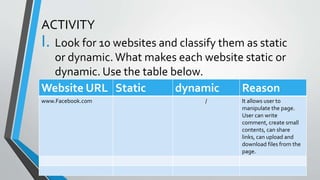
ACTIVITY
I. Look for 10 websites and classify them as static
or dynamic.What makes each website static or
dynamic. Use the table below.
Website URL Static dynamic Reason
www.Facebook.com / It allows user to
manipulate the page.
User can write
comment, create small
contents, can share
links, can upload and
download files from the
page.
II. Identifying the correct web platform for social
change
1. Identify a problem in your community (garbage
disposal, blocked drainage)
2. Imagine that you are going to create a website to
persuade both community leaders and members to
solve this problem.
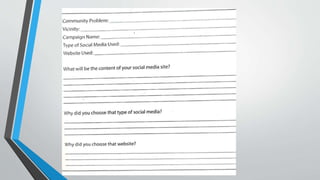
3. Fill out the form below.
LESSON 1 INFORMATION AND COMMUNICATION TECHNOLOGY.pptx

LESSON 1 INFORMATION AND COMMUNICATION TECHNOLOGY.pptx

  • 1.
  • 2.
    PRE-TEST Choose the letterof the best answer.Write the chosen letter on a separate sheet of paper. 1. This media is designed to help people who have visual and reading impairments. a. Assistive Media b. Social Media c. Bookmarking Site d. Media Sharing 2. 2. Pinterest is a social media website that can be classified as a. Media Sharing b. Microblogging c. Blogs and Forums d. Bookmarking Sites 3.This operating system is used by apple devices such as iPhone. a. Symbian b.Windows OS c. iOS d. Black
  • 3.
    4.Which of thefollowing is an example of a social networking site? a. Pinterest b. Google + c. Flickr d.YouTube 5.This feature ofWeb 2.0 allows users to categorize information through tagging. a. Hashtag b. Folksonomy c. User participation d.Taxonomy
  • 4.
    1. This mediais designed to help people who have visual and reading impairments. a. Assistive Media b. Social Media c. Bookmarking Site d. Media Sharing 2. Pinterest is a social media website that can be classified as a. Media Sharing b. Microblogging c. Blogs and Forums d. Bookmarking Sites 3.This operating system is used by apple devices such as iPhone. a. Symbian b.Windows OS c. iOS d. Black
  • 5.
    4.Which of thefollowing is an example of a social networking site? a. Pinterest b. Google + c. Flickr d.YouTube 5.This feature ofWeb 2.0 allows users to categorize information through tagging. a. Hashtag b. Folksonomy c. User participation d.Taxonomy
  • 6.
    At the endof the lessons, students are expected to: 1.differentiateWeb 1.0,Web 2.0 and 3.0; and 2.compare and contrast the nuances of varied online platforms, sites and content.
  • 7.
    WHAT IS INFORMATIONAND COMMUNICATIONTECHNOLOGY OR ICT? It deals with the use of different communication technologies that can locate, store, create, and share or exchange of information. Example: mobile phones, Internet
  • 8.
    WORLDWIDE WEB •commonly referredto as WWW, W3, or simply the Web is an interconnected system of public webpages accessible through the Internet. It was invented by Sir Tim Berners- Lee in 1989 •world wide web can be either static or dynamic.
  • 9.
    WEB 1.0 •Web pagesare static and not interactive.You can’t post comments or create an account. Examples ofWebsites inWeb 1.0 1.Jekyll.com 2.Getpelican.com 3.Brunch.io
  • 11.
    WEB 2.0 •term usedto describe the present generation of theWorldWideWeb that concentrates on its capability of providing people the means to collaborate and share information online. •The second stage inWorldWideWeb •DynamicWebsite • The content of the website changes
  • 12.
    WEB 2.0 •Interactive •enables anincreased user participation in the web •The term was popularized by Tim O'Reilly and Dale Dougherty at the O'Reilly Media Web 2.0 Conference in late 2004 (TechTarget, 2015).
  • 13.
    FEAUTURES OF WEB2.0 •FOLKSONOMY - It allows users to categorize and classify/arrange information using freely chosen keywords (e.g., tagging).
  • 14.
    FOLKSONOMY Popular social networkingsites that uses hashtags areTwitter, Instagram, Facebook, etc. use tags that start with the pound sign (#).This is also referred to as hashtag.
  • 15.
    RICH USER EXPERIENCE -Contentis dynamic and is responsive to user’s input. An example would be a website that shows local content. In the case of social networking sites, when logged on, your account is used to modify what you see in their website. FEAUTURES OF WEB 2.0
  • 16.
    USER PARTICIPATION - Theowner of the website is not the only one who is able to put content. Others are able to place a content of their own by means of comment, reviews, and evaluation. Some websites allow readers to comment on an article, participate in a poll, or review a specific product (e.g., Amazon.com). FEAUTURES OF WEB 2.0
  • 17.
    SOFTWARE AS ASERVICE - Users will subscribe to a software only when needed rather than purchasing them.This is a cheaper option if you do not always need to use a software. - Software as a service allows you to “rent” a software for a minimal fee FEAUTURES OF WEB 2.0
  • 18.
    MASS PARTICIPATION - Itis a diverse information sharing through universal web access. Since most users can use the Internet,Web 2.0’s content is based on people from various cultures. FEAUTURES OF WEB 2.0
  • 19.
    WEB 3.0 •also calledas SemanticWeb • Semantics – ability ofWeb technologies to understand and interpret human generated content •The aim of Web 3.0 is to have machines understand the user’s preferences to be able to deliver web content specifically targeting the user. •The Internet is able to predict the best possible answers to your question by “learning from your previous choices
  • 20.
    TRENDS IN ICT 1.CONVERGENCE Technological convergence is the synergy of technological advancements to work on a similar goal or task. Example: besides using your personal computer to create word documents, you can now use smartphone.
  • 21.
    2. Social Media -Itis a website, application, or online channel that enables web users to create, co-create, modify, and exchange user-generated content. TYPES OF SOCIAL MEDIA 1. Social Networks - sites that allow you to connect with other people with same interests or background. Examples: Facebook, Google+
  • 22.
    TYPES OF SOCIALMEDIA 2. Bookmarking Sites - sites that allow users to store and manage links to various websites and resources, and to tag. Examples: StumbleUpon, Pinterest 3. Social News - sites that allow users to post their own news items or links to other news sources. Examples: reddit, digg
  • 25.
    TYPES OF SOCIALMEDIA 4. Media Sharing - sites that allow you to upload and share media content like images, music, and video. Examples: Flickr,YouTube, and Instagram 5. Microblogging - sites that focus on short updates from the user.Those who are subscribed will receive updates. Examples: Twitter Plurk
  • 26.
    5. Microblogging -sites that focus on short updates from the user.Those who are subscribed will receive updates. Examples:Twitter TYPES OF SOCIAL MEDIA
  • 27.
    TYPES OF SOCIALMEDIA 6. Blogs and Forums - sites that allow users to post their content. Examples: Blogger,WordPress,Tumblr
  • 28.
    3. MobileTechnologies The popularityof smartphones and tablets has taken a major rise over the years.This is largely because of the devices’ capability to do tasks that were originally found in personal computers. TRENDS IN ICT
  • 29.
    Different types ofmobile operating systems: 1. iOS – used in Apple devices such as the iPhone and iPad 2. Android – an open source operating system developed by Google. Being open source means several mobile phone companies use this OS for free. 3. Blackberry OS – used in blackberry devices
  • 30.
    4.Windows Phone OS– a closed source and proprietary operating system developed by Microsoft 5. Symbian – the original smartphone OS used by Nokia devices 6.WebOS – originally used for smartphones; now used for smartTVs Different types of mobile operating systems:
  • 31.
    7.Windows Mobile –developed by Microsoft for smartphones and pocket PCs. Different types of mobile operating systems:
  • 32.
    4. ASSISTIVE MEDIA -It is a nonprofit service designed to help people who have visual and reading impairments. A database of audio recordings is used to read to the user. TRENDS IN ICT
  • 33.
    ACTIVITY I. Look for10 websites and classify them as static or dynamic.What makes each website static or dynamic. Use the table below. Website URL Static dynamic Reason www.Facebook.com / It allows user to manipulate the page. User can write comment, create small contents, can share links, can upload and download files from the page.
  • 34.
    II. Identifying thecorrect web platform for social change 1. Identify a problem in your community (garbage disposal, blocked drainage) 2. Imagine that you are going to create a website to persuade both community leaders and members to solve this problem. 3. Fill out the form below.

Editor's Notes

  • #8 Having a unified way to communicate is one of the goals of ICT. We spend less because of ICT. Information and communication technologies (ICT) is defined as a diverse set of technological tools and resources used to transmit, store, create, share or exchange information. These technological tools and resources include computers, the Internet (websites, blogs and emails), live broadcasting technologies (radio, television and webcasting), recorded broadcasting technologies (podcasting, audio and video players, and storage devices) and telephony (fixed or mobile, satellite, visio/video-conferencing, etc.). ICT is also used to refer to the convergence of audiovisual and telephone networks with computer networks through a single cabling or link system. There are large economic incentives to merge the telephone network with the computer network system using a single unified system of cabling, signal distribution, and management. ICT is an umbrella term that includes any communication device, encompassing radio, television, cell phones, computer and network hardware, satellite systems and so on, as well as the various services and appliances with them such as video conferencing and distance learning. ICT also includes analog technology, such as paper communication, and any mode that transmits communication.[2]
  • #9 What is www in ICT? History of www What is the use of www? The World Wide Web has become the world's dominant software platform. Static website – one with the stable content, where every user sees the exact same thing on each individual page. Dynamic website – id one where content is pulled on the fly, allowing its content to change with the user.
  • #10 EXAMPLE OF WWW THAT DON’T ACCEPT EDETING, COMMENTS The page is as is and cannot be manipulated. Np collaboration
  • #13 Interactive -The user may be able to comment or create user account HISTORY OF WEB 2.0
  • #14 Hashtag makes it easier to find information with a theme or specific. Easily find information.
  • #16 Example: google chrome, facebook – you can modify the page, it allows you to download files. Not just searching.
  • #17 This page allows you to create content by means of comments, reviews, evaluation. – SHOPPE, LAZADA
  • #18 For instance, Google Docs is a free web-based application that allows the user to create and edit word processing and spreadsheet documents online. When you need a software, like a Word Processor, you can purchase it for a one-time huge amount and install it in your computer and it is yours forever. Software as a service allows you to “rent” a software for a minimal fee
  • #19 FACEBOOK, TWITTER, INSTAGRAM
  • #20 Web 3.0 if in use today Problems Compatiblity to web browser Security Vastness Logic – limitation for computer to be able to predict what the user is referring to at a given time.
  • #21 Clouds, google drive Compare old technologies and todays technology in termrs of accessing files Searches, storage, Multiple gadgets or device be use as medium of your work.
  • #22 IS INSTAGRAMS, TWITTER A SOCIAL NETWORKS Social networks – group pages, share contents
  • #23 Bookmarking sites? Social news? Pinterest, slideshare Social news – similar to regular news sites in that they provide news. The difference is that the news is provided by users, and users get to vote on the stories to determine which news items are ranked hishest on the site. Members can share news about almost any topic – celebrity goddips, politics,
  • #26 Twitter - subcription
  • #33 TRY TO VISIT THE SITE You may visit http://assistivemedia.org/ for several of their audio recordings.
  • #34 POST TEST GENERALIZATION EVALUATION GIVING OF ASSIGNMENT