WIT Project Managementa quick and dirty introduction to project management for small web development projects with new and junior developers
Why Formal Project Managementunderstand the projectincrease likelihood of successknow what success isreduce stressmake effective use of resourcesfit the project into a larger contextother projectsexternal eventsreduce uncertainty
Traditional PM4-5 main phasesinitiation/visionplanning/designexecution/developmentevaluation/monitoring & controlclosing/deployment/releaselots of planningclean hand off between phases
Waterfall PM – Software DevelopmentInitiationSpecificationPlanning & DesignImplementationTesting and DebuggingRelease & Hand-offMaintenance
Limitations of Traditional PMinflexiblenew infoproject changesknown-result orientedoverwhelmingboth takes over and intimidatingbenefits drop for smaller projectshigh overheadmisses some key web/software aspects
Software/Web PMoften exploratory / inventivehigh uncertaintyparticular focus on testing / debuggingadditional post-release maintenance phaserequirements are often fluidstakeholders often don’t understand the capabilities of the technologydirect stakeholder interaction (WIT)
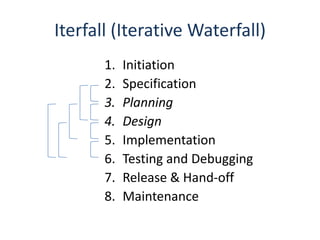
Iterfall (Iterative Waterfall)InitiationSpecificationPlanning DesignImplementationTesting and DebuggingRelease & Hand-offMaintenance
Agile PM / XP / etccreated explicitly for quick software developmentfunctionality focusedvery flexiblevery human-interactiveworks well for small, tight teamsmost appropriate for non-critical projects
Agile Detailsbreak tasks into small incrementsproject is a series of iterative cyclesvery short, 1-4 weeksspec, plan, dev, testing process for that short spanresults in a working productteam (5-9 people) is cross functional and self organizingplan is more general further off in time
Agile PM sounds good, BUT...Agile PM / XP / etc. requires senior developers to be effective!requires very frequent sponsor feedbackrelies on people being able to self-organizeleverages expertise – low/no expertise greatly reduces benefitsecho chamber can enhance mistakes
A Middle Groundtraditional (planning oriented)clear project understandingguidance for junior developerseasier top-down involvementagile (implementation & feedback oriented)well suited to web / software developmentself-directed and -organized where possibleteam orientedflexibleworking product oriented
Existing Solutionsthere are a number of processes out there that attempt to balance TPM and APM. Generally theyare for larger projectsare for longer time framestrade on the certainty–flexibility axisrely on (at least some) experienced developers
Main Goals for WIT PMfit the project into the fixed time frame (7-8 weeks)make sure it’s feasiblemake sure work is being doneflexibilitysemi-fluid requirements / goals (BUT, minimal scope creep)self-organizing where possibleguide junior developersclearly defined responsibilitiestasks that need doinglimits of scopeintern responsibilitiessponsor responsbilitiessponsors...work directly with interns (faculty-student interaction is a key part of WIT)are happy with the resultsstudents...work directly with faculty (see above)get training, up front and ongoingself-evaluate, both process and product
Combining Traditional and Agiletraditional provides larger structureover all time frameabstract milestoneseasily teachable approachclear goalsagile provides per-task implementation modelteam orientedexploratoryflexibility
WITerfallPhases for WITInitiation – donea clear vision is last step of 1 or the first step of 2Specification (trad) – lots of helpPlanning (hybrid) – moderate helpDesign (agile) – minimal helpImplementation (agile) – minimal helpTesting and Debugging (agile) – minimal helpRelease & Hand-off (hybrid) – moderate helpMaintenance – outside WIT
SpecificationWork with sponsors, or at least provide educated guessesProject Overviewhigh-level why’shigh-level what’smajor, key pointsspecific what’sspecific technologies involvedContent DescriptionMaintainerswho (individual or ex officio)what partswhen and howRequirementssubjective goals / guidesobjective, measurable goals / deliverablesScope Limitsdegree of uncertaintylikelihood of changeouter boundsStakeholdersAudienceor ordered list of audiences
Planning the WorkMilestoneswhat & when : an ordered list of stagesTasks (/Tickets/Items/Steps/ToDo’s/etc.)associated with a milestonenote specialized skill requirementslikely problem areasnote dependenciesand opportunities for parallel work
Milestone and Task (and Dependency Problem) ExampleLawn is mowedget lawn mower back from neighborreturn special Tibetan pillow to neighborfix pillowget stuffingshave yakbreak in to zooexplain to the nice officer why you’re climbing the fence to the yak exhibit with a razor and a can of Barbisol
Project Milestones (Web)Project management set upProject SpecifiedDocumentation framework set upDevelopment environment set upContent organizedBase theme chosen (WP)Functioning web sitePlaceholder content enteredVisual mockups approvedMedia preparedCustom functionality implementedTheme finishedMedia deployedFinal content in placeHelp docs completeSponsor approvalReleasedHanded off to sponsorPresentation Done
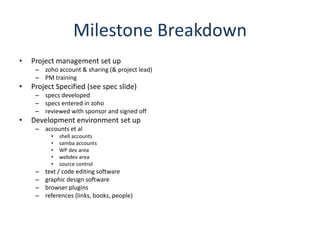
Milestone BreakdownProject management set upzoho account & sharing (& project lead)PM trainingProject Specified (see spec slide)specs developedspecs entered in zohoreviewed with sponsor and signed offDevelopment environment set upaccounts et alshell accountssamba accountsWP dev areawebdev areasource controltext / code editing softwaregraphic design softwarebrowser pluginsreferences (links, books, people)
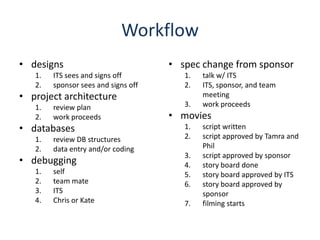
WorkflowdesignsITS sees and signs offsponsor sees and signs offproject architecturereview planwork proceedsdatabasesreview DB structuresdata entry and/or codingdebuggingselfteam mateITSChris or Katespec change from sponsortalk w/ ITSITS, sponsor, and team meetingwork proceedsmoviesscript writtenscript approved by Tamra and Philscript approved by sponsorstory board donestory board approved by ITSstory board approved by sponsorfilming starts

Web Project Management for Small Projects

  • 1.
    WIT Project Managementaquick and dirty introduction to project management for small web development projects with new and junior developers
  • 2.
    Why Formal ProjectManagementunderstand the projectincrease likelihood of successknow what success isreduce stressmake effective use of resourcesfit the project into a larger contextother projectsexternal eventsreduce uncertainty
  • 3.
    Traditional PM4-5 mainphasesinitiation/visionplanning/designexecution/developmentevaluation/monitoring & controlclosing/deployment/releaselots of planningclean hand off between phases
  • 4.
    Waterfall PM –Software DevelopmentInitiationSpecificationPlanning & DesignImplementationTesting and DebuggingRelease & Hand-offMaintenance
  • 5.
    Limitations of TraditionalPMinflexiblenew infoproject changesknown-result orientedoverwhelmingboth takes over and intimidatingbenefits drop for smaller projectshigh overheadmisses some key web/software aspects
  • 6.
    Software/Web PMoften exploratory/ inventivehigh uncertaintyparticular focus on testing / debuggingadditional post-release maintenance phaserequirements are often fluidstakeholders often don’t understand the capabilities of the technologydirect stakeholder interaction (WIT)
  • 7.
    Iterfall (Iterative Waterfall)InitiationSpecificationPlanningDesignImplementationTesting and DebuggingRelease & Hand-offMaintenance
  • 8.
    Agile PM /XP / etccreated explicitly for quick software developmentfunctionality focusedvery flexiblevery human-interactiveworks well for small, tight teamsmost appropriate for non-critical projects
  • 9.
    Agile Detailsbreak tasksinto small incrementsproject is a series of iterative cyclesvery short, 1-4 weeksspec, plan, dev, testing process for that short spanresults in a working productteam (5-9 people) is cross functional and self organizingplan is more general further off in time
  • 10.
    Agile PM soundsgood, BUT...Agile PM / XP / etc. requires senior developers to be effective!requires very frequent sponsor feedbackrelies on people being able to self-organizeleverages expertise – low/no expertise greatly reduces benefitsecho chamber can enhance mistakes
  • 11.
    A Middle Groundtraditional(planning oriented)clear project understandingguidance for junior developerseasier top-down involvementagile (implementation & feedback oriented)well suited to web / software developmentself-directed and -organized where possibleteam orientedflexibleworking product oriented
  • 12.
    Existing Solutionsthere area number of processes out there that attempt to balance TPM and APM. Generally theyare for larger projectsare for longer time framestrade on the certainty–flexibility axisrely on (at least some) experienced developers
  • 13.
    Main Goals forWIT PMfit the project into the fixed time frame (7-8 weeks)make sure it’s feasiblemake sure work is being doneflexibilitysemi-fluid requirements / goals (BUT, minimal scope creep)self-organizing where possibleguide junior developersclearly defined responsibilitiestasks that need doinglimits of scopeintern responsibilitiessponsor responsbilitiessponsors...work directly with interns (faculty-student interaction is a key part of WIT)are happy with the resultsstudents...work directly with faculty (see above)get training, up front and ongoingself-evaluate, both process and product
  • 14.
    Combining Traditional andAgiletraditional provides larger structureover all time frameabstract milestoneseasily teachable approachclear goalsagile provides per-task implementation modelteam orientedexploratoryflexibility
  • 15.
    WITerfallPhases for WITInitiation– donea clear vision is last step of 1 or the first step of 2Specification (trad) – lots of helpPlanning (hybrid) – moderate helpDesign (agile) – minimal helpImplementation (agile) – minimal helpTesting and Debugging (agile) – minimal helpRelease & Hand-off (hybrid) – moderate helpMaintenance – outside WIT
  • 16.
    SpecificationWork with sponsors,or at least provide educated guessesProject Overviewhigh-level why’shigh-level what’smajor, key pointsspecific what’sspecific technologies involvedContent DescriptionMaintainerswho (individual or ex officio)what partswhen and howRequirementssubjective goals / guidesobjective, measurable goals / deliverablesScope Limitsdegree of uncertaintylikelihood of changeouter boundsStakeholdersAudienceor ordered list of audiences
  • 17.
    Planning the WorkMilestoneswhat& when : an ordered list of stagesTasks (/Tickets/Items/Steps/ToDo’s/etc.)associated with a milestonenote specialized skill requirementslikely problem areasnote dependenciesand opportunities for parallel work
  • 18.
    Milestone and Task(and Dependency Problem) ExampleLawn is mowedget lawn mower back from neighborreturn special Tibetan pillow to neighborfix pillowget stuffingshave yakbreak in to zooexplain to the nice officer why you’re climbing the fence to the yak exhibit with a razor and a can of Barbisol
  • 19.
    Project Milestones (Web)Projectmanagement set upProject SpecifiedDocumentation framework set upDevelopment environment set upContent organizedBase theme chosen (WP)Functioning web sitePlaceholder content enteredVisual mockups approvedMedia preparedCustom functionality implementedTheme finishedMedia deployedFinal content in placeHelp docs completeSponsor approvalReleasedHanded off to sponsorPresentation Done
  • 20.
    Milestone BreakdownProject managementset upzoho account & sharing (& project lead)PM trainingProject Specified (see spec slide)specs developedspecs entered in zohoreviewed with sponsor and signed offDevelopment environment set upaccounts et alshell accountssamba accountsWP dev areawebdev areasource controltext / code editing softwaregraphic design softwarebrowser pluginsreferences (links, books, people)
  • 21.
    WorkflowdesignsITS sees andsigns offsponsor sees and signs offproject architecturereview planwork proceedsdatabasesreview DB structuresdata entry and/or codingdebuggingselfteam mateITSChris or Katespec change from sponsortalk w/ ITSITS, sponsor, and team meetingwork proceedsmoviesscript writtenscript approved by Tamra and Philscript approved by sponsorstory board donestory board approved by ITSstory board approved by sponsorfilming starts