


Using programme management to deliver 
strategic objectives  
 
Author 
Melanie Franklin, Chief Executive, 
Maven Training Limited 
Contents                                                                                                                                            
                                                                                                                                                    
 
    Overview ................................................................................................................................ 3 
    Vision and Blueprint ............................................................................................................... 5 
    The importance of benefits ................................................................................................... 6 
                                         .
    Programmes and projects ...................................................................................................... 7 
    Change management framework .......................................................................................... 8 
    Challenges .............................................................................................................................. 9 
    Conclusion ............................................................................................................................ 10 
    Company Overview .............................................................................................................. 11 


PRINCE2® is a Registered Trade Mark of the Office of Government Commerce in the United Kingdom and other countries 
MSP® is a Registered Trade Mark of the Office of Government Commerce in the United Kingdom and other countries 
M_o_R® is a Registered Trade Mark of the Office of Government Commerce in the United Kingdom and other countries 
 
Overview                                                                                    
                                                                                            
This paper sets out to explain programme management from a senior management perspective 
demonstrating how programme management is an effective mechanism for translating strategic 
plans and goals into definitive actions and clearly understood responsibilities. 
 
I have not assumed that those reading this paper have any prior knowledge of programme or 
project management and have sought to explain definitions and terminology in straightforward 
language in the hope of avoiding the jargon that is often employed in these contexts. 
 

         A programme is a temporary, flexible organisation created to co‐ordinate, direct 
         and oversee the implementation of a set of related projects and activities in order 
         to deliver outcomes and benefits related to the organisation’s strategic objectives.  
          
         Programme management is the co‐ordinated organisation, direction and 
         implementation of a dossier of projects and transformation activities to achieve 
         outcomes and realise benefits of strategic important to the business. 
          
                                                     Managing Successful Programmes 2011 

 
In the project management community programme management appears as a logical progression 
bringing multiple projects together so that their related deliverables, resources, risks and issues 
can be addressed as a whole whilst their day‐to‐day management can be treated independently. 
 
For senior managers programme management offers a structure for defining, managing and 
implementing the transformational changes associated with achieving strategic objectives. 
 
Using this structure removes some of the uncertainty and chaos that is often associated with 
transformational change: 
     It breaks down the many moving parts of the change into clearly defined pieces of work, 
        reducing the paralysis that arises when staff and managers feel the work is so complex that 
        they don’t know where to start 
     It produces a roadmap of changes and new capabilities that are expected as a result of all 
        the different projects which enables people to identify how they will be affected and how 
        they can become involved 
     It creates a single version of the truth, a unified vision of what is to be delivered that can be 
        clearly communicated  
     By grouping the projects and change activities together the total amount of resource 
        required can be clearly seen and decisions can be taken to balance the work against the 
        available resources 
 
Programmes have two elements that come together to make the strategy a reality: 
     A clear description of the future of the organisation that will be created as a result of the 
        programme 
     An explanation of why this future is necessary and beneficial 
 
Copyright © Maven Training Ltd 2011                                                           Page 3 of 12  
www.maventraining.co.uk  І  020 7089 6161 


Copyright © Maven Training Ltd 2011              Page 4 of 12  
www.maventraining.co.uk  І  020 7089 6161 
Vision and Blueprint                                                                               
                                                                                                   
 
The clear description of the future is provided by creating a vision and a blueprint. 
 
The vision is the description of what the programme will achieve. Essentially it describes the future 
of the organisation assuming that the strategy has become a reality. It might describe the size of 
the organisation, where it operates, its sources of revenue, its customer base, the products and 
services that it now offers or its reputation in the market place. 
 
The vision provides the initial guide to what work must be included in the programme i.e. growth, 
an efficient working environment, the results of a restructuring or the impact of a change in values 
and culture. 
 
It is very high level and does not provide enough detail to identify every project that is to be 
undertaken. Often it is a short paragraph that hopefully everyone involved in the programme can 
remember. The secret to writing an effective vision is to use words that excite and inspire people 
to create what is being described. Essentially it is the ‘marketing blurb’ for the programme, 
advertising the delight of a new working environment. It needs to describe a future that people 
intuitively want to be a part of, an organisation that they feel proud to work for. It needs to avoid 
management jargon and instead use simple language that everyone can understand. 
 
The blueprint provides an index of all the aspects of the organisation that will need to change to 
achieve the vision of the programme.  
 
For every new process or system that the programme creates the blueprint defines the resources 
and skills needed to operate them, the inputs required to undertake them and the data generated 
by them. The blueprint defines what measures the organisation will use to assess its performance 
and identifies which processes and systems are used to generate this data. 
 
Creating the blueprint produces a definitive picture of all the changes that the organisation will be 
undertaking as a result of the programme and helps to ensure changes are only included if they 
make a genuine contribution to the achievement of the strategy, removing ideas which have 
support but are not essential. 
 
The blueprint demonstrates the complexity of the programme and gives a valuable overview of its 
impact. The scale of the changes defined in the blueprint can be considerable, and will need to be 
balanced against their contribution to the achievement of the strategic objectives and the value of 
delivering the new strategy. The benefits and costs of each change must be identified in the 
business case and the blueprint balanced to ensure that the changes deliver the greatest possible 
value for the organisation for the spend involved. 


Copyright © Maven Training Ltd 2011                                                          Page 5 of 12  
www.maventraining.co.uk  І  020 7089 6161 
The importance of benefits                                                                         
                                                                                                   
 
Programmes must be benefits led – such a significant use of resources cannot be assigned to an 
idea that ‘feels right’ – there must be a very clear idea of what benefits will be realized, when and 
in what areas of the organization. 
 
The programme is the mechanism for delivering these benefits but the benefits themselves come 
from the research and analysis used to identify the strategy for the organization. A benefit is the 
measurable advantage that comes from the new operating model. Decisions have been taken on 
whether the organization is growing: pursuing new markets, developing new products and 
services or retrenching, streamlining processes, reducing staff.  
 
By planning the programme the activities needed to achieve these benefits are defined and these 
activities are shaped by the type and scale of benefits and the timeframe within which they are to 
be achieved. 
 
This timescale is reflected in the business case which summarises all of the benefits set against the 
cost of achieving them and defining when they will be realized, with the objective of ensuring that 
as many benefits as possible are achieved as early as possible during the programme. This ensures 
that we are not committing to a piece of work that offers only costs in its early years, and where 
the organization has to wait several years before the benefits come on stream. 
 
A benefit profile provides a detailed description of the benefits explaining the measures that need 
to be taken to prove that it is being achieved. 
 
The decision on what data is to be measured is important because the areas that are measured 
will inevitably be prioritized. Selecting the wrong measures can also lead to the law of unintended 
consequences – by improving something over here we have a negative impact over there. There 
are many examples of this in cost cutting programmes where on the surface costs have been cut 
through the reduction of staff and a streamlining of processes without realizing that the behind 
the scenes the cost per transaction is rising due to the cost of handling customer complaints and 
the cost of rework to fix mistakes 
 
Whatever measures we choose for our business will be what our staff strive to achieve, so we 
must select them carefully and achieve a balance that emphasizes the need to be more efficient 
without losing elements of customer satisfaction, staff satisfaction and a quality reputation. 


Copyright © Maven Training Ltd 2011                                                          Page 6 of 12  
www.maventraining.co.uk  І  020 7089 6161 
Programmes and projects                                                                          
                                                                                                 
 
Programme management must be underpinned by effective project management. A programme 
can only be successful if each of its component parts is delivered on time and on budget and 
meets the needs of the users. Programme management co‐ordinates all of the project activity and 
without a project management framework there will be different approaches to managing each 
piece of work which makes this co‐ordination extremely difficult.  
 
Each project needs to have a common approach to planning, reporting and managing risks and 
changes. The programme manager needs to be fed important information that is in the same 
format and is provided at the same level of detail so that it can be assimilated into a 
comprehensive view of programme progress (for reporting to stakeholders) and overlaps and 
inter‐dependencies can be more easily spotted (for reporting to all project managers). 
 
Projects are clearly defined units of work that result in the creation of something new. This new 
thing can be an amended / changed version of something that already exists or it can be the 
creation of something totally different that did not exist before. 
 
The benefits of dividing work into projects is that it gives the creation a focus. The work is not 
absorbed into business as usual where there is the risk that day‐to‐day demands of generating 
revenue, servicing customers and meeting targets will push it to the bottom of the priority list. 
 
The project structure ensures that definite decisions are taken about who is going to do the work, 
when it will be done and emphasises the need to research and specify exactly what is to be 
created. 
 
Projects sometimes get a bad press because they fail to deliver what was expected, exceed the 
agreed timescales and budgets or deliver something that is never fully adopted by users who see 
the deliverables as an additional problem and not the solution they were hoping for. All of these 
issues tend to have a common cause which is the failure to define the exact requirements at the 
beginning of the project and a failure to control any changes during the project. 
 
Senior managers can improve the success of projects by ensuring that all requests to change the 
scope and deliverables of the project are carefully evaluated.   All those expected to use what the 
project delivers must be consulted and their requirements evaluated and prioritised. 


Copyright © Maven Training Ltd 2011                                                        Page 7 of 12  
www.maventraining.co.uk  І  020 7089 6161 
Change management framework                                                                         
                                                                                                     
 
Benefits are only realized once the new processes, systems and capabilities created by the 
programme have been successfully implemented and the new ways of working have been 
adopted to become ‘business as usual’. Individual project managers have a responsibility for 
ensuring that their project deliverables are handed over to users effectively i.e. training has taken 
place and user guides have been created. However changing how people work requires support 
that can only be provided by the managers within the organization. Time must be made available 
for training, staff must feel able to ask questions and practise new skills without fear that their 
performance will be criticized. Managers must temporarily amend targets and offer 
encouragement and praise as their staff adopt new approaches and learn new systems. 
 
A change management framework is beneficial because it provides a clear set of activities that 
managers and staff can work through to evolve their working practices until the vision of the 
programme, that is the new business environment, has been achieved.  
 
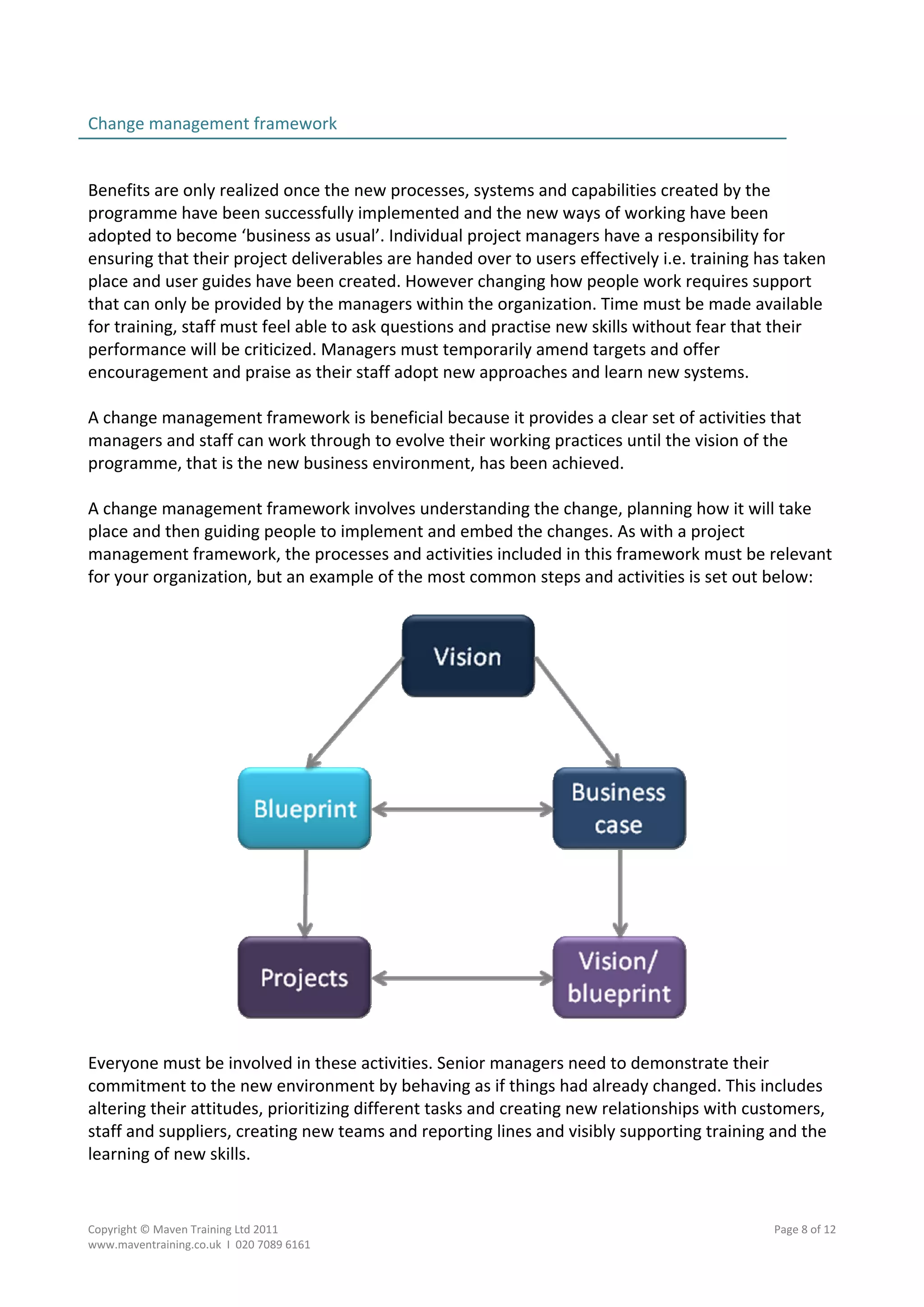
A change management framework involves understanding the change, planning how it will take 
place and then guiding people to implement and embed the changes. As with a project 
management framework, the processes and activities included in this framework must be relevant 
for your organization, but an example of the most common steps and activities is set out below: 


Everyone must be involved in these activities. Senior managers need to demonstrate their 
commitment to the new environment by behaving as if things had already changed. This includes 
altering their attitudes, prioritizing different tasks and creating new relationships with customers, 
staff and suppliers, creating new teams and reporting lines and visibly supporting training and the 
learning of new skills. 


Copyright © Maven Training Ltd 2011                                                           Page 8 of 12  
www.maventraining.co.uk  І  020 7089 6161 
Challenges                                                                                          
                                                                                                    
 
Defining the scope of the Programme is critical to ensuring that it is a viable, realistic and 
achievable piece of work. Turning strategy into concrete specific actions can be hard as there are 
so many unknowns and it is tempting to wait until there are more definite requirements for what 
is needed before starting a programme. Programme management encourages an iterative 
approach that enables large‐scale transformational change to begin by making decisions about the 
initial steps, with planning for later activities taking place once more information becomes 
available. 
 
As a programme is a significant piece of work, budget and resources will be assigned to it. This can 
lead to pressure from managers to include in the programme projects that offer solutions to 
existing business problems as well as those projects that create the new business environment. 
Those managing and sponsoring programmes must be alert to this risk and, as much as possible, 
must keep the activity concentrated on delivering the strategy and not short term tactical 
solutions. 
 
To define the programme correctly requires a significant amount of time and resources because 
every action needs to be assessed for its knock on effect to everything else. This period of research 
and design can feel frustrating because it absorbs resources but produces nothing concrete and 
the temptation can be to get started before sufficient thinking has taken place. This achieves the 
common 'busy fools' scenario where there is a lot of activity producing lots of new processes, 
systems and data not all necessarily contributing to the strategy which those working in the 
business as usual environment struggle to assimilate. 
 
As programmes are a collection of projects and changes, some organisations fall into the trap of 
believing that the programme can be run alongside business as usual responsibilities so they fail to 
appoint full time dedicated resources to it. Whilst it is certainly possible for managers to take 
responsibility for projects alongside their ‘day job’ there does need to be full time co‐ordination of 
a programme where the programme manager is responsible for active pursuit of progress, 
constantly assessing the environment for risks and issues that could prevent successful 
achievement of the objectives. 
 
Programme management offers an effective structure for managing transformational change, with 
clearly defined processes, documentation, decision points, techniques and individual 
responsibilities. It is important to ensure that those working in the programme have been given 
some training in programme management otherwise their progress will be hampered by ‘feeling 
their way’, often failing to carry out essential tasks simply because they did not know that these 
tasks were required. 


Copyright © Maven Training Ltd 2011                                                           Page 9 of 12  
www.maventraining.co.uk  І  020 7089 6161 
Conclusion                                                                                        
                                                                                                  
 
Programme management is an essential skill set for senior managers who are increasingly 
responsible for the definition and implementation of initiatives to restructure, re‐organise and 
grow their organisations. 
 
Knowledge of programme management is part of the strategic toolkit, and is the next logical step 
after strategy definition. It is this link to strategy which has led to its inclusion in so many MBA 
courses and executive development programmes. 
 
Programme management provides a structure through which you can set the direction that needs 
to be taken and your managers and staff can use to deliver the components that lead to successful 
achievement of the strategic objectives. 


Copyright © Maven Training Ltd 2011                                                        Page 10 of 12  
www.maventraining.co.uk  І  020 7089 6161 
Company Overview                                                                                  


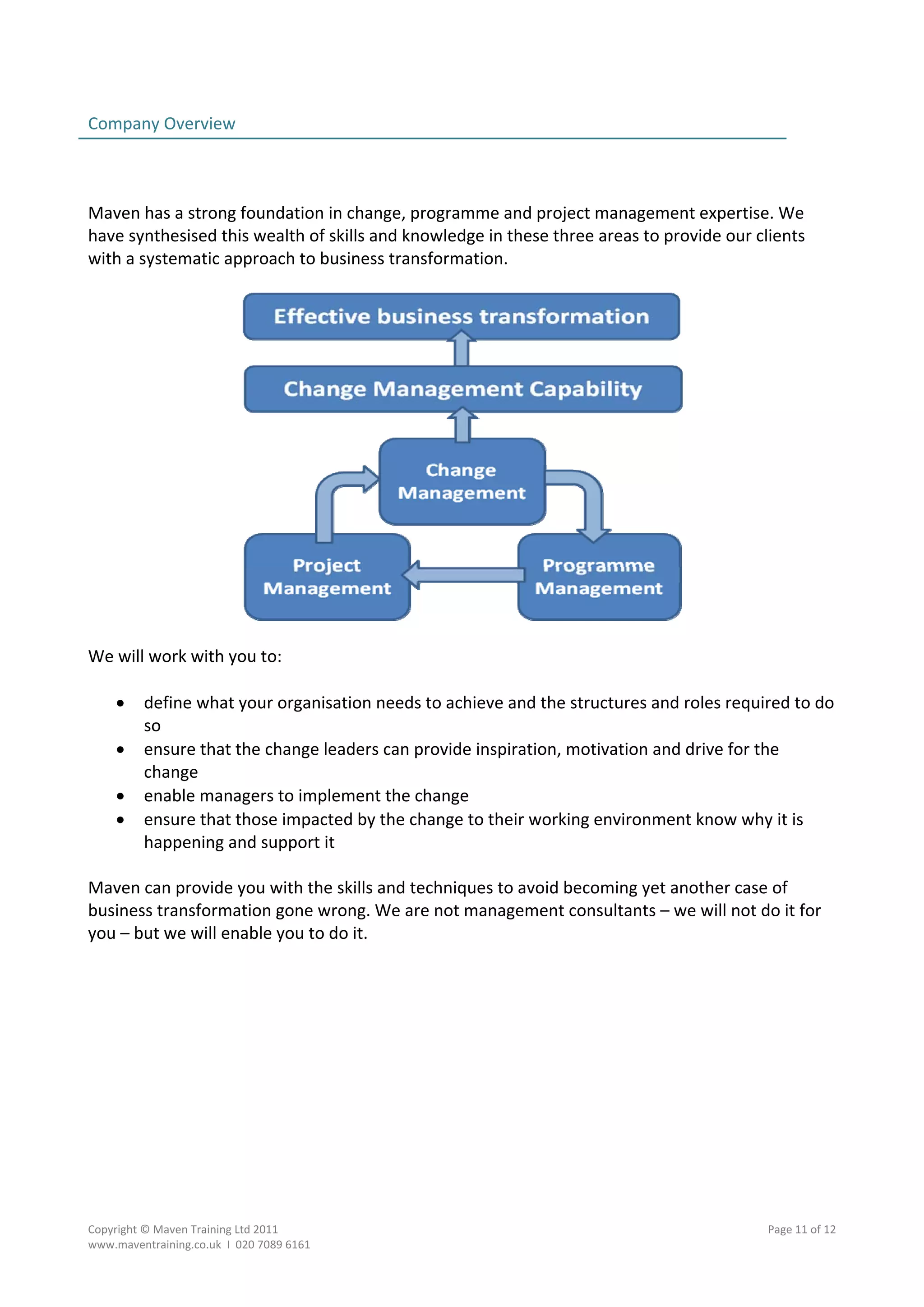
Maven has a strong foundation in change, programme and project management expertise. We 
have synthesised this wealth of skills and knowledge in these three areas to provide our clients 
with a systematic approach to business transformation.  


We will work with you to: 
 
    define what your organisation needs to achieve and the structures and roles required to do 
       so 
    ensure that the change leaders can provide inspiration, motivation and drive for the 
       change 
    enable managers to implement the change 
    ensure that those impacted by the change to their working environment know why it is 
       happening and support it 
        
Maven can provide you with the skills and techniques to avoid becoming yet another case of 
business transformation gone wrong. We are not management consultants – we will not do it for 
you – but we will enable you to do it.   


Copyright © Maven Training Ltd 2011                                                        Page 11 of 12  
www.maventraining.co.uk  І  020 7089 6161 


For further information about Maven Training and its capability building services 
please contact: 
 
Melanie Franklin 
Telephone: 020 7403 7100 
e‐mail: melanie.franklin@maventraining.co.uk or e‐mail: info@maventraining.co.uk 
website: www.maventraining.co.uk 

Using programme management to deliver strategic objectives 1.0

  • 1.
  • 2.
    Contents        Overview ................................................................................................................................ 3  Vision and Blueprint ............................................................................................................... 5  The importance of benefits ................................................................................................... 6  . Programmes and projects ...................................................................................................... 7  Change management framework .......................................................................................... 8  Challenges .............................................................................................................................. 9  Conclusion ............................................................................................................................ 10  Company Overview .............................................................................................................. 11      PRINCE2® is a Registered Trade Mark of the Office of Government Commerce in the United Kingdom and other countries  MSP® is a Registered Trade Mark of the Office of Government Commerce in the United Kingdom and other countries  M_o_R® is a Registered Trade Mark of the Office of Government Commerce in the United Kingdom and other countries   
  • 3.
    Overview      This paper sets out to explain programme management from a senior management perspective  demonstrating how programme management is an effective mechanism for translating strategic  plans and goals into definitive actions and clearly understood responsibilities.    I have not assumed that those reading this paper have any prior knowledge of programme or  project management and have sought to explain definitions and terminology in straightforward  language in the hope of avoiding the jargon that is often employed in these contexts.    A programme is a temporary, flexible organisation created to co‐ordinate, direct  and oversee the implementation of a set of related projects and activities in order  to deliver outcomes and benefits related to the organisation’s strategic objectives.     Programme management is the co‐ordinated organisation, direction and  implementation of a dossier of projects and transformation activities to achieve  outcomes and realise benefits of strategic important to the business.    Managing Successful Programmes 2011    In the project management community programme management appears as a logical progression  bringing multiple projects together so that their related deliverables, resources, risks and issues  can be addressed as a whole whilst their day‐to‐day management can be treated independently.    For senior managers programme management offers a structure for defining, managing and  implementing the transformational changes associated with achieving strategic objectives.    Using this structure removes some of the uncertainty and chaos that is often associated with  transformational change:   It breaks down the many moving parts of the change into clearly defined pieces of work,  reducing the paralysis that arises when staff and managers feel the work is so complex that  they don’t know where to start   It produces a roadmap of changes and new capabilities that are expected as a result of all  the different projects which enables people to identify how they will be affected and how  they can become involved   It creates a single version of the truth, a unified vision of what is to be delivered that can be  clearly communicated    By grouping the projects and change activities together the total amount of resource  required can be clearly seen and decisions can be taken to balance the work against the  available resources    Programmes have two elements that come together to make the strategy a reality:   A clear description of the future of the organisation that will be created as a result of the  programme   An explanation of why this future is necessary and beneficial    Copyright © Maven Training Ltd 2011    Page 3 of 12   www.maventraining.co.uk  І  020 7089 6161 
  • 4.
      Copyright © Maven Training Ltd 2011    Page 4 of 12   www.maventraining.co.uk  І  020 7089 6161 
  • 5.
    Vision and Blueprint        The clear description of the future is provided by creating a vision and a blueprint.    The vision is the description of what the programme will achieve. Essentially it describes the future  of the organisation assuming that the strategy has become a reality. It might describe the size of  the organisation, where it operates, its sources of revenue, its customer base, the products and  services that it now offers or its reputation in the market place.    The vision provides the initial guide to what work must be included in the programme i.e. growth,  an efficient working environment, the results of a restructuring or the impact of a change in values  and culture.    It is very high level and does not provide enough detail to identify every project that is to be  undertaken. Often it is a short paragraph that hopefully everyone involved in the programme can  remember. The secret to writing an effective vision is to use words that excite and inspire people  to create what is being described. Essentially it is the ‘marketing blurb’ for the programme,  advertising the delight of a new working environment. It needs to describe a future that people  intuitively want to be a part of, an organisation that they feel proud to work for. It needs to avoid  management jargon and instead use simple language that everyone can understand.    The blueprint provides an index of all the aspects of the organisation that will need to change to  achieve the vision of the programme.     For every new process or system that the programme creates the blueprint defines the resources  and skills needed to operate them, the inputs required to undertake them and the data generated  by them. The blueprint defines what measures the organisation will use to assess its performance  and identifies which processes and systems are used to generate this data.    Creating the blueprint produces a definitive picture of all the changes that the organisation will be  undertaking as a result of the programme and helps to ensure changes are only included if they  make a genuine contribution to the achievement of the strategy, removing ideas which have  support but are not essential.    The blueprint demonstrates the complexity of the programme and gives a valuable overview of its  impact. The scale of the changes defined in the blueprint can be considerable, and will need to be  balanced against their contribution to the achievement of the strategic objectives and the value of  delivering the new strategy. The benefits and costs of each change must be identified in the  business case and the blueprint balanced to ensure that the changes deliver the greatest possible  value for the organisation for the spend involved.        Copyright © Maven Training Ltd 2011    Page 5 of 12   www.maventraining.co.uk  І  020 7089 6161 
  • 6.
    The importance of benefits        Programmes must be benefits led – such a significant use of resources cannot be assigned to an  idea that ‘feels right’ – there must be a very clear idea of what benefits will be realized, when and  in what areas of the organization.    The programme is the mechanism for delivering these benefits but the benefits themselves come  from the research and analysis used to identify the strategy for the organization. A benefit is the  measurable advantage that comes from the new operating model. Decisions have been taken on  whether the organization is growing: pursuing new markets, developing new products and  services or retrenching, streamlining processes, reducing staff.     By planning the programme the activities needed to achieve these benefits are defined and these  activities are shaped by the type and scale of benefits and the timeframe within which they are to  be achieved.    This timescale is reflected in the business case which summarises all of the benefits set against the  cost of achieving them and defining when they will be realized, with the objective of ensuring that  as many benefits as possible are achieved as early as possible during the programme. This ensures  that we are not committing to a piece of work that offers only costs in its early years, and where  the organization has to wait several years before the benefits come on stream.    A benefit profile provides a detailed description of the benefits explaining the measures that need  to be taken to prove that it is being achieved.    The decision on what data is to be measured is important because the areas that are measured  will inevitably be prioritized. Selecting the wrong measures can also lead to the law of unintended  consequences – by improving something over here we have a negative impact over there. There  are many examples of this in cost cutting programmes where on the surface costs have been cut  through the reduction of staff and a streamlining of processes without realizing that the behind  the scenes the cost per transaction is rising due to the cost of handling customer complaints and  the cost of rework to fix mistakes    Whatever measures we choose for our business will be what our staff strive to achieve, so we  must select them carefully and achieve a balance that emphasizes the need to be more efficient  without losing elements of customer satisfaction, staff satisfaction and a quality reputation.  Copyright © Maven Training Ltd 2011    Page 6 of 12   www.maventraining.co.uk  І  020 7089 6161 
  • 7.
    Programmes and projects        Programme management must be underpinned by effective project management. A programme  can only be successful if each of its component parts is delivered on time and on budget and  meets the needs of the users. Programme management co‐ordinates all of the project activity and  without a project management framework there will be different approaches to managing each  piece of work which makes this co‐ordination extremely difficult.     Each project needs to have a common approach to planning, reporting and managing risks and  changes. The programme manager needs to be fed important information that is in the same  format and is provided at the same level of detail so that it can be assimilated into a  comprehensive view of programme progress (for reporting to stakeholders) and overlaps and  inter‐dependencies can be more easily spotted (for reporting to all project managers).    Projects are clearly defined units of work that result in the creation of something new. This new  thing can be an amended / changed version of something that already exists or it can be the  creation of something totally different that did not exist before.    The benefits of dividing work into projects is that it gives the creation a focus. The work is not  absorbed into business as usual where there is the risk that day‐to‐day demands of generating  revenue, servicing customers and meeting targets will push it to the bottom of the priority list.    The project structure ensures that definite decisions are taken about who is going to do the work,  when it will be done and emphasises the need to research and specify exactly what is to be  created.    Projects sometimes get a bad press because they fail to deliver what was expected, exceed the  agreed timescales and budgets or deliver something that is never fully adopted by users who see  the deliverables as an additional problem and not the solution they were hoping for. All of these  issues tend to have a common cause which is the failure to define the exact requirements at the  beginning of the project and a failure to control any changes during the project.    Senior managers can improve the success of projects by ensuring that all requests to change the  scope and deliverables of the project are carefully evaluated.   All those expected to use what the  project delivers must be consulted and their requirements evaluated and prioritised.  Copyright © Maven Training Ltd 2011    Page 7 of 12   www.maventraining.co.uk  І  020 7089 6161 
  • 8.
    Change management framework         Benefits are only realized once the new processes, systems and capabilities created by the  programme have been successfully implemented and the new ways of working have been  adopted to become ‘business as usual’. Individual project managers have a responsibility for  ensuring that their project deliverables are handed over to users effectively i.e. training has taken  place and user guides have been created. However changing how people work requires support  that can only be provided by the managers within the organization. Time must be made available  for training, staff must feel able to ask questions and practise new skills without fear that their  performance will be criticized. Managers must temporarily amend targets and offer  encouragement and praise as their staff adopt new approaches and learn new systems.    A change management framework is beneficial because it provides a clear set of activities that  managers and staff can work through to evolve their working practices until the vision of the  programme, that is the new business environment, has been achieved.     A change management framework involves understanding the change, planning how it will take  place and then guiding people to implement and embed the changes. As with a project  management framework, the processes and activities included in this framework must be relevant  for your organization, but an example of the most common steps and activities is set out below:        Everyone must be involved in these activities. Senior managers need to demonstrate their  commitment to the new environment by behaving as if things had already changed. This includes  altering their attitudes, prioritizing different tasks and creating new relationships with customers,  staff and suppliers, creating new teams and reporting lines and visibly supporting training and the  learning of new skills.  Copyright © Maven Training Ltd 2011    Page 8 of 12   www.maventraining.co.uk  І  020 7089 6161 
  • 9.
    Challenges        Defining the scope of the Programme is critical to ensuring that it is a viable, realistic and  achievable piece of work. Turning strategy into concrete specific actions can be hard as there are  so many unknowns and it is tempting to wait until there are more definite requirements for what  is needed before starting a programme. Programme management encourages an iterative  approach that enables large‐scale transformational change to begin by making decisions about the  initial steps, with planning for later activities taking place once more information becomes  available.    As a programme is a significant piece of work, budget and resources will be assigned to it. This can  lead to pressure from managers to include in the programme projects that offer solutions to  existing business problems as well as those projects that create the new business environment.  Those managing and sponsoring programmes must be alert to this risk and, as much as possible,  must keep the activity concentrated on delivering the strategy and not short term tactical  solutions.    To define the programme correctly requires a significant amount of time and resources because  every action needs to be assessed for its knock on effect to everything else. This period of research  and design can feel frustrating because it absorbs resources but produces nothing concrete and  the temptation can be to get started before sufficient thinking has taken place. This achieves the  common 'busy fools' scenario where there is a lot of activity producing lots of new processes,  systems and data not all necessarily contributing to the strategy which those working in the  business as usual environment struggle to assimilate.    As programmes are a collection of projects and changes, some organisations fall into the trap of  believing that the programme can be run alongside business as usual responsibilities so they fail to  appoint full time dedicated resources to it. Whilst it is certainly possible for managers to take  responsibility for projects alongside their ‘day job’ there does need to be full time co‐ordination of  a programme where the programme manager is responsible for active pursuit of progress,  constantly assessing the environment for risks and issues that could prevent successful  achievement of the objectives.    Programme management offers an effective structure for managing transformational change, with  clearly defined processes, documentation, decision points, techniques and individual  responsibilities. It is important to ensure that those working in the programme have been given  some training in programme management otherwise their progress will be hampered by ‘feeling  their way’, often failing to carry out essential tasks simply because they did not know that these  tasks were required.  Copyright © Maven Training Ltd 2011    Page 9 of 12   www.maventraining.co.uk  І  020 7089 6161 
  • 10.
    Conclusion        Programme management is an essential skill set for senior managers who are increasingly  responsible for the definition and implementation of initiatives to restructure, re‐organise and  grow their organisations.    Knowledge of programme management is part of the strategic toolkit, and is the next logical step  after strategy definition. It is this link to strategy which has led to its inclusion in so many MBA  courses and executive development programmes.    Programme management provides a structure through which you can set the direction that needs  to be taken and your managers and staff can use to deliver the components that lead to successful  achievement of the strategic objectives.  Copyright © Maven Training Ltd 2011    Page 10 of 12   www.maventraining.co.uk  І  020 7089 6161 
  • 11.
    Company Overview          Maven has a strong foundation in change, programme and project management expertise. We  have synthesised this wealth of skills and knowledge in these three areas to provide our clients  with a systematic approach to business transformation.         We will work with you to:     define what your organisation needs to achieve and the structures and roles required to do  so   ensure that the change leaders can provide inspiration, motivation and drive for the  change   enable managers to implement the change   ensure that those impacted by the change to their working environment know why it is  happening and support it    Maven can provide you with the skills and techniques to avoid becoming yet another case of  business transformation gone wrong. We are not management consultants – we will not do it for  you – but we will enable you to do it.    Copyright © Maven Training Ltd 2011    Page 11 of 12   www.maventraining.co.uk  І  020 7089 6161 
  • 12.