Service Review
Younger audiences:
BBC Three, Radio 1
and 1Xtra
June 2009
Getting the best out of the BBC for licence fee payers
Service Review: Younger Audiences
Contents
Contents 2
Executive Summary 3
Introduction 12
Background to this review 12
The scope and aims of our review 12
Methodology 13
Report structure 15
Section 1: How the BBC serves younger audiences 16
1.1 REACH 17
1.2 DELIVERY OF THE BBC’S PUBLIC PURPOSES 20
1.3 CONCLUSIONS 25
Section 2: BBC Three 27
2.1 REACH 27
2.2 QUALITY 34
2.3 IMPACT – DELIVERY OF THE BBC’S PUBLIC PURPOSES 36
2.4 VALUE FOR MONEY 46
Section 3: BBC Radio 1 49
3.1 REACH 49
3.2 QUALITY 55
3.3 IMPACT – DELIVERY OF THE BBC’S PUBLIC PURPOSES 55
3.4 VALUE FOR MONEY 66
Section 4: BBC Radio 1Xtra 68
4.1 REACH 68
4.2 QUALITY 69
4.3 IMPACT – DELIVERY OF THE BBC’S PUBLIC PURPOSES 69
4.4 VALUE FOR MONEY 78
June 2009 2
Service Review: Younger Audiences
June 2009 3
Executive Summary
This report focuses on the BBC’s services for younger audiences and follows our review of
services and content for children aged under 13, published in February 2009. The report
includes:
Service licence reviews of three services the BBC targets at younger audiences:
BBC Three, BBC Radio 1 and BBC Radio 1Xtra.1
These reviews examine how well
these services are performing against the terms of their service licences, and
whether the licences need to change.
Consideration of how well the BBC serves younger audiences as whole across all
of its television, radio and online services, to place the performance of the three
targeted services within a broader context. This includes an assessment of
output aimed at younger audiences which is hosted by other BBC services,
including BBC Switch, and formal learning provision targeted at younger
audiences.
Our conclusions
How well does the BBC serve younger audiences? We found that the
BBC serves young people well overall. Usage is high on television, radio and
online, and some of the public purposes are delivered very well. However, the
BBC faces growing challenges to deliver news to young people and to reach
teenagers on television. We also believe that the BBC could do more to gain
credit for its range of its provision for the young. We are very clear, too, that
where the BBC aims to serve young people on services specifically targeted at
them, while it may often be appropriate to tailor the presentation, tone and
subject nature to meet their specific tastes and expectations, all content must
conform to the BBC's editorial standards.
How well is BBC Three performing against the terms of its service
licence? BBC Three’s effectiveness in reaching young people makes it an
important part of the BBC television portfolio. The quality and range of its
output are seen by viewers as good overall, and we are very supportive of its
track record and willingness to take creative risks. We want BBC Three’s focus
to remain on UK originations, and we support BBC management’s aim to
develop its provision further in some certain genres. We will amend parts of
the channel’s service licence to set a clearer framework for how we expect it to
deliver public value to young people.
How well is Radio 1 performing against the terms of its service
licence? Radio 1’s high reach to young people makes it a very important
service for the BBC. It is highly effective at delivering some of the BBC’s public
purposes to young people. We believe it has potential to increase its public
value further, given the strength of its market position; in particular we have
1
BBC Asian Network has a primary target audience of British Asians age 35 and under, but we will be reviewing this station
at a later date.
Service Review: Younger Audiences
June 2009 4
asked the station to renew its focus on serving a young audience and to
deliver more public value via its speech output.
How well is 1Xtra performing against the terms of its service licence?
1Xtra is a growing service, although digital-only distribution has limited the size
of its audience. We are approving two changes to the service which we believe
will enable it to offer greater public value, by increasing its ability to deliver the
BBC’s public purposes to its listeners.
HOW THE BBC SERVES YOUNGER AUDIENCES
The BBC is a major media provider for younger audiences, with more than 9
out of 10 young people using BBC services each week. While young people
have a generally positive view of the BBC, we believe that the BBC could do
more to gain credit for its range of its provision for the young. The BBC
delivers some of its public purposes well to young people but faces challenges
to deliver news to them, and to serve teenagers on television.
Despite the huge growth in choice of media, the BBC remains a very important
part of young people’s media consumption. The BBC reaches around 92 per cent of
15-34 year olds each week and BBC television remains successful at reaching younger
audiences, although its usage has declined significantly in recent years. While other
media providers, particularly Channel 4, are more readily associated with provision for
young people than the BBC, we believe the BBC still has a unique role in bringing all
audiences together, particularly at key national moments, on its broad-appeal mainstream
services. In recognition of this, we will consider the interests of children and young
people in other service reviews, particularly our reviews of BBC One and BBC Two due to
commence later in 2009.
BBC radio’s reach to young people has held broadly steady since 2003, although it still
reaches fewer young people than commercial radio each week. Usage of BBC Online has
increased in recent years and it is now an important part of the BBC’s offering to young
people.
We have been unable to assess fully how young people use BBC services across TV, radio
and online due to difficulties of measuring consumption across platforms. The BBC is
developing a new audience measurement system to meet this challenge and BBC
management should consider young people, whose technology and media habits are
changing faster than other audience groups, a priority audience for this.
The BBC delivers some of its public purposes well among young people but
faces challenges in some important areas. Younger audiences think the BBC delivers
its education and learning purpose well. Usage levels of the BBC’s formal learning content
are high among teenagers and young adults and research shows that the services are
highly valued by users.
This shows
that the BBC is
successfully
appealing to
this
demographic
This means
that the BBC's
share of the
television
audience is
perhaps lower
and that there
are difficulties
in getting this
audience
engaged in
news
programmes.
Service Review: Younger Audiences
June 2009 5
Younger audiences also believe that the BBC delivers programming about the wider world
very well and appreciate the range of programmes and services available from the BBC,
although they want more programmes to show fresh and new ideas.
In terms of delivering the citizenship purpose, there is a growing challenge to engage
young people, especially those from lower income households, with the BBC’s news
output, particularly on television. The BBC will need to use the full range of its platforms –
TV, radio and online – to find a solution to falling consumption of television news and
consider the role of the broad-appeal linear TV and radio services alongside online. Given
the importance of news to the BBC’s public service remit, this is a major challenge for the
BBC.
Teenagers’ and very young adults’ media habits are changing fast and BBC Online is
becoming an important way for the BBC to deliver its public purposes to the young. There
has been a significant decline in the numbers of teenagers watching BBC television while
online consumption has grown in recent years. BBC Switch, launched in October 2007
with the aim of providing original content specifically aimed at 12 to 17 year olds. Switch
has performed fairly well on radio and online, but has not yet reached many teenagers on
television. We continue to think that it is important for the BBC to provide older children
and teenagers with some targeted output on television.
Action 1
The BBC needs to be able to track audience behaviour across TV, radio and
online and is in the process of developing a new audience measurement tool
which will allow detailed analysis of audience usage across platforms and
services. Once the BBC has put this new measurement system in place, we
recommend that younger audiences are treated as a priority audience group
for measurement.
Action 2
We regard BBC News’ reach to young people as a very important performance
indicator and are asking BBC management to focus on this in our regular
performance assessment activities. We will report publicly in future Annual
Reports on BBC News’ performance in reaching young people.
BBC THREE
BBC Three’s effectiveness in reaching young people makes it an important part
of the BBC television portfolio. The quality and range of its output is seen by
viewers as good overall, and we are very supportive of its track record and
willingness to take creative risks. We want BBC Three’s focus to remain on UK
originations, and we support BBC management’s aim to develop its provision
further in some genres.
Service Review: Younger Audiences
June 2009 6
BBC Three has become an important part of the BBC’s television portfolio, both
in terms of its reach to younger audiences and its willingness to innovate and
take creative risks. BBC Three has increased its reach significantly in recent years,
particularly among its target audience of 16 to 34 year olds.
Audience perceptions of the quality of BBC Three’s programmes are fairly strong, and BBC
Three has worked hard to deliver its remit to be innovative and take creative risks with
programmes that show fresh and new ideas. We have found that BBC Three is fulfilling its
remit to support new and emerging talent.
BBC Three’s lower reach to ethnic minority audiences reflects the pattern for
the BBC television portfolio as a whole. BBC Three’s reach to ethnic minorities is
significantly below its average reach to 16 to 34 year olds. This reflects a wider pattern
across all of the BBC’s television channels. We will aim to reach a deeper understanding
of how the BBC can serve ethnic minority viewers better in our review of the other BBC
television channels, due to start later in 2009.
BBC Three has developed a strong reputation in some genres, but opportunities still exist
to fulfil audience expectations in others. BBC Three’s remit is to provide a consistently
mixed-genre schedule. This presents a challenge for the channel because audiences
generally expect digital channels to focus on either entertainment or factual genres. In
this context, BBC Three has built a very strong reputation for its comedy output and has
had some successes in original drama, current affairs and factual programming. Its news
bulletins also appear to fulfil an audience need for ‘bitesize’ news.
Across the range of genres, however, BBC Three has had less success in developing
entertainment programming and audience perceptions of BBC Three’s serious factual
content do not match the level of provision. Finally, we believe that the channel’s stated
‘special commitment to the UK animation sector’ may be too challenging for a single
channel of this scale.
The majority of BBC Three’s airtime is committed to originated programming
and we want this to remain the focus of the channel. Originations (new
programmes commissioned by BBC Three) account for the majority of the channel’s
output, around 77 per cent of airtime. Acquisitions and programmes transferred from BBC
One and BBC Two provided around 32 per cent and 19 per cent of viewing respectively to
BBC Three from 22 per cent of its airtime in 2008-09. We recognise that audiences
appreciate the channel’s transfers and acquisitions and that acquisitions can expand the
range and quality of its schedule at relatively low cost and bring new talent and material
to the audience.
While the majority of BBC Three’s expenditure is on UK originations, we note that
acquisitions account for a growing proportion of the channel’s programme budget. We see
the primary goal of the channel as being to provide new UK originated programming for
younger audiences and we do not expect it to rely on acquisitions to support its
performance. Nor do we expect BBC Three to treat its statutory obligation for originated
programming – that at least 70 per cent of its output is originated, including in peak time
- as a ‘floor’ and we will monitor delivery against this annual quota to ensure this is not
the case. We will consider the role of acquisitions across all BBC channels in our review of
BBC One, BBC Two and BBC Four later this year.
BBC management has suggested that it could start transmitting BBC Three at 3pm
instead of 7pm in order to improve reach and value for money. While we understand the
logic and potential benefits of this in terms of meeting audience expectations, we will
need to consider any formal proposal for extension in the context of the BBC’s overall use
Service Review: Younger Audiences
June 2009 7
of digital terrestrial spectrum and its affordability, as well as the need to maintain the
quality of the whole BBC Three service.
Awareness and usage of BBC Three’s online activities is still low. BBC Three’s
remit encourages the channel to use digital and interactive platforms to build a
relationship with its audience and it has aimed to innovate by, for example, premiering
programmes online and developing entertainment programmes with integral online
elements. However, despite the fact that usage of online and other digital media is much
higher amongst younger people, usage of the BBC Three homepage and individual
programme sites is low compared with other BBC sites aimed at young people, and BBC
management’s qualitative and quantitative research has shown that there is low
awareness of BBC Three’s interactive and digital offerings.
We believe that online offers considerable potential for the BBC to maintain a connection
with young people and deliver its public purposes to them and would like to see a growth
in usage of BBC Three online in the future.
BBC Three’s value for money appears to be improving, although we are unable
to make a definitive assessment. BBC Three’s cost per viewer hour has improved
significantly, from 15.6 pence per hour in 2006-07 to 10.6 pence per hour in 2008-09.
Although this remains more expensive than BBC One and BBC Two, it is lower than BBC
Four. However, as currently calculated, this measure does not include either non-linear
viewing of BBC Three programmes (for example through the iPlayer) or the costs of
programmes which have been transferred from other BBC channels. These factors limit
our ability to draw value for money conclusions based on cost per user hour and we
would like to address this analytical gap.
Action 3
There are a number of areas where we will amend BBC Three’s service licence
to set a clearer framework for how we expect it to deliver public value to
young people. These are:
a) Specifying its target audience as 16 to 34 year olds;
b) reflecting the channel’s role in broadcasting sporting events of
particular relevance to younger audiences;
c) including a wider range of genres than news and current affairs in its
broadcasting of programmes about the wider world.
Action 4
Three issues arising from this review will be included in our service reviews of
BBC One, BBC Two and BBC Four, which will start later in 2009:
a) the issue of BBC television’s lower reach to ethnic minority audiences
across all television channels;
b) the role of acquisitions alongside UK originated output;
c) an improved approach to defining value for money, taking into
account the increasing volume of non-linear viewing of TV output and
Service Review: Younger Audiences
June 2009 8
how this may affect cost allocation.
Action 5
BBC Three’s digital and interactive activities are a core part of the channel’s
remit and have been identified by BBC management as an important part of its
future strategy. We will monitor usage of BBC Three’s offerings on BBC Online
as part of our regular performance assessment activities.
We expect redesigns of the website to ensure that links to BBC news remain
both permanent (not as rolling alternatives to other content) and prominent on
the homepage, in line with BBC Three’s service licence commitment.
RADIO 1
Radio 1’s high reach to young people makes it a very important service for the
BBC. It is highly effective at delivering some of the BBC’s public purposes to
young people. We believe it has potential to increase its public value further,
given the strength of its market position.
Radio 1 reaches a large number of young people which enables it to make a strong
contribution to delivering some of the BBC’s public purposes. Radio 1’s listeners include
many who do not listen to any other BBC radio station. This makes the station an
important part of the BBC’s overall offering to young people.
Radio 1 is fulfilling its remit to support new music and plays a very important
role in promoting new artists in the UK. We have found that Radio 1 is distinctive in
terms of the amount of new music it plays. This is supported by audience perceptions,
while the music industry recognises the important role played by Radio 1 in supporting
emerging musical artists, through both its specialist and daytime output. Radio 1’s live
music programmes and events are very highly valued by listeners.
Radio 1 also makes a strong contribution to delivering the citizenship purpose through its
news output, which reaches a very large number of young people.
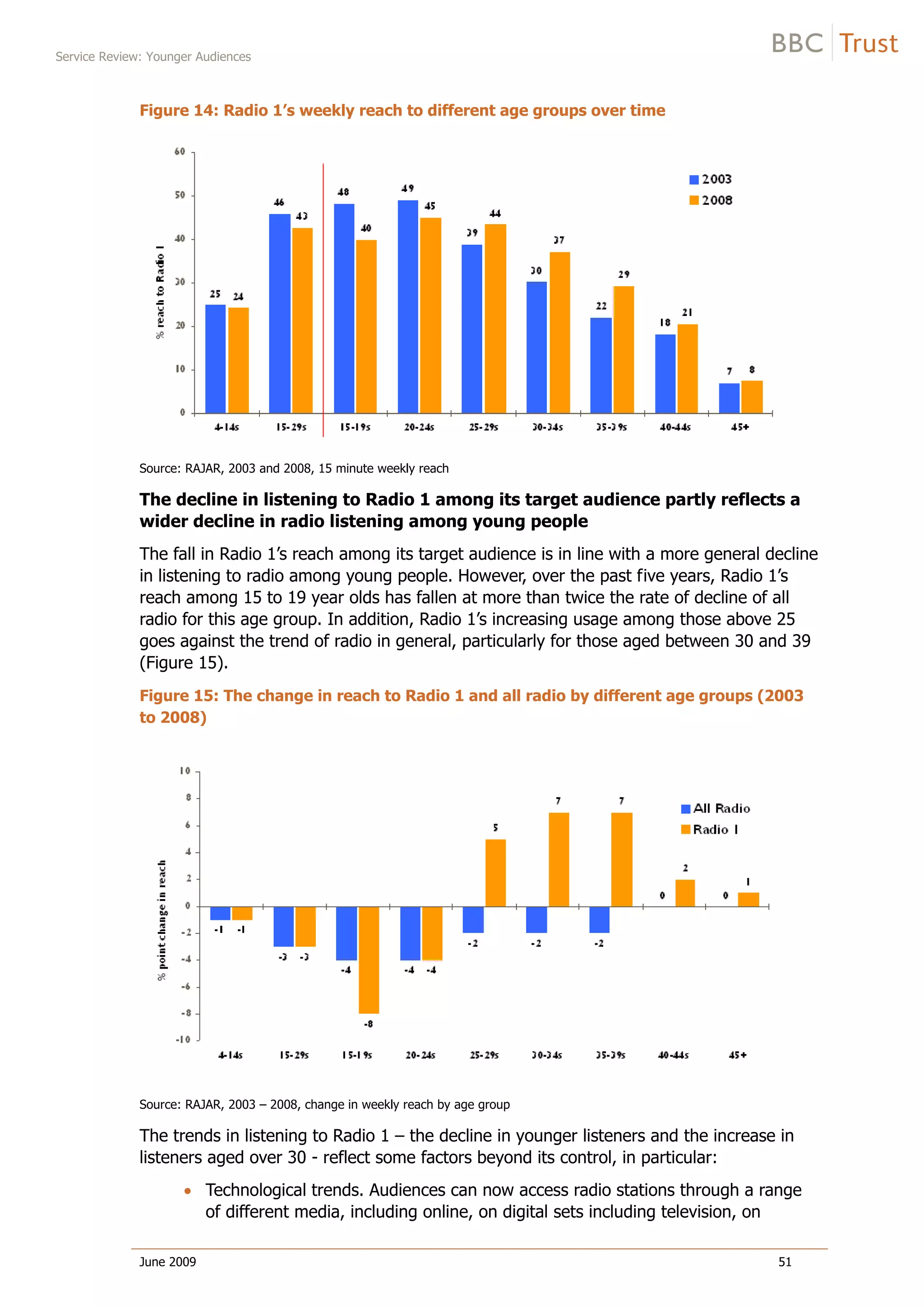
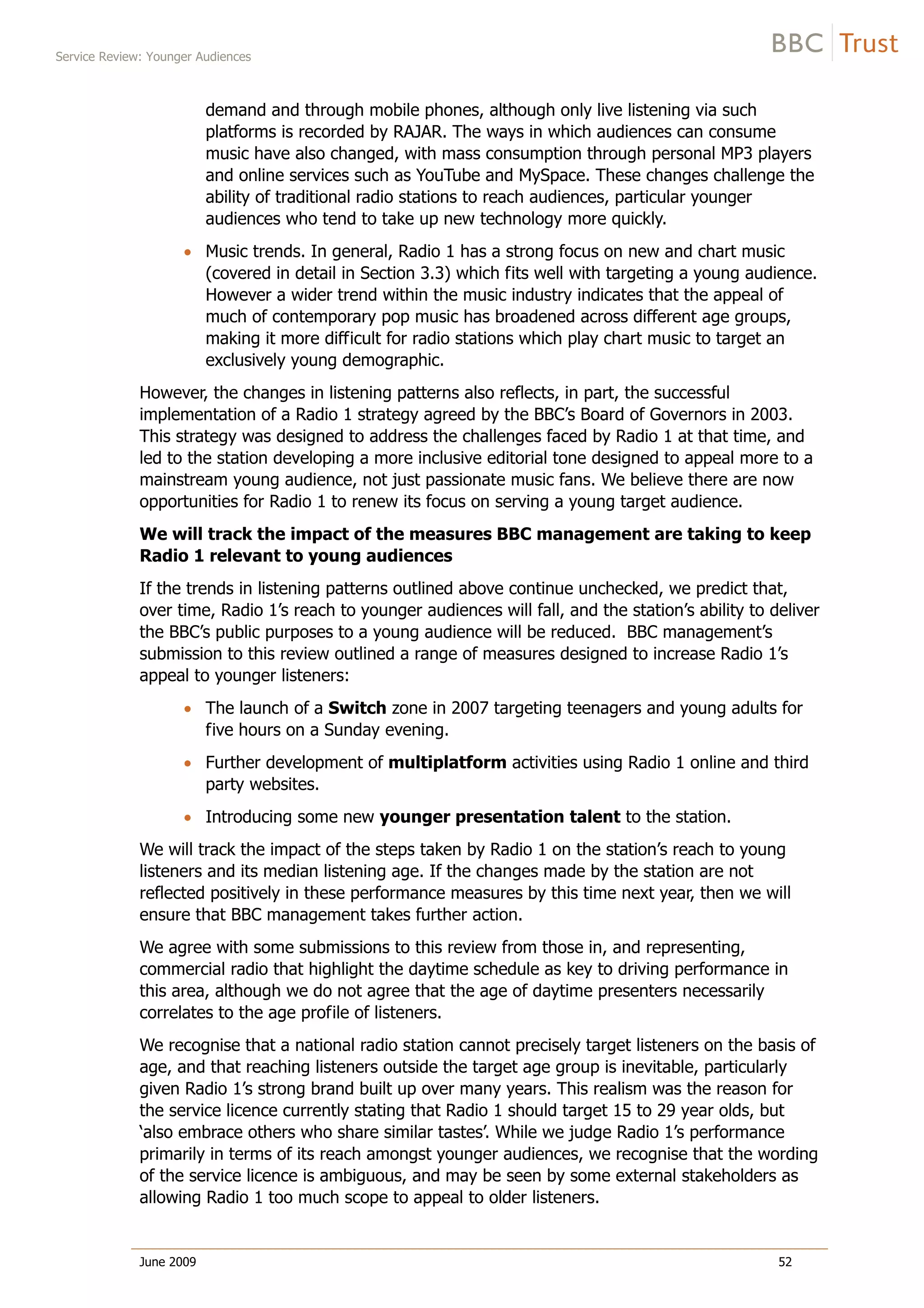
Radio 1 should renew its focus on serving a young target audience. While Radio
1’s percentage reach to 15 to 29 year olds has only fallen slightly in recent years, its
reach to the lower end of its target age group (15 to 19 year olds) has fallen significantly,
and at a faster rate than that of radio as a whole. Radio 1 also reaches a large number of
people outside its 15 to 29 year old target age group, with reach to 30-39 year olds
having grown significantly in recent years. While these trends in listening partly reflect
factors beyond the station’s control, in particular changes in the way people consume
radio and music, the choice of stations on offer, and popular music trends, we believe
there are opportunities for Radio 1 to renew its focus on serving a young target audience.
We will track the impact of the measures BBC management is taking to keep
Radio 1 relevant to young audiences. If the trends in listening patterns outlined
Service Review: Younger Audiences
June 2009 9
above continue, we predict that over time, Radio 1’s reach to younger audiences will fall,
and the station’s ability to deliver the BBC’s public purposes to a young audience will be
reduced. BBC management’s submission to this review outlined a range of measures
designed to increase Radio 1’s appeal to younger listeners. We will track the impact of
these on the station’s reach to young listeners and its median listening age. If the
changes made by the station are not reflected positively in these performance measures
by this time next year, then we will ensure that BBC management takes further action.
We believe that the daytime schedule is the key to driving performance in this area,
although we do not agree with some submissions to this review that the age of Radio 1’s
presenters necessarily correlates to the age profile of listeners.
Radio 1 reaches a lower proportion of young people from ethnic minority
backgrounds. Radio 1’s reach is much lower among young ethnic minorities and has
fallen significantly since 2003. We believe this is due to a variety of reasons, including the
growth in reach to newer BBC services, such as 1Xtra and the BBC Asian Network. Partly
because of the range of other music radio stations which have a strong appeal to this
audience, Radio 1’s reach is generally lower, too, in urban areas such as London, where
ethnic minorities make up a higher proportion of the audience. Despite these factors,
Radio 1’s remit states that it should ‘engage a broad range of young listeners’, and we
would be concerned if this disparity between listeners from different ethnic backgrounds
becomes more pronounced.
We believe that Radio 1’s general speech output could be more ambitious in
terms of delivering some of the BBC’s public purposes. The primary aim of Radio
1’s presenter speech in daytime is to entertain listeners. We believe that this is legitimate
for Radio 1 and fits with its remit. It also supports the reach and impact of the station,
driving delivery of the music and news output which is more directly related to the
promotion of the BBC’s public purposes.
Given that Radio 1 is a public service, however, we believe that there is potential for
Radio 1 presenters to do more to deliver some of the BBC’s public purposes, and we think
that a positive first step in this direction is an increase in the amount and ambition of
Radio 1’s social action output.
Action 6
While we do not believe that any radio station can restrict listening only to its
stated target audience, we do expect Radio 1 to focus on serving 15-29 year
olds, rather than older listeners. To reinforce this expectation, we are
tightening the wording of Radio 1’s service licence remit. This currently states
that Radio 1 should target 15 to 29 year olds, but ‘also embrace others who
share similar tastes’. This has been interpreted by some external stakeholders
to mean the station is being encouraged to target older listeners, and we will
remove this wording from the service licence. We will also make clear that
Radio 1 should provide some programming for younger teenagers.
Radio 1’s performance in serving a young target audience will be the focus of
our routine performance assessment activity in future years. We expect Radio
1 to maintain its reach to 15 to 29 year olds and to ensure that the median
age of its listeners remains within its target age range. We will track Radio 1’s
performance against these performance measures each quarter, and will report
publicly on Radio 1’s performance in future Annual Reports. If the changes
Service Review: Younger Audiences
June 2009 10
made by the station are not reflected in these performance measures by this
time next year, then we will ensure that BBC management takes further action.
Action 7
There are a number of reasons why Radio 1’s reach to young ethnic minorities
is low and has declined in recent years. However, we would be concerned if
the disparity between reach to listeners from different ethnic backgrounds
becomes more pronounced. We will, therefore, monitor Radio 1’s reach to
ethnic minority listeners closely as part of our regular performance assessment
work.
Action 8
We will amend parts of Radio 1’s service licence to set a clearer framework for
how we expect it to deliver public value to young people. These changes will
be designed to:
a) better reflect the value Radio 1 creates through its support for new
music and emerging UK music artists;
b) reflect our expectation that Radio 1’s speech output can do more to
deliver a range of public purpose objectives, including ensuring a
minimum number of social action campaigns each year.
IXTRA
1Xtra is a growing service, although digital-only distribution has limited the
size of its audience. We are approving two changes to the service which we
believe will enable it to offer greater public value, by increasing its ability to
deliver the BBC’s public purposes to its listeners.
1Xtra has shown encouraging signs of growth in 2008 and a large proportion of its
listeners are from its target audience. However, as a digital-only service, its reach remains
small relative to Radio 1. The take up of DAB radio among 1Xtra’s target audience is low
and is a factor in limiting audience awareness and usage of the station.
1Xtra listeners are positive about the quality of its output, particularly its music, and the
station has had some successes in supporting black music and emerging UK artists.
However its overall impact in this area has been limited and we agree with BBC
management that it could do more in this respect. We are approving an amendment to
the definition of new music on 1Xtra designed to improve its support for emerging black
music artists.
Service Review: Younger Audiences
June 2009 11
1Xtra currently broadcasts a high volume of news but listening levels are relatively low for
its extended news programme and overall, 1Xtra’s news provision is not meeting the
needs of its listeners. We are approving changes to 1Xtra’s news output which will reduce
the volume of news on the station, but should increase reach, and therefore, impact in
terms of delivering the BBC’s citizenship purpose.
Action 9
We have approved an amendment to the definition of new music in 1Xtra’s
service licence. This will allow music which is an ‘underground or emerging’ UK
track from the last six months to qualify as new music and should help the
station increase its support for the UK black music industry.
To monitor the impact of this change, we will continue to ask BBC
management to report levels of new and UK music to the Trust at regular
intervals. We will also ask BBC management to provide other evidence to us at
the end of the 2009-10 financial year that the changes have increased 1Xtra’s
support for the UK black music industry.
Action 10
We have approved changes to the volume and format of news on 1Xtra. The
major change is to replace the two hour weekday news programme with two
fifteen minute extended bulletins scheduled when listening levels are higher.
We will no longer require the station to broadcast hourly bulletins overnight.
We will amend 1Xtra’s service licence to reflect these changes.
Service Review: Younger Audiences
June 2009 12
Introduction
Background to this review
The public has high expectations of the BBC - they trust it to make brilliant programmes;
to maintain the highest standards of distinctive, independent broadcasting; to offer
everyone something they will love; and to do things that others cannot or will not
attempt. They expect it to be special and to stay special, particularly at a time when
broadcasting is undergoing such change and consumers have so much choice. At the BBC
Trust it is our responsibility to get the best out of the BBC for licence fee payers. To help
deliver this remit we review each of the BBC’s services at least once every five years.2
This service review focuses on the BBC’s provision for younger audiences and follows on
from our review of services and content for children, published in February 2009. Our
decision to focus on provision for younger audiences was informed by two main
considerations:
Firstly, the BBC has faced long-standing challenges to serve younger audiences
as well as it does older viewers and listeners
Secondly, new technology is changing the way people consume media, and
young audiences are leading the shift to digital, interactive and on-demand
services. This presents both challenges and opportunities for all broadcasters
including the BBC.
The scope and aims of our review
We published the terms of reference for this review in September 2008. These said that
we would examine the BBC’s provision for younger audiences through:
Formal reviews of three services the BBC targets at younger audiences: BBC
Three, BBC Radio 1 and BBC Radio 1Xtra. These reviews cover how well these
services are performing against the terms of their service licences, and whether
the licences need to change. This report specifies the areas where we have
decided to change the service licences, which we will re-issue following the
publication of this report.
Consideration of how well the BBC serves younger audiences as whole across
television, radio and online, to place the performance of these services within a
broader understanding of younger audiences. This includes an assessment of
output aimed at younger audiences which is hosted by other BBC services,
including: BBC Switch, content designed for 12 to17 year olds available on BBC
Two, Radio 1 and bbc.co.uk; and formal learning provision targeted at younger
audiences on bbc.co.uk (Key Stage 3 and GCSE Bitesize, BBC Blast, and Learning
Zone Broadband) and BBC Two (BBC Schools TV).
2
The Trust is required under the BBC’s Charter and Agreement to review each of the BBC’s services at least once every five
years and whenever the public interest demands it.
Service Review: Younger Audiences
June 2009 13
At the outset of this review we also identified a number of areas outside the scope of this
review:
Editorial issues and the portrayal of young people by the BBC. In scoping this
review it became clear that many young people are concerned that they are
portrayed negatively in the media. However, as these concerns were often more
about broadcasters as a whole, including BBC services which are not part of this
review, we decided not to cover this area.
Talent costs. We reviewed this area separately in 2008.
Compliance with the BBC’s quotas for independent radio production. We are
reviewing the quotas for independent radio production separately later in 2009.
Market Impact. Service reviews are intended to inform our duty of performance
assessment, rather than assist in the approval of any new activities or services,
so do not include a market impact assessment.
Methodology
This review was carried out for the Trust by its independent advisers in the Trust Unit
under the direction of the review’s lead Trustee, Alison Hastings. We gathered evidence
from a wide range of sources which are summarised below.
Public consultation. We used the relevant service licences to develop a set of questions
for public consultation. The consultation ran from 23 September to 16 December 2008
and we received some 9,100 responses from individuals. We also received 8 responses
from organisations, and 4 responses from our Audience Councils in England, Northern
Ireland, Scotland and Wales.
BBC management submission. BBC management submitted a report to us which we
have published alongside this report.
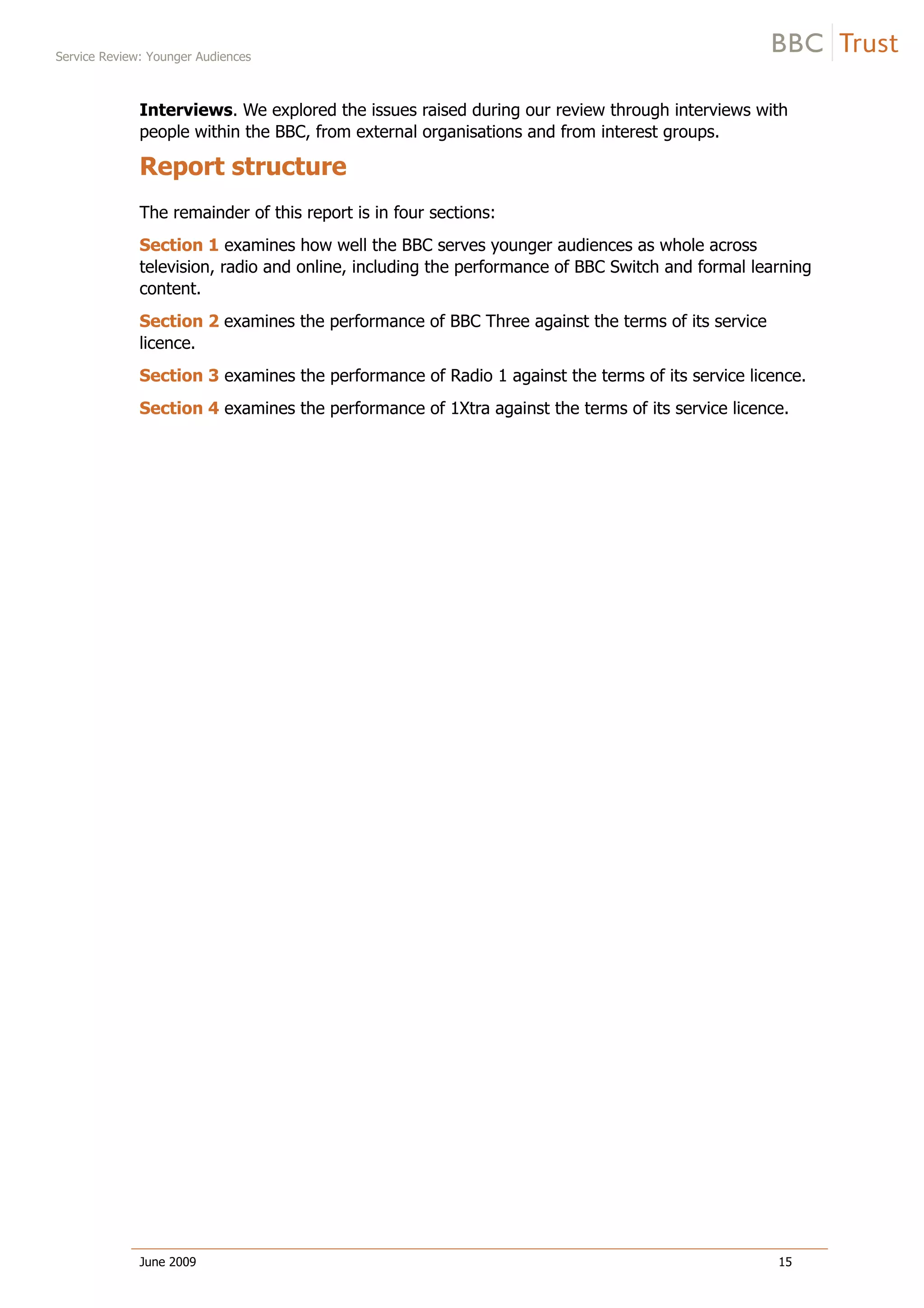
Performance data analysis. We analysed performance data using the BBC’s RQIV
performance framework which considers four drivers of public value – reach, quality,
impact and value for money. This framework is set out in Figure 1.
Service Review: Younger Audiences
June 2009 14
Figure 1: The BBC’s RQIV performance framework
Reach - The extent to which BBC services are used by the audience. In this
report, unless otherwise stated, the reach of television or radio services is
expressed as the percentage of the population who have watched or listened
for a consecutive fifteen minute period in a week.
Quality - Quality is measured in terms of audience perception, in particular
through measurement of the characteristics which the Agreement 3
states
should be features of public service broadcasting. These characteristics are
‘high quality’, ‘original’, ‘challenging’, ‘innovative’ and ‘engaging’.
Impact - The extent to which BBC services create public value by delivering
the BBC’s public purposes. The purposes, which are set out in the BBC’s Royal
Charter, require the BBC to:
sustain citizenship and civil society
promote education and learning
stimulate creativity and cultural excellence
represent the UK, its nations, regions and communities
bring the UK to the world and the world to the UK
help to deliver to the public the benefit of emerging communications
technologies and services.
Value for Money - A consideration of usage alongside cost to provide a
perspective on cost-effectiveness.
Audience research. We have drawn on several pieces of audience research to inform
our thinking for this review:
our Purpose Remit research, a survey of more than 2,000 adults to assess how
well the BBC delivers the public purposes to licence fee payers.
research commissioned by BBC management from YouGov, surveying more than
6,000 people to assess how well BBC Three, Radio 1 and 1Xtra deliver the BBC’s
public purposes.
qualitative research commissioned by BBC management from Sparkler to
understand in more depth how well the BBC serves young people.
Audience engagement. We worked with the British Youth Council (‘BYC’) to run a
series of focus groups exploring young people’s views and opinions about the BBC. The
BYC ran sessions in London, Birmingham and Merseyside, attended by around 40 young
people mostly aged between 14 and 25. Our Audience Councils also ran audience
engagement events across England, Northern Ireland Scotland and Wales. Further details
are available in their submissions to this review, available on our website.
3
The Agreement is between the BBC and the Secretary of State for Culture, Media and Sport and complements the
Charter.
http://www.bbc.co.uk/bbctrust/assets/files/pdf/regulatory_framework/charter_agreement/bbcagreement_july06.pdf
Service Review: Younger Audiences
June 2009 15
Interviews. We explored the issues raised during our review through interviews with
people within the BBC, from external organisations and from interest groups.
Report structure
The remainder of this report is in four sections:
Section 1 examines how well the BBC serves younger audiences as whole across
television, radio and online, including the performance of BBC Switch and formal learning
content.
Section 2 examines the performance of BBC Three against the terms of its service
licence.
Section 3 examines the performance of Radio 1 against the terms of its service licence.
Section 4 examines the performance of 1Xtra against the terms of its service licence.
Service Review: Younger Audiences
June 2009 16
Section 1: How the BBC serves
younger audiences
This section examines the performance, at a high level, of the BBC in serving younger
audiences across television, radio and online.
The BBC is a major media provider for younger audiences, with more than 9
out of 10 young people using BBC services each week. The BBC has some of
the leading media brands aimed at young people, such as Radio 1, BBC Bitesize
and, increasingly, BBC Three. While young people have a generally positive
view of the BBC, we believe that the BBC could do more to gain credit for its
range of its provision for the young.
This review covers a diverse range of audiences
There are around 17.5 million people aged between 13 and 34 in the UK – representing
around 30 per cent of the total population. This is a diverse audience, covering a number
of different ‘life stages’, ranging from young teenagers living at home with their parents to
those who are studying or looking for their first job, through to those who have started
their own family and are in settled careers.
Younger audiences’ media behaviour is changing more quickly than that of
older adults and this presents challenges for the BBC
Young people are much more likely than older audiences to have access to new media
technologies, as well as using existing media in more sophisticated ways. For example,
83 per cent of 16 to 19 year olds regularly use the internet compared with 48 per cent of
those aged over 35 while 72 per cent of 16 to 19 year olds regularly use MP3 players
compared with 15 per cent of those aged over 35.4
Young people are also more likely to interact with traditional forms of broadcasting in
different ways, for example accessing audio and video content through mobile phones or
‘on demand.’ While all adults consider the four main terrestrial television providers (BBC,
ITV, Channel 4 and Five) as the most important media platforms, younger audiences,
particularly teenagers, consider their mobile phones, personal computers and broadband
internet as more important than the main television channels, while radio sets does not
feature at all in the top five media for younger audiences.5
The pace and scale of technological change presents challenges for the BBC. The
remainder of this section of this report outlines the BBC’s future strategy to respond to
these challenges and evaluates how well the BBC is meeting them in order to reach
younger audiences on television, radio and online and to deliver its public purposes to
them.
The BBC has developed a strategy to serve younger audiences, covering
mainstream and targeted services
The BBC’s strategy to deliver public value to young people involves a mix of:
4
Ofcom Media Literacy Audit, 2007
5
BBC Emerging Media survey, 2007
Service Review: Younger Audiences
June 2009 17
content for broad audiences, including the young carried on mainstream services
such as BBC One, BBC Two and BBC Online;
linear services specifically targeted at young people, including Radio 1, 1Xtra and
BBC Three;
content targeted at young people carried on mainstream services, including:
formal learning on BBC Online; and BBC Switch, branded content for teenagers
hosted on Radio 1, BBC Two and BBC Online;
Stronger on-demand provision to increase availability of BBC content.
1.1 REACH
The BBC remains an important part of young people’s media consumption,
reaching around 92 per cent of 15 to 34 year olds each week
The BBC measures how many people claim to use any of its services on a weekly basis
through an online survey. This shows that usage of the BBC remains very high, with
around 92 per cent of 15 to 34 year olds claiming to watch, listen to or use the BBC’s
services each week.6
The BBC’s measurement systems do not, however, allow us to measure and report actual
usage of the BBC by young audiences across different services and platforms, such as
how many young people listen to Radio 1 but no other BBC service, or how many people
are accessing BBC content through third parties such as YouTube. The BBC is in the
process of developing a new audience measurement tool which will allow more detailed
analysis of audience usage across platforms and services, including amounts of unique
reach.
Action 1
The BBC needs to be able to track audience behaviour across TV, radio and
online and is in the process of developing a new audience measurement tool
which will allow detailed analysis of audience usage across platforms and
services. Once the BBC has put this new measurement system in place, we
recommend that younger audiences are treated as a priority audience group
for measurement
BBC One is the most heavily used service by younger audiences, while targeted
BBC services have greatest focus on this audience
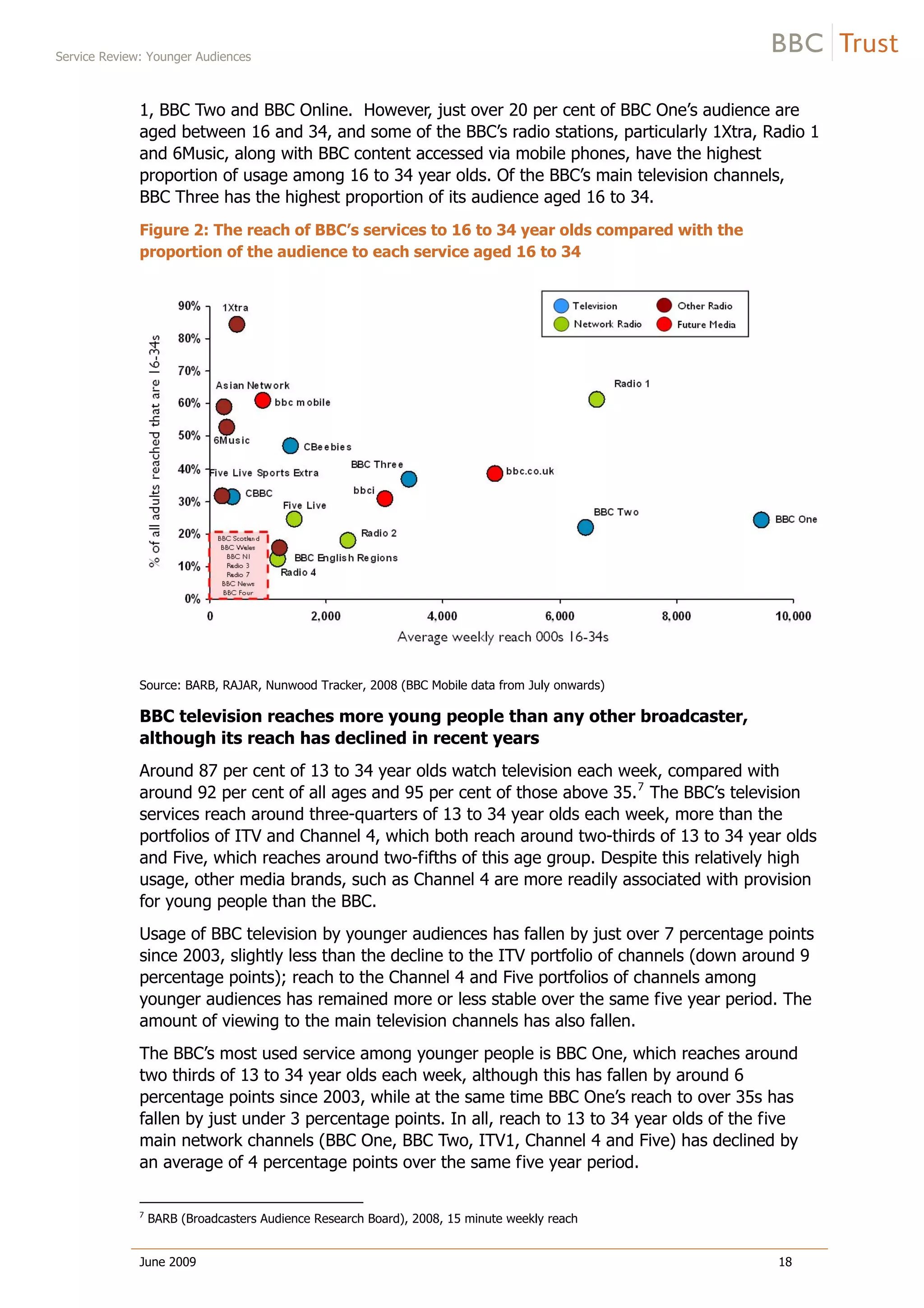
Figure 2 shows the reach of each of the BBC’s services among 16 to 34 year olds plotted
alongside the percentage of the audience to that service who are aged between 16 and
34. This shows total usage of BBC services by young people, alongside the degree of
focus by those services on young people.
This shows that BBC One is, by some way, the most used of the BBC’s service by younger
audiences, reaching around two-thirds of 16 to 34 year olds each week, followed by Radio
6
PBTS (Pan BBC Tracking Survey), 2008, Base: Adults aged 15+
Service Review: Younger Audiences
June 2009 18
1, BBC Two and BBC Online. However, just over 20 per cent of BBC One’s audience are
aged between 16 and 34, and some of the BBC’s radio stations, particularly 1Xtra, Radio 1
and 6Music, along with BBC content accessed via mobile phones, have the highest
proportion of usage among 16 to 34 year olds. Of the BBC’s main television channels,
BBC Three has the highest proportion of its audience aged 16 to 34.
Figure 2: The reach of BBC’s services to 16 to 34 year olds compared with the
proportion of the audience to each service aged 16 to 34
Source: BARB, RAJAR, Nunwood Tracker, 2008 (BBC Mobile data from July onwards)
BBC television reaches more young people than any other broadcaster,
although its reach has declined in recent years
Around 87 per cent of 13 to 34 year olds watch television each week, compared with
around 92 per cent of all ages and 95 per cent of those above 35.7
The BBC’s television
services reach around three-quarters of 13 to 34 year olds each week, more than the
portfolios of ITV and Channel 4, which both reach around two-thirds of 13 to 34 year olds
and Five, which reaches around two-fifths of this age group. Despite this relatively high
usage, other media brands, such as Channel 4 are more readily associated with provision
for young people than the BBC.
Usage of BBC television by younger audiences has fallen by just over 7 percentage points
since 2003, slightly less than the decline to the ITV portfolio of channels (down around 9
percentage points); reach to the Channel 4 and Five portfolios of channels among
younger audiences has remained more or less stable over the same five year period. The
amount of viewing to the main television channels has also fallen.
The BBC’s most used service among younger people is BBC One, which reaches around
two thirds of 13 to 34 year olds each week, although this has fallen by around 6
percentage points since 2003, while at the same time BBC One’s reach to over 35s has
fallen by just under 3 percentage points. In all, reach to 13 to 34 year olds of the five
main network channels (BBC One, BBC Two, ITV1, Channel 4 and Five) has declined by
an average of 4 percentage points over the same five year period.
7
BARB (Broadcasters Audience Research Board), 2008, 15 minute weekly reach
Service Review: Younger Audiences
June 2009 19
BBC radio’s reach to young people has held broadly steady since 2003,
although it still reaches fewer young people than commercial radio each week
Around 89 per cent of 13 to 34 year olds listen to the radio each week8
, on a par with the
population as a whole, while BBC radio reaches around 60 per cent of 13 to 34 year olds
each week, a number that has held steady in recent years. In comparison, commercial
radio stations reach more than 70 per cent of 13 to 34 year olds each week, although this
level has declined by around 7 percentage points since 2003. Radio 1 is by some distance
the most popular radio station - BBC or commercial - for younger audiences, reaching
some 40 per cent of 13 to 34 year olds each week.
BBC Online has become an important part of the BBC’s offering to young
people
More than one-quarter (28 per cent) of all 16 to 34 year olds use BBC Online each week9
,
the same proportion as all adults, making BBC Online the fifth most popular website for
this age group in the UK, behind Google, MSN, Facebook and Yahoo. Reach to BBC Online
among younger audiences has risen by around 9 percentage points since 2003.10
Some
sections of BBC Online have particularly strong appeal to younger audiences, notably the
formal learning websites for children and young adults.
A decline in the numbers of teenagers watching BBC television has driven an
overall fall in BBC reach amongst teenagers
The BBC faces a particular challenge to serve teenagers and young adults where the
technological changes and declines in reach described above are most acute. In 2008, the
most popular programmes on television among teenagers were broadly the same as for
all audiences – entertainment shows such as Britain’s Got Talent and The Apprentice,
popular dramas such as Eastenders and Doctor Who, and some live sport, particularly
football. However, in 2008:
BBC television11
reached two-thirds of teenagers (13 to 19 year olds), compared
with 84 per cent of all individuals, while the average amount of viewing for
teenagers was just 24 minutes a day (compared with 75 minutes for all
individuals). BBC’s television reach to teenagers has fallen by around 12
percentage points since 2003.
BBC radio reached 56 per cent of teenagers compared with 64 per cent for all
individuals, and both reach and amount of listening has remained relatively
stable since 2003 (55 per cent).12
There has however been a significant decline
in amount of listening among teenagers to commercial radio stations.
BBC Online reached an average 42 per cent of teenagers per month, compared
with 51 per cent of all individuals.13
8
RAJAR (Radio Joint Audience Research), 2008, 15 minute weekly reach
9
Nunwood New Media Tracker, December 2008 (increases to 43 per cent amongst 16 to 34 year olds in internet homes)
10
Nunwood New Media Tracker, December 2008, 19 per cent of 15 to 34 year olds (increases to 31 per cent amongst 15 to
34 year olds in internet homes)
11
BARB, 2008, 15 minute weekly reach, BBC Television includes BBC One to Four, BBC News, BBC Parliament, CBBC and
CBeebies
12
RAJAR, 2003 – 2008, 15 minute weekly reach, BBC Radio includes 8 network stations, BBC Nations radio and 40 local
radio stations in England
13
Nielsen, December 2008, monthly reach in internet homes
Service Review: Younger Audiences
June 2009 20
In response to its decline in reach to teenagers, the BBC launched BBC Switch
on television, radio and online
BBC Switch was launched in October 2007 with the aim of providing original content
specifically aimed at 12 to 17 year olds. Switch is not governed by a service licence as it
occupies “zones” on other services - on BBC Two (Saturdays 12-1.30pm), a mixture of
acquisitions and originated content including a current affairs strand and music magazine
format; Sunday evenings on Radio 1 (Switch, 7-10pm and The Surgery, 10-midnight);
and online.
The performance of Switch to date has been mixed. Consumption of Switch
content has been encouraging on radio and online, but teenagers’ viewing of
Switch on television is still low
While we recognise that BBC Switch is still an emerging proposition, our view is that its
performance to date has been variable, with its television programmes in particular not
yet reaching high enough volumes of the target audience.
On television, BBC Switch reached an average audience of 326,000 individuals each week
in 2008, of which just 36,000 were aged 12 to 17 (0.8 per cent of the people in this age
group)14
. On Radio 1, the Switch slot has a weekly reach of just over 1 million individuals,
including 180,000 aged 12 to 17 (4 per cent of this age group)15
. Online, BBC Switch
reaches an average of 120,000 unique users each week.16
While we are unable to assess
fully the effectiveness of Switch online in reaching teenagers as the BBC does not
measure usage data by age for the site, the Switch website was the most common
answer among respondents to our public consultation question about what they
particularly liked about BBC Switch.
BBC management's submission to this review acknowledged that the limited potential for
Switch to gain reach and impact in its current position and volume of hours, on BBC Two.
This view was supported by some of the responses to our public consultation about BBC
Switch which questioned whether the scheduling was appropriate for teenagers. We
believe that it is important for the BBC to offer some targeted content for older children
and we will await an update from BBC management on the future of the Switch slot on
BBC Two.
1.2 DELIVERY OF THE BBC’S PUBLIC PURPOSES
Sections 2, 3 and 4 of this report examine how well BBC Three, Radio 1 and 1Xtra deliver
the public purposes. This section provides an overview of how well younger audiences
think the BBC as a whole delivers the public purposes to them.
The BBC is able to deliver some of its public purposes well among young
people but faces challenges in other areas
In order to assess the BBC’s performance in this area, we drew on data from our annual
purpose remit survey17
which tracks how important audiences think it is that the BBC
delivers each purpose, and how well they think the BBC is doing so. The data shows that,
with a few exceptions, younger audiences have similar expectations of the BBC, and
14
BARB, 29 March – 12 December 2008 excluding July to August when off air for summer holidays, 15 minute weekly reach
15
RAJAR, 2008, 15 minute weekly reach
16
BBC server logs, 2008, weekly unique users (BBC server logs based on computer browsers)
17
BBC Trust Purpose Remit Survey, BMRB, 2008 – 2009
Service Review: Younger Audiences
June 2009 21
perceptions of how well the BBC meets them, to the rest of the audience. The remainder
of this section provides a brief commentary of each of the purposes.
Sustaining Citizenship and Civil Society
Younger audiences perceive the BBC’s performance in delivering the
citizenship purpose as reasonably good overall, although there are growing
challenges to engage some young people with the BBC’s news output
The BBC’s news provision is the heart of the BBC’s public service offering and we are
encouraged that the majority of young people we surveyed believe that the BBC delivers
‘high quality independent journalism’ well.18
However, there is a gap between the number
of young people who think it is important that the BBC ‘makes news and current affairs
interesting to me’ and the number who believe that the BBC is currently delivering this.
This perception gap is, perhaps, a reflection of the declining reach of BBC News on
television - 45 per cent of those aged 16 to 34 in 2008 watched BBC News each week, a
fall of 7 percentage points since 2004, compared with 68 per cent of all adults.19
The
decline has not been halted in spite of the introduction of new ways to reach younger
audiences with BBC News, such as the 90 second 8pm bulletin on BBC One, and is most
acute among young people living in lower income households, where consumption of BBC
News online has not filled the gap left by the fall in reach to news on television.
BBC News on the radio reaches half of 16 to 34 year olds each week20
and this has
remained broadly steady since 2004. BBC News online reaches 23 per cent of young
people with access to the internet, although no trend data is available.21
BBC News’ is developing its approach to reaching younger audiences, in particular
increasing the usage among young people of BBC News online and considering the scope
for syndicating BBC News content on third party websites. BBC News’ is also considering
whether there are more opportunities to provide ‘bitesize’ news bulletins (such as the 90
second bulletin at 8pm on BBC One) on television.
The BBC will need to use the full range of its platforms – TV, radio and online – to find a
solution to falling consumption of television news and consider the role of its broad-
appeal linear TV and radio services alongside online. Given the importance of news to the
BBC’s public service remit, this is a major challenge for the BBC.
Action 2
We regard BBC News’ reach to young people as a very important performance
indicator and are asking BBC management to focus on this in our regular
performance assessment activities. We will report publicly in future Annual
Reports on BBC News’ performance in reaching young people.
18
BBC Trust Purpose Remit Survey, BMRB, 2008 – 2009
19
BARB, 2008, 3 minute weekly reach
20
RAJAR, Q4 2008, 15 minute weekly reach
21
Nielsen, December 2008, monthly reach in internet homes
Service Review: Younger Audiences
June 2009 22
Promoting education and learning
Usage of the BBC’s formal learning content is high among teenagers and young
adults and research shows that the services are highly valued by users
Younger audiences consider this purpose to be the most important of the BBC’s public
purposes, and overall believe that the BBC delivers this very well. Some four-fifths of
those 15 to 34 year olds that we surveyed felt that they had ‘learned new things while
enjoying programmes or content on the BBC,’22
and while there is a small gap between
the numbers of people who think it is important that the BBC ‘helps children/ teens with
what they learn at school or college’ and those who agree the BBC delivers this well, the
BBC’s overall performance in this area is strong.
As part of this review we considered the performance of BBC’s formal learning provision
for teenagers and young adults, particularly BBC Bitesize (Key Stage 3 and GCSE), BBC
Blast, and Learning Zone Broadband.
BBC Bitesize
BBC Bitesize is an online revision service covering each of the national curriculum key
stages. Usage among teenagers is high and growing strongly. In 2008 nearly 400,000
unique users each week23
used GCSE Bitesize across the UK, around 18 per cent more
than in 2007. Usage was particularly high in May 2008 with more than 700,000 unique
users. Usage of Key Stage 3 Bitesize is also high at around 130,000 unique users each
week in 2008, an increase of around one-third from 2007 and also peaked in May 2008
with nearly a quarter of a million unique users. Usage of the BBC’s formal learning
websites which cover parts of the curriculum in Scotland, Wales and Northern Ireland was
also high.
Regular audience surveys conducted by BBC management24
shows that BBC Bitesize is
highly rated by both children and teachers: 90 per cent of secondary school aged children
were aware of BBC Bitesize, while nearly two-thirds of children who use Bitesize are ‘high
approvers’ of the service (rating it at 7 or more out of 10) and 83 per cent of children said
that Bitesize had helped them with their schoolwork.25
These findings are supported by
responses from our four Audience Councils and the young people we spoke to as part of
this review, who were very positive about Bitesize, as well as responses to our public
consultation, where around two thirds of those who responded praised the BBC’s formal
learning websites, Bitesize in particular.
“Bitesize – my lifesaver!”
Attendee at audience event, Merseyside, December 2008
BBC Blast
BBC Blast provides online training in skills related to creative arts such as fashion, film
making and design. In 2008, there were around 70,000 unique users to BBC Blast
website each week,26
and more than 350,000 young people have worked with Blast at
22
BBC Trust Purpose Remit Survey, BMRB, 2008 – 2009
23
BBC server logs, 2008, weekly unique users
24
BBC Learning Children’s Tracker / BBC Learning Teachers’ Tracker
25
BBC Learning Teachers’ Tracker, wave 3
26
BBC server logs, 2008
Service Review: Younger Audiences
June 2009 23
outreach and workshop events. BBC Blast was highly praised in submissions to this review
from the Audience Councils for Scotland and England.
Learning Zone Broadband
Learning Zone Broadband provides audio visual clips related to the curriculum content for
use in the class room, similar to BBC Schools’ content on television. The BBC’s strategy is
to make audio-visual clips to assist classroom learning available online rather than
through linear television, as online learning better reflects teachers’ requirements. As a
relatively new proposition, very little performance data is available for Learning Zone
Broadband at present.
The BBC’s formal learning provision offers good value for money
As part of our review of children’s services and content, published in February 2009,27
we
committed to concluding on the overall value for money of the BBC’s formal learning
content in this review, as the BBC Learning division runs its activities for children and
teenagers together, so the costs of each element cannot be split.
In total, the BBC spent £9.8 million in 2007-08 on its formal learning resources for
children and young people. In 2008, these sites, which include those aimed at primary
school aged children, had around 1 million unique users each month.
In 2007-08 the cost per weekly unique user of the BBC Bitesize, schools and Blast
websites targeted at 5 to 19 year olds was low, at around 8p for each weekly unique
user.28
This is significantly cheaper than the cost for each unique user of BBC Online over
the same period.
Therefore, on the basis that the BBC’s formal learning websites are heavily used, well
liked and make a strong contribution to delivering the BBC’s public purposes, as well as
their relatively low cost per unique user, we believe that their value for money is good. In
addition, BBC surveys of teachers show that around three-quarters of primary and
secondary school teachers rated the BBC’s formal learning websites highly in terms of
providing value for money for the licence fee.
There are some industry concerns about the distinctiveness of the BBC’s
formal learning content
As part of this review some organisations wrote to us raising concerns about the
distinctiveness and market impact of parts of the BBC’s formal learning provision and the
ways in which they are developing. Under the terms of the BBC’s Charter, we have a duty
to have regard to the competitive impact of the BBC’s activities and we are considering
this issue separately to this review.
Stimulating creativity and cultural excellence
Younger audiences like the range of programmes and services available from
the BBC, although they want more programmes to show fresh and new ideas
This purpose covers a wide range of areas and younger audience perceptions of the
importance and performance of the BBC in this area are broadly in line with that of all
adults. The two most important areas for audiences are that the BBC:
27
See http://www.bbc.co.uk/bbctrust/framework/bbc_service_licences/childrens.html
28
We have not assessed the value for money for Learning Zone Broadband as this is a new proposition which is still being
developed.
Service Review: Younger Audiences
June 2009 24
‘has a wide range of enjoyable and entertaining programmes and content’.
Among 15 to 34 year olds, although there is a small ‘performance gap’ (where
more people think it is important that the BBC provides this than think the BBC
currently delivers it) for this statement, the percentage agreeing that the BBC
delivers this well is high at 71 per cent.29
In support of this, a frequent answer
from respondents to our public consultation question on what makes the BBC
stand out from other broadcasters was the range and variety of programming.
‘has lots of fresh and new ideas’. While 70 per cent of 15 to 34 year olds think it
is important the BBC does this, only 60 per cent think the BBC does this well.
These scores are broadly similar to those for all audiences, and are in line with
what audiences have told us in previous audience surveys. In October 2007, we
set the BBC the strategic objective to increase audience perceptions that the BBC
provides content and programmes that are original and different. While there are
some encouraging signs of progress in meeting this objective, for example the
percentage of viewers who think BBC One has programmes which show original
ideas has increased over the past year, we are clear that the BBC has more work
to do to narrow the performance gap described above.
Representing the UK’s nations, regions and communities
Younger audiences generally consider the statements relating to this public
purpose to be less important than those associated with other purposes
The most important statement under this purpose for younger audiences is that ‘the BBC
provides me with the opportunity to share the same experiences with other people (like
major events, live events and popular programmes)’. 63 per cent of those surveyed think
this is important, while 61 per cent think the BBC delivers this well. The largest
performance gap was for statements such as ‘the BBC is good at portraying my particular
culture or community to other people in the UK’. While only 56 per cent of younger
audiences felt it was important that the BBC does this, just 40 per cent think it is done
well. It is likely that for young people, this is partly related to their feeling that they are
not portrayed well by the BBC or other media organisations. This issue was raised both by
the young people we spoke to as part of this review, and in responses from our Audience
Councils, but as explained in the Introduction, is outside the scope of this review.
Bringing the world to the UK and the UK to the world
Younger audiences believe that the BBC delivers programming about the wider
world very well
In common with individuals of all ages, younger audiences consider it very important that
the BBC helps them ‘understand what's going on in the wider world’ and ‘understand and
appreciate different cultures and lifestyles of people from around the world’. Audiences
believe that the BBC delivers these statements very well, with no performance gap.
29
BBC Trust Purpose Remit Survey, BMRB, 2008 – 2009
Service Review: Younger Audiences
June 2009 25
Emerging communications
The BBC’s digital and technological activities are more important to young
people than the audience as a whole and it is clear that the BBC’s future online
activities form a key part of meeting the challenge to serve younger audiences
Younger audiences see this purpose as significantly more important than audiences aged
over 35. For example, whereas only 46 per cent of all adults think it is important that ‘the
BBC provides quality content that I find enjoyable or useful on the internet’, nearly two-
thirds of those aged 15 to 34 think this is important. The largest performance gap in this
area is for the statement ‘the BBC provides quality content that I find enjoyable or useful
on mobile phones’ – while only one-third of 15 to 34 year olds think is important, only
around one-quarter think that the BBC does this well.
The BBC iPlayer has had a significant impact with young people, and has developed into a
strong brand which was highly praised in submissions to this review from our Audience
Councils for Scotland, Northern Ireland and Wales.
“I especially like BBC iPlayer - as a Uni. student I use it a lot…best of all is bbc.co.uk.
It keeps me up to date with everything that’s going on in the news, is easy to navigate
and to dip in and out of.”
Respondent to our public consultation question ‘which things are
particularly good about the BBC?’, aged 18 to 21
1.3 CONCLUSIONS
We endorse the BBC’s strategy of serving younger audiences with a mixture of
mainstream and targeted content and services.
One respondent to our public consultation suggested that the BBC may be in danger of
using a disproportionate amount of resources to target this group (young people). Given
the size of this group within the population and the fact that usage of many BBC services
is skewed towards older adults, we do not believe that there is any risk of this at present.
We are content with the current level of provision.
We are clear that the BBC’s mainstream services, in particular BBC One, remain important
to the BBC in reaching and delivering public value to all audiences including young
people, and we believe the BBC has a unique role in bringing all audiences together,
particularly at key national moments, on its broad appeal mainstream services. We will
therefore consider the interests of children and young people in other service reviews,
particularly our reviews of BBC One and BBC Two due to start later in 2009. However we
have also found that the services the BBC specifically targets at younger audiences,
particularly Radio 1 and BBC Three play an important role in serving young people, and
we note that the BBC’s online provision is becoming more important in this regard.
In terms of delivering the public purposes, we are concerned at the apparent decline in
usage of BBC News by young people. We also continue to believe that the BBC could do
more to provide output that is original and different and shows fresh and new ideas on its
Service Review: Younger Audiences
June 2009 26
mainstream services and we will continue to encourage BBC management to pursue this
objective across all services.
The BBC remains popular among younger audiences, and overall usage, despite some
decline in the case of television, is still very high among young people. While young
people associate the BBC brand with trust and with the quality and range of its
programming, other media providers have stronger youth brands overall, despite being
used less by young people. Therefore we think there may be more that the BBC could do
to gain credit from young people for its range of output for them as, taken individually, it
has some very strong brands – such as Radio 1, BBC Three and BBC Bitesize. While
defining specific actions to address this challenge is a matter for BBC management, we
think there may be more scope for the targeted services to collaborate in order to
enhance the BBC’s perceived value amongst the young. We are very clear, too, that where
the BBC aims to serve young people on services specifically targeted at them, while it
may often be appropriate to tailor the presentation, tone and subject nature to meet their
specific tastes and expectations, all content must conform to the BBC's editorial
standards.
Service Review: Younger Audiences
June 2009 27
Section 2: BBC Three
BBC Three’s remit is ‘to bring younger audiences to high quality public service
broadcasting through a mixed-genre schedule of innovative UK content featuring new UK
talent. The channel should use the full range of digital platforms to deliver its content and
to build an interactive relationship with its audience.’
Although not stated in its service licence, BBC Three defines its younger target audience
as 16 to 34 year olds.
Our assessment of performance
BBC Three’s effectiveness in reaching young people makes it an important part
of the BBC television portfolio. The quality and range of its output is seen by
viewers as good overall, and we are very supportive of its track record and
willingness to take creative risks. We want BBC Three’s focus to remain on UK
originations and we support BBC management’s aim to develop its provision
further in some genres. We will amend parts of the channel’s service licence to
set a clearer framework for how we expect it to deliver public value to young
people.
2.1 REACH
BBC Three has increased its reach significantly in recent years, particularly
among its target audience, and has become an important part of the BBC’s
television portfolio
In 2008, BBC Three reached some 10.4 million people each week, nearly 20 per cent of
the population.30
BBC Three reached some 3.4 million 16 to 34 year olds, 26 per cent of
this age group.31
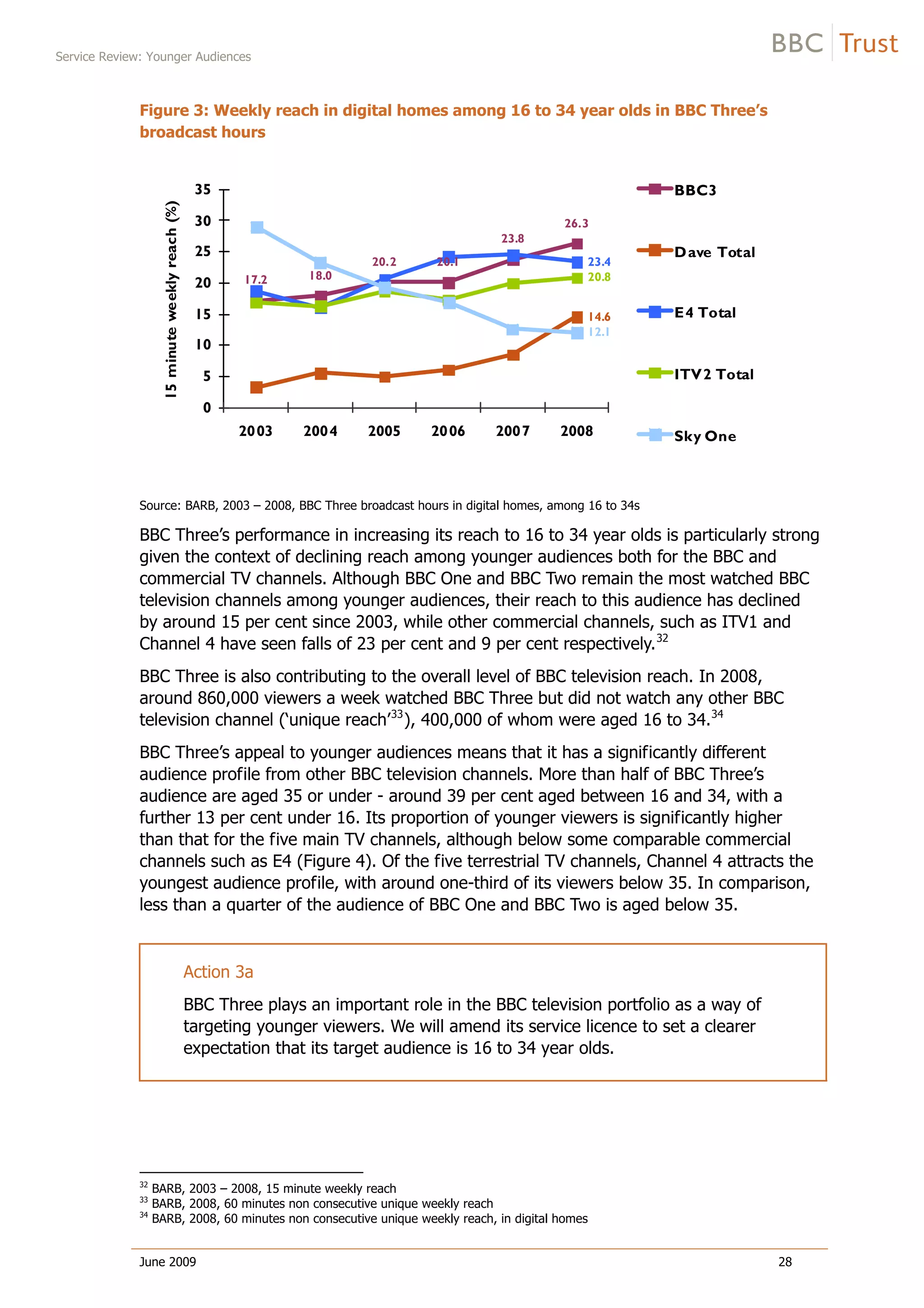
Within its broadcast hours, BBC Three now reaches more of its target audience than
comparable broadcasters (Figure 3) below, with reach growing by around 20 per cent
each year since 2004.
30
BARB, 2008, 15 minute weekly reach
31
BARB, 2008, 15 minute weekly reach in digital homes
Service Review: Younger Audiences
June 2009 28
Figure 3: Weekly reach in digital homes among 16 to 34 year olds in BBC Three’s
broadcast hours
17.2 18.0
20.1
26.3
14.6
20.8
12.1
23.8
20.2 23.4
0
5
10
15
20
25
30
35
2003 2004 2005 2006 2007 2008
15minuteweeklyreach(%)
BBC3
Dave Total
E4 Total
ITV2 Total
Sky One
Source: BARB, 2003 – 2008, BBC Three broadcast hours in digital homes, among 16 to 34s
BBC Three’s performance in increasing its reach to 16 to 34 year olds is particularly strong
given the context of declining reach among younger audiences both for the BBC and
commercial TV channels. Although BBC One and BBC Two remain the most watched BBC
television channels among younger audiences, their reach to this audience has declined
by around 15 per cent since 2003, while other commercial channels, such as ITV1 and
Channel 4 have seen falls of 23 per cent and 9 per cent respectively.32
BBC Three is also contributing to the overall level of BBC television reach. In 2008,
around 860,000 viewers a week watched BBC Three but did not watch any other BBC
television channel (‘unique reach’33
), 400,000 of whom were aged 16 to 34.34
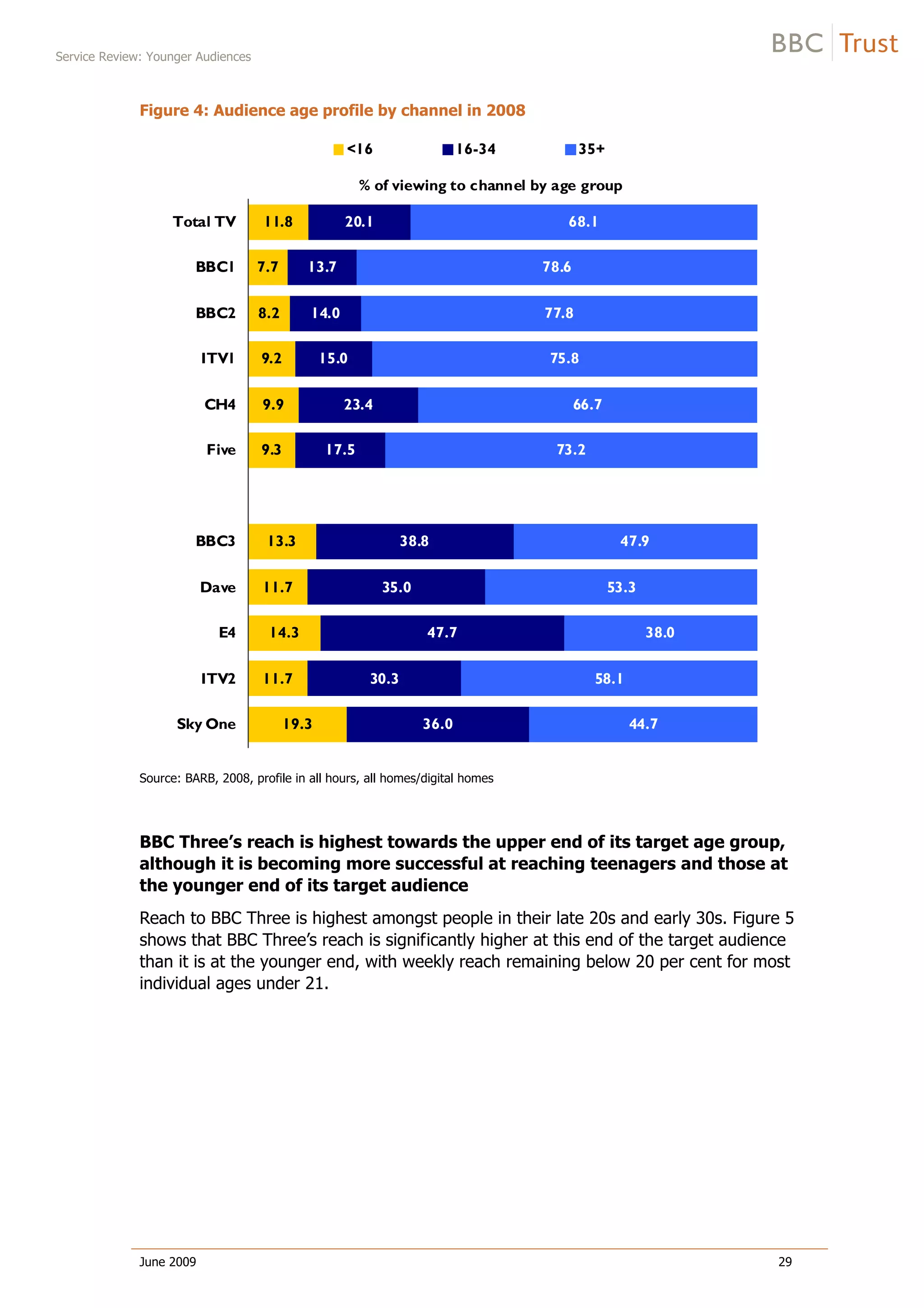
BBC Three’s appeal to younger audiences means that it has a significantly different
audience profile from other BBC television channels. More than half of BBC Three’s
audience are aged 35 or under - around 39 per cent aged between 16 and 34, with a
further 13 per cent under 16. Its proportion of younger viewers is significantly higher
than that for the five main TV channels, although below some comparable commercial
channels such as E4 (Figure 4). Of the five terrestrial TV channels, Channel 4 attracts the
youngest audience profile, with around one-third of its viewers below 35. In comparison,
less than a quarter of the audience of BBC One and BBC Two is aged below 35.
Action 3a
BBC Three plays an important role in the BBC television portfolio as a way of
targeting younger viewers. We will amend its service licence to set a clearer
expectation that its target audience is 16 to 34 year olds.
32
BARB, 2003 – 2008, 15 minute weekly reach
33
BARB, 2008, 60 minutes non consecutive unique weekly reach
34
BARB, 2008, 60 minutes non consecutive unique weekly reach, in digital homes
Service Review: Younger Audiences
June 2009 29
Figure 4: Audience age profile by channel in 2008
11.8
7.7
8.2
9.2
9.9
9.3
13.3
11.7
14.3
11.7
19.3
20.1
13.7
14.0
15.0
23.4
17.5
38.8
35.0
47.7
30.3
36.0
68.1
78.6
77.8
75.8
66.7
73.2
47.9
53.3
38.0
58.1
44.7
Total TV
BBC1
BBC2
ITV1
CH4
Five
BBC3
Dave
E4
ITV2
Sky One
% of viewing to channel by age group
<16 16-34 35+
Source: BARB, 2008, profile in all hours, all homes/digital homes
BBC Three’s reach is highest towards the upper end of its target age group,
although it is becoming more successful at reaching teenagers and those at
the younger end of its target audience
Reach to BBC Three is highest amongst people in their late 20s and early 30s. Figure 5
shows that BBC Three’s reach is significantly higher at this end of the target audience
than it is at the younger end, with weekly reach remaining below 20 per cent for most
individual ages under 21.
Service Review: Younger Audiences
June 2009 30
Figure 5: Weekly reach by individual age in all homes, all hours
Source: BARB, 2008, all hours, all homes
Since 2005, however, BBC Three’s has attracted viewers from teenagers and young
adults, at a greater rate than other ages (Figure 6). Its appeal to younger audiences was
reflected by some of the young people we spoke to as part of this review who described
BBC Three as youth led and aimed at young people.35
Figure 6: Weekly reach to BBC Three by age group over time
Source: BARB, 2005 – 2008, BBC Three broadcast hours in digital homes
35
Events organised and run by the British Youth Council
Service Review: Younger Audiences
June 2009 31
A large proportion of viewing to BBC Three is driven by small number of
programmes
In common with many digital channels, a small number of programme strands drive reach
and consumption of BBC Three. Around 49 per cent of all viewing to the channel among
16 to 34s is to its top ten programmes.36
As part of this review, BBC management has suggested that it could start BBC
Three at 3pm instead of 7pm in order to improve reach and value for money
BBC Three’s remit allows it to broadcast on television between 7pm and 4am. Most other
television channels, in particular those aiming to reach younger audiences, are available
for 24 hours a day, which results in a significant increase in their overall reach. For
example while BBC Three reaches 400,000 more viewers than E4 in its broadcast hours,
E4 has higher reach across all hours (Figure 7).
Figure 7: Weekly reach to BBC Three and comparable commercial broadcasters
3,410
1,894
2,691
1,572
3,031
776
970
387
1,048
BBC3
Dave Total
E4 Total
ITV2 Total
Sky One
19:00-04:00 Other hours
3.4m
2.7m
4.0m
3.7m
2.0m
Source: BARB, 2008, weekly reach in digital homes
BBC management estimates that allowing BBC Three to start transmitting at 3pm would
increase the channel’s reach by around 20 per cent - with BBC Three gaining from
additional viewing between 3pm and 7pm as well as between 7pm and 9pm where
viewing is currently lower than later in the evening. The majority of people who
responded to our public consultation on this issue were supportive of allowing BBC Three
to broadcast for more hours than it does currently. Women and those aged 13 to 17 were
particularly in favour of an earlier start time. The responses to our public consultation as
well as submissions to this review from each of our four Audience Councils, and an
organisation representing young people who responded to this consultation, all indicated
a general sense that younger audiences expect television channels aimed at them to be
available for longer than BBC Three at present.
36
BARB, 2008, total minutes of viewing in digital homes
Service Review: Younger Audiences
June 2009 32
“That it is only on a limited time (after 7 and not during the day), I would quite like to
watch it at other times of the day, because I am normally doing things like homework
at this time, and on the weekend, which is when I have the most free time.”
Respondent to our public consultation ‘what do you think is not so good
about BBC Three?’, aged 13 to 17
Extending the hours of BBC Three would, however, use more of the BBC’s limited digital
terrestrial transmission spectrum. This could be used for other BBC services, and BBC
management is currently considering the relative prioritisation of the services which
would be affected before submitting a formal proposal to the Trust.
Therefore, while we understand the logic and potential benefits of BBC management’s
aim to extend BBC Three’s hours of transmission, we will need to consider this proposal in
the context of the BBC’s overall usage of its digital terrestrial spectrum.
BBC management believes that the additional four broadcast hours on BBC Three could
be delivered at low cost with a mix of originations, repeats and broadcasts of music and
sports events and learning content commissioned by other services. If BBC management
does formally propose an extension of BBC Three’s transmission hours, the proposal
should include further detail on the nature of the content it will broadcast, as well as
consideration of value for money and affordability. We will not support a proposal to
extend BBC Three’s hours without clear evidence that it will not impact negatively on the
funding and levels of quality of the whole BBC Three schedule.
BBC Three’s reach to the various audience groups within its target age range is
variable
BBC Three has a commitment to serving a broad range of younger audiences. We
compared BBC Three’s reach to different audience groups against that of other BBC
television channels. Our analysis, as illustrated in Figure 8 below, shows that while for
many audience groups BBC Three’s reach profile follows a similar pattern to other
channels, BBC Three is more successful (proportionally) at reaching people in Scotland
and those in lower income households.
We also note that, in common with other digital entertainment channels, such as Dave
and E4, BBC Three has lower reach in Northern Ireland. Its reach is slightly lower
amongst men and better off young people, compared with its average reach amongst all
16-34 year olds. We do not see these variances as a cause for concern.
Service Review: Younger Audiences
June 2009 33
Figure 8: BBC Three’s reach among audience groups aged 16 to 34
26.3
25.3
27.5
24.9
27.8
26.8
26.4
20.4
26.5
22.8
26.9
Adults 16-34
ABC1
C2DE
Men
Women
Scotland
Wales
NI
England
Non white
White
15 minute weekly reach (%) to BBC Three
Source: BARB, 2008, BBC Three broadcast hours in digital homes
BBC Three’s lower reach to ethnic minority audiences reflects the pattern for
the BBC television portfolio as a whole
Although BBC Three reaches the same percentage of ethnic minorities as white viewers
among all ages, among 16 to 34 year olds, BBC Three’s reach to ethnic minority
audiences is 13 per cent below its average reach to all 16 to 34s. This reflects a wider
pattern across all of the BBC’s television channels – for example BBC television’s reach to
16 to 34 year old ethnic minorities is 8 per cent below its average reach to all 16 to 34
year olds.
As part of our review of children’s content and services, published in February 2009,37
we
undertook some audience research to understand better the media usage of children in
ethnic minority homes. While the focus of this research was on children aged 8 to 12, it
also drew out some general themes on media consumption among ethnic minority
audiences which may help explain BBC Three’s performance. In particular, the BBC often
faces more competition in ethnic minority homes, for example from ethnic or religious
media, particularly Asian television channels.
Action 4a
We will consider the issue of BBC television’s lower reach amongst ethnic
minority audiences across all television channels in our service reviews of BBC
One, BBC Two and BBC Four, which will start later in 2009.
37
See http://www.bbc.co.uk/bbctrust/framework/bbc_service_licences/childrens.html
Service Review: Younger Audiences
June 2009 34
2.2 QUALITY
BBC Three’s service licence sets out that it should deliver:
high quality public service broadcasting
through a mixed genre schedule.
Audience perceptions of the quality of BBC Three’s programmes are fairly
strong
A range of metrics suggest that BBC Three is perceived positively amongst its target
audience of 16-34 year olds: they give BBC Three a higher average approval rating than
any other BBC television channel38
and a higher average appreciation index (‘AI’) score;
the number who rate its programmes as high quality is also higher than for BBC One and
BBC Two.39
Among viewers of all ages, audience perceptions of programme quality on BBC Three fall
slightly, although they remain reasonable in comparison to other television channels.
BBC Three’s willingness to take creative risks sometimes results in lower
quality scores for its programmes
Some programmes shown by BBC Three in the past year are not seen by audiences as
high quality. These were a mix of factual, entertainment and comedy originations. One of
the key messages that audiences have told us in the last two years about the BBC is that
they want to see more creativity and innovation on screen. We believe that there is
sometimes a trade-off between levels of quality and creative risk taking, as taking
creative risks can lead to higher failure rates.
Given BBC Three’s strong performance in terms of innovation and creativity (covered in
Section 2.3 below) we believe that many of the programmes which audiences rated as
lower quality were legitimate attempts to innovate which did not succeed with this
audience. In addition, around one-quarter of BBC Three’s output is comedy, a genre in
which it is generally harder to get high quality scores from audiences. Conversely, natural
history and period dramas, types of programmes which tend to get very high quality
scores from audiences, are not part of BBC Three’s genre mix. BBC Three is also less
reliant on established presenters or actors than many other television channels – often
audiences will automatically associate particular presenters or actors with quality.
We therefore accept that under its current remit some of BBC Three’s output is unlikely to
meet viewers’ expectations of quality. However, we fully support the channel’s willingness
to innovate and take creative risks as we believe this benefits licence fee payers.
“I think that BBC Three definitely features new ideas, though naturally few of these
end up being hugely successful. Still, I think it is good that the BBC can provide a
platform for these sorts of programmes”
Respondent to our public consultation, ‘how well do you think BBC Three
provides programmes that feature fresh and new ideas’, aged 18 to 21
38
PBTS, 2008
39
BBC Pulse survey, April 2008 – March 2009
Service Review: Younger Audiences
June 2009 35
BBC Three commissions a small number of list and clip programmes each year.
We believe that these programmes may have a negative effect on the
reputation of the channel
BBC Three commissions a small number of list and clip programmes each year (for
example The Most Annoying People of 2008) which are repeated heavily at particular
points in the schedule and at times of the year when viewing overall is expected to be
lower due to competition from other channels. In 2008-09, these programmes
represented 144 hours, 4 per cent of BBC Three’s airtime, compared with around 21
hours on BBC One (0.2 per cent airtime) and 104 hours on E4 (2 per cent of airtime.40
Although these types of programmes attract a fair number of viewers - reach to these
programmes is only slightly below the average reach for BBC Three - our audience
research41
has identified that these formats score consistently poorly in terms of audience
appreciation, both for quality and originality. We are therefore concerned about their
impact on overall audience perceptions of the quality and originality of BBC Three and
suggest that the BBC minimises the use of these formats.
BBC Three’s genre mix
BBC Three broadcasts a greater range of programmes and genres than
comparable broadcasters.
While the majority - around three quarters - of BBC Three’s airtime is accounted for by
two genres (Figure 9) - factual and comedy - BBC Three’s programme mix includes
original UK drama, entertainment, current affairs, news, music and arts programming. In
all, BBC Three broadcasts a broader range of genres than commercial digital channels
which target younger audiences. This can present challenges for the channel because
audiences expectations of digital channels are that they focus one or two genres,
particularly entertainment or factual.
Figure 9: BBC Three’s genre mix
24%
32%
8%
11%9%
7%
41% 24%
6%
11%
2%
1%
3% 10%
5% 2%
% of all BBC Three airtime by
genre
% of all BBC Three viewing by
genre
Other
Current Affairs
Soaps
Music and arts
Film
Factual
Ents (ex comedy)
Drama (no soaps)
Comedy
Source: BARB, April 2008 – March 2009, using BBC genre codes
40
BARB, April 2008 – March 2009
41
This was reported in Part 1 of the BBC Annual Report 2007-08, page 22
Service Review: Younger Audiences
June 2009 36
The majority of BBC Three’s airtime is committed to originated programming,
although acquired programming and transfers of programmes shown on other
BBC channels are important drivers of reach
BBC Three’s service licence states that the channel should broadcast a high proportion of
original UK content. Originations (new programmes commissioned by BBC Three) account
for the majority of the channel’s output, around 77 per cent of airtime.42
The rest of the schedule comprises programmes originally shown on BBC One and BBC
Two (‘transfers’) and acquired programming from overseas, including films. These
programmes provide a disproportionate amount of viewing compared with their airtime -
around 19 per cent and 32 per cent of viewing respectively from 22 per cent of airtime.
BBC Three often schedules transfers between 7pm and 10:30pm, with the aim of building
the channel’s audience through the evening for the 10:30pm slot, where new originated
programming is often premiered. The young people we spoke to, and those who
responded to our consultation, told us that transfers and acquisitions were important to
them, and welcomed in particular the chance to catch up on repeats from other BBC
channels, such as Eastenders, Doctor Who and Top Gear, as well as premieres of BBC
One and BBC Two content, such as Heroes and Spooks.
BBC Three’s service licence states that its strategy for acquired programmes should
concentrate on bringing new material and talent to the screen and not on competing for
well established programmes. We recognise the use of acquisitions where they expand
the range and quality of a schedule at relatively low cost and bring new talent and
material to the audience.
While the majority of BBC Three’s expenditure is on UK originations (see Figure 12), we
note that acquisitions account for a growing proportion of the channel’s programme
budget. We see the primary goal of the channel as being to provide new UK originated
programming for younger audiences and we do not expect it to rely on acquisitions to
support its performance. Nor do we expect BBC Three to treat its statutory obligation for
originated programming – that at least 70 per cent of its output is originated, including in
peak time - as a ‘floor’ and will monitor delivery against this annual quota to ensure this is
not the case. We will consider the role of acquisitions across all BBC channels in our
review of BBC One, BBC Two and BBC Four later this year.
Action 4b
We will consider the role of acquisitions alongside UK originated content as
part of our service reviews of BBC One, BBC Two and BBC Four, which will start
later in 2009.
2.3 IMPACT – DELIVERY OF THE BBC’S PUBLIC
PURPOSES
BBC Three’s service licence requires it to make a contribution to all six of the BBC’s public
purposes, with particular emphasis on ‘stimulating creativity and cultural excellence’.
42
BARB, April 2008 – March 2009
Service Review: Younger Audiences
June 2009 37
Stimulating creativity and cultural excellence
BBC Three’s service licence states that the channel should deliver this through:
content which displays creative risk taking and uses new and emerging talent
its drama, entertainment and comedy programmes with a special commitment to
UK animation
coverage of cultural events particularly in music and arts
supporting its television output interactively (this is covered in the emerging
communications part of this section)
BBC Three is fulfilling its remit to be innovative and take creative risks
We drew on a range of audience data to assess whether BBC Three was fulfilling its remit
in this area. Among BBC Three’s target audience, around 45 per cent consider its
programmes to be ‘original and different’ – higher than Channel 4 which has a remit to
take creative risks, and much higher than BBC One. Among all viewers, the percentage of
original and different programmes falls slightly to around 43 per cent, but remains well
above the levels on BBC One and Channel 4.43
In addition, BBC management’s YouGov research for this review shows that audiences
perceive BBC Three to be better than comparable broadcasters with regards to
statements such as ‘not afraid to take risks and try new things’. Among 16 to 34 year
olds, BBC Three scored 7.1 out of ten, ahead of the highest comparable broadcaster, E4,
which scored 7. This view was also reflected by respondents to our public consultation -
nearly two thirds of whom told us that BBC Three is performing well at providing
programmes that feature fresh and new ideas.
We also spoke to programme commissioners and genre heads within the BBC, who gave
us a strong sense that BBC Three is the channel within the BBC television portfolio where
they felt most able to experiment with new programme ideas and approaches.
We believe that BBC Three is fulfilling its commitment to support new and
emerging talent and is less reliant on established presenting or acting talent
than other channels
It is not possible to measure BBC Three’s success in developing talent in an empirical way
although BBC management’s YouGov research shows that audiences perceive BBC Three
to be better than comparable broadcasters with regard to the statement ‘features new UK
faces on screen’ – scoring 7.2 out of 10 among 16 to 34 year olds, with the nearest
comparable broadcaster scoring 6.5.44
We have also found several good examples of BBC
Three using new, or yet to be established, talent and the young people we spoke to as
part of this review praised BBC Three for its willingness to take risks with new talent that
might not otherwise be seen. In addition, the majority of responses to our public
consultation indicated that BBC Three is supporting new talent and providing a showcase
for new and undiscovered actors, writers and presenters.
43
BBC Pulse survey, April 2008 – March 2009
44
YouGov purposes research, September & October 2008
Service Review: Younger Audiences
June 2009 38
“This is an aspect of BBC Three that is accomplished with great skill. There appears to
be a regular stream of unknowns contributing to a multitude of different programmes
on BBC Three. Admittedly, this can have its disadvantages, but it is something which
gives BBC Three character and a level of intrigue, seeing as there are so few channels
which can claim to do the same”
Respondent to our public consultation, ‘how well do you think BBC Three
provides a showcase for new and undiscovered actors?’, aged 22 to 29
BBC Three has built a very strong reputation for its comedy output. The
performance of drama and entertainment programmes, however, has been
variable, and future success will remain a challenge due to the low volume of
new output
Audience perceptions among 16 to 34 year olds that BBC Three is the best channel for
comedy have increased in each of the past four years, with 14 per cent of 16 to 34 year
olds now spontaneously citing BBC Three as the best channel for comedy.45
This is ahead
of both BBC One and BBC Two, and is behind only Channel 4 (16 per cent).
However BBC Three faces challenges to maintain this performance and to continue to
improve its reputation for comedy, notably because of the transfer of its most successful
titles to BBC One. In BBC Three’s case, the transfer of key comedy titles such as Gavin
and Stacey and Little Britain to BBC One presents an ongoing challenge to develop and
commission successful new programmes.
Drama is an important genre for BBC Three, particularly in terms of developing
appreciation and loyalty among younger audiences. Although BBC Three’s originated
drama has had some successes over recent years, BBC management has recognised that
overall performance has been inconsistent and has identified drama as a key area for
improvement. BBC Three will broadcast three new original dramas for 2009 (18 first run
hours in total) – broadly similar levels to previous years. The first of these, Being Human,
was shown in early 2009 and was a very positive first step towards improving
performance in this area, generating high reach, quality and originality ratings. However
the relatively low volume of new drama output means that there is a risk that the channel
will not generate the impact it is aiming for, and leaves little room for failure.
BBC management has also stated that its performance in entertainment programming has
been inconsistent. While BBC Three has not fully developed its programme plans to
improve its performance in this area, audience research46
shows that for the BBC
entertainment programming is the hardest genre in which to produce high quality and
original programming in. Therefore, while we endorse BBC management’s aim to ‘build a
stronger, more consistent slate of entertainment programming’ on the channel, we would
encourage them to develop programme ideas and plans which are consistent with its
remit to take creative risks and develop new talent.
45
PBTS, 2008
46
BBC Pulse survey, April 2008 – March 2009
Service Review: Younger Audiences
June 2009 39
BBC Three’s commitment to UK animation is only partially being met although
we accept it may be too challenging for a single channel of this scale
BBC Three’s service licence states it has a ‘special commitment to UK animation’. While
BBC Three does broadcast animated programming, this is generally through acquired
programming, such as Family Guy and animated films, or transfers from other BBC
channels, such as Wallace and Gromit.
In 2008, BBC Three partially fulfilled its remit in this area through broadcasting The
Wrong Door, an originated comedy which includes some computer-generated-imaging
(CGI). BBC Three also runs a scheme called Fresh Animation on Three, where the public
are invited to send in their animated comedy sketches which BBC Three produces into a
fifteen minute broadcast shown on the channel.
On this basis, BBC Three is only partially fulfilling its commitment to UK animation. We
accept that the channel faces challenges in meeting its commitment in this area –
animation is an expensive genre with very high levels of audience expectation set by the
high quality of a handful of American programmes shown in the UK.
BBC Three’s commitment to music and arts is met through coverage of music
festivals, as well as occasional arts programmes specially commissioned for
the channel
BBC Three broadcast around 72 hours of music and arts output in 2008-09, of which 56
hours qualified as originated content against its service licence condition to show 35
hours of new programming. The majority of this output comprises the broadcast of music
festivals such as Glastonbury, Reading and Leeds, and Radio 1’s Big Weekend.
BBC Three also commissions one-off arts and religious programmes, including The
Manchester Passion and The Liverpool Nativity, first broadcast in 2007. The latter of these
attracted a cumulative audience of close to 1 million and was rated highly by audiences
for being original and different. The channel also broadcast Jonathon Ross Japanorama in
2007, a series examining the art and culture of Japan. However, no arts programming was
shown in 2008.
We recognise that arts programming, which attracts quite small audiences on mainstream
channels relative to other programme genres, is a challenging genre for BBC Three.
However, given its importance to the BBC’s public purposes, we encourage BBC Three to
continue to find occasional opportunities to provide arts output which is relevant to young
people.
BBC Three’s sports coverage can deliver public value to young people
Sport can also make a contribution to the delivery of this purpose by entertaining the
audience, bringing people together for shared experiences and, occasionally, encouraging
the audience to participate in sport. In recent years, BBC Three has broadcast a number
of sporting events, ranging from live coverage of African Nations Football to highlights of
Rugby Union internationals and Formula 1 racing. The overall reach to sport on the
channel in 2008-09 was 11 per cent.47
The importance of sport to young people came
through clearly in responses to our public consultation, and we therefore believe that BBC
Three should continue to deliver public value through showing sports events of particular
relevance to young people.
47
BARB, April 2008 – March 2009, 15 minute reach in digital homes
Service Review: Younger Audiences
June 2009 40
Action 3b
We will amend BBC Three’s service licence to set a clearer framework for how
we expect it to deliver public value to young people through broadcasting
sporting events which are of particular relevance to younger audiences.
Promoting education and learning
BBC Three’s service licence requires the channel to make a strong contribution to this
purpose through:
Bringing younger audiences to factual programming
Finding new ways to attract younger viewers to subjects such as science,
business, religion and ethics
Participating in social action campaigns
BBC Three’s factual programming reaches a young audience and has covered a
wide range of subject areas
Around 40 per cent of BBC Three’s airtime is devoted to factual programming,48
and in
recent years, BBC Three has broadcast a number of successful programme strands which
attract a significantly younger audience than factual programming on BBC One and BBC
Two by virtue of the channel’s strong appeal to 16 to 34 year olds. BBC Three’s factual
programming has also covered a wide range of subjects, including science (for example,
Kill it, Cook it, Eat it), business (The Last Millionaire; Money Makers: Beach Break Live)
and religion and ethics (Deborah 13: Servant of God; Blood, Sweat and T-shirts).
Some of those people that BBC management spoke to as part of their qualitative research
for this review said that the factual content on the channel was not hard-hitting enough
and was too close to being ‘light entertainment’. Kill it, Cook it, Eat it was highlighted as a
notable exception. A similar message came through from a small number of responses to
our public consultation on BBC Three’s factual content.
“Not that well, too many documentaries about unimportant topics! Need more topics
that have issues that affect teenagers, not just ones that attract them with silly issues”
Respondent to our public consultation question ‘how well do you think BBC
Three’s current affairs programmes and documentaries cover important
topics in ways that appeal to younger audiences?’, aged 18 to 21
This is reflected in BBC management’s YouGov research, which shows that while audience
perceptions of BBC Three’s delivery of this purpose are more positive than they are of of
most comparable broadcasters, they are some way below those for the culture and
creativity purpose. Perceptions that BBC Three programmes “help you learn new things”
are particularly low.
48
BARB, April 2008 – March 2009
Service Review: Younger Audiences
June 2009 41
BBC management’s Sparkler research suggests that one reason for this may be that
audiences associate BBC Three so strongly with its comedy output, some of the messages
from its more serious factual output are obscured. Having reviewed the output of the
channel we believe that, to some degree, audience perceptions in this area are lagging
behind what the channel is actually broadcasting. We therefore encourage BBC Three to
maintain its focus on providing ambitious and serious factual programming for younger
audiences and expect that, over time, audiences will recognise its efforts in this area. We
are also interested in how the performance and impact of BBC Three's factual output can
be further enhanced online, as the BBC develops its overall online knowledge strategy
Sustaining Citizenship and Civil Society
BBC Three’s service licence requires the channel to contribute to this purpose through its
news and current affairs output.
BBC Three’s 60 second news bulletin is helping BBC News reach a young
audience on television and is well received by the younger end of its target
audience
Given BBC News’ declining reach to younger audiences on television, outlined in Section
1.2, BBC Three’s 60 second news bulletins have become an important part of the BBC’s
overall news offering on television. In 2008, BBC Three’s 60 second bulletins reached an
average of 5.3 million viewers each week, including 1.6 million 16 to 34 year olds.49
A minority of respondents to our public consultation, particularly those from the older end
of BBC Three’s target audience, did not like the style and presentation of the 60 second
bulletins. However the majority of responses, as well as the findings from BBC
management’s Sparkler research, were positive about BBC Three’s news bulletins, feeling
that the length and style suit the channel, particularly given the range of in-depth news
available to audiences on other BBC channels.
BBC Three’s website has not provided the consistent linking to BBC News
online required by its service licence commitment
As BBC Three’s news bulletins do not provide in-depth news coverage, BBC Three’s
service licence makes it clear that BBC Three should support its bulletins by providing
links from its website to BBC News online. During the course of this review however, we
found that links from the BBC Three website to BBC News online were neither permanent
nor prominent, particularly in comparison to the Radio 1 website where news content and
links are fully integrated into the station’s website. We wish to be assured that links will
now remain permanent and prominent on the homepage - see action 7, below.
BBC Three’s current affairs programmes have had some notable successes
BBC Three has a service licence commitment to broadcast at least 15 hours of new
current affairs programming each year. Although this is a relatively small volume, most
other digital channels aimed at younger audiences do not broadcast any current affairs
programmes, and BBC Three’s coverage allows the channel to add depth to its 60 second
news bulletins. Many of the responses to our consultation felt that BBC Three’s current
affairs programmes were covering important topics and successfully appealing to younger
audiences. Kizzy: Mum at 14 was a notable success, reaching a cumulative audience of
49
BARB, 2008, 1 minute reach in digital homes
Service Review: Younger Audiences
June 2009 42
over 2.5 million viewers on BBC Three, and a further 2.2 million to a repeat on BBC
One.50
Representing the UK’s nations, regions and communities
BBC Three’s service licence requires the channel to contribute to this purpose through
stimulating, supporting and reflecting UK society in ways that reflect the lives of its
audience.
As set out in Section 2.1, some demographic groups watch BBC Three more than others.
However, BBC management’s YouGov research indicates that audiences perceive that BBC
Three delivers programming and content ‘that caters for your particular area or
community’ better than comparable broadcasters.
Bringing the world to the UK
BBC Three’s service licence requires the channel to contribute to this purpose through
coverage of international issues including through news and current affairs.
BBC Three’s programming has successfully engaged younger audiences with
stories from outside the UK
BBC Three delivers this purpose through:
its 60 second news bulletins, one of which each night focuses exclusively on
world news
current affairs programming covering international topics such as Jack: A
Soldier’s Story, a one off documentary about a solider fighting in Afghanistan
and then re-adjusting to civilian life
factual programming such as Last Man Standing. BBC Three’s most notable
success in this genre was Blood, Sweat and T-shirts, a series about globalisation
in the fashion industry. The series delivered high reach (3.2 million individuals)51
and high levels of appreciation - 75 per cent of the audience strongly agreed it
was ‘original and different’ (against an average of 36 per cent) and 81 per cent
agreed they had ‘learned something new’ (against an average of 44 Per cent).52
While audiences rated BBC Three’s delivery of the purpose statement ‘helps you know
and understand what is going on in the world’ lower than for other statements,
perceptions were above those for most other comparable broadcasters. In a response to
our public consultation, one organisation praised BBC Three for the ‘imagination and
innovation’ of its programming about the wider world, although suggested that BBC
Three’s service licence should be revised to include commitments to the global purpose in
genres other than news and current affairs.
50
BARB
51
BARB, 15 minute cumulative reach
52
BBC Pulse survey, April 2008 – March 2009
Service Review: Younger Audiences
June 2009 43
Action 3c
We believe that BBC Three’s output about the wider world is delivering public
value to young people. However, its service licence does not fully reflect the
range of genres in which it broadcasts programming about the wider world.
We will amend BBC Three’s service licence to make our expectation clearer
that its programming should make a contribution to this purpose across a
range of genres, particularly through its news, current affairs and factual
programming.
Emerging communications
BBC Three’s service licence states that the channel should promote this purpose through
offering content on a range of digital platforms as well as experimenting with digital
technologies to encourage innovation within the BBC.
BBC Three makes some contribution to this purpose, although awareness and
usage of its online activities is generally low
BBC Three’s remit states that it should use “the full range of digital platforms to deliver its
content and build an interactive relationship with its audience.” The potential for BBC
Three to use the internet in particular should be greater than for other channels due to
the young target audience’s high usage of online. The channel has commissioned some
“multiplatform” programmes, where online is integral to the TV offering. It has also had
some success with using third party sites for programme clips (such as Kizzy: Mum at 14),
both to promote programming on TV and to experiment with new ways of delivering
content in its own right. BBC Three has also taken steps to syndicate programmes and
content on other, third party websites such as YouTube. There is no performance data
which allows us to measure with accuracy the success of this activity.
However, BBC management’s qualitative and quantitative research showed that there is
low awareness of BBC Three’s interactive and digital offerings and low understanding of
the channel’s online activities, compared with E4.
Usage of the BBC Three homepage and individual programme sites has also been
surprisingly low: in 2008, BBC Three’s home page and programme related sites (such as
that for Being Human) were accessed by around 163,000 unique users each week. This is
significantly behind BBC One (1.1million), and BBC Two (336,000) but higher than BBC
Four (66,000).53
It is also low compared with the reach of other BBC sites designed for
young people, such as Radio 1 and BBC Bitesize.
As stated in section 1, we believe that online activities offer considerable potential for the
BBC to maintain a connection with young people and promote its public purposes
amongst them. We are disappointed by the relatively low usage and awareness of BBC
Three’s online activities and received mixed feedback from respondents to our public
consultation. Almost half of respondents were either not aware of, or had not used, the
53
BBC server logs, 19th
April – 31st
December 2008. Weekly unique users including programme pages
Service Review: Younger Audiences
June 2009 44
BBC Three website. Of those that used it, many liked it, although some respondents felt it
was too slow and too graphic-heavy. It is worth noting, however, that recent results from
the BBC’s main survey of audience perceptions of the quality of BBC Three’s website
showed some encouraging signs of improvement.54
“I think that it is an interesting website as well as being easy to use. It is also colourful
and sticks to the theme of the channel itself.”
Respondent to our public consultation question ‘what do you think about
BBC Three’s website?’, aged 13 to 17
“Horrible, horrible, horrible. Too much Flash, too little content. Since the re-launch of
the website I avoid it like the plague and even visit websites other than the BBC Three
website to have a look at BBC Three’s schedule”
Respondent to our public consultation question ‘what do you think about
BBC Three’s website?’, aged 22 to 29
Action 5
BBC Three’s digital and interactive activities are a core part of the channel’s
remit and have been identified by BBC management as an important part of its
future strategy. We will monitor usage of BBC Three’s offerings on BBC Online,
as part of our regular performance assessment activities.
We expect redesigns of the website to ensure that links to BBC News remain
both permanent (not as rolling alternatives to other content) and prominent on
the homepage, in line with BBC Three’s service licence commitment.
Digital technologies including personal video recorders and iPlayer are playing
an important role in extending the reach of BBC Three programmes
The development of new technologies in recent years means that viewers, in particular
younger audiences, are able to watch television beyond live linear TV channels,
particularly through personal video recorders, the iPlayer and viewing on websites
including third party sites such as YouTube
As of March 2009, around 29 per cent of UK households owned a personal video recorder
which allows them to pause and record live television.55
Alongside video and DVD
recorders, this means that around 4 per cent of all television viewing is not live. This
figure rises to 7.4 per cent for BBC Three (Figure 10). Among PVR owners, the
54
NetPromoter survey
55
BARB, March 2009
Service Review: Younger Audiences
June 2009 45
percentage of non live viewing to BBC Three rises to 26 per cent, 8 percentage points
higher than all TV.
Figure 10: The amount of non live viewing as a percentage of total viewing in 2008
4.1%
3.8%
4.6%
4.3%
7.4%
6.9%
5.6%
10.7%
3.7%
1.9%
6.2%
7.2%
5.3%
11.3%
3.5%
2.5%
3.5%
3.7%
5.3%
5.2%
5.3%
5.5%
4.1%
6.8%
All
TV
BBC
TV
BBC1 BBC2 ITV1 Ch4 BBC3 BBC4 E4 Sky1 ITV2 Dave
% of viewing by all
individuals that is not live
% of viewing by 1634s that
is not live
Source: BARB, 2008, percentage of minutes viewed in all homes
The BBC iPlayer is also extending the reach of BBC Three programmes - in the second
half of 2008, around 9 per cent of all iPlayer requests were for BBC Three programmes.56
This is a significantly higher proportion than BBC Three’s share of viewing among BBC
channels on television, which is around 3 per cent.57
Figure 11 shows how the reach of the final episode of BBC Three drama Being Human
was extended significantly by people watching the programme after its original
transmission on BBC Three - only 27 per cent of the 2.6 million who watched the episode
did so live at time of first transmission.
56
BBC iPlayer logs, July 2008 – December 2008
57
BARB, July 2008 – December 2008, share of viewing in all homes
Service Review: Younger Audiences
June 2009 46
Figure 11: Viewing to the final episode of Being Human
Source: BARB / BBC iPlayer logs
Note: iPlayer ‘viewing’ represents the numbers of stream or downloads started
2.4 VALUE FOR MONEY
Figure 12 shows BBC Three’s expenditure against its service licence budget over the past
three financial years.
BBC Three’s expenditure has fallen between 2007-08 and 2008-09. In 2007 we approved
the BBC’s five year strategy, Delivering Creative Future, which will result in the budgets
for all BBC television channels being reduced in real terms by 2012, with an increase in
expenditure on BBC Online. As part of this strategy we agreed with BBC management
that BBC Three should reduce its budgets by slightly more, proportionately, than other
BBC television channels in order to provide funding for new initiatives such as BBC Switch.
BBC Three's spending against its agreed service licence budget has remained well within
the 10 per cent parameter around the agreed service licence budget, beyond which BBC
management would need to ask for our approval for further spending.
Other changes between years are due to operational factors such as a one-off allocation
to BBC Three in 2007-08 from a central television fund for specific projects and some
rollover of expenditure from 2006-07 and 2007-08 to reflect programmes being
commissioned in one financial year and transmitted in the next. We have commented on
the increase in expenditure on acquisitions (stated in Figure 12 together with repeat
costs) as a proportion of the channel’s total programme budget in Section 2.2.
Service Review: Younger Audiences
June 2009 47
Figure 12: BBC Three’s service licence expenditure and other costs
£ millions 2006-07 2007-08 2008-09 (2)
Drama, comedy and
entertainment
55.4 49.2 41.1
Factual 23.0 29.6 23.1
News & sport 2.2 1.7 1.1
Total originations
spend
80.6 80.5 65.3
Programme
acquisitions and
repeats
4.0 6.1 9.7
Other programme
related costs (1)
8.2 10.4 12.3
Total service
licence content
spend
92.9 97 87.3
Service licence
budget
90.7 93.4 89.5
Total service
licence content
spend
92.9 97 87.3
Distribution costs 2.4 3.1 4.2
Infrastructure/support 23.7 25.6 23.1
Total spend 119 125.7 114.6
(1) Other costs directly related to programme making include copyright costs, presentation, newsgathering and helplines
(2) Subject to finalisation of 2008-09 financial statements
BBC Three’s value for money appears to be improving, although we are unable
to make a definitive assessment because usage and cost allocation are
becoming more complex
The BBC uses a measure called cost per user hour to assess value for money. This
measure equates to the average cost incurred for every hour that a person watches BBC
Three. Combining BBC Three’s increased reach with its lower cost means that its value for
money, measured through cost per user hour, has improved significantly, from 15.6 pence
per hour in 2006-07 to 12.5 pence per hour in 2007-08 and 10.6 pence per hour in 2008-
09. Although this remains more expensive than BBC One (6.8 pence per hour) and BBC
Two (7.5 pence per hour), it is lower than another of the BBC’s digital channels, BBC Four
(16.7 pence per hour).
The BBC’s approach to allocating costs to services means that the cost of making or
acquiring a programme are generally allocated to the service which first transmits it. This
means that the costs of some programmes shown by BBC Three are not included within
its budget. For example, the cost of making some programmes transferred to BBC Three
from BBC One or BBC Two are usually borne by the BBC One or BBC Two budgets. These
costs are therefore not included in BBC Three’s service licence budget or cost per user
hour calculations despite contributing to the channel’s usage. In addition, an increasing
proportion of the consumption of BBC Three programmes, for example through the
Service Review: Younger Audiences
June 2009 48
iPlayer, is not captured within cost per user hour metrics (see Figure 11). These factors
limit our ability to draw value for money conclusions based on cost per user hour.
Action 4c
As part of our television services review later in 2009, we will work with BBC
management to define how value for money can be measured more
effectively, taking into account how costs are allocated and how viewing is
increasingly spread across a range of transmissions and on a range of
platforms.
Service Review: Younger Audiences
June 2009 49
Section 3: BBC Radio 1
Radio 1’s remit is ‘to entertain and engage a broad range of young listeners with a
distinctive mix of contemporary music and speech. It should reflect the lives and interests
of 15-29 year olds but also embrace others who share similar tastes. It should offer a
range of new music, support emerging artists - especially those from the UK - and
provide a platform for live music. News, documentaries and advice campaigns should
cover areas of relevance to young adults.’
Our assessment of performance
Radio 1’s high reach to young people makes it a very important service for the
BBC. It is highly effective at delivering some of the BBC’s public purposes to
young people. We believe it has potential to deliver some further public value,
given the strength of its market position; in particular we have asked the
station to renew its focus on serving a young audience and to deliver more
public value via its speech output.
3.1 REACH
Radio 1 reaches a large number of young people, making it an important part
of the BBC’s overall offering to young people
In 2008, around 5 million 15 to 29 year olds listened to Radio 1 each week, some 43 per
cent of all 15 to 29 year olds in the UK. Of these, around 3.1 million did not listen to any
other BBC radio output in an average week.58
Radio 1’s reach to 15 to 29 year olds is
considerably higher than any other radio station (Figure 13), and is the BBC’s second
largest service for this age group across television, radio and online, behind only BBC
One.
58
RAJAR, 2008. All RAJAR listening data is based on calendar year (January – December), for all individuals aged 4+,
unless otherwise stated.
Service Review: Younger Audiences
June 2009 50
Figure 13: Radio 1 reaches more 15 to 29 year olds than any other radio station
Weekly reach: 15 to 29 year olds
Millions %
BBC Radio 1 5.0 43
BBC Radio 2 1.4 12
The Hits 1.1 9
BBC Radio 5 Live 0.9 8
Smash Hits Radio 0.7 6
BBC Radio 4 0.7 6
Absolute Radio 0.4 4
Classic FM 0.6 5
TalkSPORT 0.6 5
1Xtra 0.4 4
Source: RAJAR, 2008, 15 minute weekly reach
Radio 1 also reaches a large number of people outside its 15 to 29 year old
target age group
Some 12.7 million people listened to Radio 1 each week in 2008. As well as the 5 million
15 to 29 year olds, Radio 1 reached just less than 2 million listeners below the age of 15,
and 5.8 million listeners aged over 30. This means that 40 per cent of Radio 1’s listeners
are aged between 15 and 29, while its average listening age is within - but at the very
upper end - of its target age group. Radio 1’s mean listening age is 29 and the median
listening age is 28.
To some degree, it is inevitable that radio stations attract listeners outside their target
age group – particularly Radio 1 which has access to national FM spectrum and has built
a strong brand over many years. In addition, the way people listen to radio means that
they often listen without specifically choosing, or wanting, to listen, for example in places
they do not have control of the radio such as in the workplace or in cars. The result is
that, for instance, more than half the listeners to Kiss FM – a commercial radio station
with a remit to attract ‘primarily under 30s in the London area’, and one of the most
successful FM radio stations at attracting a young audience - are not aged between 15
and 29.
Radio 1’s reach to young people has fallen slightly in recent years, particularly
at the lower end of its target age group
In 2008, Radio 1 reached slightly more 15 to 29 year olds than it did in 2003. However
the overall number of people aged 15 to 29 in the UK population has risen over this
period, with the result that, across the five year period, Radio 1’s percentage reach to 15
to 29 year olds has fallen by around 3 percentage points.
The biggest fall is among listeners aged 15 to 19, where reach has fallen from 48 per
cent to below 40 per cent; while a lower percentage of 20 to 24 year olds are also now
listening to Radio 1 (Figure 14). Conversely, Radio 1 is reaching significantly more 30 to
39 year olds. These trends in listening were reflected by the young people aged 14 to 25
we spoke to as part of this review, who expressed a general sense that Radio 1 was
aimed more towards the older end of its target age group than the younger end.59
59
Events organised and run by the British Youth Council
Service Review: Younger Audiences
June 2009 51
Figure 14: Radio 1’s weekly reach to different age groups over time
Source: RAJAR, 2003 and 2008, 15 minute weekly reach
The decline in listening to Radio 1 among its target audience partly reflects a
wider decline in radio listening among young people
The fall in Radio 1’s reach among its target audience is in line with a more general decline
in listening to radio among young people. However, over the past five years, Radio 1’s
reach among 15 to 19 year olds has fallen at more than twice the rate of decline of all
radio for this age group. In addition, Radio 1’s increasing usage among those above 25
goes against the trend of radio in general, particularly for those aged between 30 and 39
(Figure 15).
Figure 15: The change in reach to Radio 1 and all radio by different age groups (2003
to 2008)
Source: RAJAR, 2003 – 2008, change in weekly reach by age group
The trends in listening to Radio 1 – the decline in younger listeners and the increase in
listeners aged over 30 - reflect some factors beyond its control, in particular:
Technological trends. Audiences can now access radio stations through a range
of different media, including online, on digital sets including television, on
Service Review: Younger Audiences
June 2009 52
demand and through mobile phones, although only live listening via such
platforms is recorded by RAJAR. The ways in which audiences can consume
music have also changed, with mass consumption through personal MP3 players
and online services such as YouTube and MySpace. These changes challenge the
ability of traditional radio stations to reach audiences, particular younger
audiences who tend to take up new technology more quickly.
Music trends. In general, Radio 1 has a strong focus on new and chart music
(covered in detail in Section 3.3) which fits well with targeting a young audience.
However a wider trend within the music industry indicates that the appeal of
much of contemporary pop music has broadened across different age groups,
making it more difficult for radio stations which play chart music to target an
exclusively young demographic.
However, the changes in listening patterns also reflects, in part, the successful
implementation of a Radio 1 strategy agreed by the BBC’s Board of Governors in 2003.
This strategy was designed to address the challenges faced by Radio 1 at that time, and
led to the station developing a more inclusive editorial tone designed to appeal more to a
mainstream young audience, not just passionate music fans. We believe there are now
opportunities for Radio 1 to renew its focus on serving a young target audience.
We will track the impact of the measures BBC management are taking to keep
Radio 1 relevant to young audiences
If the trends in listening patterns outlined above continue unchecked, we predict that,
over time, Radio 1’s reach to younger audiences will fall, and the station’s ability to deliver
the BBC’s public purposes to a young audience will be reduced. BBC management’s
submission to this review outlined a range of measures designed to increase Radio 1’s
appeal to younger listeners:
The launch of a Switch zone in 2007 targeting teenagers and young adults for
five hours on a Sunday evening.
Further development of multiplatform activities using Radio 1 online and third
party websites.
Introducing some new younger presentation talent to the station.
We will track the impact of the steps taken by Radio 1 on the station’s reach to young
listeners and its median listening age. If the changes made by the station are not
reflected positively in these performance measures by this time next year, then we will
ensure that BBC management takes further action.
We agree with some submissions to this review from those in, and representing,
commercial radio that highlight the daytime schedule as key to driving performance in
this area, although we do not agree that the age of daytime presenters necessarily
correlates to the age profile of listeners.
We recognise that a national radio station cannot precisely target listeners on the basis of
age, and that reaching listeners outside the target age group is inevitable, particularly
given Radio 1’s strong brand built up over many years. This realism was the reason for
the service licence currently stating that Radio 1 should target 15 to 29 year olds, but
‘also embrace others who share similar tastes’. While we judge Radio 1’s performance
primarily in terms of its reach amongst younger audiences, we recognise that the wording
of the service licence is ambiguous, and may be seen by some external stakeholders as
allowing Radio 1 too much scope to appeal to older listeners.
Service Review: Younger Audiences
June 2009 53
Action 6
While we do not believe that any radio station can restrict listening only to its
stated target audience, we do expect Radio 1 to focus on serving 15-29 year
olds, rather than older listeners. To reinforce this expectation, we are
tightening the wording of Radio 1’s service licence remit. This currently states
that Radio 1 should target 15 to 29 year olds, but ‘also embrace others who
share similar tastes’ and has been interpreted by some external stakeholders
to mean that the station is being encouraged to target older listeners, and we
will remove this wording from the service licence. We will also make clear that
Radio 1 should provide some programming for younger teenagers.
Radio 1’s performance in serving a young target audience will be the focus of
our routine performance assessment activity in future years. We expect Radio
1 to maintain its reach to 15 to 29 year olds and to ensure that the median
age of its listeners remains within its target age range. We will track Radio 1’s
performance against these measures each quarter, and will report publicly on
Radio 1’s performance in future Annual Reports. If the changes made by the
station are not reflected positively in these performance measures by this time
next year, then we will ensure that BBC management takes further action.
In response to submissions from external stakeholders, we have considered amending the
lower end of Radio 1’s target age to start at 13. However, we believe that the service
should remain editorially focussed on serving an adult audience (while assuming that
children may also be listening), rather than needing to consider the needs of under 15s in
all of its output which would be likely to confuse the clarity of its editorial proposition and
overall tone and style.
Radio 1 reaches a broad range of young people. However its reach to young
ethnic minorities is low and has declined significantly in recent years
Radio 1 has a service licence commitment to serve a broad range of young listeners.
Broadly speaking, the audience profile of Radio 1 mirrors that of BBC radio as a whole
and reaches a range of younger audience groups effectively (Figure 16).
Service Review: Younger Audiences
June 2009 54
Figure 16: Radio 1’s weekly reach to 15 to 29 year olds amongst different demographic
groups
Source: RAJAR, 2008, 15 minute weekly reach amongst 15-29 year olds
However, Radio 1’s reach to ethnic minorities has fallen significantly over recent years.
Around 28 per cent of ethnic minorities aged 15 to 29 listened each week in 2003, falling
to just 18 per cent in 2008, compared with 43 per cent of all 15 to 29 year olds and 47
per cent of white 15 to 29s. To some degree this trend reflects the broader trends in
listening to any radio among ethnic minorities, which has fallen by around 8 percentage
points over the same period of time. In the case of Radio 1, this decline in reach can also
partly be explained by:
the launch of 1Xtra and Asian Network in 2002 which have stronger appeal
amongst young people from ethnic minority backgrounds;
greater competition from niche commercial radio stations in urban areas. Radio 1
reaches fewer people in London and large urban areas, where ethnic minority
populations are higher, and where there is a broader choice of music stations
with strong appeal to them;
Radio 1 reflecting trends in popular music tastes which in recent years have
tended towards indie and rock based acts which, in general, appeal less to some
ethnic minorities.
Despite these factors, Radio 1’s remit states that it should ‘engage a broad range of
young listeners’ and we would be concerned if this disparity between white and black and
minority ethnic listeners became more pronounced. We will, therefore, monitor Radio 1’s
reach to ethnic minority listeners closely.
42.8
44.1
47.3
17.9
47.5
37.4
42.6
61.8
49.6
41.4
41.0
All 15-29s
Men
Women
White
Black & minority ethnic
ABC1
C2DE
England
Scotland
Wales
N.Ireland
Service Review: Younger Audiences
June 2009 55
Action 7
There are a number of reasons why Radio 1’s reach to young ethnic minorities
is low and has declined in recent years. However, we would be concerned if
the disparity reach to listeners from different ethnic backgrounds becomes
more pronounced. We will, therefore, monitor Radio 1’s reach to ethnic
minority listeners closely as part of our regular performance assessment work.
3.2 QUALITY
Audiences, particularly those among Radio 1’s target audience, think Radio 1 is
a high-quality service
The BBC measures the quality of its radio stations using a range of different audience
surveys. On average, listeners gave Radio 1 an approval score of 7.7 out of 10, rising to
8.3 among listeners aged 15 to 29.60
This is the highest for any BBC network radio station
among this age group, while around three-quarters of 15 to 29s who listen to Radio 1 are
‘high approvers’ of the service, giving a score of at least 8 out of ten. Radio 1’s
Appreciation Index (‘AI’) scores61
have remained stable over the last few years, with an
average of 76 out of 100 in 2008. Although this is slightly below the average AI for BBC
Radio as a whole (79), and for Radio 2, the majority of responses to our public
consultation were positive about Radio 1’s quality in the core areas of its remit.
3.3 IMPACT – DELIVERY OF THE BBC’S PUBLIC
PURPOSES
Radio 1’s service licence requires it to make a contribution to all six of the BBC’s public
purposes, with particular emphasis on delivering the purpose to ‘stimulate creativity and
cultural excellence’.
Stimulating creativity and cultural excellence
Radio 1’s service licence states that the station should deliver this purpose through:
providing a significant platform for new music and emerging UK artists across a
wide range of musical genres and providing a platform for live music;
entertaining and engaging young listeners with a distinctive mix of contemporary
music and speech;
coverage of other significant aspects of cultural life, for example film, comedy
and entertainment.
Radio 1 is fulfilling its remit to support new music and plays a very important
role in promoting new artists in the UK
60
PBTS, 2008, Base: Adults aged 15+
61
BBC Pulse survey, 2008
Service Review: Younger Audiences
June 2009 56
We drew on a range of evidence to assess whether BBC was fulfilling its remit in this
area. In particular, we reviewed detailed content analysis commissioned by BBC
management from Intelligent Media62
which compares the songs played on Radio 1 to
those played on six comparable commercial radio stations63
across two one week periods
each year.64
We have compared this analysis to that included in submissions from external
stakeholders from those in, and representing commercial radio. While the figures
obtained from monitoring music output in any individual week, and the approach taken to
categorising of tracks, can vary significantly, where a similar methodological approach
was used, the data submitted was broadly consistent to BBC management’s.
Radio 1 has a service licence condition that 45 per cent of its music in daytime is new
(defined as being either unreleased or less than one month since release date). Across
the two sampled weeks in 2008, we found that 59 per cent of music played was new (467
out of the total of 790 plays65
). While commercial stations are not obliged to meet the
same condition, we note that Radio 1 appears to be clearly distinctive in this respect. The
closest commercial station included in the analysis was Galaxy FM, of which 32 per cent
of music played in daytime was ‘new’.
BBC management’s YouGov research66
also shows that audience perceptions that Radio 1
‘plays a wide variety of new bands and new music’ were high and significantly better than
for comparable commercial radio stations, with 15 to 29 year olds giving Radio 1 an
average score of 7.4 out of 10 compared with 6.5 out of 10 for the highest rated
commercial station.
Similarly, while a minority of those who responded to our public consultation question
‘what do you not like about Radio 1’ cited that the playlists were too repetitive and
wanted greater variety and more music, a significant majority of those who responded to
our question about how well Radio 1 was providing a range of new music were positive.
The response to this review from the Trust’s Audience Council for England, based on a
series of audience events across England, concluded that Radio 1 had a good reputation
for bringing new music to listeners.
62
Independent analysis of two sample weeks each year. Data used based on average across May and November 2008,
unless otherwise stated.
63
Capital FM (London), Galaxy 105-106 (Newcastle), Key 103 FM (Manchester), Kiss 100 FM (London), Virgin FM/Absolute
Radio (London) and XFM (London)
64
BBC management measures output for new and UK music conditions four times a year, including two additional surveys
in August 2008 and February 2009. To enable consistent comparison with other stations, we have reported numbers across
two sample weeks in this report.
65
Performance against the condition is measured by ‘plays’ rather than individual tracks. If a track is played twice it counts
as two ‘plays’. This method reflects the nature of Radio 1’s output most accurately.
66
YouGov purposes research September 2008 - October 2008
Service Review: Younger Audiences
June 2009 57
”It is excellent. The new music is well introduced and I’ve heard about many new
bands and groups I would otherwise not have known about.”
Respondent to our public consultation question, ‘how well do you think
Radio 1 provides a range of new music?’, age unspecified
“Quite well, although I don’t feel it is spread evenly throughout the day – mostly it is
just during the evenings, when more people are watching TV”
Respondent to our public consultation question, ‘how well do you think
Radio 1 provides a range of new music?’, aged 13 to 17
Radio 1’s remit states that the station must also provide a platform for emerging musical
artists, particularly through its specialist music shows. BBC management’s submission to
this review highlights a number of examples of success in developing emerging artists,
primarily through using its specialist evening shows to introduce them to listeners. The
artists are then gradually exposed into the daytime playlists. BBC management estimates
that around three quarters of the songs added to daytime playlists also featured in
specialist shows. Radio 1 also uses its Upfront playlist in daytime as a means of
introducing emerging music to the station. The Upfront list is made up of up to five acts
which have not usually been on the main Radio 1 daytime playlists previously. These
songs usually get around 3 to 4 plays each in daytime across a week.
To get a better understanding of Radio 1’s impact in this area, we spoke to the
Association of Independent Music (‘AIM’), a trade body representing independent record
labels. AIM told us that Radio 1’s contribution to the music industry in the UK was
invaluable, in particular its willingness to take risks in supporting new artists and playing
unfamiliar music.
Overall, we are satisfied that Radio 1’s approach to the development and promotion of
emerging artists, by gradual exposure into the daytime schedule, is appropriate and
effective. The vast majority of responses to our public consultation were positive about
Radio 1’s support for new and emerging musical artists. While a minority of respondents
felt that more could be done during daytime programming, there was also an
understanding that evening shows were often the best place to introduce emerging artists
to the audience.
For these reasons, we do not accept the arguments put forward to this review by those
in, and representing, the commercial radio sector that Radio 1 should be required to play
many more unfamiliar tracks in daytime as being either in the interests of the audience or
of the artists themselves. We will however amend Radio 1’s service licence to reflect
better the value Radio 1 creates through supporting new music and artists.
Action 8a
Radio 1’s remit states that it should “support emerging artists – especially
those from the UK…” The way in which its quota for new music is defined -
‘either unreleased or less than one month since release date’ – does not
Service Review: Younger Audiences
June 2009 58
guarantee that any of Radio 1’s new music comes from emerging artists, and
theoretically all of Radio 1’s new music could come from established artists.
While we have found in this review that this is not the case in practice, we will
amend Radio 1’s service licence to set a clearer framework for how we expect
it to deliver public value in this area.
Radio 1 plays less UK music than commercial stations in daytime, although
more of Radio 1’s UK music qualifies as new
Radio 1 has a service licence condition that 40 per cent of its music in daytime should be
from UK artists. The content analysis commissioned by BBC management shows that
across the two sample weeks in 2008, just under half (48 per cent) of Radio 1’s daytime
plays were by UK artists or bands. This is a lower level than two of the commercial
stations sampled (Virgin/ Absolute at 64 per cent and XFM at 70 per cent). However, the
majority of UK music played by Radio 1 was new music (229 plays), a much higher level
than for the highest commercial station sampled, XFM (169). In addition, around half of
the new music played on Radio 1 in daytime was by a UK act, and there was significantly
more new, UK music than on the closest commercial station.
BBC management’s YouGov research also shows that younger audiences believe that
Radio 1 ‘supports UK bands and artists’ well and that they perceive it to be significantly
better than comparable commercial radio stations in this respect.
Radio 1 has extensive live music activities and plays more live music than
competitors, both in daytime and across all hours
In 2008-09, Radio 1 covered 27 major live music events and festivals and broadcast 356
new live sessions, against its service licence commitment to cover 25 festivals and 250
new sessions.
Content analysis showed that Radio 1 featured an average of 59 live songs across the
sampled weeks. There was little live music on commercial stations surveyed other than
XFM, so we are confident that Radio 1 is distinctive from other stations in this respect.
We are also pleased to see that live music is not confined to off-peak specialist
programming: 15 of the 59 live tracks played by Radio 1 were in the peak listening period
(daytime), three times as many as nearest commercial station, XFM.
BBC management’s YouGov research shows that audience perceptions that Radio 1
‘covers a good range of live music and events’ were very high and significantly better
than for comparable commercial radio stations. Those 15 to 29 year olds that were
surveyed gave Radio 1 an average score of 7.7 out of 10 compared with 6.2 out of 10 for
the highest commercial station. These findings are supported by responses to our public
consultation, where respondents, across all demographic groups, were almost universally
positive to our question about how well Radio 1 plays and covers live music.
Service Review: Younger Audiences
June 2009 59
“The Live Lounge is fab! It gives a platform to lesser known bands and highlights the
talent of better known bands”
Respondent to our public consultation question, ‘how well do you think
Radio 1 covers and plays live music?’, age unspecified
Radio 1’s specialist music output is highly valued by listeners
In 2008, Radio 1 played around 65 hours of specialist music programming each week and
BBC management estimates that around 80 per cent of the music played in Radio 1’s
specialist shows is new, with just one-quarter from artists signed to major labels. The
content analysis shows that Radio 1 plays a much greater range of songs in the evening
than chosen commercial stations. BBC management’s YouGov research shows that
audience perceptions among 15-29 year olds that Radio 1 ‘has presenters who know a lot
about the music they play’ were high (7.4 out of 10), reflecting the role of specialist DJs
as ‘trusted guides’ to listeners.
Radio 1 broadcasts significantly more speech than most music radio stations
Speech forms a significant part of Radio 1’s output, around 42 per cent in daytime. This
includes presenter chat, but also news bulletins and social action/advice (covered later in
this section). The levels of speech are a key difference from commercial music radio,
where generally the levels of speech are much lower, even when adverts are taken into
account. Content analysis shows that, across the sampled weeks, Radio 1’s output
contained twice as much speech as on Capital and almost three times as much as Galaxy.
The primary aim of Radio 1’s presenter speech is to entertain the audience and
support the delivery of the station’s public purposes.
The vast majority of Radio 1’s presenter speech is designed to entertain the audience. We
believe that this is legitimate for Radio 1 and fits with its remit. It also supports the reach
and impact of the station, driving delivery of public purposes, particularly around the
delivery of news and new music. Audience data67
shows that the most common reason
for listening to Radio 1 is because they ‘like the presenters’.
This is supported by BBC management’s YouGov research, where 15 to 29 year olds rated
Radio 1 higher than comparable commercial stations for ‘having entertaining presenters’,
and responses to our public consultation where over three quarters of responses to the
question ’what do you think is good about Radio 1’ referred to the presenters, either in
general or by name. This is particularly the case among regular listeners.
67
BBC Pulse survey, January 2009
Service Review: Younger Audiences
June 2009 60
“In general I think the DJs are in a league above any other station for entertainment
value (with the odd exception) and I love that there are no adverts and when they do
play new music that’s really exciting to me.”
Respondent to our public consultation question ‘what makes Radio 1
different and stand out from other radio stations?’, age unspecified.
As explained in the Introduction, we have not considered editorial compliance as part of
this review. However, it is worth mentioning our duties in this area as it has some impact
on audience perceptions of Radio 1. The nature of Radio 1’s output – live, unscripted,
personality-driven and designed to appeal primarily to young listeners – is such that it
does not appeal to everyone’s tastes. When the station breaches editorial guidelines, we
treat these matters very seriously. We note, however, that the vast majority of Radio 1
output conforms to the BBC’s editorial guidelines.
We believe that Radio 1’s daytime speech output could be more ambitious in
terms of delivering some of the BBC’s public purposes
As well as monitoring Radio 1’s music output, BBC management also commissions
Intelligent Media to monitor Radio 1’s speech output, with the aim of relating the speech
to specific public purposes. While this is a subjective exercise, the analysis does suggest
that most (around two-thirds) of presenter speech on Radio 1 serves the purpose to
stimulate culture and creativity, generally falling under the broad headings ‘cultural
comment’, ‘listener interaction’ and ’interviews’.
Beyond these broad classifications, however, very little of the speech on Radio 1 in
daytime serves more tangible and specific parts of the culture and creativity purpose, by,
for example, commenting on the music being played on the station, or serving the BBC’s
other public purposes. An average of just 10 minutes during daytime in the sampled
weeks was allocated to the purpose to promote education and learning – although it is
worth noting this would vary if different weeks were sampled, for example during a week
where Radio 1 was running a major social action campaign.
Given its high usage among young people, and its strong brand identity, Radio 1 has a
very high capability to deliver and promote important messages to young people and,
during the course of this review, we have seen how effective presenters can be at
achieving specific objectives, such as the fund-raising achieved for Comic Relief in March
2009.
While it is not realistic to expect such output on a daily basis, and we will not be
prescriptive about what Radio 1’s presenters talk about, we do think that more of Radio
1’s presenter speech could have a clearer relationship to delivering the public purposes.
We think that a positive first step in this direction is an increase in the volume and
ambition of Radio 1’s social action output (see paragraphs below).
Service Review: Younger Audiences
June 2009 61
Promoting education and learning
Radio 1’s service licence requires the channel to make a significant contribution to this
purpose through its social action output, a regular advice programme, its documentaries
and its vocational initiatives.
Radio 1’s The Surgery programme is effective at reaching a young audience
The Surgery is a regular advice programme broadcast on Sunday from 10pm until
midnight. It offers information and advice on a range of issues relevant to young people,
such as body image, sex, alcohol, and exams. The show reaches just over 250,000
listeners each week68
, around 60 per cent of whom are aged 15 to 29 and 25 per cent
are 15 to 19, both considerably higher than for the station as a whole. Of those w
responded to our public consultation question on this issue, most were positive about The
Surgery, although there were some negative comments about specific aspects of the
programme.
ho
Radio 1 also runs a number of themed campaigns throughout the year. We
support BBC management’s aim to increase their impact
Radio 1 runs around three specific social action campaigns each year. The station’s
approach is to build these into existing schedules, including in daytime, rather than being
specific built programmes. Recent campaigns have covered the effects of alcohol
consumption, mental health and bullying. We support the approach Radio 1 has taken to
campaigns, in particular using its presenters who have developed a relationship of trust
and loyalty with their audience to deliver campaign messages represents a genuine
commitment to delivering public purpose objectives. Radio 1 provides additional support
and information online.
While we are unable to measure the reach and impact of these campaigns empirically,
mainly because of the ways in which radio listening is measured (by quarter hour slots
averaged across a three month period rather than by individual programmes on specific
dates), responses to our public consultation for this review were largely positive about
them, particularly among those at the younger end of Radio 1’s target audience.
“Radio 1 does this well too. Last week was Careers Week, Alan Sugar was in to talk
about careers – Someone that people would want to get advice from. Exam helpline is
great too. Shows an awareness of your target audience and the needs of young
people!”
Respondent to our public consultation question ‘how well do you think
Radio 1 keeps young people informed, and provides advice, on a range of
issues relevant to young people?, aged 18 to 21
“Again this is covered mainly in the evenings and should be integrated more in the day
shows at various intervals, to hit a wider audience”
Respondent to our public consultation question ‘how well do you think
Radio 1 keeps young people informed, and provides advice, on a range of
issues relevant to young people?, aged 22 to 29
68
RAJAR, 2008, 15 minute weekly reach
Service Review: Younger Audiences
June 2009 62
Evidence from BBC management’s YouGov research suggests that the target audience
rates Radio 1 fairly highly for its performance in ‘dealing with issues that matter to young
people’, giving it an average score of 7.0 out of 10. However, it is not clear from this
statement that those who were surveyed were thinking about social action campaigns
when judging Radio 1’s performance in this area.
In its submission to this review, BBC management highlighted an aim to ’develop social
action into the core of Radio 1’s offer’ and increase its impact. This builds on evidence
gathered from qualitative research undertaken for BBC management by Sparkler for this
review, which found that audiences were often not aware of Radio 1’s campaigns.
Action 8b
We support this objective as part of a wider strategic aim for Radio 1 to deliver
a greater range of public purpose objectives through its speech output. We will
strengthen Radio 1’s service licence to reflect our expectations that Radio 1’s
speech output should do more to deliver a range of public purpose objectives,
including ensuring a minimum number of social action campaigns each year.
We will work with BBC management to develop better ways of measuring the
impact of its speech output in delivering the BBC’s public purposes.
Radio 1 broadcasts a range of documentaries. Tactical scheduling of these may
be the most effective way to use them, but makes assessment of their impact
difficult.
In 2008-09 Radio 1 broadcast 43 documentaries against a service licence condition of at
least 40 new documentaries each year.
These documentaries cover a range of cultural subject areas including youth culture, film,
and music. As with social action campaigns, we are unable to measure the reach of Radio
1’s documentaries as they are not broadcast in a regular slot. Qualitative research
undertaken for this review by Sparkler69
, however, found that audiences had very low
awareness of the documentaries on Radio 1. One organisation which responded to our
public consultation suggested that Radio 1 should be required to broadcast a higher
volume of documentaries. We have found no evidence during this review that increasing
Radio 1’s documentary quotas would increase its delivery of the public purposes to
audiences – indeed, as described above, we believe that Radio 1’s live speech can be the
most effective way to promote the BBC’s public purposes. We do, however, support BBC
management’s aim to increase the impact of its documentary output among younger
audiences as part of a wider strategic aim for Radio 1 to deliver a greater range of public
purpose objectives through its speech output.
69
Research commissioned by BBC management. September 2008
Service Review: Younger Audiences
June 2009 63
Sustaining Citizenship and Civil Society
Radio 1’s service licence requires the station to make a strong contribution to this purpose
through its news and current affairs output.
Radio 1 broadcasts a significant volume of news during daytime, reaching a
large number of young people and making a strong contribution to the
promotion of the BBC’s citizenship purpose.
Radio 1 has a service licence condition to ‘broadcast at least 1 hour of news during
daytime each weekday, including two extended bulletins’. This is fulfilled through bulletins
every half hour during breakfast, and bulletins every hour during the rest of daytime, as
well as two extended bulletins at 12:45 and 17:45 each weekday. The total news output
on Radio 1 in daytime is 68 minutes each weekday, considerably higher than on
commercial music radio stations that target a young audience, for example twice as much
as on Capital and four times as much as on Galaxy.
In total, news on Radio 1 reaches some 11.4 million listeners each week, including 4.5
million 15 to 29 year olds70
. Around 4.7 million people listen to Radio 1’s extended
Newsbeat bulletins, of which 44 per cent are aged 15 to 29. Although we are unable to
measure the number of listeners to news on Radio 1 who do not consume news
elsewhere on the BBC, given the relatively high amount of unique reach to Radio 1, it is
likely to be a significant number.
Two organisations which responded to our public consultation argued that Radio 1 should
be required to broadcast an extended news bulletin during the breakfast show, where
listening is highest. We have found no evidence, however, from our public consultation or
from audience research, that there is audience demand for more news on Radio 1 (indeed
some respondents to our consultation felt the news bulletins were too frequent). And in
light of the volume of news provided by the BBC and others at that time on television and
radio, we are satisfied that BBC management’s current approach to delivering news on
Radio 1 is appropriate and effective.
Listeners have generally positive views on the quality of Radio 1’s news output
The audience has varying views on the general tone and ‘gravity’ of Radio 1’s news
output. The young people we spoke to as part of this review described Newsbeat as a
concise and snappy way of getting information across to a young audience, which
covered a good range of topics from international to entertainment news.71
Similarly, the
majority of respondents to our public consultation, particularly those at the younger end
of Radio 1’s target age group, liked Newsbeat. At the older end however – among those
aged 22 and over - some felt that the tone of Newsbeat was a little too simplistic.
“Good – sometimes they sound a little bit condescending – like as young people we
might be a bit stupid, but in general very informative and interesting without ever
being boring.”
Respondent to our public consultation question ‘what do you think of Radio
1’s Newsbeat programmes and news bulletins?, aged 22 to 29
70
RAJAR, 2008, 15 minute weekly reach
71
Events organised and run by the British Youth Council
Service Review: Younger Audiences
June 2009 64
BBC management’s YouGov research shows that, whilst 15 to 29 year olds rate Radio 1
higher than comparable commercial radio stations for ‘makes news and current affairs
and other topical issues interesting to you’ and ‘provides high quality independent
journalism’, these scores were lower than for other purpose related statements, with
Radio 1 scoring 6.1 and 5.7 out of 10 respectively. One possible explanation for these
relatively low scores is that audiences do not tune in to Radio 1 specifically for its news
output, and do not readily associate news with Radio 1 in the way they would, for
example, with Radio 4.
Radio 1’s news is well supported online
Radio 1’s service licence states that its news output should be supported by a continuous
online service. Radio 1 meets this through Newsbeat online, which in 2008 had around
425,000 unique users in the UK each week,72
assisted by prominent links from Radio 1’s
homepage. The Newsbeat online pages also provide prominent links to BBC News main
online pages.
Representing the UK’s nations, regions and communities
Radio 1’s service licence requires the station to contribute to this purpose through its live
music schedule as well as weekly ‘opt-out’ programmes for Scotland, Wales and Northern
Ireland.
Radio 1’s live music programme covers a range of events from across the UK
Radio 1’s live event programmes cover a range of music events from across the UK. Most
are based outside London and Radio 1 also locates its own live event, Radio 1’s Big
Weekend, outside London, choosing Preston, Dundee, Maidstone and Swindon in the past
four years.
The main role of Radio 1’s opt-outs for each nation is to promote new music
from across the UK
Radio 1’s service licence requires it to broadcast over 200 hours of opt out programming
from Scotland, Wales and Northern Ireland each year.
These programmes are broadcast from each nation to those listening in each nation (and
are available online to all across the UK). Radio 1’s opt outs are part of the BBC
Introducing strand, which primarily plays music from bands and artists from each nation
between 12am and 2am every Thursday. The opt-outs have helped Radio 1 discover and
develop new presenting talent for the station but reach is relatively low - below 100,000
listeners each week – due to the late timeslot.
Bringing the world to the UK
Radio 1’s service licence requires the station to contribute to this purpose through playing
music from artists around the world, providing a platform for British talent as well as
coverage of world events in its news output.
Audiences think that Radio 1 delivers this purpose reasonably well
72
BBC server logs, 2008, weekly unique users
Service Review: Younger Audiences
June 2009 65
Radio 1 meets this purpose mainly through its music coverage, which includes songs from
popular non-UK acts as well as occasional live events. BBC management’s YouGov
research showed that on the statement ‘helps you know and understand about what is
going on in the world’, Radio 1 listeners aged 15 to 29 gave Radio 1 an average score of
6.2 out of 10, ahead of all comparable commercial radio stations.
Emerging communications
Radio 1’s service licence states that the channel should promote this purpose through
offering and supporting its content on a range of digital platforms, and encouraging the
take up of DAB.
Usage of Radio 1’s website is high, particularly among its target audience
Radio 1’s website reaches around 900,000 unique users in the UK each week.73
This
represents around 40 per cent of the total number of users to the BBC’s Audio & Music
division sites; reach to Radio 1’s website has grown by some 50 per cent since 2005.
Much of the usage comes from young people - over half of those who use the website are
aged between 16 and 2474
, compared with around one-third of actual listeners to Radio
1.
Users are positive about Radio 1’s online activities
BBC management’s YouGov research shows that audience perceptions that Radio 1 ‘uses
the internet in interesting ways’ are significantly higher than for comparable commercial
radio stations, at 7.2 out of 10 compared with 6.1 out of 10 for the highest commercial
f
to our public consultation question about Radio 1’s website were positive
t it.
station.
The BBC’s main survey of quality perceptions shows that audience views of the quality o
Radio 1’s website are slightly below average compared with the websites of other BBC
radio stations and BBC Online as a whole.75
However, the vast majority of those that
responded
abou
“Radio 1’s website is clear, professional, modern and easy to use, and so are the
podcasts”
Respondent to our public consultation question, ‘what do you think about
Radio 1’s website and podcasts?’, aged 13 to 17
sume Radio 1’s output in a number of ways beyond the analogue
third party websites such as YouTube. While these new platforms have not had the same
Audiences con
radio station
Beyond the analogue station, audiences can listen to Radio 1 on DAB radio sets, through
digital television, ‘live’ on the internet and on demand through the iPlayer, podcasts and
73
BBC server logs, 2008, weekly unique users
74
BBC Pulse survey, 2008
75
NetPromoter survey
Service Review: Younger Audiences
June 2009 66
effect on radio listening76
as they have had on television viewing (see Section 2.3) –
analogue radio still accounts for over three quarters of live listening - they have presented
new ways for audiences to access and use Radio 1, and are likely to become more
important as the ways younger audience consume both music and radio change.
Around one in five listeners to Radio 1 tune in digitally77
(via a DAB radio set,
digital TV or the internet), including around 1.4 million listeners via DAB. Radio 1
also occasionally broadcasts live events on television through the red button,
with an estimated over 1 million people78
watching some of its coverage of Radio
1’s Big Weekend in 2009.
There was an average 4.6 million hours of live streaming of Radio 1 content per
month across 2008, the highest of any BBC radio station.
The iPlayer enables audiences to catch up with broadcasts they previously
missed – in the final quarter of 2008 there was an average of around 310,000
requests each week for Radio 1 content.
There was an average of 450,000 requests from the UK for downloads of Radio 1
podcasts per week, across 2008 – representing more than 10 per cent of all BBC
Radio podcasts. The most popular podcasts were highlights of The Best of Chris
Moyles and Scott Mills Daily. Three one-off podcasts, featuring Kings of Leon,
Coldplay and The Ting Tings, each attracted between 67,000-78,000 requests.
The ability of audiences to listen to Radio 1 output through these methods is reflected in
the target audience’s perception that Radio 1 ‘provides content and programmes in a
variety of ways’, which scored an average of 7.3 out of 10. The highest comparable
commercial station scored 6.2
BBC management has identified its online and digital initiatives as a core part
of Radio 1’s forward strategy
BBC management’s submission to this review outlines the ways in which Radio 1 aims to
use digital and online platforms in the future to enhance its delivery of the public
purposes and increase its focus on younger audiences. BBC management believes that,
in the medium term, Radio 1’s service licence may need amending to reflect better its
digital activities beyond linear radio broadcasting. We believe that Radio 1’s current
service licence provides sufficient scope and clarity on its digital initiatives. However we
recognize that over time, if BBC management proposes to develop Radio 1 in ways
beyond those which are currently approved, we may need to review Radio 1’s service
licence to ensure it is fit for purpose.
3.4 VALUE FOR MONEY
Performance measures indicate that Radio 1 offers good value for money
Figure 17 provides a breakdown of Radio 1’s service licence expenditure across the three
most recent financial years. This has increased slightly over the three years but has
remained well within the 10 per cent parameter around the agreed service licence
budget, beyond which BBC management would need to ask for our approval for further
expenditure.
76
RAJAR only measures live listening, so on-demand listening is not included.
77
RAJAR, October 2008 – December 2008, Base: Adults aged 15+
78
BARB – estimated reach in digital homes, includes highlights of 2008 event
Service Review: Younger Audiences
June 2009 67
We think it is useful to provide some transparency over the allocation of Radio 1’s service
licence budget to different types of costs, as the annual budget of £32.5 million is often
quoted by commercial radio operators as being very high. As Figure 17 shows, the costs
incurred making Radio 1’s programmes represent around half of the total spending
against its service licence budget.
Other spending against the service licence budget comprises an allocation of centrally
managed BBC costs – of which the vast majority relate to newsgathering and collecting
society payments. Collecting society payments are allocated by the BBC across its various
services based on BBC management’s estimate of the amount incurred by each service.
These costs are included in the service licence budget in order that the fullest or truest
total cost of delivering each service to the audience can be calculated and value for
money judgements made on this basis.
Figure 17: Radio 1 expenditure against service licence budget and other costs
£ millions 2006-07 2007-08 2008-09 (3)
Costs incurred making
Radio 1 programmes (1)
14.9 15.5 16.9
Central costs allocated
to Radio 1 (2)
15.9 16.0 16.2
Total service licence
content spend
30.8 31.5 33.1
Service licence
budget
30.4 31.3 31.3
Total service licence
content spend
30.8 31.5 33.1
Distribution costs 3.9 4.2 3.5
Infrastructure/support 8.1 7.4 6.4
Total 42.8 43.1 43.0
(1) Programme costs include all direct costs of making programmes on Radio 1 except news: staff, studio, IT & other
equipment, travel, commissioning and scheduling and commissioned programme costs.
(2) Central costs allocated to Radio 1 include the BBC’s collecting society payments, newsgathering costs and central
helpline costs.
(3) Subject to finalisation of 2008-09 financial statements
One organisation provided some confidential data to us as part of this review, which
indicated Radio 1’s programme budget is higher than some commercial radio stations. We
have not benchmarked individual cost components as part of this review because the BBC
is undertaking a separate piece of analysis looking at the value for money of all BBC radio
stations, including the scope to compare costs between the BBC and commercial radio.
The BBC uses a measure called cost per user hour to assess value for money. This
measure equates to the average cost incurred for every hour that a person listens to
Radio 1. Combining Radio 1’s high reach with its cost, means that Radio 1’s value for
money is very good, costing just 0.6 pence for every listening hour. This number has
remained stable for several years. Because these cost per user hour metrics do not
include all listening which is not-live, over time the BBC may need to review its approach
to measuring the value for money of its radio stations.
Service Review: Younger Audiences
June 2009 68
Section 4: BBC Radio 1Xtra
1Xtra’s remit is ’to play the best in contemporary black music with a strong emphasis on
live music and supporting new UK artists. The schedule should also offer a bespoke news
service, regular discussion programmes and specially commissioned documentaries
relevant to the young target audience (15-24 year olds), particularly - although not
exclusively - those from ethnic minorities.’
A small minority of those who responded to our public consultation on 1Xtra expressed a
concern that the station’s remit was to play ‘music for black people’. While 1Xtra does
have a remit to appeal to those from ethnic minorities, its remit is actually to play
contemporary black music, and we are clear that this is not to be exclusive of any ethnic
group - indeed more than 70 per cent of listeners to the station are white.79
The term
‘black music’ is a standard collective description for a wide range of music genres such as
drum and bass, rhythm and blues, UK garage, dancehall and hip-hop.
Our assessment of performance
1Xtra is a growing service, although digital-only distribution has limited the size
of its audience. We are approving two changes to the service which we believe
will enable it to offer greater public value by increasing its ability to deliver the
BBC’s public purposes to its listeners.
4.1 REACH
1Xtra’s reach is relatively small although it has shown encouraging signs of
growth in recent times
In 2008, around 650,000 people listened to 1Xtra each week, making it the third most
used of the BBC’s five digital-only radio services. 80
Some 180,000 (36 per cent) of these
did not listen to any other BBC radio station in an average week. 1Xtra’s reach has shown
encouraging signs of growth over the year, with around one-third more listeners in 2008
than 2007; however awareness of the station remains low - less than one in four adults
have heard of it.
A large proportion of 1Xtra’s listeners are from its target audience
1Xtra has a remit to target ‘young adults aged 15 to 24, particularly, but not exclusively
those from ethnic minorities’. In 2008, around 350,000 (53 per cent) of its listeners were
aged between 15 and 24, representing reach to around 4 per cent of all 15 to 24 year
olds in the UK. The mean listening age to 1Xtra is 24 and the median listening age is 20.
79
RAJAR, 2008. All RAJAR listening data is based on calendar year (January-December), for all individuals aged 4+, unless
otherwise stated.
80
RAJAR, 2008, 15 minute weekly reach
Service Review: Younger Audiences
June 2009 69
Around 186,000 (28 per cent) of 1Xtra’s listeners are from ethnic minorities, including
90,000 aged between 15 and 24, meaning that 1Xtra is listened to by around 7 per cent
of ethnic minorities in the UK aged between 15 and 24.
The take up of DAB radio among 1Xtra’s target audience is low
1Xtra is a digital-only radio station; people can listen to the station through DAB radio,
digital television and online. However, the take up of DAB radio sets is low among young
adults and makes up only 8 per cent of all listening among 15 to 24 year olds,81
DAB
radio is currently not widely accessible in places where high amounts of radio listening
take place, particularly in cars and, for a young audience, through mobile phones.
In line with this, unlike the BBC’s other digital radio stations, the most popular way of
listening to 1Xtra is through digital television, with only around one-quarter of listeners
accessing 1Xtra through DAB radio sets.82
Some of the young people that we spoke to as
part of this review told us that they would listen to 1Xtra more if they had better access
to digital radios.83
We recognise that the limited take up of the DAB platform to date is a factor in limiting
audience awareness and usage of 1Xtra. We are keen for BBC management to continue
to explore ways in which the reach of the existing DAB transmission network can be
strengthened in the UK, although we will need to consider carefully the value for money
of any proposals to do so.
4.2 QUALITY
1Xtra listeners are positive about the quality of its output
Just under a third of 1Xtra listeners agree strongly that the station has ‘high quality, well
made programmes’84
- a higher proportion of listeners than Choice FM, the commercial
radio station BBC management considers is most directly comparable.
Many of the other standard measures the BBC uses to assess the quality of its services,
such as overall approval, are not available for 1Xtra because the samples of listeners
surveyed are not robust enough.
4.3 IMPACT – DELIVERY OF THE BBC’S PUBLIC
PURPOSES
1Xtra’s service licence requires it to make a contribution to all six of the BBC’s public
purposes, with particular emphasis on delivering the purpose to ‘stimulate creativity and
cultural excellence’.
81
RAJAR, October 2008 – December 2008, listening hours
82
RAJAR, October 2008 – December 2008. Caution should be taken with the interpretation of listening by different digital
platforms as 41 per cent of listening to 1Xtra is via an unspecified platform.
83
Events organised and run by the British Youth Council
84
BBC Quality & Impact Survey, average score across two fieldwork periods in 2008.
Service Review: Younger Audiences
June 2009 70
Stimulating creativity and cultural excellence
1Xtra’s service licence states that the station should deliver this purpose through
being the home of new black music in the UK and providing a platform for a
range of music rarely heard elsewhere
supporting the UK black music industry by helping to raise the profile of UK
artists and identifying and supporting new musical talent
its emphasis on live performances and club nights
1Xtra plays a wide range of music
We drew on a range of audience data to assess whether 1Xtra was fulfilling its remit in
this area. In particular, we reviewed detailed content analysis commissioned by BBC
management from Intelligent Media85
which compares the songs played on 1Xtra with
those played on three comparable commercial radio stations86
across two one week
periods each year.87
Content analysis shows that 1Xtra plays a wider range of music than comparable
commercial radio stations. Across the two sampled weeks in 2008, 1Xtra played an
average of 1,226 songs each week, 384 of which were played during peak listening hours
(daytime). Both of these figures are higher than the average numbers across the three
commercial stations (743 including 292 songs in daytime), with Choice FM the closest
individual station (965 including 353 songs in daytime). Across the sampled weeks, 74 per
cent of all songs played in daytime on 1Xtra were not played on any of the three
commercial stations in daytime in the same weeks.
BBC management’s YouGov research shows that audience perceptions that 1Xtra ‘plays a
wide variety of new black music’ were better than for comparable commercial radio
stations. Those 15 to 24 year olds that were surveyed gave 1Xtra an average score of 6.8
out of 10 compared with 6.5 out of 10 for the closest commercial station.
In addition, the young people that we spoke to as part of this review88
praised 1Xtra for
providing a platform for music that is not heard elsewhere and is often neglected by other
broadcasters, while the most common answer among those who responded to our public
consultation question about what was particularly good about 1Xtra was its range of
music. Over two thirds of respondents indicated that 1Xtra was fulfilling its objective to
provide a range of music not heard elsewhere, although a relatively small proportion of
the respondents thought that a lot more unheard black music could be played (examples
given include African or French).
“They play a lot of UK music and cover all spectrum of black music.”
Respondent to our public consultation question ‘what do you think is
particularly good about 1Xtra?’, aged 18 to 21
85
Content analysis undertaken by Intelligent Media on behalf of BBC management across a sample week, twice a year.
Data presented in this review is based on an average across two weeks in 2008 (May and November).
86
Choice FM, Galaxy and Kiss FM
87
Output for new and UK music conditions is measured four times a year, including two additional surveys in August 2008
and February 2009.
88
Events organised and run by the British Youth Council
Service Review: Younger Audiences
June 2009 71
“It is one of a kind in terms of being a legitimate and legal radio station that serves as
an avenue for 'black/urban' music of all kinds that is not always mainstream, to be
available to a wide and diverse audience and makes no apologies for that.”
Respondent to our public consultation question ‘what do you think is
particularly good about 1Xtra?’, aged 30 to 34
The majority of the music played by 1Xtra is new
1Xtra has a service licence condition that at least 60 per cent of its music in daytime is
new, which it met in 2008. Across the two sampled weeks in 2008 we found that 60 per
cent of music played in daytime (550 out of the total of 918 plays89
) was new. This is
comfortably above that of the closest commercial station, Choice FM, 46 per cent of
whose songs would qualify as new.
1Xtra has had some successes in supporting black music and emerging UK
artists. However its overall impact in this area has been limited
1Xtra has a service licence condition that 35 per cent of its music in daytime should be
from UK artists. Across the two sampled weeks in 2008, around 40 per cent of the music
played on 1Xtra in daytime was from UK artists or bands – higher than all of the three
commercial stations sampled, with the closest being Kiss FM at 30 per cent. 70 per cent
of the UK music played on 1Xtra in daytime - 252 plays, also qualifies as new music.
BBC management’s YouGov research indicates that audience perceptions that 1Xtra
‘supports UK bands and artists’ were only marginally better than for comparable
commercial radio stations. Those 15 to 24 year olds that were surveyed gave 1Xtra an
average score of 6.5 out of 10 compared with 6.4 out of 10 for the closest commercial
station. However, nearly two thirds of responses to our public consultation indicated that
1Xtra was providing a platform for new musical artists from the UK, particularly through
the Homegrown programme. It is also worth noting that listeners to 1Xtra scored the
station considerably higher - giving the station an average score of 8.3 out of 10 for
‘supporting UK bands and artists’. While the sample size of this group is too low to draw
definitive conclusions, it does indicate that among listeners perceptions that 1Xtra delivers
this statement is strong, and that overall audience perceptions are held back by relatively
low usage and awareness of the station.
We are approving an amendment to the definition of new music on 1Xtra
designed to improve its support for emerging UK black music artists
During the course of this review, BBC management submitted a formal proposal to us to
amend the definition of new music for 1Xtra.
For a song to qualify as new music under the current definition, it must be either
unreleased or played less than one month since release date. BBC management believes
that this definition is hindering the ability of 1Xtra to support the UK black music industry
and that allowing a longer ‘window’ for new tracks from UK artists to become established
would increase the potential for them to be successful.
89
Performance against the condition is measured by ‘plays’ rather than individual tracks. If a track is played twice it counts
as two ‘plays’. This method reflects the nature of Radio 1Xtra’s output most accurately.
Service Review: Younger Audiences
June 2009 72
This is because of the nature of the UK black music industry. For example, few UK record
labels in this area have developed the infrastructure to compete with larger American
labels meaning that many UK black music acts struggle to gain significant airplay on
mainstream radio and lack the profile of artists from the USA. Because of this, many
tracks remain largely unknown amongst wider audiences, even after being played on
1Xtra pre-release and during the 30 day ‘new’ window post-release. BBC management
have told us that in some cases 1Xtra has reduced plays of such tracks in favour of newer
ones to ensure it meets its ‘new’ music condition, and that focussing on fewer tracks, but
playing them for longer, would enable 1Xtra to increase its support for the black music
industry.
BBC management’s formal proposal is to retain the volume of new music at current levels,
but allow music which is an ‘underground or emerging’ UK track from the last six months
to qualify in addition to tracks which qualify under the current definition.
As this definition would increase the pool of UK music available to 1Xtra we have
considered whether to increase the volume of UK music 1Xtra is required to play.
However given the revised definition of new music focuses solely on UK artists, and
provides BBC management with an incentive to play songs from emerging UK artists for
longer periods of time, we agree with BBC management that the volume of UK music
1Xtra is required to play should be kept at current levels.
As required under the terms of the BBC’s Royal Charter, we have considered whether this
change will have a negative impact on any relevant commercial operators. However, we
do not believe that this change will lead to a significant increase in reach or listening to
1Xtra, therefore it ought not to have a negative effect on the reach of commercial radio
stations. Although the amount of new music played by 1Xtra (as previously defined,
excluding any ‘underground’ element) is likely to fall slightly, it should still remain
significantly above the levels featured on similar commercial stations.
Action 9
We support BBC management’s proposal which is designed to increase 1Xtra’s
support for the UK’s black music industry. We will therefore amend 1Xtra’s
service licence to allow music which is an ‘underground or emerging’ UK track
from the last six months to qualify as new music.
We will, however, monitor the impact of this change. In particular, in order to
ensure the levels of new and UK music are set at appropriate levels, we will
continue to ask BBC management to report levels of new and UK music to the
Trust at regular intervals, and we will ask management to provide other
evidence to us at the end of 2009-10 that the changes have increased 1Xtra’s
contribution to the UK black music industry.
1Xtra’s live music and events are popular among listeners, but awareness of
1Xtra’s live music activities is low
In 2008-09 1Xtra broadcast 56 live music events ranging from major festivals to club
nights. The Intelligent Media content analysis90
shows that 1Xtra featured an average of
90
Data based on average of two sample weeks in May 2008 and November 2008
Service Review: Younger Audiences
June 2009 73
19 live songs per week (including 4 live songs in daytime), with little live music on the
other stations surveyed. Nearly two thirds of those who responded to our public
consultation question about live music on 1Xtra felt that 1Xtra covers live music well.
However, qualitative research commissioned by us in 200791
suggested that overall
awareness of 1Xtra’s live music is low and BBC management’s YouGov research for this
review found that perceptions amongst 15-24 year olds that 1Xtra ‘covers a good range of
live music and events’ were also relatively low.
This was only marginally ahead of the highest scoring commercial station, and given the
large difference in the amounts of live music played on 1Xtra compared with these
commercial radio stations, we would have expected a greater difference in audience
perceptions. It is likely that perceptions in this area reflect the relatively low awareness of
the station as well as the nature of the music played.
Sustaining Citizenship and Civil Society
1Xtra’s service licence requires the station should make a strong contribution to this
purpose through its news and current affairs output.
1Xtra currently broadcasts a high volume of news but listening levels are low
for the extended programmes
1Xtra’s service licence states that at least 10 per cent of output should be news, current
affairs and social action. This condition was set when the service was originally approved
in 2002. In total, 1Xtra broadcasts around 150 news bulletins each week, over half of
which are in daytime. Alongside these bulletins, 1Xtra broadcasts a 2 hour news
programme each weekday from 2pm until 4pm.
In 2008 1Xtra’s news reached around 450,00092
listeners each week, a very high
proportion of its total audience. However, on average, only around 128,000 adults93
listened to some of 1Xtra’s 2 hour news programme each week. This programme is
broadcast on weekday afternoons, when listening across most digital radio stations is low.
1Xtra’s news provision is not meeting the needs of its listeners
BBC management’s YouGov research indicates that, despite the high volume of news on
1Xtra, audiences do not recognise that the station delivers this purpose well, with the
station only scoring marginally higher than commercial radio stations which have much
less news output. While the majority of responses to our public consultation question
about 1Xtra’s news were positive, around one-fifth of respondents were negative and a
further fifth were not aware or did not listen to 1Xtra’s news.
BBC management has proposed changes to the format and volume of news
output on 1Xtra
BBC management has proposed that the current approach to delivering news on 1Xtra
should be changed to reflect audience needs better. Specifically, they have proposed:
replacing the 2 hour programme between 2pm and 4pm with two 15 minute
extended bulletins in the style of Radio 1’s Newsbeat in daytime with longer one
hour news programmes three to four times a year featuring topics of particular
91
Opinion Leader qualitative research, commissioned by BBC Trust as part of Service Licence consultation.
92
RAJAR, January 2008 – June 2008, 15 minute weekly reach
93
RAJAR, January 2008 – June 2008, 15 minute weekly reach, Base: All listeners aged 15+
Service Review: Younger Audiences
June 2009 74
relevance to the audience. Speech within the 2 hour programme would focus on
topical and cultural issues, rather on than news
continuing to provide hourly bulletins during daytime but providing shorter
bulletins each hour between 7pm and 11pm and no longer broadcasting
overnight bulletins where output is more specialist in nature.
BBC management’s proposals will reduce the overall volume of news on the
station, but we believe that the changes may increase the reach of 1Xtra’s
news
Together, the changes proposed by BBC management will reduce the volume of news on
1Xtra from around 10.3 per cent of output to around 4.5 per cent. The overall volume in
daytime would fall from 14 hours to 6 hours a week (8.3 per cent of daytime output),
although it would remain high in comparison to commercial radio stations aiming for a
similar audience.
However, as shown in Figure 18, the new 15 minute bulletins would be broadcast at times
when reach is higher and so should reach a larger audience. Based on the current
listening patterns to the station, we believe there will be an uplift in the numbers of
people listening. In total, BBC management estimates that audiences to the extended
bulletins should increase by around one third compared with those for the current 2 hour
programme.
Figure 18: BBC management’s proposed revised approach to news on 1Xtra
0
5
10
15
20
25
30
35
40
06:00
09:00
12:00
15:00
18:00
21:00
Midnight
3am
Average weekday
Reach(000s)
Current
2-hour
news
show
Proposed
15-minute
bulletin Proposed
15-minute
bulletin
Shorter hourly
bulletins (7pm ––
11pm)
Hourly bulletins (6am-7pm)
Source: RAJAR. Average reach by quarter hour across average weekday on 1Xtra, 2008.
1Xtra’s service licence states that the station ‘should provide regular bulletins of accurate,
impartial and independent news specially made for 1Xtra, and a comprehensive
programme each weekday providing reporting and analysis of UK and international
issues.’ This is part of the ‘key characteristics of the service’, and replacing the 2 hour
programme broadcast by 1Xtra in daytime with two 15 minute bulletins, requires a
change to the key characteristics of the service licence. The BBC’s Framework Agreement
requires us to consider whether a Public Value Test is needed before making this change.
Service Review: Younger Audiences
June 2009 75
We have reviewed the implications of the proposed change against the four criteria set
out in the Agreement and set out our assessment in Figure 19.94
Figure 19: Our assessment of whether a Public Value Test is required
Impact. The changes are designed to increase the audience to news on 1Xtra using
the extended news bulletin model which is proven as an effective means of delivering
news to younger audiences on Radio 1.
We believe that the changes are unlikely to increase the overall reach to 1Xtra as
research indicates that audiences do not tune in to 1Xtra for its news. This means
that the changes are unlikely to have a significant negative impact on commercial
radio stations.
Financial implications. The level of financial investment in news will remain the
same.
Novelty. The changes do not move 1Xtra into a new area of activity for the BBC.
Duration. The changes are expected to be permanent.
We believe that this change is significant in only one respect – duration and we
have, therefore, concluded that this change does not require the application of a
Public Value Test.
We are approving changes to the format and volume of news on 1Xtra
We believe that the changes to news proposed by BBC management have a strong
rationale. The current format does not meet the needs of 1Xtra’s audience, and the
changes should increase the number of people who listen to news on 1Xtra and increase
its ability to deliver the public purpose ‘to sustain citizenship and civil society’. We are
therefore approving the changes, on the conditions that:
the output broadcast in 1Xtra’s new extended bulletins is designed to cover news
in ways that are appropriate for the particular lives and interests of 1Xtra’s target
audience and does not simply directly replicate Radio 1’s Newsbeat programme.
1Xtra’s extended news bulletins are not normally scheduled for broadcast at the
same time as Radio 1’s Newsbeat.
Action 10
We have approved the changes proposed by BBC management to the format
and volume of 1Xtra’s news and we will amend 1Xtra’s service licence to reflect
the changes.
94
The consideration of whether a Public Value Test was required for this change was undertaken by the Trust’s Audience
and Performance Committee on 6 May 2009. The Committee recommended that a PVT was not required to the full Trust.
The Trust accepted this recommendation at its meeting on 21 May 2009.
Service Review: Younger Audiences
June 2009 76
Promoting education and learning
1Xtra’s service licence requires the channel to play a part in promoting this purpose
through its social action output and vocational initiatives.
1Xtra runs a number of social action campaigns each year, although their
impact has been limited and, as with Radio 1, BBC management aims to
increase their impact
1Xtra runs around three specific social action campaigns each year, often in conjunction
with Radio 1. In addition, 1Xtra’s regular speech content, news and documentaries
contribute to the delivery of this purpose. Subjects covered by 1Xtra in recent years have
included gun and knife crime, the effects of alcohol and careers advice.
While we are unable to measure the reach and impact of these campaigns in an empirical
manner, mainly because of the ways in which radio listening is measured (by 15 minute
slots averaged across a 3 month period rather than by individual programmes on specific
dates), those respondents to our public consultation who were aware of the social action
content on 1Xtra generally felt that it was done well. In addition, those young people that
we spoke to as part of this review95
praised 1Xtra for its coverage of a wide range of
topics that affect young people such as bullying, drugs, and mental health.
However, evidence from BBC management’s YouGov research96
suggests that 15 to 24
year olds do not rate 1Xtra particularly well for its performance in ‘dealing with issues that
matter to young people’, giving the station an average score of 6.4 out of 10, higher than
Choice (5.6) but below Kiss FM (6.5). While it is not clear from this statement whether
those who were surveyed were thinking about social action campaigns when judging
performance in this area, BBC management has, as for Radio 1, identified an aim to make
1Xtra’s social action more effective. We support this objective.
1Xtra is meeting its remit to provide advice to those wishing to pursue a career
in the music industry
1Xtra has a service licence commitment to provide on its website practical vocational
advice to those wishing to pursue a career in the music industry. While such advice is
available on 1Xtra’s website, it is not straightforward to find, and would benefit from
being given greater prominence on the site.
Representing the UK’s nations, regions and communities
Radio 1’s service licence requires the station to contribute to this purpose by bringing
together the diversity of black music and culture across the UK and broadcasting live
music from a wide range of venues around the UK.
1Xtra makes a reasonable contribution to this purpose among its target
audience
BBC management’s YouGov research shows that 15 to 24 year olds rated 1Xtra
reasonably highly for ‘reflecting black music and culture in the UK’, with an average score
of 6.7 out of 10, marginally higher than the closest commercial radio station surveyed. For
the statement 1Xtra ‘reflects the lives interests and experiences of young people in the
UK today’, 1Xtra scored 6.4, higher than Choice FM (5.7) but lower than Kiss FM (6.6).
95
Events organised and run by the British Youth Council
96
YouGov purpose research September 2008 – October 2008.
Service Review: Younger Audiences
June 2009 77
Bringing the world to the UK
1Xtra’s service licence requires the station to contribute to this purpose through its
coverage of global black music and key international black music and news events.
Listeners perceive that 1Xtra’s coverage of global issues and music is in line
with comparable commercial radio stations
BBC management’s YouGov research showed that 15-24 year olds had a low perception
that 1Xtra ‘helps you understand what is going on in the world’, with an average score of
5.7 out of 10. This was broadly the same as the closest comparable commercial radio
station surveyed.
Emerging communications
1Xtra’s service licence remit states that the channel should promote this purpose through
offering and supporting its content on a range of digital platforms, and supporting the
radio station online.
Usage of 1Xtra’s website is high relative to its radio listening
1Xtra’s website had an average 74,000 unique users each week in 200897
. This is broadly
in line with the usage of some of the BBC’s other digital radio station websites, 6 Music
and BBC 7. Analysis of respondents to a BBC Online survey98
indicates that some two-
thirds of users of the 1Xtra website are aged 16 to 24.
1Xtra’s website is liked by those who use it
The perceptions of 15 to 24 year olds that 1Xtra ‘uses the internet in interesting ways’ is
broadly in line with the closest comparable radio station. Views of the quality of 1Xtra’s
website99
are significantly above average compared with the websites of other BBC radio
stations and BBC Online as a whole. Among those who responded to our public
consultation question about 1Xtra’s website, responses were generally positive.
Audiences consume 1Xtra’s output in a number of ways beyond the analogue
radio station
In addition to live listening to the digital radio station, in 2008 users made around 55,000
requests per week100
for 1Xtra content on-demand, with an additional 18,000 requests for
downloads of podcasts per week.101
1Xtra’s Drum and Bass Top 10 was the most popular
weekly podcast with an average 4,000 requests per week. BBC management’s YouGov
research shows that audience perceptions that 1Xtra ‘provides content and programmes
in a variety of ways’ was higher than for comparable commercial radio stations.
BBC management has identified 1Xtra’s online and digital initiatives as a core
part of its forward strategy
As with Radio 1, BBC management’s submission to this review outlines the ways in which
1Xtra aims to use digital and online platforms in the future to enhance its delivery of the
public purposes and increase its appeal to younger audiences. BBC management believes
97
BBC server logs, 2008, weekly unique users
98
BBC Pulse survey, October 2008 – December 2008
99
NetPromoter, October 2008 – December 2008 Based on Q4 2008
100
BBC server logs, October 2008 – December 2008, weekly requests
101
BBC server logs, 2008, weekly requests
Service Review: Younger Audiences
June 2009 78
that in the medium term, 1Xtra’s service licence may need amending to reflect better its
digital activities beyond linear radio broadcasting. We believe that 1Xtra’s current service
licence provides sufficient scope and clarity on its digital initiatives. However we recognise
that over time, if BBC management proposes to develop 1Xtra in ways beyond those
which are currently approved, we may need to review its service licence to ensure it is fit
for purpose.
4.4 VALUE FOR MONEY
Available data indicates that 1Xtra offers reasonable value for money
Figure 20 provides a break down of 1Xtra’s service licence and other expenditure across
the three most recent financial years. BBC management is permitted to spend up to 10
per cent more or less than an agreed service licence budget without needing Trust. We
review quarterly financial reports from BBC management throughout the year with
projections for the final year outturn against these budgets and are updated immediately
if there is any likelihood of a breach of the 10 per cent parameter.
1Xtra's expenditure was marginally in excess of the 10 per cent parameter in 2006-07, but
the first 9 months of this year were before the service licence budget was agreed, so this
was not investigated further. In 2007-08, the outturn was also in excess of the 10 per
cent parameter. This was due to a change in the allocation of overheads amongst BBC
services which had a disproportionate effect on services with the lowest budgets. As a
result, we approved an increase in 1Xtra’s service licence budget in April 2008 to allow for
a reallocation of overheads and other costs between groups of BBC services. The BBC’s
external auditors, KPMG, reviewed the revised cost allocation methodology at the time
and we were satisfied that it was appropriate.102
Figure 20: 1Xtra expenditure against its service licence budget, plus other costs
£ millions 2006-07 2007-08 2008-09 (3)
Costs incurred
making 1Xtra
programmes(1)
5.7 6.1 6.3
Central costs
allocated to 1Xtra (2)
0.7 0.6 0.5
Total service
Licence content
spend
6.4 6.7 6.8
Service licence
budget
5.8 6.0 7.2
Total service
Licence content
spend
6.4 6.7 6.8
Distribution costs 0.5 0.6 0.5
Infrastructure/support 2.1 2.0 2.2
Total expenditure 9.0 9.3 9.5
102
See http://www.bbc.co.uk/bbctrust/assets/files/pdf/regulatory_framework/service_licences/explanatory_note.pdf
Service Review: Younger Audiences
June 2009 79
(1) Programme costs include all direct costs of making programmes on 1Xtra including news: staff, studio, IT & other
equipment, travel, commissioning and scheduling and commissioned programme costs.
(2) Central costs allocated to 1Xtra 1 include the BBC’s collecting society payments and central helpline costs
(3) Subject to finalisation of 2008-09 financial statements
The BBC uses a measure called cost per user hour to assess value for money. This
measure equates to the average cost incurred for every hour that a person listens to
1Xtra. Combining 1Xtra’s reach with its cost, means that 1Xtra cost 4.7 pence for every
listener hour in 2008-09. This number has remained stable for several years, although is
the second highest of the BBC’s digital radio stations. Because these cost per user hour
metrics do not include all listening which is not-live, over time the BBC may need to
review its approach to measuring the value for money of its radio stations.

Yar review

  • 1.
    Service Review Younger audiences: BBCThree, Radio 1 and 1Xtra June 2009 Getting the best out of the BBC for licence fee payers
  • 2.
    Service Review: YoungerAudiences Contents Contents 2 Executive Summary 3 Introduction 12 Background to this review 12 The scope and aims of our review 12 Methodology 13 Report structure 15 Section 1: How the BBC serves younger audiences 16 1.1 REACH 17 1.2 DELIVERY OF THE BBC’S PUBLIC PURPOSES 20 1.3 CONCLUSIONS 25 Section 2: BBC Three 27 2.1 REACH 27 2.2 QUALITY 34 2.3 IMPACT – DELIVERY OF THE BBC’S PUBLIC PURPOSES 36 2.4 VALUE FOR MONEY 46 Section 3: BBC Radio 1 49 3.1 REACH 49 3.2 QUALITY 55 3.3 IMPACT – DELIVERY OF THE BBC’S PUBLIC PURPOSES 55 3.4 VALUE FOR MONEY 66 Section 4: BBC Radio 1Xtra 68 4.1 REACH 68 4.2 QUALITY 69 4.3 IMPACT – DELIVERY OF THE BBC’S PUBLIC PURPOSES 69 4.4 VALUE FOR MONEY 78 June 2009 2
  • 3.
    Service Review: YoungerAudiences June 2009 3 Executive Summary This report focuses on the BBC’s services for younger audiences and follows our review of services and content for children aged under 13, published in February 2009. The report includes: Service licence reviews of three services the BBC targets at younger audiences: BBC Three, BBC Radio 1 and BBC Radio 1Xtra.1 These reviews examine how well these services are performing against the terms of their service licences, and whether the licences need to change. Consideration of how well the BBC serves younger audiences as whole across all of its television, radio and online services, to place the performance of the three targeted services within a broader context. This includes an assessment of output aimed at younger audiences which is hosted by other BBC services, including BBC Switch, and formal learning provision targeted at younger audiences. Our conclusions How well does the BBC serve younger audiences? We found that the BBC serves young people well overall. Usage is high on television, radio and online, and some of the public purposes are delivered very well. However, the BBC faces growing challenges to deliver news to young people and to reach teenagers on television. We also believe that the BBC could do more to gain credit for its range of its provision for the young. We are very clear, too, that where the BBC aims to serve young people on services specifically targeted at them, while it may often be appropriate to tailor the presentation, tone and subject nature to meet their specific tastes and expectations, all content must conform to the BBC's editorial standards. How well is BBC Three performing against the terms of its service licence? BBC Three’s effectiveness in reaching young people makes it an important part of the BBC television portfolio. The quality and range of its output are seen by viewers as good overall, and we are very supportive of its track record and willingness to take creative risks. We want BBC Three’s focus to remain on UK originations, and we support BBC management’s aim to develop its provision further in some certain genres. We will amend parts of the channel’s service licence to set a clearer framework for how we expect it to deliver public value to young people. How well is Radio 1 performing against the terms of its service licence? Radio 1’s high reach to young people makes it a very important service for the BBC. It is highly effective at delivering some of the BBC’s public purposes to young people. We believe it has potential to increase its public value further, given the strength of its market position; in particular we have 1 BBC Asian Network has a primary target audience of British Asians age 35 and under, but we will be reviewing this station at a later date.
  • 4.
    Service Review: YoungerAudiences June 2009 4 asked the station to renew its focus on serving a young audience and to deliver more public value via its speech output. How well is 1Xtra performing against the terms of its service licence? 1Xtra is a growing service, although digital-only distribution has limited the size of its audience. We are approving two changes to the service which we believe will enable it to offer greater public value, by increasing its ability to deliver the BBC’s public purposes to its listeners. HOW THE BBC SERVES YOUNGER AUDIENCES The BBC is a major media provider for younger audiences, with more than 9 out of 10 young people using BBC services each week. While young people have a generally positive view of the BBC, we believe that the BBC could do more to gain credit for its range of its provision for the young. The BBC delivers some of its public purposes well to young people but faces challenges to deliver news to them, and to serve teenagers on television. Despite the huge growth in choice of media, the BBC remains a very important part of young people’s media consumption. The BBC reaches around 92 per cent of 15-34 year olds each week and BBC television remains successful at reaching younger audiences, although its usage has declined significantly in recent years. While other media providers, particularly Channel 4, are more readily associated with provision for young people than the BBC, we believe the BBC still has a unique role in bringing all audiences together, particularly at key national moments, on its broad-appeal mainstream services. In recognition of this, we will consider the interests of children and young people in other service reviews, particularly our reviews of BBC One and BBC Two due to commence later in 2009. BBC radio’s reach to young people has held broadly steady since 2003, although it still reaches fewer young people than commercial radio each week. Usage of BBC Online has increased in recent years and it is now an important part of the BBC’s offering to young people. We have been unable to assess fully how young people use BBC services across TV, radio and online due to difficulties of measuring consumption across platforms. The BBC is developing a new audience measurement system to meet this challenge and BBC management should consider young people, whose technology and media habits are changing faster than other audience groups, a priority audience for this. The BBC delivers some of its public purposes well among young people but faces challenges in some important areas. Younger audiences think the BBC delivers its education and learning purpose well. Usage levels of the BBC’s formal learning content are high among teenagers and young adults and research shows that the services are highly valued by users. This shows that the BBC is successfully appealing to this demographic This means that the BBC's share of the television audience is perhaps lower and that there are difficulties in getting this audience engaged in news programmes.
  • 5.
    Service Review: YoungerAudiences June 2009 5 Younger audiences also believe that the BBC delivers programming about the wider world very well and appreciate the range of programmes and services available from the BBC, although they want more programmes to show fresh and new ideas. In terms of delivering the citizenship purpose, there is a growing challenge to engage young people, especially those from lower income households, with the BBC’s news output, particularly on television. The BBC will need to use the full range of its platforms – TV, radio and online – to find a solution to falling consumption of television news and consider the role of the broad-appeal linear TV and radio services alongside online. Given the importance of news to the BBC’s public service remit, this is a major challenge for the BBC. Teenagers’ and very young adults’ media habits are changing fast and BBC Online is becoming an important way for the BBC to deliver its public purposes to the young. There has been a significant decline in the numbers of teenagers watching BBC television while online consumption has grown in recent years. BBC Switch, launched in October 2007 with the aim of providing original content specifically aimed at 12 to 17 year olds. Switch has performed fairly well on radio and online, but has not yet reached many teenagers on television. We continue to think that it is important for the BBC to provide older children and teenagers with some targeted output on television. Action 1 The BBC needs to be able to track audience behaviour across TV, radio and online and is in the process of developing a new audience measurement tool which will allow detailed analysis of audience usage across platforms and services. Once the BBC has put this new measurement system in place, we recommend that younger audiences are treated as a priority audience group for measurement. Action 2 We regard BBC News’ reach to young people as a very important performance indicator and are asking BBC management to focus on this in our regular performance assessment activities. We will report publicly in future Annual Reports on BBC News’ performance in reaching young people. BBC THREE BBC Three’s effectiveness in reaching young people makes it an important part of the BBC television portfolio. The quality and range of its output is seen by viewers as good overall, and we are very supportive of its track record and willingness to take creative risks. We want BBC Three’s focus to remain on UK originations, and we support BBC management’s aim to develop its provision further in some genres.
  • 6.
    Service Review: YoungerAudiences June 2009 6 BBC Three has become an important part of the BBC’s television portfolio, both in terms of its reach to younger audiences and its willingness to innovate and take creative risks. BBC Three has increased its reach significantly in recent years, particularly among its target audience of 16 to 34 year olds. Audience perceptions of the quality of BBC Three’s programmes are fairly strong, and BBC Three has worked hard to deliver its remit to be innovative and take creative risks with programmes that show fresh and new ideas. We have found that BBC Three is fulfilling its remit to support new and emerging talent. BBC Three’s lower reach to ethnic minority audiences reflects the pattern for the BBC television portfolio as a whole. BBC Three’s reach to ethnic minorities is significantly below its average reach to 16 to 34 year olds. This reflects a wider pattern across all of the BBC’s television channels. We will aim to reach a deeper understanding of how the BBC can serve ethnic minority viewers better in our review of the other BBC television channels, due to start later in 2009. BBC Three has developed a strong reputation in some genres, but opportunities still exist to fulfil audience expectations in others. BBC Three’s remit is to provide a consistently mixed-genre schedule. This presents a challenge for the channel because audiences generally expect digital channels to focus on either entertainment or factual genres. In this context, BBC Three has built a very strong reputation for its comedy output and has had some successes in original drama, current affairs and factual programming. Its news bulletins also appear to fulfil an audience need for ‘bitesize’ news. Across the range of genres, however, BBC Three has had less success in developing entertainment programming and audience perceptions of BBC Three’s serious factual content do not match the level of provision. Finally, we believe that the channel’s stated ‘special commitment to the UK animation sector’ may be too challenging for a single channel of this scale. The majority of BBC Three’s airtime is committed to originated programming and we want this to remain the focus of the channel. Originations (new programmes commissioned by BBC Three) account for the majority of the channel’s output, around 77 per cent of airtime. Acquisitions and programmes transferred from BBC One and BBC Two provided around 32 per cent and 19 per cent of viewing respectively to BBC Three from 22 per cent of its airtime in 2008-09. We recognise that audiences appreciate the channel’s transfers and acquisitions and that acquisitions can expand the range and quality of its schedule at relatively low cost and bring new talent and material to the audience. While the majority of BBC Three’s expenditure is on UK originations, we note that acquisitions account for a growing proportion of the channel’s programme budget. We see the primary goal of the channel as being to provide new UK originated programming for younger audiences and we do not expect it to rely on acquisitions to support its performance. Nor do we expect BBC Three to treat its statutory obligation for originated programming – that at least 70 per cent of its output is originated, including in peak time - as a ‘floor’ and we will monitor delivery against this annual quota to ensure this is not the case. We will consider the role of acquisitions across all BBC channels in our review of BBC One, BBC Two and BBC Four later this year. BBC management has suggested that it could start transmitting BBC Three at 3pm instead of 7pm in order to improve reach and value for money. While we understand the logic and potential benefits of this in terms of meeting audience expectations, we will need to consider any formal proposal for extension in the context of the BBC’s overall use
  • 7.
    Service Review: YoungerAudiences June 2009 7 of digital terrestrial spectrum and its affordability, as well as the need to maintain the quality of the whole BBC Three service. Awareness and usage of BBC Three’s online activities is still low. BBC Three’s remit encourages the channel to use digital and interactive platforms to build a relationship with its audience and it has aimed to innovate by, for example, premiering programmes online and developing entertainment programmes with integral online elements. However, despite the fact that usage of online and other digital media is much higher amongst younger people, usage of the BBC Three homepage and individual programme sites is low compared with other BBC sites aimed at young people, and BBC management’s qualitative and quantitative research has shown that there is low awareness of BBC Three’s interactive and digital offerings. We believe that online offers considerable potential for the BBC to maintain a connection with young people and deliver its public purposes to them and would like to see a growth in usage of BBC Three online in the future. BBC Three’s value for money appears to be improving, although we are unable to make a definitive assessment. BBC Three’s cost per viewer hour has improved significantly, from 15.6 pence per hour in 2006-07 to 10.6 pence per hour in 2008-09. Although this remains more expensive than BBC One and BBC Two, it is lower than BBC Four. However, as currently calculated, this measure does not include either non-linear viewing of BBC Three programmes (for example through the iPlayer) or the costs of programmes which have been transferred from other BBC channels. These factors limit our ability to draw value for money conclusions based on cost per user hour and we would like to address this analytical gap. Action 3 There are a number of areas where we will amend BBC Three’s service licence to set a clearer framework for how we expect it to deliver public value to young people. These are: a) Specifying its target audience as 16 to 34 year olds; b) reflecting the channel’s role in broadcasting sporting events of particular relevance to younger audiences; c) including a wider range of genres than news and current affairs in its broadcasting of programmes about the wider world. Action 4 Three issues arising from this review will be included in our service reviews of BBC One, BBC Two and BBC Four, which will start later in 2009: a) the issue of BBC television’s lower reach to ethnic minority audiences across all television channels; b) the role of acquisitions alongside UK originated output; c) an improved approach to defining value for money, taking into account the increasing volume of non-linear viewing of TV output and
  • 8.
    Service Review: YoungerAudiences June 2009 8 how this may affect cost allocation. Action 5 BBC Three’s digital and interactive activities are a core part of the channel’s remit and have been identified by BBC management as an important part of its future strategy. We will monitor usage of BBC Three’s offerings on BBC Online as part of our regular performance assessment activities. We expect redesigns of the website to ensure that links to BBC news remain both permanent (not as rolling alternatives to other content) and prominent on the homepage, in line with BBC Three’s service licence commitment. RADIO 1 Radio 1’s high reach to young people makes it a very important service for the BBC. It is highly effective at delivering some of the BBC’s public purposes to young people. We believe it has potential to increase its public value further, given the strength of its market position. Radio 1 reaches a large number of young people which enables it to make a strong contribution to delivering some of the BBC’s public purposes. Radio 1’s listeners include many who do not listen to any other BBC radio station. This makes the station an important part of the BBC’s overall offering to young people. Radio 1 is fulfilling its remit to support new music and plays a very important role in promoting new artists in the UK. We have found that Radio 1 is distinctive in terms of the amount of new music it plays. This is supported by audience perceptions, while the music industry recognises the important role played by Radio 1 in supporting emerging musical artists, through both its specialist and daytime output. Radio 1’s live music programmes and events are very highly valued by listeners. Radio 1 also makes a strong contribution to delivering the citizenship purpose through its news output, which reaches a very large number of young people. Radio 1 should renew its focus on serving a young target audience. While Radio 1’s percentage reach to 15 to 29 year olds has only fallen slightly in recent years, its reach to the lower end of its target age group (15 to 19 year olds) has fallen significantly, and at a faster rate than that of radio as a whole. Radio 1 also reaches a large number of people outside its 15 to 29 year old target age group, with reach to 30-39 year olds having grown significantly in recent years. While these trends in listening partly reflect factors beyond the station’s control, in particular changes in the way people consume radio and music, the choice of stations on offer, and popular music trends, we believe there are opportunities for Radio 1 to renew its focus on serving a young target audience. We will track the impact of the measures BBC management is taking to keep Radio 1 relevant to young audiences. If the trends in listening patterns outlined
  • 9.
    Service Review: YoungerAudiences June 2009 9 above continue, we predict that over time, Radio 1’s reach to younger audiences will fall, and the station’s ability to deliver the BBC’s public purposes to a young audience will be reduced. BBC management’s submission to this review outlined a range of measures designed to increase Radio 1’s appeal to younger listeners. We will track the impact of these on the station’s reach to young listeners and its median listening age. If the changes made by the station are not reflected positively in these performance measures by this time next year, then we will ensure that BBC management takes further action. We believe that the daytime schedule is the key to driving performance in this area, although we do not agree with some submissions to this review that the age of Radio 1’s presenters necessarily correlates to the age profile of listeners. Radio 1 reaches a lower proportion of young people from ethnic minority backgrounds. Radio 1’s reach is much lower among young ethnic minorities and has fallen significantly since 2003. We believe this is due to a variety of reasons, including the growth in reach to newer BBC services, such as 1Xtra and the BBC Asian Network. Partly because of the range of other music radio stations which have a strong appeal to this audience, Radio 1’s reach is generally lower, too, in urban areas such as London, where ethnic minorities make up a higher proportion of the audience. Despite these factors, Radio 1’s remit states that it should ‘engage a broad range of young listeners’, and we would be concerned if this disparity between listeners from different ethnic backgrounds becomes more pronounced. We believe that Radio 1’s general speech output could be more ambitious in terms of delivering some of the BBC’s public purposes. The primary aim of Radio 1’s presenter speech in daytime is to entertain listeners. We believe that this is legitimate for Radio 1 and fits with its remit. It also supports the reach and impact of the station, driving delivery of the music and news output which is more directly related to the promotion of the BBC’s public purposes. Given that Radio 1 is a public service, however, we believe that there is potential for Radio 1 presenters to do more to deliver some of the BBC’s public purposes, and we think that a positive first step in this direction is an increase in the amount and ambition of Radio 1’s social action output. Action 6 While we do not believe that any radio station can restrict listening only to its stated target audience, we do expect Radio 1 to focus on serving 15-29 year olds, rather than older listeners. To reinforce this expectation, we are tightening the wording of Radio 1’s service licence remit. This currently states that Radio 1 should target 15 to 29 year olds, but ‘also embrace others who share similar tastes’. This has been interpreted by some external stakeholders to mean the station is being encouraged to target older listeners, and we will remove this wording from the service licence. We will also make clear that Radio 1 should provide some programming for younger teenagers. Radio 1’s performance in serving a young target audience will be the focus of our routine performance assessment activity in future years. We expect Radio 1 to maintain its reach to 15 to 29 year olds and to ensure that the median age of its listeners remains within its target age range. We will track Radio 1’s performance against these performance measures each quarter, and will report publicly on Radio 1’s performance in future Annual Reports. If the changes
  • 10.
    Service Review: YoungerAudiences June 2009 10 made by the station are not reflected in these performance measures by this time next year, then we will ensure that BBC management takes further action. Action 7 There are a number of reasons why Radio 1’s reach to young ethnic minorities is low and has declined in recent years. However, we would be concerned if the disparity between reach to listeners from different ethnic backgrounds becomes more pronounced. We will, therefore, monitor Radio 1’s reach to ethnic minority listeners closely as part of our regular performance assessment work. Action 8 We will amend parts of Radio 1’s service licence to set a clearer framework for how we expect it to deliver public value to young people. These changes will be designed to: a) better reflect the value Radio 1 creates through its support for new music and emerging UK music artists; b) reflect our expectation that Radio 1’s speech output can do more to deliver a range of public purpose objectives, including ensuring a minimum number of social action campaigns each year. IXTRA 1Xtra is a growing service, although digital-only distribution has limited the size of its audience. We are approving two changes to the service which we believe will enable it to offer greater public value, by increasing its ability to deliver the BBC’s public purposes to its listeners. 1Xtra has shown encouraging signs of growth in 2008 and a large proportion of its listeners are from its target audience. However, as a digital-only service, its reach remains small relative to Radio 1. The take up of DAB radio among 1Xtra’s target audience is low and is a factor in limiting audience awareness and usage of the station. 1Xtra listeners are positive about the quality of its output, particularly its music, and the station has had some successes in supporting black music and emerging UK artists. However its overall impact in this area has been limited and we agree with BBC management that it could do more in this respect. We are approving an amendment to the definition of new music on 1Xtra designed to improve its support for emerging black music artists.
  • 11.
    Service Review: YoungerAudiences June 2009 11 1Xtra currently broadcasts a high volume of news but listening levels are relatively low for its extended news programme and overall, 1Xtra’s news provision is not meeting the needs of its listeners. We are approving changes to 1Xtra’s news output which will reduce the volume of news on the station, but should increase reach, and therefore, impact in terms of delivering the BBC’s citizenship purpose. Action 9 We have approved an amendment to the definition of new music in 1Xtra’s service licence. This will allow music which is an ‘underground or emerging’ UK track from the last six months to qualify as new music and should help the station increase its support for the UK black music industry. To monitor the impact of this change, we will continue to ask BBC management to report levels of new and UK music to the Trust at regular intervals. We will also ask BBC management to provide other evidence to us at the end of the 2009-10 financial year that the changes have increased 1Xtra’s support for the UK black music industry. Action 10 We have approved changes to the volume and format of news on 1Xtra. The major change is to replace the two hour weekday news programme with two fifteen minute extended bulletins scheduled when listening levels are higher. We will no longer require the station to broadcast hourly bulletins overnight. We will amend 1Xtra’s service licence to reflect these changes.
  • 12.
    Service Review: YoungerAudiences June 2009 12 Introduction Background to this review The public has high expectations of the BBC - they trust it to make brilliant programmes; to maintain the highest standards of distinctive, independent broadcasting; to offer everyone something they will love; and to do things that others cannot or will not attempt. They expect it to be special and to stay special, particularly at a time when broadcasting is undergoing such change and consumers have so much choice. At the BBC Trust it is our responsibility to get the best out of the BBC for licence fee payers. To help deliver this remit we review each of the BBC’s services at least once every five years.2 This service review focuses on the BBC’s provision for younger audiences and follows on from our review of services and content for children, published in February 2009. Our decision to focus on provision for younger audiences was informed by two main considerations: Firstly, the BBC has faced long-standing challenges to serve younger audiences as well as it does older viewers and listeners Secondly, new technology is changing the way people consume media, and young audiences are leading the shift to digital, interactive and on-demand services. This presents both challenges and opportunities for all broadcasters including the BBC. The scope and aims of our review We published the terms of reference for this review in September 2008. These said that we would examine the BBC’s provision for younger audiences through: Formal reviews of three services the BBC targets at younger audiences: BBC Three, BBC Radio 1 and BBC Radio 1Xtra. These reviews cover how well these services are performing against the terms of their service licences, and whether the licences need to change. This report specifies the areas where we have decided to change the service licences, which we will re-issue following the publication of this report. Consideration of how well the BBC serves younger audiences as whole across television, radio and online, to place the performance of these services within a broader understanding of younger audiences. This includes an assessment of output aimed at younger audiences which is hosted by other BBC services, including: BBC Switch, content designed for 12 to17 year olds available on BBC Two, Radio 1 and bbc.co.uk; and formal learning provision targeted at younger audiences on bbc.co.uk (Key Stage 3 and GCSE Bitesize, BBC Blast, and Learning Zone Broadband) and BBC Two (BBC Schools TV). 2 The Trust is required under the BBC’s Charter and Agreement to review each of the BBC’s services at least once every five years and whenever the public interest demands it.
  • 13.
    Service Review: YoungerAudiences June 2009 13 At the outset of this review we also identified a number of areas outside the scope of this review: Editorial issues and the portrayal of young people by the BBC. In scoping this review it became clear that many young people are concerned that they are portrayed negatively in the media. However, as these concerns were often more about broadcasters as a whole, including BBC services which are not part of this review, we decided not to cover this area. Talent costs. We reviewed this area separately in 2008. Compliance with the BBC’s quotas for independent radio production. We are reviewing the quotas for independent radio production separately later in 2009. Market Impact. Service reviews are intended to inform our duty of performance assessment, rather than assist in the approval of any new activities or services, so do not include a market impact assessment. Methodology This review was carried out for the Trust by its independent advisers in the Trust Unit under the direction of the review’s lead Trustee, Alison Hastings. We gathered evidence from a wide range of sources which are summarised below. Public consultation. We used the relevant service licences to develop a set of questions for public consultation. The consultation ran from 23 September to 16 December 2008 and we received some 9,100 responses from individuals. We also received 8 responses from organisations, and 4 responses from our Audience Councils in England, Northern Ireland, Scotland and Wales. BBC management submission. BBC management submitted a report to us which we have published alongside this report. Performance data analysis. We analysed performance data using the BBC’s RQIV performance framework which considers four drivers of public value – reach, quality, impact and value for money. This framework is set out in Figure 1.
  • 14.
    Service Review: YoungerAudiences June 2009 14 Figure 1: The BBC’s RQIV performance framework Reach - The extent to which BBC services are used by the audience. In this report, unless otherwise stated, the reach of television or radio services is expressed as the percentage of the population who have watched or listened for a consecutive fifteen minute period in a week. Quality - Quality is measured in terms of audience perception, in particular through measurement of the characteristics which the Agreement 3 states should be features of public service broadcasting. These characteristics are ‘high quality’, ‘original’, ‘challenging’, ‘innovative’ and ‘engaging’. Impact - The extent to which BBC services create public value by delivering the BBC’s public purposes. The purposes, which are set out in the BBC’s Royal Charter, require the BBC to: sustain citizenship and civil society promote education and learning stimulate creativity and cultural excellence represent the UK, its nations, regions and communities bring the UK to the world and the world to the UK help to deliver to the public the benefit of emerging communications technologies and services. Value for Money - A consideration of usage alongside cost to provide a perspective on cost-effectiveness. Audience research. We have drawn on several pieces of audience research to inform our thinking for this review: our Purpose Remit research, a survey of more than 2,000 adults to assess how well the BBC delivers the public purposes to licence fee payers. research commissioned by BBC management from YouGov, surveying more than 6,000 people to assess how well BBC Three, Radio 1 and 1Xtra deliver the BBC’s public purposes. qualitative research commissioned by BBC management from Sparkler to understand in more depth how well the BBC serves young people. Audience engagement. We worked with the British Youth Council (‘BYC’) to run a series of focus groups exploring young people’s views and opinions about the BBC. The BYC ran sessions in London, Birmingham and Merseyside, attended by around 40 young people mostly aged between 14 and 25. Our Audience Councils also ran audience engagement events across England, Northern Ireland Scotland and Wales. Further details are available in their submissions to this review, available on our website. 3 The Agreement is between the BBC and the Secretary of State for Culture, Media and Sport and complements the Charter. http://www.bbc.co.uk/bbctrust/assets/files/pdf/regulatory_framework/charter_agreement/bbcagreement_july06.pdf
  • 15.
    Service Review: YoungerAudiences June 2009 15 Interviews. We explored the issues raised during our review through interviews with people within the BBC, from external organisations and from interest groups. Report structure The remainder of this report is in four sections: Section 1 examines how well the BBC serves younger audiences as whole across television, radio and online, including the performance of BBC Switch and formal learning content. Section 2 examines the performance of BBC Three against the terms of its service licence. Section 3 examines the performance of Radio 1 against the terms of its service licence. Section 4 examines the performance of 1Xtra against the terms of its service licence.
  • 16.
    Service Review: YoungerAudiences June 2009 16 Section 1: How the BBC serves younger audiences This section examines the performance, at a high level, of the BBC in serving younger audiences across television, radio and online. The BBC is a major media provider for younger audiences, with more than 9 out of 10 young people using BBC services each week. The BBC has some of the leading media brands aimed at young people, such as Radio 1, BBC Bitesize and, increasingly, BBC Three. While young people have a generally positive view of the BBC, we believe that the BBC could do more to gain credit for its range of its provision for the young. This review covers a diverse range of audiences There are around 17.5 million people aged between 13 and 34 in the UK – representing around 30 per cent of the total population. This is a diverse audience, covering a number of different ‘life stages’, ranging from young teenagers living at home with their parents to those who are studying or looking for their first job, through to those who have started their own family and are in settled careers. Younger audiences’ media behaviour is changing more quickly than that of older adults and this presents challenges for the BBC Young people are much more likely than older audiences to have access to new media technologies, as well as using existing media in more sophisticated ways. For example, 83 per cent of 16 to 19 year olds regularly use the internet compared with 48 per cent of those aged over 35 while 72 per cent of 16 to 19 year olds regularly use MP3 players compared with 15 per cent of those aged over 35.4 Young people are also more likely to interact with traditional forms of broadcasting in different ways, for example accessing audio and video content through mobile phones or ‘on demand.’ While all adults consider the four main terrestrial television providers (BBC, ITV, Channel 4 and Five) as the most important media platforms, younger audiences, particularly teenagers, consider their mobile phones, personal computers and broadband internet as more important than the main television channels, while radio sets does not feature at all in the top five media for younger audiences.5 The pace and scale of technological change presents challenges for the BBC. The remainder of this section of this report outlines the BBC’s future strategy to respond to these challenges and evaluates how well the BBC is meeting them in order to reach younger audiences on television, radio and online and to deliver its public purposes to them. The BBC has developed a strategy to serve younger audiences, covering mainstream and targeted services The BBC’s strategy to deliver public value to young people involves a mix of: 4 Ofcom Media Literacy Audit, 2007 5 BBC Emerging Media survey, 2007
  • 17.
    Service Review: YoungerAudiences June 2009 17 content for broad audiences, including the young carried on mainstream services such as BBC One, BBC Two and BBC Online; linear services specifically targeted at young people, including Radio 1, 1Xtra and BBC Three; content targeted at young people carried on mainstream services, including: formal learning on BBC Online; and BBC Switch, branded content for teenagers hosted on Radio 1, BBC Two and BBC Online; Stronger on-demand provision to increase availability of BBC content. 1.1 REACH The BBC remains an important part of young people’s media consumption, reaching around 92 per cent of 15 to 34 year olds each week The BBC measures how many people claim to use any of its services on a weekly basis through an online survey. This shows that usage of the BBC remains very high, with around 92 per cent of 15 to 34 year olds claiming to watch, listen to or use the BBC’s services each week.6 The BBC’s measurement systems do not, however, allow us to measure and report actual usage of the BBC by young audiences across different services and platforms, such as how many young people listen to Radio 1 but no other BBC service, or how many people are accessing BBC content through third parties such as YouTube. The BBC is in the process of developing a new audience measurement tool which will allow more detailed analysis of audience usage across platforms and services, including amounts of unique reach. Action 1 The BBC needs to be able to track audience behaviour across TV, radio and online and is in the process of developing a new audience measurement tool which will allow detailed analysis of audience usage across platforms and services. Once the BBC has put this new measurement system in place, we recommend that younger audiences are treated as a priority audience group for measurement BBC One is the most heavily used service by younger audiences, while targeted BBC services have greatest focus on this audience Figure 2 shows the reach of each of the BBC’s services among 16 to 34 year olds plotted alongside the percentage of the audience to that service who are aged between 16 and 34. This shows total usage of BBC services by young people, alongside the degree of focus by those services on young people. This shows that BBC One is, by some way, the most used of the BBC’s service by younger audiences, reaching around two-thirds of 16 to 34 year olds each week, followed by Radio 6 PBTS (Pan BBC Tracking Survey), 2008, Base: Adults aged 15+
  • 18.
    Service Review: YoungerAudiences June 2009 18 1, BBC Two and BBC Online. However, just over 20 per cent of BBC One’s audience are aged between 16 and 34, and some of the BBC’s radio stations, particularly 1Xtra, Radio 1 and 6Music, along with BBC content accessed via mobile phones, have the highest proportion of usage among 16 to 34 year olds. Of the BBC’s main television channels, BBC Three has the highest proportion of its audience aged 16 to 34. Figure 2: The reach of BBC’s services to 16 to 34 year olds compared with the proportion of the audience to each service aged 16 to 34 Source: BARB, RAJAR, Nunwood Tracker, 2008 (BBC Mobile data from July onwards) BBC television reaches more young people than any other broadcaster, although its reach has declined in recent years Around 87 per cent of 13 to 34 year olds watch television each week, compared with around 92 per cent of all ages and 95 per cent of those above 35.7 The BBC’s television services reach around three-quarters of 13 to 34 year olds each week, more than the portfolios of ITV and Channel 4, which both reach around two-thirds of 13 to 34 year olds and Five, which reaches around two-fifths of this age group. Despite this relatively high usage, other media brands, such as Channel 4 are more readily associated with provision for young people than the BBC. Usage of BBC television by younger audiences has fallen by just over 7 percentage points since 2003, slightly less than the decline to the ITV portfolio of channels (down around 9 percentage points); reach to the Channel 4 and Five portfolios of channels among younger audiences has remained more or less stable over the same five year period. The amount of viewing to the main television channels has also fallen. The BBC’s most used service among younger people is BBC One, which reaches around two thirds of 13 to 34 year olds each week, although this has fallen by around 6 percentage points since 2003, while at the same time BBC One’s reach to over 35s has fallen by just under 3 percentage points. In all, reach to 13 to 34 year olds of the five main network channels (BBC One, BBC Two, ITV1, Channel 4 and Five) has declined by an average of 4 percentage points over the same five year period. 7 BARB (Broadcasters Audience Research Board), 2008, 15 minute weekly reach
  • 19.
    Service Review: YoungerAudiences June 2009 19 BBC radio’s reach to young people has held broadly steady since 2003, although it still reaches fewer young people than commercial radio each week Around 89 per cent of 13 to 34 year olds listen to the radio each week8 , on a par with the population as a whole, while BBC radio reaches around 60 per cent of 13 to 34 year olds each week, a number that has held steady in recent years. In comparison, commercial radio stations reach more than 70 per cent of 13 to 34 year olds each week, although this level has declined by around 7 percentage points since 2003. Radio 1 is by some distance the most popular radio station - BBC or commercial - for younger audiences, reaching some 40 per cent of 13 to 34 year olds each week. BBC Online has become an important part of the BBC’s offering to young people More than one-quarter (28 per cent) of all 16 to 34 year olds use BBC Online each week9 , the same proportion as all adults, making BBC Online the fifth most popular website for this age group in the UK, behind Google, MSN, Facebook and Yahoo. Reach to BBC Online among younger audiences has risen by around 9 percentage points since 2003.10 Some sections of BBC Online have particularly strong appeal to younger audiences, notably the formal learning websites for children and young adults. A decline in the numbers of teenagers watching BBC television has driven an overall fall in BBC reach amongst teenagers The BBC faces a particular challenge to serve teenagers and young adults where the technological changes and declines in reach described above are most acute. In 2008, the most popular programmes on television among teenagers were broadly the same as for all audiences – entertainment shows such as Britain’s Got Talent and The Apprentice, popular dramas such as Eastenders and Doctor Who, and some live sport, particularly football. However, in 2008: BBC television11 reached two-thirds of teenagers (13 to 19 year olds), compared with 84 per cent of all individuals, while the average amount of viewing for teenagers was just 24 minutes a day (compared with 75 minutes for all individuals). BBC’s television reach to teenagers has fallen by around 12 percentage points since 2003. BBC radio reached 56 per cent of teenagers compared with 64 per cent for all individuals, and both reach and amount of listening has remained relatively stable since 2003 (55 per cent).12 There has however been a significant decline in amount of listening among teenagers to commercial radio stations. BBC Online reached an average 42 per cent of teenagers per month, compared with 51 per cent of all individuals.13 8 RAJAR (Radio Joint Audience Research), 2008, 15 minute weekly reach 9 Nunwood New Media Tracker, December 2008 (increases to 43 per cent amongst 16 to 34 year olds in internet homes) 10 Nunwood New Media Tracker, December 2008, 19 per cent of 15 to 34 year olds (increases to 31 per cent amongst 15 to 34 year olds in internet homes) 11 BARB, 2008, 15 minute weekly reach, BBC Television includes BBC One to Four, BBC News, BBC Parliament, CBBC and CBeebies 12 RAJAR, 2003 – 2008, 15 minute weekly reach, BBC Radio includes 8 network stations, BBC Nations radio and 40 local radio stations in England 13 Nielsen, December 2008, monthly reach in internet homes
  • 20.
    Service Review: YoungerAudiences June 2009 20 In response to its decline in reach to teenagers, the BBC launched BBC Switch on television, radio and online BBC Switch was launched in October 2007 with the aim of providing original content specifically aimed at 12 to 17 year olds. Switch is not governed by a service licence as it occupies “zones” on other services - on BBC Two (Saturdays 12-1.30pm), a mixture of acquisitions and originated content including a current affairs strand and music magazine format; Sunday evenings on Radio 1 (Switch, 7-10pm and The Surgery, 10-midnight); and online. The performance of Switch to date has been mixed. Consumption of Switch content has been encouraging on radio and online, but teenagers’ viewing of Switch on television is still low While we recognise that BBC Switch is still an emerging proposition, our view is that its performance to date has been variable, with its television programmes in particular not yet reaching high enough volumes of the target audience. On television, BBC Switch reached an average audience of 326,000 individuals each week in 2008, of which just 36,000 were aged 12 to 17 (0.8 per cent of the people in this age group)14 . On Radio 1, the Switch slot has a weekly reach of just over 1 million individuals, including 180,000 aged 12 to 17 (4 per cent of this age group)15 . Online, BBC Switch reaches an average of 120,000 unique users each week.16 While we are unable to assess fully the effectiveness of Switch online in reaching teenagers as the BBC does not measure usage data by age for the site, the Switch website was the most common answer among respondents to our public consultation question about what they particularly liked about BBC Switch. BBC management's submission to this review acknowledged that the limited potential for Switch to gain reach and impact in its current position and volume of hours, on BBC Two. This view was supported by some of the responses to our public consultation about BBC Switch which questioned whether the scheduling was appropriate for teenagers. We believe that it is important for the BBC to offer some targeted content for older children and we will await an update from BBC management on the future of the Switch slot on BBC Two. 1.2 DELIVERY OF THE BBC’S PUBLIC PURPOSES Sections 2, 3 and 4 of this report examine how well BBC Three, Radio 1 and 1Xtra deliver the public purposes. This section provides an overview of how well younger audiences think the BBC as a whole delivers the public purposes to them. The BBC is able to deliver some of its public purposes well among young people but faces challenges in other areas In order to assess the BBC’s performance in this area, we drew on data from our annual purpose remit survey17 which tracks how important audiences think it is that the BBC delivers each purpose, and how well they think the BBC is doing so. The data shows that, with a few exceptions, younger audiences have similar expectations of the BBC, and 14 BARB, 29 March – 12 December 2008 excluding July to August when off air for summer holidays, 15 minute weekly reach 15 RAJAR, 2008, 15 minute weekly reach 16 BBC server logs, 2008, weekly unique users (BBC server logs based on computer browsers) 17 BBC Trust Purpose Remit Survey, BMRB, 2008 – 2009
  • 21.
    Service Review: YoungerAudiences June 2009 21 perceptions of how well the BBC meets them, to the rest of the audience. The remainder of this section provides a brief commentary of each of the purposes. Sustaining Citizenship and Civil Society Younger audiences perceive the BBC’s performance in delivering the citizenship purpose as reasonably good overall, although there are growing challenges to engage some young people with the BBC’s news output The BBC’s news provision is the heart of the BBC’s public service offering and we are encouraged that the majority of young people we surveyed believe that the BBC delivers ‘high quality independent journalism’ well.18 However, there is a gap between the number of young people who think it is important that the BBC ‘makes news and current affairs interesting to me’ and the number who believe that the BBC is currently delivering this. This perception gap is, perhaps, a reflection of the declining reach of BBC News on television - 45 per cent of those aged 16 to 34 in 2008 watched BBC News each week, a fall of 7 percentage points since 2004, compared with 68 per cent of all adults.19 The decline has not been halted in spite of the introduction of new ways to reach younger audiences with BBC News, such as the 90 second 8pm bulletin on BBC One, and is most acute among young people living in lower income households, where consumption of BBC News online has not filled the gap left by the fall in reach to news on television. BBC News on the radio reaches half of 16 to 34 year olds each week20 and this has remained broadly steady since 2004. BBC News online reaches 23 per cent of young people with access to the internet, although no trend data is available.21 BBC News’ is developing its approach to reaching younger audiences, in particular increasing the usage among young people of BBC News online and considering the scope for syndicating BBC News content on third party websites. BBC News’ is also considering whether there are more opportunities to provide ‘bitesize’ news bulletins (such as the 90 second bulletin at 8pm on BBC One) on television. The BBC will need to use the full range of its platforms – TV, radio and online – to find a solution to falling consumption of television news and consider the role of its broad- appeal linear TV and radio services alongside online. Given the importance of news to the BBC’s public service remit, this is a major challenge for the BBC. Action 2 We regard BBC News’ reach to young people as a very important performance indicator and are asking BBC management to focus on this in our regular performance assessment activities. We will report publicly in future Annual Reports on BBC News’ performance in reaching young people. 18 BBC Trust Purpose Remit Survey, BMRB, 2008 – 2009 19 BARB, 2008, 3 minute weekly reach 20 RAJAR, Q4 2008, 15 minute weekly reach 21 Nielsen, December 2008, monthly reach in internet homes
  • 22.
    Service Review: YoungerAudiences June 2009 22 Promoting education and learning Usage of the BBC’s formal learning content is high among teenagers and young adults and research shows that the services are highly valued by users Younger audiences consider this purpose to be the most important of the BBC’s public purposes, and overall believe that the BBC delivers this very well. Some four-fifths of those 15 to 34 year olds that we surveyed felt that they had ‘learned new things while enjoying programmes or content on the BBC,’22 and while there is a small gap between the numbers of people who think it is important that the BBC ‘helps children/ teens with what they learn at school or college’ and those who agree the BBC delivers this well, the BBC’s overall performance in this area is strong. As part of this review we considered the performance of BBC’s formal learning provision for teenagers and young adults, particularly BBC Bitesize (Key Stage 3 and GCSE), BBC Blast, and Learning Zone Broadband. BBC Bitesize BBC Bitesize is an online revision service covering each of the national curriculum key stages. Usage among teenagers is high and growing strongly. In 2008 nearly 400,000 unique users each week23 used GCSE Bitesize across the UK, around 18 per cent more than in 2007. Usage was particularly high in May 2008 with more than 700,000 unique users. Usage of Key Stage 3 Bitesize is also high at around 130,000 unique users each week in 2008, an increase of around one-third from 2007 and also peaked in May 2008 with nearly a quarter of a million unique users. Usage of the BBC’s formal learning websites which cover parts of the curriculum in Scotland, Wales and Northern Ireland was also high. Regular audience surveys conducted by BBC management24 shows that BBC Bitesize is highly rated by both children and teachers: 90 per cent of secondary school aged children were aware of BBC Bitesize, while nearly two-thirds of children who use Bitesize are ‘high approvers’ of the service (rating it at 7 or more out of 10) and 83 per cent of children said that Bitesize had helped them with their schoolwork.25 These findings are supported by responses from our four Audience Councils and the young people we spoke to as part of this review, who were very positive about Bitesize, as well as responses to our public consultation, where around two thirds of those who responded praised the BBC’s formal learning websites, Bitesize in particular. “Bitesize – my lifesaver!” Attendee at audience event, Merseyside, December 2008 BBC Blast BBC Blast provides online training in skills related to creative arts such as fashion, film making and design. In 2008, there were around 70,000 unique users to BBC Blast website each week,26 and more than 350,000 young people have worked with Blast at 22 BBC Trust Purpose Remit Survey, BMRB, 2008 – 2009 23 BBC server logs, 2008, weekly unique users 24 BBC Learning Children’s Tracker / BBC Learning Teachers’ Tracker 25 BBC Learning Teachers’ Tracker, wave 3 26 BBC server logs, 2008
  • 23.
    Service Review: YoungerAudiences June 2009 23 outreach and workshop events. BBC Blast was highly praised in submissions to this review from the Audience Councils for Scotland and England. Learning Zone Broadband Learning Zone Broadband provides audio visual clips related to the curriculum content for use in the class room, similar to BBC Schools’ content on television. The BBC’s strategy is to make audio-visual clips to assist classroom learning available online rather than through linear television, as online learning better reflects teachers’ requirements. As a relatively new proposition, very little performance data is available for Learning Zone Broadband at present. The BBC’s formal learning provision offers good value for money As part of our review of children’s services and content, published in February 2009,27 we committed to concluding on the overall value for money of the BBC’s formal learning content in this review, as the BBC Learning division runs its activities for children and teenagers together, so the costs of each element cannot be split. In total, the BBC spent £9.8 million in 2007-08 on its formal learning resources for children and young people. In 2008, these sites, which include those aimed at primary school aged children, had around 1 million unique users each month. In 2007-08 the cost per weekly unique user of the BBC Bitesize, schools and Blast websites targeted at 5 to 19 year olds was low, at around 8p for each weekly unique user.28 This is significantly cheaper than the cost for each unique user of BBC Online over the same period. Therefore, on the basis that the BBC’s formal learning websites are heavily used, well liked and make a strong contribution to delivering the BBC’s public purposes, as well as their relatively low cost per unique user, we believe that their value for money is good. In addition, BBC surveys of teachers show that around three-quarters of primary and secondary school teachers rated the BBC’s formal learning websites highly in terms of providing value for money for the licence fee. There are some industry concerns about the distinctiveness of the BBC’s formal learning content As part of this review some organisations wrote to us raising concerns about the distinctiveness and market impact of parts of the BBC’s formal learning provision and the ways in which they are developing. Under the terms of the BBC’s Charter, we have a duty to have regard to the competitive impact of the BBC’s activities and we are considering this issue separately to this review. Stimulating creativity and cultural excellence Younger audiences like the range of programmes and services available from the BBC, although they want more programmes to show fresh and new ideas This purpose covers a wide range of areas and younger audience perceptions of the importance and performance of the BBC in this area are broadly in line with that of all adults. The two most important areas for audiences are that the BBC: 27 See http://www.bbc.co.uk/bbctrust/framework/bbc_service_licences/childrens.html 28 We have not assessed the value for money for Learning Zone Broadband as this is a new proposition which is still being developed.
  • 24.
    Service Review: YoungerAudiences June 2009 24 ‘has a wide range of enjoyable and entertaining programmes and content’. Among 15 to 34 year olds, although there is a small ‘performance gap’ (where more people think it is important that the BBC provides this than think the BBC currently delivers it) for this statement, the percentage agreeing that the BBC delivers this well is high at 71 per cent.29 In support of this, a frequent answer from respondents to our public consultation question on what makes the BBC stand out from other broadcasters was the range and variety of programming. ‘has lots of fresh and new ideas’. While 70 per cent of 15 to 34 year olds think it is important the BBC does this, only 60 per cent think the BBC does this well. These scores are broadly similar to those for all audiences, and are in line with what audiences have told us in previous audience surveys. In October 2007, we set the BBC the strategic objective to increase audience perceptions that the BBC provides content and programmes that are original and different. While there are some encouraging signs of progress in meeting this objective, for example the percentage of viewers who think BBC One has programmes which show original ideas has increased over the past year, we are clear that the BBC has more work to do to narrow the performance gap described above. Representing the UK’s nations, regions and communities Younger audiences generally consider the statements relating to this public purpose to be less important than those associated with other purposes The most important statement under this purpose for younger audiences is that ‘the BBC provides me with the opportunity to share the same experiences with other people (like major events, live events and popular programmes)’. 63 per cent of those surveyed think this is important, while 61 per cent think the BBC delivers this well. The largest performance gap was for statements such as ‘the BBC is good at portraying my particular culture or community to other people in the UK’. While only 56 per cent of younger audiences felt it was important that the BBC does this, just 40 per cent think it is done well. It is likely that for young people, this is partly related to their feeling that they are not portrayed well by the BBC or other media organisations. This issue was raised both by the young people we spoke to as part of this review, and in responses from our Audience Councils, but as explained in the Introduction, is outside the scope of this review. Bringing the world to the UK and the UK to the world Younger audiences believe that the BBC delivers programming about the wider world very well In common with individuals of all ages, younger audiences consider it very important that the BBC helps them ‘understand what's going on in the wider world’ and ‘understand and appreciate different cultures and lifestyles of people from around the world’. Audiences believe that the BBC delivers these statements very well, with no performance gap. 29 BBC Trust Purpose Remit Survey, BMRB, 2008 – 2009
  • 25.
    Service Review: YoungerAudiences June 2009 25 Emerging communications The BBC’s digital and technological activities are more important to young people than the audience as a whole and it is clear that the BBC’s future online activities form a key part of meeting the challenge to serve younger audiences Younger audiences see this purpose as significantly more important than audiences aged over 35. For example, whereas only 46 per cent of all adults think it is important that ‘the BBC provides quality content that I find enjoyable or useful on the internet’, nearly two- thirds of those aged 15 to 34 think this is important. The largest performance gap in this area is for the statement ‘the BBC provides quality content that I find enjoyable or useful on mobile phones’ – while only one-third of 15 to 34 year olds think is important, only around one-quarter think that the BBC does this well. The BBC iPlayer has had a significant impact with young people, and has developed into a strong brand which was highly praised in submissions to this review from our Audience Councils for Scotland, Northern Ireland and Wales. “I especially like BBC iPlayer - as a Uni. student I use it a lot…best of all is bbc.co.uk. It keeps me up to date with everything that’s going on in the news, is easy to navigate and to dip in and out of.” Respondent to our public consultation question ‘which things are particularly good about the BBC?’, aged 18 to 21 1.3 CONCLUSIONS We endorse the BBC’s strategy of serving younger audiences with a mixture of mainstream and targeted content and services. One respondent to our public consultation suggested that the BBC may be in danger of using a disproportionate amount of resources to target this group (young people). Given the size of this group within the population and the fact that usage of many BBC services is skewed towards older adults, we do not believe that there is any risk of this at present. We are content with the current level of provision. We are clear that the BBC’s mainstream services, in particular BBC One, remain important to the BBC in reaching and delivering public value to all audiences including young people, and we believe the BBC has a unique role in bringing all audiences together, particularly at key national moments, on its broad appeal mainstream services. We will therefore consider the interests of children and young people in other service reviews, particularly our reviews of BBC One and BBC Two due to start later in 2009. However we have also found that the services the BBC specifically targets at younger audiences, particularly Radio 1 and BBC Three play an important role in serving young people, and we note that the BBC’s online provision is becoming more important in this regard. In terms of delivering the public purposes, we are concerned at the apparent decline in usage of BBC News by young people. We also continue to believe that the BBC could do more to provide output that is original and different and shows fresh and new ideas on its
  • 26.
    Service Review: YoungerAudiences June 2009 26 mainstream services and we will continue to encourage BBC management to pursue this objective across all services. The BBC remains popular among younger audiences, and overall usage, despite some decline in the case of television, is still very high among young people. While young people associate the BBC brand with trust and with the quality and range of its programming, other media providers have stronger youth brands overall, despite being used less by young people. Therefore we think there may be more that the BBC could do to gain credit from young people for its range of output for them as, taken individually, it has some very strong brands – such as Radio 1, BBC Three and BBC Bitesize. While defining specific actions to address this challenge is a matter for BBC management, we think there may be more scope for the targeted services to collaborate in order to enhance the BBC’s perceived value amongst the young. We are very clear, too, that where the BBC aims to serve young people on services specifically targeted at them, while it may often be appropriate to tailor the presentation, tone and subject nature to meet their specific tastes and expectations, all content must conform to the BBC's editorial standards.
  • 27.
    Service Review: YoungerAudiences June 2009 27 Section 2: BBC Three BBC Three’s remit is ‘to bring younger audiences to high quality public service broadcasting through a mixed-genre schedule of innovative UK content featuring new UK talent. The channel should use the full range of digital platforms to deliver its content and to build an interactive relationship with its audience.’ Although not stated in its service licence, BBC Three defines its younger target audience as 16 to 34 year olds. Our assessment of performance BBC Three’s effectiveness in reaching young people makes it an important part of the BBC television portfolio. The quality and range of its output is seen by viewers as good overall, and we are very supportive of its track record and willingness to take creative risks. We want BBC Three’s focus to remain on UK originations and we support BBC management’s aim to develop its provision further in some genres. We will amend parts of the channel’s service licence to set a clearer framework for how we expect it to deliver public value to young people. 2.1 REACH BBC Three has increased its reach significantly in recent years, particularly among its target audience, and has become an important part of the BBC’s television portfolio In 2008, BBC Three reached some 10.4 million people each week, nearly 20 per cent of the population.30 BBC Three reached some 3.4 million 16 to 34 year olds, 26 per cent of this age group.31 Within its broadcast hours, BBC Three now reaches more of its target audience than comparable broadcasters (Figure 3) below, with reach growing by around 20 per cent each year since 2004. 30 BARB, 2008, 15 minute weekly reach 31 BARB, 2008, 15 minute weekly reach in digital homes
  • 28.
    Service Review: YoungerAudiences June 2009 28 Figure 3: Weekly reach in digital homes among 16 to 34 year olds in BBC Three’s broadcast hours 17.2 18.0 20.1 26.3 14.6 20.8 12.1 23.8 20.2 23.4 0 5 10 15 20 25 30 35 2003 2004 2005 2006 2007 2008 15minuteweeklyreach(%) BBC3 Dave Total E4 Total ITV2 Total Sky One Source: BARB, 2003 – 2008, BBC Three broadcast hours in digital homes, among 16 to 34s BBC Three’s performance in increasing its reach to 16 to 34 year olds is particularly strong given the context of declining reach among younger audiences both for the BBC and commercial TV channels. Although BBC One and BBC Two remain the most watched BBC television channels among younger audiences, their reach to this audience has declined by around 15 per cent since 2003, while other commercial channels, such as ITV1 and Channel 4 have seen falls of 23 per cent and 9 per cent respectively.32 BBC Three is also contributing to the overall level of BBC television reach. In 2008, around 860,000 viewers a week watched BBC Three but did not watch any other BBC television channel (‘unique reach’33 ), 400,000 of whom were aged 16 to 34.34 BBC Three’s appeal to younger audiences means that it has a significantly different audience profile from other BBC television channels. More than half of BBC Three’s audience are aged 35 or under - around 39 per cent aged between 16 and 34, with a further 13 per cent under 16. Its proportion of younger viewers is significantly higher than that for the five main TV channels, although below some comparable commercial channels such as E4 (Figure 4). Of the five terrestrial TV channels, Channel 4 attracts the youngest audience profile, with around one-third of its viewers below 35. In comparison, less than a quarter of the audience of BBC One and BBC Two is aged below 35. Action 3a BBC Three plays an important role in the BBC television portfolio as a way of targeting younger viewers. We will amend its service licence to set a clearer expectation that its target audience is 16 to 34 year olds. 32 BARB, 2003 – 2008, 15 minute weekly reach 33 BARB, 2008, 60 minutes non consecutive unique weekly reach 34 BARB, 2008, 60 minutes non consecutive unique weekly reach, in digital homes
  • 29.
    Service Review: YoungerAudiences June 2009 29 Figure 4: Audience age profile by channel in 2008 11.8 7.7 8.2 9.2 9.9 9.3 13.3 11.7 14.3 11.7 19.3 20.1 13.7 14.0 15.0 23.4 17.5 38.8 35.0 47.7 30.3 36.0 68.1 78.6 77.8 75.8 66.7 73.2 47.9 53.3 38.0 58.1 44.7 Total TV BBC1 BBC2 ITV1 CH4 Five BBC3 Dave E4 ITV2 Sky One % of viewing to channel by age group <16 16-34 35+ Source: BARB, 2008, profile in all hours, all homes/digital homes BBC Three’s reach is highest towards the upper end of its target age group, although it is becoming more successful at reaching teenagers and those at the younger end of its target audience Reach to BBC Three is highest amongst people in their late 20s and early 30s. Figure 5 shows that BBC Three’s reach is significantly higher at this end of the target audience than it is at the younger end, with weekly reach remaining below 20 per cent for most individual ages under 21.
  • 30.
    Service Review: YoungerAudiences June 2009 30 Figure 5: Weekly reach by individual age in all homes, all hours Source: BARB, 2008, all hours, all homes Since 2005, however, BBC Three’s has attracted viewers from teenagers and young adults, at a greater rate than other ages (Figure 6). Its appeal to younger audiences was reflected by some of the young people we spoke to as part of this review who described BBC Three as youth led and aimed at young people.35 Figure 6: Weekly reach to BBC Three by age group over time Source: BARB, 2005 – 2008, BBC Three broadcast hours in digital homes 35 Events organised and run by the British Youth Council
  • 31.
    Service Review: YoungerAudiences June 2009 31 A large proportion of viewing to BBC Three is driven by small number of programmes In common with many digital channels, a small number of programme strands drive reach and consumption of BBC Three. Around 49 per cent of all viewing to the channel among 16 to 34s is to its top ten programmes.36 As part of this review, BBC management has suggested that it could start BBC Three at 3pm instead of 7pm in order to improve reach and value for money BBC Three’s remit allows it to broadcast on television between 7pm and 4am. Most other television channels, in particular those aiming to reach younger audiences, are available for 24 hours a day, which results in a significant increase in their overall reach. For example while BBC Three reaches 400,000 more viewers than E4 in its broadcast hours, E4 has higher reach across all hours (Figure 7). Figure 7: Weekly reach to BBC Three and comparable commercial broadcasters 3,410 1,894 2,691 1,572 3,031 776 970 387 1,048 BBC3 Dave Total E4 Total ITV2 Total Sky One 19:00-04:00 Other hours 3.4m 2.7m 4.0m 3.7m 2.0m Source: BARB, 2008, weekly reach in digital homes BBC management estimates that allowing BBC Three to start transmitting at 3pm would increase the channel’s reach by around 20 per cent - with BBC Three gaining from additional viewing between 3pm and 7pm as well as between 7pm and 9pm where viewing is currently lower than later in the evening. The majority of people who responded to our public consultation on this issue were supportive of allowing BBC Three to broadcast for more hours than it does currently. Women and those aged 13 to 17 were particularly in favour of an earlier start time. The responses to our public consultation as well as submissions to this review from each of our four Audience Councils, and an organisation representing young people who responded to this consultation, all indicated a general sense that younger audiences expect television channels aimed at them to be available for longer than BBC Three at present. 36 BARB, 2008, total minutes of viewing in digital homes
  • 32.
    Service Review: YoungerAudiences June 2009 32 “That it is only on a limited time (after 7 and not during the day), I would quite like to watch it at other times of the day, because I am normally doing things like homework at this time, and on the weekend, which is when I have the most free time.” Respondent to our public consultation ‘what do you think is not so good about BBC Three?’, aged 13 to 17 Extending the hours of BBC Three would, however, use more of the BBC’s limited digital terrestrial transmission spectrum. This could be used for other BBC services, and BBC management is currently considering the relative prioritisation of the services which would be affected before submitting a formal proposal to the Trust. Therefore, while we understand the logic and potential benefits of BBC management’s aim to extend BBC Three’s hours of transmission, we will need to consider this proposal in the context of the BBC’s overall usage of its digital terrestrial spectrum. BBC management believes that the additional four broadcast hours on BBC Three could be delivered at low cost with a mix of originations, repeats and broadcasts of music and sports events and learning content commissioned by other services. If BBC management does formally propose an extension of BBC Three’s transmission hours, the proposal should include further detail on the nature of the content it will broadcast, as well as consideration of value for money and affordability. We will not support a proposal to extend BBC Three’s hours without clear evidence that it will not impact negatively on the funding and levels of quality of the whole BBC Three schedule. BBC Three’s reach to the various audience groups within its target age range is variable BBC Three has a commitment to serving a broad range of younger audiences. We compared BBC Three’s reach to different audience groups against that of other BBC television channels. Our analysis, as illustrated in Figure 8 below, shows that while for many audience groups BBC Three’s reach profile follows a similar pattern to other channels, BBC Three is more successful (proportionally) at reaching people in Scotland and those in lower income households. We also note that, in common with other digital entertainment channels, such as Dave and E4, BBC Three has lower reach in Northern Ireland. Its reach is slightly lower amongst men and better off young people, compared with its average reach amongst all 16-34 year olds. We do not see these variances as a cause for concern.
  • 33.
    Service Review: YoungerAudiences June 2009 33 Figure 8: BBC Three’s reach among audience groups aged 16 to 34 26.3 25.3 27.5 24.9 27.8 26.8 26.4 20.4 26.5 22.8 26.9 Adults 16-34 ABC1 C2DE Men Women Scotland Wales NI England Non white White 15 minute weekly reach (%) to BBC Three Source: BARB, 2008, BBC Three broadcast hours in digital homes BBC Three’s lower reach to ethnic minority audiences reflects the pattern for the BBC television portfolio as a whole Although BBC Three reaches the same percentage of ethnic minorities as white viewers among all ages, among 16 to 34 year olds, BBC Three’s reach to ethnic minority audiences is 13 per cent below its average reach to all 16 to 34s. This reflects a wider pattern across all of the BBC’s television channels – for example BBC television’s reach to 16 to 34 year old ethnic minorities is 8 per cent below its average reach to all 16 to 34 year olds. As part of our review of children’s content and services, published in February 2009,37 we undertook some audience research to understand better the media usage of children in ethnic minority homes. While the focus of this research was on children aged 8 to 12, it also drew out some general themes on media consumption among ethnic minority audiences which may help explain BBC Three’s performance. In particular, the BBC often faces more competition in ethnic minority homes, for example from ethnic or religious media, particularly Asian television channels. Action 4a We will consider the issue of BBC television’s lower reach amongst ethnic minority audiences across all television channels in our service reviews of BBC One, BBC Two and BBC Four, which will start later in 2009. 37 See http://www.bbc.co.uk/bbctrust/framework/bbc_service_licences/childrens.html
  • 34.
    Service Review: YoungerAudiences June 2009 34 2.2 QUALITY BBC Three’s service licence sets out that it should deliver: high quality public service broadcasting through a mixed genre schedule. Audience perceptions of the quality of BBC Three’s programmes are fairly strong A range of metrics suggest that BBC Three is perceived positively amongst its target audience of 16-34 year olds: they give BBC Three a higher average approval rating than any other BBC television channel38 and a higher average appreciation index (‘AI’) score; the number who rate its programmes as high quality is also higher than for BBC One and BBC Two.39 Among viewers of all ages, audience perceptions of programme quality on BBC Three fall slightly, although they remain reasonable in comparison to other television channels. BBC Three’s willingness to take creative risks sometimes results in lower quality scores for its programmes Some programmes shown by BBC Three in the past year are not seen by audiences as high quality. These were a mix of factual, entertainment and comedy originations. One of the key messages that audiences have told us in the last two years about the BBC is that they want to see more creativity and innovation on screen. We believe that there is sometimes a trade-off between levels of quality and creative risk taking, as taking creative risks can lead to higher failure rates. Given BBC Three’s strong performance in terms of innovation and creativity (covered in Section 2.3 below) we believe that many of the programmes which audiences rated as lower quality were legitimate attempts to innovate which did not succeed with this audience. In addition, around one-quarter of BBC Three’s output is comedy, a genre in which it is generally harder to get high quality scores from audiences. Conversely, natural history and period dramas, types of programmes which tend to get very high quality scores from audiences, are not part of BBC Three’s genre mix. BBC Three is also less reliant on established presenters or actors than many other television channels – often audiences will automatically associate particular presenters or actors with quality. We therefore accept that under its current remit some of BBC Three’s output is unlikely to meet viewers’ expectations of quality. However, we fully support the channel’s willingness to innovate and take creative risks as we believe this benefits licence fee payers. “I think that BBC Three definitely features new ideas, though naturally few of these end up being hugely successful. Still, I think it is good that the BBC can provide a platform for these sorts of programmes” Respondent to our public consultation, ‘how well do you think BBC Three provides programmes that feature fresh and new ideas’, aged 18 to 21 38 PBTS, 2008 39 BBC Pulse survey, April 2008 – March 2009
  • 35.
    Service Review: YoungerAudiences June 2009 35 BBC Three commissions a small number of list and clip programmes each year. We believe that these programmes may have a negative effect on the reputation of the channel BBC Three commissions a small number of list and clip programmes each year (for example The Most Annoying People of 2008) which are repeated heavily at particular points in the schedule and at times of the year when viewing overall is expected to be lower due to competition from other channels. In 2008-09, these programmes represented 144 hours, 4 per cent of BBC Three’s airtime, compared with around 21 hours on BBC One (0.2 per cent airtime) and 104 hours on E4 (2 per cent of airtime.40 Although these types of programmes attract a fair number of viewers - reach to these programmes is only slightly below the average reach for BBC Three - our audience research41 has identified that these formats score consistently poorly in terms of audience appreciation, both for quality and originality. We are therefore concerned about their impact on overall audience perceptions of the quality and originality of BBC Three and suggest that the BBC minimises the use of these formats. BBC Three’s genre mix BBC Three broadcasts a greater range of programmes and genres than comparable broadcasters. While the majority - around three quarters - of BBC Three’s airtime is accounted for by two genres (Figure 9) - factual and comedy - BBC Three’s programme mix includes original UK drama, entertainment, current affairs, news, music and arts programming. In all, BBC Three broadcasts a broader range of genres than commercial digital channels which target younger audiences. This can present challenges for the channel because audiences expectations of digital channels are that they focus one or two genres, particularly entertainment or factual. Figure 9: BBC Three’s genre mix 24% 32% 8% 11%9% 7% 41% 24% 6% 11% 2% 1% 3% 10% 5% 2% % of all BBC Three airtime by genre % of all BBC Three viewing by genre Other Current Affairs Soaps Music and arts Film Factual Ents (ex comedy) Drama (no soaps) Comedy Source: BARB, April 2008 – March 2009, using BBC genre codes 40 BARB, April 2008 – March 2009 41 This was reported in Part 1 of the BBC Annual Report 2007-08, page 22
  • 36.
    Service Review: YoungerAudiences June 2009 36 The majority of BBC Three’s airtime is committed to originated programming, although acquired programming and transfers of programmes shown on other BBC channels are important drivers of reach BBC Three’s service licence states that the channel should broadcast a high proportion of original UK content. Originations (new programmes commissioned by BBC Three) account for the majority of the channel’s output, around 77 per cent of airtime.42 The rest of the schedule comprises programmes originally shown on BBC One and BBC Two (‘transfers’) and acquired programming from overseas, including films. These programmes provide a disproportionate amount of viewing compared with their airtime - around 19 per cent and 32 per cent of viewing respectively from 22 per cent of airtime. BBC Three often schedules transfers between 7pm and 10:30pm, with the aim of building the channel’s audience through the evening for the 10:30pm slot, where new originated programming is often premiered. The young people we spoke to, and those who responded to our consultation, told us that transfers and acquisitions were important to them, and welcomed in particular the chance to catch up on repeats from other BBC channels, such as Eastenders, Doctor Who and Top Gear, as well as premieres of BBC One and BBC Two content, such as Heroes and Spooks. BBC Three’s service licence states that its strategy for acquired programmes should concentrate on bringing new material and talent to the screen and not on competing for well established programmes. We recognise the use of acquisitions where they expand the range and quality of a schedule at relatively low cost and bring new talent and material to the audience. While the majority of BBC Three’s expenditure is on UK originations (see Figure 12), we note that acquisitions account for a growing proportion of the channel’s programme budget. We see the primary goal of the channel as being to provide new UK originated programming for younger audiences and we do not expect it to rely on acquisitions to support its performance. Nor do we expect BBC Three to treat its statutory obligation for originated programming – that at least 70 per cent of its output is originated, including in peak time - as a ‘floor’ and will monitor delivery against this annual quota to ensure this is not the case. We will consider the role of acquisitions across all BBC channels in our review of BBC One, BBC Two and BBC Four later this year. Action 4b We will consider the role of acquisitions alongside UK originated content as part of our service reviews of BBC One, BBC Two and BBC Four, which will start later in 2009. 2.3 IMPACT – DELIVERY OF THE BBC’S PUBLIC PURPOSES BBC Three’s service licence requires it to make a contribution to all six of the BBC’s public purposes, with particular emphasis on ‘stimulating creativity and cultural excellence’. 42 BARB, April 2008 – March 2009
  • 37.
    Service Review: YoungerAudiences June 2009 37 Stimulating creativity and cultural excellence BBC Three’s service licence states that the channel should deliver this through: content which displays creative risk taking and uses new and emerging talent its drama, entertainment and comedy programmes with a special commitment to UK animation coverage of cultural events particularly in music and arts supporting its television output interactively (this is covered in the emerging communications part of this section) BBC Three is fulfilling its remit to be innovative and take creative risks We drew on a range of audience data to assess whether BBC Three was fulfilling its remit in this area. Among BBC Three’s target audience, around 45 per cent consider its programmes to be ‘original and different’ – higher than Channel 4 which has a remit to take creative risks, and much higher than BBC One. Among all viewers, the percentage of original and different programmes falls slightly to around 43 per cent, but remains well above the levels on BBC One and Channel 4.43 In addition, BBC management’s YouGov research for this review shows that audiences perceive BBC Three to be better than comparable broadcasters with regards to statements such as ‘not afraid to take risks and try new things’. Among 16 to 34 year olds, BBC Three scored 7.1 out of ten, ahead of the highest comparable broadcaster, E4, which scored 7. This view was also reflected by respondents to our public consultation - nearly two thirds of whom told us that BBC Three is performing well at providing programmes that feature fresh and new ideas. We also spoke to programme commissioners and genre heads within the BBC, who gave us a strong sense that BBC Three is the channel within the BBC television portfolio where they felt most able to experiment with new programme ideas and approaches. We believe that BBC Three is fulfilling its commitment to support new and emerging talent and is less reliant on established presenting or acting talent than other channels It is not possible to measure BBC Three’s success in developing talent in an empirical way although BBC management’s YouGov research shows that audiences perceive BBC Three to be better than comparable broadcasters with regard to the statement ‘features new UK faces on screen’ – scoring 7.2 out of 10 among 16 to 34 year olds, with the nearest comparable broadcaster scoring 6.5.44 We have also found several good examples of BBC Three using new, or yet to be established, talent and the young people we spoke to as part of this review praised BBC Three for its willingness to take risks with new talent that might not otherwise be seen. In addition, the majority of responses to our public consultation indicated that BBC Three is supporting new talent and providing a showcase for new and undiscovered actors, writers and presenters. 43 BBC Pulse survey, April 2008 – March 2009 44 YouGov purposes research, September & October 2008
  • 38.
    Service Review: YoungerAudiences June 2009 38 “This is an aspect of BBC Three that is accomplished with great skill. There appears to be a regular stream of unknowns contributing to a multitude of different programmes on BBC Three. Admittedly, this can have its disadvantages, but it is something which gives BBC Three character and a level of intrigue, seeing as there are so few channels which can claim to do the same” Respondent to our public consultation, ‘how well do you think BBC Three provides a showcase for new and undiscovered actors?’, aged 22 to 29 BBC Three has built a very strong reputation for its comedy output. The performance of drama and entertainment programmes, however, has been variable, and future success will remain a challenge due to the low volume of new output Audience perceptions among 16 to 34 year olds that BBC Three is the best channel for comedy have increased in each of the past four years, with 14 per cent of 16 to 34 year olds now spontaneously citing BBC Three as the best channel for comedy.45 This is ahead of both BBC One and BBC Two, and is behind only Channel 4 (16 per cent). However BBC Three faces challenges to maintain this performance and to continue to improve its reputation for comedy, notably because of the transfer of its most successful titles to BBC One. In BBC Three’s case, the transfer of key comedy titles such as Gavin and Stacey and Little Britain to BBC One presents an ongoing challenge to develop and commission successful new programmes. Drama is an important genre for BBC Three, particularly in terms of developing appreciation and loyalty among younger audiences. Although BBC Three’s originated drama has had some successes over recent years, BBC management has recognised that overall performance has been inconsistent and has identified drama as a key area for improvement. BBC Three will broadcast three new original dramas for 2009 (18 first run hours in total) – broadly similar levels to previous years. The first of these, Being Human, was shown in early 2009 and was a very positive first step towards improving performance in this area, generating high reach, quality and originality ratings. However the relatively low volume of new drama output means that there is a risk that the channel will not generate the impact it is aiming for, and leaves little room for failure. BBC management has also stated that its performance in entertainment programming has been inconsistent. While BBC Three has not fully developed its programme plans to improve its performance in this area, audience research46 shows that for the BBC entertainment programming is the hardest genre in which to produce high quality and original programming in. Therefore, while we endorse BBC management’s aim to ‘build a stronger, more consistent slate of entertainment programming’ on the channel, we would encourage them to develop programme ideas and plans which are consistent with its remit to take creative risks and develop new talent. 45 PBTS, 2008 46 BBC Pulse survey, April 2008 – March 2009
  • 39.
    Service Review: YoungerAudiences June 2009 39 BBC Three’s commitment to UK animation is only partially being met although we accept it may be too challenging for a single channel of this scale BBC Three’s service licence states it has a ‘special commitment to UK animation’. While BBC Three does broadcast animated programming, this is generally through acquired programming, such as Family Guy and animated films, or transfers from other BBC channels, such as Wallace and Gromit. In 2008, BBC Three partially fulfilled its remit in this area through broadcasting The Wrong Door, an originated comedy which includes some computer-generated-imaging (CGI). BBC Three also runs a scheme called Fresh Animation on Three, where the public are invited to send in their animated comedy sketches which BBC Three produces into a fifteen minute broadcast shown on the channel. On this basis, BBC Three is only partially fulfilling its commitment to UK animation. We accept that the channel faces challenges in meeting its commitment in this area – animation is an expensive genre with very high levels of audience expectation set by the high quality of a handful of American programmes shown in the UK. BBC Three’s commitment to music and arts is met through coverage of music festivals, as well as occasional arts programmes specially commissioned for the channel BBC Three broadcast around 72 hours of music and arts output in 2008-09, of which 56 hours qualified as originated content against its service licence condition to show 35 hours of new programming. The majority of this output comprises the broadcast of music festivals such as Glastonbury, Reading and Leeds, and Radio 1’s Big Weekend. BBC Three also commissions one-off arts and religious programmes, including The Manchester Passion and The Liverpool Nativity, first broadcast in 2007. The latter of these attracted a cumulative audience of close to 1 million and was rated highly by audiences for being original and different. The channel also broadcast Jonathon Ross Japanorama in 2007, a series examining the art and culture of Japan. However, no arts programming was shown in 2008. We recognise that arts programming, which attracts quite small audiences on mainstream channels relative to other programme genres, is a challenging genre for BBC Three. However, given its importance to the BBC’s public purposes, we encourage BBC Three to continue to find occasional opportunities to provide arts output which is relevant to young people. BBC Three’s sports coverage can deliver public value to young people Sport can also make a contribution to the delivery of this purpose by entertaining the audience, bringing people together for shared experiences and, occasionally, encouraging the audience to participate in sport. In recent years, BBC Three has broadcast a number of sporting events, ranging from live coverage of African Nations Football to highlights of Rugby Union internationals and Formula 1 racing. The overall reach to sport on the channel in 2008-09 was 11 per cent.47 The importance of sport to young people came through clearly in responses to our public consultation, and we therefore believe that BBC Three should continue to deliver public value through showing sports events of particular relevance to young people. 47 BARB, April 2008 – March 2009, 15 minute reach in digital homes
  • 40.
    Service Review: YoungerAudiences June 2009 40 Action 3b We will amend BBC Three’s service licence to set a clearer framework for how we expect it to deliver public value to young people through broadcasting sporting events which are of particular relevance to younger audiences. Promoting education and learning BBC Three’s service licence requires the channel to make a strong contribution to this purpose through: Bringing younger audiences to factual programming Finding new ways to attract younger viewers to subjects such as science, business, religion and ethics Participating in social action campaigns BBC Three’s factual programming reaches a young audience and has covered a wide range of subject areas Around 40 per cent of BBC Three’s airtime is devoted to factual programming,48 and in recent years, BBC Three has broadcast a number of successful programme strands which attract a significantly younger audience than factual programming on BBC One and BBC Two by virtue of the channel’s strong appeal to 16 to 34 year olds. BBC Three’s factual programming has also covered a wide range of subjects, including science (for example, Kill it, Cook it, Eat it), business (The Last Millionaire; Money Makers: Beach Break Live) and religion and ethics (Deborah 13: Servant of God; Blood, Sweat and T-shirts). Some of those people that BBC management spoke to as part of their qualitative research for this review said that the factual content on the channel was not hard-hitting enough and was too close to being ‘light entertainment’. Kill it, Cook it, Eat it was highlighted as a notable exception. A similar message came through from a small number of responses to our public consultation on BBC Three’s factual content. “Not that well, too many documentaries about unimportant topics! Need more topics that have issues that affect teenagers, not just ones that attract them with silly issues” Respondent to our public consultation question ‘how well do you think BBC Three’s current affairs programmes and documentaries cover important topics in ways that appeal to younger audiences?’, aged 18 to 21 This is reflected in BBC management’s YouGov research, which shows that while audience perceptions of BBC Three’s delivery of this purpose are more positive than they are of of most comparable broadcasters, they are some way below those for the culture and creativity purpose. Perceptions that BBC Three programmes “help you learn new things” are particularly low. 48 BARB, April 2008 – March 2009
  • 41.
    Service Review: YoungerAudiences June 2009 41 BBC management’s Sparkler research suggests that one reason for this may be that audiences associate BBC Three so strongly with its comedy output, some of the messages from its more serious factual output are obscured. Having reviewed the output of the channel we believe that, to some degree, audience perceptions in this area are lagging behind what the channel is actually broadcasting. We therefore encourage BBC Three to maintain its focus on providing ambitious and serious factual programming for younger audiences and expect that, over time, audiences will recognise its efforts in this area. We are also interested in how the performance and impact of BBC Three's factual output can be further enhanced online, as the BBC develops its overall online knowledge strategy Sustaining Citizenship and Civil Society BBC Three’s service licence requires the channel to contribute to this purpose through its news and current affairs output. BBC Three’s 60 second news bulletin is helping BBC News reach a young audience on television and is well received by the younger end of its target audience Given BBC News’ declining reach to younger audiences on television, outlined in Section 1.2, BBC Three’s 60 second news bulletins have become an important part of the BBC’s overall news offering on television. In 2008, BBC Three’s 60 second bulletins reached an average of 5.3 million viewers each week, including 1.6 million 16 to 34 year olds.49 A minority of respondents to our public consultation, particularly those from the older end of BBC Three’s target audience, did not like the style and presentation of the 60 second bulletins. However the majority of responses, as well as the findings from BBC management’s Sparkler research, were positive about BBC Three’s news bulletins, feeling that the length and style suit the channel, particularly given the range of in-depth news available to audiences on other BBC channels. BBC Three’s website has not provided the consistent linking to BBC News online required by its service licence commitment As BBC Three’s news bulletins do not provide in-depth news coverage, BBC Three’s service licence makes it clear that BBC Three should support its bulletins by providing links from its website to BBC News online. During the course of this review however, we found that links from the BBC Three website to BBC News online were neither permanent nor prominent, particularly in comparison to the Radio 1 website where news content and links are fully integrated into the station’s website. We wish to be assured that links will now remain permanent and prominent on the homepage - see action 7, below. BBC Three’s current affairs programmes have had some notable successes BBC Three has a service licence commitment to broadcast at least 15 hours of new current affairs programming each year. Although this is a relatively small volume, most other digital channels aimed at younger audiences do not broadcast any current affairs programmes, and BBC Three’s coverage allows the channel to add depth to its 60 second news bulletins. Many of the responses to our consultation felt that BBC Three’s current affairs programmes were covering important topics and successfully appealing to younger audiences. Kizzy: Mum at 14 was a notable success, reaching a cumulative audience of 49 BARB, 2008, 1 minute reach in digital homes
  • 42.
    Service Review: YoungerAudiences June 2009 42 over 2.5 million viewers on BBC Three, and a further 2.2 million to a repeat on BBC One.50 Representing the UK’s nations, regions and communities BBC Three’s service licence requires the channel to contribute to this purpose through stimulating, supporting and reflecting UK society in ways that reflect the lives of its audience. As set out in Section 2.1, some demographic groups watch BBC Three more than others. However, BBC management’s YouGov research indicates that audiences perceive that BBC Three delivers programming and content ‘that caters for your particular area or community’ better than comparable broadcasters. Bringing the world to the UK BBC Three’s service licence requires the channel to contribute to this purpose through coverage of international issues including through news and current affairs. BBC Three’s programming has successfully engaged younger audiences with stories from outside the UK BBC Three delivers this purpose through: its 60 second news bulletins, one of which each night focuses exclusively on world news current affairs programming covering international topics such as Jack: A Soldier’s Story, a one off documentary about a solider fighting in Afghanistan and then re-adjusting to civilian life factual programming such as Last Man Standing. BBC Three’s most notable success in this genre was Blood, Sweat and T-shirts, a series about globalisation in the fashion industry. The series delivered high reach (3.2 million individuals)51 and high levels of appreciation - 75 per cent of the audience strongly agreed it was ‘original and different’ (against an average of 36 per cent) and 81 per cent agreed they had ‘learned something new’ (against an average of 44 Per cent).52 While audiences rated BBC Three’s delivery of the purpose statement ‘helps you know and understand what is going on in the world’ lower than for other statements, perceptions were above those for most other comparable broadcasters. In a response to our public consultation, one organisation praised BBC Three for the ‘imagination and innovation’ of its programming about the wider world, although suggested that BBC Three’s service licence should be revised to include commitments to the global purpose in genres other than news and current affairs. 50 BARB 51 BARB, 15 minute cumulative reach 52 BBC Pulse survey, April 2008 – March 2009
  • 43.
    Service Review: YoungerAudiences June 2009 43 Action 3c We believe that BBC Three’s output about the wider world is delivering public value to young people. However, its service licence does not fully reflect the range of genres in which it broadcasts programming about the wider world. We will amend BBC Three’s service licence to make our expectation clearer that its programming should make a contribution to this purpose across a range of genres, particularly through its news, current affairs and factual programming. Emerging communications BBC Three’s service licence states that the channel should promote this purpose through offering content on a range of digital platforms as well as experimenting with digital technologies to encourage innovation within the BBC. BBC Three makes some contribution to this purpose, although awareness and usage of its online activities is generally low BBC Three’s remit states that it should use “the full range of digital platforms to deliver its content and build an interactive relationship with its audience.” The potential for BBC Three to use the internet in particular should be greater than for other channels due to the young target audience’s high usage of online. The channel has commissioned some “multiplatform” programmes, where online is integral to the TV offering. It has also had some success with using third party sites for programme clips (such as Kizzy: Mum at 14), both to promote programming on TV and to experiment with new ways of delivering content in its own right. BBC Three has also taken steps to syndicate programmes and content on other, third party websites such as YouTube. There is no performance data which allows us to measure with accuracy the success of this activity. However, BBC management’s qualitative and quantitative research showed that there is low awareness of BBC Three’s interactive and digital offerings and low understanding of the channel’s online activities, compared with E4. Usage of the BBC Three homepage and individual programme sites has also been surprisingly low: in 2008, BBC Three’s home page and programme related sites (such as that for Being Human) were accessed by around 163,000 unique users each week. This is significantly behind BBC One (1.1million), and BBC Two (336,000) but higher than BBC Four (66,000).53 It is also low compared with the reach of other BBC sites designed for young people, such as Radio 1 and BBC Bitesize. As stated in section 1, we believe that online activities offer considerable potential for the BBC to maintain a connection with young people and promote its public purposes amongst them. We are disappointed by the relatively low usage and awareness of BBC Three’s online activities and received mixed feedback from respondents to our public consultation. Almost half of respondents were either not aware of, or had not used, the 53 BBC server logs, 19th April – 31st December 2008. Weekly unique users including programme pages
  • 44.
    Service Review: YoungerAudiences June 2009 44 BBC Three website. Of those that used it, many liked it, although some respondents felt it was too slow and too graphic-heavy. It is worth noting, however, that recent results from the BBC’s main survey of audience perceptions of the quality of BBC Three’s website showed some encouraging signs of improvement.54 “I think that it is an interesting website as well as being easy to use. It is also colourful and sticks to the theme of the channel itself.” Respondent to our public consultation question ‘what do you think about BBC Three’s website?’, aged 13 to 17 “Horrible, horrible, horrible. Too much Flash, too little content. Since the re-launch of the website I avoid it like the plague and even visit websites other than the BBC Three website to have a look at BBC Three’s schedule” Respondent to our public consultation question ‘what do you think about BBC Three’s website?’, aged 22 to 29 Action 5 BBC Three’s digital and interactive activities are a core part of the channel’s remit and have been identified by BBC management as an important part of its future strategy. We will monitor usage of BBC Three’s offerings on BBC Online, as part of our regular performance assessment activities. We expect redesigns of the website to ensure that links to BBC News remain both permanent (not as rolling alternatives to other content) and prominent on the homepage, in line with BBC Three’s service licence commitment. Digital technologies including personal video recorders and iPlayer are playing an important role in extending the reach of BBC Three programmes The development of new technologies in recent years means that viewers, in particular younger audiences, are able to watch television beyond live linear TV channels, particularly through personal video recorders, the iPlayer and viewing on websites including third party sites such as YouTube As of March 2009, around 29 per cent of UK households owned a personal video recorder which allows them to pause and record live television.55 Alongside video and DVD recorders, this means that around 4 per cent of all television viewing is not live. This figure rises to 7.4 per cent for BBC Three (Figure 10). Among PVR owners, the 54 NetPromoter survey 55 BARB, March 2009
  • 45.
    Service Review: YoungerAudiences June 2009 45 percentage of non live viewing to BBC Three rises to 26 per cent, 8 percentage points higher than all TV. Figure 10: The amount of non live viewing as a percentage of total viewing in 2008 4.1% 3.8% 4.6% 4.3% 7.4% 6.9% 5.6% 10.7% 3.7% 1.9% 6.2% 7.2% 5.3% 11.3% 3.5% 2.5% 3.5% 3.7% 5.3% 5.2% 5.3% 5.5% 4.1% 6.8% All TV BBC TV BBC1 BBC2 ITV1 Ch4 BBC3 BBC4 E4 Sky1 ITV2 Dave % of viewing by all individuals that is not live % of viewing by 1634s that is not live Source: BARB, 2008, percentage of minutes viewed in all homes The BBC iPlayer is also extending the reach of BBC Three programmes - in the second half of 2008, around 9 per cent of all iPlayer requests were for BBC Three programmes.56 This is a significantly higher proportion than BBC Three’s share of viewing among BBC channels on television, which is around 3 per cent.57 Figure 11 shows how the reach of the final episode of BBC Three drama Being Human was extended significantly by people watching the programme after its original transmission on BBC Three - only 27 per cent of the 2.6 million who watched the episode did so live at time of first transmission. 56 BBC iPlayer logs, July 2008 – December 2008 57 BARB, July 2008 – December 2008, share of viewing in all homes
  • 46.
    Service Review: YoungerAudiences June 2009 46 Figure 11: Viewing to the final episode of Being Human Source: BARB / BBC iPlayer logs Note: iPlayer ‘viewing’ represents the numbers of stream or downloads started 2.4 VALUE FOR MONEY Figure 12 shows BBC Three’s expenditure against its service licence budget over the past three financial years. BBC Three’s expenditure has fallen between 2007-08 and 2008-09. In 2007 we approved the BBC’s five year strategy, Delivering Creative Future, which will result in the budgets for all BBC television channels being reduced in real terms by 2012, with an increase in expenditure on BBC Online. As part of this strategy we agreed with BBC management that BBC Three should reduce its budgets by slightly more, proportionately, than other BBC television channels in order to provide funding for new initiatives such as BBC Switch. BBC Three's spending against its agreed service licence budget has remained well within the 10 per cent parameter around the agreed service licence budget, beyond which BBC management would need to ask for our approval for further spending. Other changes between years are due to operational factors such as a one-off allocation to BBC Three in 2007-08 from a central television fund for specific projects and some rollover of expenditure from 2006-07 and 2007-08 to reflect programmes being commissioned in one financial year and transmitted in the next. We have commented on the increase in expenditure on acquisitions (stated in Figure 12 together with repeat costs) as a proportion of the channel’s total programme budget in Section 2.2.
  • 47.
    Service Review: YoungerAudiences June 2009 47 Figure 12: BBC Three’s service licence expenditure and other costs £ millions 2006-07 2007-08 2008-09 (2) Drama, comedy and entertainment 55.4 49.2 41.1 Factual 23.0 29.6 23.1 News & sport 2.2 1.7 1.1 Total originations spend 80.6 80.5 65.3 Programme acquisitions and repeats 4.0 6.1 9.7 Other programme related costs (1) 8.2 10.4 12.3 Total service licence content spend 92.9 97 87.3 Service licence budget 90.7 93.4 89.5 Total service licence content spend 92.9 97 87.3 Distribution costs 2.4 3.1 4.2 Infrastructure/support 23.7 25.6 23.1 Total spend 119 125.7 114.6 (1) Other costs directly related to programme making include copyright costs, presentation, newsgathering and helplines (2) Subject to finalisation of 2008-09 financial statements BBC Three’s value for money appears to be improving, although we are unable to make a definitive assessment because usage and cost allocation are becoming more complex The BBC uses a measure called cost per user hour to assess value for money. This measure equates to the average cost incurred for every hour that a person watches BBC Three. Combining BBC Three’s increased reach with its lower cost means that its value for money, measured through cost per user hour, has improved significantly, from 15.6 pence per hour in 2006-07 to 12.5 pence per hour in 2007-08 and 10.6 pence per hour in 2008- 09. Although this remains more expensive than BBC One (6.8 pence per hour) and BBC Two (7.5 pence per hour), it is lower than another of the BBC’s digital channels, BBC Four (16.7 pence per hour). The BBC’s approach to allocating costs to services means that the cost of making or acquiring a programme are generally allocated to the service which first transmits it. This means that the costs of some programmes shown by BBC Three are not included within its budget. For example, the cost of making some programmes transferred to BBC Three from BBC One or BBC Two are usually borne by the BBC One or BBC Two budgets. These costs are therefore not included in BBC Three’s service licence budget or cost per user hour calculations despite contributing to the channel’s usage. In addition, an increasing proportion of the consumption of BBC Three programmes, for example through the
  • 48.
    Service Review: YoungerAudiences June 2009 48 iPlayer, is not captured within cost per user hour metrics (see Figure 11). These factors limit our ability to draw value for money conclusions based on cost per user hour. Action 4c As part of our television services review later in 2009, we will work with BBC management to define how value for money can be measured more effectively, taking into account how costs are allocated and how viewing is increasingly spread across a range of transmissions and on a range of platforms.
  • 49.
    Service Review: YoungerAudiences June 2009 49 Section 3: BBC Radio 1 Radio 1’s remit is ‘to entertain and engage a broad range of young listeners with a distinctive mix of contemporary music and speech. It should reflect the lives and interests of 15-29 year olds but also embrace others who share similar tastes. It should offer a range of new music, support emerging artists - especially those from the UK - and provide a platform for live music. News, documentaries and advice campaigns should cover areas of relevance to young adults.’ Our assessment of performance Radio 1’s high reach to young people makes it a very important service for the BBC. It is highly effective at delivering some of the BBC’s public purposes to young people. We believe it has potential to deliver some further public value, given the strength of its market position; in particular we have asked the station to renew its focus on serving a young audience and to deliver more public value via its speech output. 3.1 REACH Radio 1 reaches a large number of young people, making it an important part of the BBC’s overall offering to young people In 2008, around 5 million 15 to 29 year olds listened to Radio 1 each week, some 43 per cent of all 15 to 29 year olds in the UK. Of these, around 3.1 million did not listen to any other BBC radio output in an average week.58 Radio 1’s reach to 15 to 29 year olds is considerably higher than any other radio station (Figure 13), and is the BBC’s second largest service for this age group across television, radio and online, behind only BBC One. 58 RAJAR, 2008. All RAJAR listening data is based on calendar year (January – December), for all individuals aged 4+, unless otherwise stated.
  • 50.
    Service Review: YoungerAudiences June 2009 50 Figure 13: Radio 1 reaches more 15 to 29 year olds than any other radio station Weekly reach: 15 to 29 year olds Millions % BBC Radio 1 5.0 43 BBC Radio 2 1.4 12 The Hits 1.1 9 BBC Radio 5 Live 0.9 8 Smash Hits Radio 0.7 6 BBC Radio 4 0.7 6 Absolute Radio 0.4 4 Classic FM 0.6 5 TalkSPORT 0.6 5 1Xtra 0.4 4 Source: RAJAR, 2008, 15 minute weekly reach Radio 1 also reaches a large number of people outside its 15 to 29 year old target age group Some 12.7 million people listened to Radio 1 each week in 2008. As well as the 5 million 15 to 29 year olds, Radio 1 reached just less than 2 million listeners below the age of 15, and 5.8 million listeners aged over 30. This means that 40 per cent of Radio 1’s listeners are aged between 15 and 29, while its average listening age is within - but at the very upper end - of its target age group. Radio 1’s mean listening age is 29 and the median listening age is 28. To some degree, it is inevitable that radio stations attract listeners outside their target age group – particularly Radio 1 which has access to national FM spectrum and has built a strong brand over many years. In addition, the way people listen to radio means that they often listen without specifically choosing, or wanting, to listen, for example in places they do not have control of the radio such as in the workplace or in cars. The result is that, for instance, more than half the listeners to Kiss FM – a commercial radio station with a remit to attract ‘primarily under 30s in the London area’, and one of the most successful FM radio stations at attracting a young audience - are not aged between 15 and 29. Radio 1’s reach to young people has fallen slightly in recent years, particularly at the lower end of its target age group In 2008, Radio 1 reached slightly more 15 to 29 year olds than it did in 2003. However the overall number of people aged 15 to 29 in the UK population has risen over this period, with the result that, across the five year period, Radio 1’s percentage reach to 15 to 29 year olds has fallen by around 3 percentage points. The biggest fall is among listeners aged 15 to 19, where reach has fallen from 48 per cent to below 40 per cent; while a lower percentage of 20 to 24 year olds are also now listening to Radio 1 (Figure 14). Conversely, Radio 1 is reaching significantly more 30 to 39 year olds. These trends in listening were reflected by the young people aged 14 to 25 we spoke to as part of this review, who expressed a general sense that Radio 1 was aimed more towards the older end of its target age group than the younger end.59 59 Events organised and run by the British Youth Council
  • 51.
    Service Review: YoungerAudiences June 2009 51 Figure 14: Radio 1’s weekly reach to different age groups over time Source: RAJAR, 2003 and 2008, 15 minute weekly reach The decline in listening to Radio 1 among its target audience partly reflects a wider decline in radio listening among young people The fall in Radio 1’s reach among its target audience is in line with a more general decline in listening to radio among young people. However, over the past five years, Radio 1’s reach among 15 to 19 year olds has fallen at more than twice the rate of decline of all radio for this age group. In addition, Radio 1’s increasing usage among those above 25 goes against the trend of radio in general, particularly for those aged between 30 and 39 (Figure 15). Figure 15: The change in reach to Radio 1 and all radio by different age groups (2003 to 2008) Source: RAJAR, 2003 – 2008, change in weekly reach by age group The trends in listening to Radio 1 – the decline in younger listeners and the increase in listeners aged over 30 - reflect some factors beyond its control, in particular: Technological trends. Audiences can now access radio stations through a range of different media, including online, on digital sets including television, on
  • 52.
    Service Review: YoungerAudiences June 2009 52 demand and through mobile phones, although only live listening via such platforms is recorded by RAJAR. The ways in which audiences can consume music have also changed, with mass consumption through personal MP3 players and online services such as YouTube and MySpace. These changes challenge the ability of traditional radio stations to reach audiences, particular younger audiences who tend to take up new technology more quickly. Music trends. In general, Radio 1 has a strong focus on new and chart music (covered in detail in Section 3.3) which fits well with targeting a young audience. However a wider trend within the music industry indicates that the appeal of much of contemporary pop music has broadened across different age groups, making it more difficult for radio stations which play chart music to target an exclusively young demographic. However, the changes in listening patterns also reflects, in part, the successful implementation of a Radio 1 strategy agreed by the BBC’s Board of Governors in 2003. This strategy was designed to address the challenges faced by Radio 1 at that time, and led to the station developing a more inclusive editorial tone designed to appeal more to a mainstream young audience, not just passionate music fans. We believe there are now opportunities for Radio 1 to renew its focus on serving a young target audience. We will track the impact of the measures BBC management are taking to keep Radio 1 relevant to young audiences If the trends in listening patterns outlined above continue unchecked, we predict that, over time, Radio 1’s reach to younger audiences will fall, and the station’s ability to deliver the BBC’s public purposes to a young audience will be reduced. BBC management’s submission to this review outlined a range of measures designed to increase Radio 1’s appeal to younger listeners: The launch of a Switch zone in 2007 targeting teenagers and young adults for five hours on a Sunday evening. Further development of multiplatform activities using Radio 1 online and third party websites. Introducing some new younger presentation talent to the station. We will track the impact of the steps taken by Radio 1 on the station’s reach to young listeners and its median listening age. If the changes made by the station are not reflected positively in these performance measures by this time next year, then we will ensure that BBC management takes further action. We agree with some submissions to this review from those in, and representing, commercial radio that highlight the daytime schedule as key to driving performance in this area, although we do not agree that the age of daytime presenters necessarily correlates to the age profile of listeners. We recognise that a national radio station cannot precisely target listeners on the basis of age, and that reaching listeners outside the target age group is inevitable, particularly given Radio 1’s strong brand built up over many years. This realism was the reason for the service licence currently stating that Radio 1 should target 15 to 29 year olds, but ‘also embrace others who share similar tastes’. While we judge Radio 1’s performance primarily in terms of its reach amongst younger audiences, we recognise that the wording of the service licence is ambiguous, and may be seen by some external stakeholders as allowing Radio 1 too much scope to appeal to older listeners.
  • 53.
    Service Review: YoungerAudiences June 2009 53 Action 6 While we do not believe that any radio station can restrict listening only to its stated target audience, we do expect Radio 1 to focus on serving 15-29 year olds, rather than older listeners. To reinforce this expectation, we are tightening the wording of Radio 1’s service licence remit. This currently states that Radio 1 should target 15 to 29 year olds, but ‘also embrace others who share similar tastes’ and has been interpreted by some external stakeholders to mean that the station is being encouraged to target older listeners, and we will remove this wording from the service licence. We will also make clear that Radio 1 should provide some programming for younger teenagers. Radio 1’s performance in serving a young target audience will be the focus of our routine performance assessment activity in future years. We expect Radio 1 to maintain its reach to 15 to 29 year olds and to ensure that the median age of its listeners remains within its target age range. We will track Radio 1’s performance against these measures each quarter, and will report publicly on Radio 1’s performance in future Annual Reports. If the changes made by the station are not reflected positively in these performance measures by this time next year, then we will ensure that BBC management takes further action. In response to submissions from external stakeholders, we have considered amending the lower end of Radio 1’s target age to start at 13. However, we believe that the service should remain editorially focussed on serving an adult audience (while assuming that children may also be listening), rather than needing to consider the needs of under 15s in all of its output which would be likely to confuse the clarity of its editorial proposition and overall tone and style. Radio 1 reaches a broad range of young people. However its reach to young ethnic minorities is low and has declined significantly in recent years Radio 1 has a service licence commitment to serve a broad range of young listeners. Broadly speaking, the audience profile of Radio 1 mirrors that of BBC radio as a whole and reaches a range of younger audience groups effectively (Figure 16).
  • 54.
    Service Review: YoungerAudiences June 2009 54 Figure 16: Radio 1’s weekly reach to 15 to 29 year olds amongst different demographic groups Source: RAJAR, 2008, 15 minute weekly reach amongst 15-29 year olds However, Radio 1’s reach to ethnic minorities has fallen significantly over recent years. Around 28 per cent of ethnic minorities aged 15 to 29 listened each week in 2003, falling to just 18 per cent in 2008, compared with 43 per cent of all 15 to 29 year olds and 47 per cent of white 15 to 29s. To some degree this trend reflects the broader trends in listening to any radio among ethnic minorities, which has fallen by around 8 percentage points over the same period of time. In the case of Radio 1, this decline in reach can also partly be explained by: the launch of 1Xtra and Asian Network in 2002 which have stronger appeal amongst young people from ethnic minority backgrounds; greater competition from niche commercial radio stations in urban areas. Radio 1 reaches fewer people in London and large urban areas, where ethnic minority populations are higher, and where there is a broader choice of music stations with strong appeal to them; Radio 1 reflecting trends in popular music tastes which in recent years have tended towards indie and rock based acts which, in general, appeal less to some ethnic minorities. Despite these factors, Radio 1’s remit states that it should ‘engage a broad range of young listeners’ and we would be concerned if this disparity between white and black and minority ethnic listeners became more pronounced. We will, therefore, monitor Radio 1’s reach to ethnic minority listeners closely. 42.8 44.1 47.3 17.9 47.5 37.4 42.6 61.8 49.6 41.4 41.0 All 15-29s Men Women White Black & minority ethnic ABC1 C2DE England Scotland Wales N.Ireland
  • 55.
    Service Review: YoungerAudiences June 2009 55 Action 7 There are a number of reasons why Radio 1’s reach to young ethnic minorities is low and has declined in recent years. However, we would be concerned if the disparity reach to listeners from different ethnic backgrounds becomes more pronounced. We will, therefore, monitor Radio 1’s reach to ethnic minority listeners closely as part of our regular performance assessment work. 3.2 QUALITY Audiences, particularly those among Radio 1’s target audience, think Radio 1 is a high-quality service The BBC measures the quality of its radio stations using a range of different audience surveys. On average, listeners gave Radio 1 an approval score of 7.7 out of 10, rising to 8.3 among listeners aged 15 to 29.60 This is the highest for any BBC network radio station among this age group, while around three-quarters of 15 to 29s who listen to Radio 1 are ‘high approvers’ of the service, giving a score of at least 8 out of ten. Radio 1’s Appreciation Index (‘AI’) scores61 have remained stable over the last few years, with an average of 76 out of 100 in 2008. Although this is slightly below the average AI for BBC Radio as a whole (79), and for Radio 2, the majority of responses to our public consultation were positive about Radio 1’s quality in the core areas of its remit. 3.3 IMPACT – DELIVERY OF THE BBC’S PUBLIC PURPOSES Radio 1’s service licence requires it to make a contribution to all six of the BBC’s public purposes, with particular emphasis on delivering the purpose to ‘stimulate creativity and cultural excellence’. Stimulating creativity and cultural excellence Radio 1’s service licence states that the station should deliver this purpose through: providing a significant platform for new music and emerging UK artists across a wide range of musical genres and providing a platform for live music; entertaining and engaging young listeners with a distinctive mix of contemporary music and speech; coverage of other significant aspects of cultural life, for example film, comedy and entertainment. Radio 1 is fulfilling its remit to support new music and plays a very important role in promoting new artists in the UK 60 PBTS, 2008, Base: Adults aged 15+ 61 BBC Pulse survey, 2008
  • 56.
    Service Review: YoungerAudiences June 2009 56 We drew on a range of evidence to assess whether BBC was fulfilling its remit in this area. In particular, we reviewed detailed content analysis commissioned by BBC management from Intelligent Media62 which compares the songs played on Radio 1 to those played on six comparable commercial radio stations63 across two one week periods each year.64 We have compared this analysis to that included in submissions from external stakeholders from those in, and representing commercial radio. While the figures obtained from monitoring music output in any individual week, and the approach taken to categorising of tracks, can vary significantly, where a similar methodological approach was used, the data submitted was broadly consistent to BBC management’s. Radio 1 has a service licence condition that 45 per cent of its music in daytime is new (defined as being either unreleased or less than one month since release date). Across the two sampled weeks in 2008, we found that 59 per cent of music played was new (467 out of the total of 790 plays65 ). While commercial stations are not obliged to meet the same condition, we note that Radio 1 appears to be clearly distinctive in this respect. The closest commercial station included in the analysis was Galaxy FM, of which 32 per cent of music played in daytime was ‘new’. BBC management’s YouGov research66 also shows that audience perceptions that Radio 1 ‘plays a wide variety of new bands and new music’ were high and significantly better than for comparable commercial radio stations, with 15 to 29 year olds giving Radio 1 an average score of 7.4 out of 10 compared with 6.5 out of 10 for the highest rated commercial station. Similarly, while a minority of those who responded to our public consultation question ‘what do you not like about Radio 1’ cited that the playlists were too repetitive and wanted greater variety and more music, a significant majority of those who responded to our question about how well Radio 1 was providing a range of new music were positive. The response to this review from the Trust’s Audience Council for England, based on a series of audience events across England, concluded that Radio 1 had a good reputation for bringing new music to listeners. 62 Independent analysis of two sample weeks each year. Data used based on average across May and November 2008, unless otherwise stated. 63 Capital FM (London), Galaxy 105-106 (Newcastle), Key 103 FM (Manchester), Kiss 100 FM (London), Virgin FM/Absolute Radio (London) and XFM (London) 64 BBC management measures output for new and UK music conditions four times a year, including two additional surveys in August 2008 and February 2009. To enable consistent comparison with other stations, we have reported numbers across two sample weeks in this report. 65 Performance against the condition is measured by ‘plays’ rather than individual tracks. If a track is played twice it counts as two ‘plays’. This method reflects the nature of Radio 1’s output most accurately. 66 YouGov purposes research September 2008 - October 2008
  • 57.
    Service Review: YoungerAudiences June 2009 57 ”It is excellent. The new music is well introduced and I’ve heard about many new bands and groups I would otherwise not have known about.” Respondent to our public consultation question, ‘how well do you think Radio 1 provides a range of new music?’, age unspecified “Quite well, although I don’t feel it is spread evenly throughout the day – mostly it is just during the evenings, when more people are watching TV” Respondent to our public consultation question, ‘how well do you think Radio 1 provides a range of new music?’, aged 13 to 17 Radio 1’s remit states that the station must also provide a platform for emerging musical artists, particularly through its specialist music shows. BBC management’s submission to this review highlights a number of examples of success in developing emerging artists, primarily through using its specialist evening shows to introduce them to listeners. The artists are then gradually exposed into the daytime playlists. BBC management estimates that around three quarters of the songs added to daytime playlists also featured in specialist shows. Radio 1 also uses its Upfront playlist in daytime as a means of introducing emerging music to the station. The Upfront list is made up of up to five acts which have not usually been on the main Radio 1 daytime playlists previously. These songs usually get around 3 to 4 plays each in daytime across a week. To get a better understanding of Radio 1’s impact in this area, we spoke to the Association of Independent Music (‘AIM’), a trade body representing independent record labels. AIM told us that Radio 1’s contribution to the music industry in the UK was invaluable, in particular its willingness to take risks in supporting new artists and playing unfamiliar music. Overall, we are satisfied that Radio 1’s approach to the development and promotion of emerging artists, by gradual exposure into the daytime schedule, is appropriate and effective. The vast majority of responses to our public consultation were positive about Radio 1’s support for new and emerging musical artists. While a minority of respondents felt that more could be done during daytime programming, there was also an understanding that evening shows were often the best place to introduce emerging artists to the audience. For these reasons, we do not accept the arguments put forward to this review by those in, and representing, the commercial radio sector that Radio 1 should be required to play many more unfamiliar tracks in daytime as being either in the interests of the audience or of the artists themselves. We will however amend Radio 1’s service licence to reflect better the value Radio 1 creates through supporting new music and artists. Action 8a Radio 1’s remit states that it should “support emerging artists – especially those from the UK…” The way in which its quota for new music is defined - ‘either unreleased or less than one month since release date’ – does not
  • 58.
    Service Review: YoungerAudiences June 2009 58 guarantee that any of Radio 1’s new music comes from emerging artists, and theoretically all of Radio 1’s new music could come from established artists. While we have found in this review that this is not the case in practice, we will amend Radio 1’s service licence to set a clearer framework for how we expect it to deliver public value in this area. Radio 1 plays less UK music than commercial stations in daytime, although more of Radio 1’s UK music qualifies as new Radio 1 has a service licence condition that 40 per cent of its music in daytime should be from UK artists. The content analysis commissioned by BBC management shows that across the two sample weeks in 2008, just under half (48 per cent) of Radio 1’s daytime plays were by UK artists or bands. This is a lower level than two of the commercial stations sampled (Virgin/ Absolute at 64 per cent and XFM at 70 per cent). However, the majority of UK music played by Radio 1 was new music (229 plays), a much higher level than for the highest commercial station sampled, XFM (169). In addition, around half of the new music played on Radio 1 in daytime was by a UK act, and there was significantly more new, UK music than on the closest commercial station. BBC management’s YouGov research also shows that younger audiences believe that Radio 1 ‘supports UK bands and artists’ well and that they perceive it to be significantly better than comparable commercial radio stations in this respect. Radio 1 has extensive live music activities and plays more live music than competitors, both in daytime and across all hours In 2008-09, Radio 1 covered 27 major live music events and festivals and broadcast 356 new live sessions, against its service licence commitment to cover 25 festivals and 250 new sessions. Content analysis showed that Radio 1 featured an average of 59 live songs across the sampled weeks. There was little live music on commercial stations surveyed other than XFM, so we are confident that Radio 1 is distinctive from other stations in this respect. We are also pleased to see that live music is not confined to off-peak specialist programming: 15 of the 59 live tracks played by Radio 1 were in the peak listening period (daytime), three times as many as nearest commercial station, XFM. BBC management’s YouGov research shows that audience perceptions that Radio 1 ‘covers a good range of live music and events’ were very high and significantly better than for comparable commercial radio stations. Those 15 to 29 year olds that were surveyed gave Radio 1 an average score of 7.7 out of 10 compared with 6.2 out of 10 for the highest commercial station. These findings are supported by responses to our public consultation, where respondents, across all demographic groups, were almost universally positive to our question about how well Radio 1 plays and covers live music.
  • 59.
    Service Review: YoungerAudiences June 2009 59 “The Live Lounge is fab! It gives a platform to lesser known bands and highlights the talent of better known bands” Respondent to our public consultation question, ‘how well do you think Radio 1 covers and plays live music?’, age unspecified Radio 1’s specialist music output is highly valued by listeners In 2008, Radio 1 played around 65 hours of specialist music programming each week and BBC management estimates that around 80 per cent of the music played in Radio 1’s specialist shows is new, with just one-quarter from artists signed to major labels. The content analysis shows that Radio 1 plays a much greater range of songs in the evening than chosen commercial stations. BBC management’s YouGov research shows that audience perceptions among 15-29 year olds that Radio 1 ‘has presenters who know a lot about the music they play’ were high (7.4 out of 10), reflecting the role of specialist DJs as ‘trusted guides’ to listeners. Radio 1 broadcasts significantly more speech than most music radio stations Speech forms a significant part of Radio 1’s output, around 42 per cent in daytime. This includes presenter chat, but also news bulletins and social action/advice (covered later in this section). The levels of speech are a key difference from commercial music radio, where generally the levels of speech are much lower, even when adverts are taken into account. Content analysis shows that, across the sampled weeks, Radio 1’s output contained twice as much speech as on Capital and almost three times as much as Galaxy. The primary aim of Radio 1’s presenter speech is to entertain the audience and support the delivery of the station’s public purposes. The vast majority of Radio 1’s presenter speech is designed to entertain the audience. We believe that this is legitimate for Radio 1 and fits with its remit. It also supports the reach and impact of the station, driving delivery of public purposes, particularly around the delivery of news and new music. Audience data67 shows that the most common reason for listening to Radio 1 is because they ‘like the presenters’. This is supported by BBC management’s YouGov research, where 15 to 29 year olds rated Radio 1 higher than comparable commercial stations for ‘having entertaining presenters’, and responses to our public consultation where over three quarters of responses to the question ’what do you think is good about Radio 1’ referred to the presenters, either in general or by name. This is particularly the case among regular listeners. 67 BBC Pulse survey, January 2009
  • 60.
    Service Review: YoungerAudiences June 2009 60 “In general I think the DJs are in a league above any other station for entertainment value (with the odd exception) and I love that there are no adverts and when they do play new music that’s really exciting to me.” Respondent to our public consultation question ‘what makes Radio 1 different and stand out from other radio stations?’, age unspecified. As explained in the Introduction, we have not considered editorial compliance as part of this review. However, it is worth mentioning our duties in this area as it has some impact on audience perceptions of Radio 1. The nature of Radio 1’s output – live, unscripted, personality-driven and designed to appeal primarily to young listeners – is such that it does not appeal to everyone’s tastes. When the station breaches editorial guidelines, we treat these matters very seriously. We note, however, that the vast majority of Radio 1 output conforms to the BBC’s editorial guidelines. We believe that Radio 1’s daytime speech output could be more ambitious in terms of delivering some of the BBC’s public purposes As well as monitoring Radio 1’s music output, BBC management also commissions Intelligent Media to monitor Radio 1’s speech output, with the aim of relating the speech to specific public purposes. While this is a subjective exercise, the analysis does suggest that most (around two-thirds) of presenter speech on Radio 1 serves the purpose to stimulate culture and creativity, generally falling under the broad headings ‘cultural comment’, ‘listener interaction’ and ’interviews’. Beyond these broad classifications, however, very little of the speech on Radio 1 in daytime serves more tangible and specific parts of the culture and creativity purpose, by, for example, commenting on the music being played on the station, or serving the BBC’s other public purposes. An average of just 10 minutes during daytime in the sampled weeks was allocated to the purpose to promote education and learning – although it is worth noting this would vary if different weeks were sampled, for example during a week where Radio 1 was running a major social action campaign. Given its high usage among young people, and its strong brand identity, Radio 1 has a very high capability to deliver and promote important messages to young people and, during the course of this review, we have seen how effective presenters can be at achieving specific objectives, such as the fund-raising achieved for Comic Relief in March 2009. While it is not realistic to expect such output on a daily basis, and we will not be prescriptive about what Radio 1’s presenters talk about, we do think that more of Radio 1’s presenter speech could have a clearer relationship to delivering the public purposes. We think that a positive first step in this direction is an increase in the volume and ambition of Radio 1’s social action output (see paragraphs below).
  • 61.
    Service Review: YoungerAudiences June 2009 61 Promoting education and learning Radio 1’s service licence requires the channel to make a significant contribution to this purpose through its social action output, a regular advice programme, its documentaries and its vocational initiatives. Radio 1’s The Surgery programme is effective at reaching a young audience The Surgery is a regular advice programme broadcast on Sunday from 10pm until midnight. It offers information and advice on a range of issues relevant to young people, such as body image, sex, alcohol, and exams. The show reaches just over 250,000 listeners each week68 , around 60 per cent of whom are aged 15 to 29 and 25 per cent are 15 to 19, both considerably higher than for the station as a whole. Of those w responded to our public consultation question on this issue, most were positive about The Surgery, although there were some negative comments about specific aspects of the programme. ho Radio 1 also runs a number of themed campaigns throughout the year. We support BBC management’s aim to increase their impact Radio 1 runs around three specific social action campaigns each year. The station’s approach is to build these into existing schedules, including in daytime, rather than being specific built programmes. Recent campaigns have covered the effects of alcohol consumption, mental health and bullying. We support the approach Radio 1 has taken to campaigns, in particular using its presenters who have developed a relationship of trust and loyalty with their audience to deliver campaign messages represents a genuine commitment to delivering public purpose objectives. Radio 1 provides additional support and information online. While we are unable to measure the reach and impact of these campaigns empirically, mainly because of the ways in which radio listening is measured (by quarter hour slots averaged across a three month period rather than by individual programmes on specific dates), responses to our public consultation for this review were largely positive about them, particularly among those at the younger end of Radio 1’s target audience. “Radio 1 does this well too. Last week was Careers Week, Alan Sugar was in to talk about careers – Someone that people would want to get advice from. Exam helpline is great too. Shows an awareness of your target audience and the needs of young people!” Respondent to our public consultation question ‘how well do you think Radio 1 keeps young people informed, and provides advice, on a range of issues relevant to young people?, aged 18 to 21 “Again this is covered mainly in the evenings and should be integrated more in the day shows at various intervals, to hit a wider audience” Respondent to our public consultation question ‘how well do you think Radio 1 keeps young people informed, and provides advice, on a range of issues relevant to young people?, aged 22 to 29 68 RAJAR, 2008, 15 minute weekly reach
  • 62.
    Service Review: YoungerAudiences June 2009 62 Evidence from BBC management’s YouGov research suggests that the target audience rates Radio 1 fairly highly for its performance in ‘dealing with issues that matter to young people’, giving it an average score of 7.0 out of 10. However, it is not clear from this statement that those who were surveyed were thinking about social action campaigns when judging Radio 1’s performance in this area. In its submission to this review, BBC management highlighted an aim to ’develop social action into the core of Radio 1’s offer’ and increase its impact. This builds on evidence gathered from qualitative research undertaken for BBC management by Sparkler for this review, which found that audiences were often not aware of Radio 1’s campaigns. Action 8b We support this objective as part of a wider strategic aim for Radio 1 to deliver a greater range of public purpose objectives through its speech output. We will strengthen Radio 1’s service licence to reflect our expectations that Radio 1’s speech output should do more to deliver a range of public purpose objectives, including ensuring a minimum number of social action campaigns each year. We will work with BBC management to develop better ways of measuring the impact of its speech output in delivering the BBC’s public purposes. Radio 1 broadcasts a range of documentaries. Tactical scheduling of these may be the most effective way to use them, but makes assessment of their impact difficult. In 2008-09 Radio 1 broadcast 43 documentaries against a service licence condition of at least 40 new documentaries each year. These documentaries cover a range of cultural subject areas including youth culture, film, and music. As with social action campaigns, we are unable to measure the reach of Radio 1’s documentaries as they are not broadcast in a regular slot. Qualitative research undertaken for this review by Sparkler69 , however, found that audiences had very low awareness of the documentaries on Radio 1. One organisation which responded to our public consultation suggested that Radio 1 should be required to broadcast a higher volume of documentaries. We have found no evidence during this review that increasing Radio 1’s documentary quotas would increase its delivery of the public purposes to audiences – indeed, as described above, we believe that Radio 1’s live speech can be the most effective way to promote the BBC’s public purposes. We do, however, support BBC management’s aim to increase the impact of its documentary output among younger audiences as part of a wider strategic aim for Radio 1 to deliver a greater range of public purpose objectives through its speech output. 69 Research commissioned by BBC management. September 2008
  • 63.
    Service Review: YoungerAudiences June 2009 63 Sustaining Citizenship and Civil Society Radio 1’s service licence requires the station to make a strong contribution to this purpose through its news and current affairs output. Radio 1 broadcasts a significant volume of news during daytime, reaching a large number of young people and making a strong contribution to the promotion of the BBC’s citizenship purpose. Radio 1 has a service licence condition to ‘broadcast at least 1 hour of news during daytime each weekday, including two extended bulletins’. This is fulfilled through bulletins every half hour during breakfast, and bulletins every hour during the rest of daytime, as well as two extended bulletins at 12:45 and 17:45 each weekday. The total news output on Radio 1 in daytime is 68 minutes each weekday, considerably higher than on commercial music radio stations that target a young audience, for example twice as much as on Capital and four times as much as on Galaxy. In total, news on Radio 1 reaches some 11.4 million listeners each week, including 4.5 million 15 to 29 year olds70 . Around 4.7 million people listen to Radio 1’s extended Newsbeat bulletins, of which 44 per cent are aged 15 to 29. Although we are unable to measure the number of listeners to news on Radio 1 who do not consume news elsewhere on the BBC, given the relatively high amount of unique reach to Radio 1, it is likely to be a significant number. Two organisations which responded to our public consultation argued that Radio 1 should be required to broadcast an extended news bulletin during the breakfast show, where listening is highest. We have found no evidence, however, from our public consultation or from audience research, that there is audience demand for more news on Radio 1 (indeed some respondents to our consultation felt the news bulletins were too frequent). And in light of the volume of news provided by the BBC and others at that time on television and radio, we are satisfied that BBC management’s current approach to delivering news on Radio 1 is appropriate and effective. Listeners have generally positive views on the quality of Radio 1’s news output The audience has varying views on the general tone and ‘gravity’ of Radio 1’s news output. The young people we spoke to as part of this review described Newsbeat as a concise and snappy way of getting information across to a young audience, which covered a good range of topics from international to entertainment news.71 Similarly, the majority of respondents to our public consultation, particularly those at the younger end of Radio 1’s target age group, liked Newsbeat. At the older end however – among those aged 22 and over - some felt that the tone of Newsbeat was a little too simplistic. “Good – sometimes they sound a little bit condescending – like as young people we might be a bit stupid, but in general very informative and interesting without ever being boring.” Respondent to our public consultation question ‘what do you think of Radio 1’s Newsbeat programmes and news bulletins?, aged 22 to 29 70 RAJAR, 2008, 15 minute weekly reach 71 Events organised and run by the British Youth Council
  • 64.
    Service Review: YoungerAudiences June 2009 64 BBC management’s YouGov research shows that, whilst 15 to 29 year olds rate Radio 1 higher than comparable commercial radio stations for ‘makes news and current affairs and other topical issues interesting to you’ and ‘provides high quality independent journalism’, these scores were lower than for other purpose related statements, with Radio 1 scoring 6.1 and 5.7 out of 10 respectively. One possible explanation for these relatively low scores is that audiences do not tune in to Radio 1 specifically for its news output, and do not readily associate news with Radio 1 in the way they would, for example, with Radio 4. Radio 1’s news is well supported online Radio 1’s service licence states that its news output should be supported by a continuous online service. Radio 1 meets this through Newsbeat online, which in 2008 had around 425,000 unique users in the UK each week,72 assisted by prominent links from Radio 1’s homepage. The Newsbeat online pages also provide prominent links to BBC News main online pages. Representing the UK’s nations, regions and communities Radio 1’s service licence requires the station to contribute to this purpose through its live music schedule as well as weekly ‘opt-out’ programmes for Scotland, Wales and Northern Ireland. Radio 1’s live music programme covers a range of events from across the UK Radio 1’s live event programmes cover a range of music events from across the UK. Most are based outside London and Radio 1 also locates its own live event, Radio 1’s Big Weekend, outside London, choosing Preston, Dundee, Maidstone and Swindon in the past four years. The main role of Radio 1’s opt-outs for each nation is to promote new music from across the UK Radio 1’s service licence requires it to broadcast over 200 hours of opt out programming from Scotland, Wales and Northern Ireland each year. These programmes are broadcast from each nation to those listening in each nation (and are available online to all across the UK). Radio 1’s opt outs are part of the BBC Introducing strand, which primarily plays music from bands and artists from each nation between 12am and 2am every Thursday. The opt-outs have helped Radio 1 discover and develop new presenting talent for the station but reach is relatively low - below 100,000 listeners each week – due to the late timeslot. Bringing the world to the UK Radio 1’s service licence requires the station to contribute to this purpose through playing music from artists around the world, providing a platform for British talent as well as coverage of world events in its news output. Audiences think that Radio 1 delivers this purpose reasonably well 72 BBC server logs, 2008, weekly unique users
  • 65.
    Service Review: YoungerAudiences June 2009 65 Radio 1 meets this purpose mainly through its music coverage, which includes songs from popular non-UK acts as well as occasional live events. BBC management’s YouGov research showed that on the statement ‘helps you know and understand about what is going on in the world’, Radio 1 listeners aged 15 to 29 gave Radio 1 an average score of 6.2 out of 10, ahead of all comparable commercial radio stations. Emerging communications Radio 1’s service licence states that the channel should promote this purpose through offering and supporting its content on a range of digital platforms, and encouraging the take up of DAB. Usage of Radio 1’s website is high, particularly among its target audience Radio 1’s website reaches around 900,000 unique users in the UK each week.73 This represents around 40 per cent of the total number of users to the BBC’s Audio & Music division sites; reach to Radio 1’s website has grown by some 50 per cent since 2005. Much of the usage comes from young people - over half of those who use the website are aged between 16 and 2474 , compared with around one-third of actual listeners to Radio 1. Users are positive about Radio 1’s online activities BBC management’s YouGov research shows that audience perceptions that Radio 1 ‘uses the internet in interesting ways’ are significantly higher than for comparable commercial radio stations, at 7.2 out of 10 compared with 6.1 out of 10 for the highest commercial f to our public consultation question about Radio 1’s website were positive t it. station. The BBC’s main survey of quality perceptions shows that audience views of the quality o Radio 1’s website are slightly below average compared with the websites of other BBC radio stations and BBC Online as a whole.75 However, the vast majority of those that responded abou “Radio 1’s website is clear, professional, modern and easy to use, and so are the podcasts” Respondent to our public consultation question, ‘what do you think about Radio 1’s website and podcasts?’, aged 13 to 17 sume Radio 1’s output in a number of ways beyond the analogue third party websites such as YouTube. While these new platforms have not had the same Audiences con radio station Beyond the analogue station, audiences can listen to Radio 1 on DAB radio sets, through digital television, ‘live’ on the internet and on demand through the iPlayer, podcasts and 73 BBC server logs, 2008, weekly unique users 74 BBC Pulse survey, 2008 75 NetPromoter survey
  • 66.
    Service Review: YoungerAudiences June 2009 66 effect on radio listening76 as they have had on television viewing (see Section 2.3) – analogue radio still accounts for over three quarters of live listening - they have presented new ways for audiences to access and use Radio 1, and are likely to become more important as the ways younger audience consume both music and radio change. Around one in five listeners to Radio 1 tune in digitally77 (via a DAB radio set, digital TV or the internet), including around 1.4 million listeners via DAB. Radio 1 also occasionally broadcasts live events on television through the red button, with an estimated over 1 million people78 watching some of its coverage of Radio 1’s Big Weekend in 2009. There was an average 4.6 million hours of live streaming of Radio 1 content per month across 2008, the highest of any BBC radio station. The iPlayer enables audiences to catch up with broadcasts they previously missed – in the final quarter of 2008 there was an average of around 310,000 requests each week for Radio 1 content. There was an average of 450,000 requests from the UK for downloads of Radio 1 podcasts per week, across 2008 – representing more than 10 per cent of all BBC Radio podcasts. The most popular podcasts were highlights of The Best of Chris Moyles and Scott Mills Daily. Three one-off podcasts, featuring Kings of Leon, Coldplay and The Ting Tings, each attracted between 67,000-78,000 requests. The ability of audiences to listen to Radio 1 output through these methods is reflected in the target audience’s perception that Radio 1 ‘provides content and programmes in a variety of ways’, which scored an average of 7.3 out of 10. The highest comparable commercial station scored 6.2 BBC management has identified its online and digital initiatives as a core part of Radio 1’s forward strategy BBC management’s submission to this review outlines the ways in which Radio 1 aims to use digital and online platforms in the future to enhance its delivery of the public purposes and increase its focus on younger audiences. BBC management believes that, in the medium term, Radio 1’s service licence may need amending to reflect better its digital activities beyond linear radio broadcasting. We believe that Radio 1’s current service licence provides sufficient scope and clarity on its digital initiatives. However we recognize that over time, if BBC management proposes to develop Radio 1 in ways beyond those which are currently approved, we may need to review Radio 1’s service licence to ensure it is fit for purpose. 3.4 VALUE FOR MONEY Performance measures indicate that Radio 1 offers good value for money Figure 17 provides a breakdown of Radio 1’s service licence expenditure across the three most recent financial years. This has increased slightly over the three years but has remained well within the 10 per cent parameter around the agreed service licence budget, beyond which BBC management would need to ask for our approval for further expenditure. 76 RAJAR only measures live listening, so on-demand listening is not included. 77 RAJAR, October 2008 – December 2008, Base: Adults aged 15+ 78 BARB – estimated reach in digital homes, includes highlights of 2008 event
  • 67.
    Service Review: YoungerAudiences June 2009 67 We think it is useful to provide some transparency over the allocation of Radio 1’s service licence budget to different types of costs, as the annual budget of £32.5 million is often quoted by commercial radio operators as being very high. As Figure 17 shows, the costs incurred making Radio 1’s programmes represent around half of the total spending against its service licence budget. Other spending against the service licence budget comprises an allocation of centrally managed BBC costs – of which the vast majority relate to newsgathering and collecting society payments. Collecting society payments are allocated by the BBC across its various services based on BBC management’s estimate of the amount incurred by each service. These costs are included in the service licence budget in order that the fullest or truest total cost of delivering each service to the audience can be calculated and value for money judgements made on this basis. Figure 17: Radio 1 expenditure against service licence budget and other costs £ millions 2006-07 2007-08 2008-09 (3) Costs incurred making Radio 1 programmes (1) 14.9 15.5 16.9 Central costs allocated to Radio 1 (2) 15.9 16.0 16.2 Total service licence content spend 30.8 31.5 33.1 Service licence budget 30.4 31.3 31.3 Total service licence content spend 30.8 31.5 33.1 Distribution costs 3.9 4.2 3.5 Infrastructure/support 8.1 7.4 6.4 Total 42.8 43.1 43.0 (1) Programme costs include all direct costs of making programmes on Radio 1 except news: staff, studio, IT & other equipment, travel, commissioning and scheduling and commissioned programme costs. (2) Central costs allocated to Radio 1 include the BBC’s collecting society payments, newsgathering costs and central helpline costs. (3) Subject to finalisation of 2008-09 financial statements One organisation provided some confidential data to us as part of this review, which indicated Radio 1’s programme budget is higher than some commercial radio stations. We have not benchmarked individual cost components as part of this review because the BBC is undertaking a separate piece of analysis looking at the value for money of all BBC radio stations, including the scope to compare costs between the BBC and commercial radio. The BBC uses a measure called cost per user hour to assess value for money. This measure equates to the average cost incurred for every hour that a person listens to Radio 1. Combining Radio 1’s high reach with its cost, means that Radio 1’s value for money is very good, costing just 0.6 pence for every listening hour. This number has remained stable for several years. Because these cost per user hour metrics do not include all listening which is not-live, over time the BBC may need to review its approach to measuring the value for money of its radio stations.
  • 68.
    Service Review: YoungerAudiences June 2009 68 Section 4: BBC Radio 1Xtra 1Xtra’s remit is ’to play the best in contemporary black music with a strong emphasis on live music and supporting new UK artists. The schedule should also offer a bespoke news service, regular discussion programmes and specially commissioned documentaries relevant to the young target audience (15-24 year olds), particularly - although not exclusively - those from ethnic minorities.’ A small minority of those who responded to our public consultation on 1Xtra expressed a concern that the station’s remit was to play ‘music for black people’. While 1Xtra does have a remit to appeal to those from ethnic minorities, its remit is actually to play contemporary black music, and we are clear that this is not to be exclusive of any ethnic group - indeed more than 70 per cent of listeners to the station are white.79 The term ‘black music’ is a standard collective description for a wide range of music genres such as drum and bass, rhythm and blues, UK garage, dancehall and hip-hop. Our assessment of performance 1Xtra is a growing service, although digital-only distribution has limited the size of its audience. We are approving two changes to the service which we believe will enable it to offer greater public value by increasing its ability to deliver the BBC’s public purposes to its listeners. 4.1 REACH 1Xtra’s reach is relatively small although it has shown encouraging signs of growth in recent times In 2008, around 650,000 people listened to 1Xtra each week, making it the third most used of the BBC’s five digital-only radio services. 80 Some 180,000 (36 per cent) of these did not listen to any other BBC radio station in an average week. 1Xtra’s reach has shown encouraging signs of growth over the year, with around one-third more listeners in 2008 than 2007; however awareness of the station remains low - less than one in four adults have heard of it. A large proportion of 1Xtra’s listeners are from its target audience 1Xtra has a remit to target ‘young adults aged 15 to 24, particularly, but not exclusively those from ethnic minorities’. In 2008, around 350,000 (53 per cent) of its listeners were aged between 15 and 24, representing reach to around 4 per cent of all 15 to 24 year olds in the UK. The mean listening age to 1Xtra is 24 and the median listening age is 20. 79 RAJAR, 2008. All RAJAR listening data is based on calendar year (January-December), for all individuals aged 4+, unless otherwise stated. 80 RAJAR, 2008, 15 minute weekly reach
  • 69.
    Service Review: YoungerAudiences June 2009 69 Around 186,000 (28 per cent) of 1Xtra’s listeners are from ethnic minorities, including 90,000 aged between 15 and 24, meaning that 1Xtra is listened to by around 7 per cent of ethnic minorities in the UK aged between 15 and 24. The take up of DAB radio among 1Xtra’s target audience is low 1Xtra is a digital-only radio station; people can listen to the station through DAB radio, digital television and online. However, the take up of DAB radio sets is low among young adults and makes up only 8 per cent of all listening among 15 to 24 year olds,81 DAB radio is currently not widely accessible in places where high amounts of radio listening take place, particularly in cars and, for a young audience, through mobile phones. In line with this, unlike the BBC’s other digital radio stations, the most popular way of listening to 1Xtra is through digital television, with only around one-quarter of listeners accessing 1Xtra through DAB radio sets.82 Some of the young people that we spoke to as part of this review told us that they would listen to 1Xtra more if they had better access to digital radios.83 We recognise that the limited take up of the DAB platform to date is a factor in limiting audience awareness and usage of 1Xtra. We are keen for BBC management to continue to explore ways in which the reach of the existing DAB transmission network can be strengthened in the UK, although we will need to consider carefully the value for money of any proposals to do so. 4.2 QUALITY 1Xtra listeners are positive about the quality of its output Just under a third of 1Xtra listeners agree strongly that the station has ‘high quality, well made programmes’84 - a higher proportion of listeners than Choice FM, the commercial radio station BBC management considers is most directly comparable. Many of the other standard measures the BBC uses to assess the quality of its services, such as overall approval, are not available for 1Xtra because the samples of listeners surveyed are not robust enough. 4.3 IMPACT – DELIVERY OF THE BBC’S PUBLIC PURPOSES 1Xtra’s service licence requires it to make a contribution to all six of the BBC’s public purposes, with particular emphasis on delivering the purpose to ‘stimulate creativity and cultural excellence’. 81 RAJAR, October 2008 – December 2008, listening hours 82 RAJAR, October 2008 – December 2008. Caution should be taken with the interpretation of listening by different digital platforms as 41 per cent of listening to 1Xtra is via an unspecified platform. 83 Events organised and run by the British Youth Council 84 BBC Quality & Impact Survey, average score across two fieldwork periods in 2008.
  • 70.
    Service Review: YoungerAudiences June 2009 70 Stimulating creativity and cultural excellence 1Xtra’s service licence states that the station should deliver this purpose through being the home of new black music in the UK and providing a platform for a range of music rarely heard elsewhere supporting the UK black music industry by helping to raise the profile of UK artists and identifying and supporting new musical talent its emphasis on live performances and club nights 1Xtra plays a wide range of music We drew on a range of audience data to assess whether 1Xtra was fulfilling its remit in this area. In particular, we reviewed detailed content analysis commissioned by BBC management from Intelligent Media85 which compares the songs played on 1Xtra with those played on three comparable commercial radio stations86 across two one week periods each year.87 Content analysis shows that 1Xtra plays a wider range of music than comparable commercial radio stations. Across the two sampled weeks in 2008, 1Xtra played an average of 1,226 songs each week, 384 of which were played during peak listening hours (daytime). Both of these figures are higher than the average numbers across the three commercial stations (743 including 292 songs in daytime), with Choice FM the closest individual station (965 including 353 songs in daytime). Across the sampled weeks, 74 per cent of all songs played in daytime on 1Xtra were not played on any of the three commercial stations in daytime in the same weeks. BBC management’s YouGov research shows that audience perceptions that 1Xtra ‘plays a wide variety of new black music’ were better than for comparable commercial radio stations. Those 15 to 24 year olds that were surveyed gave 1Xtra an average score of 6.8 out of 10 compared with 6.5 out of 10 for the closest commercial station. In addition, the young people that we spoke to as part of this review88 praised 1Xtra for providing a platform for music that is not heard elsewhere and is often neglected by other broadcasters, while the most common answer among those who responded to our public consultation question about what was particularly good about 1Xtra was its range of music. Over two thirds of respondents indicated that 1Xtra was fulfilling its objective to provide a range of music not heard elsewhere, although a relatively small proportion of the respondents thought that a lot more unheard black music could be played (examples given include African or French). “They play a lot of UK music and cover all spectrum of black music.” Respondent to our public consultation question ‘what do you think is particularly good about 1Xtra?’, aged 18 to 21 85 Content analysis undertaken by Intelligent Media on behalf of BBC management across a sample week, twice a year. Data presented in this review is based on an average across two weeks in 2008 (May and November). 86 Choice FM, Galaxy and Kiss FM 87 Output for new and UK music conditions is measured four times a year, including two additional surveys in August 2008 and February 2009. 88 Events organised and run by the British Youth Council
  • 71.
    Service Review: YoungerAudiences June 2009 71 “It is one of a kind in terms of being a legitimate and legal radio station that serves as an avenue for 'black/urban' music of all kinds that is not always mainstream, to be available to a wide and diverse audience and makes no apologies for that.” Respondent to our public consultation question ‘what do you think is particularly good about 1Xtra?’, aged 30 to 34 The majority of the music played by 1Xtra is new 1Xtra has a service licence condition that at least 60 per cent of its music in daytime is new, which it met in 2008. Across the two sampled weeks in 2008 we found that 60 per cent of music played in daytime (550 out of the total of 918 plays89 ) was new. This is comfortably above that of the closest commercial station, Choice FM, 46 per cent of whose songs would qualify as new. 1Xtra has had some successes in supporting black music and emerging UK artists. However its overall impact in this area has been limited 1Xtra has a service licence condition that 35 per cent of its music in daytime should be from UK artists. Across the two sampled weeks in 2008, around 40 per cent of the music played on 1Xtra in daytime was from UK artists or bands – higher than all of the three commercial stations sampled, with the closest being Kiss FM at 30 per cent. 70 per cent of the UK music played on 1Xtra in daytime - 252 plays, also qualifies as new music. BBC management’s YouGov research indicates that audience perceptions that 1Xtra ‘supports UK bands and artists’ were only marginally better than for comparable commercial radio stations. Those 15 to 24 year olds that were surveyed gave 1Xtra an average score of 6.5 out of 10 compared with 6.4 out of 10 for the closest commercial station. However, nearly two thirds of responses to our public consultation indicated that 1Xtra was providing a platform for new musical artists from the UK, particularly through the Homegrown programme. It is also worth noting that listeners to 1Xtra scored the station considerably higher - giving the station an average score of 8.3 out of 10 for ‘supporting UK bands and artists’. While the sample size of this group is too low to draw definitive conclusions, it does indicate that among listeners perceptions that 1Xtra delivers this statement is strong, and that overall audience perceptions are held back by relatively low usage and awareness of the station. We are approving an amendment to the definition of new music on 1Xtra designed to improve its support for emerging UK black music artists During the course of this review, BBC management submitted a formal proposal to us to amend the definition of new music for 1Xtra. For a song to qualify as new music under the current definition, it must be either unreleased or played less than one month since release date. BBC management believes that this definition is hindering the ability of 1Xtra to support the UK black music industry and that allowing a longer ‘window’ for new tracks from UK artists to become established would increase the potential for them to be successful. 89 Performance against the condition is measured by ‘plays’ rather than individual tracks. If a track is played twice it counts as two ‘plays’. This method reflects the nature of Radio 1Xtra’s output most accurately.
  • 72.
    Service Review: YoungerAudiences June 2009 72 This is because of the nature of the UK black music industry. For example, few UK record labels in this area have developed the infrastructure to compete with larger American labels meaning that many UK black music acts struggle to gain significant airplay on mainstream radio and lack the profile of artists from the USA. Because of this, many tracks remain largely unknown amongst wider audiences, even after being played on 1Xtra pre-release and during the 30 day ‘new’ window post-release. BBC management have told us that in some cases 1Xtra has reduced plays of such tracks in favour of newer ones to ensure it meets its ‘new’ music condition, and that focussing on fewer tracks, but playing them for longer, would enable 1Xtra to increase its support for the black music industry. BBC management’s formal proposal is to retain the volume of new music at current levels, but allow music which is an ‘underground or emerging’ UK track from the last six months to qualify in addition to tracks which qualify under the current definition. As this definition would increase the pool of UK music available to 1Xtra we have considered whether to increase the volume of UK music 1Xtra is required to play. However given the revised definition of new music focuses solely on UK artists, and provides BBC management with an incentive to play songs from emerging UK artists for longer periods of time, we agree with BBC management that the volume of UK music 1Xtra is required to play should be kept at current levels. As required under the terms of the BBC’s Royal Charter, we have considered whether this change will have a negative impact on any relevant commercial operators. However, we do not believe that this change will lead to a significant increase in reach or listening to 1Xtra, therefore it ought not to have a negative effect on the reach of commercial radio stations. Although the amount of new music played by 1Xtra (as previously defined, excluding any ‘underground’ element) is likely to fall slightly, it should still remain significantly above the levels featured on similar commercial stations. Action 9 We support BBC management’s proposal which is designed to increase 1Xtra’s support for the UK’s black music industry. We will therefore amend 1Xtra’s service licence to allow music which is an ‘underground or emerging’ UK track from the last six months to qualify as new music. We will, however, monitor the impact of this change. In particular, in order to ensure the levels of new and UK music are set at appropriate levels, we will continue to ask BBC management to report levels of new and UK music to the Trust at regular intervals, and we will ask management to provide other evidence to us at the end of 2009-10 that the changes have increased 1Xtra’s contribution to the UK black music industry. 1Xtra’s live music and events are popular among listeners, but awareness of 1Xtra’s live music activities is low In 2008-09 1Xtra broadcast 56 live music events ranging from major festivals to club nights. The Intelligent Media content analysis90 shows that 1Xtra featured an average of 90 Data based on average of two sample weeks in May 2008 and November 2008
  • 73.
    Service Review: YoungerAudiences June 2009 73 19 live songs per week (including 4 live songs in daytime), with little live music on the other stations surveyed. Nearly two thirds of those who responded to our public consultation question about live music on 1Xtra felt that 1Xtra covers live music well. However, qualitative research commissioned by us in 200791 suggested that overall awareness of 1Xtra’s live music is low and BBC management’s YouGov research for this review found that perceptions amongst 15-24 year olds that 1Xtra ‘covers a good range of live music and events’ were also relatively low. This was only marginally ahead of the highest scoring commercial station, and given the large difference in the amounts of live music played on 1Xtra compared with these commercial radio stations, we would have expected a greater difference in audience perceptions. It is likely that perceptions in this area reflect the relatively low awareness of the station as well as the nature of the music played. Sustaining Citizenship and Civil Society 1Xtra’s service licence requires the station should make a strong contribution to this purpose through its news and current affairs output. 1Xtra currently broadcasts a high volume of news but listening levels are low for the extended programmes 1Xtra’s service licence states that at least 10 per cent of output should be news, current affairs and social action. This condition was set when the service was originally approved in 2002. In total, 1Xtra broadcasts around 150 news bulletins each week, over half of which are in daytime. Alongside these bulletins, 1Xtra broadcasts a 2 hour news programme each weekday from 2pm until 4pm. In 2008 1Xtra’s news reached around 450,00092 listeners each week, a very high proportion of its total audience. However, on average, only around 128,000 adults93 listened to some of 1Xtra’s 2 hour news programme each week. This programme is broadcast on weekday afternoons, when listening across most digital radio stations is low. 1Xtra’s news provision is not meeting the needs of its listeners BBC management’s YouGov research indicates that, despite the high volume of news on 1Xtra, audiences do not recognise that the station delivers this purpose well, with the station only scoring marginally higher than commercial radio stations which have much less news output. While the majority of responses to our public consultation question about 1Xtra’s news were positive, around one-fifth of respondents were negative and a further fifth were not aware or did not listen to 1Xtra’s news. BBC management has proposed changes to the format and volume of news output on 1Xtra BBC management has proposed that the current approach to delivering news on 1Xtra should be changed to reflect audience needs better. Specifically, they have proposed: replacing the 2 hour programme between 2pm and 4pm with two 15 minute extended bulletins in the style of Radio 1’s Newsbeat in daytime with longer one hour news programmes three to four times a year featuring topics of particular 91 Opinion Leader qualitative research, commissioned by BBC Trust as part of Service Licence consultation. 92 RAJAR, January 2008 – June 2008, 15 minute weekly reach 93 RAJAR, January 2008 – June 2008, 15 minute weekly reach, Base: All listeners aged 15+
  • 74.
    Service Review: YoungerAudiences June 2009 74 relevance to the audience. Speech within the 2 hour programme would focus on topical and cultural issues, rather on than news continuing to provide hourly bulletins during daytime but providing shorter bulletins each hour between 7pm and 11pm and no longer broadcasting overnight bulletins where output is more specialist in nature. BBC management’s proposals will reduce the overall volume of news on the station, but we believe that the changes may increase the reach of 1Xtra’s news Together, the changes proposed by BBC management will reduce the volume of news on 1Xtra from around 10.3 per cent of output to around 4.5 per cent. The overall volume in daytime would fall from 14 hours to 6 hours a week (8.3 per cent of daytime output), although it would remain high in comparison to commercial radio stations aiming for a similar audience. However, as shown in Figure 18, the new 15 minute bulletins would be broadcast at times when reach is higher and so should reach a larger audience. Based on the current listening patterns to the station, we believe there will be an uplift in the numbers of people listening. In total, BBC management estimates that audiences to the extended bulletins should increase by around one third compared with those for the current 2 hour programme. Figure 18: BBC management’s proposed revised approach to news on 1Xtra 0 5 10 15 20 25 30 35 40 06:00 09:00 12:00 15:00 18:00 21:00 Midnight 3am Average weekday Reach(000s) Current 2-hour news show Proposed 15-minute bulletin Proposed 15-minute bulletin Shorter hourly bulletins (7pm –– 11pm) Hourly bulletins (6am-7pm) Source: RAJAR. Average reach by quarter hour across average weekday on 1Xtra, 2008. 1Xtra’s service licence states that the station ‘should provide regular bulletins of accurate, impartial and independent news specially made for 1Xtra, and a comprehensive programme each weekday providing reporting and analysis of UK and international issues.’ This is part of the ‘key characteristics of the service’, and replacing the 2 hour programme broadcast by 1Xtra in daytime with two 15 minute bulletins, requires a change to the key characteristics of the service licence. The BBC’s Framework Agreement requires us to consider whether a Public Value Test is needed before making this change.
  • 75.
    Service Review: YoungerAudiences June 2009 75 We have reviewed the implications of the proposed change against the four criteria set out in the Agreement and set out our assessment in Figure 19.94 Figure 19: Our assessment of whether a Public Value Test is required Impact. The changes are designed to increase the audience to news on 1Xtra using the extended news bulletin model which is proven as an effective means of delivering news to younger audiences on Radio 1. We believe that the changes are unlikely to increase the overall reach to 1Xtra as research indicates that audiences do not tune in to 1Xtra for its news. This means that the changes are unlikely to have a significant negative impact on commercial radio stations. Financial implications. The level of financial investment in news will remain the same. Novelty. The changes do not move 1Xtra into a new area of activity for the BBC. Duration. The changes are expected to be permanent. We believe that this change is significant in only one respect – duration and we have, therefore, concluded that this change does not require the application of a Public Value Test. We are approving changes to the format and volume of news on 1Xtra We believe that the changes to news proposed by BBC management have a strong rationale. The current format does not meet the needs of 1Xtra’s audience, and the changes should increase the number of people who listen to news on 1Xtra and increase its ability to deliver the public purpose ‘to sustain citizenship and civil society’. We are therefore approving the changes, on the conditions that: the output broadcast in 1Xtra’s new extended bulletins is designed to cover news in ways that are appropriate for the particular lives and interests of 1Xtra’s target audience and does not simply directly replicate Radio 1’s Newsbeat programme. 1Xtra’s extended news bulletins are not normally scheduled for broadcast at the same time as Radio 1’s Newsbeat. Action 10 We have approved the changes proposed by BBC management to the format and volume of 1Xtra’s news and we will amend 1Xtra’s service licence to reflect the changes. 94 The consideration of whether a Public Value Test was required for this change was undertaken by the Trust’s Audience and Performance Committee on 6 May 2009. The Committee recommended that a PVT was not required to the full Trust. The Trust accepted this recommendation at its meeting on 21 May 2009.
  • 76.
    Service Review: YoungerAudiences June 2009 76 Promoting education and learning 1Xtra’s service licence requires the channel to play a part in promoting this purpose through its social action output and vocational initiatives. 1Xtra runs a number of social action campaigns each year, although their impact has been limited and, as with Radio 1, BBC management aims to increase their impact 1Xtra runs around three specific social action campaigns each year, often in conjunction with Radio 1. In addition, 1Xtra’s regular speech content, news and documentaries contribute to the delivery of this purpose. Subjects covered by 1Xtra in recent years have included gun and knife crime, the effects of alcohol and careers advice. While we are unable to measure the reach and impact of these campaigns in an empirical manner, mainly because of the ways in which radio listening is measured (by 15 minute slots averaged across a 3 month period rather than by individual programmes on specific dates), those respondents to our public consultation who were aware of the social action content on 1Xtra generally felt that it was done well. In addition, those young people that we spoke to as part of this review95 praised 1Xtra for its coverage of a wide range of topics that affect young people such as bullying, drugs, and mental health. However, evidence from BBC management’s YouGov research96 suggests that 15 to 24 year olds do not rate 1Xtra particularly well for its performance in ‘dealing with issues that matter to young people’, giving the station an average score of 6.4 out of 10, higher than Choice (5.6) but below Kiss FM (6.5). While it is not clear from this statement whether those who were surveyed were thinking about social action campaigns when judging performance in this area, BBC management has, as for Radio 1, identified an aim to make 1Xtra’s social action more effective. We support this objective. 1Xtra is meeting its remit to provide advice to those wishing to pursue a career in the music industry 1Xtra has a service licence commitment to provide on its website practical vocational advice to those wishing to pursue a career in the music industry. While such advice is available on 1Xtra’s website, it is not straightforward to find, and would benefit from being given greater prominence on the site. Representing the UK’s nations, regions and communities Radio 1’s service licence requires the station to contribute to this purpose by bringing together the diversity of black music and culture across the UK and broadcasting live music from a wide range of venues around the UK. 1Xtra makes a reasonable contribution to this purpose among its target audience BBC management’s YouGov research shows that 15 to 24 year olds rated 1Xtra reasonably highly for ‘reflecting black music and culture in the UK’, with an average score of 6.7 out of 10, marginally higher than the closest commercial radio station surveyed. For the statement 1Xtra ‘reflects the lives interests and experiences of young people in the UK today’, 1Xtra scored 6.4, higher than Choice FM (5.7) but lower than Kiss FM (6.6). 95 Events organised and run by the British Youth Council 96 YouGov purpose research September 2008 – October 2008.
  • 77.
    Service Review: YoungerAudiences June 2009 77 Bringing the world to the UK 1Xtra’s service licence requires the station to contribute to this purpose through its coverage of global black music and key international black music and news events. Listeners perceive that 1Xtra’s coverage of global issues and music is in line with comparable commercial radio stations BBC management’s YouGov research showed that 15-24 year olds had a low perception that 1Xtra ‘helps you understand what is going on in the world’, with an average score of 5.7 out of 10. This was broadly the same as the closest comparable commercial radio station surveyed. Emerging communications 1Xtra’s service licence remit states that the channel should promote this purpose through offering and supporting its content on a range of digital platforms, and supporting the radio station online. Usage of 1Xtra’s website is high relative to its radio listening 1Xtra’s website had an average 74,000 unique users each week in 200897 . This is broadly in line with the usage of some of the BBC’s other digital radio station websites, 6 Music and BBC 7. Analysis of respondents to a BBC Online survey98 indicates that some two- thirds of users of the 1Xtra website are aged 16 to 24. 1Xtra’s website is liked by those who use it The perceptions of 15 to 24 year olds that 1Xtra ‘uses the internet in interesting ways’ is broadly in line with the closest comparable radio station. Views of the quality of 1Xtra’s website99 are significantly above average compared with the websites of other BBC radio stations and BBC Online as a whole. Among those who responded to our public consultation question about 1Xtra’s website, responses were generally positive. Audiences consume 1Xtra’s output in a number of ways beyond the analogue radio station In addition to live listening to the digital radio station, in 2008 users made around 55,000 requests per week100 for 1Xtra content on-demand, with an additional 18,000 requests for downloads of podcasts per week.101 1Xtra’s Drum and Bass Top 10 was the most popular weekly podcast with an average 4,000 requests per week. BBC management’s YouGov research shows that audience perceptions that 1Xtra ‘provides content and programmes in a variety of ways’ was higher than for comparable commercial radio stations. BBC management has identified 1Xtra’s online and digital initiatives as a core part of its forward strategy As with Radio 1, BBC management’s submission to this review outlines the ways in which 1Xtra aims to use digital and online platforms in the future to enhance its delivery of the public purposes and increase its appeal to younger audiences. BBC management believes 97 BBC server logs, 2008, weekly unique users 98 BBC Pulse survey, October 2008 – December 2008 99 NetPromoter, October 2008 – December 2008 Based on Q4 2008 100 BBC server logs, October 2008 – December 2008, weekly requests 101 BBC server logs, 2008, weekly requests
  • 78.
    Service Review: YoungerAudiences June 2009 78 that in the medium term, 1Xtra’s service licence may need amending to reflect better its digital activities beyond linear radio broadcasting. We believe that 1Xtra’s current service licence provides sufficient scope and clarity on its digital initiatives. However we recognise that over time, if BBC management proposes to develop 1Xtra in ways beyond those which are currently approved, we may need to review its service licence to ensure it is fit for purpose. 4.4 VALUE FOR MONEY Available data indicates that 1Xtra offers reasonable value for money Figure 20 provides a break down of 1Xtra’s service licence and other expenditure across the three most recent financial years. BBC management is permitted to spend up to 10 per cent more or less than an agreed service licence budget without needing Trust. We review quarterly financial reports from BBC management throughout the year with projections for the final year outturn against these budgets and are updated immediately if there is any likelihood of a breach of the 10 per cent parameter. 1Xtra's expenditure was marginally in excess of the 10 per cent parameter in 2006-07, but the first 9 months of this year were before the service licence budget was agreed, so this was not investigated further. In 2007-08, the outturn was also in excess of the 10 per cent parameter. This was due to a change in the allocation of overheads amongst BBC services which had a disproportionate effect on services with the lowest budgets. As a result, we approved an increase in 1Xtra’s service licence budget in April 2008 to allow for a reallocation of overheads and other costs between groups of BBC services. The BBC’s external auditors, KPMG, reviewed the revised cost allocation methodology at the time and we were satisfied that it was appropriate.102 Figure 20: 1Xtra expenditure against its service licence budget, plus other costs £ millions 2006-07 2007-08 2008-09 (3) Costs incurred making 1Xtra programmes(1) 5.7 6.1 6.3 Central costs allocated to 1Xtra (2) 0.7 0.6 0.5 Total service Licence content spend 6.4 6.7 6.8 Service licence budget 5.8 6.0 7.2 Total service Licence content spend 6.4 6.7 6.8 Distribution costs 0.5 0.6 0.5 Infrastructure/support 2.1 2.0 2.2 Total expenditure 9.0 9.3 9.5 102 See http://www.bbc.co.uk/bbctrust/assets/files/pdf/regulatory_framework/service_licences/explanatory_note.pdf
  • 79.
    Service Review: YoungerAudiences June 2009 79 (1) Programme costs include all direct costs of making programmes on 1Xtra including news: staff, studio, IT & other equipment, travel, commissioning and scheduling and commissioned programme costs. (2) Central costs allocated to 1Xtra 1 include the BBC’s collecting society payments and central helpline costs (3) Subject to finalisation of 2008-09 financial statements The BBC uses a measure called cost per user hour to assess value for money. This measure equates to the average cost incurred for every hour that a person listens to 1Xtra. Combining 1Xtra’s reach with its cost, means that 1Xtra cost 4.7 pence for every listener hour in 2008-09. This number has remained stable for several years, although is the second highest of the BBC’s digital radio stations. Because these cost per user hour metrics do not include all listening which is not-live, over time the BBC may need to review its approach to measuring the value for money of its radio stations.